Backpack sprayer mildew control in French vineyards: a field guide

TL;DR
- In French vineyards, backpack sprayers handle mildew where tractors can't go: steep slopes, young vines, and gap-fill sprays.
- Downy mildew (Plasmopara viticola) and powdery mildew (Erysiphe necator) each need different chemistry, timing windows as tight as 48 hours after rain, and complete spray records under French pesticide law (Certiphyto).
- A 15-20L knapsack with a hollow-cone or flat-fan nozzle covers roughly 0.2-0.5 ha per day per operator.
Why do French vineyard workers still use backpack sprayers for mildew?
Tractors win on scale. They lose everywhere else. France has roughly 45,000 individual vineyard holdings, and a large share of them sit on slopes where a tractor cannot operate safely or at all. [1] Think Alsace's Grand Cru hillsides, the steep Côte de Nuits, or the terraced plots of Collioure. On those sites, a backpack sprayer is not a backup tool. It's the primary one.
There are logistical reasons even on flatter ground. Early-season gap sprays between tractor passes, young vine blocks not yet worth running the full rig through, and missed rows from a poorly calibrated boom all get covered with a knapsack. Some small-scale vignerons with under 2 hectares never bother with a tractor-mounted sprayer at all.
The trade-off is physical. A 20-liter tank with copper product weighs close to 25 kg loaded. On a warm day in June, you'll cover maybe 0.3 hectares before a refill, and the spray window for downy mildew might stay open only a day or two after a wetting event. You move fast, or you lose the window. This guide is about doing exactly that.
What are the two mildews, and why do they need different approaches?
Downy mildew (Plasmopara viticola) and powdery mildew (Erysiphe necator) both tear through French vineyards. They're completely different organisms with different weaknesses, and conflating them in your spray plan is how you lose a vintage.
Downy mildew is an oomycete, closer to an alga than a true fungus. It needs free water and temperatures above about 10°C (50°F) to sporulate. The Goidanich rule (also called the 3-10-10 rule) gives you the threshold: 10 cm of shoot growth, 10 consecutive hours of leaf wetness, and 10°C minimum temperature. When all three align, an infection event is underway. [2] The classic symptom is the "oil spot" on the upper leaf surface with white cottony sporulation underneath. Berries infected before they reach pea size can be destroyed completely.
Powdery mildew is a true fungus. It does not need rain. Rain can actually wash spores away for a while. It spreads by airborne conidia and thrives in warm, dry conditions with moderate humidity (40-70% RH). [3] You'll see the powdery white coating on shoots, leaves, and berries. Infected berries crack and are lost to Botrytis afterward.
For downy mildew you use protectant or systemic fungicides with oomycete activity: copper, mancozeb (where still approved), cymoxanil, or phosphonates. For powdery mildew you reach for sulfur (the workhorse in organic and conventional alike), DMI fungicides (tebuconazole, myclobutanil), or SDHI fungicides. A few products target both. Most do not. Always read the label for the specific organism listed.
When should you actually spray: timing windows that make or break control
Timing matters more than any other single variable. A perfectly calibrated backpack sprayer loaded with the right product, used at the wrong moment, is wasted time and money.
For downy mildew, the infection calendar in France typically opens from late April to early May (around BBCH 12-15, the 2-3 leaf stage) and stays open through veraison. The highest-risk period is May-June, when nights are still cool and wet. France's national weather service (Météo-France) publishes downloadable disease risk models that many vignerons now use. [4] The IFV (Institut Français de la Vigne et du Vin) produces region-specific bulletins called Bulletins de Santé du Végétal (BSV) that tell you when warning conditions have been met in your zone. Checking the BSV before every spray decision saves product and reduces resistance pressure.
For powdery mildew, the critical window is BBCH 17 (7 leaves) through BBCH 77 (berries at pea size). Research from INRAE and IFV consistently shows the 3-4 weeks around flowering (BBCH 65-71) carry the highest infection risk for berries. [5] Miss that window and you spend the rest of the season fighting from behind.
A practical calendar for a Bordeaux-climate site:
| BBCH Stage | Approx. Date | Primary Threat | Recommended Product Type |
|---|---|---|---|
| 05-09 (bud burst) | Late March-April | Low | Optional copper pre-spray |
| 12-15 (2-5 leaves) | Late April-May | Downy mildew | Copper or contact fungicide |
| 53-57 (inflorescence) | May | Both | Systemic + sulfur |
| 65-69 (flowering) | May-June | Powdery (critical) | DMI or SDHI + downy cover |
| 71-75 (fruit set) | June | Both | Systemic combination |
| 77-79 (pea size) | June-July | Both | Final systemic window |
| 81+ (veraison) | July-August | Botrytis shift | Often reduced/stopped |
The exact dates slide by 2-4 weeks depending on whether you're in Alsace (later) or Roussillon (earlier), and by as much as 3-4 weeks depending on the vintage.
What equipment specs actually matter for a backpack sprayer in the vineyard?
Tank size is the first decision. The standard choice in French viticulture runs between 15 and 20 liters. A 15L tank is more comfortable for a full day of work. A 20L means fewer refills but more back strain. On slopes, comfort and safety matter more than efficiency. If you're regularly spraying more than 0.3 ha per session, consider a 16L tank with a frame harness rather than a simple shoulder-strap model.
Pressure matters a lot for coverage. Most backpack sprayers for vineyard use operate between 2 and 4 bar when hand-pumped, or 3-5 bar if motorized. Motorized (engine-driven) knapsack mistblowers are a different category. They cover far more volume per hour, but they cost more (roughly 600-1,200 EUR versus 80-300 EUR for a manual unit) and need extra maintenance. [6]
Nozzle selection is where most people cut corners and regret it. For row vine canopy penetration, a hollow-cone nozzle (buse creux cone) gives good droplet distribution into the cluster zone. For flat surface coverage of leaves, a flat-fan works. Anti-drift nozzles reduce off-target movement, which matters under French Écophyto rules when you're near watercourses or field boundaries. The EU's directive on sustainable use of pesticides (SUD, 2009/128/EC) mandates buffer zones that vary by product and equipment class. [7]
Check and replace nozzle tips on a schedule. A worn tip delivers unpredictable flow rates, and you'll over- or under-apply without knowing it. UC Davis viticulture extension notes that nozzle wear of as little as 10% can change output by 15-20% over a season. [8]
How do you calibrate a backpack sprayer for accurate coverage in the vine rows?
Calibration is not optional. Every French pesticide use scenario requires that you apply the labeled rate, and you can't do that without knowing your actual output.
The field method works like this. Fill the tank with clean water. Walk at your normal working pace through a representative row for exactly 1 minute while pumping at your normal rhythm. Measure the volume collected. That's your output in liters per minute. Then measure your row length and vine spacing, calculate your area per minute, and compute liters per hectare. Compare that against the label rate and adjust your pace or nozzle.
A common benchmark in French viticultural guidance: a hand-pumped backpack at a comfortable pace typically delivers 200-400 L/ha depending on canopy architecture. Double Guyot-trained vines with a larger canopy need more volume than Gobelet-pruned bush vines. [2]
Recalibrate at the start of each season and whenever you swap nozzles. Write down the results. If an inspector asks how you set your application rate, "I just sprayed until it looked right" is not an acceptable answer under Certiphyto rules.
What products are approved for mildew in French vineyards, and what's actually changing?
France operates under EU pesticide regulation (EC) 1107/2009, which means active substances must hold EU authorization and national registration. The French approval list (liste des produits autorisés) is maintained by ANSES (Agence nationale de sécurité sanitaire). [9]
For downy mildew, the dominant products in French viticulture are:
- Copper (various formulations, now capped at 28 kg/ha over 7 years, or 4 kg/ha/year under EU Reg. 2018/1981) [10]
- Cymoxanil (systemic, short residual, usually tank-mixed)
- Fosetyl-aluminum (phosphonate, locally systemic)
- Mandipropamid (CAA group, watch resistance)
- Ametoctradin combinations
For powdery mildew:
- Sulfur (permitted in organic; roughly 80% of French vineyards use sulfur at some point in the season)
- Tebuconazole (DMI group, FRAC Group 3)
- Myclobutanil
- Boscalid + kresoxim-methyl combinations (SDHI + QoI)
- Potassium bicarbonate (approved for organic)
The regulatory ground is shifting. France's Écophyto II+ plan set a target to reduce pesticide use by 50% by 2030 from the 2015-2017 baseline. [11] Several QoI fungicides (strobilurins) have shown resistance levels in French powdery mildew populations above 80% in some regions, which makes them unreliable without mixing partners. INRAE published resistance monitoring data showing QoI resistance in E. necator isolates from multiple regions. Rotate FRAC groups across applications.
For organic producers, the approved toolkit is narrower: copper, sulfur, potassium bicarbonate, lime sulfur (bouillie soufrée), and a short list of biocontrol products including Bacillus subtilis and Trichoderma strains. Check ANSES and ITAB (Institut Technique de l'Agriculture Biologique) guidance each season, because the list updates.
What PPE is legally required when backpack spraying fungicides in France?
This is where operators get caught out. French pesticide law and EU-derived rules (through Directive 2009/128/EC and national arrêtés) specify PPE that varies by product hazard class. The label is law. If it says chemical-resistant gloves and a half-face respirator, those are not suggestions. [7]
A baseline for most mildew fungicides applied by backpack in France:
- Chemical-resistant gloves (nitrile, minimum 0.35mm, or the product-specified material)
- Waterproof boots
- Coverall or chemical-resistant apron
- Eye protection (goggles, not glasses) when mixing concentrates
- Half-face respirator with the right filter (P3 for dusty formulations, A2/B2 for liquid concentrates that generate vapor)
For copper-based products specifically, chronic inhalation risk is real. ANSES has issued guidance on copper handling that recommends respiratory protection during mixing even for products with relatively low acute toxicity.
The EPA's Worker Protection Standard (WPS) in the US gives a useful comparison. It mandates closed mixing/loading systems for certain products and requires a pesticide safety training program for all agricultural workers. [12] French law has its own version through the Certiphyto certification, which anyone purchasing or applying professional-use pesticides (produits phytopharmaceutiques à usage professionnel) must hold. Certiphyto is not optional. Fines for applying without it start at 750 EUR for individuals under Article L254-1 of the French Rural Code.
Store PPE away from the sprayer and chemicals. Gloves that pick up product and then touch your face are one of the more common exposure routes field operators don't think about.
How do spray records work for mildew applications in France, and what does an inspection look at?
France requires a Registre Phytosanitaire (phytosanitary register) for every professional agricultural operation. This is not a formality. An inspection from the DGAL (Direction Générale de l'Alimentation) or a certification auditor goes straight to your records. [9]
Each spray entry must include at minimum:
- Date of application
- Product name and registration number (numéro AMM)
- Active substance(s) and formulation
- Quantity applied per hectare
- Area treated (parcel ID, ideally cross-referenced to the RPG, the national parcel registry)
- Pest or disease targeted
- Equipment used
- Operator name and Certiphyto number
- Weather conditions at time of application (temperature, wind speed, wind direction)
- Buffer zones observed if near water
That's a lot to write down in a field notebook after a hard spray day. This is where digital record-keeping tools earn their keep. VitiScribe, for example, is built around the French and EU compliance record structure, so you can log sprays from a phone while you're still at the sprayer and auto-populate parcel data from your base map. Whatever system you use, the record has to be complete and legible.
Records must be kept for at least 5 years under French regulation. If you're in an AOP (Appellation d'Origine Protégée) with its own cahier des charges (Bordeaux, Burgundy, Champagne, or Alsace), expect extra restrictions: which products are permitted, pre-harvest intervals shorter than the national minimum, and maximum copper use stricter than the EU cap. Check both the national approval and your appellation rules.
What are the copper use limits and why do they matter for small-scale operators?
Copper is the backbone of mildew management for organic and many conventional producers in France. It's also a soil accumulator with documented toxicity to earthworms and soil microbiota at high concentrations. [10]
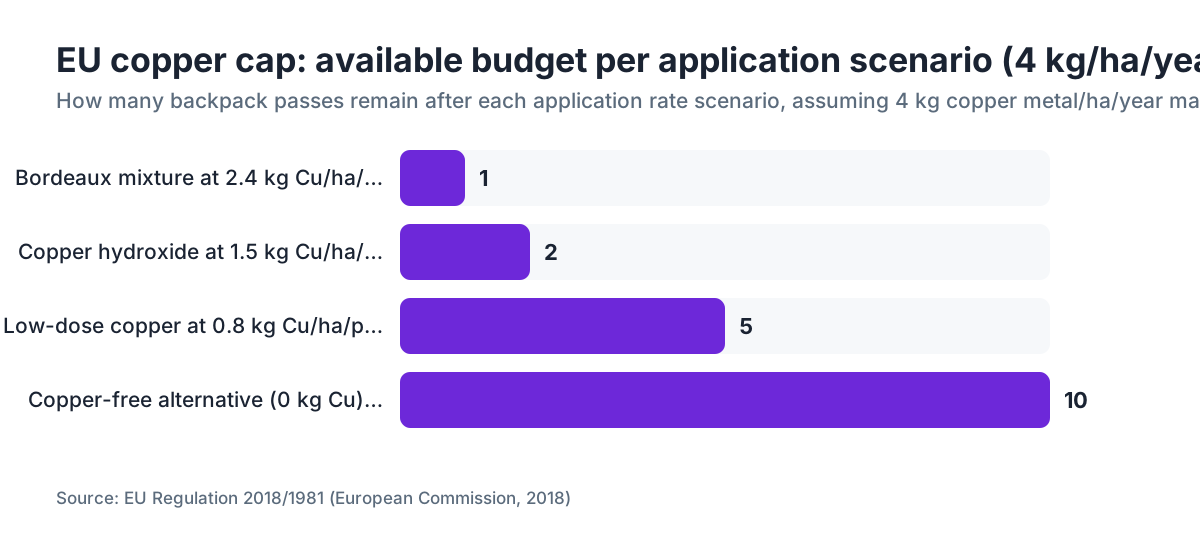
EU Regulation 2018/1981 (implementing Regulation EC 1107/2009) capped copper use for all member states at 28 kg copper metal per hectare over any 7-year period. That works out to an average of 4 kg/ha/year. France implemented this through revised product labels effective 2019.
For a backpack operator, the math matters. Bordeaux mixture at 8 g copper per liter of spray solution at 300 L/ha puts down 2.4 kg copper/ha per application. At that rate you have roughly 1.5 applications per season before you hit the 4 kg/ha/year ceiling. In a high-pressure year needing 8-10 spray passes, that forces you to alternate copper with non-copper alternatives and track cumulative copper use per parcel over the 7-year rolling window.
Many small vignerons don't track this properly. An inspector or organic certifier who asks for your copper ledger and finds nothing, or records that imply overuse, is a serious problem. The 7-year rolling total means what you applied in 2019 still counts against your 2025 budget.
Formulations differ. Copper hydroxide, copper oxychloride, and tribasic copper sulfate carry different copper metal percentages per gram of product. Always convert to copper metal equivalent, not product weight, for your records.
How does manual backpack spraying compare to tractor boom or airblast for mildew coverage?
The honest answer: worse on coverage uniformity and throughput, better on access and flexibility. Nobody should pretend otherwise.
A tractor-mounted airblast sprayer on standard 2.5m row spacing covers 3-6 hectares per hour depending on speed and crop load. [6] A backpack operator doing diligent work covers 0.2-0.5 hectares per hour. For a 10-hectare property with a tight spray window, that math becomes a problem fast unless you have several operators going at once.
Coverage quality with a backpack depends entirely on operator technique. Inconsistent pump pressure, walking speed variation, and fatigue all produce uneven deposition in ways a tractor boom doesn't. Cornell University's extension work on spray coverage recommends water-sensitive paper cards placed in the canopy to verify actual droplet coverage, a method that works for backpack validation as well as tractor calibration. [13]
| Method | Typical Coverage Rate | Access on Slopes >30% | Upfront Equipment Cost (EUR) | Main Limitation |
|---|---|---|---|---|
| Backpack (manual) | 0.2-0.5 ha/hr | Yes | 80-300 | Physical output, fatigue |
| Backpack (motorized mist) | 0.5-1.0 ha/hr | Partial | 600-1,200 | Drift risk, noise |
| Tractor airblast | 3-6 ha/hr | No (slope limit) | 8,000-25,000 | Terrain, min. parcel size |
| Tractor boom | 2-4 ha/hr | No | 5,000-15,000 | Canopy penetration |
| Helicopter/drone | 10-30 ha/hr | Yes | Contractor only | Cost, regulation |
For vignerons with mixed terrain, the practical reality is simple: tractor-based equipment on accessible plots, backpacks on everything else. Pushing a tractor onto steep or narrow plots creates compaction, slope stability risks, and usually worse coverage anyway.
What are the resistance management rules you need to follow when rotating fungicides?
Resistance is the slow crisis in French viticulture. QoI (strobilurin) resistance in powdery mildew is now widespread enough that FRAC (Fungicide Resistance Action Committee) recommends treating QoIs as having no solo efficacy against powdery mildew and using them only in mixtures with a different mode of action. [5]
FRAC group classification is the tool. Every fungicide active substance carries a FRAC code. The rule: never apply the same FRAC group in two consecutive applications on the same parcel during the same season. For a backpack operator doing 6-10 downy mildew passes per season, a workable rotation might look like:
- Passes 1-2: Copper (FRAC M01) + contact
- Pass 3: Cymoxanil (FRAC 27) + copper
- Pass 4: Mandipropamid (FRAC 40)
- Pass 5: Fosetyl-Al (FRAC 33)
- Pass 6+: Rotate back, not the same as pass 5
For powdery mildew:
- Sulfur (FRAC M02) is low resistance risk and can be used more freely
- DMI fungicides (FRAC 3): max 3 applications per season in French label guidance
- SDHI (FRAC 7): max 2 applications per season, always tank-mix with a different group
Record the FRAC group used for each application in your spray register. It takes 10 seconds to add, and it lets you verify at a glance that you're rotating. Skip the record and you'll forget, and you'll repeat a group by accident.
How do you handle tank mixing, dilution, and disposal in the field?
Tank mixing two fungicides for combined downy and powdery control is common and often cheaper. But not all products are compatible, and a bad mix can clog your nozzle, cut efficacy, or burn the vine.
The general mixing order for backpack sprayers: fill the tank two-thirds with water first, add wettable powders or WG formulations while agitating, then add liquids (EC, SC, SL formulations), then top up with water to volume. Copper products go in last when mixing with organics. Never mix concentrated products together outside the tank.
For organic producers mixing copper with sulfur: the traditional Bouillie Bordelaise (Bordeaux mixture) already combines both. Applying them separately but close together in time (within 24 hours) raises phytotoxicity risk on sensitive varieties like Chardonnay and some aromatic whites in hot weather. Keep copper and sulfur applications at least 48 hours apart when temperatures run above 30°C.
Spray effluent and rinse water disposal is regulated. Under the French arrêté du 4 mai 2017, you cannot dump rinse water or leftover product in ditches, near watercourses, or on non-target areas. Most farms install a biobed or phytobac system for effluent treatment. For small-scale backpack users, triple-rinsing the tank into the treated plot and disposing of rinse water there (when the product label permits) is the most common compliant approach. Keep your disposal records.
Frequently asked questions
How many liters per hectare should I apply with a backpack sprayer for downy mildew?
French viticultural guidance generally targets 200-400 liters per hectare for downy mildew depending on canopy density and training system. Double Guyot at full canopy needs more volume than Gobelet-pruned bush vines. Calibrate your specific sprayer and walking pace with a measured water trial before the season starts. The labeled rate converts to a dose per hectare, not a volume, so volume is your delivery vehicle and the label dose is fixed.
Can I use a backpack sprayer for copper applications in an organic French vineyard?
Yes. Copper is permitted in organic viticulture in France under EU Reg. 2018/1981 and the EU organic regulation (EC 2018/848), subject to the 4 kg copper metal per hectare per year cap averaged over 7 years. A backpack is a fully legal method. You must still hold Certiphyto, record the copper metal equivalent per parcel, and check that your specific copper formulation appears on the ANSES approved list for the current season.
What is Certiphyto and do I need it to spray my own vineyard?
Certiphyto (Certificat Individuel Produits Phytopharmaceutiques) is the French mandatory certification for anyone who purchases or applies professional-use plant protection products. If you own and spray your own vineyard with products classified as usage professionnel, yes, you need it. The certificate requires a training course and exam and is valid for 5 years. Operating without it violates Article L254-1 of the French Rural Code and carries fines starting at 750 EUR.
What is the 3-10-10 rule for downy mildew in vineyards?
The 3-10-10 rule (also called the Goidanich rule or règle des 3 dix in French) states that downy mildew primary infections occur when vines have shoots at least 10 cm long, temperatures exceed 10°C, and leaf wetness lasts at least 10 consecutive hours. When all three conditions hit at once, a primary infection event is underway. Regional BSV bulletins issued by local agricultural chambers announce when these conditions have been observed in your area.
How do I record spray applications to comply with French law?
Every application must be logged in your Registre Phytosanitaire shortly after the spray event. Required fields include date, product name and AMM number, active substance, rate per hectare, area treated with parcel identifier, pest targeted, equipment used, operator name and Certiphyto number, and weather conditions (temperature, wind speed, wind direction). Records must be kept for 5 years minimum. AOP vineyards may add appellation-specific record requirements beyond the national baseline.
What PPE is required for backpack spraying copper fungicides in France?
At minimum: chemical-resistant nitrile gloves (0.35mm or thicker), waterproof boots, a full-body coverall or apron, and eye protection when handling concentrate. For many copper formulations, ANSES guidance also recommends a half-face respirator during mixing. The product label specifies PPE and the label is legally binding. Failing to wear specified PPE is a compliance violation even if you own the land and are only spraying your own vines.
Is sulfur safe to apply during hot weather in the vineyard?
Sulfur causes phytotoxicity (leaf and berry burn) above 30-32°C. This is well established in French viticultural practice and in university extension guidance from UC Davis and Cornell. The standard rule is to stop sulfur applications when the forecast shows temperatures above 30°C for the 24-48 hours after spray. Early morning applications reduce risk. Chardonnay, Gewürztraminer, and some Pinot clones show elevated sulfur sensitivity even at moderate temperatures.
How far from watercourses can I spray with a backpack in France?
Buffer zones are product-specific and equipment-specific under the French arrêté du 4 mai 2017 implementing Directive 2009/128/EC. Many fungicides have a 5-meter minimum buffer from permanent watercourses with standard equipment. Some high-risk products require 20-50 meters. Anti-drift nozzles can reduce the required buffer. Check the current label, not a remembered number from a previous year, because buffer zone requirements updated on most labels between 2019 and 2022.
What's the difference between a backpack mistblower and a standard hand-pump backpack sprayer?
A standard hand-pump backpack uses manual pressure (you pump a lever continuously) and delivers coarser droplets through a wand nozzle. A motorized backpack mistblower uses a small engine to generate airflow that fragments liquid into fine droplets for wider canopy penetration. Mistblowers cover more area per hour (roughly double) and penetrate dense canopies better, but cost 600-1,200 EUR versus 80-300 EUR for manual units, need fuel and engine maintenance, and produce smaller droplets with higher drift risk near boundary features.
How do I know which FRAC group my fungicide belongs to, and why does rotation matter?
FRAC group codes appear on product labels in France under EU labeling rules. Rotating FRAC groups means consecutive applications hit the pathogen through different biochemical mechanisms, which slows resistance. In practice: if pass 3 used a DMI fungicide (FRAC Group 3), pass 4 should use a different group, such as a QoI-DMI mix (FRAC 11+3) only if truly necessary, or preferably a CAA (FRAC 40) or phosphonate (FRAC 33). The FRAC website maintains a current code list for all registered actives.
Can I use potassium bicarbonate for powdery mildew control on organic vines?
Yes. Potassium bicarbonate is approved in organic viticulture in France and listed on the EU basic substances list. It works by raising surface pH on the leaf and berry, which disrupts powdery mildew growth. Efficacy is best as a protectant applied before infection pressure builds; it has limited curative activity. Typical rates run 2-4 kg/ha per application. It's low-residue, low-toxicity, and can be mixed with copper for combined disease management in organic systems.
How do small French vignerons with under 2 hectares typically manage mildew without a tractor?
Most rely entirely on backpack sprayers, often pairing a hand-pump knapsack for accessible plots with a motorized mistblower for denser canopy sections. They calibrate manually using a watch-and-measure method, rotate between copper and alternative actives to stay within the 4 kg/ha copper cap, and keep their spray register in a physical notebook or phone-based system. BSV bulletins from local chambers of agriculture drive their timing decisions rather than a fixed calendar.
Does the EU sustainable use of pesticides directive affect how I spray for mildew in France?
Yes, directly. EU Directive 2009/128/EC (SUD) and France's Écophyto II+ plan commit to a 50% pesticide use reduction by 2030 from the 2015-2017 baseline. In practice this means tighter buffer zone rules, mandatory spray equipment inspection every 3 years in France (inspection des pulvérisateurs), Certiphyto requirements, and pressure to reduce treatment frequency through IPM (integrated pest management). The directive doesn't ban specific products on its own, but it shapes the approval context for renewals.
Sources
- IFV (Institut Français de la Vigne et du Vin) - Mildiou de la vigne technical guide: The 3-10-10 rule (Goidanich rule) for downy mildew infection conditions; backpack application volumes of 200-400 L/ha for vine canopies.
- UC Davis Viticulture and Enology - Powdery Mildew of Grape: Powdery mildew (Erysiphe necator) spreads by airborne conidia and thrives in warm, dry conditions with moderate humidity (40-70% RH); sulfur phytotoxicity risk above 30-32°C.
- Météo-France - Agrometeorology services: Météo-France publishes agrometeorological disease risk models used by French vignerons for downy mildew spray timing.
- FRAC (Fungicide Resistance Action Committee) - FRAC Code List 2023: QoI resistance in Erysiphe necator is widespread; FRAC recommends QoIs only in mixtures for powdery mildew; BBCH 65-71 (flowering) is the highest berry infection risk window.
- IFV - Matériel de pulvérisation viticole (spray equipment guide): Tractor-mounted airblast sprayers cover 3-6 ha/hr; motorized backpack mistblowers cost approximately 600-1,200 EUR; manual backpack sprayers cost approximately 80-300 EUR.
- EUR-Lex - Directive 2009/128/EC on sustainable use of pesticides: EU Directive 2009/128/EC mandates buffer zones, PPE requirements, and equipment inspection intervals for pesticide application in member states.
- UC Davis Cooperative Extension - Vineyard Spray Application: Nozzle wear of 10% can change output by 15-20% over a season, affecting accurate pesticide application.
- ANSES (Agence nationale de sécurité sanitaire) - E-phy pesticide database: ANSES maintains the French national approved pesticide list and the Registre Phytosanitaire requirements; DGAL conducts compliance inspections.
- EUR-Lex - Commission Implementing Regulation (EU) 2018/1981 on copper renewal: EU Reg. 2018/1981 caps copper use at 28 kg/ha over 7 years (average 4 kg/ha/year); copper accumulation causes documented toxicity to earthworms at high concentrations.
- French Ministry of Agriculture - Écophyto II+ plan: France's Écophyto II+ plan targets a 50% reduction in pesticide use by 2030 from the 2015-2017 baseline.
- US EPA - Worker Protection Standard (WPS) for Agricultural Pesticides: EPA WPS mandates closed mixing/loading systems for certain products and requires pesticide safety training for all agricultural workers.
- Cornell University Cooperative Extension - Integrated Crop and Pest Management: Vineyard Spray Application: Water-sensitive paper cards placed in the canopy are recommended to verify actual droplet coverage from backpack and tractor sprayers in vineyards.
Last updated 2026-07-09