Baking soda for powdery mildew on grapes: does it actually work?
TL;DR
- Baking soda (sodium bicarbonate) raises leaf surface pH high enough to stall Erysiphe necator, the fungus behind grape powdery mildew.
- It works best as a preventive spray at 0.5 to 1% with a spreader-sticker.
- It's a real low-toxicity tool, not a rescue.
- UC Davis and Cornell trials show modest efficacy.
- It fits a resistance-management rotation, but it won't save a bad outbreak.
What is powdery mildew on grapes and why is it so hard to control?
Grape powdery mildew is caused by Erysiphe necator (formerly Uncinula necator), an obligate fungal parasite that lives only on living plant tissue. It doesn't need free water to germinate. Spores (conidia) can germinate at relative humidity as low as 40%, and prolonged rain actually suppresses the fungus. That biology is why it's so stubborn in dry regions like Paso Robles and the Yakima Valley. The conditions that make those places great for grapes are the same conditions the fungus loves.
The fungus colonizes young shoot tissue, leaves, and berries. Berry infection before 10 to 12 weeks post-bloom does the most damage: fruit cracks, secondary rots move in, and in red varieties you get off-flavors that survive fermentation. On whites like Chardonnay, infection after lag phase still wrecks aromatics. By the time you see the white coating on a cluster, the colonization happened two to three weeks earlier. You're always chasing a ghost.
Control programs run from bud break through veraison, usually on a 7-to-14-day spray interval depending on pressure. The pathogen develops resistance to single-site fungicides fast, especially the DMI (sterol inhibitor) class and the strobilurins. That's the whole reason growers keep looking at low-resistance-risk materials like sodium bicarbonate, and it's a good reason. [1] [2]
How does baking soda kill or suppress powdery mildew?
Baking soda doesn't poison Erysiphe necator the way a synthetic fungicide does. It shifts the pH of the leaf surface. When a 0.5 to 1% solution dries on tissue, it leaves a residue that pushes the cuticle to roughly pH 8.0 to 8.5. The fungus prefers a range of about 5.0 to 7.0. Outside that band, spore germination and hyphal growth slow way down. [3]
There's a second effect. The high salt load on the leaf pulls water out of fungal cells by osmosis. Sodium bicarbonate also reacts with CO2 in the air and gives off a brief burst of carbonic acid at the surface, which helps disrupt the fungal cell membrane.
So baking soda is a protectant, not an eradicant. Spray before spores land and germinate, and you cut the odds of infection. Spray onto an established colony, and you get partial suppression but no cleanup. That difference drives everything about timing. Treat it like copper or sulfur: get ahead of the threat, don't chase it.
Potassium bicarbonate works by the same pH mechanism and beats sodium bicarbonate in most head-to-head trials. It's registered as a biopesticide under EPA rules and sold as Kaligreen and Milstop. Plain baking soda (sodium bicarbonate) is exempt from pesticide registration under FIFRA Section 25(b) when used as a spray, which changes your paperwork obligations. More on that below. [4]
What do university trials actually show about efficacy?
The honest answer: modest efficacy, and it lives or dies on timing, concentration, and adjuvant. Not a material you set and forget.
Cornell's New York State Agricultural Experiment Station published work in the 1990s and early 2000s comparing sodium bicarbonate, potassium bicarbonate, and synthetic standards on cucurbits and grapes. Sodium bicarbonate at 1% with horticultural oil cut powdery mildew severity by 50 to 75% in cucumber trials against untreated controls. Grape results were more variable, and efficacy fell off hard once application intervals stretched past ten days or conditions favored fast disease development. [5]
UC Davis guidance on organic viticulture lists potassium bicarbonate as an approved material with documented efficacy against powdery mildew, and treats sodium bicarbonate as a cheaper alternative with slightly less consistent performance. The UC Integrated Pest Management program for grapes puts sulfur at the center of organic programs and positions bicarbonates as rotation partners, useful where sulfur residue on harvest-sensitive blocks is a worry. [6]
Washington State University Extension says bicarbonate products do best under low-to-moderate disease pressure and recommends pairing them with a spreader-sticker to improve coverage and rainfastness. [7]
Nobody has long-term resistance data on bicarbonates against Erysiphe necator on grapes. The general read from plant pathologists is that resistance risk is low, because the mechanism is physical and chemical rather than aimed at one fungal enzyme. That's a real edge in a rotation.
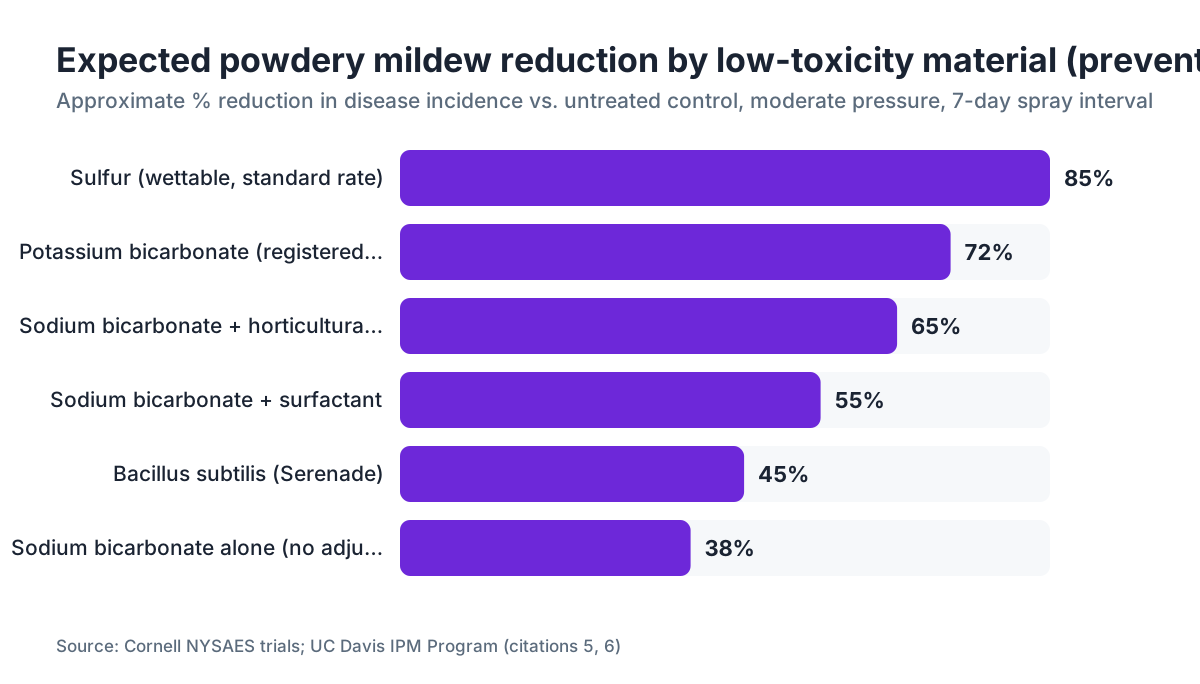
Here's the number to remember. Expect a 40 to 70% reduction in powdery mildew incidence from a preventive bicarbonate spray on a 7-day schedule under moderate pressure. Don't expect that on a 14-day schedule in a high-pressure year. [5] [6]
What concentration and formulation actually works on grapes?
For plain baking soda, the working range is 0.5 to 1% weight-to-volume. That's roughly 1 to 2 tablespoons per gallon of water, or about 4 to 8 pounds per 100 gallons for a backpack or airblast application. Stay under 1.5%. Higher concentrations burn young shoot tissue in the heat, and the leaf edge scorch and cuticle damage that follows actually opens the plant to secondary infection.
Always add a spreader-sticker or non-ionic surfactant. Skip it and the solution beads right off the waxy leaf surface, leaving you with patchy coverage and patchy protection. A non-ionic surfactant at 0.1 to 0.25% is plenty. Some growers add 1% horticultural oil, and trials say that combination beats bicarbonate alone, though oil raises the burn risk in heat. Don't spray oil above 90 degrees F or within two weeks of a sulfur application.
Mixing baking soda with soap (insecticidal or castile) is a home-garden favorite. It works somewhat, but the pH interaction between soap and bicarbonate can partly cancel the alkalinity you're trying to build. If you want a wetting agent, use a pH-neutral non-ionic surfactant instead.
Spray early morning or evening. A midday spray on a hot day concentrates fast as water evaporates, and that raises the risk of salt burn on leaves and young berries.
| Formulation | Concentration | Relative efficacy | Phytotox risk | Cost per 100 gal |
|---|---|---|---|---|
| Sodium bicarbonate alone | 0.5 to 1% | Moderate | Low-moderate | ~$1 to 3 |
| Sodium bicarbonate + surfactant | 0.5 to 1% + 0.1% surfactant | Moderate-good | Low-moderate | ~$2 to 5 |
| Sodium bicarbonate + hort oil | 1% + 1% oil | Good | Moderate | ~$4 to 8 |
| Potassium bicarbonate (registered) | Per label (typ. 1.5 to 3 lb/100 gal) | Good-very good | Low | ~$15 to 30 |
| Sulfur (benchmark) | Per label | Very good | Moderate (heat) | ~$5 to 12 |
Costs are rough estimates from bulk pricing as of 2024 to 2025. Potassium bicarbonate products vary a lot by brand. [3] [6]
When in the season should you spray baking soda for grape powdery mildew?
The highest-value window runs from bud break through about 4 to 6 weeks post-bloom. That's when young tissue is most susceptible and when berry infection (the expensive kind) happens. Shoot tissue with leaves under half their final size is the most vulnerable of all.
For a bicarbonate program, start spraying when shoot growth begins if your region has a history of early pressure. Don't wait for symptoms. A 7-day interval is realistic under moderate pressure. Tighten it to 5 to 6 days under high pressure or after a run of warm nights (above 60 degrees F) and warm days.
From berry set through lag phase, the critical fruit-infection window, hold the interval at 7 days if bicarbonates are your main tool. After lag phase and into veraison, fruit pressure drops because the berries load sugar and stop being good hosts. Leaf infections can keep going but matter less economically then. Plenty of growers thin the spray program after veraison, and that's reasonable.
Baking soda has no pre-harvest interval to work around. EPA sets no PHI for sodium bicarbonate on grapes. That's handy in the 2 to 3 weeks before harvest when you want to keep residues off the fruit. Registered potassium bicarbonate products usually carry a zero-day PHI too, but confirm it on the specific label. [4] [8]
Is baking soda spray safe for grape leaves, shoots, and fruit?
At label rates, yes, with caveats. Sodium bicarbonate at 0.5 to 1% with a proper surfactant is generally well tolerated by Vitis vinifera. The trouble spots: concentrations above 1.5%, spraying in high heat (above 85 to 90 degrees F), spraying stressed or drought-stressed vines, and hitting very young tissue (shoots under 2 inches).
Phytotoxicity shows up as marginal leaf scorch or a gray-silver film on the leaf. It's usually cosmetic and doesn't cut yield. But on premium blocks where leaf photosynthesis drives ripening, repeated phytotoxic sprays can matter at the edges. Test on one or two vines and wait 48 to 72 hours before you run a block-wide pass with any new formulation or adjuvant.
On fruit, sodium buildup is a theoretical concern if you spray sodium bicarbonate often. A 1% solution carries about 270 mg sodium per 100 mL, and repeat applications leave some residue behind. A few small tree-fruit studies raised the sodium question, but nobody has studied it well in wine grapes, and residue levels look low after normal weathering. If it worries you, switch to potassium bicarbonate. That removes the sodium issue outright, and potassium is a macronutrient the vine can actually use.
None of the extension programs reviewed here (UC Davis, Cornell, WSU) flag sodium bicarbonate as a real phytotoxicity risk at labeled rates. [6] [7]
Does baking soda qualify for organic viticulture and what are the record-keeping rules?
Sodium bicarbonate is on the National Organic Program (NOP) National List as a material allowed in organic crop production. It sits under 7 CFR 205.601 as a non-synthetic substance. You don't need a certifier annotation to use it. If you're certified through CCOF, OTCO, or Oregon Tilth, it's a clean approval. Still, check with your certifier, because some want documentation of the specific product and any additives, and a surfactant in the tank may need its own review. [9]
Here's where growers trip on the paperwork. FIFRA Section 25(b) exempts certain minimum-risk pesticides from registration, and sodium bicarbonate is on that list. Exempt status means you don't carry a Restricted Use Pesticide record the way you would for a Schedule II material. It does not mean you have zero record-keeping duty.
California's Pesticide Use Reporting (PUR) system requires reporting of every pesticide application on an agricultural operation, including 25(b) exempt materials. California growers report to their county agricultural commissioner with records covering product, rate, area treated, and date. Other states differ. Oregon, Washington, and New York each have their own rules. Check with your state department of agriculture.
Under the EPA Worker Protection Standard (WPS), 40 CFR Part 170, employees who handle pesticide applications (including 25(b) materials) have rights to safety information, and you have to keep a central posting of pesticide details. EPA revised the WPS in 2015, and the 2017 updates tightened the recordkeeping and worker-training provisions. [10] [11]
Good records, even for exempt materials, protect you in an audit and show you what's actually working in your disease program. A lot of vineyard operations run digital field logs to capture this automatically, which kills the transcription errors that ruin paper records. VitiScribe's spray log module records 25(b) materials right alongside registered pesticides in the same screen, so the whole season is in one place when the county inspector shows up.
How does baking soda compare to other low-toxicity powdery mildew options?
The realistic low-toxicity and organic options are sulfur, potassium bicarbonate, copper (limited use), neem oil, and biologicals like Bacillus subtilis (Serenade) or Bacillus amyloliquefaciens (Regalia, Double Nickel).
Sulfur is the most effective of the bunch and has decades of resistance-free field history against Erysiphe necator. Elemental and wettable sulfur formulations anchor most organic mildew programs. The downsides: it burns above 90 degrees F, it can't go within two weeks of horticultural oil, it carries applicator safety concerns at high rates, and sulfur residue on harvest fruit gets more scrutiny every year from certain wineries and buyers.
Potassium bicarbonate beats sodium bicarbonate in head-to-head trials, mostly because the potassium ion is gentler on tissue and the product dissolves cleaner. Milstop (BioWorks) and Kaligreen are labeled for grapes with established rates. The cost is the catch: roughly $15 to 30 per 100-gallon mix versus $1 to 5 for baking soda.
Biologicals like Serenade (Bacillus subtilis QST 713) carry EPA registration and NOP approval and work best applied preventively. Efficacy in hot, dry climates runs lower than in moderate ones. Good rotation partners, weak primary defense in a high-pressure year.
Neem oil (azadirachtin-based products) has some powdery mildew data but is mainly an insecticide. It's messy to mix and has a trickier phytotoxicity profile than bicarbonates.
So here's the honest ranking. Baking soda is the cheapest thing in this category, and its efficacy is good enough to carry a block through a low-to-moderate pressure year, especially rotated with sulfur. It's not the best tool in the box. It earns its place. [3] [5] [6]
What's a practical spray program that includes baking soda?
Here's a sample program for a moderate-pressure region (think Willamette Valley or parts of the Sierra Foothills).
Bud break to 6 inches: Sulfur (3 lb/100 gal) on a 10-day interval. Young tissue is vulnerable and sulfur is your most reliable material here.
6-inch shoot to pre-bloom: Rotate sulfur with potassium bicarbonate or sodium bicarbonate on a 7-day interval. This is where baking soda earns its keep as a rotation partner.
Bloom: Many growers skip bloom-time sprays to protect pollinators and avoid berry set issues. If pressure is high, use sulfur carefully at low rates.
Fruit set through lag phase: The critical window. Use your highest-efficacy tools (sulfur, registered potassium bicarbonate). Sodium bicarbonate can take one spray in the rotation, but I wouldn't lean on it here.
Lag phase through veraison: Fruit pressure drops. Bicarbonate sprays on a 10-day interval work fine. You can slot a biological in here too.
Post-veraison: Cut frequency. Leaves are worth protecting for photosynthesis and to hold down overwintering inoculum, but fruit infection risk is low.
Pre-harvest (0 to 21 days out): Bicarbonate sprays shine here because of the zero-day PHI. Sulfur can leave detectable residue if applied too close to pick, so check your winery's residue tolerances and any export requirements.
A program like this is exactly the thing worth logging in your field records. Applications, weather, disease pressure notes, and any phytotoxicity you spot all build into a record you can use to sharpen the program year over year. VitiScribe's compliance tools are built for a multi-material spray calendar like this, including 25(b) exempt materials tracked alongside registered ones.
Can you use baking soda on grapes right before harvest?
Yes. This is one of sodium bicarbonate's genuine advantages. There's no established pre-harvest interval for sodium bicarbonate on grapes, because it isn't an EPA-registered pesticide under FIFRA (it's a 25(b) exempt material). No registration means no tolerance setting and no PHI. [4] [10]
Some growers save a bicarbonate spray for the final 1 to 2 weeks before harvest, especially on fruit lots headed to buyers with strict sulfur residue specs. Registered potassium bicarbonate products sit in the same spot, with most labels carrying a zero-day PHI.
That said, use your head. A late, high-concentration sodium bicarbonate spray on fruit near harvest could in theory nudge fermentation (very high pH would stall yeast), but at 1% the effect on must chemistry after normal sorting and pressing is negligible. Nobody has published concern about it, and winemakers don't flag it.
If you make wine for export to the EU, Japan, or another market with its own MRL framework, check whether that market has any sodium or bicarbonate specifications. I haven't seen it be a problem in practice, but it's a question worth asking your export compliance contact instead of assuming.
What are the limits of baking soda and when should you use something else?
Baking soda has real limits, and they're worth naming plainly.
In a high-pressure year, it won't carry a block alone. If you're seeing flagshoot infections before you've sprayed anything, or the weather's been warm and humid for a stretch, bicarbonate alone on a 7-day schedule falls short. You need sulfur, potassium bicarbonate at higher rates, or a synthetic as backup.
On a severe established infection, it does nothing useful. Curative activity is minimal. Once more than 10 to 15% of cluster surface shows infection, you're in cleanup mode and you need a contact eradicant (sulfur) or a systemic with curative claims. Baking soda on existing colonies at that point is a waste of a spray day.
Rain washes it off fast. Sodium bicarbonate has poor rainfastness even with a surfactant. More than 0.25 inch of rain within 24 to 48 hours of application, and you're reapplying. That caps its usefulness in wet regions like the Hudson Valley or western Oregon in a rainy year.
Repeated sodium bicarbonate sprays over several seasons could in theory raise soil sodium in the row if runoff is significant, though the concentrations are low enough that it's unlikely to matter in most settings. On very low-sodium soils with a sodium-sensitive rootstock, monitor it.
Application quality matters more with bicarbonates than with most materials. Poor coverage means poor protection, full stop. Calibrate your airblast sprayer for canopy penetration, more than perimeter wetting, and keep water volume high enough for real contact across leaf surfaces. WSU Extension recommends a minimum of 50 gallons per acre for airblast in dense canopies. [7]
Frequently asked questions
How much baking soda do I mix per gallon of water for grape powdery mildew?
Use 1 to 2 tablespoons of baking soda per gallon of water, roughly a 0.5 to 1% solution. Add a non-ionic surfactant at about 1/4 teaspoon per gallon to improve coverage. Don't exceed 1.5% or you risk leaf scorch. For a commercial airblast application, that scales to 4 to 8 pounds of sodium bicarbonate per 100 gallons of water.
Does baking soda spray burn grape leaves?
It can at high concentrations or in high heat. At 0.5 to 1% with a surfactant, phytotoxicity risk is low under normal conditions. Spray early morning or evening when temperatures are below 85 degrees F. Concentrations above 1.5%, sprays during heat spikes, or applications without enough dilution cause marginal leaf scorch. Test on a few vines first if you're trying a new adjuvant or formulation.
Is baking soda approved for organic grape growing?
Yes. Sodium bicarbonate is listed as a permitted non-synthetic substance under USDA National Organic Program rules (7 CFR 205.601). It needs no annotation from your certifier for basic use, though any surfactant you add should also be NOP-compliant. Confirm with your specific certifier before the first application; some require documentation of the formulation.
How often should I spray baking soda to control powdery mildew on vines?
Every 7 days under moderate disease pressure, tightened to 5 to 6 days under high pressure or after warm nights above 60 degrees F. Reapply within 24 to 48 hours after any rain above 0.25 inch, because sodium bicarbonate washes off fast. Don't stretch intervals past 10 days in active disease conditions, or efficacy drops sharply.
What's the difference between baking soda and potassium bicarbonate for powdery mildew?
Same pH-based mechanism, but potassium bicarbonate performs better in trials, causes less phytotoxicity, and holds EPA pesticide registration for grapes. Products like Milstop and Kaligreen are labeled for viticulture. The trade-off is cost: potassium bicarbonate runs roughly 5 to 10 times more per 100-gallon mix than plain baking soda. For organic programs on a budget, sodium bicarbonate as a rotation partner is defensible.
Can I mix baking soda with dish soap or neem oil for powdery mildew?
Adding dish soap isn't ideal, because the pH interaction can partly cancel the alkalinity that makes bicarbonate work. Use a pH-neutral non-ionic surfactant instead. Combining with horticultural oil at 1% improves efficacy in some trials, but never spray oil above 90 degrees F or within two weeks of a sulfur application. Combining with neem oil adds complexity without clear benefit over bicarbonate plus surfactant alone.
Do I need to keep spray records when using baking soda on grapes?
Yes. Even though sodium bicarbonate is FIFRA Section 25(b) exempt and needs no pesticide registration, California requires reporting all pesticide applications through the county agricultural commissioner's Pesticide Use Reporting system, including exempt materials. Other states have similar rules. EPA Worker Protection Standard obligations also apply. Record product, rate, area treated, and date regardless of the material's registration status.
How long before harvest can I spray baking soda on grapes?
There's no established pre-harvest interval for sodium bicarbonate, because it isn't an EPA-registered pesticide. You can apply it right up to harvest day. That makes it useful in the final weeks before pick, especially when your buyer restricts sulfur residue. Registered potassium bicarbonate products also usually carry a zero-day PHI; confirm on the specific product label.
Will baking soda work on an existing powdery mildew infection on grapes?
Not well. Sodium bicarbonate is primarily a preventive material with minimal curative activity. On established colonies with visible white mycelium, it gives partial suppression at best. If you're already seeing significant infection on leaves or clusters, you need a contact eradicant like sulfur or a systemic fungicide with curative claims. Save bicarbonate sprays for prevention or for rotation with stronger materials.
Is there a risk of powdery mildew developing resistance to baking soda?
The consensus is that resistance risk is low. Baking soda works by physically shifting leaf surface pH and creating osmotic stress, not by targeting a specific fungal enzyme pathway. Erysiphe necator can't easily evolve around a pH shift the way it mutates to overcome DMI fungicides or strobilurins. This is a big reason bicarbonates hold value in resistance-management rotations, even when their solo efficacy is modest.
How does baking soda compare to sulfur for grape powdery mildew?
Sulfur is consistently more effective. It's the benchmark low-toxicity material for Erysiphe necator control and shows essentially zero documented resistance after decades of use. Baking soda's edges over sulfur: lower cost, no heat-related burn risk, no restriction near harvest, and no interaction with predatory mite populations that sulfur can affect. The smart play is sulfur as your primary tool and bicarbonate as a rotation partner, not a replacement.
Can I use baking soda in a backpack sprayer for small vineyard blocks?
Yes, backpack sprayers work fine for small blocks. Mix 1 to 2 tablespoons per gallon with a non-ionic surfactant. Get thorough canopy penetration, more than surface wetting. Spray until runoff but don't drench to the point of puddling. For blocks over 2 to 3 acres, a tractor-mounted airblast sprayer gives far better coverage and a real difference in efficacy. WSU recommends at least 50 gallons per acre for dense canopies.
What adjuvants improve baking soda's performance on grapevines?
A pH-neutral non-ionic surfactant at 0.1 to 0.25% is the most reliable improvement. It helps the solution spread across the waxy grape leaf instead of beading off. Adding 1% horticultural oil improves efficacy in Cornell trial data, but adds burn risk in heat and can't be used near sulfur. Avoid soap-based adjuvants, since they can neutralize the alkalinity you're trying to create.
Sources
- UC Davis Integrated Pest Management Program, Grapes Pest Management Guidelines: Powdery mildew (Erysiphe necator) biology, infection conditions, and management overview for California vineyards
- Cornell University, New York State Integrated Pest Management Program: Fungicide resistance risk in grape powdery mildew and the role of low-resistance-risk materials in rotation programs
- Horticultural Science Journal, Homma et al., Bicarbonate ion and pH effects on powdery mildew: Sodium bicarbonate raises leaf surface pH to approximately 8.0 to 8.5, inhibiting Erysiphe spore germination outside the fungus's preferred pH range of 5.0 to 7.0
- EPA, FIFRA Section 25(b) Minimum Risk Pesticides: Sodium bicarbonate is listed as a minimum-risk substance exempt from pesticide registration under FIFRA Section 25(b)
- Cornell University, New York State Agricultural Experiment Station: Cornell NYSAES trials found sodium bicarbonate at 1% with horticultural oil reduced powdery mildew severity by 50 to 75% in cucumber trials, with more variable grape results that dropped when intervals exceeded ten days
- UC Davis Integrated Pest Management Program, Grape Powdery Mildew Management: UC IPM positions sulfur as the backbone of organic mildew programs and treats bicarbonates as rotation partners; lists potassium bicarbonate as approved with documented efficacy
- Washington State University Extension, Organic Pest Management in Vineyards: WSU Extension recommends combining bicarbonate-based products with a spreader-sticker adjuvant and using a minimum of 50 gallons per acre for airblast applications in dense canopies; bicarbonates perform best under low-to-moderate disease pressure
- EPA, Pesticide Registration, Pre-Harvest Interval Guidance: No EPA-established pre-harvest interval exists for sodium bicarbonate used as a pesticide on grapes because it is exempt from registration under FIFRA Section 25(b)
- USDA National Organic Program, 7 CFR 205.601, National List of Allowed Substances: Sodium bicarbonate is listed as a permitted non-synthetic substance for use in organic crop production under 7 CFR 205.601
- EPA Worker Protection Standard, 40 CFR Part 170: EPA Worker Protection Standard (revised 2015, updated 2017) requires safety information posting and record-keeping for pesticide applications including 25(b) exempt materials; worker rights provisions apply broadly
- California Department of Pesticide Regulation, Pesticide Use Reporting: California requires reporting of all pesticide applications to the county agricultural commissioner under the Pesticide Use Reporting system, including materials exempt from federal registration under FIFRA Section 25(b)
Last updated 2026-07-09