Concord grapes and powdery mildew: what actually works
TL;DR
- Concord grapes (Vitis labrusca) have moderate native resistance to powdery mildew but they aren't immune.
- Unmanaged infections cut cluster weight 20 to 30 percent and depress sugar, per Cornell data.
- Wettable sulfur applied at the 3 to 5 inch shoot stage is the cheapest reliable defense.
- Mildew-dusted fruit tastes off but isn't toxic.
- Heavy internal infection is a different story.
What is powdery mildew and why does it hit Concord vines?
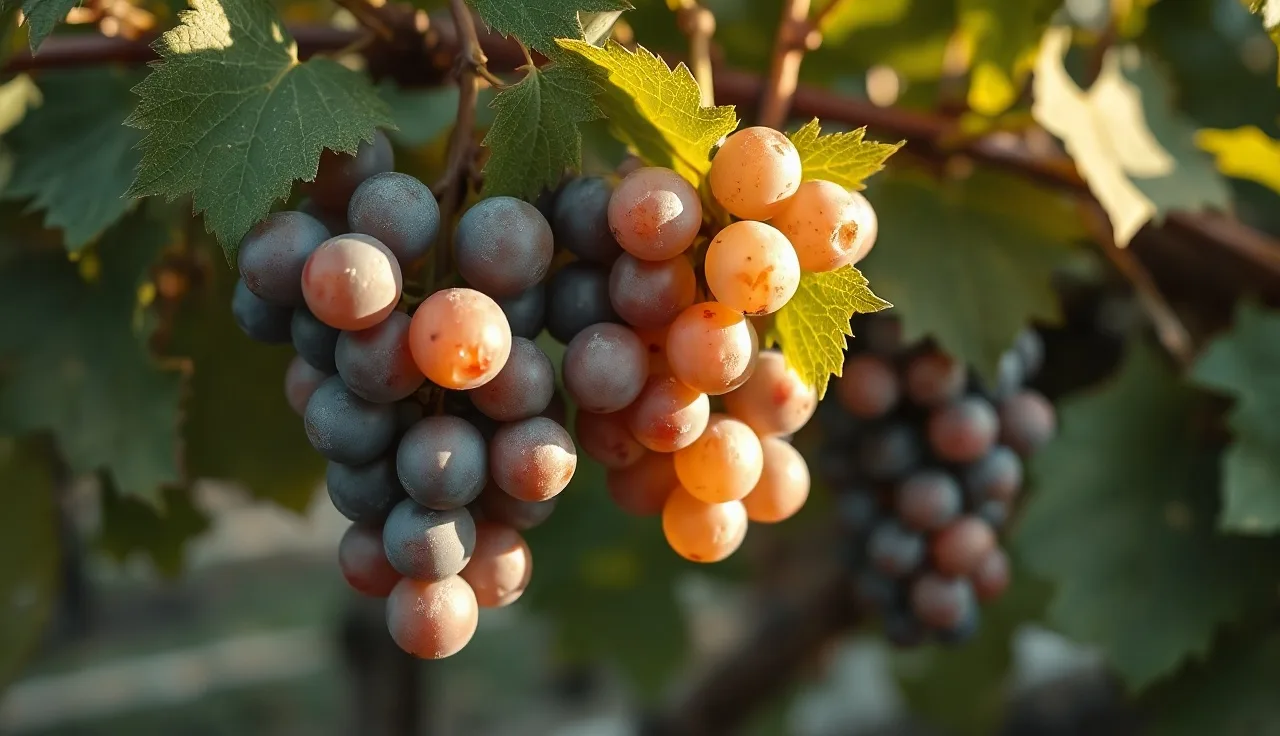
Powdery mildew on grapes comes from one fungus: Erysiphe necator (formerly Uncinula necator). It's an obligate pathogen, meaning it can only live on living grape tissue. Unlike most fungi, it needs no free water to infect. It colonizes epidermal cells and pulls nutrients straight out of them. [1] The white or gray dust you see is a mat of mycelium and spores sitting on the surface. It isn't rotting the berry from the inside the way Botrytis does.
Concord is Vitis labrusca, and that species background buys it real tolerance compared to European V. vinifera like Cabernet Sauvignon or Chardonnay. Cornell's viticulture program rates Concord as moderately resistant, so you can often stretch intervals and skip a spray or two that vinifera would demand. [2] Moderately resistant is not immune, though. Give it warm nights in the low 60s, dry days, and a dense canopy that traps still air, and Concord will show heavy colonization on leaves, clusters, and canes.
The fungus overwinters as chasmothecia, the sexual fruiting bodies, tucked into bark and old canes. Primary infection kicks off when temperatures hold above 50 degrees and ascospores release, usually around budbreak across the northeast and midwest where most commercial Concord grows. From there, asexual conidia repeat the cycle every 5 to 7 days when conditions cooperate. [1] That fast cycle is exactly why early control beats July catch-up every time.
How bad can powdery mildew actually get on Concord?
Worse than most juice growers think. Cornell extension data shows severe powdery mildew can cut cluster weight by 20 to 30 percent and drag down soluble solids (Brix), because infected berries never accumulate sugar properly. [2] Flavor takes a hit too. Heavily mildewed Concord loses some of the foxy, methyl-anthranilate aroma that makes the variety worth growing in the first place.
Mildew scars crack berry skins, and cracks open the door to Botrytis and sour rot. That cascade matters if you sell fresh-market Concord or press estate juice, where visual quality and microbial stability decide whether the fruit gets accepted.
On leaves, the disease causes chlorotic patches and, when it's bad, early defoliation. A defoliated cane goes into winter short on stored carbohydrate, and winter hardiness slips. For Concord in zones where January drops to minus 10 or minus 15 degrees, that's not a small thing.
Here's the honest picture. In a well-managed block with open canopy airflow, powdery mildew sits a rung below Phomopsis cane and leaf spot, black rot, and downy mildew on your worry list. Ignore it for two or three seasons in a crowded canopy and it climbs straight to the top.
What conditions trigger powdery mildew on Concord vines?
The disease triangle is simple. You need susceptible tissue, live inoculum, and the right weather. All three line up on Concord every spring like clockwork.
Temperature runs the show. E. necator grows between roughly 50 and 95 degrees, with a sweet spot around 68 to 77. [1] Infection starts as low as 50 degrees, which is unusually cold-hardy for a fungal pathogen. Sporulation peaks at 70 to 77. Push past 95 degrees with direct sun and conidia die back, which is part of why a dense shaded canopy is so much worse than an open-trained vine.
Dry weather actually helps this fungus. It needs no free moisture to germinate, unlike downy mildew or black rot. Humidity above 40 percent helps it along, but a hard rain can wash conidia off the leaves and knock the disease back for a bit. So a wet summer won't bail you out. Plan around that.
New tissue is the target. Shoot tips, young leaves in the first six to eight nodes from the tip, and clusters in the first three to four weeks after bloom are the highest-risk tissue on the whole vine. [2] Once berry skins lignify, around 8 to 10 weeks past bloom, infection risk falls off a cliff. That single fact shapes the spray calendar more than anything else you'll read here.
Is Concord more resistant to powdery mildew than other grapes?
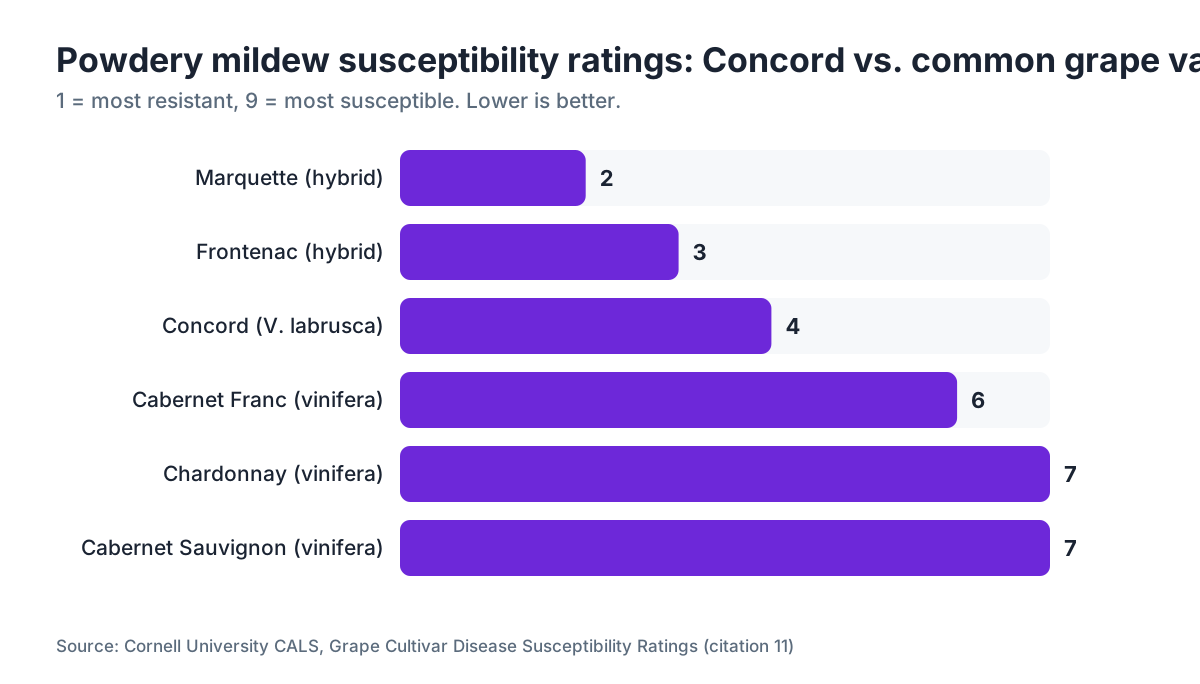
Yes, and the gap shows up in your spray bill. Cornell's disease ratings put Concord and other V. labrusca cultivars at a 4 on a 1 to 9 susceptibility scale (9 being most susceptible), against Chardonnay at 7 and Cabernet Franc at 6. [11] Disease-resistant hybrids like Marquette and Frontenac land in the 2 to 3 range.
The resistance mechanism in V. labrusca isn't fully worked out. It seems to combine physical traits (thicker cuticle, different epidermal cell structure) with biochemical differences that slow mycelial colonization. It's not single-gene, gene-for-gene resistance that a lone mutation defeats, which is part of why Concord has held the line against this disease across decades of pressure.
For a commercial grower, that means a conventional Concord program might run 4 to 6 fungicide applications in a normal year, versus 8 to 12 for a vinifera block down the road. That difference is real money. At roughly 15 to 40 dollars per acre per application for material and labor, the labrusca advantage stacks up fast over a season.
One caveat. Cornell's ratings came mostly from New York trials. Pathogen populations vary by region, and WSU's Pacific Northwest work shows somewhat different disease dynamics for labrusca types grown out there. [3] Know your own ground before you copy anyone's calendar.
When should you start spraying for powdery mildew on Concord?
Start early, before you see a single white colony. That's the answer from every extension program worth citing. By the time colonies show on leaves, you're already 5 to 7 days into an infection cycle with secondary spread underway.
Cornell's IPM guidelines say begin the program at the 3 to 5 inch shoot stage, roughly early May in New York and earlier in warmer zones. [2] Early intervals can stretch to 14 to 21 days when pressure is low and you're running a systemic product. Once you hit bloom and fruit set, tighten to 7 to 10 days with the right materials.
Here are the phenological windows where Concord needs cover:
| Growth Stage | Spray Priority | Interval |
|---|---|---|
| 3-5 inch shoot (pre-bloom) | Moderate | 14-21 days |
| Immediate pre-bloom | High | 7-14 days |
| Bloom through fruit set | High | 7-10 days |
| 3-4 weeks post fruit set | Moderate-High | 10-14 days |
| Berry touch (veraison approach) | Low-Moderate | 14-21 days |
| Post-veraison | Low | Only if heavy pressure |
The pre-harvest interval (PHI) on your chosen fungicide decides when you stop. Sulfur products usually run PHIs of 0 to 7 days. Some sterol inhibitors go to 14. Read the current label every time. [4]
Managing more than one block? Spray record software earns its keep tracking which block got which product, on what date, and where the PHI window closes. That's exactly what a tool like VitiScribe handles.
What fungicides actually work on powdery mildew in Concord vineyards?
Sulfur is the workhorse, full stop. Wettable sulfur and sulfur dust have controlled grape powdery mildew for over a century. They're cheap, they carry essentially no resistance risk, and they're allowed in organic programs under the USDA National Organic Program. [5] Elemental sulfur kills by contact, disrupting fungal respiration. It has zero systemic movement, so coverage is everything.
A few sulfur cautions that bite growers:
First, phytotoxicity. Sulfur burns leaves above 90 degrees, or within about two weeks of an oil spray like dormant oil. Concord leaf tissue runs a bit more sensitive than some vinifera, so this matters. When the forecast shows three straight days over 90, switch products or cut the rate.
Second, sulfur prevents new infections but doesn't cure old ones. If you're already staring at white colonies, you need a curative product in the rotation.
Sterol inhibitor (DMI) fungicides such as myclobutanil (Rally), tebuconazole (Elite), and triadimefon (Bayleton) give you both protectant and curative action, moving into tissue to stop mycelial spread. [6] They work well and see wide use, but resistance management means rotating them against other modes of action. Cornell and WSU both cap it at two to three consecutive applications of any single FRAC group. [2][3]
QoI (strobilurin) fungicides like azoxystrobin (Abound) and trifloxystrobin (Flint) hit hard but carry serious resistance risk, because E. necator develops resistance to them fast. FRAC Group 11 resistance is documented in multiple U.S. grape states. Treat these as reserve tools, not routine ones. [6]
Potassium bicarbonate (Kaligreen, Armicarb) is an OMRI-listed contact material that kills existing mycelium on contact and fits an organic rotation well. It breaks down quickly and comes with minimal pre-harvest restrictions. For a Concord block under moderate pressure, a rotation of sulfur, potassium bicarbonate, and copper gives you workable organic control.
Pre-mixed biologicals like Bacillus subtilis (Serenade) have shaky efficacy data on grape powdery mildew. Using them isn't wrong. Just don't lean on them as your main tool when pressure climbs.
How do you track spray applications and stay compliant with worker safety rules?
Every pesticide application in a commercial U.S. vineyard falls under the EPA's Worker Protection Standard (WPS), codified at 40 CFR Part 170. The WPS requires restricted-entry intervals (REIs) posted at the treated area, annual worker safety training, and application records kept for two years from the date of application. [7]
For powdery mildew sprays, the REI on most sulfur products is 24 hours. Some sterol inhibitors run 24 hours, others 48. Strobilurin REIs vary by product. Check the label. The label is a federal legal document, and "the label is the law" is literally true under FIFRA, which makes it unlawful "to use any registered pesticide in a manner inconsistent with its labeling." [8]
State record-keeping rules often go past the federal WPS floor. New York requires records with the pesticide registration number, rate applied, total amount used, and treated acreage. California's DPR requires use reports filed with the county Agricultural Commissioner within 30 days of application for certain pesticides. [9] Check what your own state demands.
A good spray record captures the application date and time, product name and EPA registration number, FRAC code, rate per acre, total volume mixed, treated block and acreage, applicator name, target pest, re-entry interval, and pre-harvest interval. Tracking one block on paper? A binder works fine. Managing several blocks across a season is where digital record-keeping closes the gap between meaning to document and actually doing it. VitiScribe was built for that field-to-record workflow.
The WPS also requires that workers and handlers get access to the safety data sheet (SDS) for any product in use. Keep current SDS documents at the work site, more than in the office.
Can you eat Concord grapes that have powdery mildew on them?
Fair question, and the answer turns on two things: how severe the infection is, and whether any fungicide went on within its pre-harvest interval.
The fungus itself, E. necator, is not toxic to humans. There are no documented cases of illness from eating powdery-mildew-infected grapes. The white coating is fungal mycelium and spores, not a toxin-producing organism. Some people taste a musty, dusty edge on heavily mildewed berries, which makes sense since you're chewing fungal material, but it isn't a food safety problem in the category of, say, Aspergillus and aflatoxin on corn.
Still, there are practical reasons to skip badly infected fruit. Berries with heavy skin cracking from mildew scarring can carry secondary bacteria and yeasts that cause off-flavors or, rarely, GI discomfort. The mildew also wrecks the actual grape flavor. So eating mildewed Concord is safe in the sense you won't get poisoned, but the experience ranges from slightly off to genuinely unpleasant depending on severity.
For juice or wine fruit, the bar moves. Processors and wineries run quality specs that reject fruit above a set percentage of infected clusters, because mildew introduces flavor compounds that carry right through processing.
The residue question is separate and heavily regulated. Grapes sprayed within a fungicide's stated PHI may carry residues above legal tolerances. The EPA sets pesticide tolerances for fruit under 40 CFR Part 180, and sulfur's tolerance on grapes is 75 ppm. [10] Respect the PHI and you stay inside tolerance. Harvest before it expires and you might not.
What canopy management practices reduce powdery mildew pressure on Concord?
Fungicides do the heavy lifting in most commercial programs, but canopy work changes the environment the fungus lives in. That's the point, because E. necator loves the warm, humid, shaded pocket inside a dense canopy.
Shoot positioning and hedging are the main levers on Concord grown on Kniffin or VSP (vertical shoot positioning) systems. Thin shoots to 3 or 4 per foot of cordon and tuck or pull laterals out of the cluster zone. Air moves, spray penetrates, and disease drops. Cornell canopy research shows open training systems lower pressure for both powdery mildew and Botrytis. [2]
Leaf removal in the cluster zone, meaning the first two or three basal leaves on each shoot at or just after fruit set, exposes clusters to airflow and sun. It's standard on vinifera and underused on Concord, mostly because growers push the variety for yield instead of fruit quality. For anyone focused on juice quality or fresh market, the 30 minutes per acre of cluster-zone leaf pulling pays back easily.
Row orientation matters, but you can't change it after planting. North-south rows catch direct sun on both canopy faces through the day, which suppresses mildew. East-west rows leave a shaded north face that holds cool, damp air favorable to the fungus deep into the afternoon.
Cover crops touch disease indirectly. Tall, dense midrow growth traps humidity at the soil surface and slows canopy drying after a dew. Mow the midrows before bloom to keep humidity down through the fruit-set window.
How do you build a powdery mildew spray program specifically for Concord?
Here's a practical conventional program for a commercial Concord block in the northeast or midwest, built on Cornell IPM guidelines: [2]
Dormant to budbreak: apply dormant oil if you know overwintering chasmothecia pressure is high. Often skippable on Concord.
3-5 inch shoot through pre-bloom: two to three applications of wettable sulfur at 3 to 6 pounds per acre on a 14-day interval. Cheap insurance that handles early-season primary infection.
Pre-bloom through fruit set, the window that decides your season: tighten to 7 to 10 days. Rotate a DMI fungicide (myclobutanil at 4 ounces per acre is common) with sulfur. Win or lose it here.
Fruit set through 4 to 5 weeks post bloom: keep going at 10 to 14 days, DMI or QoI (sparingly) rotated with sulfur or potassium bicarbonate.
Approach to harvest: sulfur or potassium bicarbonate as pressure demands, and mind your PHIs.
For an organic program, rotate sulfur, potassium bicarbonate, and copper (copper hydroxide or copper octanoate), with biologicals added where budget allows. Organic programs need more frequent applications and tighter intervals, because none of those materials cure an established infection.
Total spray cost for a moderate-pressure conventional Concord program runs roughly 80 to 150 dollars per acre per season in materials alone, based on typical retail pricing near 1 to 3 dollars per pound for wettable sulfur and 15 to 25 dollars per treated acre for DMI products. Labor and equipment add a lot on top. The organic version usually costs more in materials, because effective OMRI-listed products price higher than sulfur.
One more thing. WSU's extension publications for Pacific Northwest growers carry Concord-specific timing and rates that differ from Cornell's, because eastern Washington summers are much drier. [3] Growing Concord outside the northeast? Use the extension guidance written for your actual climate.
How does resistance management factor into a Concord powdery mildew program?
Resistance is real and getting worse in commercial grape production. The Fungicide Resistance Action Committee (FRAC) classifies fungicide modes of action, and it has documented E. necator resistance to QoI fungicides (FRAC Group 11) in multiple U.S. states. DMI resistance (FRAC Group 3) shows up too, though it usually looks like reduced sensitivity rather than full resistance. [6]
For Concord growers the takeaway is plain. Rotate FRAC groups. Cap QoI applications at two per season. Never lean on one mode of action alone. Sulfur has no known resistance mechanism and should stay fully effective indefinitely, which is a genuinely strong case for keeping it as the backbone of any Concord program.
Read the label before you mix. Some products ban tank-mixing with certain partners, and some combinations (sulfur plus oil, sulfur in the heat) cause phytotoxicity. A missed label restriction is an agronomic problem and a legal one under FIFRA at the same time.
Recording the FRAC code on every application is the only way to audit your own rotation at season's end and catch drift toward overreliance on one group. Structured spray logs, paper or digital, make that audit possible instead of theoretical.
Frequently asked questions
Is it safe to eat Concord grapes with powdery mildew on them?
The fungus Erysiphe necator isn't toxic to humans, so lightly mildewed Concord grapes won't make you sick. They'll taste noticeably off, and berries with cracked skin may carry secondary microbial growth that adds to the bad flavor. If the grapes were sprayed within a fungicide's pre-harvest interval, that's a separate residue concern. Respect the PHI and the residue risk is managed.
How resistant are Concord grapes to powdery mildew compared to wine grapes?
Cornell rates Concord (Vitis labrusca) at about a 4 on a 1 to 9 susceptibility scale, against 6 to 7 for common vinifera like Chardonnay or Cabernet Franc. In practice that means roughly half the fungicide applications per season. It's meaningful resistance, not immunity. Dense canopies and high-pressure years can still drive significant infection on Concord.
What is the best fungicide for powdery mildew on Concord grapes?
Wettable sulfur is the best starting point for most Concord programs. It's cheap, carries no resistance risk, and is allowed in organic production. For curative action or high pressure, rotate in a DMI fungicide like myclobutanil (Rally) at labeled rates. Cap strobilurin (QoI) use at two applications per season because of resistance risk. Cornell's IPM guidelines give a full Concord rotation schedule.
When should I start spraying for powdery mildew on Concord?
Start at the 3 to 5 inch shoot stage in spring, before any symptoms appear. Cornell recommends this timing because primary infections begin at budbreak, and the 5 to 7 day infection cycle means visible symptoms show up well after the window has opened. Early applications at 14 to 21 day intervals with sulfur are cheap and highly effective. Late-season catch-up sprays are neither.
Can powdery mildew spread from Concord grapes to my garden plants?
No. Erysiphe necator, the grape powdery mildew pathogen, is host-specific to Vitis species. It won't jump to tomatoes, roses, cucurbits, or other garden plants. Those have their own distinct powdery mildew species (Sphaerotheca, Podosphaera, and others) that are equally host-specific. Cross-infection between grape powdery mildew and non-Vitis plants isn't documented.
Does rain wash away powdery mildew on grapes?
Rain can physically knock conidia off leaf surfaces and give temporary suppression. But unlike downy mildew or black rot, powdery mildew needs no free water to infect, so a rainy stretch won't reliably control it. Once mycelium is established in tissue, rain doesn't kill it. High humidity plus moderate temperatures after a rain can actually help secondary spread.
What's the pre-harvest interval for sulfur on grapes?
Most sulfur-based grape labels carry a pre-harvest interval (PHI) of 0 to 7 days, depending on formulation. Some wettable sulfur products list a zero-day PHI; dusts vary. Always read the current product label, not generic guidance, because PHIs differ between formulations of the same active ingredient. The EPA sets sulfur's tolerance on grapes at 75 ppm under 40 CFR Part 180.
How do I tell powdery mildew apart from downy mildew on Concord leaves?
Powdery mildew shows as white to gray powdery colonies on the upper leaf surface and sometimes underneath, and it looks dry. Downy mildew shows yellow-green oil spots on the upper surface with a white cottony sporulation underneath in humid weather. Downy mildew needs free moisture to infect; powdery mildew doesn't. Both can hit Concord at the same time in the northeast.
How do I document powdery mildew sprays to comply with the EPA Worker Protection Standard?
The EPA WPS (40 CFR Part 170) requires application records kept for two years, REIs posted at treated areas, and annual worker training. Your records should include the application date, product name and EPA registration number, rate applied, treated acreage, block ID, applicator name, target pest, and the REI and PHI from the label. State rules often add detail, so check your state agricultural department.
Can I use organic fungicides on Concord grapes for powdery mildew?
Yes. Elemental sulfur, potassium bicarbonate (Kaligreen, Armicarb), and copper products are all OMRI-listed and allowed under the USDA National Organic Program for certified organic vineyards. Bacillus subtilis (Serenade) is listed too but has inconsistent efficacy data on grape powdery mildew. Organic programs usually need tighter intervals than conventional ones, since none of these materials have strong curative action.
Does pruning help prevent powdery mildew on Concord?
Removing infected canes during winter pruning cuts the overwintering chasmothecia heading into next season, which lowers the starting inoculum. Opening the canopy through shoot thinning and leaf removal around clusters during the season reduces the warm, humid pocket the fungus prefers. Canopy management alone won't wipe out the disease, but it makes fungicide programs work much harder for you.
What FRAC groups should I rotate for powdery mildew resistance management?
Cornell and WSU both recommend rotating among FRAC Group 3 (DMI fungicides like myclobutanil), Group 11 (QoI strobilurins like azoxystrobin), Group M2 (sulfur), and Group 19 (potassium bicarbonate). Cap Group 11 at two applications per season because E. necator resistance is documented. Keep Group 3 to no more than two or three consecutive applications. Sulfur has no resistance risk and anchors the rotation.
How does temperature affect powdery mildew risk in Concord vineyards?
Erysiphe necator infects as low as 50 degrees and sporulates fastest at 68 to 77. Above 95 degrees with intense sun, conidia die back. So spring nights that stay above 50 trigger the disease season earlier than many growers expect, and the moderate summers typical of the northeast are nearly ideal for the pathogen. Dense canopies hold those favorable temperatures longer than open-trained vines.
Sources
- UC Statewide Integrated Pest Management Program (UC ANR), Grape Powdery Mildew: Erysiphe necator biology, infection temperature range (50-95F), and 5-7 day secondary cycle under favorable conditions
- Cornell University New York State Integrated Pest Management Program, Grape Disease Management: Concord susceptibility rating, spray timing starting at 3-5 inch shoot stage, canopy management effects on disease pressure, and 20-30 percent cluster weight loss under severe infection
- Washington State University Extension, Pacific Northwest Pest Management Handbooks, Grape Powdery Mildew: Regional fungicide program timing and FRAC rotation recommendations for Pacific Northwest Concord and vinifera grapes
- EPA, Pesticide Labels and Labeling: Pre-harvest intervals are legally binding label requirements; sulfur PHI on grapes varies by product formulation from 0-7 days
- USDA National Organic Program, Agricultural Marketing Service: Elemental sulfur, potassium bicarbonate, and copper products are allowed inputs for certified organic grape production under the National Organic Program
- Fungicide Resistance Action Committee (FRAC), FRAC Code List for Fungicides: Documented resistance to FRAC Group 11 (QoI) fungicides in E. necator populations; DMI (Group 3) resistance documented as reduced sensitivity in multiple U.S. grape-growing states
- EPA, Agricultural Worker Protection Standard, 40 CFR Part 170: WPS requires pesticide application records kept for two years, REI posting at treated areas, and annual worker safety training
- Federal Insecticide, Fungicide, and Rodenticide Act (FIFRA), 7 U.S.C. 136j(a)(2)(G): FIFRA makes it unlawful to use a registered pesticide in a manner inconsistent with its labeling; the label is the law
- California Department of Pesticide Regulation, Pesticide Use Reporting: California requires pesticide use reports submitted to the county Agricultural Commissioner within 30 days of application for certain pesticides
- EPA, 40 CFR Part 180, Tolerances and Exemptions for Pesticide Chemical Residues in Food: EPA sets sulfur tolerance at 75 ppm on grapes under 40 CFR Part 180
- Cornell University College of Agriculture and Life Sciences, Grapes and Wine, Disease Susceptibility Ratings for Grape Cultivars: Concord rated approximately 4 on 1-9 susceptibility scale; vinifera varieties Chardonnay and Cabernet Franc rated 6-7
Last updated 2026-07-09