Downy mildew vs powdery mildew on grapes: fungicides that actually work
TL;DR
- Downy mildew (Plasmopara viticola) and powdery mildew (Erysiphe necator) are caused by completely different organisms and need different fungicides.
- Downy mildew responds to oomycete-active chemistries: mancozeb, phosphonates, or mefenoxam.
- Powdery mildew responds to DMI fungicides, SDHI, quinoxyfen, or sulfur.
- Mix them up and you waste money while your vines stay unprotected.
What is the difference between downy mildew and powdery mildew on grapes?
Two different organisms. Two different treatment lists. Confusing them is one of the more expensive mistakes you can make in a spray program, and it happens constantly.
Powdery mildew is caused by the fungus Erysiphe necator (formerly Uncinula necator), an obligate parasite that lives entirely on the surface of grape tissue [1]. It produces that white, talcum-powder coating on leaves, shoots, and berries. It does not need free water to germinate. Spores spread and infect in dry conditions as long as relative humidity sits above about 40 percent. That's why you see powdery mildew exploding in inland California valleys with hot, dry summers.
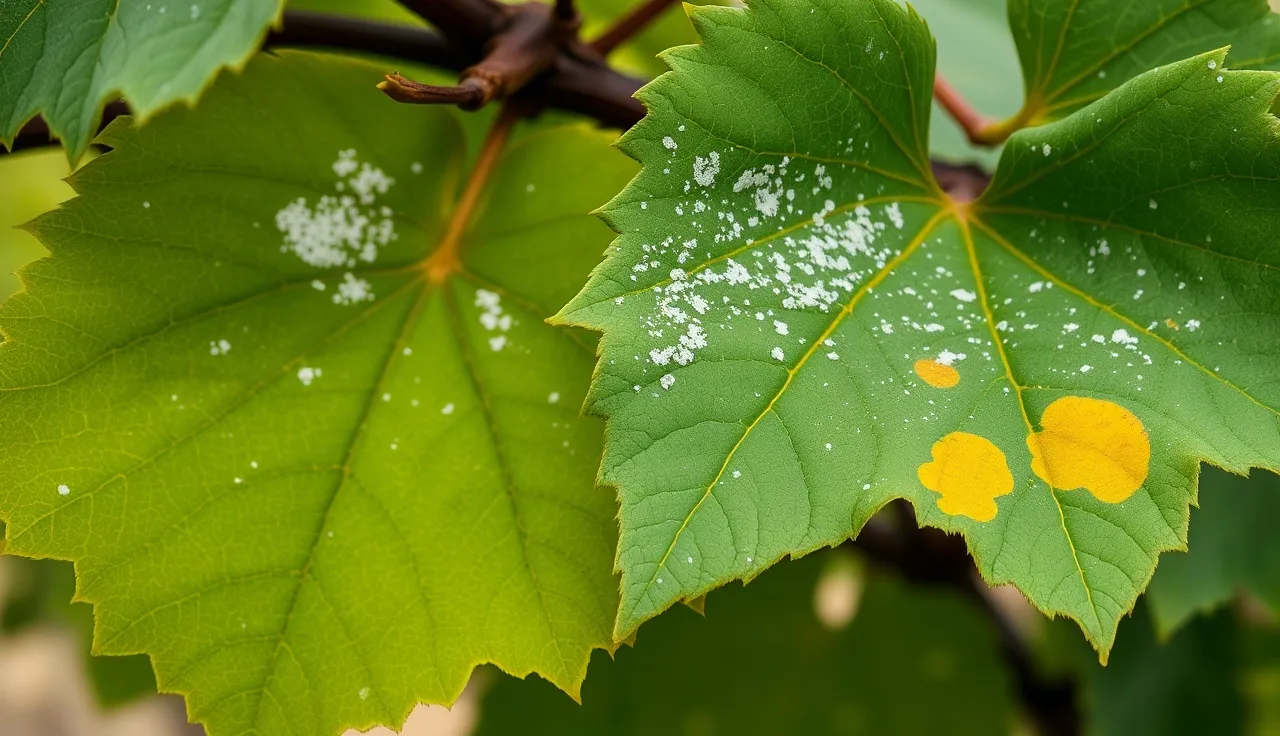
Downy mildew is caused by Plasmopara viticola, which is not a true fungus at all. It's an oomycete, more closely related to water molds and brown algae than to fungi [2]. It needs liquid water or very high humidity for sporangia to form and zoospores to release. You'll see the classic yellow oil spots on the upper leaf surface and, in humid weather, a white cottony sporulation on the underside of that same leaf. The white fuzz underneath is the sign that tells it apart from powdery mildew.
Here's the practical consequence. Spray a DMI (demethylation inhibitor) like tebuconazole to fight downy mildew and you've done nothing. DMIs have no activity against oomycetes. Spray a phosphonate or mefenoxam product against powdery mildew and you've also done nothing. The target sites don't overlap.
If you want to compare symptoms side by side, UC Cooperative Extension publishes grape disease photo guides showing both diseases on leaves and berries at different growth stages [1].
How do you identify downy mildew vs powdery mildew by sight?
The fastest diagnostic in the field: flip the leaf over.
White sporulation on the underside of a leaf that has yellow oil spots on top? That's downy mildew. The sporulation looks fuzzy or cottony, not powdery. Early infections make irregular, angular yellow patches bounded by leaf veins. Later the tissue browns and dies. On young berries, downy mildew makes them shrivel, turn gray-brown, and harden, which growers sometimes call 'grey rot' even though it's completely distinct from Botrytis.
Powdery mildew looks different on every tissue it touches. On leaves, the white mycelium sits on the upper surface and the leaf often curls upward at the margins. Infected berries get a dusty white coating early, then crack badly as the season runs on, which opens the door for Botrytis and sour rot to pile in. Infected berries can also develop a netted russeting pattern that stays visible long after the mildew itself is gone.
Shoot tips infected with powdery mildew curl and stunt. You won't see that with downy mildew. Downy mildew hits hardest on shoot tips and expanding leaves during the wet spring, then eases off as the weather dries. Powdery mildew often gets worse through summer.
For pictures of powdery mildew and downy mildew on grapes side by side, the Cornell Integrated Pest Management program keeps a grape disease identification resource that most New York and eastern growers trust [3]. UC Cooperative Extension has California-specific photo references too [1].
Which fungicides work for powdery mildew on grapes?
Powdery mildew is one of the better-studied corners of applied vineyard fungicide chemistry. You have real choices. Rotating among FRAC groups is not optional if you want to keep resistance from wrecking your program.
Sulfur is the backbone of most programs, especially organic ones. It's cheap, has no known resistance issues in powdery mildew, and gives good protectant activity. Two constraints: temperature (don't apply when temps will top 90 degrees F within 24 hours, or you risk severe phytotoxicity) and short residual (it burns off fast in heat). Wettable sulfur or dust every 7 to 14 days, depending on pressure and weather, is still standard practice across much of California [1].
DMI fungicides (FRAC Group 3) include tebuconazole, myclobutanil, and others. They're systemic and curative to a point, giving some knockback up to roughly 96 hours post-infection under the right conditions. Resistance in Erysiphe necator to DMIs is documented worldwide. Don't run them as your only chemistry.
SDHI fungicides (FRAC Group 7) like fluxapyroxad and boscalid have gotten more common. They act as protectants and curatives and need careful rotation, because resistance is a live concern.
Quinone outside inhibitors (QoI, FRAC Group 11) like azoxystrobin and trifloxystrobin were highly effective when they arrived. Resistance is now widespread in some regions. Washington State University research found QoI-resistant Erysiphe necator isolates in Washington vineyards [4]. Use QoIs only when tank-mixed with a partner from a different FRAC group.
Quinoxyfen (FRAC Group 13) is a solid pick with a unique mode of action. It's protectant only, no curative activity. It fits well early in the season.
Potassium bicarbonate products are OMRI-listed and work reasonably well as contact materials. They shift surface pH and disrupt the mycelium. Best used inside an organic program, not as your sole control when pressure is high.
A general rule from WSU extension: no more than two consecutive applications from the same FRAC group, and keep a running tally of which groups you've used season to date [4]. The table below lists common active ingredients by FRAC group with typical rates.
| Active Ingredient | FRAC Group | Mode | Typical Rate (oz/acre) | Notes |
|---|---|---|---|---|
| Sulfur (wettable) | M2 | Protectant | 5-10 lbs | No resistance; temp limit 90°F |
| Myclobutanil | 3 (DMI) | Protectant/Curative | 2.5-4 oz | Resistance documented |
| Tebuconazole | 3 (DMI) | Protectant/Curative | 4-8 oz | Resistance documented |
| Azoxystrobin | 11 (QoI) | Protectant/Curative | 6-15.4 oz | Always tank-mix; resistance widespread |
| Fluxapyroxad | 7 (SDHI) | Protectant/Curative | 4-5 oz | Rotate strictly |
| Quinoxyfen | 13 | Protectant | 4-6 oz | Early season; no curative activity |
| Potassium bicarbonate | NC | Contact | 2.5-5 lbs | Organic; best in low-moderate pressure |
Which fungicides work for downy mildew on grapes?
Because Plasmopara viticola is an oomycete, not a true fungus, the chemistry is a separate list entirely. This trips up growers who grab a generic 'fungicide' off the shelf and assume it covers everything.
Mancozeb (FRAC Group M3) is the traditional workhorse. Broad-spectrum, multi-site, contact protectant, no resistance concerns, low cost. You need to track its pre-harvest and restricted-entry intervals, and EPA re-registration reviews are ongoing. Its one real limit: zero systemic activity, so getting the timing right ahead of infection events matters a lot [5].
Phosphonates (FRAC Group 33), meaning fosetyl-aluminum and potassium phosphonate products, work by stimulating the plant's own defense response and also hit Plasmopara directly. They're systemic and move both up and down in the plant. Resistance to phosphonates in downy mildew has turned up in Europe, but it's less of a problem in North America so far. Plenty of California programs lean on phosphonates for their curative window.
Mefenoxam and metalaxyl (FRAC Group 4) are highly systemic and very effective against downy mildew. Resistance hit them hard early in their history, so most extension guidance now says use them only in mixtures with a protectant partner and cap total applications per season. Cornell's extension guidelines recommend no more than two applications of Group 4 products per season [3].
Cymoxanil (FRAC Group 27) has a short curative window (24 to 48 hours post-infection) and almost always goes into a tank mix. It's not a standalone program.
Ametoctradin (FRAC Group 45) is newer, with good activity against downy mildew and a different mode of action. A good rotation partner.
Zoxamide (FRAC Group 22) is another solid choice. It binds tubulin in oomycetes and has good contact activity. It usually comes combined with mancozeb in commercial formulations.
Copper fungicides (FRAC Group M1) are the oldest downy mildew control and still widely used, especially in organic systems. Fixed copper products give good protectant activity. Phytotoxicity is the risk, especially on copper-sensitive varieties or when applied too often. Copper buildup in vineyard soils is a documented problem in European wine regions and gets more scrutiny in California every year [6].
The timing principle that matters: downy mildew infection follows the Goidanich rule of thumb (older guides call it the 'three-ten' rule). Infection risk runs high when shoots are longer than 10 cm, at least 10 mm of rain has fallen, and temperature has stayed above 10 degrees C for 24 hours [2]. Track those conditions with a weather station, put a protectant on before the infection period, and you're ahead of most operations.
What is the best spray program timing for grape mildew control?
Timing beats product choice most years. A well-timed moderate fungicide beats a premium fungicide applied a week late, every time.
For powdery mildew, the highest-risk stretch starts at budbreak and runs through three to four weeks after bloom. The flowering and immediate post-bloom window (roughly 2 to 6 weeks after bloom) is when berry infections set up future cracking. Many programs put their best systemic powdery mildew fungicide on right before bloom and again immediately after. After veraison, pressure usually drops enough to shift to sulfur alone or stretch intervals, though late-season infections do show up on rachis and stems.
For downy mildew, timing follows weather events. You're protecting against infection periods, which require rain. That's why eastern programs run much tighter downy mildew schedules than California programs. In the Finger Lakes or Hudson Valley, a 7 to 10 day interval during spring wet periods is common. In Napa or Sonoma during a dry year, you might skip most downy mildew applications entirely after May. Know your region.
A practical program for a region carrying both disease pressures (mid-Atlantic, Pacific Northwest, cool coastal California) looks roughly like this:
Budbreak to 4-leaf: Copper or mancozeb for downy mildew; sulfur or another low-resistance-risk material for powdery mildew.
4-leaf through pre-bloom: Tighten to 10 to 14 days. Add a systemic component if weather has been wet (for downy) or warm and dry (for powdery). This is the window to use a FRAC Group 4 product if pressure justifies it.
Bloom through 3 weeks post-bloom: The most important window for both diseases. Many advisors say if you can only afford a good program for part of the season, spend it here. Apply every 7 to 10 days. Consider curative-active products in case you missed an infection period.
Post-bloom through veraison: Hold your coverage. Rotate FRAC groups. Start watching pre-harvest intervals (PHIs) as you schedule.
Post-veraison: Downy mildew risk drops sharply in most regions. Powdery mildew on rachis stays a concern. PHIs become the dominant limit on what chemistry you can pick.
WSU's grape mildew guide recommends starting a spray program when shoots reach 1 to 2 inches (roughly 3 to 5 cm) regardless of weather, because that early protectant catches the period when the vine is most susceptible and inoculum is building [4].
How do you manage fungicide resistance in grape mildew programs?
Resistance is real, it's documented in both pathogens, and ignoring it buys you a program that drains your budget and delivers no protection.
The core rules from every extension program and from the Fungicide Resistance Action Committee:
Rotate by FRAC group, not by trade name. Two products from FRAC Group 3 are not a rotation. Print the FRAC code chart (it's free on the FRAC website) and tape it to your spray room wall [7].
Cap total applications per season from any single FRAC group. For high-risk groups like 11 (QoI) and 4 (phenylamides, mefenoxam), Cornell and WSU both recommend two applications maximum per season per site [3][4].
Always mix a systemic or at-risk material with a multi-site contact protectant. That dilutes the selection pressure for resistance. Mancozeb with mefenoxam is the classic example, which is why so many commercial formulations combining the two were built that way.
Don't lean on the same curative chemistry year after year just because it worked last season. Resistance can build in a population within a few seasons under strong selection pressure.
Seeing control failures? Send samples for resistance testing before you decide a product is done. UC Davis plant pathology extension has resources on fungicide resistance diagnostics [1].
An honest read: QoI resistance in powdery mildew is widespread enough in California and Washington that treating azoxystrobin as a standalone is a gamble. Mancozeb is still the most sensible multi-site anchor for downy mildew programs in most regions. Nobody has great regional resistance frequency data for mefenoxam in western US Plasmopara populations specifically, but European data shows it's a real risk when programs haven't rotated [7].
What are the EPA and worker protection rules for applying mildew fungicides in vineyards?
The EPA's Worker Protection Standard (WPS), updated in 2015, sets the baseline rules for all agricultural pesticide applications, fungicides in vineyards included [8]. Here's what vineyard managers need to track.
Restricted Entry Intervals (REIs) vary by product. Mancozeb runs a 24-hour REI. Mefenoxam products are often 12 hours. Copper sulfate products can run 24 to 48 hours depending on formulation. The label is the law. You cannot send workers into a treated area during an active REI unless they have the right personal protective equipment and you've posted the area.
Application Exclusion Zones (AEZ) came in with the 2015 WPS revision. For most ground-based sprayers, the AEZ is 100 feet downwind from the point of application. Workers not involved in the application cannot be in the AEZ while spraying is happening.
Label literacy is a legal requirement. Under WPS, the applicator must have access to the product labeling during application, and the safety data sheet must be accessible to workers at the central location (your shop, barn, or field headquarters).
Pesticide safety training must go to all agricultural workers within 30 days of their first entry into a treated area and annually after that. The EPA provides WPS training materials directly [8].
For organic-approved materials like copper and sulfur, WPS rules still apply. OMRI listing does not exempt you from label requirements or REIs.
Record-keeping lands here too. State agriculture departments often audit WPS compliance through pesticide use records. In California, Pesticide Use Reports (PURs) are required for all restricted-use pesticides and many general-use materials [9]. California's Department of Pesticide Regulation has reporting requirements that go beyond federal minimums, and county agricultural commissioners enforce them.
If you're tracking spray records across multiple blocks, multiple people, and multiple products in a season, a platform like VitiScribe can log REIs, PHIs, and applicator certifications against your field calendar so nothing slips during harvest crunch.
Oregon, Washington, and New York rules track closely with the federal WPS, but check your state ag department for additions. Washington's WSDA has extra requirements for notification to farmworker housing [10].
Can you tank-mix downy and powdery mildew fungicides together?
Yes, and in most multi-disease programs you should. A tank mix covering both pathogens is standard practice and usually cheaper than two separate spray passes.
Check compatibility before you mix. Copper and sulfur together can cause phytotoxicity. Mancozeb and sulfur are generally compatible. Most product labels have a compatibility section, and the manufacturer's technical line can walk you through specific combinations.
A common California coastal approach: mancozeb plus a phosphonate for downy mildew, combined with sulfur for powdery mildew, as a base program. During bloom and post-bloom, add a systemic component for powdery mildew (DMI or SDHI), given how severe berry infection gets if that window is missed.
In the East and Pacific Northwest, where downy mildew pressure is higher and intervals run tighter, a tank mix of a phenylamide (mefenoxam) plus mancozeb, combined with a QoI or DMI for powdery mildew, is common. Given QoI resistance concerns, the QoI needs a partner from a different FRAC group.
One thing to watch in combination programs: your label compliance. Tank-mix two products and the most restrictive label governs the whole tank. If Product A has a 30-day PHI and Product B has a 7-day PHI, you observe the 30-day restriction for the entire mix. Applicators miss this all the time.
The adjuvant question: most modern fungicide labels spell out whether a surfactant or spreader-sticker helps. Copper and mancozeb generally don't need extra adjuvants. DMI fungicides sometimes benefit from a low-rate spreader, but over-adjuvanting can raise the risk of phytotoxicity.
Are there organic-approved fungicides for grape downy and powdery mildew?
Organic growers have real options. Organic programs just demand tighter timing and higher spray frequency to make up for the lack of systemic curative materials.
For powdery mildew: Sulfur is the primary tool and it works well on a steady 7 to 14 day schedule. Potassium bicarbonate (products like Kaligreen and MilStop) is OMRI-listed and gives decent contact knockback. Neem oil-based products are approved in some certification programs, but the efficacy data for powdery mildew specifically is less consistent. Kaolin clay sometimes gets used as a barrier treatment.
For downy mildew: Copper is the primary organic option and it works. Fixed copper formulations (copper hydroxide, copper oxychloride, copper octanoate) give better crop safety than Bordeaux mixture in most modern programs. Potassium phosphonate sits in a complicated space: it's OMRI-listed in some formulations, but certification bodies split on whether it's allowed. Check with your certifier before using any phosphonate product.
Biostimulant and SAR (systemic acquired resistance) inducers like acibenzolar-S-methyl and phosphorous acid sometimes appear in organic-adjacent programs to prime plant defenses. The efficacy data is real but modest. They don't replace fungicide applications under high pressure.
The honest tradeoff: in a region with heavy downy mildew pressure and frequent rain (New York, Oregon, Virginia), an organic program means a serious commitment to weather monitoring and probably 30 to 50 percent more spray passes than a conventional program. UC Cooperative Extension has published organic grape production guidelines that address this cost tradeoff head-on [11].
How much does a grape mildew fungicide program cost per acre?
Costs swing hard by region, disease pressure, and program intensity. Anyone who hands you a single number is glossing over real variation. That said, here are the rough ranges from published data and extension budgets.
UC Cooperative Extension publishes annual sample costs of production for California wine grapes that break out pesticide costs as a line item [11]. The 2022 Napa Valley example put disease management (fungicides) at roughly $400 to $600 per acre per year for conventional programs in high-pressure years. North Coast low-pressure years can run closer to $200 to $300.
Cornell's farm management team publishes cost-of-production estimates for New York wine grapes, where disease pressure is higher. Disease management costs in Finger Lakes conventional programs get cited around $350 to $500 per acre for fungicides and application labor combined.
WSU's enterprise budgets for Washington wine grapes put disease management materials at about $150 to $350 per acre, depending on variety (some thin-skinned varieties need much more aggressive programs) and the vintage's disease pressure [12].
Application cost (equipment, labor, fuel) often runs higher than the material cost itself. A tractor-mounted air-blast sprayer run by one person might cost $15 to $25 per acre per pass for labor and fuel alone. At 6 to 12 passes per season, that's $90 to $300 per acre in application costs before you buy a single ounce of product.
Where organic programs save money: copper and sulfur are cheap. Where they cost money: you need more passes. Organic material costs might be lower per pass, but total season cost lands similar or higher once you count the frequency.
Smaller operations buying at retail pay substantially more per unit than large operations buying through a PCA or co-op program. The retail-to-commercial markup on mancozeb, for one, can run 30 to 50 percent.
How do weather and climate affect mildew risk in vineyards?
Downy and powdery mildew have almost opposite climate triggers, which is one reason the two diseases don't always peak together.
Downy mildew is fundamentally a wet-weather disease. Sporangia form at night when humidity sits near 100 percent, and the release and movement of zoospores need free water. The primary infection model in most forecasting tools uses leaf wetness duration plus temperature to estimate infection risk. Oregon State University's Integrated Plant Protection Center and Cornell both provide disease forecasting models that vineyard managers use to time sprays to actual infection risk instead of the calendar [3].
Powdery mildew does not need rain. Rain can actually wash spores off leaves and cut short-term spread. Warm days (77 to 95 degrees F / 25 to 35 degrees C) and moderate humidity (40 to 70 percent RH) favor germination and spread. Cool nights followed by warm days with light dew are ideal for powdery mildew epidemics. The marine-influence years along the California coast tend to produce high powdery mildew pressure.
Climate change matters here. There's genuine data showing that warming temperatures and shifting precipitation are moving disease pressure windows around. A 2020 study in Agricultural and Forest Meteorology found that in European wine regions, downy mildew season length is projected to change meaningfully under RCP 4.5 and 8.5 scenarios, with more variable infection risk windows rather than a clean northward shift [13]. For spray program design, that means more year-to-year variability, not a simple story of more or less disease.
If your vineyard has a weather station with leaf wetness and relative humidity sensors, use the data. A basic station logging those parameters costs between $500 and $2,000 installed and can cut unnecessary spray passes in dry years. Most vineyards see that return in the first drought year.
How should you keep spray records for mildew applications in vineyards?
Record-keeping for pesticide applications is not optional. California requires Pesticide Use Reports filed monthly with the county agricultural commissioner for restricted-use pesticides and most general-use materials [9]. Other states set varying requirements, but federal WPS mandates that application records be kept for at least two years [8].
A complete spray record needs: date and time of application, applicator name and license number, product name and EPA registration number, application rate and total product used, acres treated, target pest, equipment used, weather at time of application (temperature, wind speed, wind direction), and the REI and PHI for the applied product.
Applying under an emergency exemption (Section 18) or an experimental use permit? Those require extra documentation.
The record-keeping load grows fast when you run multiple blocks with different varieties, multiple applicators, and a full-season program of 8 to 12 applications across 20 products. Paper systems work, but audits get painful. Digital logs tied to your block map make compliance reporting and year-over-year program review much faster.
VitiScribe is built for vineyard operations that need to track spray records alongside field scouting and a compliance calendar. The trial is free if you want to see whether it fits your operation.
Beyond compliance, your records are your best tool for looking backward. Had a powdery mildew outbreak in one block? Your spray log tells you which FRAC groups you leaned on, whether you missed an application during a key window, or whether that specific block underperforms every year despite the same program applied everywhere else. Patterns in the data save you money. They're invisible without the records.
Frequently asked questions
Can the same fungicide spray treat both downy mildew and powdery mildew on grapes?
Not with a single active ingredient, because they're different organisms. You need an oomycete-active material (mancozeb, copper, phosphonate, mefenoxam) for downy mildew and a fungal-active material (sulfur, DMI, SDHI, quinoxyfen) for powdery mildew. Many growers tank-mix products to cover both in one pass, which is practical and commonly done. Check label compatibility and use the most restrictive PHI and REI of the combination.
What does powdery mildew on grape berries look like?
Early infections produce a white, dusty or powdery coating on the berry surface. As the berry grows, the hardened infected skin fails to expand with the flesh, so the berry cracks. Later in the season, cracked berries attract Botrytis and sour rot. You may also see a brownish net-like russeting pattern on infected berries after the visible mycelium is gone, which can reduce wine quality even without visible active disease.
What does downy mildew look like on grape leaves?
Look for irregular, pale yellow or light green oil-spot lesions on the upper leaf surface, often slightly translucent when held to light. The underside of that same leaf, in humid conditions, shows a white to grayish cottony sporulation. That fuzzy growth underneath is the key identifying feature. Older lesions turn brown and the tissue dies. Severely infected leaves drop early, weakening the vine and cutting fruit quality.
When should I start spraying for powdery mildew in my vineyard?
WSU and Cornell both recommend starting your powdery mildew program when shoots reach 1 to 2 inches (about 3 to 5 cm). Don't wait for symptoms. The stretch from budbreak through three to four weeks after bloom is the highest-risk window for infections that damage the fruit crop. A missed application during bloom can set up berry infections that drive cracking and secondary disease all season.
Is sulfur effective against downy mildew on grapes?
No. Sulfur has no meaningful activity against Plasmopara viticola, the oomycete behind downy mildew. Sulfur works on powdery mildew only. This is one of the most common errors in home vineyard and small-farm programs. If sulfur is your only spray and you have downy mildew pressure, you need to add a copper product, mancozeb, or a phosphonate.
Does mefenoxam work on powdery mildew?
No. Mefenoxam (and its parent compound metalaxyl) are active only against oomycetes and have no effect on true fungi. They work for downy mildew but do nothing to Erysiphe necator. The confusion comes because both mefenoxam and some powdery mildew fungicides are systemic, but the biochemical targets are entirely different. Applying mefenoxam to control powdery mildew is a waste of money.
How do resistance risks differ between downy and powdery mildew fungicides?
Both pathogens have documented fungicide resistance. In powdery mildew, QoI (FRAC Group 11) resistance is widespread in California and Washington, and DMI resistance is increasing. For downy mildew, phenylamide (mefenoxam, FRAC Group 4) resistance developed early in the product's history and remains a concern. The fix in both cases is the same: rotate FRAC groups, cap high-risk group applications at two per season, and always mix with a multi-site contact fungicide.
What is the pre-harvest interval for common grape fungicides?
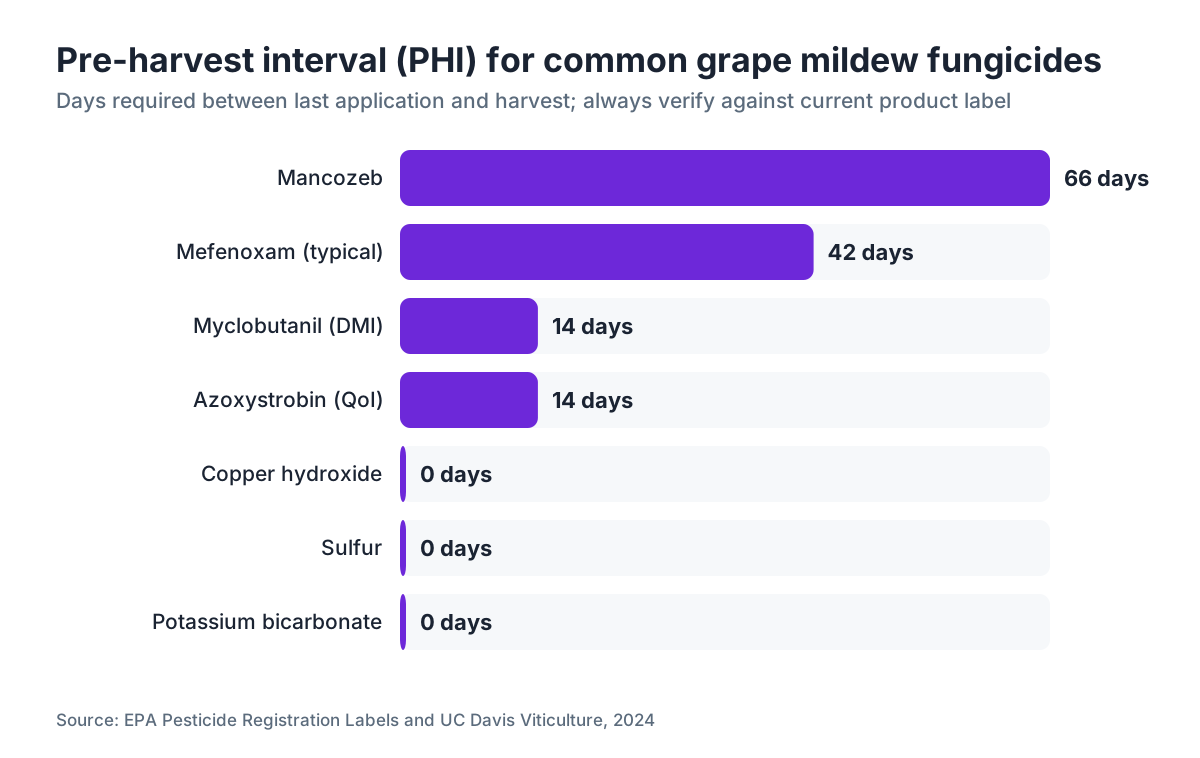
PHIs vary widely by product. Mancozeb has a 66-day PHI for grapes. Sulfur is typically 0 days. Copper products range from 0 to a few days depending on formulation. Many DMI fungicides run PHIs of 7 to 14 days. Mefenoxam products are often 42 to 66 days. Always read the current label, since PHIs change with label revisions. When tank-mixing, the longest PHI in the combination governs the whole application.
Are copper fungicides safe for organic grape production?
Copper is OMRI-listed and allowed in certified organic programs, but it accumulates in vineyard soils with repeated applications. Copper phytotoxicity is a real risk at high rates or in cool, wet weather. Most organic certification programs require copper to be minimized; the European Union limits copper applications to an average of 2.8 kilograms of copper metal per hectare per year. Check your certifier's current rules and use the lowest effective rate of a modern fixed-copper formulation.
Can I use potassium phosphonate for downy mildew in an organic vineyard?
It depends on your certifier. Potassium phosphonate sits in a gray area: some OMRI-listed formulations exist, but not all organic certifiers accept it. The National Organic Program has had ongoing debate about phosphonate classification. Confirm with your specific certifier before using any phosphonate product. The chemistry is effective for downy mildew, but a compliance violation caught at certification renewal is a bad trade.
How many spray passes do most vineyards need for mildew control in a typical season?
It depends heavily on region and vintage. California's Central Valley might need 4 to 6 passes in a dry year. North Coast coastal sites often run 8 to 12 passes. Eastern U.S. programs in wet years commonly run 12 to 18 passes for combined downy and powdery mildew control. The interval between passes is typically 7 to 14 days, compressed to 5 to 7 days during high-risk periods like wet springs and the bloom window.
What records do I need to keep for vineyard fungicide applications under the EPA Worker Protection Standard?
The WPS requires records of pesticide applications for at least two years. Required information includes the product name and EPA registration number, application rate, total amount used, acreage treated, application date, and target pest. State requirements often go further. California requires monthly Pesticide Use Reports filed with the county agricultural commissioner. Applicator license numbers and weather conditions at the time of application are also typically required at the state level.
How do I know if a fungicide failure is due to resistance or a timing mistake?
Timing failures typically show up as uniform infections across a block right after a missed or delayed spray, especially following a clear weather infection event. Resistance failures often show up as breakthrough disease on blocks that got timely applications, or as one product failing where another chemistry in the same program still works. Send plant samples to your state plant diagnostic lab for confirmation before concluding resistance, since poor coverage and temperature extremes also cut efficacy.
Sources
- UC Cooperative Extension, Plasmopara viticola biology and infection requirements: Downy mildew caused by Plasmopara viticola, an oomycete requiring free water for zoospore release, and the 10-10-10 infection rule
- Washington State University Extension, Grape Powdery Mildew Management: QoI-resistant Erysiphe necator isolates documented in Washington vineyards; recommendation to begin spray program at 1-2 inch shoot growth; FRAC rotation guidance
- EPA, Mancozeb Pesticide Registration and Tolerance Information: Mancozeb 66-day pre-harvest interval for grapes and multi-site mode of action classification
- EPA, Copper-Based Pesticide Registrations and Environmental Concerns: Copper accumulation in vineyard soils documented as an environmental concern in repeated-application programs
- Fungicide Resistance Action Committee (FRAC), FRAC Code List for Fungal Pathogens: FRAC group classifications for fungicide active ingredients and resistance risk ratings; European data on mefenoxam resistance development in Plasmopara viticola
- EPA, Worker Protection Standard for Agricultural Pesticides: WPS 2015 revision requiring Application Exclusion Zones, annual worker training, and two-year record retention for pesticide applications
- California Department of Pesticide Regulation, Pesticide Use Reporting: California monthly Pesticide Use Report requirement for restricted-use and many general-use pesticides, enforced by county agricultural commissioners
- Washington State Department of Agriculture, Pesticide Regulation and Worker Notification: Washington state additional WPS requirements including farmworker housing notification for pesticide applications
- UC Cooperative Extension, Sample Costs to Establish and Produce Wine Grapes, Napa Valley: Disease management fungicide costs in Napa Valley conventional programs estimated at $400-$600 per acre in high-pressure years; organic grape production guidelines addressing spray frequency tradeoffs
- Washington State University Extension, Enterprise Budgets for Wine Grape Production: Washington wine grape disease management material costs estimated at $150-$350 per acre depending on variety and vintage pressure
- Agricultural and Forest Meteorology, Climate change and grapevine disease risk projections (2020): Downy mildew season length in European wine regions projected to shift under RCP 4.5 and 8.5 scenarios, with increased variability rather than uniform directional change
Last updated 2026-07-09