California powdery mildew on grapes: damage, costs, and control
TL;DR
- Powdery mildew (Erysiphe necator) is the most expensive fungal disease in California vineyards.
- Untreated infections destroy 30 to 100% of a crop in susceptible varieties.
- Growers spend an estimated $50 to 100 million a year fighting it.
- Control comes down to hitting the right spray windows, especially budbreak through bloom, when the vine has almost no natural defense.
How bad is powdery mildew damage on grapes in California?
Powdery mildew is the single most expensive disease California grape growers deal with. The University of California Cooperative Extension has documented it in every major grape region, from the North Coast to the San Joaquin Valley, with crop losses in poorly managed vineyards running from 30% to total failure depending on variety and conditions [1].
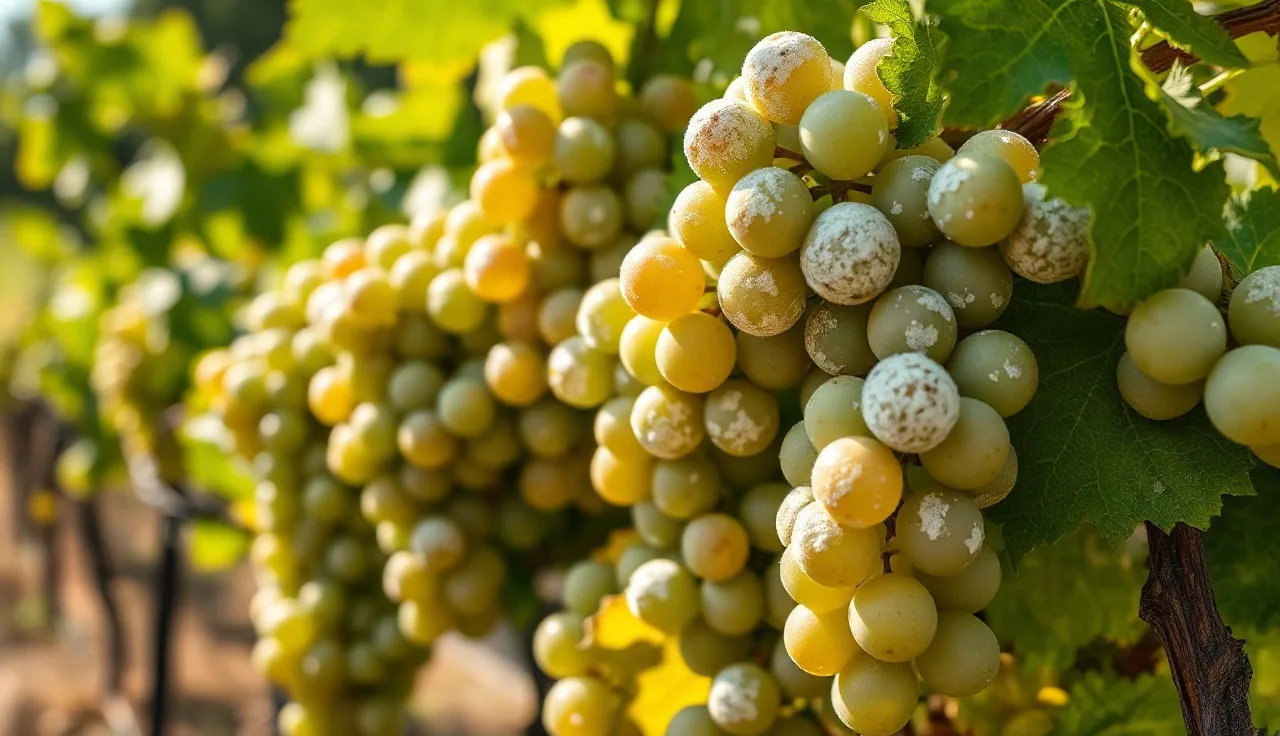
The pathogen, Erysiphe necator (older texts call it Uncinula necator), colonizes green tissue: leaves, shoots, and most damagingly, berries. Infect a berry before or just after bloom and the skin stops expanding while the flesh keeps growing. The berry splits. That crack is an open door for Botrytis and other rots. On wine grapes, even trace berry infection produces off-flavors, usually described as mushroomy or earthy, that ride straight through fermentation and tank aging [2].
On the valley floor, table grape and raisin growers have lost entire blocks to early-season infections nobody caught in time. In Napa and Sonoma, where planted vineyard land runs roughly $200,000 to $500,000 per acre, a 20% crop loss is a six-figure hit per block, not a line item you shrug off [3].
California's climate keeps the problem alive. Warm days and cool nights through spring and early summer sit right in the band (65 to 77 degrees F) where E. necator grows fastest. Here's the part that trips people up: mildew doesn't need rain. It actually prefers low surface wetness, which is the opposite of downy mildew and most other vineyard fungi. Coastal fog in Paso Robles or Santa Barbara doesn't suppress it the way rain suppresses those diseases [1].
What are the economic costs of powdery mildew in California vineyards?
The most-cited statewide figure puts direct crop losses plus control costs at $50 million to $100 million a year, from UC IPM and UC Davis Viticulture and Enology work. Be honest about that range. The methodology dates to studies from the early 2000s, and nobody has a fully updated number, because USDA and CDFA crop reports don't break out losses by pathogen [1][4].
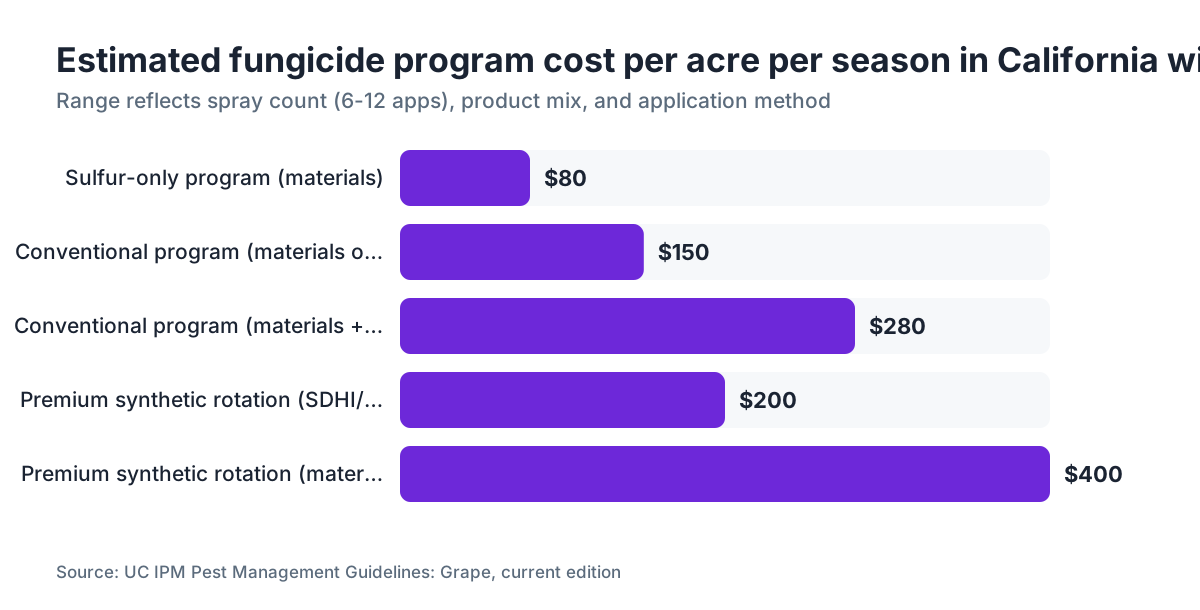
Per-acre spending is easier to pin down. A typical California wine grape program runs 6 to 12 spray applications a season depending on disease pressure and variety. Materials for a conventional program (sulfur base with synthetic rotations) run roughly $80 to $200 per acre. Add application and you're at $150 to $400 per acre depending on equipment and labor [4].
Then there's resistance. Strobilurin (QoI) fungicides started losing efficacy against California E. necator in the early 2000s [5]. Growers who leaned on them had to shift to pricier SDHI or DMI chemistries, which run $30 to $60 per application against $8 to $15 for sulfur.
Run the math on a real block. A 50-acre Napa Cabernet running a full 10-spray season at $300 per acre in total spray cost is $15,000 in disease management before you lose a single berry. Miss a window and that money buys you nothing. Nail the timing and you can often drop two or three sprays without losing control [1].
| Cost category | Low estimate | High estimate | Notes |
|---|---|---|---|
| Fungicide materials (per acre/season) | $80 | $200 | Conventional program, 6-12 apps |
| Application costs (per acre/season) | $70 | $200 | Labor + equipment |
| Resistance-related switching premium | $15 | $45 | Per application, SDHI/DMI vs sulfur |
| Crop loss (susceptible variety, poor control) | 20% | 100% | % of expected yield |
| Statewide annual impact estimate | $50M | $100M | UC IPM / UC Davis estimate |
When during the season does powdery mildew cause the most damage?
The window that matters most is budbreak through three to four weeks after bloom. UC Davis plant pathology research confirms berries stay susceptible from the time they form until roughly 3 to 4 weeks post-bloom, when skin hardening sharply cuts successful infection [1][2]. Miss that stretch unprotected and no spray fixes a berry infection after the fact.
Flag these growth stages on the calendar:
- Budbreak to 1-inch shoot growth: chasmothecia (the overwintering spore structures) release ascospores. The season's first infections start here.
- Bloom (5 to 8 leaves): the highest-risk period. Flowers and newly set berries have almost zero natural resistance.
- Berry set to three weeks post-bloom: still very high risk. Berries take infection through the skin until cell division slows.
- Veraison onward: berry susceptibility drops off. Leaf infections keep going but rarely hurt fruit at this point.
The index of infection model from UC Davis tracks how much disease-friendly weather has piled up since budbreak [2]. It runs on temperature: hours between 70 and 85 degrees F carry the most weight. Most California farm advisors run it on a spreadsheet or through UC IPM's online tools. Getting the first spray on at budbreak, before the first index warning, is almost always the right call on susceptible varieties. Wait for visible symptoms and you're already behind.
Fall counts too, in a different way. After harvest, chasmothecia form on infected leaves and wood and set next year's inoculum load. In high-pressure years, dormant or delayed-dormant copper can knock that load down, though study results on efficacy vary [1].
Which California grape varieties are most vulnerable to powdery mildew damage?
Vitis vinifera has essentially no natural resistance to E. necator. The fungus co-evolved with North American wild Vitis species, and vinifera met a pathogen it had no history with. Within vinifera, though, susceptibility ranges enormously [2].
High-susceptibility varieties where you cannot afford to miss sprays:
- Chardonnay
- Cabernet Sauvignon
- Merlot
- Muscat (all types)
- Zinfandel (especially in warm interior regions)
- Thompson Seedless (table/raisin)
Moderate susceptibility:
- Sauvignon Blanc
- Syrah
- Grenache
Relatively tolerant (not immune):
- Pinot Gris
- Riesling (somewhat, in cooler climates)
- Mourvedre
Interspecific hybrids bred with American Vitis resistance genes hold the most promise for cutting spray loads. UC Davis and the USDA Agricultural Research Service breeding programs have released varieties with partial E. necator resistance [6]. Some Paso Robles and Sierra Foothills growers have put in experimental blocks. Results look good, but adoption in premium regions moves slowly, because appellation rules and what wine drinkers expect still drive planting decisions.
For existing vinifera, the practical move is to know each block's susceptibility and build the program around it. A block of Muscat next to a block of Mourvedre needs a different plan, not the same calendar sprays smeared across the whole ranch.
What does powdery mildew damage actually look like on grapes?
On leaves, the first sign is a faint yellow or pale green blotch on the upper surface, often with a powdery white or gray coating of mycelium underneath. That white coating is the fungus growing on the outside, throwing off conidia (asexual spores). Badly hit leaves curl, turn chlorotic, and drop early, which cuts the vine's photosynthetic capacity going into harvest [2].
On shoots, white powdery patches show on green tissue. Heavy infection leaves brown or rusty lesions where the fungus killed surface cells. Those lesions stay on dormant wood as reddish-brown staining, which is handy for reading last year's pressure when you walk blocks in winter.
On clusters, early infection near bloom shows as white powder on the rachis (the cluster stem). As it moves, individual berries get powdery coatings, then the skin cracks. Cracked berries in a Cabernet or Chardonnay block are one of the clearest late-season tells of a failed program. By then, secondary Botrytis is usually moving in alongside.
One diagnostic trap: sulfur residue looks a lot like mild mildew powder. Wipe the white material with a damp cloth. Sulfur wipes off clean. Mildew leaves a stain or residue underneath. A microscope settles it for good but isn't practical in the field.
UC Davis-recommended scouting cadence is weekly from budbreak through berry set, then every two weeks through veraison [1]. Walk the interior of the canopy, not the perimeter. Mildew loves low-airflow zones.
What fungicides are registered and effective for powdery mildew in California?
The California Department of Pesticide Regulation (CDPR) keeps the registration list, and efficacy ratings for each active ingredient live in the UC IPM Pest Management Guidelines for Grapes, which the UC Statewide IPM Program updates every year [4].
Sulfur is the backbone of most California programs. It's cheap ($8 to $15 per acre per application), effective applied preventively, and has no meaningful resistance in E. necator. The catch is heat: sulfur applied when canopy temperatures top 90 degrees F can burn leaves and berries. In San Joaquin Valley summers, that's a hard constraint on when you can spray.
Synthetic classes in use:
- DMI (demethylation inhibitors, FRAC Group 3): tebuconazole, myclobutanil. Effective, moderate resistance risk in California populations.
- SDHI (succinate dehydrogenase inhibitors, FRAC Group 7): fluopyram, boscalid. Good efficacy, rotate with other modes of action.
- QoI (strobilurins, FRAC Group 11): azoxystrobin, trifloxystrobin. Serious resistance documented in California; use only in rotation, with caution [5].
- Quinoxyfen (FRAC Group 13): good efficacy, low resistance risk so far.
- Bicarbonates and mineral oil: lower efficacy, useful as rotation tools for resistance management.
Rotation by FRAC group isn't optional. The Fungicide Resistance Action Committee and UC IPM both cap it at no more than two consecutive applications of the same FRAC group per season [4][5]. California growers who ignored that in the strobilurin era now farm populations that don't respond to QoIs at all.
For certified organic operations, sulfur is the workhorse. Copper (as copper hydroxide or copper sulfate) and potassium bicarbonate are registered too. Oil-based products have moderate efficacy. UC Davis Cooperative Extension has documented that well-timed sulfur alone, every 10 to 14 days through the susceptibility window, can reach 80 to 90% control in moderate-pressure years [1].
Re-entry intervals (REIs) and pre-harvest intervals (PHIs) vary by product. Read the label every time. The EPA Worker Protection Standard (40 CFR Part 170) sets minimum applicator safety, posting, and training standards even where state labels run stricter [7].
How do California regulations affect powdery mildew spray records?
California requires a pesticide use report (PUR) for every commercial application, filed with the county agricultural commissioner within 7 days [8]. That covers every product with a California registration number, sulfur and copper included. It's state law under California Food and Agricultural Code Section 12981, not a suggestion [11].
Your records need, at minimum: product name and EPA registration number, the rate applied, acreage treated, the crop and site, the applicator's name and license number (if a licensed PCA or QAL is involved), and the date and time of application [8].
Here's why this bites harder for mildew than for most jobs. A California mildew program easily runs 8 to 12 spray events per block per season. Spread that across a 100-acre ranch with several varieties and staggered spray dates and you're generating hundreds of individual application records in a single year. Errors, missed entries, and late filings stack up fast.
County ag commissioners run spot audits, and penalties for late or incomplete PURs range from warning letters to fines depending on the county and the pattern of violations. The bigger practical risk: if you sell grapes under a custom crush contract or to a large winery, the buyer may pull your spray records for their food safety or sustainability certification. Records that don't reconcile against your application invoices create problems you don't want at delivery.
Keeping spray records digitally, tied to a specific block and date, is where a tool like VitiScribe earns its keep. It's built around California's PUR requirements, so you log applications in the field, export for county filing, and hand records to buyers without rebuilding a spreadsheet every time someone asks.
Growers in Paso Robles or the South Coast should check with their county ag commissioner directly. Some counties (Riverside, San Bernardino) layer local requirements on top of the state PUR system [8].
What does the UC Davis powdery mildew research say about spray timing models?
UC Davis has produced some of the most usable mildew modeling in the industry. The Gubler-Thomas Risk Index, developed by UC Davis plant pathologist Doug Gubler, is the standard tool California farm advisors use to set spray intervals [1]. It accumulates temperature-weighted hours in the optimal growth range (70 to 85 degrees F) and spits out a numerical risk score.
The logic is simple. When accumulated hours push risk into the high category, you tighten the spray interval to 7 days. In low-risk stretches (cool nights, temperatures below 50 degrees F that stall conidial germination), you can sometimes stretch to 14 days. The model doesn't kill sprays outright. It trims the unnecessary ones during cool spells, which helps on both cost and resistance.
The UC IPM website hosts the current risk model and pulls in county-level weather data for California [4]. Several private weather services (Onset, DTN, Pessl Instruments) have built the Gubler-Thomas model into their station outputs, so you can run it without your own spreadsheet.
A 2022 meta-analysis in Plant Disease found that timing-model-guided programs matched or beat calendar-based programs on disease control in 8 of 10 studies reviewed, while cutting total applications by an average of 2.1 per season [9]. At California fungicide prices, that's roughly $150 to $250 per acre saved. Real money across a commercial ranch.
UC Cooperative Extension farm advisors in most California wine regions (Sonoma, Napa, San Luis Obispo, Fresno) keep demonstration blocks and publish local disease pressure updates through the season. If you're not on your local advisor's email list, fix that before next season.
How does powdery mildew affect wine quality in California grapes, beyond yield?
This is the part that gets underrated. Even when infection stays low enough that you never see catastrophic berry splitting or yield loss, subclinical mildew shows up in the glass.
The best-documented quality hit is the production of 1-octen-3-ol and 1-octen-3-one by E. necator during berry infection [2]. Those compounds carry the mushroomy, moldy, earthy off-aromas that get called mildew taint. UC Davis Plant Pathology literature cites a study finding that infection of as little as 3% of berries in a lot can produce detectable off-aromas in finished wine [2]. Three percent is nothing. It's a number you can walk right past in a visual cluster inspection.
Mildew also scrambles the chemistry. Infected berries pile up less sugar and shed tartaric acid faster than healthy fruit, which changes must composition and how the fermentation behaves.
For growers selling under contract, the stakes are direct. Many winery contracts in Napa, Sonoma, and Paso Robles carry quality rejection clauses for mildew taint, triggered by sensory evaluation of fruit samples at delivery. A rejected load is lost revenue and often a breach-of-contract fight. The Paso Robles wine region has seen contract disputes over mildew-tainted Zinfandel in years with heavy early-season pressure.
For estate wineries making their own wine, the risk changes shape: mildew taint can survive into bottle and become a consumer-facing problem rather than a vineyard one. That reputational cost never appears in any crop loss statistic.
What's the best integrated pest management approach for California vineyards?
An IPM program for mildew in California hasn't changed much from what UC Davis has recommended for 25 years, because the fundamentals work. What's improved is the precision of timing and the sophistication of resistance management.
Canopy management comes first. Dense, shaded canopies are mildew nurseries. Shoot positioning, leaf removal in the fruit zone, and hedging to open airflow all cut the microclimate that favors infection. UC Cooperative Extension trials in Napa and Sonoma consistently show open-canopy blocks need fewer fungicide applications for the same disease control as dense, unmanaged canopies [10]. It's not dramatic, usually one to two fewer sprays, but it adds up.
Monitor early and often. Walk blocks weekly from budbreak. Use the Gubler-Thomas index to set intervals. Scout from inside the canopy, not the end rows.
A spray program that works for most California wine regions:
- Budbreak: sulfur at the first inch of shoot growth
- Pre-bloom through post-bloom: your highest-efficacy synthetic in rotation with sulfur, on a 7 to 10 day interval
- Post-fruit set through veraison: keep rotating, stretch to 10 to 14 days as the risk model allows
- Post-veraison: sulfur or a lower-risk product if needed; focus on leaf infections, berry risk is minimal
Rotate FRAC groups. Never more than two consecutive applications of any single group. Log which chemistry you used on each date, more than the product name.
Organic operations run tighter intervals (often 7 days with sulfur in high-pressure spells) and coverage quality matters more, because organically approved products are mostly contact-acting rather than systemic.
Field records tied to a specific block, rate, and date are how you confirm the program ran as planned, more than as intended. That's where vineyard management software, including VitiScribe, makes the compliance and agronomic paperwork less painful than a paper logbook across multiple blocks.
Visit the vineyard resource library for links to current UC IPM guidelines and CDPR registration lookup tools.
What worker safety rules apply to fungicide applications in California vineyards?
The federal EPA Worker Protection Standard (WPS), at 40 CFR Part 170, covers all pesticide applications in agriculture, vineyard fungicide programs included [7]. California adds protections through CDPR regulations and Cal/OSHA that in several areas run past federal minimums.
Key WPS requirements vineyard operators have to meet:
- Personal protective equipment (PPE) per the product label. Most sulfur applications call for coveralls, chemical-resistant gloves, and eye protection at minimum. Systemic fungicides often require a respirator.
- Re-entry intervals (REIs): the minimum time after application before workers can enter treated areas without full PPE. Sulfur typically carries a 24-hour REI. Some synthetics are 12 hours, others 24 to 48. Check the label.
- Application Exclusion Zones (AEZs): workers and bystanders must stay outside a defined buffer during application. Set by the 2015 WPS revision.
- Central posting of application information where all workers can see it, including the spray block, product applied, and REI end time.
- Annual pesticide safety training for every agricultural worker who might enter treated areas.
California also requires employers to provide pesticide safety information in a language workers understand [8]. In most San Joaquin Valley and North Coast operations that means Spanish-language materials, and CDPR publishes translated versions.
The practical weight for mildew: a 10-spray season means 10 posting events, 10 REI tracking obligations, and 10 application records. Run multiple crews across multiple blocks on overlapping schedules and the paperwork gets heavy. Tracking REI compliance in the same system as your spray records is the only sane way to hold it together at scale.
For licensing, California requires a Qualified Applicator License (QAL) or Qualified Applicator Certificate (QAC) for most restricted-use pesticides. Many mildew fungicides aren't restricted-use, but your county may have local use requirements. Check with your county agricultural commissioner.
Frequently asked questions
How much yield loss can powdery mildew cause in California wine grapes?
Losses run from near zero in well-managed blocks with tolerant varieties to 100% crop failure in unmanaged, high-susceptibility blocks during a bad year. UC Davis and UC IPM document that susceptible varieties like Chardonnay and Zinfandel can lose 30 to 80% of a crop in a high-pressure mildew year without adequate spray coverage, especially when the bloom window goes unprotected.
What temperature range is most favorable for powdery mildew on grapes?
E. necator grows fastest between 65 and 77 degrees F (18 to 25 C). Conidia germinate and infect even at temperatures as low as 50 degrees F. Growth stalls above about 95 degrees F, but the pathogen survives. California spring and early summer temperatures in most wine regions sit right in the optimal band, which is why the disease is endemic statewide.
Does rain suppress grape powdery mildew in California?
Only temporarily and unreliably. Unlike downy mildew, E. necator doesn't need free water on leaf surfaces to infect. Heavy rain can physically wash off conidia, but the fungus resumes sporulating fast once things dry. California's dry summers actually favor mildew, because there's no rain-based suppression during the peak susceptibility window from bloom through berry set.
Can powdery mildew taint affect wine flavor even with low infection levels?
Yes. UC Davis research documented that infection of as little as 3% of berries in a lot can produce detectable off-aromas in finished wine, specifically mushroomy or earthy notes from 1-octen-3-ol compounds the fungus makes during berry infection. That threshold is low enough to miss in visual field scouting, which is why preventive spray timing beats reactive control.
How many fungicide sprays does a typical California mildew program require?
Most California wine grape programs run 6 to 12 applications a season. The count depends on variety susceptibility, regional pressure, whether a timing model like the Gubler-Thomas index is stretching intervals, and canopy density. Well-managed open-canopy blocks on model-guided sprays can sometimes get by with 6 to 8. Dense canopies with susceptible varieties in warm regions often need 10 to 12.
What are the California pesticide use reporting requirements for fungicide applications?
California requires a pesticide use report (PUR) filed with the county agricultural commissioner within 7 days of each application, under California Food and Agricultural Code Section 12981. Reports must list product name, EPA registration number, rate, acreage, crop, application date, and applicator information. This applies to all registered fungicides, sulfur and copper included, not only restricted-use materials.
Is sulfur still effective for powdery mildew control in California, or has resistance developed?
Sulfur stays effective with no documented resistance in E. necator populations. It's a multi-site mode of action, which resists resistance developing. The main limit is phytotoxicity above 90 degrees F canopy temperature. In San Joaquin Valley summers, timing has to work around the heat, but sulfur is still the most used and most cost-effective product in California mildew programs at $8 to $15 per acre per application.
How do I identify powdery mildew versus sulfur residue on grape berries?
Both show up as white powdery coating. Wipe with a damp cloth: sulfur residue comes off clean, while powdery mildew leaves a stain or residue on the berry skin underneath. Mildew colonies also tend to sit in irregular patches and may carry a faint gray or tan tint, while sulfur residue is more uniformly white and evenly spread across the sprayed surface.
Do California organic vineyards have effective options for powdery mildew control?
Yes, though the margin for error is thinner. Sulfur is the primary tool, registered for organic production and genuinely effective applied preventively on a 7 to 10 day interval through the high-risk window. Copper, potassium bicarbonate, and approved mineral oils are also registered. Canopy management matters even more in organic programs, because coverage quality and timing carry more weight when products are contact-acting rather than systemic.
What is the Gubler-Thomas index and how do California growers use it?
The Gubler-Thomas Risk Index, developed at UC Davis, accumulates temperature-weighted hours in the 70 to 85 degrees F range to estimate mildew infection risk. Low risk lets spray intervals stretch to 14 days. High risk tightens them to 7. It's available through UC IPM online tools and integrates with several commercial weather station platforms. Using it can cut total sprays by 2 to 3 per season while holding disease control.
Which California grape-growing regions have the worst powdery mildew pressure?
The San Joaquin Valley (Fresno, Tulare, Kings counties) sees high pressure from warm temperatures and dense canopies in high-yield systems. The North Coast (Napa, Sonoma) has significant pressure on susceptible varieties, made worse by foggy mornings that slow drying. Interior regions like the Sierra Foothills and Paso Robles also see meaningful pressure. No California wine region is low enough to skip a mildew program on susceptible varieties.
What does strobilurin fungicide resistance mean for my California mildew program?
E. necator populations with high resistance to QoI fungicides (the strobilurin class, FRAC Group 11) are documented across multiple California wine regions. Lean on azoxystrobin or trifloxystrobin as primary products without rotating to other FRAC groups and you may see control failures even at label rates. The fix is to hold QoI applications to no more than two per season and rotate with DMI, SDHI, or quinoxyfen chemistries.
What worker protection rules apply to my vineyard fungicide sprays?
The EPA Worker Protection Standard (40 CFR Part 170) requires PPE per product label, re-entry interval compliance, application exclusion zones, central posting of spray information, and annual worker safety training. California adds requirements through CDPR, including materials in workers' primary language. Every fungicide application, sulfur included, triggers posting and REI tracking obligations. California also requires licensed applicators for restricted-use materials.
Sources
- UC IPM, UC Statewide Integrated Pest Management Program, Powdery Mildew of Grape: Powdery mildew is present in every major California wine grape region; crop losses can range from 30% to total crop failure in unmanaged vineyards; the Gubler-Thomas index is the standard CA timing model
- UC Davis Plant Pathology, Erysiphe necator biology and berry susceptibility: Berries are susceptible from formation through 3-4 weeks post-bloom; infection of as little as 3% of berries can produce detectable off-aromas; 1-octen-3-ol and 1-octen-3-one are the key off-flavor compounds
- USDA National Agricultural Statistics Service, California Vineyard Report: California vineyard land values context; statewide wine grape acreage and production statistics
- UC IPM Pest Management Guidelines: Grape, Fungicide Efficacy Ratings: Fungicide efficacy ratings by FRAC group; per-acre spray cost estimates; recommendation for no more than two consecutive applications of the same FRAC group
- Fungicide Resistance Action Committee (FRAC), FRAC Code List for Grape Pathogens: QoI (strobilurin, FRAC Group 11) resistance documented in California E. necator populations; rotation guidelines by FRAC group
- USDA Agricultural Research Service, Grape Genetics Research Unit: USDA ARS breeding programs have released interspecific hybrid grape varieties with partial E. necator resistance
- US EPA, Worker Protection Standard, 40 CFR Part 170: WPS requirements for PPE, re-entry intervals, application exclusion zones, central posting, and annual worker training in agricultural settings
- California Department of Pesticide Regulation (CDPR), Pesticide Use Reporting: California requires pesticide use reports filed with county agricultural commissioner within 7 days of application; required report fields; language access requirements
- Plant Disease journal, Meta-analysis of timing-model-guided vs calendar spray programs for grape powdery mildew (2022): Timing-model-guided programs achieved equivalent or better disease control in 8 of 10 studies and reduced total applications by an average of 2.1 per season
- UC Cooperative Extension, Sonoma County, Canopy Management and Disease Pressure in Wine Grapes: Open-canopy blocks require fewer fungicide applications for equivalent mildew control compared to dense unmanaged canopies; typically 1-2 fewer sprays per season
- California Food and Agricultural Code, Section 12981: State law basis for California pesticide use reporting requirement
Last updated 2026-07-09