Bayer fungicides for powdery mildew in grapes: what actually works
TL;DR
- Bayer's three main grape powdery mildew products are Flint Extra (trifloxystrobin + tebuconazole, FRAC 11+3), Luna Experience (fluopyram + tebuconazole, FRAC 7+3), and Sereno (mefentrifluconazole, FRAC 3).
- Rotate FRAC groups every one to two sprays to slow resistance.
- Start at early shoot growth (BBCH 05-09) and never exceed the label's seasonal application limits.
What does powdery mildew actually do to a grapevine?
Powdery mildew, caused by Erysiphe necator (formerly Uncinula necator), is the most economically damaging fungal disease in most North American vineyards. [1] It does not need free moisture to germinate, which is what separates it from downy mildew and botrytis. Conidia germinate at relative humidity as low as 40 percent, and infection peaks between 70 and 85 degrees F. [1]
What you see is a white-gray powder on shoot tips, young leaves, and berries. Early berry infection (before three to four weeks post-bloom) stops the skin from expanding while the pulp keeps growing. The berry cracks or russets. Those splits then invite botrytis and sour rot, so one disease turns into three. On red varieties the russeting shows up as a brown net pattern at harvest and it kills your premium pricing.
The pathogen overwinters two ways: as cleistothecia (the sexual stage) tucked in bark, and as mycelia in dormant buds. Bud infection is what produces the flag shoots you see in spring, and those flag shoots become the primary inoculum for the whole block. [1] If you're not scouting for flag shoots at bud break, you're already behind.
Clean management means keeping the canopy covered from early shoot growth through roughly six to eight weeks post-bloom, when the skin thickens and surface pH drops and the berries stop being easy targets. In a high-pressure year that window is eight to ten applications. In a dry year with wide intervals, it's fewer.
Which Bayer fungicides are registered for powdery mildew on grapes?
Bayer's Crop Science division sells several systemic fungicides labeled against Erysiphe necator on grapes in the United States. Three show up in most vineyard spray programs: Flint Extra, Luna Experience, and Sereno. Each carries a different FRAC profile, which is the whole reason to keep more than one on hand.
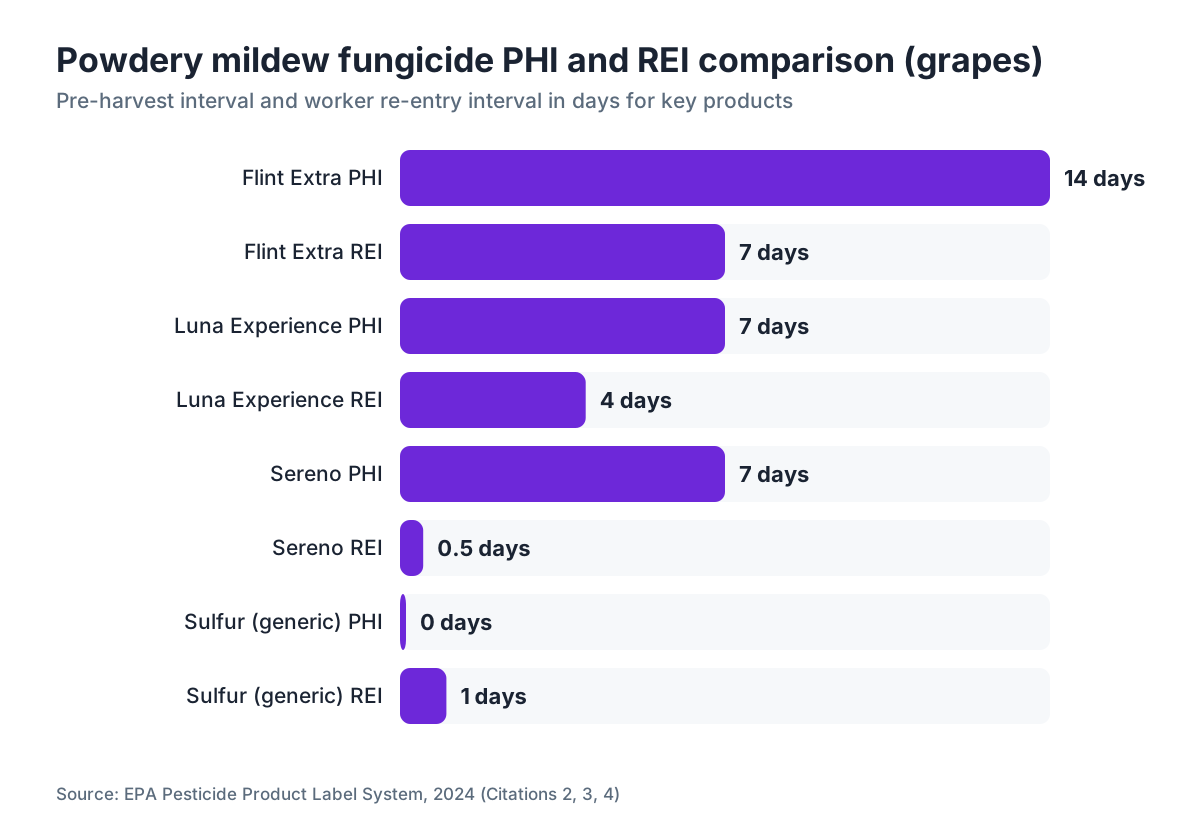
Flint Extra contains trifloxystrobin (FRAC 11, QoI/strobilurin) at 14.4% and tebuconazole (FRAC 3, DMI/triazole) at 18.7%. The FRAC 11 gives you fast contact knockdown and the FRAC 3 gives you systemic curative reach. Label rate on grapes is 4-5 fl oz per acre, with a 7-day re-entry interval (REI) and a 14-day pre-harvest interval (PHI). [2]
Luna Experience combines fluopyram (FRAC 7, SDHI) at 16.8% with tebuconazole (FRAC 3) at 16.8%. SDHI fungicides shut down succinate dehydrogenase in the mitochondrial respiratory chain, a different target site than strobilurins hit. So running Luna Experience plus an independent FRAC 11 in rotation puts three FRAC groups across two sprays. Label rate is 6-8.2 fl oz per acre depending on pressure, with a 4-day REI and a 7-day PHI. [3]
Sereno is a newer FRAC 3 (active ingredient mefentrifluconazole, an isopropanol-azole). Bayer positions it as a stronger DMI than older triazoles because it binds the target fungus's CYP51 enzyme more tightly. Label rate on grapes is 3.0-4.4 fl oz per acre, 12-hour REI, 7-day PHI. [4]
Bayer also sells sulfur products like Kumulus DF that some programs use as a low-cost filler, but those are generic sulfur registrations, not proprietary Bayer chemistry.
| Product | Active Ingredients | FRAC Groups | Label Rate (grapevines) | PHI | REI |
|---|---|---|---|---|---|
| Flint Extra | Trifloxystrobin + Tebuconazole | 11 + 3 | 4-5 fl oz/A | 14 days | 7 days |
| Luna Experience | Fluopyram + Tebuconazole | 7 + 3 | 6-8.2 fl oz/A | 7 days | 4 days |
| Sereno | Mefentrifluconazole | 3 | 3.0-4.4 fl oz/A | 7 days | 12 hours |
| Kumulus DF | Sulfur | M2 | 3-10 lb/A | 0 days | 24 hours |
Sources: Bayer Crop Science product labels filed with EPA; see citations [2][3][4].
How do FRAC groups affect resistance, and why does it matter for grape programs?
Resistance to powdery mildew fungicides is real and measured, not a warning label abstraction. Strobilurin (FRAC 11) resistance in Erysiphe necator is documented in California, New York, and Oregon. [5] It comes from a single point mutation (G143A) in the cytochrome b gene, and once that mutation is in your local population, strobilurins give you essentially zero control. You will not know it's happening unless you scout closely or send isolates to a diagnostic lab.
The Fungicide Resistance Action Committee (FRAC) assigns every mode of action a code. A product with two codes (Flint Extra, FRAC 11+3) puts two modes of action in a single spray, which slows resistance compared to a single-site fungicide used alone. But hitting the block with the same two-FRAC combination every time is not rotation. Real rotation cycles through independent FRAC groups across the season.
For an 8-spray program on a high-pressure variety like Chardonnay or Pinot noir, here is a structure that works:
- Sprays 1-2: FRAC M (sulfur or copper) at pre-bloom, low pressure, low cost
- Sprays 3-4: FRAC 7+3 (Luna Experience) from bloom through fruit set, the highest-pressure window
- Sprays 5-6: FRAC 11+3 (Flint Extra) during mid-canopy growth
- Sprays 7-8: FRAC 3 solo (Sereno) or FRAC M to close the season
WSU Extension states it plainly: never apply the same FRAC group more than twice in a row, and never exceed the labeled seasonal maximums (typically 2 applications per season for Flint Extra, 4 for Luna Experience). [6] Go over those limits and you have done more than raise a resistance risk. You have committed a label violation under FIFRA.
When should you start spraying: what does the research say about timing?
Start at 1-3 inch shoot growth (BBCH 07-09), well before bloom. That is the answer, and for the first two sprays timing beats product choice every time. UC Davis IPM recommends this window because developing tissue is at its most susceptible then and flag shoot inoculum is already moving through the block. [1]
The classic UC Davis risk model, built by Douglas Gubler and colleagues, counts cumulative hours in the 70-85 degree F range over a rolling 7-day period and turns them into a risk index of 0 to 100. Scores below 30 mean 14-day intervals are fine. Scores of 30 to 60 mean 7 to 10 days. Scores above 60 mean you're already in trouble and need 5 to 7 day intervals with a curative-capable product. [1] The model is free through UC Integrated Pest Management Online.
Most growers who lose a season to powdery mildew did not pick the wrong product. They started too late (waiting for visible symptoms, by which point you're 7 to 14 days behind the infection cycle) or they stretched intervals during a cool week and got clobbered when the temperature spiked. Bayer's own Flint Extra label reflects this. It specifies preventive to early curative timing, not rescue treatment. [2]
One caveat worth knowing. Very hot weather above 95 degrees F actually suppresses E. necator because conidia lose viability at high temperatures. But that heat window rarely holds long enough to protect you, not in California's coastal valleys and not in the humid East.
What are the EPA and Worker Protection Standard requirements for these products?
Every one of these Bayer products is a federally registered pesticide under FIFRA. Use any of them off-label (wrong crop, wrong rate, wrong PHI) and you've committed a federal violation, more than a best-practice slip. [7]
EPA's Worker Protection Standard (WPS), reissued in 2015 and effective January 2017, requires that workers get pesticide safety training before they enter treated areas, and that employers post application information in a central location workers can reach. [8] The REI for each product (see the table above) sets how long workers must stay out of a treated block without personal protective equipment.
Flint Extra's 7-day REI is the one that bites. Run a 7-day spray interval during bloom with a crew doing shoot positioning or leaf pulling, and you're stuck: either stretch the interval or keep workers out of the block during canopy work you can't skip. Luna Experience at 4 days and Sereno at 12 hours are far easier to schedule around.
California adds a layer. The California Department of Pesticide Regulation (CDPR) requires pesticide use reporting for every one of these applications, and some counties require permits for triazole or strobilurin fungicides. [9] New York and Washington run their own DEC and WSDA reporting rules. Check your state separately from the federal label.
The EPA label is the law. Bayer's supplemental labels and state registrations can be stricter, never looser. When you're unsure, pull the current federal label from EPA's Pesticide Product Label System and read it.
How do you build a real spray record that holds up to audit?
A spray record for a Bayer fungicide application needs to capture the EPA registration number, the product name, the active ingredients, the rate per acre, total volume, the target pest, the application date and time, the operator of record, weather at application, the REI posted, and the block or APN treated. [9] That's the whole list, and it's the minimum an inspector expects.
It sounds like a lot until you build the record while you're spraying instead of reconstructing it two weeks later from memory. Reconstructed records fail audits. The weather data doesn't match, the rate math has rounding errors, and the operator listed wasn't the person who was actually in the tractor.
This is where a tool like VitiScribe earns its keep. A good system walks you through every required field at the moment of application, fills in the EPA number and REI from a built-in database, and timestamps the record with location. A record built that way is defensible to a CDPR or WSDA inspector because it has no reconstruction gaps.
If you run organic transition blocks next to conventional ones, your system also needs to flag which products are OMRI-listed (none of the Bayer synthetics above are) so you don't put a conventional product on a certified block by accident.
WSU Extension's grape pest management guides push one habit hard: keep records by individual block, not by farm or permit. [6] Residue testing at harvest traces back to a specific vineyard block, not to the operation as a whole. Your paperwork should match how the fruit gets tested.
What do efficacy trials say about how well Bayer products control grape powdery mildew?
University trials give you the cleanest unbiased read on real-world performance. Here's what the data says.
Cornell University's New York State IPM Program has ranked Luna Experience and Flint Extra in its top efficacy tier for E. necator in side-by-side trials across Finger Lakes and Hudson Valley vineyards. [10] Cornell rates fungicides on a 1-to-5 scale, and both products score 4 to 5 when used preventively at labeled rates.
UC Cooperative Extension trials in Napa and Sonoma found that fluopyram-containing products (FRAC 7, the fluopyram in Luna Experience) gave excellent control in early-season sprays, but flagged that SDHI resistance monitoring has to stay active. SDHI resistance has already surfaced in other crops worldwide, and E. necator populations sit under the same selection pressure. [11]
Nobody has strong long-term resistance surveillance data specifically on FRAC 7 in E. necator in North American vineyards as of this writing. The closest evidence comes from greenhouse mutation-frequency studies showing E. necator mutates at the SDHI target site less readily than at the FRAC 11 site. That's one reason fluopyram products still work in fields where strobilurins have quit. It's a resistance cliff you should be watching, not one you should assume away.
Strobilurin (FRAC 11) failures in California were documented in published research from UC Davis and USDA ARS starting around 2010 to 2013. [5] If your program leans on Flint Extra and you're seeing breakthrough disease, send samples to your state diagnostic lab before you blame the sprayer.
How does Bayer's chemistry compare to alternatives from other companies?
Resistance rotation forces you outside a single company's catalog, so you need to know the competition. Here's how the main alternatives line up against the three Bayer products.
| Product | Company | FRAC | Active Ingredient | PHI (grapes) |
|---|---|---|---|---|
| Flint Extra | Bayer | 11+3 | Trifloxystrobin + Tebuconazole | 14 days |
| Luna Experience | Bayer | 7+3 | Fluopyram + Tebuconazole | 7 days |
| Sereno | Bayer | 3 | Mefentrifluconazole | 7 days |
| Pristine | BASF | 11+7 | Pyraclostrobin + Boscalid | 0 days |
| Vivando | BASF | 13 | Metrafenone | 0 days |
| Torino | ISK | U8 | Cyflufenamid | 7 days |
| Quintec | Corteva | 13 | Quinoxyfen | 14 days |
| Endura | BASF | 7 | Boscalid | 0 days |
| Sulfur (generic) | Various | M2 | Sulfur | 0 days |
A few things jump off that table. Vivando and Pristine from BASF carry a 0-day PHI, handy for late-season sprays when you're right up against harvest. Flint Extra's 14-day PHI is the longest in the group, which means you can't use it past about veraison on a typical California harvest schedule.
Torino (cyflufenamid, FRAC U8) is a genuinely different mode of action that still works against strobilurin-resistant populations. It's a good rotation partner for any of the Bayer products, and Cornell's powdery mildew guide lists it as a high-efficacy option. [10]
If you're growing for wineries that run their own residue testing, ask about their specific maximum residue limits. Some premium wineries, especially those selling into EU export markets, hold internal MRL policies tighter than EPA tolerances for tebuconazole.
What are the common application mistakes that undermine these products?
The Flint Extra label says 4-5 fl oz per acre. That rate assumes complete canopy coverage at a calibrated spray volume, and that assumption is where most failures hide. Run a ground sprayer at 30 gallons per acre through a dense Chardonnay canopy with foliage two nodes past the wire and you are not putting 30 gallons on the interior leaves. You might hit 30 on the outside and 12 on the inside. The active ingredient is still in the tank water you sprayed. The fungus doesn't care about your tank math.
Calibrating spray volume to canopy size is something both WSU Extension and UC Davis IPM push hard. WSU's powdery mildew guide recommends adjusting volume to tree row volume (TRV) for the actual height and width of your training system. [6] A sprawling vertical shoot positioning canopy at 8 feet needs more volume than a bilateral cordon at 4 feet. Same product, different math.
Mixing order matters more than most applicators think. Add the Bayer fungicide to a tank already holding a spray adjuvant and high-pH water, and you can degrade the tebuconazole before it ever reaches the canopy. Check label compatibility and your local water pH. Hard water above pH 8 is a genuine problem in parts of eastern Washington and California's Central Valley.
Spraying in wind above 10 mph is two problems at once. It's often a label or permit violation (many state permits cap application wind speed) and it wrecks coverage. Drift takes product off the target block and can land it on adjacent sensitive areas. Spray on a 15 mph afternoon because the tractor happened to be free and you've burned the product cost and built yourself a liability.
How do you track Bayer fungicide applications for wine grape certification and audits?
The documentation chain runs the same whether the fruit goes to a big cooperative or one small winery: application record to spray log to residue tolerance to winery receiving inspection. Break the chain anywhere and you create exposure.
None of the synthetic Bayer products here are permitted under USDA National Organic Program standards. If you manage mixed conventional and transitional blocks, the spray log has to separate applications cleanly by block and certification status. [12] Sloppy separation there is how a transition block loses its clock.
For conventional wine grapes headed to export, the EU sets specific maximum residue limits (MRLs) for triazoles including tebuconazole. The EU MRL for tebuconazole in grapes is 1 mg/kg under the current EU Pesticide MRL database. [13] If your log shows three tebuconazole applications in the 30 days before harvest, get a pre-harvest residue test before you ship to any EU buyer.
Keeping records by GPS-referenced block in something like VitiScribe means you can pull a full application history for any block in about two minutes when a winery asks. Premium wine grape contracts increasingly expect that, and treat it as a baseline rather than a nice extra.
The GAP (Good Agricultural Practices) standard used by many food safety schemes requires pesticide records to be kept for at least 3 years. Some winery contracts demand 5. Back your records up offsite. A spray log living only in a paper binder in the farm office is one structure fire away from being unauditable.
Is organic or low-spray management realistic for grape powdery mildew?
Yes, but the yield and labor math shifts hard. Certified organic vineyards run mostly on sulfur (FRAC M2), copper (FRAC M1), potassium bicarbonate (FRAC NC), and biologicals like Bacillus subtilis (Serenade, FRAC BM02). None of these match the single-application punch of Luna Experience or Flint Extra under moderate-to-high pressure. [11]
The tradeoff is frequency. A conventional program might run 6 to 8 sprays at 10 to 14 day intervals. A well-run sulfur program often runs 10 to 14 sprays at 7 to 10 day intervals, especially from bloom through fruit set. More passes means more fuel, more labor, more tractor compaction. That's the real organic cost, and extension budgets tend to underrepresent it.
Variety choice matters enormously if you're going low-spray. Varieties with partial genetic resistance to E. necator (many Bouquet and PIWI types, some newer UC Davis releases) need far fewer sprays. If you're planting a new block on a site with steady powdery mildew pressure and you want organic production, picking a partially resistant variety from the start beats fighting a susceptible one with sulfur for the next 20 years.
For a mixed operation running a conventional vineyard alongside organic blocks, physical separation and documentation discipline weigh as much as the chemistry. Drift from a Flint Extra application into a certified organic block is a certification violation, not a philosophical one.
Frequently asked questions
What is the pre-harvest interval for Bayer Luna Experience on wine grapes?
Luna Experience has a 7-day pre-harvest interval (PHI) on grapes under its current EPA label. The last application must be at least 7 days before harvest begins. Flint Extra carries a longer 14-day PHI, and Sereno is also 7 days. Always confirm against the current label, since PHIs can change at label revision.
Can you mix Flint Extra with other fungicides in the tank?
Tank mixing Flint Extra with a non-Bayer fungicide from a different FRAC group is common practice, but confirm compatibility with a jar test and make sure both labels permit the mix. Some growers add a FRAC M product (sulfur or copper) to broaden coverage. Check both labels for pH restrictions and mixing order. Never assume compatibility without testing.
How many times can you spray Flint Extra per season on grapes?
The Flint Extra label permits a maximum of 2 applications per season on grapes. Luna Experience allows up to 4. Exceeding these limits is a FIFRA label violation regardless of disease pressure. The maximums exist to slow resistance development in the local pathogen population, and inspectors do check application counts against your records.
Does Bayer Flint Extra work on downy mildew as well as powdery mildew?
Flint Extra targets Erysiphe necator (powdery mildew) with some Botrytis suppression. Trifloxystrobin shows activity against downy mildew (Plasmopara viticola) in lab settings, but the label does not position Flint Extra as a primary downy mildew product. It should not replace a dedicated phosphonate or mandipropamid in your downy mildew rotation.
What FRAC group is Luna Experience, and is there resistance to it yet?
Luna Experience is FRAC 7 (fluopyram, SDHI) plus FRAC 3 (tebuconazole, DMI). As of current literature, documented field resistance to SDHI chemistry in Erysiphe necator in North American vineyards is not well-characterized, though SDHI resistance has emerged in E. necator in some European vineyards. Ongoing monitoring by UC Davis and Cornell is the best early-warning system available.
What is the EPA registration number for Flint Extra fungicide?
Flint Extra's EPA registration number is EPA Reg. No. 264-1155. Verify it on the current label through Bayer's product portal or EPA's Pesticide Product Label System. Always record the EPA registration number in your spray log. It's a required field for WPS compliance and nearly every audit standard, and a missing number is an easy audit finding.
Is Sereno a systemic or contact fungicide on grapes?
Sereno (mefentrifluconazole, FRAC 3) is a systemic DMI fungicide. It moves acropetally (toward growing tissue) after absorption through leaf surfaces. It has both preventive and early curative activity, so it can arrest infections that have begun but aren't yet visible. It is not effective as a rescue treatment on established, heavily sporulating colonies.
What temperature is too hot to spray sulfur near Bayer fungicide applications?
Sulfur applied above roughly 90 degrees F can cause phytotoxicity on grapevine foliage and developing berries. This threshold is widely cited in UC Davis IPM guidance. Bayer's synthetic fungicides don't share this restriction, but growers often pair them with sulfur, so the sulfur temperature limit becomes the practical constraint on hot-day applications.
Do Bayer fungicides meet National Organic Program standards for grapes?
No. Flint Extra, Luna Experience, and Sereno are all synthetic pesticides not permitted under USDA National Organic Program (NOP) standards. Certified organic vineyards must rely on OMRI-listed materials like sulfur, copper, potassium bicarbonate, and biological fungicides. Using a synthetic Bayer product on a certified organic block would cost that block its certification.
What is the worker re-entry interval for Luna Experience?
Luna Experience carries a 4-day (96-hour) restricted-entry interval (REI) under the EPA Worker Protection Standard. Workers cannot enter treated areas within 4 days of application without WPS-required personal protective equipment. The REI must be posted at the treated area and at a central location on the farm. Flint Extra's REI is 7 days, much longer and important to schedule around.
How do I record a Bayer fungicide application for CDPR compliance in California?
California requires Pesticide Use Reports (PURs) for all agricultural pesticide applications. For a Bayer fungicide on grapes, record the application date, county and site, commodity (wine grapes), EPA registration number, product name, amount applied, acres treated, and your operator permit number. Reports go to your county Agricultural Commissioner, typically monthly. CDPR's eDPR system accepts electronic submissions.
What powdery mildew risk model should I use with Bayer fungicide scheduling?
The UC Davis Powdery Mildew Risk Index, built by Douglas Gubler, is the most widely validated model for timing spray intervals. It uses hourly temperature data to count cumulative hours in the 70-85 degree F infection-favorable range over a rolling 7-day window. Scores above 60 indicate high pressure and call for 5 to 7 day intervals. It's free through UC IPM Online.
Can I use Bayer fungicides on Concord or labrusca-type grapes?
The Bayer products here are labeled for Vitis vinifera wine grapes and table grapes. V. labrusca and hybrid varieties usually fall under the broad 'grapes' crop definition on federal labels, but read the current label language carefully. Some DMI and strobilurin products have caused phytotoxicity on specific labrusca varieties. Confirm with your local Cooperative Extension office before first use on an unlabeled variety type.
What happens if powdery mildew is already visible when I spray a Bayer product?
Luna Experience and Sereno have meaningful early curative activity within about 72 to 96 hours of infection, and Flint Extra's tebuconazole component also has curative properties. But if you're seeing abundant white sporulating colonies on shoot tips or multiple clusters, you're past the effective curative window for any of these. At that stage, improve coverage, shorten intervals, and use a product rated highly curative by Cornell or UC Davis.
Sources
- UC IPM Online, UC Davis: Powdery Mildew of Grape: Erysiphe necator infects at relative humidity as low as 40%, optimum temperature 70-85 F; UC Davis Gubler risk model thresholds; start sprays at 1-3 inch shoot growth
- EPA Pesticide Product Label System: Flint Extra Fungicide (EPA Reg. No. 264-1155): Flint Extra label rate 4-5 fl oz/A on grapes, 14-day PHI, 7-day REI, maximum 2 applications per season
- EPA Pesticide Product Label System: Luna Experience Fungicide: Luna Experience label rate 6-8.2 fl oz/A on grapes, 7-day PHI, 4-day REI, maximum 4 applications per season
- EPA Pesticide Product Label System: Sereno Fungicide: Sereno (mefentrifluconazole) label rate 3.0-4.4 fl oz/A on grapes, 7-day PHI, 12-hour REI
- UC Davis Plant Pathology / USDA ARS: Strobilurin resistance in Erysiphe necator in California: FRAC 11 (strobilurin) resistance documented in E. necator populations in California vineyards, tied to G143A cytochrome b mutation
- Washington State University Extension: Grape Powdery Mildew Management: Do not apply same FRAC group more than twice consecutively; adjust spray volume to tree row volume; record applications by individual block
- EPA: Federal Insecticide, Fungicide, and Rodenticide Act (FIFRA): Using a pesticide off-label (wrong crop, rate, or PHI) is a federal violation under FIFRA
- EPA: Worker Protection Standard for Agricultural Pesticides: WPS reissued 2015, effective January 2017; requires worker safety training before entry into treated areas; REI posting requirements
- California Department of Pesticide Regulation: Pesticide Use Reporting: California requires Pesticide Use Reports for all agricultural pesticide applications; county Agricultural Commissioner receives monthly reports
- Cornell University New York State IPM Program: Grape Powdery Mildew Fungicide Efficacy: Cornell rates Luna Experience and Flint Extra in top-tier efficacy (4-5 of 5) for E. necator; Torino (cyflufenamid, FRAC U8) also rated high-efficacy
- UC Cooperative Extension: Organic Grape Powdery Mildew Management: Organic programs rely on sulfur, copper, potassium bicarbonate, and Bacillus subtilis; fluopyram-containing products noted for SDHI resistance monitoring need
- USDA National Organic Program: Allowed and Prohibited Substances: Synthetic fungicides including triazoles and strobilurins are not permitted under NOP for certified organic production
- European Commission: EU Pesticide MRL Database: EU MRL for tebuconazole in grapes is 1 mg/kg; relevant for wine grape export compliance
Last updated 2026-07-09