Grape powdery mildew: the complete management guide for vineyard operators

TL;DR
- Grape powdery mildew (Erysiphe necator) is the most economically damaging fungal disease in most U.S.
- wine grape regions.
- Spores infect green tissue when temperatures hold between 50 and 95°F, and unlike most fungi it needs no free water to do it.
- Control comes down to three things: accurate forecasting, spray timing keyed to shoot growth, and rotating fungicide modes of action to stall resistance.
What is grape powdery mildew and why does it matter so much?
Grape powdery mildew is caused by Erysiphe necator (formerly Uncinula necator), an obligate fungal pathogen. Obligate means it only survives on living plant tissue. That one biological fact shapes everything about how you fight it.
The disease attacks all green tissue: leaves, shoots, tendrils, and most destructively, berries. On leaves you get the familiar white-gray powdery colonies. On berries infected before they reach about 8 Brix, the skin cells die and the berry cracks open as the pulp keeps growing, opening the door to Botrytis and other rots. Infections after berry softening leave russet scarring and a musty, earthy off-flavor sommeliers call powdery mildew taint. The sensory threshold for that taint in finished wine is debated, but UC Davis research has found detectable off-flavors at infection rates well below what looks alarming out in the vineyard [1].
The money side is serious. University of California work puts powdery mildew control costs in California alone in the tens of millions of dollars a year in fungicides and application labor, and yield losses in unmanaged or badly timed programs can hit 30 to 50% in high-pressure years [2][9]. In the Finger Lakes or the Willamette Valley the pressure looks different but it's still real. You can't skip a program and hope.
Here's what trips up growers new to the vine: powdery mildew does not need wet weather to infect. It germinates and grows best in dry conditions with moderate humidity, which is exactly why it thrives in irrigated inland valleys and Mediterranean-climate regions. Rain can actually knock spores loose and slow an epidemic. That's the opposite of downy mildew. Mix the two up and you'll build the wrong program.
How does powdery mildew overwinter and where do primary infections come from?
The pathogen overwinters two ways. The bigger one in mild-winter regions is dormant mycelium tucked inside dormant buds. When those buds push in spring, the fungus grows right along with the shoot and produces flag shoots: stunted, distorted, powdery shoots colonized from the inside out. Flag shoots throw off enormous numbers of spores and seed the rest of the vineyard.
The second form is cleistothecia, the sexual fruiting bodies. They show up as tiny black specks on bark and on last season's infected berries. Cleistothecia release ascospores in spring when temperature and rainfall trigger them, usually starting when shoots reach the 1-inch stage (BBCH 09) and running through about the 4 to 6 inch stage. Release events are short and violent. Washington State University extension work has shown that a single significant ascospore release, often set off by 0.1 inches of rain after a dry stretch, can expose an entire vineyard to primary infection in one night [3].
So here's the practical part. You cannot wait to see disease before you start spraying. By the time flag shoots are obvious, inoculum pressure is already high. And by the time you spot colonies on young berries, you've almost certainly lost some of them to the internal cell death that cracks fruit later.
Where winters get cold enough to kill buds carrying dormant mycelium, cleistothecia become the main primary source. Cornell's viticulture program has done long-running work on this in New York, showing that cleistothecia viability and ascospore maturity are the variables worth tracking in regions like the Finger Lakes [4][10].
What environmental conditions drive powdery mildew infection?
The infection window for E. necator is unusually wide. Conidia germinate and infect between roughly 50 and 95°F, with the optimum around 68 to 77°F [1]. Unlike almost every other fungal pathogen in the vineyard, this one needs no free water on the leaf to infect. Relative humidity above about 40% is enough. Rain at moderate temperatures can even wash spores off and slow things down for a while.
Heat is what kills it. Several hours above 95°F will kill surface mycelium and conidia. That's why powdery mildew seems to vanish during a July heat wave and then comes roaring back once temperatures ease. The fungus retreats into internal leaf tissue and resurges the moment conditions return to its favored range. Don't read a heat wave as permission to push your next application.
Light matters too. The fungus grows better in shade, which is one reason canopy management ties so tightly to disease pressure. Dense, shaded canopies in the cluster zone are where outbreaks explode. This is about more than fungicide penetration. It's the microclimate those canopies build.
The "ten-degree rule" in some forecasting systems says 10 straight days with temperatures between 70 and 85°F and low rainfall create very high infection risk. That threshold comes from the Gubler-Thomas Powdery Mildew Risk Index, which UC Cooperative Extension developed and which most western U.S. growers use as the foundation of their programs [2].
How do powdery mildew forecasting models work and which ones should you use?
Powdery mildew forecasting is one of the more mature corners of disease modeling in viticulture, mostly because UC Davis researchers built the Gubler-Thomas model in the 1990s and growers have tested it across many regions since. The model puts out a risk index of 0 to 100 based on temperature duration: the number of consecutive hours with temperatures in the 70 to 85°F range [2]. Zero to 30 is low risk, 30 to 60 is moderate, above 60 is high. California's CIMIS weather stations publish the index in real time.
Cornell's Network for Environment and Weather Applications (NEWA) runs a similar tool tuned to eastern conditions, folding in both temperature and ascospore maturity [10]. WSU Extension delivers weather-based disease forecasting through AgWeatherNet, covering Washington and Oregon [3]. If you aren't using at least one of these, you're guessing on spray timing.
Understand what these models are and aren't. They're risk indices, not guarantees. They tell you when conditions favor infection so you can tighten your interval. They don't tell you whether inoculum is present or how dense it is, which is why scouting, especially for flag shoots early, still carries real weight.
A few commercial weather services and vineyard platforms have layered proprietary forecasting on top of the public models, pulling from on-site stations to give block-level risk scores. In broken terrain the accuracy gain from on-site data is real. If your vineyard spans more than a few hundred feet of elevation, the nearest AgWeatherNet station may be reporting weather your vines never see.
Managers who log spray applications and weather for compliance get a bonus here: forecasting data sitting next to application records in one system makes audits far cleaner. VitiScribe was built partly for that, linking weather thresholds to spray event records without retyping from a separate weather portal.
What are the critical spray timing windows for powdery mildew control?
For most growers already running decent chemistry, timing beats product selection. The single most important window is shoot growth from budbreak through the 12-inch stage (roughly BBCH 09-15). Tissue is growing faster than many fungicides can protect it, and the primary infection events from overwintered inoculum are landing. Miss this window, or stretch intervals past 10 to 14 days during high risk, and that's the most common reason a program falls apart.
The second window runs pre-bloom through 3 to 4 weeks post-bloom, matching berry development from fruit set through roughly 8 to 10 Brix. Infections here cause the most damaging berry symptoms: cracking and secondary rot. UC Cooperative Extension recommends 7 to 10 day intervals with effective chemistry through this window, dropping to 7 days when the Gubler-Thomas index stays high [2][8].
After veraison the economic threshold for new berry infections drops hard because the skin has hardened. You still protect leaves to keep the vine healthy and building carbohydrate, but intervals can usually stretch to 14 to 21 days and you can shift down to cheaper chemistry if pressure allows.
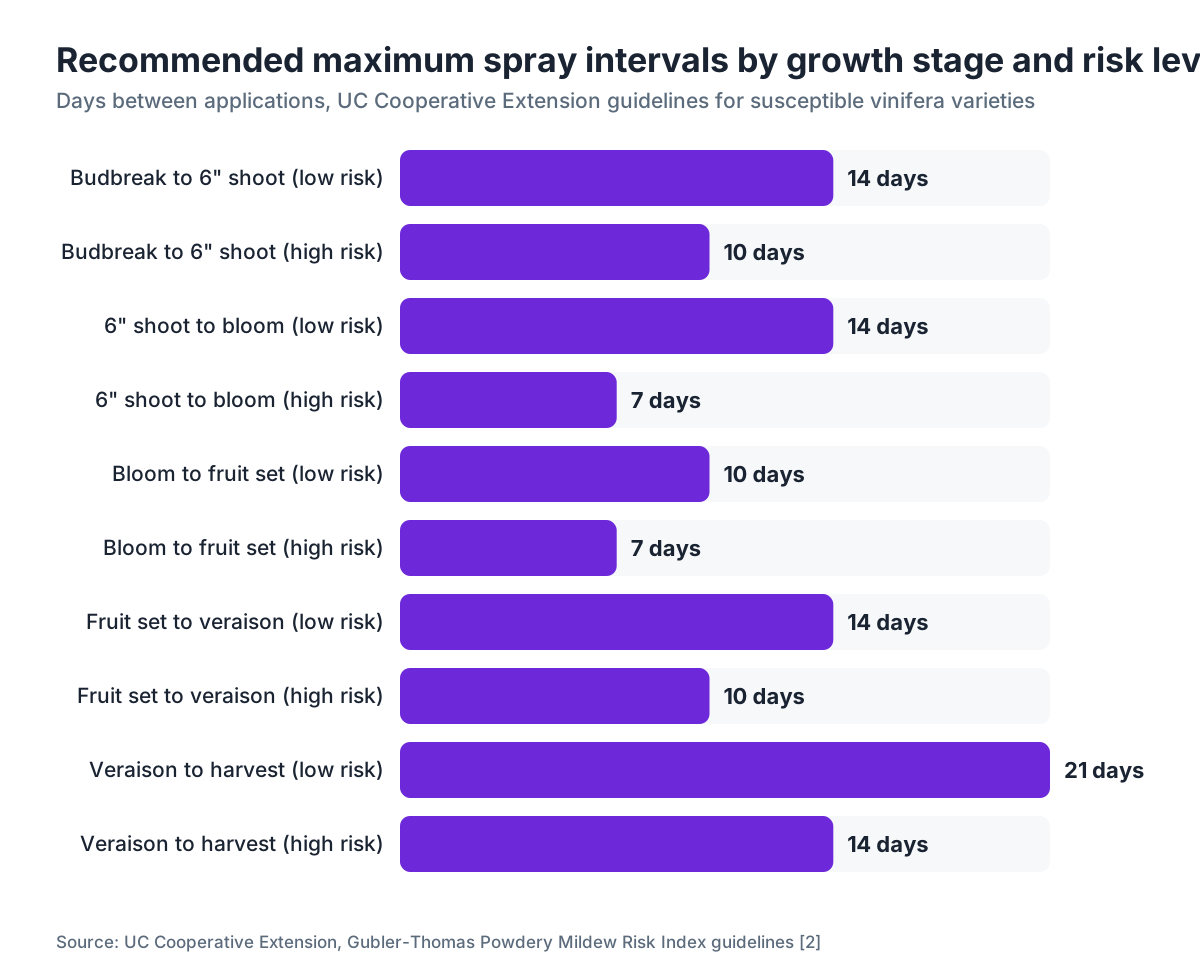
The table below lays out interval guidance by growth stage and risk.
| Growth stage | Low risk interval | High risk interval | Notes |
|---|---|---|---|
| Budbreak to 6" shoot | 14 days | 7-10 days | Flag shoot scouting starts here |
| 6" shoot to bloom | 10-14 days | 7 days | Critical window, do not stretch |
| Bloom to fruit set | 7-10 days | 7 days | Highest economic risk |
| Fruit set to veraison | 10-14 days | 10 days | Maintain cover on berries |
| Veraison to harvest | 14-21 days | 14 days | Leaf protection, check pre-harvest interval |
Pre-harvest intervals (PHIs) are non-negotiable. Check your specific product label before any application after veraison. PHIs range from 0 days for some sulfur formulations to 14 to 28 days for several SI and SDHI fungicides.
Which fungicides work best and how do you rotate them to prevent resistance?
Fungicide resistance in powdery mildew is documented, not theoretical. Resistance to DMI (sterol inhibitor, FRAC Group 3) fungicides is confirmed in California vineyards, and QoI (strobilurin, FRAC Group 11) resistance is emerging in some regions [5]. The FRAC group number on every label is your rotation map.
Sulfur is the backbone of most programs, especially early. It's cheap, effective, carries no documented resistance mechanism in E. necator, and is allowed in organic programs. Two constraints: don't apply sulfur within 2 weeks of an oil spray (phytotoxicity), and don't apply it above 90°F, especially on sulfur-sensitive varieties like Carignane, Concord, and some muscadines. Wettable sulfur at 3 to 6 lb/acre is a standard rate. Check your label [8].
For the bloom-to-fruit-set window, many advisors step up to a DMI or SDHI, or a premix, for better kickback if an infection event has already happened. DMI fungicides (myclobutanil, tebuconazole) have 72 to 120 hour kickback windows, meaning they can stop an infection started a few days earlier. That's genuinely useful when you're managing around weather.
QoI fungicides (azoxystrobin, pyraclostrobin) were excellent when they arrived, but resistance management is now the whole game. FRAC guidance says no more than 2 applications of a single group per season, and many advisors have gone to a single QoI as policy [5].
Kaolin clay and potassium bicarbonate are registered alternatives with some efficacy, useful in organic programs but weaker than synthetics under high pressure. Biological products based on Bacillus subtilis (Serenade) and Reynoutria (Regalia) give inconsistent results in independent university trials. The honest read: they work as supplements in low-to-moderate pressure, not as standalone programs.
Any commercial grape program in California, Washington, Oregon, or New York has to comply with EPA-registered label requirements under FIFRA. The label is the law. Application records must capture product name, EPA registration number, rate, date, location, and applicator license to satisfy both your state Department of Agriculture and the EPA Worker Protection Standard [6].
How does canopy management affect powdery mildew pressure?
Canopy management is the most underrated piece of a powdery mildew program. The link isn't subtle. Dense, unmanaged canopies build humid, shaded microclimates in the cluster zone that are nearly perfect for the fungus. Sprays penetrate those canopies poorly, so you coat the outer leaf wall while disease develops in the cluster zone where it actually costs you.
Leaf removal in the cluster zone, pulling 2 to 4 leaves on the east or morning-sun side in warm climates (or both sides in cool climates), has solid research behind it. WSU Extension recommends pre-bloom leaf removal as a disease tool more than a fruit-quality tool, noting that cluster exposure at bloom and shortly after ties to markedly lower powdery mildew severity at harvest [3][11].
Shoot thinning and positioning count too. Laterals growing back into the canopy mid-season rebuild the same shading problem. A monthly pass through dense canopies to strip suckers and reposition shoots is routine on high-pressure sites, and it pays for itself in fungicide savings.
From a vineyard operations angle, the whole trick is scheduling canopy work before the pressure peak, not after. Pulling leaves in July because the intern finally got to it means you're late. Pre-bloom or right after fruit set is the timing that works.
What are the EPA Worker Protection Standard requirements for fungicide applications?
The EPA Worker Protection Standard (WPS), codified at 40 CFR Part 170, covers pesticide applications in agricultural settings. EPA finalized major revisions in 2015, and they took effect in 2017 [6]. For a powdery mildew program, the parts that touch you most fall into a few buckets.
Restricted-Entry Intervals (REIs) must be posted at the vineyard entrance and communicated to workers before you spray. Most sulfur and SDHI labels carry a 4 to 24 hour REI; some systemics run to 48 hours. Workers can't enter a treated area during the REI without the PPE the label specifies, and the employer has to supply that PPE.
The Application Exclusion Zone (AEZ) came in with the 2015 revision. It requires keeping workers and other people out of a set zone around the running equipment while spraying. For ground-based airblast sprayers, the vineyard standard, the AEZ is 100 feet in the direction of airblast and 25 feet in all other directions.
Training rules under the revised WPS require agricultural workers and handlers to get pesticide safety training every year. Handlers, the people actually applying, must be trained before they work with pesticides. Keep those training records for 2 years.
Central display rules mean you post specific information where workers can reach it: safety data sheets, application information, and emergency contacts. Most operations run this as a posted binder or laminated sheet at the shop or breakroom.
State rules stack on top of federal WPS. California's Department of Pesticide Regulation, for one, adds pesticide use reporting under the California Food and Agriculture Code, requiring growers to report all restricted material applications to their county agricultural commissioner [7]. Washington and Oregon run analogous systems. Check your state ag department for the specifics.
How should you keep spray records to stay compliant and actually use the data?
Spray records are a legal requirement, but the growers who get the most from them treat them as an operational tool, not a compliance file. At minimum, a compliant record for a powdery mildew application has to include date and time, product name and EPA registration number, formulation and rate per acre, total amount applied, location (block ID or legal description), target pest, applicator name and license number, and weather at time of application (wind speed and direction, temperature, relative humidity) [6][7].
That last item, weather, is the one people fudge or leave blank in field-filled records. It matters for WPS compliance and for your own post-mortem on why a program worked or didn't. Log applications against actual weather station data instead of a recalled guess and, after harvest, you can line up your spray timing against the Gubler-Thomas index peaks and see exactly where you were ahead of infections and where you were behind.
In California, restricted material applications must go to the county Ag Commissioner on set timeframes, usually monthly or quarterly depending on the material and county. Missing those filings is one of the more common violations cited in county audits.
Digital recordkeeping makes the logging faster and the audit cleaner. VitiScribe is built for vineyard operations, with spray log templates shaped around state reporting rules and the ability to pull weather into application records automatically. Software or a well-designed paper form, either works. The point is filling it out at the time of application, not rebuilding it from memory on Friday.
Keep spray records at least 2 years (federal WPS minimum). Several states require 3 years for pesticide records, and some grant programs want 5. Store them somewhere they survive a dead hard drive or a barn fire.
How do you scout for powdery mildew and track disease progression?
Systematic scouting is the only way to know whether your program is actually holding. For powdery mildew, scouting starts at budbreak with a hunt for flag shoots. Walk every block and check the first 3 to 5 inches of emerging shoots. Flag shoots are distorted and coated in white powdery growth. Even one per 100 vines is meaningful inoculum.
Post-bloom, the focus shifts to berries in the cluster zone. Part clusters at 20 to 30 random points per block and look for white, dusty colonies on the berry surface. Rate each cluster clean or infected and calculate percent incidence. Cross 5% cluster incidence in early post-fruit-set and you have a real problem that calls for shorter intervals and possibly a chemistry upgrade.
Leaf scouting through the season gives you the canopy picture. Rate leaves clean, trace (1 to 5% leaf area), light (5 to 25%), moderate (25 to 50%), or severe (above 50%). Most advisors run a simplified 0 to 3 scale in the field. The goal is catching blocks trending upward early enough to act before berry infections take off.
Cornell's IPM program recommends scouting every 7 to 14 days through the growing season, with records tied to your spray log so you can see the disease population's response, or lack of one, to each application [4]. That feedback loop is what separates growers who dial in their programs from those who spray on the calendar and hope.
Photographic records earn their keep, especially if you work with a PCA or consultant who isn't on-site every week. A phone photo of a scouted cluster with a date stamp says more than a written severity rating.
Are some grape varieties more resistant to powdery mildew than others?
Yes, and variety matters a lot, which gets more relevant as breeders release disease-resistant cultivars aimed at reduced-input and organic programs. Vitis vinifera, which covers essentially every classic European wine grape, has little to no natural resistance to E. necator. The pathogen co-evolved with North American Vitis species, and European vinifera had almost no exposure until European colonization. That's why powdery mildew was a catastrophe when it reached Europe in the 1840s.
Among vinifera, susceptibility varies. Chardonnay, Cabernet Franc, and Zinfandel rank as highly susceptible. Syrah and Grenache sit at moderate. Carignan is a hard case: fairly susceptible and sulfur-sensitive at the same time. But even the less susceptible vinifera can't be grown without a spray program in most production regions.
Interspecific hybrids, crosses between vinifera and American species, carry varying resistance depending on how much North American genetics went in and which resistance genes are present. Cornell has released several hybrid cultivars (Marquette, Frontenac, Traminette) with meaningfully lower powdery mildew susceptibility than vinifera [4]. European PIWI (Pilzwiderstandsfähige) varieties like Regent and Cabernet Blanc were bred for resistance on similar principles and are gaining ground in parts of the U.S.
For new plantings on high-pressure sites, variety selection is a legitimate disease tool. Nobody talks about it enough. A resistant hybrid can outperform a vinifera variety with no spray program at all, and in organic or low-input systems that trade-off is worth running the numbers on seriously.
What does a full-season powdery mildew spray program look like in practice?
Here's how a practical program runs in a California Central Coast or inland valley vineyard with moderately susceptible vinifera and standard pressure. It's not a prescription. Local conditions, variety, and budget all shift the specifics. But it's what a well-run program actually looks like, not a theoretical ideal.
Budbreak through 6-inch shoot (March/April): sulfur at 4 to 5 lb/acre on a 10 to 14 day interval if it's cool, 7 to 10 days if temperatures spike into the 70s for several days running. Scout every 7 days for flag shoots. Flag shoots show up, shorten the interval right away and think about adding a DMI.
6-inch shoot through bloom (April/May): keep the sulfur going but add a DMI or SDHI at least once in this window, ideally at 50% bloom. This is where you spend on chemistry because this is where yield is on the line. Hold the interval tight at 7 to 10 days regardless of the model if the model has sat in the moderate range for any part of the stretch.
Bloom through fruit set (May/June): the most critical 3 to 4 weeks of the season. Sulfur plus a systemic partner at 7-day intervals under high pressure. Your one QoI application, if you're using one, often goes here because the kickback matters most. This is also where rain events or short labor most often blow up the schedule, and where most season-defining failures happen.
Fruit set through veraison (June/July/August): step back to sulfur as the primary, 10 to 14 day intervals under moderate risk. Keep scouting. If disease broke through during bloom, be honest about it and manage accordingly instead of pretending the program is still on track.
Veraison through harvest: dial back input, watch pre-harvest intervals, keep leaves healthy. Sulfur, potassium bicarbonate, or biologicals fit best here because many synthetics carry PHIs that turn into constraints as harvest closes in.
Total material cost for a standard vinifera program in California runs roughly $100 to $250 per acre per season in fungicides alone, depending on chemistry and number of passes. Labor for 8 to 12 applications adds plenty more, which is exactly why canopy management to stretch intervals is genuinely economical, more than a cultural preference.
Frequently asked questions
At what temperature does grape powdery mildew stop infecting?
Erysiphe necator conidia can't germinate below about 50°F or above 95°F. The sweet spot is 68 to 77°F. Above 95°F, direct sun and heat can kill surface mycelium within a few hours, but the fungus survives in internal leaf tissue and resurges when temperatures drop. Cold winters below roughly 10 to 15°F can kill infected buds, but cleistothecia on bark usually survive and stay viable for spring infection.
Can you use sulfur during flowering on grapevines?
Yes, sulfur is commonly applied through bloom. The main caution is temperature: don't apply when temperatures will top 90°F within 24 to 48 hours, since phytotoxicity risk climbs fast. Keep a 2-week minimum between any sulfur application and an oil spray. Wettable sulfur at 3 to 5 lb/acre applied in the morning has the lowest phytotoxicity risk. Sulfur-sensitive varieties like Carignane and some muscadines shouldn't get sulfur at all.
What is the Gubler-Thomas powdery mildew risk index?
The Gubler-Thomas model assigns a 0 to 100 risk index based on cumulative hours with temperatures in the 70 to 85°F range. A score of 0 to 30 is low risk, 30 to 60 moderate, above 60 high. UC Cooperative Extension developed it in the 1990s and California CIMIS stations publish it in real time. It's the most widely used grape powdery mildew forecasting model in the western U.S. and the basis for most spray interval guidelines.
How does powdery mildew affect wine quality even with low visible infection?
UC Davis research has shown powdery mildew taint, tied to compounds including 1-octen-3-ol and geosmin from the fungus and associated organisms, is detectable by trained panels at infection rates that look minor in the field. Even 3 to 5% cluster infection at harvest can produce off-flavors described as musty, earthy, or moldy. High-pressure years in the Finger Lakes or Willamette Valley regularly turn out wines affected at levels field scouting never flagged.
How many FRAC group rotations do I need per season for resistance management?
The Fungicide Resistance Action Committee recommends no more than 2 sequential applications of the same FRAC group before rotating to a different mode of action, and no more than 2 total applications of Group 11 (QoI/strobilurin) per season given documented resistance. Most vineyard resistance programs run a minimum of 3 to 4 FRAC groups across the season, anchored by sulfur (FRAC M2), which has no documented resistance mechanism in E. necator.
What records do I legally need to keep for powdery mildew fungicide applications?
Federal WPS (40 CFR Part 170) requires application records including product name, EPA registration number, rate, amount applied, date and time, location, target pest, applicator name and license number, and weather conditions. Keep records at least 2 years. California additionally requires reporting restricted material applications to the county Agricultural Commissioner. Several states require 3-year retention. Store records in a format that survives physical disasters.
Does rain help or hurt powdery mildew spread in vineyards?
It depends on timing and intensity. Rain can physically wash conidia off surfaces and briefly suppress the epidemic, which is why powdery mildew sometimes eases after a wet stretch. But significant rainfall, as little as 0.1 inches, can trigger ascospore release from cleistothecia early in the season, creating intense primary infection pressure. Net effect: moderate spring rain often raises early-season risk even as it appears to clean up visible disease.
What is the pre-harvest interval for common powdery mildew fungicides?
PHIs vary a lot by product. Wettable sulfur is typically 0 days. Most DMI fungicides (myclobutanil, tebuconazole) carry 7 to 14 day PHIs. Some SDHI and combination products run 14 to 28 days. QoI fungicides like azoxystrobin are typically 14 days on grapes. Always check the current registered label for your specific product and state registration, since PHIs can change with label amendments. The label is the legal document.
How do I know if my block has developed fungicide resistance?
The clearest field sign is disease that keeps progressing despite timely, correctly applied applications of a specific fungicide class. If sulfur is failing, the cause is usually timing or penetration rather than resistance, since sulfur resistance is rare. If a DMI is failing at labeled rates on a well-timed schedule, resistance is plausible. Confirmatory bioassays are available through some university plant pathology labs. Rotate immediately if you suspect it and tell your UC, Cornell, or WSU extension advisor.
Are PIWI or disease-resistant hybrid varieties worth planting for powdery mildew management?
On high-pressure sites or in organic programs, yes, seriously. Cornell's Marquette and Frontenac show markedly lower powdery mildew susceptibility than vinifera and need fewer applications to keep fruit clean. European PIWI varieties like Regent and Cabernet Blanc are legal to grow in the U.S. and have gained traction in cool, humid regions. Market acceptance for hybrid wines varies by region, and that commercial math matters as much as the disease math when you evaluate new plantings.
What is the application exclusion zone for vineyard airblast sprayer applications under WPS?
Under the 2015 EPA Worker Protection Standard revision, ground-based airblast equipment creates an application exclusion zone of 100 feet in the direction of the airblast and 25 feet in all other directions. Workers and other people must stay out of this zone during application. The AEZ is separate from the restricted-entry interval, which begins after the application finishes. Supervisors must monitor the AEZ perimeter while spraying.
When should I first start scouting for powdery mildew each season?
At budbreak, BBCH 09, scouting for flag shoots on the first 3 to 5 inches of emerging growth. Walk every block systematically and look for distorted, powdery white shoots, which signal overwintered mycelium in the bud. Even one flag shoot per 100 vines is significant. Find flag shoots and you shorten your interval immediately and consider stepping up to a systemic fungicide. Wait until you see leaf colonies and you're already behind.
Can I use biological fungicides alone for powdery mildew in a commercial vineyard?
Honestly, probably not in a high-pressure year with susceptible vinifera. Products based on Bacillus subtilis (Serenade) or Reynoutria sachalinensis (Regalia) show real but modest efficacy in university trials, usually less consistent than sulfur alone under high pressure. They work best as supplements during low-pressure periods or in a late-season organic program after the critical berry infection window has closed. For certified organic programs with severe pressure, potassium bicarbonate plus sulfur is the more defensible backbone.
Sources
- UC Davis Viticulture and Enology, Powdery Mildew of Grape: Powdery mildew conidia germinate and infect between 50-95°F with optimal range 68-77°F; sensory taint detectable at low cluster infection rates
- UC Cooperative Extension, Gubler-Thomas Powdery Mildew Risk Index and management guidelines: Gubler-Thomas model assigns 0-100 risk index based on temperature duration 70-85°F; yield losses in poorly managed programs can reach 30-50%; spray interval guidelines by growth stage
- Washington State University Extension, AgWeatherNet Grape Disease Forecasting: A single ascospore release event triggered by 0.1 inches rainfall can expose the whole vineyard to primary infection; pre-bloom leaf removal recommended as disease management tool
- Cornell Cooperative Extension, Grape Powdery Mildew and Integrated Pest Management for New York: Cleistothecia viability and ascospore maturity are key variables in cold-winter regions; hybrid cultivars with lower susceptibility; scouting every 7-14 days recommended
- Fungicide Resistance Action Committee (FRAC), Grape Powdery Mildew Resistance Management Guidelines: DMI resistance confirmed in California vineyards; QoI resistance emerging; no more than 2 sequential applications of same FRAC group; maximum 2 QoI applications per season recommended
- U.S. EPA, Worker Protection Standard for Agricultural Pesticides, 40 CFR Part 170: WPS requires application records including EPA registration number, rate, date, location, applicator license, and weather conditions; AEZ of 100 feet in direction of airblast for ground equipment; records kept minimum 2 years
- California Department of Pesticide Regulation, Pesticide Use Reporting: California requires reporting of all restricted material applications to county Agricultural Commissioner; specific reporting timeframes apply by material and county
- UC IPM Pest Management Guidelines: Grape, Powdery Mildew: Spray interval and fungicide class recommendations by growth stage; sulfur rate 3-6 lb/acre; cautions on sulfur-sensitive varieties; pre-harvest interval guidance
- USDA National Agricultural Statistics Service, Grape Production and Value: Powdery mildew control costs California growers tens of millions annually in fungicide and application labor costs
- Cornell NEWA, Network for Environment and Weather Applications, Grape Disease Forecasting Tools: NEWA runs temperature and ascospore maturity forecasting models calibrated to eastern U.S. grape growing regions
- WSU Extension, Grape Powdery Mildew Biology and Management, Pacific Northwest: Dense shaded canopies associated with higher powdery mildew pressure; cluster zone exposure at bloom linked to lower severity at harvest
Last updated 2026-07-09