How to fight grape powdery mildew: the complete field guide
TL;DR
- Grape powdery mildew (Erysiphe necator) is the most economically damaging fungal disease in most wine regions.
- Start sprays at woolly bud, track degree-day models for timing, rotate fungicide FRAC groups to slow resistance, and keep spray records that satisfy both FIFRA and your state ag department.
- Missing the early window is the single most common reason programs fail.
What is grape powdery mildew and why does it cost so much?
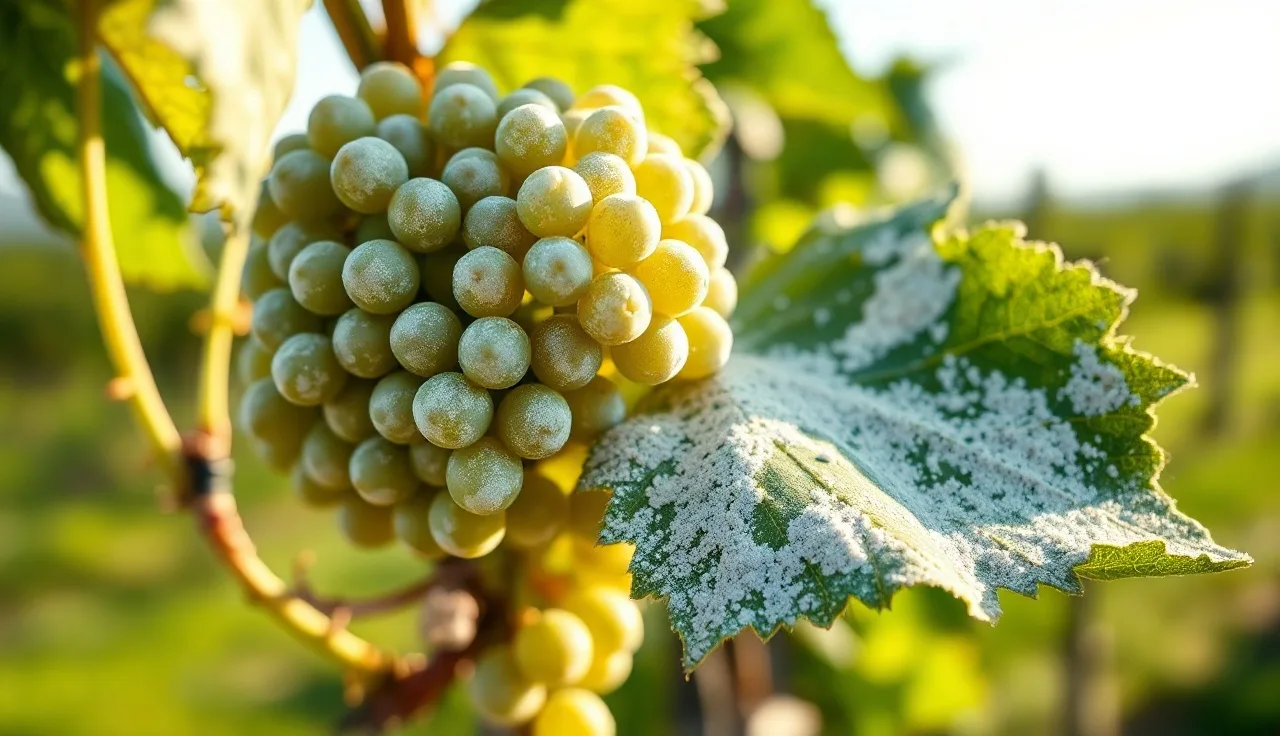
Grape powdery mildew is a fungus that feeds only on living grape tissue and needs no free water to infect. That last part sets it apart from downy mildew and Botrytis, which both want wet leaves. Erysiphe necator (once called Uncinula necator) germinates at relative humidity as low as 20% and spreads its white mealy coating across leaves, shoot tips, flower clusters, and berry surfaces. [1]
The damage is real and documented. UC IPM work puts yield losses at 20 to 40 percent in years when the disease establishes early in unmanaged or badly-timed programs. Berry cracking from infected skin, secondary Botrytis moving through those cracks, and off-aromas in pressed juice all stack on top of the direct crop loss. [2]
The pathogen overwinters two ways. It survives as cleistothecia (sexual fruiting bodies) tucked into bark, and as dormant mycelium inside buds. That bud-borne inoculum is what makes early timing so unforgiving. When primary shoots push out of infected buds, they carry active mycelium from the first inch of growth. See white powder on a shoot tip in late spring, and the infection was already running at bud-break weeks earlier. [1]
Some varieties get hit far harder than others. Chardonnay, Cabernet Sauvignon, and Merlot sit in the high-susceptibility group. Carignan and Riesling are moderate. Real resistance shows up in some interspecific hybrids, but most growers in California, Washington, and Oregon are farming highly susceptible Vitis vinifera. [2]
When should you start spraying for powdery mildew?
Start at woolly bud. That's the short answer, and it matters more than almost any timing call you make all season. Wait until you can see disease and the fungus already has an established colony. The window for cheap control is gone.
The UC IPM program, one of the most referenced grape disease resources in the country, recommends beginning when shoots reach 1 to 6 inches (roughly BBCH 09 to 11) if you had real pressure last year or you're growing susceptible varieties. [2]
Degree-day models tighten this further. The UC Davis powdery mildew risk model uses a base temperature of 50 degrees F (10 C). Ascospore maturation begins after roughly 165 degree-days (base 50 F) accumulate after January 1 in California. Your county farm advisor or state extension can tell you whether your region has a calibrated model running. [2]
The working spray calendar for a susceptible variety in a high-pressure region reads like this: first application at woolly bud, then every 7 to 14 days through bloom until berries hit E-L 29 (pea size, about 6 to 8 mm across). After pea size, berry skin resistance climbs sharply. You can generally stretch to 14 to 21 days post-veraison depending on heat and humidity.
Bloom is the highest-risk window, full stop. From cap-fall (calyptra) through three weeks post-fruit set, the fungus infects developing berries most easily. Getting a protectant on before a bloom rain is worth rearranging your week over. Miss that window and no fungicide program buys the loss back. [3]
What does powdery mildew look like on grape leaves and shoots?
On the leaf, powdery mildew shows first as small, pale yellow or light-green spots on the upper surface. Flip the leaf and you'll usually find the white to gray mealy growth underneath. Older infections develop a brown, angular, dead center as the tissue dies below the colony. Badly infected leaves curl or twist upward at the margins. [1]
Shoot infections are easy to read. New growth wears a white powder, and the tip often curls or stunts. Infected internodes carry dark, irregular, oily-looking patches that later turn brown or rusty-red. Growers call these "oil spots" early on, before the white sporulation gets obvious. [2]
On clusters, infection before fruit set kills flowers and wrecks set. After set but before pea size, infected berries go rusty brown under a thin white coating. As those berries keep growing and the fungus has stiffened their skin, they crack. The cracks let in Botrytis cinerea and other secondary pathogens, which is why a late-season Botrytis outbreak often traces back to a powdery mildew event two or three weeks earlier. [3]
Upper-surface mildew gets confused with spray residue all the time. Here's the fast diagnostic: residue doesn't wipe off to reveal yellow tissue. Active mildew wipes off the white powder and leaves the tissue underneath discolored. Still unsure? Send a sample to your state plant diagnostic lab.
Which fungicide groups work, and how do you rotate them to prevent resistance?
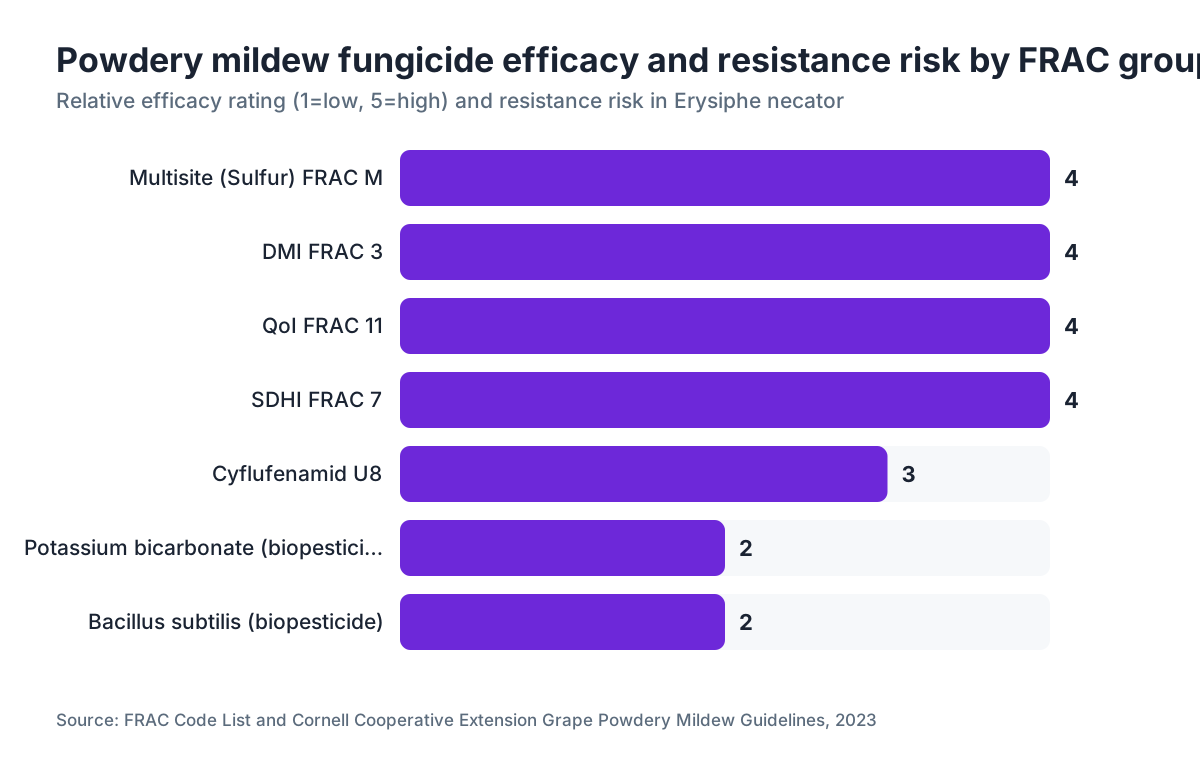
FRAC group classification is the framework every serious spray program runs on. Erysiphe necator has documented resistance to DMI (FRAC Group 3) and QoI (FRAC Group 11, strobilurins) fungicides in California, Oregon, and New York. Resistance to SDHI (FRAC Group 7) materials is emerging in some regions. Rotating across FRAC groups isn't optional anymore in most wine regions. [4]
Here's how the main groups compare:
| FRAC Group | Mode of Action | Example Active Ingredients | Resistance Risk | Notes |
|---|---|---|---|---|
| 3 (DMI) | Sterol biosynthesis inhibition | Myclobutanil, Tebuconazole, Metconazole | High (resistance confirmed) | Still effective at reduced sensitivity; use in mix |
| 11 (QoI) | Respiration (Qo site) | Azoxystrobin, Trifloxystrobin | High (resistance confirmed) | Avoid solo use; mix with multisite |
| 7 (SDHI) | Succinate dehydrogenase inhibition | Fluopyram, Fluxapyroxad | Moderate/increasing | Newer group; rotate carefully |
| U8 (Cyflufenamid) | Unknown | Cyflufenamid | Low | Niche; limit to 2 apps/season |
| M (Multisite) | Multiple sites | Sulfur, Copper sulfate | Negligible | Workhorse materials; no resistance concern |
| Biopesticide | Various | Potassium bicarbonate, Bacillus subtilis | Negligible | Lower efficacy; good fit for organic or as buffer sprays |
Sulfur is still the most widely used powdery mildew material on earth. It's cheap, it works, and it carries no resistance concern. The catch: don't apply it when temperatures will top 90 F (32 C) within 24 hours, because phytotoxicity is the real risk. Don't apply within 14 days of a captan or oil application either. WSU Extension recommends wettable sulfur at 3 to 5 lbs per 100 gallons as the backbone of most programs. [3]
For high-pressure situations or susceptible varieties, premixed products that pair a DMI or SDHI with a multisite are worth the higher per-application cost. They force a rotation inside a single tank. Cornell's powdery mildew guidelines say never use the same FRAC group in back-to-back applications, and cap QoI materials at no more than two applications per season total. [5]
Organic programs lean on sulfur, copper, potassium bicarbonate (sold as Kaligreen, Armicarb, others), and biologicals like Bacillus subtilis (Serenade). The efficacy is real but narrower. You need shorter intervals (7 days in high-pressure periods versus 10 to 14 for conventional materials) and coverage that leaves nothing uncovered. Spray volume carries more weight in organic programs because you're relying entirely on contact and protectant activity.
How does temperature and humidity affect powdery mildew risk?
Erysiphe necator loves the same temperatures that ripen wine grapes. Best growth runs between 65 F and 86 F (18 to 30 C). Below 50 F the fungus is essentially dormant. Above 95 F it starts to die, which gives the hottest desert wine regions some natural suppression. [1]
The UC Davis powdery mildew risk index, developed by Gubler and colleagues, uses a 3-day running average temperature to set daily risk. Low risk sits below 70 F or above 95 F. Moderate is 70 to 85 F. High risk hits when temperatures hold between 70 and 85 F with more than 6 consecutive hours above 70 F. Accumulated risk units drive spray timing better than the calendar alone. [2]
Humidity trips people up with this pathogen. Unlike most fungi, powdery mildew needs no leaf wetness or rain to infect. Conidia actually wash off leaves in heavy rain, so warm, dry stretches are often the highest-risk windows. Overhead irrigation, heavy dew, and dense canopies that trap humidity at the cluster zone all feed the disease, no rain required. [1]
Fog-prone coastal sites have their own problem. Morning fog hands the fungus the 3 to 6 hours of high humidity it needs to germinate, and the afternoon warm-up parks temperatures in the sweet spot. Farm a coastal fog belt and you should plan on 7-day intervals through the critical period regardless of what the calendar says.
What canopy management practices reduce powdery mildew pressure?
Spray programs don't work in a vacuum. Canopy management sets how much disease you carry all season.
Leaf removal in the fruit zone is the highest-impact cultural practice you have for powdery mildew. UC Cooperative Extension trials in California found early leaf removal (at fruit set) cut cluster mildew severity by 30 to 60% versus no leaf removal in Chardonnay. [2] The reason is simple. Better air movement dries the cluster zone faster, drops humidity, and gets fungicide where it needs to be.
Shoot positioning and hedging keep the canopy open. A vertical shoot positioning system with shoots properly tucked, or a divided canopy, gives your spray access to the interior. Spraying a wall of dense, unmanaged shoots is mostly decorative. The material coats the outside leaves and never reaches the clusters. [5]
Timing of leaf removal matters as much as doing it. Removing leaves before or at bloom gives the most disease benefit but risks sunburn on clusters in hot inland sites. In coastal or moderate climates, pre-bloom leaf removal on the sun-exposed side is almost always worth doing. In hot inland valleys, wait until after fruit set and pull leaves on the shade side.
Vigorous, nitrogen-heavy vines with dense canopies run higher mildew pressure than balanced vines, year after year. Irrigation that holds vine vigor moderate, paired with sensible nitrogen inputs, drops disease pressure over the long run. This isn't an argument for stressing vines. It's a reminder that pushing maximum vegetative growth costs you in more than one place.
Running a vineyard with a mix of variety blocks? Hit leaf removal and tight spray intervals on the Chardonnay and Cabernet blocks before you get to the more tolerant varieties.
How do you calibrate your sprayer for good powdery mildew coverage?
A well-timed spray with poor coverage is barely better than no spray at all. Coverage failures break more programs than product selection ever does.
What you're after: deposit on both upper and lower leaf surfaces, on shoot tips, and on the berry surface. Water-sensitive paper placed inside the canopy (at the cluster zone and deeper in the foliage) tells you fast whether your sprayer is penetrating. If the inner papers show fewer than 30 coverage marks per square centimeter, you have a penetration problem. [3]
For conventional air-blast sprayers, your levers are speed, airflow, and volume rate. Typical water volumes in California run 50 to 150 gallons per acre (GPA) depending on canopy size. WSU Extension recommends calibrating to the actual canopy and pushing volume up for larger canopies rather than locking in a fixed GPA. [3]
Nozzle condition matters more than people think. Worn nozzles delivering 10% over rated output are common in older rigs, and they throw off your per-acre rate with no visible warning. Check nozzle output every 25,000 gallons or once a year, whichever comes first. Replace any nozzle running more than 10% above or below its rated output.
Spray timing within the day is its own lever. Early morning or evening applications cut evaporation loss and drop the phytotoxicity risk with sulfur. If your forecast shows temperatures above 88 F by mid-morning, finish your sulfur before 8 AM or wait for evening.
Complete spray records aren't optional, for compliance or for judging your own program. Managing several blocks with different products and timing gets messy fast. A tool like VitiScribe keeps records organized by block, FRAC group, and re-entry interval so nothing slips through on a busy harvest week.
What do EPA worker protection standard requirements mean for your spray records?
The EPA Worker Protection Standard (WPS), 40 CFR Part 170, applies to most agricultural pesticide applications in commercial vineyards, including sole-proprietor operations with at least one worker. [6] Getting it wrong carries real cost. EPA enforcement actions against vineyards for WPS violations have brought penalties from several hundred to tens of thousands of dollars depending on the violation and history.
The WPS makes you post pesticide application information in a central location (or provide it on request) for 30 days after each application. Required information includes the product name, EPA registration number, active ingredient(s), location treated, date and time of application, and the restricted-entry interval (REI). [6]
For powdery mildew materials, REIs vary a lot:
| Active Ingredient | Typical REI | Signal Word |
|---|---|---|
| Sulfur (wettable) | 24 hours | Caution |
| Myclobutanil | 24 hours | Warning |
| Azoxystrobin | 4 hours | Caution |
| Fluopyram | 12 hours | Warning |
| Cyflufenamid | 12 hours | Caution |
| Potassium bicarbonate | 4 hours | Caution |
Always check the current label. Labels shift between formulations and years, and the label is the law under FIFRA Section 12. [7] Using a product at a rate or timing off-label is a federal violation.
California adds requirements under California Code of Regulations Title 3, run through the county agricultural commissioner. Pesticide Use Reports (PURs) are required for every restricted-use and many non-restricted-use applications, filed monthly with the county commissioner. [8] Washington State has similar Pesticide Application Records requirements under RCW 17.21. [9]
Complete spray records are also your best defense in a neighbor complaint or drift investigation. Courts and agencies look at whether your records show proper application rates, timing, and wind conditions.
How do you build a full-season powdery mildew spray program?
A program that works has structure, more than a pile of individual sprays. Here's how to build one from scratch.
Start with your baseline risk. How much disease did you carry last year? What varieties sit in your highest-risk blocks? What's your climate type (fog belt, hot inland valley, Pacific Northwest maritime, humid East Coast)? Those answers decide whether you run a protective program at 7-day intervals from woolly bud onward, or a risk-based program using degree-day models to stretch intervals when risk is low.
Next, lock in your FRAC rotation before the season starts. A simple frame: alternate a DMI or SDHI material with sulfur through most of the season, cap QoI applications at two total, and drop in at least one biological or multisite-only spray as a buffer when pressure is low. Cornell's powdery mildew guidelines lay out a seasonal rotation that's widely adapted across the industry. [5]
A working example calendar for a susceptible variety in a moderate-pressure region:
- Woolly bud (E-L 04): Wettable sulfur (FRAC M)
- 1-3 inch shoots (E-L 09): DMI fungicide + sulfur (FRAC 3 + M)
- Pre-bloom (E-L 15): SDHI + sulfur premix (FRAC 7 + M)
- Full bloom (E-L 23): Sulfur solo (FRAC M), 7-day interval
- Fruit set (E-L 26): QoI + sulfur (FRAC 11 + M), limit use
- Pea size (E-L 29): DMI (FRAC 3)
- Post-veraison: Potassium bicarbonate or sulfur at extended 14-21 day intervals if needed
Then build in scouting triggers. Don't wait on the calendar if you're seeing early disease. One percent leaf incidence in your most susceptible block is a trigger to tighten intervals by 3 to 5 days and consider a higher-efficacy material.
Record every application with product, FRAC group, rate, water volume, block, applicator, and conditions. Tracking FRAC group history by block across years is how you spot when you're at risk of selecting for resistance. Most growers don't do this systematically. The ones who do make better rotation calls.
What resistance management rules prevent powdery mildew fungicides from failing?
Fungicide resistance in Erysiphe necator isn't hypothetical. Reduced sensitivity to DMI fungicides (myclobutanil, tebuconazole) has been documented in California vineyards since the late 1990s. QoI resistance (strobilurin failure) is confirmed in New York and the Pacific Northwest. [4]
FRAC guidelines for high-risk groups recommend no more than two to three applications per season per FRAC group, and never a single-site material alone without a multisite partner. Mixing with sulfur or copper is cheap insurance against selecting for resistance. [4]
Seeing field failures? The question is whether it's true resistance or a coverage and timing problem. Coverage is the more common culprit. True resistance usually shows as failure across the whole block with good coverage, labeled rates, and the right temperature window. Send samples to a university diagnostic lab for resistance testing before you write off an entire FRAC group. UC Davis and Cornell both run grape disease diagnostic services. [2][5]
Rotate mechanistically distinct groups. Going from azoxystrobin (QoI) to another QoI because it has a different trade name isn't a rotation. The FRAC code on the label tells you what group you're in. Every QoI carries FRAC 11 and shares the same resistance mechanism regardless of the molecule.
One clean rule from FRAC: "Do not use products with the same FRAC code consecutively." [4] That single sentence, applied every time you plan a spray, stops most resistance mistakes before they start.
How do organic vineyards manage powdery mildew without synthetic fungicides?
Organic management is harder and costs more per acre than a conventional program. That's honest. It's also workable with the right approach.
Sulfur is the foundation. It's allowed under USDA National Organic Program standards (7 CFR Part 205) and has a long efficacy record. The limits: skip applications when temperatures top 90 F, and hold the 14-day gap before captan or oil. [10]
Potassium bicarbonate materials (Kaligreen, Armicarb, MilStop) work by disrupting fungal cell walls and raising surface pH. They have genuine efficacy, especially as a post-infection material in the 24 to 48 hours after an infection period. They cost more per application than sulfur but give you a rotation option inside organic materials.
Biologicals, mainly Bacillus subtilis (Serenade) and Bacillus amyloliquefaciens, show consistent suppression in trial work at Cornell and UC Davis, though efficacy runs lower than synthetic options. Use them in a tank mix or rotation, not as stand-alone sprays. [5]
Neem oil and plant-based materials carry variable efficacy data and can suppress populations without preventing them. Slot them as gap-fillers between sulfur applications, not as primary tools.
The interval question for organic: 7 days is the maximum safe interval in high-pressure conditions (bloom through pea size). After pea size, 10 to 12 days is reasonable if pressure is moderate. Pushing to 14 days during high-risk periods with organic materials is exactly how organic programs break down.
Running certified organic blocks at a south coast winery or paso robles wineries operation? The afternoon temperature limits on sulfur at those inland-influenced sites force early morning applications and careful timing.
What records do you need to pass a spray record audit?
Audits come from several directions: your state ag department, the EPA through a WPS inspection, your certifier if you're organic, your buyer if you're under a management agreement, or your TTB permit if you're a licensed winery. Most want the same core data. The format and retention period differ. [6][7]
Core required fields for every spray application:
- Date and time of application
- Product name and EPA registration number
- Active ingredient(s) and FRAC code (good practice, not always legally required)
- Rate applied (per acre, per 100 gallons, per hectare)
- Total volume of spray mix applied
- Block or field identifier (GPS coordinates increasingly expected)
- Target pest or disease
- Applicator name and license number
- Equipment used
- Weather conditions at application (wind speed and direction, temperature, relative humidity)
- PHI and REI for the product applied
California requires monthly Pesticide Use Reports filed with the county agricultural commissioner within the first 10 working days of the following month. Late or incomplete filings trigger follow-up. [8]
Retention: California requires pesticide use records kept for a minimum of 2 years. Federal WPS records must be kept for 2 years. Some buyer contracts want 5 years. Keep 5 years as your standard if there's any question which requirement applies.
Managing more than a handful of blocks across varieties and spray programs? A paper logbook is how audits find gaps. VitiScribe was built for exactly this, letting you log applications by block with autofilled product data, FRAC codes, and REI notifications so records stay complete without the paperwork drag.
Vineyards under a mountain winery or similar integrated winery-estate model feel the record-keeping pressure more, because they carry both TTB compliance and state ag oversight at once.
Frequently asked questions
Can powdery mildew spread on grapes without rain?
Yes. Erysiphe necator conidia germinate at relative humidity as low as 20% and don't require leaf wetness or rain. Moderate temperatures (65 to 86 F) plus light dew or overhead irrigation are enough for infection. Heavy rain actually washes spores off leaves and temporarily reduces spread. That's why warm, dry periods with morning dew are high-risk windows.
What temperature kills powdery mildew on grapes?
Temperatures above 95 F (35 C) suppress and eventually kill active Erysiphe necator colonies. Below 50 F, growth stops entirely. The optimal growth range is 65 to 86 F. These thresholds are the basis of the UC Davis powdery mildew risk index, which assigns risk levels from 3-day running average temperatures.
How often should I spray for powdery mildew during bloom?
Every 7 days during bloom is the standard for susceptible varieties under high-pressure conditions. Bloom is the highest-risk growth stage because flower caps and developing berries are highly susceptible. Missing a spray from cap-fall to three weeks post-fruit set is one of the most common reasons season-long programs fail, even when everything else goes right.
Is sulfur safe to apply right before harvest?
Check the label pre-harvest interval (PHI). Most wettable sulfur formulations carry a PHI of zero days (applied up to the day of harvest), but some differ, so verify the specific product. Also, sulfur residue on fruit can generate hydrogen sulfide during fermentation. Many winemakers stop sulfur at least 30 days before harvest as a quality measure, even when the label doesn't require it.
What FRAC groups have confirmed resistance in Erysiphe necator?
FRAC Group 3 (DMI fungicides, including myclobutanil and tebuconazole) and FRAC Group 11 (QoI/strobilurin fungicides, including azoxystrobin and trifloxystrobin) show documented reduced sensitivity in California, New York, and the Pacific Northwest. Resistance to FRAC Group 7 (SDHI fungicides) is emerging in some regions. Rotate with multisite materials and limit single-site applications per season.
Does leaf removal actually reduce powdery mildew on clusters?
Yes, meaningfully. UC Cooperative Extension California trials found early leaf removal (at fruit set) cut cluster mildew severity by 30 to 60% in Chardonnay versus no leaf removal. The mechanism is better air movement, faster drying, and improved fungicide penetration to the cluster zone. Pre-bloom leaf removal shows the greatest benefit; removing leaves on the shade side reduces sunburn risk in hot sites.
How do I tell powdery mildew from spray residue on grape leaves?
Wipe the white coating with a damp cloth. Spray residue doesn't wipe cleanly or leaves no discoloration underneath. Active powdery mildew wipes off but leaves the tissue yellow or light green where the colony was feeding. Infected tissue on the lower leaf surface shows matching yellow or brown angular spots on the upper surface. Still uncertain? Send a sample to your state plant diagnostic laboratory.
Can Botrytis be caused by powdery mildew infection?
Indirectly, yes. Powdery mildew restricts the elasticity of developing berry skin. As the berry grows, infected skin cracks. Those cracks are entry points for Botrytis cinerea and other secondary pathogens. Late-season Botrytis outbreaks often trace back to powdery mildew infections 2 to 4 weeks earlier, during the pea-size to veraison window. Controlling powdery mildew early reduces Botrytis risk later.
How long do I have to keep pesticide spray records in California?
California requires pesticide use records retained for a minimum of 2 years under the California Code of Regulations Title 3. Federal WPS requirements also call for 2 years. Many buyer contracts and organic certification programs require 5 years. Keeping records for 5 years is the safest standard if your operation falls under multiple sets of requirements.
What's the difference between powdery mildew and downy mildew on grapes?
Powdery mildew (Erysiphe necator) grows on the surface of tissue as white-gray powder and needs no free water to infect. Downy mildew (Plasmopara viticola) requires leaf wetness and shows as yellow 'oil spots' on the upper leaf surface with white fuzzy sporulation underneath. They are completely different pathogens needing different fungicide groups and different management timing.
Do biopesticides like Bacillus subtilis actually control powdery mildew?
They provide genuine suppression, not eradication. Cornell and UC Davis trial work shows Bacillus subtilis (Serenade) products reduce powdery mildew severity consistently, but efficacy runs lower than synthetic single-site fungicides. They work best in a rotation or tank mix, not as standalone sprays. In organic programs, they're valuable gap-fillers between sulfur applications or partners with potassium bicarbonate.
How many powdery mildew sprays can I apply per season with strobilurin fungicides?
FRAC guidelines and most strobilurin labels recommend no more than two applications per season, given the high resistance risk in FRAC Group 11. Cornell Cooperative Extension's powdery mildew guidelines reinforce this limit. Using strobilurins beyond two applications per season, especially without a multisite partner in the tank, accelerates resistance selection. Save those two for high-risk windows like bloom.
What wind speed is too high to spray powdery mildew fungicides in a vineyard?
Most state regulations and label language caution against application above 10 mph for air-blast sprayers, and many set 15 mph as the hard limit. The EPA Worker Protection Standard and state drift regulations both apply. California DPR guidance for vineyard applications generally recommends staying below 10 mph. Always record wind speed and direction as part of both best practice and legal protection.
Sources
- UC IPM Online, UC Statewide IPM Program: Powdery Mildew on Grapes: Erysiphe necator germinates at RH as low as 20%, overwinters as cleistothecia in bark and dormant mycelium in buds, and grows optimally between 65 and 86 F
- UC Cooperative Extension, UC Davis: Grape Powdery Mildew Management: Yield losses of 20-40% in unmanaged programs; first spray at 1-6 inch shoots; degree-day base 50 F model; leaf removal reduces cluster mildew 30-60%
- Washington State University Extension: Powdery Mildew Management in Pacific Northwest Vineyards: Wettable sulfur at 3-5 lbs per 100 gallons recommended as program backbone; bloom is highest-risk window; water-sensitive paper for coverage evaluation
- Fungicide Resistance Action Committee (FRAC): FRAC Code List for Plant Pathogens: DMI (FRAC 3) and QoI (FRAC 11) resistance confirmed in Erysiphe necator; SDHI (FRAC 7) resistance emerging; guidance states do not use same FRAC code consecutively
- Cornell Cooperative Extension: Powdery Mildew Management Guidelines for Grapes: No more than two QoI applications per season; never use single-site materials without multisite partner; Bacillus subtilis shows consistent suppression in trial work
- US EPA: Worker Protection Standard (WPS), 40 CFR Part 170: WPS requires posting pesticide application info for 30 days post-application including product name, EPA reg number, active ingredient, date, time, REI, and location
- US EPA: Federal Insecticide, Fungicide, and Rodenticide Act (FIFRA) Section 12: Using a pesticide inconsistently with its label is a federal violation under FIFRA Section 12; the label is the law
- California Department of Pesticide Regulation: Pesticide Use Reporting: California requires monthly Pesticide Use Reports submitted to county agricultural commissioners within first 10 working days of the following month; records retained minimum 2 years
- Washington State Legislature: RCW 17.21, Washington Pesticide Application Act: Washington State requires pesticide application records under RCW 17.21 for licensed commercial applicators
- USDA Agricultural Marketing Service: National Organic Program, 7 CFR Part 205: Sulfur is allowed as a plant disease control material under USDA National Organic Program standards at 7 CFR Part 205
Last updated 2026-07-09