Grape powdery mildew eradication: what actually works in the vineyard
TL;DR
- You can't fully eradicate grape powdery mildew (Erysiphe necator) from an established vineyard, but you can stop an active infection with eradicant fungicides (sterol inhibitors, DMIs, or potassium bicarbonate) applied within 72 to 96 hours of infection.
- Sulfur stays the cheap preventive backbone.
- Starting at 10-inch shoot growth and holding 7 to 14 day intervals through bloom are the two decisions that matter most all season.
What is grape powdery mildew and why is it so hard to kill?
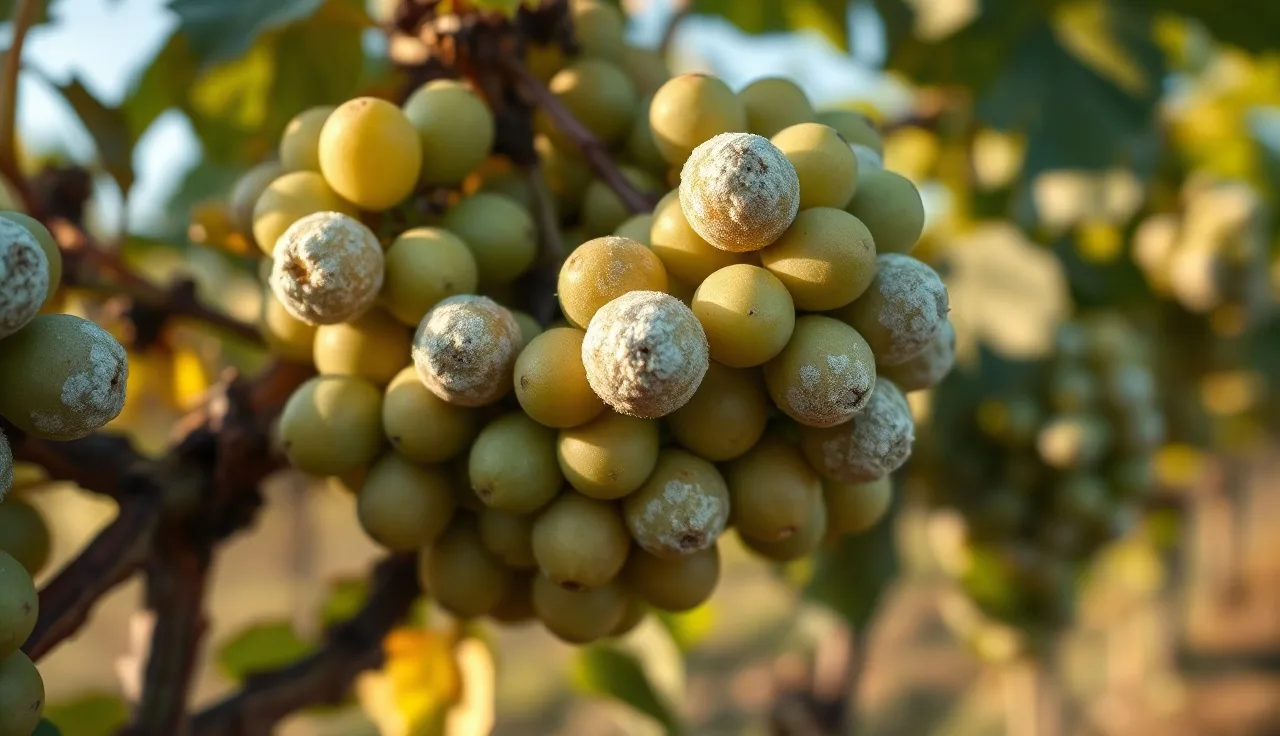
Grape powdery mildew is caused by Erysiphe necator (formerly Uncinula necator), an obligate biotrophic fungus that lives only on living plant tissue. It doesn't need free water to germinate, which sets it apart from most vineyard pathogens. Relative humidity anywhere from 40% to 100% works for spore germination, and temperatures from about 50°F to 90°F suit it, with the sweet spot around 68 to 77°F. [1]
That biology is why it never leaves. The fungus overwinters as chasmothecia (sexual spore structures) in bark crevices and as dormant mycelium inside infected buds. Come spring, both release spores right when vines push new growth. You're never starting with a clean slate.
The word 'eradication' shows up in grower talk and on fungicide labels, and it needs a reality check. Eradicant chemistry kills fungal mycelium and spores already sitting on leaf and berry surfaces, which stops an active infection cold. It does not pull the fungus out of tissue it has already colonized. A colony growing longer than about 72 to 96 hours is much harder to stop, and colonies older than a week are past the reach of any single spray. [2]
So here's the honest answer: you manage powdery mildew season after season. The job is to hold inoculum pressure low enough that fruit gets through its susceptibility window clean, which runs from just before bloom through roughly 4 to 6 weeks post-bloom, when berries harden and turn resistant.
When does powdery mildew cause the most damage to grapes?
Bloom through about 3 to 4 weeks after fruit set is the window that empties your checkbook. Berries hit maximum susceptibility from shortly before bloom (roughly E-L stage 17) until the flesh reaches about 4% sugar, which usually lands 3 to 5 weeks after fruit set depending on variety and climate. [1]
After that sugar threshold, the berry skin lignifies and shrugs the fungus off. Leaves stay susceptible all season, but foliar infection alone rarely costs yield unless it's severe enough to defoliate the canopy and cut late-season photosynthesis. The money damage comes from berry infection: skin cracking, secondary Botrytis, and flavor taint from geosmin and other off-compounds that ride straight through fermentation. [3]
In high-pressure years, untreated powdery mildew can take more than 30 to 50% of yield in susceptible varieties. UC extension research has documented this in coastal California vineyards. [3] That number gets thrown around a lot, and it's real. A Chardonnay block at peak bloom with no spray through a warm, moderately humid stretch can go from clean to heavily infected berries in 8 to 12 days.
Chasmothecia overwintering in bark release ascospores during spring rains, right around 1 inch of shoot growth. That first inoculum event is the one to suppress hardest, because it sets disease pressure for the rest of the season.
Which fungicides actually eradicate powdery mildew after infection has started?
Four fungicide categories carry genuine eradicant activity against Erysiphe necator. Here's how each one behaves.
Sterol biosynthesis inhibitors (DMIs / Group 3): Myclobutanil, tebuconazole, and related compounds. They shut down ergosterol production in the fungal cell membrane. They move translaminar, through the leaf, so they hit colonies on both surfaces. Eradicant activity is real up to about 72 to 96 hours post-infection, then it falls off fast. [2]
Quinone outside inhibitors (QoIs / Group 11): Azoxystrobin, pyraclostrobin, trifloxystrobin. Strong preventive and early eradicant activity. QoIs carry a high resistance risk with E. necator because of a single-point mutation (the G143A substitution in cytochrome b), and resistance is now widespread across many wine regions. Don't lean on a QoI as your main eradicant in a program that hasn't tracked resistance. WSU's monitoring work spells this out. [4]
Succinate dehydrogenase inhibitors (SDHIs / Group 7): Fluopyram, boscalid. Good preventive activity, moderate eradicant activity inside about 48 to 72 hours. Resistance is emerging. Rotate.
Potassium bicarbonate (Group NC): Kaligreen, Armicarb, and similar. These raise the pH on leaf surfaces and rupture fungal cell walls. Solid contact eradicant on visible colonies, zero FRAC resistance risk. The catch: you need thorough coverage, and it works best on young colonies. It's also cleared for organic programs. [5]
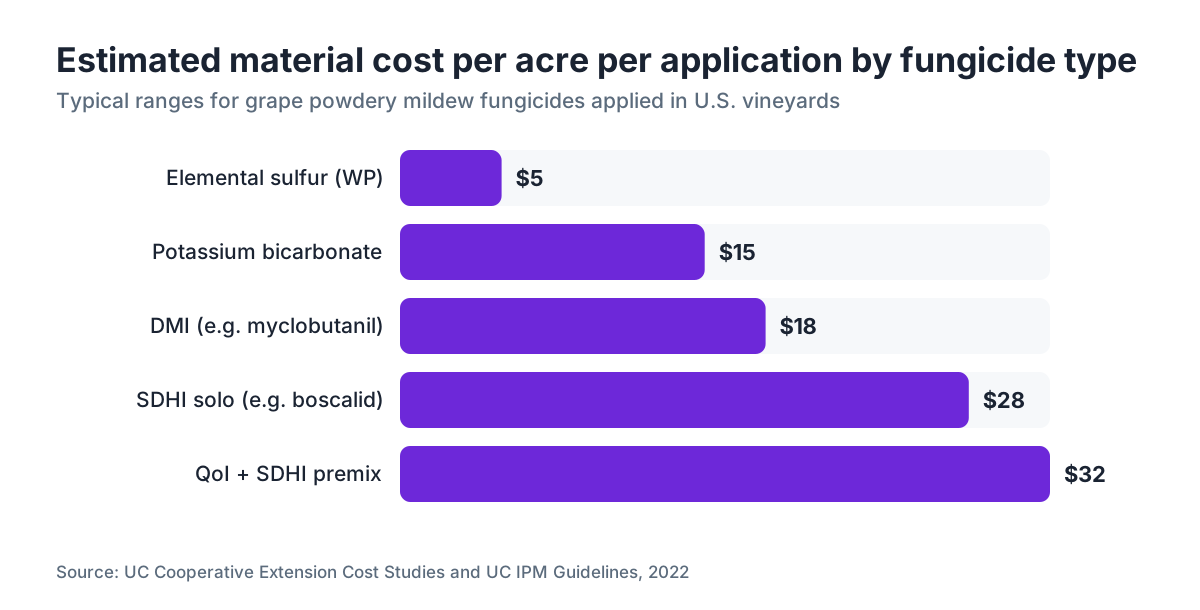
Sulfur: Mostly preventive. It vaporizes and disrupts spore germination. At high label rates applied straight to early-stage colonies it has some knockdown, but don't count on it as an eradicant. Sulfur burns foliage above about 90°F and can't go on within two weeks of an oil application. It's still the cheapest backbone in most programs at roughly $2 to $8 per acre per application depending on formulation.
Here's how the main eradicant options stack up:
| Active ingredient | FRAC Group | Eradicant window | Resistance risk | Organic? |
|---|---|---|---|---|
| Myclobutanil | 3 (DMI) | 72-96 hrs | Moderate | No |
| Tebuconazole | 3 (DMI) | 72-96 hrs | Moderate | No |
| Azoxystrobin | 11 (QoI) | 48-72 hrs | HIGH | No |
| Pyraclostrobin | 11 (QoI) | 48-72 hrs | HIGH | No |
| Boscalid | 7 (SDHI) | 48-72 hrs | Moderate | No |
| Fluopyram | 7 (SDHI) | 48-72 hrs | Moderate | No |
| Potassium bicarbonate | NC | 24-48 hrs | None | Yes |
| Elemental sulfur | M2 | Very limited | None | Yes |
Source: FRAC Code List 2024 and UC IPM guidelines [2][5]
How do you build a spray program that actually stops powdery mildew?
UC Davis, Cornell, and WSU all land on the same structure: start early, rotate modes of action, and set spray intervals by infection risk instead of the calendar.
Start at 10-inch shoot growth (E-L stage 12), or earlier if the prior season hit you hard. Waiting for visible symptoms is too late. By the time you spot white colonies on leaves or berries, the fungus has been colonizing for 7 to 10 days. [1]
From shoot emergence through 3 to 4 weeks post-fruit-set, aim for a 7 to 14 day spray interval. Tighten to 7 days through bloom and the 2 to 3 weeks ahead of it, when conditions favor fast spread. Stretch to 14 days only in dry, hot stretches, because sustained temperatures above 90°F genuinely suppress mycelium growth and spore germination. [3]
Rotate FRAC groups every 2 sprays. Never run the same mode of action back to back more than twice. A workable rotation: sulfur (M2), then a DMI (Group 3), then sulfur again, then an SDHI (Group 7), then sulfur, then a DMI. If your regional monitoring shows QoI resistance in local E. necator populations (ask your farm advisor or state department of agriculture), pull Group 11 out of the rotation entirely instead of hoping.
Canopy management earns its keep here too. Dense canopies build the humidity and shade Erysiphe necator loves. Shoot positioning, leaf removal on the east-facing side of the canopy (northern hemisphere), and holding shoot density below about 3 to 4 shoots per foot of cordon all cut disease pressure you can measure. None of that replaces fungicides in a high-pressure site, but it trims the number of applications you need to hit your quality target.
Cornell's IPM guidelines put the bloom window front and center: "Infections that occur during or shortly after bloom can cause the most damage to fruit quality." [6] That line is straight from their published guidance, and it's the frame every spray decision should hang on.
Record every spray: date, product, rate, growth stage, weather during application, and re-entry interval. That's non-negotiable for pesticide compliance, and just as non-negotiable when you're trying to reconstruct what worked last year while planning this one. (See the compliance section below.)
How do powdery mildew infection models help you time eradicant sprays?
Infection models turn temperature and humidity data into an estimated risk of Erysiphe necator germinating and setting up colonies. The two used most in U.S. viticulture are the UC Davis Gubler-Thomas model and Cornell's integrated approach.
The Gubler-Thomas model scores powdery mildew risk on the number of consecutive hours temperature holds between 70°F and 85°F. Six or more consecutive hours in that range counts as a high-risk event, scored 0 to 100. [1] When the index is high and you haven't sprayed in 10 or more days, that's your trigger for an eradicant. When the index drops (extended heat above 90°F, or a cold snap below 50°F), you can stretch intervals with a clear conscience.
Models don't replace scouting. Walk the block. Check shoot tips and cluster stems (rachises) for early white colonies. Rachis infection is the nasty one, because it can girdle the stem and kill whole clusters. Grab a hand lens and read the lower-canopy leaves, which hold humidity longer and often show infection first.
WSU's Decision Aid System (DAS) blends weather data with disease models for Pacific Northwest growers and hands back spray timing tuned to local conditions. [4] If you farm in Washington or Oregon, set that tool up at the start of the season.
The honest limit on all these models: they're only as good as your weather station data. Park a station at the vineyard edge in a microclimate different from your block and you'll get numbers that don't match what's happening in the fruit zone. Siting matters.
What does resistance to powdery mildew fungicides actually look like, and how do you manage it?
Resistance in Erysiphe necator is real, documented, and getting worse across California, Washington, Oregon, and most major wine regions worldwide. It doesn't announce itself in the field until you've already made things worse.
The tell: a product that used to give you clean fruit stops working even though you applied it at the right timing and rate. QoI (Group 11) resistance is the most widespread. The G143A mutation makes azoxystrobin and pyraclostrobin essentially useless against resistant populations. UC Davis plant pathology work has documented QoI-resistant E. necator in multiple California counties. [3]
DMI resistance is partial and quantitative. It shifts the dose-response curve rather than flipping a population from susceptible to resistant, so you see fading efficacy instead of a clean failure. That's harder to catch.
The management answers are simple to state, less simple to live with:
- Rotate FRAC groups as above.
- Never apply a Group 11 solo. If you use a QoI, pair it with a partner active that has a different mode of action.
- Don't cut rates below label minimums to save money. Sub-lethal doses are one of the surest ways to breed resistant populations.
- Ask your extension office or certified crop advisor whether resistance monitoring data exists for your county. In California, CDFA and UC Cooperative Extension sometimes run sentinel vineyard programs. [7]
If several FRAC groups are failing you at once, reset. Build the program around sulfur (no resistance mechanism exists for this inorganic material) and potassium bicarbonate, push through the high-risk window on the only tools resistance can't touch, then rebuild your rotation with fresh resistance data in hand.
What are the EPA Worker Protection Standard requirements for powdery mildew sprays?
Vineyard pesticide applications fall under the EPA's Worker Protection Standard (WPS), codified at 40 CFR Part 170. The 2015 revision tightened the rules hard, and they apply to any commercial pesticide application in an agricultural setting. [8]
The pieces that touch a powdery mildew program most directly:
Restricted-entry intervals (REIs): Every label carries one. For vineyard fungicides, common REIs run from 4 hours (many sulfur products) to 24 hours (many DMIs) to 48 hours (some systemics). Workers can't enter a treated area until the REI expires unless they have the full PPE the label spells out. Federal requirement, not a suggestion.
Central posting: REIs and application information go at a central spot (usually the farm office or equipment building) where workers can see it. Under the 2015 rule, you must post a standardized pesticide safety information poster in an accessible location and update application records within 24 hours of a spray.
Pesticide application records: FIFRA requires commercial agricultural producers to keep pesticide application records for at least 2 years. Most states want longer. California requires 3 years under DPR's pesticide use reporting system, with records submitted to the county agricultural commissioner. [9] Washington requires records kept a minimum of 2 years and holds applicators to WSDA licensing rules. [10]
PPE and training: Handlers (anyone who mixes, loads, or applies) must complete handler training under WPS. Workers who enter treated areas within 30 days of application need worker training. Keep the training records. EPA's WPS training materials are free at epa.gov. [8]
The practical version for a small operation: build one spray log that captures product name, EPA registration number, rate applied, total acres treated, application date and time, applicator name, and REI expiration. That single document covers most of your federal and state recordkeeping and is your first line of defense in an audit.
How do you track spray records and stay audit-ready year-round?
Plenty of small operations run spray records in a notebook or a spreadsheet, and that holds up until it doesn't. The failure point is usually retrieval. When the county ag commissioner calls or a buyer wants a block's full spray history, digging every record out of a paper system across a whole season eats hours and breeds errors.
A good spray record captures the minimum set: block ID and acreage, application date and start/end time, product trade name, EPA registration number, active ingredient, rate per acre, total product used, target pest, REI, applicator name and license number (if applicable), weather at spray time (wind speed, temperature, relative humidity), and equipment used. In a county with mandatory pesticide use reporting, add the application type code and any county-specific fields. [9]
Digital systems have one edge that's easy to miss: they can flag when you've applied the same FRAC group back to back, or when a spray interval has drifted past your target. That automatic check is hard to run in a notebook. Tools like VitiScribe are built for vineyard compliance recordkeeping and can generate state-formatted pesticide use reports straight from your spray log, which kills the double-data-entry step that causes most reporting mistakes.
For an organic operation or a vineyard chasing third-party sustainability certification (LIVE, SIP, CCOF), spray records double as your audit trail for input approvals. Keep every pesticide label and your OMRI-listed product documentation in the same place as your logs. Auditors look for that pairing.
Archive spray records for at least 3 years no matter what your state requires. Buyers, lenders, and insurance adjusters all ask for historic records, and having them on hand is worth the filing space.
Are there resistant grape varieties that reduce powdery mildew pressure?
Yes, and the breeding programs have made real ground over the past 20 years. Powdery mildew resistance in Vitis traces mainly to the Ren (Resistance to Erysiphe necator) genes, several of which have been identified and moved into hybrid and interspecific varieties. [11]
Varieties with documented resistance across multiple trials include Marquette, Frontenac, La Crescent, and several PIWI varieties bred in Germany (Regent, Cabernet Blanc, Souvignier Gris). They carry Ren1 or related genes from wild Vitis species. Cornell's breeding program has been busy here too, releasing Arandell, Aromella, and Noiret, all with reduced susceptibility in Hudson Valley and Finger Lakes trial data. [6]
The honest caveat: 'reduced susceptibility' is not 'immune'. Under very high inoculum pressure, even resistant varieties can throw some mildew, and the resistance can break if new races of E. necator show up. Growers in New York and the upper Midwest have cut spray programs from 15 to 18 applications per season on susceptible varieties down to 4 to 6 on resistant ones. That's a real economic and environmental win.
For growers married to Vitis vinifera (Chardonnay, Pinot Noir, Cabernet Sauvignon), variety choice barely helps, because those varieties are all highly susceptible. Cabernet Sauvignon and Merlot tend to be a bit more prone to rachis infection than Chardonnay in most regions, but the spread within vinifera is small next to the gap between vinifera and the hybrids. Inside the vinifera portfolio, canopy management and spray timing carry far more weight than which variety is on the trellis.
What does a complete powdery mildew program cost per acre?
Cost swings hard by region, operation size, spray equipment, and how many applications you end up making. Real numbers still exist to anchor a budget.
A 2022 UC Cooperative Extension cost study for North Coast wine grapes (Napa/Sonoma) put disease management costs (fungicides plus application labor and equipment) at roughly $400 to $700 per acre per season for a conventional program hitting powdery mildew and Botrytis together. [12] A sulfur-heavy, more conservative Central Valley program runs closer to $150 to $300 per acre, thanks to lower labor costs and less complex disease pressure. In Washington's Columbia Valley, WSU enterprise budget data puts fungicide costs for a conventional program near $200 to $400 per acre. [4]
Material costs alone, before labor:
- Elemental sulfur (wettable powder): roughly $2 to $8 per acre per application
- DMI fungicide (e.g., myclobutanil): $12 to $25 per acre per application
- SDHI or QoI (e.g., boscalid plus pyraclostrobin premix): $20 to $45 per acre per application
- Potassium bicarbonate: $10 to $20 per acre per application
Make 10 to 15 applications through the season (typical for a high-pressure coastal site) and material costs alone reach $150 to $400 per acre before any labor. That's the whole argument for managing intervals with a disease model. Every skipped application when risk is genuinely low is $20 to $45 back in your pocket.
Resistant varieties can trim spray costs 50 to 70% across a season, which becomes a real financial case for replanting when blocks need renovation anyway. The upfront decision compounds in your favor over a 25-year vineyard life.
What extension resources are available for powdery mildew management guidance?
Three university programs hold the deepest published material on grape powdery mildew: UC Davis (California), Cornell (New York), and WSU (Washington and the Pacific Northwest).
UC Davis's IPM program publishes a regularly updated pest management guidelines document for grape powdery mildew covering the Gubler-Thomas risk index, fungicide efficacy tables, and resistance management protocols. It's free at ipm.ucanr.edu. [1]
Cornell Cooperative Extension's viticulture team, based in the Finger Lakes and Hudson Valley, publishes the New York and Pennsylvania Pest Management Guidelines for Grapes each year. It covers every major disease and pest, with fungicide efficacy ratings and timing built for cool, humid northeast conditions. [6]
WSU's Plant Pathology Extension program runs the Decision Aid System (DAS) for online disease risk modeling, plus a range of published guides through the WSU Extension Publications catalog. [4] For Pacific Northwest growers, WSU's work with Oregon State and the Northwest Center for Small Fruits Research turns out region-specific recommendations that separate Columbia Basin from western Oregon conditions.
None of these needs a subscription. They're publicly funded, and they update more often than most commercial publications. The extension plant pathologist in your state can also answer questions about local resistance trends and new chemistry that hit the market since the last guideline revision.
If you run complex multi-block vineyards, staying current with at least one extension source each year, rather than relying only on a PCA's recommendations, gives you a better baseline for asking sharp questions during spray season.
The 2015 EPA WPS rule is worth reading straight from the source too. EPA's agricultural workers page at epa.gov lays out handler training, REI posting, and the application exclusion zone (AEZ) rules that govern where workers can be during a spray. [8]
How do you scout for powdery mildew to know when eradicant timing is needed?
Scouting is the feedback loop that makes everything else work. Skip it and you're spraying on a schedule that ignores field conditions, which means you're either over-spraying (expensive, resistance-building) or under-spraying (expensive in a different way).
The standard protocol: scout at least once a week from shoot emergence through 4 to 6 weeks post-fruit-set. In high-pressure stretches, twice a week. Walk a W or Z pattern through the block, more than the edges. Sample at least 5 vines per sampling unit (a 2 to 5 acre block is usually one unit; bigger blocks need several).
At each vine, read the 3 to 5 youngest leaves on several shoots, plus cluster stems (rachises) at or just before bloom. Look for the white to gray powdery colonies that name the disease. Under a hand lens, the conidiophores and conidia (spore chains) of Erysiphe necator are distinctive and unmistakable once you've seen them.
Record which tissue is hit (leaf upper surface, leaf lower surface, shoot, rachis, berry), the rough percent of tissue covered, and the shoot growth stage. Log the scouting date and weather too. That record is your early warning and your evidence base for adjusting intervals.
Find any rachis infection before or during bloom and treat it as a high-priority trigger for an eradicant inside 24 to 48 hours. Rachis infections get undercounted because they hide in dense canopies, and they cause damage way out of proportion to what you can see.
For operations tracking multiple blocks and spray events across a season, a field-ready digital log (a purpose-built tool like VitiScribe or a tightly organized spreadsheet) makes it far easier to see patterns across blocks and years that a paper system buries.
Frequently asked questions
Can you completely eradicate powdery mildew from a vineyard?
No. Erysiphe necator overwinters as chasmothecia in bark and as dormant mycelium in infected buds, so complete eradication from an established vineyard isn't achievable with current chemistry or cultural practices. What you can do is suppress inoculum below economically damaging levels each season through timely preventive and eradicant fungicide applications, canopy management, and rotation of fungicide modes of action.
How late after infection can you apply an eradicant fungicide and still get control?
Most eradicant fungicides (DMIs, QoIs, SDHIs) work best applied within 72 to 96 hours of infection. After about 5 to 7 days, the colony is established deeply enough that even the best eradicant gives incomplete control. Potassium bicarbonate works as a contact eradicant on young visible colonies but fades as colonies mature. Spray as soon as an infection event is confirmed. Don't wait.
What is the Gubler-Thomas powdery mildew risk model?
The Gubler-Thomas model, developed at UC Davis, assigns a daily powdery mildew risk index based on the consecutive hours temperature holds between 70°F and 85°F. Six or more consecutive hours in that range triggers a high-risk day. Growers use the cumulative index to decide when to spray and whether conditions call for a preventive or eradicant product. It's free through the UC IPM program.
Is sulfur good enough to control powdery mildew on its own?
Sulfur is an excellent preventive fungicide with no resistance risk, and it's the backbone of most low-cost programs. Applied every 7 to 10 days at adequate rates, it suppresses spore germination well. The limits: very little eradicant activity on established colonies, phytotoxicity above about 90°F, and no application within two weeks of an oil spray. In high-pressure sites, most growers pair sulfur with at least one systemic mode of action.
What powdery mildew sprays are approved for certified organic vineyards?
Certified organic programs lean on elemental sulfur and potassium bicarbonate (Kaligreen and Armicarb are OMRI-listed). Copper has some suppressive activity on powdery mildew but is mainly aimed at downy mildew. Neem oil and some plant extract products (like Regalia, based on Reynoutria sachalinensis) show partial efficacy. Organic programs usually need tighter spray intervals and more careful scouting because fewer eradicant options exist.
How do I know if powdery mildew has developed resistance to the fungicide I'm using?
Resistance shows up as reduced or absent control despite correct timing, rate, and application quality. The clearest signal is a product that worked in prior seasons suddenly failing. QoI (Group 11) resistance in Erysiphe necator is now widespread; if azoxystrobin or pyraclostrobin is your main tool and control is slipping, resistance is likely. Contact your extension plant pathologist or the FRAC monitoring program for regional resistance data before switching products.
What spray records am I legally required to keep for powdery mildew fungicide applications?
Federal FIFRA law requires commercial agricultural producers to keep pesticide application records for at least 2 years. Most states require more: California mandates 3-year retention and monthly reporting to the county agricultural commissioner through the DPR pesticide use reporting system. Washington requires 2 years under WSDA rules. Records must include product name, EPA registration number, rate, acres treated, application date, and applicator identity. The EPA Worker Protection Standard adds posting and training recordkeeping requirements.
What spray interval should I target during grape bloom for powdery mildew?
Target a 7-day interval from roughly 10-inch shoot growth through 2 to 3 weeks after fruit set, tightening to 5 to 7 days during bloom itself if conditions favor the fungus (sustained 68 to 77°F, humidity above 40%). This is the highest-risk window and the one that most directly affects fruit quality. Stretch intervals only during sustained heat above 90°F or cold below 50°F, when spread is genuinely suppressed.
How does canopy management affect powdery mildew pressure?
Dense canopies hold humidity, cut airflow, and block spray penetration, all of which favor Erysiphe necator. Shoot positioning, holding shoot density at 3 to 4 shoots per foot of cordon, and targeted leaf removal (especially the cluster-zone east face in the northern hemisphere) measurably reduce disease incidence. University trials consistently show open canopies need fewer fungicide applications to hit the same control as dense ones.
Are there grape varieties that resist powdery mildew so I can spray less?
Yes. Varieties carrying Ren resistance genes, including Marquette, Frontenac, many PIWI varieties (Regent, Cabernet Blanc), and Cornell releases like Noiret, show substantially reduced susceptibility. Growers in New York and the Midwest have cut spray programs from 15 to 18 applications per season on Vitis vinifera down to 4 to 6 on resistant varieties. For vinifera operations, canopy management and spray timing matter more than varietal differences within that species.
What PPE do I need when applying powdery mildew fungicides in the vineyard?
PPE requirements sit on each product's label and are legally enforceable. Most sulfur products call for a long-sleeved shirt, long pants, shoes plus socks, and chemical-resistant gloves. Systemic fungicides (DMIs, SDHIs) usually add eye protection and sometimes a respirator. Handlers who mix and load concentrated products often face stricter PPE than those applying diluted spray. Always read the label PPE section for the specific product in the tank.
How do I use a disease model to decide between a preventive and an eradicant product?
Use a preventive (sulfur, copper, or a low-resistance-risk systemic at preventive timing) when the model shows moderate to high risk but no recent confirmed infection and your last application is within interval. Switch to an eradicant (DMI, SDHI, or potassium bicarbonate) when you've had a confirmed high-risk infection event in the past 72 to 96 hours and want to stop an active colony. Scouting evidence of early colonies should push you toward eradicant timing regardless of the model.
Can I use the same powdery mildew fungicide all season if it's working?
No. Running the same fungicide or FRAC group all season is one of the fastest ways to breed resistance in the local Erysiphe necator population. Even when a product works perfectly, rotate to a different mode of action every 1 to 2 applications. Use multi-site contact fungicides (sulfur, potassium bicarbonate) as interval fillers between systemic rotations to cut selection pressure on any single chemistry.
What is the application exclusion zone (AEZ) and does it affect vineyard spraying?
The Application Exclusion Zone is a WPS requirement introduced in the 2015 rule. It bars workers and early-entry workers from an area within 100 feet of a sprayer operating in outdoor production (or 25 feet indoors). For vineyard spraying, workers doing other tasks in adjacent rows must clear out before the rig enters. Violating the AEZ is a WPS violation regardless of whether anyone gets hurt.
Sources
- UC IPM, UC Davis -- Grape Powdery Mildew Pest Management Guidelines: Gubler-Thomas risk index methodology, temperature and humidity ranges for Erysiphe necator, and berry susceptibility window through approximately 4% sugar in flesh
- UC Cooperative Extension -- Fungicide Efficacy and Resistance Management for Grape Powdery Mildew: Eradicant activity of DMI and QoI fungicides is most effective within 72-96 hours of infection; efficacy drops sharply beyond that window
- University of California Division of Agriculture and Natural Resources -- Grape Pest Management Publication 3343: Powdery mildew losses can exceed 30-50% of yield in susceptible varieties during high-pressure years in coastal California vineyards; QoI-resistant E. necator documented in multiple California counties
- Washington State University Extension -- Grape Powdery Mildew and Decision Aid System: WSU Decision Aid System integrates weather data with disease models for Pacific Northwest growers; QoI resistance documented in E. necator populations; WSU enterprise budget data for fungicide costs in Columbia Valley
- USDA Agricultural Marketing Service -- National Organic Program, Potassium Bicarbonate Listing: Potassium bicarbonate is listed as an approved material for organic production and has no documented FRAC resistance mechanism
- Cornell Cooperative Extension -- New York and Pennsylvania Pest Management Guidelines for Grapes: Quoted guidance that infections occurring during or shortly after bloom cause the most damage to fruit quality; Cornell variety trial data on resistant varieties including Noiret and Arandell
- California Department of Food and Agriculture (CDFA) -- Pesticide Use Reporting and Compliance: CDFA and UC Cooperative Extension sentinel vineyard programs for resistance monitoring; California pesticide use reporting requirements
- U.S. EPA -- Agricultural Worker Protection Standard (WPS), 40 CFR Part 170: WPS 2015 revision requirements including REIs, central posting, application exclusion zones, handler training, worker training, and recordkeeping obligations
- California Department of Pesticide Regulation (CDPR) -- Pesticide Use Reporting System: California requires pesticide application records to be retained for 3 years and submitted monthly to the county agricultural commissioner
- Washington State Department of Agriculture (WSDA) -- Pesticide Management: Washington requires pesticide application records be kept for a minimum of 2 years and mandates Commercial Pesticide Applicator License requirements
- American Journal of Enology and Viticulture -- Genetics of Powdery Mildew Resistance in Vitis: Ren (Resistance to Erysiphe necator) genes identified and introgressed into hybrid varieties; genetic basis of powdery mildew resistance in Vitis
- UC Cooperative Extension -- Sample Costs to Establish a Vineyard and Produce Wine Grapes, North Coast 2022: Disease management costs estimated at $400-700 per acre per season for North Coast wine grapes in a conventional program targeting powdery mildew and Botrytis
Last updated 2026-07-09