Grape powdery mildew control schedule: timing, products, and records
TL;DR
- Powdery mildew control on grapes starts at budbreak (0 to 3 inch shoots) and runs through veraison, with sprays every 7 to 14 days depending on weather risk.
- Sulfur, DMI fungicides, and OMRI-listed materials all work when timed right.
- Miss the pre-bloom and immediate post-bloom windows and you can lose the whole crop to Erysiphe necator.
What is grape powdery mildew and why does timing matter so much?
Grape powdery mildew is caused by Erysiphe necator (formerly Uncinula necator), an obligate fungus that lives only on living tissue. It overwinters as chasmothecia tucked in bark or as mycelium inside infected buds, then releases ascospores around budbreak once cumulative temperatures pass about 50 degree-days (base 50°F) after January 1 [1]. That biological clock is why timing beats product choice every time.
The fungus thrives between 70 and 85°F. It needs leaf wetness for less than two hours to infect, unlike most other fungal diseases. Relative humidity above 40% is enough. Bright, dry days are not safe days if nights stay warm and humid. You can get a bad outbreak in a year that looks bone dry.
The most susceptible tissues are young leaves (within 3 to 4 weeks of emergence) and berries from just before bloom through about 4 weeks after bloom. UC Davis plant pathology research found that infection of berries between full bloom and 3 to 4 weeks post-bloom caused near-total crop loss in susceptible varieties in inoculated trials [2]. Once berry skin cells stop dividing, roughly at the 8 to 10 mm stage, new infections still happen but stop causing the skin cracking that opens the door to botrytis.
Here's the practical part. Miss the pre-bloom window and you're already behind. Miss the two-week post-bloom window and you're in trouble.
When should you start your first powdery mildew spray?
The first spray goes on at 0 to 3 inch shoot growth. No exceptions. That's the UC IPM and WSU extension consensus, and it holds whether or not you've seen any disease [1][3]. Infected buds release mycelium that colonizes the base of new shoots before any white powder shows up. By the time you spot symptoms, the population is already large.
If your region has a disease model, use it. The UC Davis Powdery Mildew Risk Index starts accumulating degree-days from January 1, and the first primary ascospore release typically begins around 50 cumulative degree-days [1]. Growers in coastal California, Oregon's Willamette Valley, and New York's Finger Lakes often hit that threshold before shoots even push out of the bud. That's exactly why a pre-budbreak lime sulfur application earns its keep in high-pressure regions.
A dormant lime sulfur spray (3 to 5 gallons per 100 gallons water, applied when temperatures will stay above freezing) kills overwintering chasmothecia. It's one of the best investments a high-pressure site can make. It won't carry you through the season on its own, but it knocks down the starting inoculum load. Cornell's New York State IPM program lists it as a recommended practice [4].
After the dormant spray, the 0 to 3 inch shoot application is the one you cannot skip.
What does a full-season powdery mildew spray schedule look like?
Below is a week-by-week framework you can actually build a season around. Real intervals depend on product, weather, and your own disease history. This structure follows UC IPM, Cornell, and WSU extension guidelines [1][3][4].
| Growth Stage | Typical Calendar (CA Central Valley) | Spray Interval | Priority Level |
|---|---|---|---|
| Dormant (pre-budbreak) | Jan, Feb | Once | High in warm regions |
| 0 to 3 inch shoots | Mar, Apr | First cover spray | Critical |
| 6 to 12 inch shoots | Apr | 7 to 10 days | Critical |
| Pre-bloom (5 to 10% cap fall) | Apr, May | 7 to 10 days | Critical |
| Full bloom | May, Jun | 7 to 10 days | Critical |
| Post-bloom (2 to 4 weeks after) | Jun | 7 to 10 days | Critical |
| Berry at 8 to 10 mm | Jun, Jul | 10 to 14 days | High |
| Veraison | Jul, Aug | 14 to 21 days | Moderate |
| Post-veraison | Aug, Sep | As needed, sulfur only if >30 days to harvest | Low |
The three Critical windows (pre-bloom through 4 weeks post-bloom) are where most growers who get burned were skipping sprays or stretching intervals. In a wet or humid spring, 7 days is the real ceiling. In a hot, dry interior valley summer, 14 days works fine once berries clear the 10 mm stage.
A high-pressure season usually runs 10 to 15 applications. A dry interior season might need 6 to 8. Nobody publishes clean regional averages on this because spray records rarely get aggregated, so this range comes from WSU's published program outlines [3].
Pre-bloom is the single most important window. WSU extension puts the period from 5% bloom through 3 to 4 weeks post-bloom as the stretch when the greatest economic losses occur from powdery mildew in grapes [3].
Which fungicides work best, and how do you rotate them?
You rotate to keep resistance from wrecking your program. Erysiphe necator develops resistance to single-site fungicides fast, especially DMIs (FRAC Group 3) and QoIs (FRAC Group 11, the strobilurins). California has documented QoI-resistant populations at multiple sites, and Cornell's work shows DMI sensitivity shifting in New York too [4].
Here's the working grouping.
Sulfur (FRAC M2): The workhorse. Cheap, effective, multi-site, so no resistance risk. Apply at 3 to 4 lb actual sulfur per acre (follow the label). Don't apply within 14 days of an oil spray (phytotoxicity), and don't apply when temperatures will pass 90 to 95°F within 24 hours. Sulfur is also the anchor of organic programs.
DMI fungicides (FRAC Group 3): Tebuconazole, myclobutanil (Rally), and trifloxystrobin/tebuconazole mixes. These have curative activity up to 3 to 4 days post-infection. Strong, but cap it at 2 to 3 applications per season to slow resistance [1].
QoI fungicides (FRAC Group 11): Azoxystrobin (Abound), trifloxystrobin (Flint). Skip these entirely if you have confirmed or suspected QoI resistance. Otherwise limit to 1 to 2 applications per season.
SDHI fungicides (FRAC Group 7): Boscalid (Endura), fluxapyroxad. Newer chemistry, good efficacy, rotate it carefully.
Potassium bicarbonate (various brands, OMRI-listed): Contact only. It knocks back existing colonies by disrupting cell membranes. Short residual, so you need 5 to 7 day intervals. Good in organic programs and late season when you want to avoid sulfur residue on fruit [5].
Kaolin clay: Physically blocks spore attachment. Weak on its own, useful as a late-season supplement in organic programs.
A real rotation looks like this: sulfur at 0 to 3 inch shoots, sulfur again at 6 to 12 inch shoots, a DMI at pre-bloom, sulfur at bloom, a QoI at post-bloom (only if resistance isn't a concern), sulfur through the berry stage, then potassium bicarbonate at veraison and beyond. Never run two back-to-back sprays from the same FRAC group.
What are the best organic control options for grape powdery mildew?
Organic powdery mildew control works. It's harder and it demands tighter intervals, but high-quality organic vineyards across California, Oregon, and New York pull it off. The difference is that organic programs lean almost entirely on contact and multi-site materials with no curative punch, so you have to stay ahead of infection events instead of chasing them.
The OMRI-listed materials with real efficacy data behind them:
Sulfur is the anchor of every organic powdery mildew program. It's allowed under the USDA National Organic Program (7 CFR Part 205) when other effective practices have been used first and when it won't contaminate water [6]. Apply every 7 to 10 days through the critical window. Wettable formulations stick better than dusts in most vineyard situations.
Potassium bicarbonate (Kaligreen, MilStop, and others) is OMRI-listed and works by raising the pH on the leaf surface. UC Davis trials showed efficacy comparable to some conventional fungicides at 7-day intervals when used preventively [2]. It costs more per application than sulfur, but it has essentially no pre-harvest interval headache.
Neem oil (clarified hydrophobic extract): OMRI-listed. Some efficacy, but don't use it within 14 days of sulfur (phytotoxicity) and skip it at high temperatures. Treat it as a supplement, not a backbone.
Copper fungicides: Labeled for powdery mildew on grapes and OMRI-listed, but copper's efficacy against powdery mildew is modest next to sulfur. It's mostly a downy mildew tool. Copper builds up in soil with repeated use, and that's a real concern.
Bacillus subtilis (Serenade, Cease): A biological fungicide, OMRI-listed, with some preventive activity in trials. It works best in alternation with sulfur rather than as a standalone.
If your vineyard is chasing CCOF or NOP certification, watch the label review process. Even OMRI-listed materials can have formulation issues. Confirm with your certifier before any new product goes into the spray program.
The honest read: organic programs mean spraying more often, especially in humid regions. If you're transitioning a high-pressure site, plan for 10 to 14 day maximum intervals and build in night-spray capacity if daytime temperatures regularly top 90°F.
How does weather affect your spray interval decisions?
The UC Davis Powdery Mildew Risk Index, part of the UC IPM program, tracks infection risk in real time using temperature and relative humidity from weather stations or CIMIS [1]. It outputs low, moderate, and high risk categories. A high-risk stretch compresses your interval to 7 days maximum. A low-risk stretch can justify pushing to 14.
The field rules experienced growers actually run by:
If nighttime temperatures sit between 65 and 77°F and relative humidity stays above 40% for more than 6 hours, that's an infection event. Rain barely matters here. Powdery mildew doesn't need it. Fog, coastal marine layer, and dew all do the job.
Hot, dry interior heat above 95°F actually shuts down sporulation and germination. Plenty of San Joaquin Valley growers stretch to 14-day intervals in July without paying for it. Run that same schedule in Sonoma in June and you'll lose fruit.
The most useful thing you can bolt onto a spray decision is a cheap on-site weather station with RH logging. Your own site's humidity pattern is worth more than any regional average. CIMIS stations are free and cover California well [7]. NEWA (Network for Environment and Weather Applications) covers Northeast vineyards through Cornell [4].
Curative DMI sprays can rescue you up to 72 to 96 hours after an infection event, but only if you know an event happened. That's one more reason the weather data pays for itself.
What spray equipment settings actually matter for coverage?
Powdery mildew lives on the surface of the tissue, so coverage is the whole game. A product that never touches the colonized tissue does nothing. Obvious, sure, but it's exactly where programs fall apart once canopies thicken up in late spring.
The settings that move the needle:
Airblast air volume has to match your canopy. WSU recommends matching air output (in cubic feet per minute) to canopy volume with the Tree Row Volume (TRV) method [3]. Under-deliver air and the material never reaches the interior canopy where the cluster-zone leaves live.
Water volume runs 50 to 100 gallons per acre for most programs. More water isn't automatically better. If it runs off the foliage before drying, you've wasted it. The target is thorough wetting without runoff. Sulfur especially needs good coverage because it has no systemic movement.
Timing matters. Spray in early morning after dew dries but before midday heat to cut phytotoxicity risk with sulfur and oils. Don't spray sulfur if temperatures will top 90°F in the next 4 hours.
Calibrate your nozzles, and check the calibration. A 10% output error across 15 applications adds up to real money and real disease. UC ANR publishes calibration guidance in Publication 3343 [12].
Record more than product and rate. Log application volume per acre and nozzle pressure. Whether you keep records in a digital field tool (VitiScribe is one growers use for this) or a paper log, those numbers earn their place both for your own program analysis and for compliance under FIFRA and the EPA Worker Protection Standard [8][11].
What records do you legally need to keep for fungicide applications?
Under FIFRA (the Federal Insecticide, Fungicide, and Rodenticide Act) and state pesticide rules, application records are required for any Restricted Use Pesticide (RUP). Most powdery mildew fungicides used in commercial vineyards aren't RUPs, but many states require records for all commercial agricultural pesticide applications regardless of RUP status.
California requires licensed pest control operators and growers using their own license to keep records for all pesticide applications for 2 years [9]. Oregon and Washington run similar 2-year retention requirements.
The EPA Worker Protection Standard (WPS) at 40 CFR Part 170 requires that certain safety information be available to agricultural workers and handlers, including the pesticide product name, EPA registration number, active ingredient, and application details [8]. EPA strengthened the WPS in 2015, with the new requirements phasing in starting in 2016.
A minimum compliant application record includes:
- Date and time of application
- Field or block identifier
- Product name and EPA registration number
- Active ingredient
- Rate applied (per acre and total)
- Water volume per acre
- Applicator name and license number (if applicable)
- Pre-harvest interval (PHI) from the label
- Re-entry interval (REI)
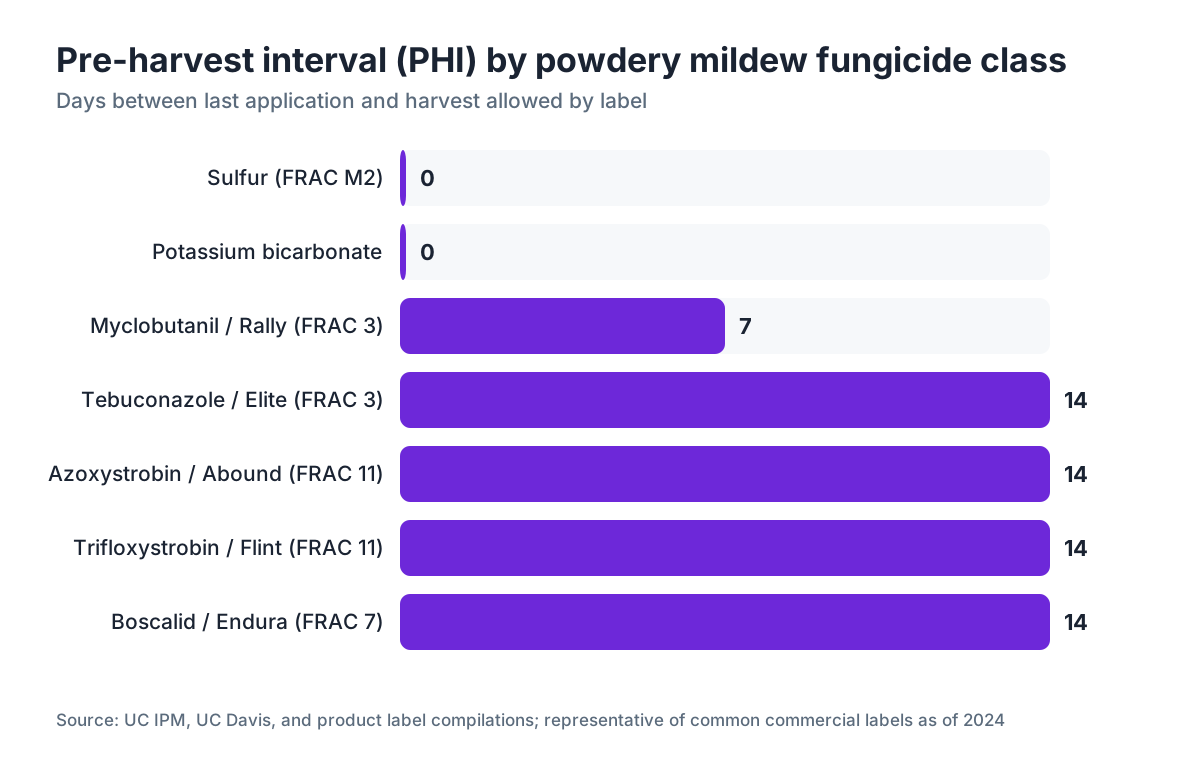
PHI and REI deserve extra attention because they drive harvest timing and worker safety directly. Sulfur has a 0-day PHI on most labels but a 24-hour REI. Some DMI products carry 7 to 30 day PHIs. If you're harvesting Chardonnay in September and you sprayed a 30-day PHI product on August 20, you have a compliance problem sitting on your calendar.
Keep records in a format you can pull fast. Compliance audits, organic certification inspections, and GAP audits all ask for application records first.
How do you handle powdery mildew in certified organic vineyards?
Certified organic vineyards face the same Erysiphe necator pressure as conventional ones, just with a smaller toolbox. The USDA National Organic Program at 7 CFR 205.601 spells out which synthetic materials are allowed, and sulfur is on the list [6]. The NOP also allows copper, potassium bicarbonate, and biological fungicides like Bacillus subtilis.
The compliance piece: your Organic System Plan (OSP) has to list the specific products you intend to use, along with their OMRI status or your certifier's approval. Switching to a new product mid-season without telling your certifier can put the certification at risk.
A practical certified-organic structure:
Start with pre-budbreak lime sulfur (if your certifier approves the formulation, so check the carriers). Then sulfur at 7-day intervals from 0 to 3 inch shoots through 3 weeks post-bloom. From berry set onward, alternate to potassium bicarbonate or Bacillus subtilis to cut sulfur residue on fruit. Some winemakers care a lot about sulfur levels on incoming fruit, so know your buyer's specs before you design the late-season program.
Canopy management carries more weight in organic programs than conventional ones. Cluster-zone leaf removal done early, around bloom, opens up air circulation and drops humidity around the fruit, which cuts infection events by a meaningful margin. Cornell research found that leaf removal at bloom reduced bunch rot incidence (which follows powdery mildew) by 30 to 50% in some trial years [4].
Variety choice matters too. Varieties with partial powdery mildew resistance (Traminette, Marquette, some hybrids) are far more manageable organically than Chardonnay or Cabernet Sauvignon.
What are the pre-harvest interval restrictions you need to plan around?
Pre-harvest interval (PHI) is the minimum number of days that must pass between the last pesticide application and harvest. It's a legal requirement printed on every pesticide label, and the label carries the force of federal law under FIFRA [11].
For powdery mildew products used in vineyards, PHIs vary a lot:
| Product (active ingredient) | FRAC Group | Typical PHI (days) | REI (hours) |
|---|---|---|---|
| Sulfur (wettable) | M2 | 0 | 24 |
| Myclobutanil (Rally) | 3 (DMI) | 7 | 24 |
| Tebuconazole (Elite) | 3 (DMI) | 14 | 12 |
| Azoxystrobin (Abound) | 11 (QoI) | 14 | 4 |
| Potassium bicarbonate (MilStop) | NC | 0 | 1 |
| Trifloxystrobin (Flint) | 11 (QoI) | 14 | 12 |
| Boscalid (Endura) | 7 (SDHI) | 14 | 12 |
Read the actual current label every time. PHIs change when labels get revised, and the label on the jug you bought this year may not match last year's version.
PHI planning means working backward from your expected harvest date and marking the last possible application date for each product in your rotation. A 14-day PHI product applied August 25 in a block you harvest September 5 is a violation, whether or not any residue shows up at harvest.
How do you assess whether your program is actually working?
Scouting is non-negotiable if you want to know whether your program is keeping pace. The standard method is a percent-incidence assessment refined through UC Davis work: walk each block on a fixed schedule (weekly during critical periods), sample 100 leaves and 100 clusters, and record the percentage showing visible powdery mildew colonies [2].
Action thresholds shift by growth stage. Before bloom, visible incidence above 1 to 2% on leaves warrants a program adjustment. After bloom, visible colonies on clusters at any level warrant a hard look at whether an application got missed or resistance is creeping in.
If you're seeing disease despite staying on schedule, run this checklist:
- Was the interval right for that week's weather?
- Was the sprayer calibrated? Was canopy coverage good enough?
- Did temperatures top 90°F within 24 hours of a sulfur application?
- Have you been leaning on the same FRAC group? Check the rotation.
- Is the site just high pressure (dense canopy, north-facing, coastal fog)?
Resistance testing is available through some university plant pathology labs if you suspect fungicide failure. Cornell and UC Davis plant pathology programs have offered sensitivity testing; contact them directly for current availability [4][2].
For ongoing analysis, a spray log you can sort by block, date, and product helps you spot patterns fast. VitiScribe's spray record module is built for this kind of block-by-block comparison and tracks PHIs automatically, which saves real time when harvest gets tight.
Are there varietal differences in powdery mildew susceptibility you should factor in?
Yes, and they change your scheduling a lot. Vitis vinifera varieties as a group are far more susceptible than hybrid or native American varieties, because vinifera co-evolved without Erysiphe necator while the pathogen's origin is tied to eastern North America.
Among vinifera:
High susceptibility: Chardonnay, Cabernet Franc, Cabernet Sauvignon, Merlot, Pinot Noir, Riesling. These need the full critical-window program at 7-day intervals.
Moderate susceptibility: Zinfandel, Grenache, Syrah. You can sometimes stretch to 10-day intervals in low-pressure conditions.
Lower susceptibility: Carignane, some Muscat clones. Don't abandon the program, but there's a little more slack.
Resistant hybrids (Marquette, La Crescent, Frontenac, Traminette) carry resistance genes from Muscadinia rotundifolia and other sources. They can be managed with much lighter programs, sometimes 2 to 3 applications per season. Washington State University's viticulture program has data on these varieties [3].
If you run mixed blocks or a mixed estate, map your varieties against susceptibility and prioritize coverage in the most susceptible blocks. Don't let a low-pressure block pull calendar time away from a high-pressure one.
Frequently asked questions
When is the most important time to spray for grape powdery mildew?
The pre-bloom to 4-weeks-post-bloom window is the most critical period. The spray at 5 to 10% cap fall (early bloom) and the one 7 to 10 days later are the two you absolutely cannot miss. Berries are most susceptible during the cell-division phase from bloom through about 3 to 4 weeks after, and infections then cause berry cracking, botrytis entry, and direct yield loss.
What is the recommended spray interval for grape powdery mildew during bloom?
Seven days is the standard maximum interval during bloom in moderate to high pressure regions. In very hot, dry conditions (daily highs above 90°F, RH below 40%), some growers extend to 10 days, but 7 days is the safer default. In a coastal or humid region with night temperatures in the 65 to 77°F range, 7 days is non-negotiable and some programs tighten to 5 to 6 days.
Can you use sulfur for organic control of powdery mildew on grapes?
Yes. Sulfur is allowed under the USDA National Organic Program (7 CFR 205.601) and anchors most certified organic grape powdery mildew programs. Apply at 3 to 4 lb actual sulfur per acre at 7 to 10 day intervals. Avoid applications when temperatures will exceed 90 to 95°F within 24 hours. Sulfur has a 0-day pre-harvest interval on most labels and multi-site activity, so resistance does not develop.
What powdery mildew fungicides have the shortest pre-harvest intervals for grapes?
Sulfur (wettable or dust) has a 0-day PHI on most labels, making it the safest choice close to harvest. Potassium bicarbonate (Kaligreen, MilStop) also carries a 0-day PHI. Most DMI and QoI fungicides run 7 to 14 day PHIs. Always check the current product label, since PHIs can change between label revisions.
How do you rotate fungicides to prevent resistance in grape powdery mildew?
Use the FRAC group codes on every fungicide label to track your rotation. Never apply two consecutive sprays from the same FRAC group. Limit DMI fungicides (Group 3) to 2 to 3 applications per season and QoI fungicides (Group 11) to 1 to 2. Sulfur (Group M2) is multi-site with no resistance risk, so it can anchor alternating applications all season.
Does grape powdery mildew spread in dry weather?
Yes. Unlike most fungal diseases, Erysiphe necator does not require rain or free water to infect. It needs relative humidity above roughly 40% and temperatures between 50 and 95°F. Coastal fog, marine layer, and dew are enough for infection events. That's why powdery mildew is a serious problem in California's nominally dry coastal valleys, and why dry weather is not a reliable reason to skip a spray.
What records are legally required for grape fungicide applications?
Requirements vary by state. In California, all commercial pesticide applications must be recorded and kept for 2 years under state pesticide regulations. Records must include the date, location, product name, EPA registration number, active ingredient, application rate, and applicator information. The EPA Worker Protection Standard (40 CFR Part 170) adds requirements for REI and safety information availability to workers and handlers.
How do you know if powdery mildew is developing resistance to your fungicides?
Signs include disease developing on your normal spray schedule with no obvious application errors, and failure concentrated in one product class. If you switch to a different FRAC group and the disease responds but returns when you go back to the original group, resistance is likely. Confirm with sensitivity testing through a university plant pathology lab such as Cornell or UC Davis. Adjust your rotation immediately and stop using the suspected FRAC group.
What canopy management practices reduce powdery mildew pressure?
Early leaf removal in the cluster zone, done around bloom, is the single most effective cultural practice. It improves air circulation, drops humidity at the fruit zone, and lets sprays reach the clusters. Cornell research found bunch rot reductions of 30 to 50% in some trial years following bloom-time leaf removal. Shoot positioning to keep the canopy open and avoiding over-fertilization (which drives excess shoot growth) both help too.
Can grape powdery mildew affect wine quality even without visible symptoms on clusters?
Yes. Sub-threshold infections that aren't visible can still push off-aromas into wine, particularly musty and mushroom notes. Research has identified volatile compounds including 1-octen-3-ol in wines made from lightly infected fruit. Some winemakers use assay tests on incoming fruit to screen for Erysiphe necator below the visible threshold, especially for high-value blocks where a whole tank is at stake.
What is the difference between powdery mildew and downy mildew on grapes?
Powdery mildew (Erysiphe necator) produces white, powdery colonies on the upper leaf surface and does not need rain to spread. Downy mildew (Plasmopara viticola) requires free water and produces yellow oil-spot lesions on the upper surface with white sporulation underneath. They need different chemistries: sulfur and DMIs for powdery mildew, copper and phosphonates for downy mildew. Growers in humid regions often manage both at once.
How many powdery mildew spray applications does a typical vineyard need per season?
High-pressure sites and susceptible varieties in humid regions typically need 10 to 15 applications per season. Drier interior regions with hot summers may get by with 6 to 8. The range comes from WSU and UC extension program outlines. Organic programs trend toward the higher end because contact-only materials require shorter intervals than systemic conventional fungicides.
Is potassium bicarbonate an effective organic treatment for grape powdery mildew?
Yes. Potassium bicarbonate (MilStop, Kaligreen, and others) is OMRI-listed and showed efficacy in UC Davis trials at 7-day intervals when used preventively. It works by disrupting fungal cell membranes and raising surface pH. Its main limits are short residual activity (5 to 7 days maximum) and higher cost per application than sulfur. It fits best as a late-season alternative to sulfur rather than a season-long backbone.
What temperature limits apply to sulfur applications in vineyards?
Do not apply sulfur when air temperatures will exceed 90 to 95°F within 24 hours of the application. Phytotoxicity risk climbs sharply above that, causing leaf and berry burn. Also avoid sulfur within 14 days of any oil-based spray (including neem and horticultural oil), since the combination causes severe phytotoxicity. Most labels spell out these restrictions, so check the current label.
Sources
- UC IPM, University of California Agriculture and Natural Resources: Powdery Mildew of Grape: Primary ascospore release begins after approximately 50 cumulative degree-days (base 50°F) from January 1; the pre-bloom through post-bloom window is the most critical for control.
- UC Davis Department of Plant Pathology: Grape Powdery Mildew Research: Infection of berries between full bloom and 3 to 4 weeks post-bloom caused near-total crop loss in susceptible varieties; potassium bicarbonate trials showed efficacy comparable to some conventional fungicides at 7-day intervals.
- Washington State University Extension: Grape Powdery Mildew Management: WSU extension identifies the period from 5% bloom through 3 to 4 weeks post-bloom as when greatest economic losses occur; recommends TRV-based airblast sprayer calibration.
- Cornell University New York State IPM Program: Grape Disease Management: Cornell recommends pre-budbreak lime sulfur as a practice to reduce overwintering inoculum; leaf removal at bloom reduced bunch rot incidence by 30 to 50% in some trial years; DMI sensitivity shifting documented in New York populations; NEWA weather network serves Northeast vineyards.
- OMRI (Organic Materials Review Institute): Product Listing: Potassium bicarbonate formulations including Kaligreen and MilStop are OMRI-listed for organic use.
- USDA Agricultural Marketing Service: National Organic Program, 7 CFR Part 205: 7 CFR 205.601 lists sulfur as an allowed synthetic material in organic crop production when other effective practices have been exhausted and contamination of water resources is not a concern.
- California Department of Water Resources: CIMIS (California Irrigation Management Information System): CIMIS provides free access to weather station data including relative humidity and temperature used for powdery mildew risk modeling in California vineyards.
- U.S. EPA: Worker Protection Standard, 40 CFR Part 170: The EPA Worker Protection Standard requires that pesticide product name, EPA registration number, active ingredient, and application details be available to agricultural workers and handlers; the standard was updated in 2015 with strengthened requirements.
- California Department of Pesticide Regulation: Pesticide Record-Keeping Requirements: California law requires commercial pesticide application records to be retained for 2 years and include product, rate, location, date, and applicator information.
- USDA Economic Research Service: Fruit and Tree Nut Data: Grape production data used for context on the scale of commercial vineyard operations in the United States.
- EPA: Federal Insecticide, Fungicide, and Rodenticide Act (FIFRA): Under FIFRA, pesticide labels are federal law; pre-harvest intervals and application requirements are legally binding label requirements.
- UC Agriculture and Natural Resources: UC ANR Publication 3343, Grape Pest Management: UC ANR provides spray calibration guidelines and disease management protocols including degree-day models for California grape production.
Last updated 2026-07-09