Grape powdery mildew cankers: what they are and how to manage them
TL;DR
- Grape powdery mildew cankers are perennial infections where Erysiphe necator survives winter inside dormant buds and beneath bark.
- In spring they push stunted flag shoots that release millions of spores before any white mycelium shows on your leaves.
- Beating them takes dormant sulfur, physical shoot removal, and a spray program timed to degree-day models rather than the calendar.
What are grape powdery mildew cankers, exactly?
Grape powdery mildew cankers are overwintering infection sites buried in grapevine wood. The fungus behind them, Erysiphe necator (formerly Uncinula necator), doesn't die back completely in winter. It survives inside dormant buds and, in mature vineyards, in lesions embedded in cordon and cane bark. Those bark cankers look like bleached or slightly sunken patches on older wood, often with a faint yellow-brown discoloration just beneath the surface.
Most textbook definitions describe powdery mildew as a leaf disease. That's accurate and incomplete. The canker form is the part that makes the disease so hard to wipe out. Because the fungus persists in wood, new infections can start from inside the vine itself, more than from a neighbor's block or wild hosts.
Cornell's grape IPM program notes the fungus can overwinter two ways: as cleistothecia (sexual fruiting bodies) on bark surfaces, and as dormant mycelium inside infected buds and wood tissue [1]. The bud route costs you the most money. Infected buds produce stunted, powdery "flag shoots" early in spring, and those shoots feed the whole season's epidemic before most growers have even fueled up a sprayer.
So how do you know if you have a canker problem versus a plain leaf-mildew problem? Here's the honest test. If mildew pressure ran high in past seasons and you see flag shoots every spring, you have both.
How does the powdery mildew life cycle start from cankers each spring?
The spring cycle starts earlier than most growers expect. Infected buds break first, right alongside or even ahead of healthy buds, and the shoots they push are colonized from the moment they emerge. UC Davis viticulture extension work describes these flag shoots as white to gray-green, stunted, often curled, with dense sporulation you can see without a hand lens [2].
From one infected bud, conidia scatter within hours of a warm, dry morning. Powdery mildew doesn't need rain to spread, which trips up a lot of people. Conidia travel on wind. Germination happens across a relative humidity range of 40 to 100 percent, best around 80 to 100 percent, but spores still germinate in dry air if temperatures are right (between 50 and 90 degrees F, with an optimum near 68 to 77) [2].
The degree-day model used across the western U.S., and built into California's UC IPM guidelines, tracks accumulated heat above a 50 degree F base after a January 1 reset. Infection risk gets serious around 50 degree-days, and the first big sporulation wave from flag shoots usually lines up with shoot growth between 1 inch and 6 inches [2][3].
What that means in the field: by the time you spot white colonies on young leaves or shoot tips, you're already behind. Canker spores have been landing and germinating for days.
How do cankers differ from standard foliar powdery mildew infections?
Standard leaf infections are, in a sense, self-limiting. Hammer the disease with fungicides and let conditions turn unfavorable, and foliar colonies die back and stop sporulating. Cankers don't play by those rules. Mycelium in bark tissue sits largely out of reach of foliar sprays, because fungicide can't push into established woody tissue at normal application rates.
Here's the practical difference laid out:
| Feature | Foliar/shoot infection | Bark/bud canker |
|---|---|---|
| Timing | Season-long, weather-driven | Perennial, overwinters |
| Visibility | White mycelium on surface | Bleached bark, flag shoots |
| Fungicide reach | Yes, most topical fungicides work | Limited; requires dormant-season approach |
| Inoculum role | Secondary spread within season | Primary inoculum source in spring |
| Management window | At-infection to before sporulation | Dormant through early bud break |
Washington State University extension research on the canker cycle is blunt about the compounding math: vineyards with high mildew pressure year over year build up more infected wood, and that wood drives higher flag-shoot counts the next spring [4]. Foliar programs alone don't break the loop.
The other distinction is time. Cankers in old cordon wood can persist for years. Pruning infected cordons back to clean wood is sometimes the only way to cut the inoculum load in a chronically infected block.
What does a powdery mildew canker look like, and how do you confirm it?
In dormant wood, look for patches of bleached, grayish bark with a clean margin where infected tissue meets healthy wood. Scrape back the outer bark with a knife and infected areas may show a yellow-brown to light tan color in the cambium. It's not the dramatic necrosis you get from Botryosphaeria or Eutypa, and that's exactly the trap. Growers walk right past it.
During the growing season, the clearest sign is the flag shoot: stunted, distorted, coated in white or gray powder from the base, showing symptoms before nearby shoots show anything at all. These turn up from late April through May across most of California and the Pacific Northwest.
On clusters, the fungus can russet or scar the berry skin (the familiar powdery mildew berry damage), and under heavy pressure it bleaches and cracks the skin, opening the door for Botrytis. In warm, dry years that cluster damage is often the most expensive outcome of the whole season.
Unsure? Send a sample to your state plant diagnostic lab. UC Davis runs a diagnostic lab service, and so does the Cornell Plant Disease Diagnostic Clinic [5][6]. Under the microscope, E. necator gives itself away with barrel-shaped conidia produced in chains. Don't guess on this one if you're basing replant or canker-removal decisions on the answer.
What spray programs actually reduce canker populations over time?
The dormant application is where most growers leave money on the table. Lime sulfur at 3 to 4 percent, put on during full dormancy with no green tissue showing, kills overwintering mycelium on bark surfaces and in cleistothecia. It won't reach deep into bark cankers, but it knocks down surface inoculum in a way you can measure. Lime sulfur at those rates burns green tissue, so the window slams shut once buds start to swell.
Once the season is running, the goal flips to protecting new green tissue before infection lands. UC IPM guidelines say to start fungicide applications at 1-inch shoot growth or around 50 degree-days (base 50 F) after January 1, whichever comes first [2][3]. Blowing this window is the single most common management mistake.
On product choice, the rotation matters more than any one material. Resistance to DMI (Group 3) fungicides is documented in California, Oregon, and Washington populations of E. necator [4][7]. WSU extension recommends rotating among Group 3 (DMIs like myclobutanil, tebuconazole), Group 11 (QoI strobilurins, high resistance risk), Group U8 (quinoxyfen), and Group M2 (sulfur) products across the season [4].
Sulfur is the backbone. It's cheap, it works, and resistance hasn't developed. Wettable sulfur at 3 lb/acre on a 7 to 14 day schedule during high-risk periods (young shoot growth, pre-bloom, bloom) covers most of what the pricier materials do, as long as you hold intervals tight and stay off it above 90 degrees F, where phytotoxicity risk climbs fast.
For blocks pushing lots of infected buds, the long-term fix stacks several moves. Dormant lime sulfur. Aggressive early-season sulfur. Physical removal and burning of flag shoots the day you see them. And in the worst blocks, cutting infected cordons back to clean wood at winter pruning. No spray program alone fixes a vineyard where the inoculum lives inside the wood.
How do you time fungicide applications using degree-day models?
Degree-day models take the guesswork out of spray timing in a way calendar scheduling never can. The model most often used in California is the UC Davis Risk Index (the Gubler-Thomas model), which weighs how long temperatures stay favorable rather than just whether a daily threshold got hit [2][3].
Here's the stripped-down version. After a spore dispersal event, which any day above 50 degrees F during early shoot growth can trigger, the model watches whether temperatures hold in the 70 to 85 degree F range. If they do, the risk index climbs fast and a fungicide is warranted within a few days. If it turns cooler, or spikes above 95 degrees F (which kills conidia), the index drops back.
Accumulated degree-days also predict when flag shoots start throwing spores. UC Cooperative Extension work found flag shoots begin releasing conidia at roughly 50 to 100 degree-days (base 50 F) from January 1, with peak early-season sporulation near 200 to 300 degree-days [2].
Two free tools get used the most:
- UC IPM's online degree-day calculator (ipm.ucanr.edu), which pulls CIMIS weather station data [3].
- WSU's Decision Aid System (DAS), which does the same job for Pacific Northwest sites [4].
If you record spray applications in a system like VitiScribe, tagging each spray with the degree-day total at time of application makes it easy to look back at end-of-season disease outcomes and tighten next year's program. That's the kind of data you can't reconstruct from memory in November.
One honest caveat. These models came mostly from California and Pacific Northwest data. If you farm in Virginia, New York, or the Southeast, the base models still apply, but your local extension office should have region-specific calibrations.
What varieties are most susceptible to canker development?
Every Vitis vinifera variety is susceptible to E. necator. This isn't a scale from resistant to susceptible. It runs from severely susceptible to moderately susceptible. American species (V. labrusca, V. riparia) carry much higher natural resistance, which is why French-American hybrids tend to run under lower mildew pressure.
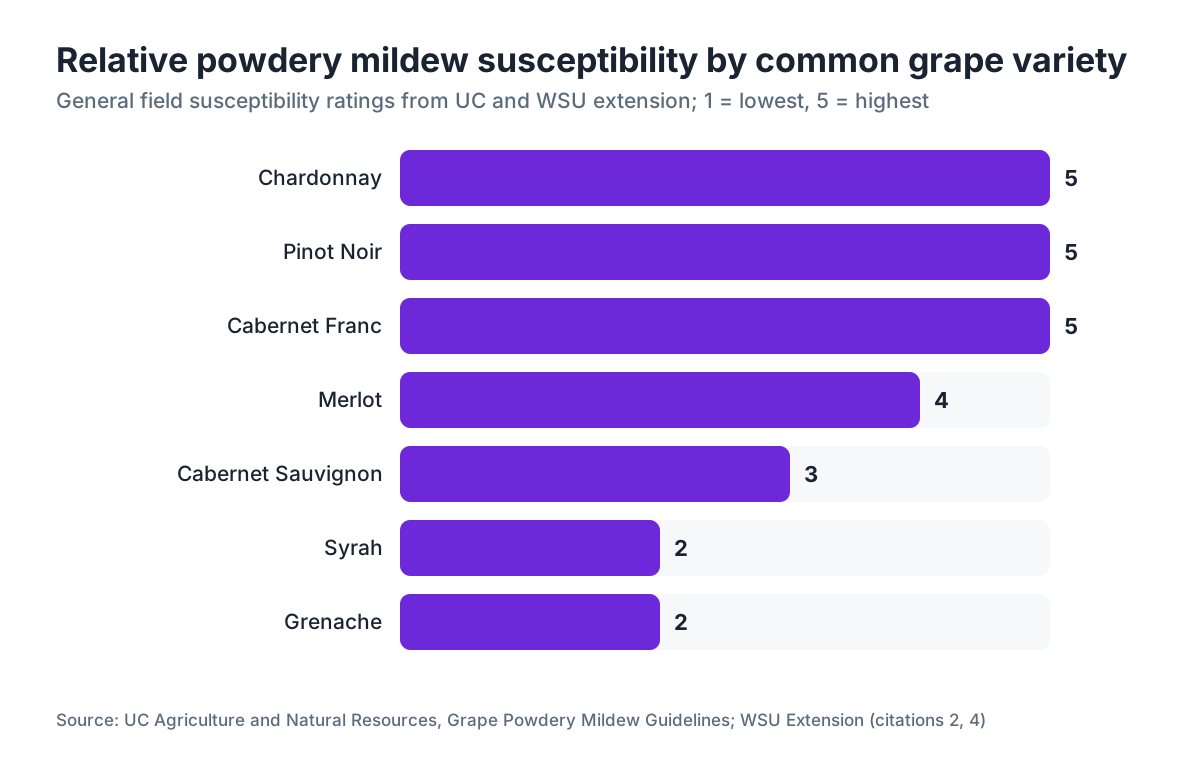
Among vinifera, Chardonnay, Cabernet Franc, Merlot, and Pinot Noir show up again and again as high-risk in both academic and grower literature. Cabernet Sauvignon lands at moderate. Syrah tends to run a bit lower in the field, though it still needs a full fungicide program.
Variety matters for cankers because more frequent, more severe leaf and shoot infections give the fungus more chances to colonize buds and eventually wood. A Chardonnay block coming off two bad mildew seasons carries a meaningfully higher canker load than a well-managed Syrah block, all else equal.
Planting a new vineyard? Factoring disease cost into variety choice pays off. Powdery mildew fungicide programs in California run roughly $150 to $350 per acre per year in materials alone, depending on how hard you lean on DMI and strobilurin products versus sulfur [7]. Put a susceptible variety on a warm coastal site and that material cost compounds every single season.
How do cankers affect wine quality and yield?
Powdery mildew hits your money three ways: direct yield loss from berry and cluster infection, wine quality loss from infected fruit, and long-term structural damage as cankers pile up in the vine.
Severe berry infection can cost 20 to 80 percent of yield in unmanaged blocks during high-pressure years. That range is wide because it's so weather-dependent. A cool, humid bloom followed by warm spring temperatures is the worst case.
On quality, infected berries produce wine with elevated 1-octen-3-ol and other fungal metabolites tied to musty, earthy off-aromas. Research in the American Journal of Enology and Viticulture documented sensory effects at low infection levels, with as little as 3 to 6 percent infected berries affecting panel scores [8]. That's why some wineries hold a zero-tolerance line on visibly infected fruit at the crush pad.
The canker-specific damage is subtler but it stacks up. Vines carrying heavy canker loads push more flag shoots and fewer productive shoots. Over several seasons you get uneven canopy, more gaps in the cordon, and weaker growth from infected positions. The vineyard loses productive capacity from the inside out.
What does the EPA worker protection standard require for powdery mildew sprays?
Most fungicides used against powdery mildew in grapes are either restricted-use pesticides (RUPs) or general-use products with specific WPS requirements. The EPA's Worker Protection Standard (40 CFR Part 170) applies to any agricultural establishment where pesticides are applied [9].
The WPS requirements that touch a powdery mildew program most:
Restricted-Entry Intervals (REIs) vary by product. Sulfur runs a 24-hour REI in most formulations. DMI fungicides like myclobutanil (Rally 40WSP) carry a 24-hour REI. Some sterol inhibitors go as high as 72 hours. Check the current label every time. The label is the law, and its REI overrides any general guidance.
The 2015 revised WPS rule, effective January 2017, added central posting of pesticide application information, minimum age rules (18 for handling most RUPs, 16 for supervised work in treated areas), and mandatory annual pesticide safety training for all workers who enter treated areas [9].
For records, you must keep a pesticide application record with the product name, EPA registration number, active ingredient, application date, location and size of the treated area, amount applied, and the name of the certified applicator or responsible person. California layers on more under its pesticide use reporting system, with submissions to the County Agricultural Commissioner [10].
The University of California Agriculture and Natural Resources office publishes a summary of California pesticide record-keeping rules worth keeping in your compliance binder [10]. Cornell Cooperative Extension has a comparable summary for New York growers covering where federal WPS meets state DEC requirements [1].
When should you remove infected wood versus spray through it?
This is the call that separates growers who keep cankers in check from growers who spend more on fungicides every year and still lose ground.
WSU extension gives a workable rule of thumb: if more than 20 to 30 percent of buds on a cordon are pushing flag shoots, that cordon is a liability [4]. Spraying harder won't touch the internal infection. You're better off cutting it back at the next winter pruning to a healthy spur or cane, eating the yield loss for a season, and rebuilding with clean wood.
For individual flag shoots during the season, the guidance is simpler. Pull them early, before they dump a full sporulation load. Get them off the trellis and out of the vineyard. Don't drop them on the ground and mow them in, because spores survive for a while on detached tissue. Burn them or haul them off-site.
When infection is light (a few scattered flag shoots, no obvious bark cankers on older wood), a strong spray program plus flag-shoot removal is enough. Track flag shoots per vine and per block. If that number climbs year over year despite a solid fungicide program, you likely have a canker load feeding the inoculum, and removal is the right move.
Replanting anyway? Don't underestimate residual inoculum from cleistothecia on fallen bark and leaves. A thorough floor cleanup before replanting, ideally with a cover crop rotation, helps break the cycle.
How does this affect organic and biodynamic operations?
Organic growers have fewer tools, but the ones they have work well against powdery mildew. Sulfur is OMRI-listed and allowed under USDA National Organic Program standards [11]. Copper is allowed with restrictions. Potassium bicarbonate (Kaligreen, Armicarb) is allowed and does a decent job, especially at early infection, though it doesn't hold as long as sulfur.
The dormant lime sulfur application is fully compatible with organic certification. It's probably the single highest-value spray an organic grower makes for canker management.
What organic programs give up: DMI fungicides, QoI fungicides, and quinoxyfen, the synthetic options with the best systemic activity against established infections. So organic programs have to be sharper on timing. Fall behind on intervals during a high-pressure stretch and you have fewer rescue options.
The degree-day models above apply to organic programs exactly the same way. Tight timing matters more, not less, when your material options are limited. Some organic growers in high-pressure regions run sulfur on 7-day intervals through bloom and early fruit set and accept the higher material and application cost as the price of the system.
UC Cooperative Extension publishes a guide to organic wine grape production that covers powdery mildew management in detail [2].
What records do you need to keep for a complete powdery mildew management audit?
Your spray records need to be complete, accurate, and held for the legally required period. In California, pesticide use records must go to the County Agricultural Commissioner within 7 days of application and be kept for 3 years [10]. Federal WPS requires application records to be retained for 2 years.
A complete powdery mildew record set for an audit covers three things.
For each application: date, time, block or field ID, acreage, product name, EPA registration number, active ingredient and rate, gallons per acre of water, application method, applicator name, REI posted, and weather at time of spray.
For disease monitoring: a scouting log showing when you looked, what you found, flag-shoot counts by block, and degree-day data from your nearest weather station for the period.
For canker decisions: notes on which cordons or canes came out, why, and when. If you're making a case to your farm advisor, your crop insurance adjuster, or a buyer that you managed the crop responsibly, this paper trail is what makes that case stick.
Keeping it all in one system saves real time at year-end and during any review. VitiScribe is built for exactly this field-to-compliance record chain, which is why growers running multiple blocks find it easier than spreadsheets once spray programs get complex.
If you farm in a state with a heavier reporting structure (California, New York, and Washington all stack their own layers on top of federal WPS), your county farm advisor can walk you through the exact local format.
Frequently asked questions
What causes grape powdery mildew cankers to form in the first place?
Cankers form when Erysiphe necator mycelium from a leaf or shoot infection colonizes dormant buds and pushes into adjacent bark tissue before the vine hardens off in fall. The fungus then survives winter inside that wood. High disease pressure in summer and fall, plus late-season infections that don't get controlled before dormancy, are the most direct causes of canker buildup.
Can powdery mildew cankers kill a grapevine?
Cankers alone rarely kill a vine outright. The usual outcome is a slow loss of productive capacity: more flag shoots, fewer healthy shoots, weaker cordons that need replanting. Over many seasons in an unmanaged block, a vine's economic productivity can drop hard. Secondary pathogens like Botrytis entering through mildew-damaged tissue can do more acute harm.
What is the grape powdery mildew definition in simple terms?
Grape powdery mildew is a fungal disease caused by Erysiphe necator that infects grapevine leaves, shoots, clusters, and wood. It produces white to gray powdery growth (masses of spores) on infected surfaces. Unlike most fungal pathogens, it needs no free water to germinate and spreads readily in warm, dry, or moderately humid conditions across the whole growing season.
How do you identify a powdery mildew canker versus other wood diseases in grapes?
Powdery mildew cankers look like bleached or grayish patches on dormant bark, often with yellow-brown discoloration just beneath the surface. They lack the dark, wedge-shaped necrosis typical of Eutypa lata or the dark-streaked wood of Botryosphaeria. The clearest seasonal tell is flag shoots: white, stunted, powdery shoots from infected buds in early spring. Send uncertain samples to a university plant diagnostic lab for confirmation.
Does dormant pruning reduce powdery mildew canker pressure?
Yes, but only if you're removing infected wood, more than any wood. Pruning cordons or canes that carried heavy flag-shoot loads back to visibly healthy tissue cuts the inoculum source for next season. Pruning on schedule without targeting infected wood doesn't do much. Burn or remove prunings from infected blocks rather than leaving them on the vineyard floor.
What is the best fungicide for grape powdery mildew cankers?
No single fungicide reaches established wood cankers well. For surface inoculum on bark, dormant lime sulfur (3 to 4 percent solution) is the most practical option. During the season, the goal is protecting green tissue before infection, not curing cankers. A rotation of wettable sulfur, DMI fungicides (Group 3), and quinoxyfen (Group U8) gives the broadest coverage while managing resistance risk.
How often should you scout for powdery mildew cankers and flag shoots in spring?
Scout at least weekly from bud swell through shoot growth of 12 inches. Count flag shoots per vine in a representative sample (at least 10 vines per block, more if the block is large or has a variable history). Record counts by row and position if you can. This data tells you which blocks carry the highest canker load and where to aim your early-season spray resources.
Are there grape varieties resistant to powdery mildew cankers?
No commercial vinifera variety is truly resistant to E. necator. Interspecific hybrids carrying resistance genes from American Vitis species (such as Marquette, Noiret, or varieties with Muscadinia rotundifolia genetics) show much lower susceptibility. Among common vinifera, Syrah and Grenache are often cited as somewhat less susceptible than Chardonnay, Pinot Noir, or Cabernet Franc, but all need a full fungicide program.
What temperature kills powdery mildew conidia on grapevines?
Temperatures above 95 degrees F (35 C) kill conidia fairly quickly, which is why disease pressure often eases during heat events. The canker-origin mycelium inside bud and bark tissue is insulated, though, and rides those episodes out. Freezing winter temperatures reduce cleistothecia on bark surfaces but don't wipe out infected-bud inoculum, which is why hard winters don't reliably reset a canker problem.
How do you treat an organic vineyard with a heavy powdery mildew canker load?
Start with dormant lime sulfur at 3 to 4 percent before bud swell. During the season, run wettable sulfur on a 7-day interval through bloom and early fruit set, stretching to 10 to 14 days if pressure drops. Potassium bicarbonate adds a useful mode of action and is OMRI-listed. Remove all flag shoots on sight. Prune infected cordons back to clean wood at winter pruning. There's no organic rescue spray; prevention is everything.
What records are legally required for grape powdery mildew fungicide applications?
Under the EPA Worker Protection Standard, you must record the product name, EPA registration number, active ingredient, application date, treated area and size, amount applied, and responsible applicator name. California also requires submission to the County Agricultural Commissioner within 7 days and a 3-year retention period. Most states layer their own pesticide use reporting requirements on top of federal rules.
Can you spray a fungicide after you see flag shoots to stop canker spread?
Fungicides applied after flag shoots emerge stop secondary spread to nearby green tissue but don't kill the internal canker infection. Remove flag shoots immediately by hand, get them off-site, and apply a protectant fungicide within 24 hours to shield adjacent new growth. That limits the season's secondary epidemic, but the infected bud positions remain an inoculum source next spring.
How long do powdery mildew cankers persist in grapevine wood if untreated?
Cankers can last the life of the infected wood structure. Infected cordon arms carry viable mycelium year after year as long as the wood stays alive and connected to the vine. Removing and replacing the infected cordon is the only reliable way to eliminate that specific inoculum source. There's no treatment that cures established wood infections; management is about reducing new wood infection each season.
Sources
- Cornell Cooperative Extension, Grape IPM and Pesticide Recordkeeping Guidance: E. necator overwinters as cleistothecia on bark and as dormant mycelium in infected buds and wood; NY growers must meet federal WPS plus state DEC requirements
- UC Agriculture and Natural Resources, Grape Powdery Mildew Pest Management Guidelines: Flag shoots begin releasing conidia at 50-100 degree-days base 50F; infection requires 50-90F with optimum near 68-77F
- UC IPM, Degree-Day Calculator and Risk Index: Fungicide applications should start at 1-inch shoot growth or ~50 degree-days (base 50F) from January 1
- Washington State University Extension, Grape Powdery Mildew Management: High mildew pressure years increase flag-shoot density the following spring; resistance to DMI fungicides documented in Pacific Northwest populations
- UC Davis Department of Plant Pathology Diagnostic Services: UC Davis offers plant diagnostic services including microscopic confirmation of E. necator
- Cornell Plant Disease Diagnostic Clinic: Cornell provides diagnostic services for grapevine fungal diseases including powdery mildew
- UC Cooperative Extension, Fungicide Resistance in Grape Powdery Mildew: Powdery mildew fungicide programs in California cost roughly $150 to $350 per acre per year in materials; DMI resistance documented in California populations
- American Journal of Enology and Viticulture, sensory impacts of powdery mildew on wine: As little as 3-6 percent infected berries in a lot can produce detectable off-aromas in wine at panel evaluation
- EPA Worker Protection Standard, 40 CFR Part 170: WPS requires REI posting, pesticide application records, annual worker safety training, and minimum worker age requirements
- California Department of Pesticide Regulation, Pesticide Use Reporting: California requires pesticide use reports submitted to the County Agricultural Commissioner within 7 days and retained for 3 years
- USDA National Organic Program, Allowed and Prohibited Substances: Sulfur and potassium bicarbonate are allowed for organic production; copper is allowed with restrictions
Last updated 2026-07-09