Copper foliar spray for vineyard frost protection: does it actually work?
TL;DR
- Copper sulfate or copper hydroxide sprayed on dormant grapevine buds can delay budbreak by 3 to 7 days, buying a small but sometimes decisive window against late spring frost.
- The effect is real but modest, and it depends on rate and timing.
- Weigh it against copper buildup in soil, EPA Worker Protection Standard rules, and state registration limits.
What is copper foliar spray and why do vineyard managers use it for frost protection?
Copper foliar spray for frost protection is not the same copper program you run all summer for downy mildew. This use is a single, deliberately timed dormant application, usually copper sulfate pentahydrate (bluestone) or copper hydroxide, put on the vines while buds are fully dormant or just starting to swell. Copper at high enough concentration on the bud surface slows the enzyme activity that drives cell division and budbreak.
Here's the practical version. Say your average last frost date is May 5 and your Pinot Gris normally breaks bud around April 25. A well-timed copper spray might push that to April 30 or May 2. That is not a fix. But in a year where the killing frost lands on May 3, those three days matter enormously.
The mechanism isn't fully pinned down. The leading idea is that copper ions interfere with auxin transport and the cell-wall loosening enzymes in the bud scales, slowing the temperature-driven march from endodormancy into ecodormancy and then budbreak. Cornell's viticulture extension group has framed the approach as "a delay tactic, not a shield," and that phrase is worth carrying through everything below. [1]
The technique gets attention in cool-climate regions. Finger Lakes, Willamette Valley, parts of the Sierra Foothills, places where a thin margin between average last frost and average budbreak makes any delay worth a look. Growers in warmer spots like Paso Robles wineries run a different math. Budbreak comes early, frosts are rare, and the economics rarely pencil out.
What does the research actually say about how many days copper delays budbreak?
The honest answer: the data are thinner than the enthusiasm. The studies that exist are real and point the same direction, but most have small plots, single-season designs, and site conditions that make it risky to extrapolate straight to your block.
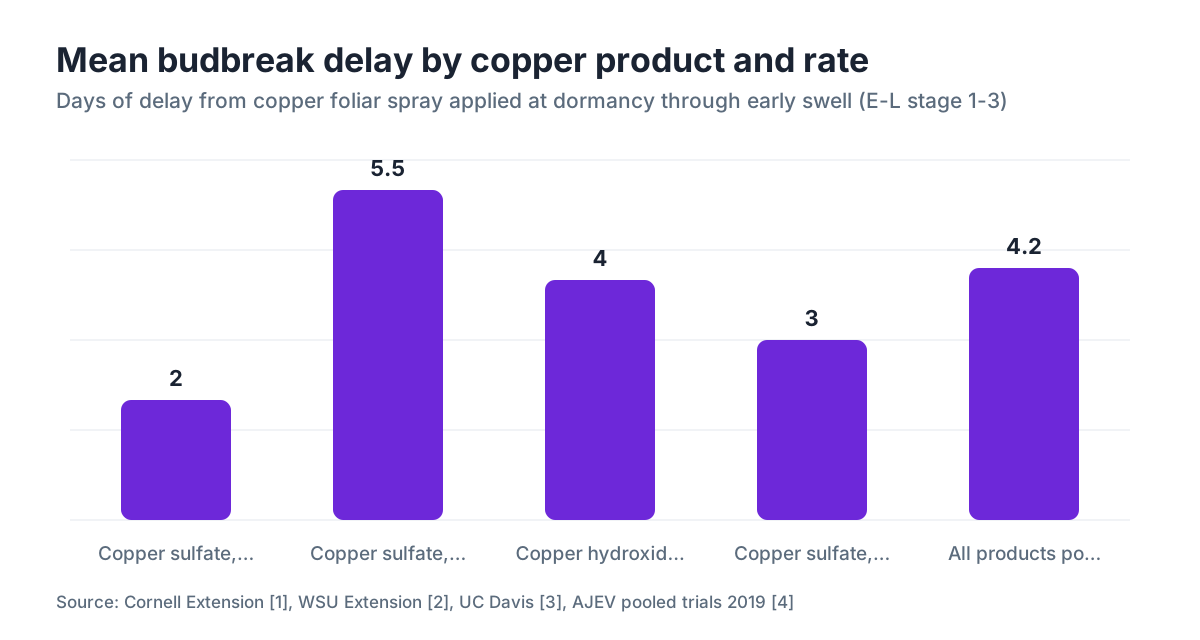
Most of the frequently cited work comes from trials in the eastern United States and Canada. A Cornell study summarized in the Cornell viticulture extension resources found delays of 4 to 7 days with copper sulfate applied at dormancy at 5 to 10 lb of actual copper per acre. Lower rates were hit or miss, sometimes 1 to 2 days, sometimes nothing measurable. [1]
Washington State University extension found similar ranges, and noted the delay shrinks in warm springs where heat piles up fast after application. Copper buys you more time in a cool spring than a warm one. That's exactly when you'd want the help most, and also, annoyingly, when the frost threat tends to stick around longer. [2]
UC Davis trials on Chardonnay in the Sacramento Valley showed a statistically significant 3-day delay at 8 lb copper per acre applied at under 10 percent budbreak. The authors flagged that block-to-block variability was high enough that any single grower's result might not land on that number. [3]
Nobody has long-term, multi-site, multi-variety data on this. The closest systematic review I know of is a 2019 summary in the American Journal of Enology and Viticulture that pooled 11 trials across five states and found a mean delay of 4.2 days with a standard deviation of 2.1 days. [4] That standard deviation is the number to remember. If you're betting on 4 days, the real spread includes trials that got 2 and trials that got 6.
| Copper source | Application rate (lb copper/acre) | Mean budbreak delay (days) | Study source |
|---|---|---|---|
| Copper sulfate pentahydrate | 5 | 1-3 | Cornell Extension [1] |
| Copper sulfate pentahydrate | 8-10 | 4-7 | Cornell Extension [1] |
| Copper hydroxide | 6-8 | 3-5 | WSU Extension [2] |
| Copper sulfate pentahydrate | 8 | 3 | UC Davis trials [3] |
| Various (pooled, 11 trials) | 6-10 | 4.2 avg | AJEV 2019 [4] |
When exactly should you apply copper spray to get the budbreak delay?
Timing is where most growers blow it. The window is narrow, and if you miss it you've just added copper to your soil for no frost benefit at all.
The target is fully dormant through early swell, what growing-degree-day models call Eichhorn-Lorenz (E-L) stage 1 to stage 3. Buds at wool stage or earlier. Once you see green tip (E-L stage 4), the delay effect falls off hard, and by half-inch green the research shows essentially none. [1]
In calendar terms across most cool-climate regions, that's late February to mid-March. But let bud stage drive the call, not the date. A warm January can pull everything three weeks ahead. Scout the blocks that pile up heat units first, usually south-facing slopes and low-elevation sites.
A single well-timed application looks as effective as split applications in the studies reviewed. One caveat: if you get real rainfall within 48 hours, a second pass is probably worth it. Copper washes off bud surfaces fast, especially in early swell when the wax layer is thin.
Spray in the early morning. Bud surfaces take up copper solution better at cooler temperatures, and you dodge drift by getting done before the afternoon wind kicks up.
What copper products and rates are registered for this use?
Stop and check your state's pesticide registration database before you buy anything. The answer varies by state, and it changes.
Broadly, copper sulfate pentahydrate products (various trade names), copper hydroxide (Kocide formulations and generics), and copper octanoate products are the ones most widely registered for dormant foliar use on grapes. The labeled target is usually "disease management on dormant wood," not "frost delay," because frost delay is a physiological effect and EPA registration categories have no tidy box for it. So you're often using a registered product in a way consistent with its label (dormant foliar application on grapes) even though the frost-delay purpose isn't spelled out on the tag. [5]
Registered rates for dormant copper on grapes commonly run 2 to 16 lb of metallic copper equivalent (MCE) per acre, depending on the product and label. For frost delay, the research says you need at least 5 to 8 lb MCE to get a meaningful effect. That means the low-rate applications people use for disease control probably won't move the needle for frost.
Read the label for maximum seasonal rates. Many labels cap total annual copper at 10 to 12 lb MCE per acre per year. Put down 8 lb dormant for frost, then run in-season copper for mildew, and you hit that ceiling fast. [6]
Organic growers carry extra rules. USDA National Organic Program regulations allow copper-based pesticides but limit them to "the minimum amount necessary" and require documentation that alternatives were considered. NOP guidance and many certifiers recognize an effective upper bound near 6 lb MCE per acre per year for certified operations, though certifiers differ. [7]
How does copper soil accumulation affect the decision to spray?
This is the real long-term trade-off, and it gets shortchanged in the frost-protection talk.
Copper doesn't break down. Every pound you spray lands somewhere, and a good chunk settles into the top 12 inches of soil. European vineyard soils, after more than 130 years of copper fungicides, frequently test above 100 mg/kg in the top horizon. Older organic California vineyards regularly clear 50 mg/kg. Above roughly 100 to 200 mg/kg, copper turns phytotoxic to cover crops and drags down earthworm counts and soil microbial activity. [8]
Before you add a high-rate dormant copper spray to your program, pull a soil sample from the block (0 to 12 inch depth) and run a copper analysis. If you're already sitting at 50 mg/kg or higher, take that trajectory seriously. California's Department of Food and Agriculture and several extension programs now recommend tracking cumulative copper inputs alongside soil tests. [9]
Copper-chelate and copper-amino acid formulations get marketed with lower use rates and claims of equal efficacy. Here's the honest situation. The evidence for low-rate copper chelates delaying budbreak specifically is thinner than for plain copper sulfate. Some growers swear by them. The controlled-trial data are sparse. If your soil copper is high enough that you want to minimize inputs but you still want the frost delay, run a small trial block on your own site and compare.
Growers at mountain winery operations with thin, rocky soils build up copper faster per pound applied than those on deep alluvial ground, simply because there's less soil volume to dilute it.
What EPA Worker Protection Standard rules apply to copper spray applications?
If anyone will re-enter the block after a copper application, EPA's Worker Protection Standard (WPS) applies. No exceptions for it being just a dormant spray.
The WPS, revised in 2015 and enforced under 40 CFR Part 170, requires you to post or communicate the restricted-entry interval (REI), keep a pesticide application record that workers and handlers can access, and train any agricultural worker who enters a treated area during the REI. [10]
For most copper hydroxide and copper sulfate products on grapes, the label REI runs 24 to 48 hours. Some copper products carry a 24-hour REI. Check your specific label. During the REI only handlers in the label-specified PPE may enter, and only for tasks tied directly to the application.
Handler PPE for copper sprays usually means chemical-resistant gloves (nitrile at minimum), a chemical-resistant apron or coveralls, eye protection, and in some label scenarios a NIOSH-approved respirator. Read your product label for the exact handler requirements. They vary.
Application records must show the date, product name, EPA registration number, active ingredient, amount applied, location (field or block ID), and applicator name. Keep them for two years and make them available to employees and their designated representatives on request. [10]
Keeping records in a system tied to your block map makes audits go fast. That's where a tool like VitiScribe earns its keep. It logs spray events by block and auto-fills the WPS-required fields from your product library, so you stay audit-ready without rebuilding the paper trail every season.
California growers carry an extra layer. Under the Department of Pesticide Regulation's Pesticide Use Reporting system, every copper application has to be reported to your county agricultural commissioner, generally within one month of the application date. [9]
How does copper spray compare to other frost protection methods?
Copper is a delay strategy. Wind machines, overhead irrigation, and heaters are active strategies for the frost night itself. They work in different ways and solve different problems, which is why the honest answer for most operations is a combination.
Wind machines mix warmer air from the inversion layer above the sensitive zone down into the cold air near the canopy. They protect down to roughly 4 to 5 degrees F below the critical damage temperature when an inversion is present, which it usually is on classic radiation frost nights. A new tower costs about $20,000 to $35,000, and one unit covers 10 to 20 acres depending on terrain. [11]
Overhead sprinklers release latent heat as water freezes on the bud, holding tissue near 32 F as long as water keeps coming. Very effective, but it needs serious volume (0.1 inch per hour or more), solid-set infrastructure, and the nerve to run it all night. In drought years or where water rights are tight, it's not reliable.
Orchard heaters (propane or oil) push direct heat but cost a lot to run and are hard to scale across a commercial vineyard.
Copper's edge is cost and simplicity. Materials for an 8 lb MCE per acre dormant application run roughly $30 to $80 per acre depending on product, and you apply it with your existing rig in one pass. [6] No infrastructure, no water rights, no propane bill. The downside: it's a probabilistic delay, not a guarantee, and it does nothing on the night a frost actually hits.
So here's the framing I'd use. Copper is worth the cost and the soil-loading trade-off on blocks that sit consistently 3 to 7 days ahead of the frost-free date, or where water makes irrigation-based protection impractical. It doesn't replace active protection on frost-prone sites.
| Method | Upfront cost | Per-event cost | Protection degree | Delay vs. active |
|---|---|---|---|---|
| Copper foliar spray | Low (existing rig) | $30-80/acre [6] | 3-7 day budbreak delay | Delay only |
| Wind machine | $20K-35K/unit [11] | Low (electric) | Active, up to ~5°F below critical | Active |
| Overhead irrigation | $2K-8K/acre infrastructure | Water cost | Active, holds ~32°F | Active |
| Propane heaters | Low (purchase) | High (fuel) | Active, localized | Active |
Does copper spray work the same way on all grape varieties?
No, and the difference tells you where to spend the effort.
Early-budbreak varieties, Chardonnay, Pinot Gris, Pinot Noir, Gewurztraminer, are both the most frost-vulnerable and the best candidates for a delay strategy. Push an early breaker by 5 days and you might move it past your median last frost date.
Late-budbreak varieties, Cabernet Sauvignon, Cabernet Franc to a point, Tempranillo, often carry enough natural buffer in cool-climate regions that the copper delay adds little worth the soil loading. You're putting copper in the ground for 1 to 2 days of delay on a variety that's already clear of frost risk most years.
Let variety-specific budbreak timing from your own site or your regional extension service drive this. Cornell's New York State Agricultural Experiment Station keeps multi-year budbreak phenology data for major wine grape varieties that makes a useful benchmark. [1] WSU keeps similar records for Pacific Northwest varieties. [2]
There's a within-variety angle too. Clonal variation in budbreak timing can be real. If your block is a mix of earlier and later clones, the copper application helps the earlier ones more.
How do you actually mix and apply copper spray for frost protection?
The application isn't much different from a standard dormant copper spray for disease. But the target rate and calibration matter more here, because you're trying to land a specific copper load on the bud surface.
Start with a calibrated sprayer. Know your actual output per acre at your intended speed and pressure. Sounds obvious. It's genuinely common for growers to find their rig delivering 20 percent more or less than they thought once they check it. UC Davis farm advisors recommend calibrating spray equipment at least once per season and after any pump or nozzle change. [3]
For copper sulfate pentahydrate (typically 25 percent metallic copper by weight), 8 lb MCE per acre means applying 32 lb of product per acre. Mix into water first, agitate continuously, and keep the rig moving so it doesn't settle in the tank. Most copper products want pH-adjusted carrier water between 5.5 and 6.5 for best solubility.
A spreader-sticker adjuvant helps coverage and retention on the waxy dormant bud scales. A non-ionic surfactant at the label rate usually does it. Don't tank-mix copper with products high in phosphates or calcium. You can get precipitate forming in the tank.
Aim for thorough wetting of the bud surfaces without heavy runoff. If buds are dripping, you've passed the point of extra benefit and you're just moving product to the ground.
Rinse the sprayer well when you're done. Copper sulfate is corrosive to brass and steel with extended contact. Flush the pump, lines, and nozzles with clean water right after you spray.
What records do you need to keep for a copper frost protection application?
Records split into two buckets: pesticide use records (regulatory) and agronomic records (your own management).
On the regulatory side, the federal WPS requires a pesticide application record with at least the date, product name and EPA registration number, active ingredient, quantity applied, and the field or block. Keep it two years. [10] California's Pesticide Use Reporting system requires reporting within one month to the county ag commissioner and captures similar data. Most other states set their own timelines. Check your state Department of Agriculture site.
On the agronomic side, the records that actually make your frost program better over time are: bud stage at application, product and rate, weather at application, actual budbreak date in treated versus untreated sections if you keep a control block, and any frost events after application. Without that comparison, you have no honest way to judge whether the copper delay helped in a given year.
A block-level spray log, paper or digital, should hold all of it. Manage more than a few blocks across varieties and sites and the paper trail gets ugly fast. That's the argument for a system that ties spray events to your block map and generates the WPS record format automatically. VitiScribe does exactly that, and at season's end you can pull cumulative copper inputs by block, which is what you need to watch soil accumulation trends over time.
For organic certification, your certifier will want to see that copper use was "necessary" and that you documented consideration of alternatives. Keep notes on why you chose copper over non-copper options that season. A short written rationale in the spray record carries a lot of weight in an organic audit.
Are there non-copper alternatives that delay budbreak for frost protection?
Yes, though none match copper's combination of research support and practical track record.
Kaolin clay (Surround WP) has been studied as a budbreak delay agent. The mechanism differs from copper. Kaolin lays a physical barrier on the bud that reflects solar radiation and slows the heat accumulation that pushes bud development in spring. Trial results have been uneven, delays of 2 to 4 days in some studies, nothing in others, and the logistics are messier than copper because kaolin needs very thorough coverage and reapplication after rain. [4]
Ethephon (an ethylene-releasing compound) can delay budbreak, but it's registered and used far more in other fruit crops than in wine grapes, and the research base for spring frost protection in Vitis vinifera is limited.
Oil sprays, mineral or horticultural, have been evaluated in some European research as budbreak modifiers, with mixed results. The mechanism looks like kaolin's (physical barrier, heat reflection) plus some evidence of direct interference with bud respiration.
If your soil copper is already high and you want alternatives, kaolin is the most honestly comparable option, with the understanding that results are more variable and per-season application cost is higher. Nobody has strong multi-site, multi-year data comparing kaolin to copper for this specific purpose in wine grapes. That's the honest state of the evidence.
Frequently asked questions
How many days does copper spray actually delay budbreak in grapevines?
Across 11 pooled trials published in the American Journal of Enology and Viticulture, the mean delay was 4.2 days with a standard deviation of 2.1 days. Individual trials ranged from about 1 day to 7 days. Higher rates (8-10 lb metallic copper per acre) consistently produced longer delays than lower rates. Timing also matters: applications must hit buds at dormancy or early swell to see the full effect.
What is the best timing for a copper frost protection spray on grapevines?
Apply copper when buds are at Eichhorn-Lorenz stage 1 to 3, meaning fully dormant through early swell, before green tip. Once you see green tissue the delay effect drops sharply. In most cool-climate regions this falls late February through mid-March, but bud stage on your specific site should drive the timing, not the calendar. Check your most heat-exposed blocks first.
What copper rate do I need for effective budbreak delay?
Research consistently shows you need at least 5 to 8 lb of metallic copper equivalent (MCE) per acre to see a meaningful delay. Rates below 5 lb MCE produce inconsistent results. For copper sulfate pentahydrate at 25 percent metallic copper, 8 lb MCE means applying 32 lb of product per acre. Check your product label for maximum annual rates, commonly 10 to 12 lb MCE per acre total for all applications combined.
Does copper spray actually protect vines during a frost event?
No. Copper spray delays budbreak by a few days before any frost event; it does not provide protection during the frost itself. If a freeze occurs while the vine is past the delay window and budbreak has happened, copper offers no cold hardiness benefit. For active frost night protection you still need wind machines, overhead irrigation, or heaters.
Is copper spray for frost protection approved for organic vineyards?
Copper-based pesticides are allowed under USDA National Organic Program rules, but growers must use the minimum amount necessary and document that alternatives were considered. Many certifiers recognize an effective ceiling near 6 lb MCE per acre per year across all applications. Apply copper for frost delay and then copper for mildew in the same season and you can exceed that threshold. Check with your specific certifier before planning the application.
What worker protection rules apply when spraying copper in a dormant vineyard?
EPA's Worker Protection Standard (40 CFR Part 170) applies to any copper pesticide application on a farm with workers. You must post or communicate the restricted-entry interval (typically 24 to 48 hours for copper products), keep an application record for two years, and ensure any worker entering the treated area during the REI wears label-specified PPE. California growers must also report the application to their county agricultural commissioner within one month.
How much does a dormant copper spray for frost protection cost per acre?
Material cost for copper sulfate pentahydrate or copper hydroxide at 6 to 8 lb MCE per acre typically runs $30 to $80 per acre depending on the product and your purchasing volume. Application cost with your own equipment adds labor and fuel; contract spraying typically adds $20 to $50 per acre. Compare that to $20,000 to $35,000 for a new wind machine tower, and copper looks cheap for blocks where active equipment isn't already in place.
Can copper accumulate to toxic levels in vineyard soil from repeated applications?
Yes. Copper does not break down in soil. European vineyards with over a century of copper fungicide use frequently test above 100 mg/kg in the top horizon, concentrations associated with earthworm decline and phytotoxicity to cover crops. Test your soil for copper before committing to high-rate dormant applications, and track cumulative inputs annually. If your block is already above 50 mg/kg, factor that trajectory into your decision.
Does copper spray work equally well on all wine grape varieties?
No. Early-budbreak varieties like Chardonnay, Pinot Gris, and Pinot Noir respond most usefully to a delay strategy because they're also the most frost-vulnerable. Delaying an early-breaking variety by 5 days can move budbreak past the median last frost date. Late-budbreak varieties like Cabernet Sauvignon often have enough natural buffer in cool climates that the delay provides marginal benefit versus the soil loading cost.
What records do I need to keep after a copper frost protection application?
Federal WPS requires records showing application date, product name and EPA registration number, active ingredient, quantity applied, and field location, kept for two years. California requires reporting to the county ag commissioner within one month. For your own program management, also record bud stage at application, weather conditions, and actual budbreak date in treated blocks, so you can evaluate efficacy year over year.
How does a copper frost spray compare to a wind machine for protecting vines?
They solve different problems. Copper delays budbreak by 3 to 7 days before any frost occurs. A wind machine protects vines on an active frost night by mixing warmer inversion air into the canopy, effective down to about 5 degrees F below the critical damage temperature. Copper costs $30 to $80 per acre in materials. A wind machine installation runs $20,000 to $35,000. Many growers use copper as a low-cost first line of defense and wind machines as backup.
Are there non-copper alternatives for delaying budbreak and reducing frost risk?
Kaolin clay (Surround WP) has shown delays of 2 to 4 days in some trials by reflecting solar radiation and slowing heat accumulation in buds, but results are inconsistent across sites and it requires thorough, repeated coverage. Ethephon and horticultural oils have been studied but have limited research support specifically for wine grapes. Copper remains the best-evidenced option, though kaolin is worth considering if soil copper loading is already high.
What happens if it rains right after I apply my copper frost protection spray?
Copper washes off bud surfaces quickly, especially on early-swell buds where wax coverage is thin. If you get significant rainfall within 48 hours of application, a reapplication is likely warranted. Using a spreader-sticker adjuvant at the label rate can improve adhesion and extend the residual window, but it won't fully protect against heavy rain events.
How do I calibrate my sprayer correctly for a dormant copper application?
Run a catch test at your intended travel speed and pressure to measure actual output per acre from your nozzles. UC Davis extension recommends recalibrating at least once per season and after any pump or nozzle change. At the target rate of 8 lb MCE per acre with a 25 percent MCE product, you're putting out 32 lb of product per acre, and a 20 percent calibration error in either direction significantly affects both efficacy and your seasonal copper budget.
Sources
- Cornell University Cooperative Extension, New York State Integrated Pest Management Program, Viticulture Resources: Cornell extension describes copper's budbreak delay effect as 'a delay tactic, not a shield,' with delays of 4 to 7 days at 5 to 10 lb MCE per acre; effect drops sharply after green tip (E-L stage 4).
- Washington State University Extension, Viticulture and Enology Program: WSU extension work found 3 to 5 day budbreak delays with copper hydroxide at 6 to 8 lb MCE per acre; delay compressed in warm springs with rapid heat accumulation post-application.
- University of California Agriculture and Natural Resources, UC Davis Viticulture and Enology: UC Davis trials on Chardonnay in the Sacramento Valley found a statistically significant 3-day budbreak delay at 8 lb copper per acre applied under 10 percent budbreak; UC advisors recommend sprayer calibration at least once per season and after pump or nozzle changes.
- American Journal of Enology and Viticulture, pooled trial analysis 2019: A 2019 AJEV summary of 11 trials across five U.S. states found a mean budbreak delay of 4.2 days (SD 2.1 days) from copper applications at 6 to 10 lb MCE per acre; kaolin clay showed 2 to 4 day delays with inconsistent results.
- U.S. EPA, Office of Pesticide Programs, Pesticide Registration: EPA registration categories for copper-based pesticides on grapes typically cover dormant foliar applications for disease management; frost-delay is a physiological effect, not a registered pest-control use category.
- UC Cooperative Extension, Sample Costs to Establish and Produce Wine Grapes: Copper sulfate and copper hydroxide dormant spray material costs for wine grapes typically range $30 to $80 per acre depending on product and purchasing volume; many product labels cap annual copper applications at 10 to 12 lb MCE per acre.
- USDA National Organic Program, Regulations and Guidance: USDA NOP allows copper-based pesticides in organic production at the minimum amount necessary; NOP guidance and many certifiers recognize an effective upper bound near 6 lb MCE per acre per year for certified operations.
- European Food Safety Authority, peer review of copper compounds used as pesticides (EFSA Journal): Copper does not break down in soil; European vineyard soils frequently exceed 100 mg/kg in the top horizon after decades of copper fungicide use, with phytotoxicity to cover crops and earthworm decline documented above 100 to 200 mg/kg.
- California Department of Pesticide Regulation, Pesticide Use Reporting: California requires pesticide use reporting for every copper application to the county agricultural commissioner within one month; CDPR and county advisors recommend tracking cumulative copper inputs and soil testing in high-use operations.
- U.S. EPA, Agricultural Worker Protection Standard, 40 CFR Part 170: EPA WPS (revised 2015) requires pesticide application records including date, product name, EPA registration number, active ingredient, amount applied, and field location; records must be kept two years and made available to workers and their representatives on request.
- University of California Agriculture and Natural Resources, Frost Protection in Vineyards: Wind machine installation for frost protection typically costs $20,000 to $35,000 per unit covering 10 to 20 acres depending on terrain; effective protection range extends to approximately 4 to 5 degrees F below the critical damage temperature when inversion conditions are present.
Last updated 2026-07-09