Best fruit tree and vineyard sprays: how to pick the right one
TL;DR
- No single spray wins every season.
- Copper and sulfur cover most fungal and bacterial threats in vineyards and orchards for $8 to $20 an acre, while synthetics like myclobutanil or mancozeb hit harder when disease pressure spikes.
- Match the active ingredient to the pest, read the label for the rate, and log every pass.
- Your label is the law.
What does 'best' actually mean for fruit tree and vineyard spray?
"Best" means nothing without context. Best for powdery mildew on Cabernet in a hot, dry Central Valley summer is a terrible answer for fire blight on apples in a wet Oregon spring. Pest identity, growth stage, resistance history on your own ground, re-entry interval, preharvest interval, and cost per treated acre all move the target.
Two things decide it. Efficacy against the actual organism, and fit with your operation's legal and agronomic limits. A product that flattens Botrytis cinerea in a university trial but carries a 14-day preharvest interval (PHI) is worthless if you're three weeks out. Start with the pest. Then the product. Then the label.
University extension programs at UC Davis, Cornell, and Washington State University publish spray guides every year that rank fungicides, insecticides, and bactericides by efficacy tier for specific crops [1][2][3]. Those guides are the most reliable place to start in the whole industry, because nobody else runs the replicated trial work at that scale.
What are the main pest categories you need to spray for in vineyards and orchards?
You're managing four buckets: fungal diseases, bacterial diseases, insects, and mites. Each wants a different chemistry, and mixing them up wastes money and invites resistance.
Fungal diseases drive most spray programs in wine grape country. Powdery mildew (Erysiphe necator) is the number one fungal threat for grapes across nearly all of North America [1]. Downy mildew (Plasmopara viticola) matters most east of the Rockies and along cool coasts. Botrytis bunch rot turns serious in tight-clustered varieties during wet harvest windows. On stone fruit and pome fruit, brown rot (Monilinia spp.) and apple scab (Venturia inaequalis) fill the same slot.
Bacterial diseases show up less often but fight harder once they take hold. Fire blight (Erwinia amylovora) can wreck an apple or pear block in one wet spring. Pierce's Disease (Xylella fastidiosa) hits grapes in warm coastal and southern regions, but you manage it through the vector, not a spray.
Insects in vineyards include grape leafhopper, Western grape leafhopper, grape mealybug, and in a growing number of states, spotted lanternfly (Lycorma delicatula), now a federally regulated pest [4]. Orchards deal with codling moth, oriental fruit moth, and the usual aphids.
Mites are the sneaky one. Pacific spider mite and Willamette mite flare after a broad-spectrum insecticide wipes out the predatory mites holding them down. That trap has cost a lot of growers more than the pest they were chasing.
Which fungicide is best for powdery mildew in grapes?
Sulfur is the backbone, and it's cheap. The 2024 UC Davis Grape Pest Management guidelines rate sulfur as a tier-1 material: effective when applied right, with no documented resistance in Erysiphe necator [1]. Figure $8 to $20 per acre per pass depending on rate and formulation. The catch is real, though. Sulfur burns vines above 90 degrees F or within two weeks of a spray oil application, so you time it around the weather.
When pressure climbs or you need longer residual, DMI fungicides (sterol demethylation inhibitors) like myclobutanil (Rally, Eagle) and tebuconazole (Elite, Monsoon) are the first synthetic reach. UC Davis notes DMIs give both protective and curative activity, which buys you a short window after infection to still catch it [1]. That window saves you during fast shoot growth, when perfect spray intervals stop being realistic.
QoI fungicides (strobilurins, FRAC code 11) like azoxystrobin (Abound) and trifloxystrobin (Flint) work well but burn out fast. FRAC and the American Phytopathological Society both call for rotating FRAC codes within a season and never running more than two consecutive applications of one mode of action [5]. QoI resistance in Erysiphe necator is already confirmed in California, New York, and Washington. Treat these as limited-use tools.
SDHI fungicides (FRAC code 7) like fluopyram (Luna Privilege) and boscalid (Endura) make good rotation partners. Certified organic operations lean on sulfur, potassium bicarbonate (Armicarb, MilStop), and some copper products.
| Active ingredient | FRAC code | Mode | PHI (grapes) | Cost/acre est. |
|---|---|---|---|---|
| Sulfur | M2 | Multi-site | 0 days | $8-20 |
| Myclobutanil | 3 (DMI) | Single-site | 7 days | $18-35 |
| Azoxystrobin | 11 (QoI) | Single-site | 0 days | $20-40 |
| Fluopyram | 7 (SDHI) | Single-site | 7 days | $30-55 |
| Potassium bicarbonate | NC | Multi-site | 0 days | $15-30 |
What spray program works best for downy mildew in grapes?
Downy mildew is a water mold (oomycete), not a true fungus, so almost everything that beats powdery mildew does nothing to it. That trips up a lot of newer growers, and the mistake shows up as rot on the underside of leaves after a rain.
Copper is the anchor. Cornell's integrated pest management program recommends copper hydroxide or copper sulfate products as the base of any downy mildew program, especially for organic growers, timed to shoot growth and rain events [2]. Copper rates run in metallic copper equivalents, and most labels allow 4 to 12 lb of metallic copper per acre per season depending on the product.
Phenylamide fungicides (FRAC code 4) like mefenoxam (Ridomil) give strong systemic activity but carry very high resistance risk, so labels require them in premixes with a contact fungicide. Phosphonate products (fosetyl-Al, potassium phosphite) are popular because they add FRAC code 33 activity and prompt plant defense responses, though the efficacy data is more scattered than for dedicated downy mildew materials.
Under high pressure in a conventional program, WSU recommendations for Washington wine grapes suggest rotating FRAC code 40 (cyazofamid), FRAC code 45 (ametoctradin), and FRAC code 49 (oxathiapiprolin) products alongside copper contacts [3]. Newer, pricier chemistries, but they plug the gaps in a rotation copper alone can't hold.
What's the best spray for fire blight in apple and pear trees?
Fire blight comes down to timing against bloom and infection events. The biology gives no mercy. Erwinia amylovora rides open blossoms in warm, wet weather, and your window to protect them is narrow.
Copper applied from green tip through pink knocks down some overwintering inoculum on the bark. Streptomycin (Agri-Mycin) is the most effective bactericide at bloom, applied when a fire blight risk model (Maryblyt or Cougarblight) flags an infection event [2]. Streptomycin resistance is documented in some regions, the Pacific Northwest especially, so watch for it and rotate.
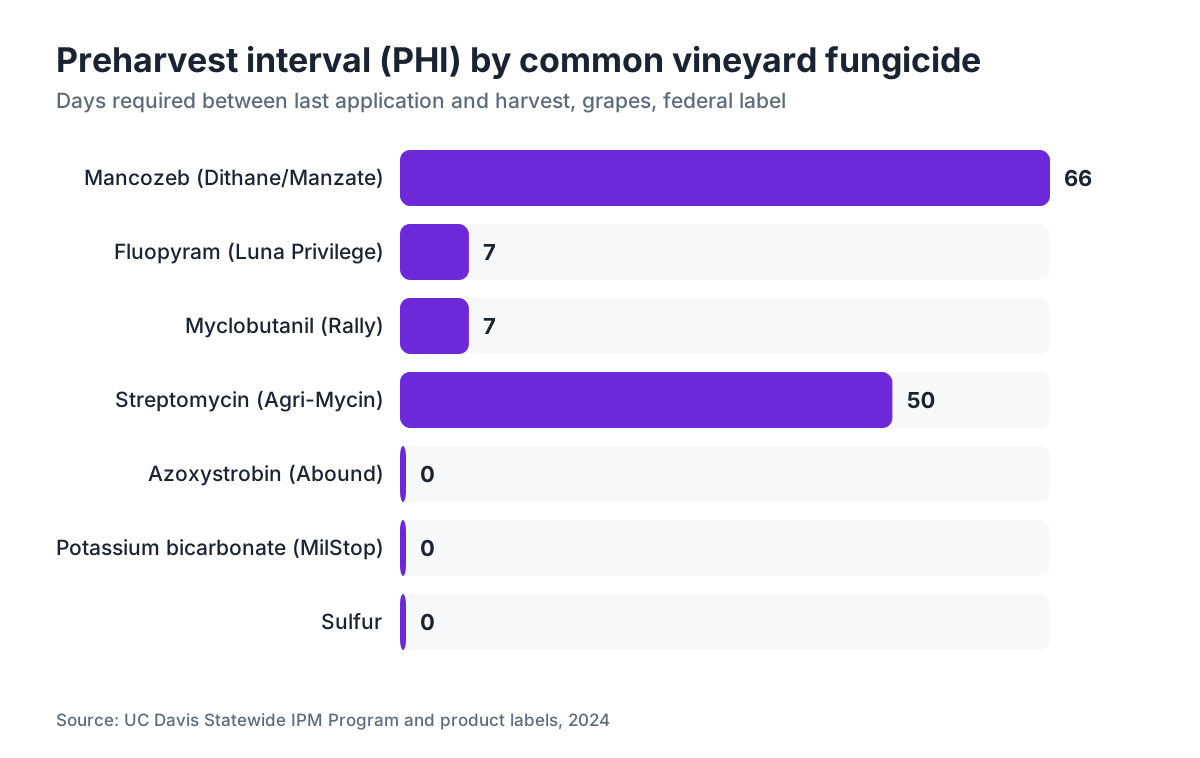
Oxytetracycline (FireLine) is the alternative antibiotic where streptomycin resistance is a concern. Both carry a 50-day preharvest interval on most labels, which makes them bloom-only tools.
And prune hard. Cut 12 inches below any visible strike that gets through. That's not a spray, but it beats anything you can spray after the infection sets.
Which insecticides are safe to use in vineyards without harming beneficial insects?
This is where IPM pays for itself. Broad-spectrum pyrethroids and organophosphates work, but they wipe out the predatory mites and parasitic wasps that hold grape mealybug and leafhoppers in check for free. Kill those beneficials and you buy yourself a secondary pest flare that costs more than the problem you started with.
For leafhoppers and mealybug, insect growth regulators like buprofezin (Applaud) and spirotetramat (Movento) go easier on beneficials. Kaolin clay (Surround) is a physical barrier with no resistance concern and little effect on non-target insects, though it needs thorough coverage and repeat passes.
Spinosad (Entrust for organic, Success for conventional) is moderately selective and works on grape berry moth, thrips, and some leafhopper nymphs. It's toxic to bees during direct application but breaks down quickly, so spray it when bees aren't foraging [1].
Spotted lanternfly sits under federal and state quarantine orders in affected states. EPA and USDA publish specific guidance on approved materials and reporting [4]. Check your state department of agriculture for current SLF rules before you apply anything, because the approved product list and restricted-use requirements keep changing as the pest spreads.
How do preharvest intervals and re-entry intervals affect which spray you can use?
The preharvest interval (PHI) is the minimum number of days between your last application and harvest. The restricted-entry interval (REI) is the minimum time before workers can go back into a treated area without full personal protective equipment. Both print on the label. Both are legally binding under the EPA Worker Protection Standard (WPS) [6].
The Worker Protection Standard, codified at 40 CFR Part 170, requires that pesticide application information be posted at a central location for workers, including the product name, EPA registration number, active ingredient, treated area, application date and time, and the REI [6]. That applies to every commercial spray on an agricultural establishment.
PHI violations are a serious compliance risk. In wine grapes, a lab running juice analysis can sometimes detect residues above tolerance, which triggers regulatory action and can void a purchase contract. Track PHI dates by block and by product. Running multiple products on one block? The longest PHI governs when you can pick that block.
REI violations turn into worker safety cases with OSHA and EPA behind them. Common REIs run short: sulfur is 24 hours, most DMI fungicides are 24 hours, mancozeb is 24 hours, and some organophosphates hit 48 hours or more [1][6].
For a manager juggling multiple blocks with overlapping schedules, a spray log that auto-flags PHI and REI windows is where a tool like VitiScribe earns its keep. Spreadsheets work fine until the day you're about to send a crew into a 48-hour REI block and nothing warns you.
What's the difference between contact, systemic, and translaminar sprays?
Contact products (sulfur, copper, mancozeb) stay put. They protect the surface they land on from spore germination but offer no cure and no movement into the tissue. Coverage is everything here. A surface you miss is a surface with no protection.
Systemic products (DMIs, QoIs, SDHIs) move inside the plant after they're absorbed. Most are xylem-mobile, so they ride the transpiration stream upward. A few move in the phloem or both directions. That systemic reach buys a curative window and protects new tissue that grows out after you spray.
Translaminar products cross the leaf from one surface to the other but don't travel through the vascular system. That's useful when the pest or pathogen lives on the underside of the leaf and your sprayer only hits the top.
Most real programs layer contact and systemic materials in rotation. All-contact programs pile pressure on coverage and interval timing. All-systemic programs speed up resistance. The right mix depends on your disease pressure and how much rotation your budget allows.
How do you build an effective fruit tree or vineyard spray program from scratch?
Build a written calendar tied to growth stages, not dates on a wall calendar. For grapes, the stages that matter are dormant, half-inch green, quarter-inch green, tight cluster, bloom, fruit set, veraison, and preharvest. Stone fruit and pome fruit have their own set (silver tip, green tip, pink, bloom, petal fall, cover sprays).
Map your target diseases and insects onto each stage. Powdery mildew risk in grapes peaks from budbreak through berry touch. Botrytis risk spikes at bloom and again near harvest. Your rotation lives inside those windows.
Rotate FRAC and IRAC codes. FRAC publishes the current resistance risk classification for every fungicide mode of action [5]. IRAC does the same for insecticides [11]. Build a program where no single mode of action shows up more than twice in a row, and where the high-risk chemistries (QoI fungicides, certain pyrethroids) come out only when they add clear value.
Budget honestly. A full-season conventional spray program for wine grapes usually runs $200 to $600 per acre in product cost alone, depending on disease pressure, region, and chemistry. Organic programs often cost more because organic materials need more frequent passes. Labor and equipment time roughly double the total.
Document every pass: product name, EPA registration number, active ingredient, rate per acre, total volume, location, date, applicator, PHI, and REI. That's what the WPS requires, and it's what a state inspector asks for [6].
Managing multiple blocks or several sites? A log stored in VitiScribe keeps the record searchable and filled in from your input instead of reconstructed from memory the night before an audit.
If you run a vineyard with complex rotations across varieties and blocks, sit down once a year with your PCA or extension agent and review the written program. Programs drift over the years as you grab whatever's on the shelf, and resistance builds quietly while you're not watching.
Are organic sprays genuinely effective, or are they a compromise?
Honest answer: organic materials do great work on some problems and force a real compromise on others.
Sulfur for powdery mildew holds up against many synthetics on a 7-to-10-day interval under moderate pressure. UC Davis rates sulfur as a tier-1 efficacy option for powdery mildew, the same tier as many synthetic fungicides, as long as coverage is good and you manage the temperature [1]. Copper for downy mildew and fire blight is the same story: strong at preventive timing, weak once the infection is in.
Where organic programs genuinely struggle is Botrytis bunch rot on tight-clustered varieties in wet years. The OMRI-listed materials (Bacillus subtilis products, potassium bicarbonate, copper) give real but incomplete suppression next to synthetic Botrytis-specific fungicides like fenhexamid or cyprodinil plus fludioxonil. Organic growers in high-Botrytis climates make up the gap with canopy management (hedging, leaf removal) to drop the humidity inside the cluster zone. That's the right move and it works. It just costs more labor.
Insect control runs the same way. Spinosad, kaolin, neem oil, and insecticidal soap carry most of the load, but a few pests (mealybug under heavy pressure is the classic one) are genuinely harder to knock back without a systemic synthetic in the box.
What equipment do you need to apply sprays effectively in a vineyard or orchard?
Coverage is the whole game. The best chemistry on earth fails if it never reaches the target surface, and this is exactly where growers underinvest.
For mature vineyards, an airblast sprayer calibrated to your row spacing, canopy density, and travel speed is the standard rig. The usual mistake is running too fast (4 to 6 mph when 2 to 3 mph is what the canopy needs) and under-delivering volume. WSU extension research found target deposition drops off sharply once travel speed climbs above 3 mph in dense canopies [3].
Orchards with tall canopies often need an air-assisted sprayer with enough airflow to push into the upper canopy, or a machine run from both sides of the row on separate passes.
Small blocks or a few isolated trees can get by with a backpack sprayer or an ATV-mounted 25-gallon unit, but be honest with yourself about coverage uniformity.
Calibrate at least once a season. Nozzle wear changes output more than people expect, and a nozzle throwing 20 percent more volume than rated means you're over-applying product and maybe busting your label rate, which is a federal offense under FIFRA [7].
Check nozzle output with a catch cup and a stopwatch. Any nozzle more than 10 percent off its rated output gets replaced. Replacement nozzles run $2 to $10 each. Cheap insurance against a regulatory action or a failed spray program.
What records do you legally have to keep for pesticide applications?
Federal law under FIFRA (7 U.S.C. § 136) requires certified applicators to keep records of restricted-use pesticide (RUP) applications for two years [7]. Most states go further, requiring records for all commercial applications rather than only RUPs, and many stretch the retention period to three years. California requires pesticide use reports (PURs) filed with the county agricultural commissioner within seven days after the end of each month for commercial agricultural operations [8].
The Worker Protection Standard separately requires application information stay posted at a central location for workers, and that posting stays up for 30 days after the REI expires [6].
Every spray record should capture, at minimum: date and time, location (field or block ID), product name and EPA registration number, active ingredient, target pest, application rate per acre, total area treated, total volume of mix applied, applicator name and license number, and wind speed and direction at application. That list satisfies both federal RUP recordkeeping and California PUR requirements.
Keep it organized. An inspector can pull records going back two or three years, and reconstructing them from memory is not a plan.
Frequently asked questions
Can I use the same spray program for grapes and apple trees?
Only partly. A few active ingredients (copper, sulfur, certain DMI fungicides) are labeled for both grapes and pome fruit. Many are not. Always check the label for the specific crop. A product labeled for grapes is not automatically legal on apples, and using a pesticide on a crop not on its label is a federal FIFRA violation. Cross-reference the WSU or UC Davis crop-specific guides for each crop you manage.
How often should I spray for powdery mildew in a vineyard?
Through the high-risk window from budbreak to berry set, a 7-day sulfur program or a 10-to-14-day synthetic fungicide program is standard under moderate pressure. In hot, dry climates with low pressure you can stretch intervals. In wet or humid conditions, tighten them. UC Davis recommends never exceeding 14 days between applications from 6-inch shoot through fruit set, when mildew risk peaks.
Is copper spray safe to use on young vines?
Copper can burn young tissue under some conditions, especially at high rates or in cool, wet weather that slows drying. UC Davis recommends low-rate copper formulations on young vines and avoiding applications in cool, cloudy conditions. The risk is real but manageable with the right rate and timing. Follow the label rate for the specific growth stage.
What is the re-entry interval for sulfur in a vineyard?
Most sulfur products carry a 24-hour restricted-entry interval (REI) under the EPA Worker Protection Standard. Check the specific product label, because some formulations differ. The REI has to be posted at a central location on the property and communicated to workers before application. Entering a treated area before the REI expires without full PPE is a WPS violation.
What's the preharvest interval for mancozeb on grapes?
Mancozeb (Dithane, Manzate, and others) carries a 66-day preharvest interval on grapes in most states, one of the longest PHIs of any common vineyard fungicide. That limits it to early-season use, typically through bloom. Confirm the PHI on the specific product label you're using, since formulations sometimes differ slightly.
Do I need a pesticide applicator license to spray my vineyard?
For restricted-use pesticides (RUPs), yes: you need a certified private applicator license or must work under the direct supervision of someone who holds one. For general-use pesticides, most states let the landowner apply without a license. Requirements vary by state, so check with your department of agriculture. California requires a written recommendation from a licensed PCA for any agricultural pesticide application by a commercial operation.
What spray should I use for grape berry moth?
Grape berry moth (Paralobesia viteana) is the main tortricid pest in eastern vineyards. Spinosad (Entrust for organic, Success for conventional), Bacillus thuringiensis var. kurstaki for early instars, and mating disruption are the primary tools recommended by Cornell and Penn State extension [10]. Degree-day models tied to biofix (first adult capture) guide timing far better than calendar dates.
How do I prevent fungicide resistance in my spray program?
Rotate FRAC codes within the season. Never run more than two consecutive applications of one mode of action. Reserve the high-risk groups (FRAC 11 strobilurins, FRAC 4 phenylamides) for situations where they add clear value, not as your workhorse. Anchor the program with multi-site contacts (sulfur, copper, mancozeb), because resistance to multi-site products is extremely rare. The FRAC website publishes the current resistance risk classification for every fungicide group.
Can I spray sulfur and copper together as a tank mix?
Generally no. Sulfur and copper sulfate mixes can react and cause phytotoxicity. Most label guidance keeps them separate, with a buffer of at least a few days between applications. Copper hydroxide products are sometimes more compatible, but check the specific label and run a jar test before a full mix. When in doubt, spray them on separate dates.
What spray works for Botrytis bunch rot on grapes near harvest?
The most effective synthetics for Botrytis are FRAC code 17 (fenhexamid, as Elevate), FRAC code 9 plus 12 premix (cyprodinil plus fludioxonil, as Switch), and FRAC code 7 SDHIs. PHIs run 0 to 7 days depending on the product, so they're usable close to harvest. For organic operations, Bacillus subtilis (Serenade) and potassium bicarbonate give partial suppression. Canopy management to improve airflow matters just as much and has no PHI.
How do I document spray applications to satisfy California PUR requirements?
A California pesticide use report must include the county, site, commodity, product name, EPA registration number, unit treated (acres), amount applied, application date, and applicator license number. Reports go to the county agricultural commissioner within seven days after the end of the month the application occurred in. The California Department of Pesticide Regulation posts the reporting format and submission instructions online.
Are neonicotinoids safe to use in a vineyard?
Neonicotinoids (imidacloprid, thiamethoxam, clothianidin) are effective systemic insecticides for mealybug and leafhopper, but they carry real pollinator risk and are restricted or banned for foliar use during bloom in many states. California applies strict restrictions, and some states require a permit for vineyard soil applications. Check your state's neonicotinoid rules first, and skip any application that could reach foraging bees.
What's the best spray schedule for dormant season in orchards?
Dormant oil (petroleum or mineral oil) applied at delayed dormant to green tip controls overwintering mite eggs, scale, and some aphid eggs. Copper at the same timing suppresses fire blight inoculum on bark and adds some brown rot and scab protection. UC Davis and Cornell both recommend a dormant copper plus oil application as the anchor of an organic or conventional tree fruit program [9].
Sources
- UC Davis Statewide IPM Program, Grape Pest Management: Sulfur rated tier-1 efficacy for powdery mildew in grapes; DMI and QoI fungicide FRAC rotation recommendations; spinosad activity and bee toxicity note
- Cornell University Integrated Pest Management, Grape and Tree Fruit Guidelines: Copper hydroxide/sulfate as base of downy mildew program; streptomycin at bloom for fire blight with Maryblyt/Cougarblight risk models
- Washington State University Extension, Pacific Northwest Pest Management Handbooks: FRAC code 40, 45, and 49 product rotation for downy mildew under high pressure; travel speed impact on canopy deposition
- Fungicide Resistance Action Committee (FRAC), FRAC Code List: FRAC code classification of fungicide modes of action and resistance risk ratings; recommendation to rotate FRAC codes and limit consecutive applications
- U.S. EPA, Worker Protection Standard (WPS), 40 CFR Part 170: WPS requires posting of application records including product name, EPA registration number, active ingredient, treated area, date and time, and REI at a central location
- U.S. EPA, Federal Insecticide, Fungicide, and Rodenticide Act (FIFRA), 7 U.S.C. § 136: Certified applicators must maintain RUP application records for two years; using a pesticide on a crop not listed on the label is a FIFRA violation
- California Department of Pesticide Regulation, Pesticide Use Reporting: California requires monthly pesticide use reports filed with county agricultural commissioner within seven days of month end for commercial agricultural operations
- UC Davis Statewide IPM Program, Tree Fruit and Nut Pest Management: Dormant oil plus copper applications at delayed dormant to green tip for overwintering mite eggs, scale, and fire blight inoculum suppression
- Penn State Extension, Grape Berry Moth Management: Spinosad, Bt kurstaki, and mating disruption as primary grape berry moth management tools; degree-day model guidance for application timing
- Insecticide Resistance Action Committee (IRAC), IRAC Mode of Action Classification: IRAC classification of insecticide modes of action for resistance management rotation in agricultural pest programs
Last updated 2026-07-09