Grapevine disease identification: a field guide for vineyard managers
TL;DR
- The five diseases that cost you money, powdery mildew, botrytis bunch rot, Eutypa dieback, downy mildew, and Pierce's disease, each leave distinct marks on leaves, canes, and clusters.
- Catching them at first symptom, not after crop loss, is the whole game.
- This guide covers what each one looks like, when it shows up, which regions face the worst risk, and what you actually do about it.
Why grapevine disease identification matters before you spray anything
Misidentifying a disease is expensive in every direction. Spray for powdery mildew when you actually have downy mildew and you've wasted money, burned a spray window, and left the real problem untouched. Spray an unregistered product because you guessed wrong on the pathogen and now you've got a residue compliance problem stacked on top of a crop problem.
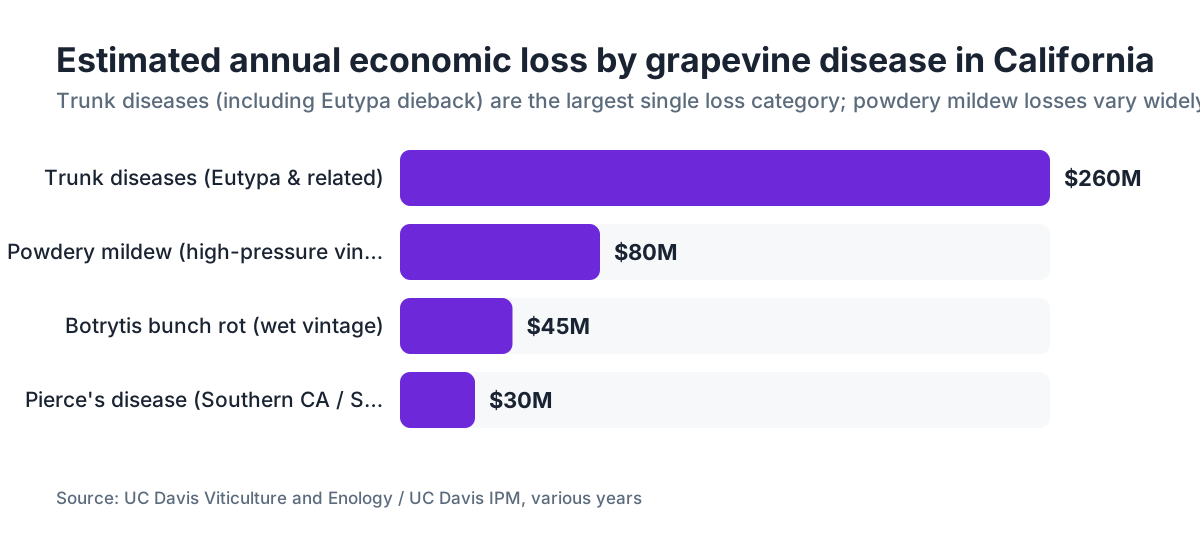
The economics are real. Powdery mildew alone can cause total crop loss in susceptible varieties if it's not caught by bloom [1]. Botrytis bunch rot cuts both yield and wine quality, and certain vintages in cool, wet regions see 20-80% cluster infection rates [2]. Eutypa dieback costs California's wine grape industry an estimated $260 million a year in lost production [3].
Accurate ID also decides what goes in your spray record. The EPA Worker Protection Standard (WPS) requires pesticide application records that include the pest you're treating, and state ag departments audit those records [4]. Logging 'fungicide applied' with no documented pest ID doesn't hold up.
This guide is organized by disease, not by symptom, because that's how you actually work in the field. You see something wrong. You want to know what it is. Start with the part of the vine that looks wrong and work from there.
What does powdery mildew look like on grapevines?
Powdery mildew (Erysiphe necator, formerly Uncinula necator) is the most economically damaging fungal disease of grapevines in most wine regions worldwide [1]. The look is unmistakable once you've seen it: a white to gray powdery coating on leaf surfaces, young shoots, and berries. That coating is the fungal mycelium and conidia living directly on the plant surface, which is odd, because this pathogen doesn't need leaf wetness to infect.
On leaves, look for the powdery patches first on the upper surface. Infected tissue often shows a faint oily or water-soaked look just before the white powder appears. Infected young leaves curl or distort. Severely infected leaves turn brown and drop early. On the underside you'll sometimes see a matching chlorotic (yellow) spot.
On berries, infection before or during bloom is the worst-case scenario. Infected berries develop a russet, webbed, or cracked skin. Berries hit early in their development may split as they expand, and split berries invite botrytis. At harvest, infected fruit smells musty and produces wine with off-flavors described as 'mousy' or 'moldy' even at infection levels invisible to the naked eye [1].
Timing is everything. Powdery mildew overwinters as chasmothecia (sexual spores) in bark crevices, and primary infection begins when temperatures pass 50°F (10°C) and shoots reach 1-3 inches. The UC Davis powdery mildew index uses a degree-day model: after 7 days above 70°F with no rainfall, risk climbs sharply [1]. WSU's weather-based forecasting tools feed this into regional risk maps for Pacific Northwest growers [5].
Management runs from sulfur (the oldest and cheapest option, roughly $10-20 per treated acre per application) to DMI fungicides (sterol inhibitors) to SDHI chemistries. Resistance management matters here. Rotate FRAC groups and document your rotations in your spray records.
How do you identify botrytis bunch rot versus other cluster diseases?
Botrytis cinerea is a generalist, meaning it infects hundreds of plant species, but on grapevines it causes two distinct syndromes depending on timing. Early-season infections hit flower clusters and young leaves. The late-season syndrome, bunch rot, is what destroys harvestable crop.
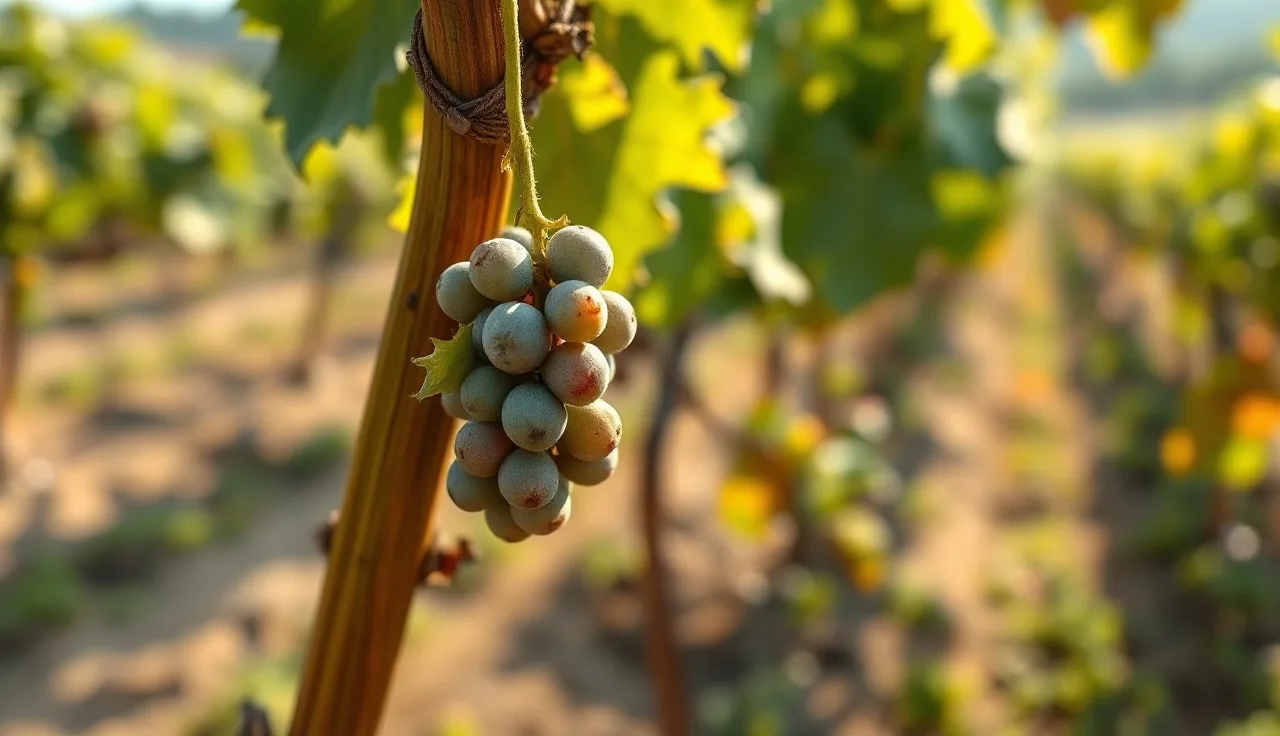
Late-season bunch rot starts as a brown, water-soaked lesion on a single berry, usually one already damaged by insects, hail, or early powdery mildew. Within 48-72 hours under humid conditions, that berry collapses and produces the signature gray-brown fuzzy sporulation (the botrytis 'gray mold'). The infection moves fast through a tight cluster because touching berries hand it pathways. A cluster that looked fine on Monday can be 50% rotted by Thursday after rain.
The fuzzy gray sporulation is what sets botrytis apart from other rot complexes. Sour rot, a bacterial and yeast-driven complex, produces a vinegar smell and often draws Drosophila flies, but no gray fuzz. Aspergillus bunch rot produces a greenish-black mold more common in hot, dry regions. See gray-brown fuzz in a collapsing berry cluster and it's botrytis until proven otherwise.
Botrytis risk spikes when relative humidity holds above 90% for 15+ hours at temperatures between 59-77°F (15-25°C) [2]. Cornell's viticulture extension has quantified how much bunch architecture matters: tight-clustered varieties like Pinot noir, Riesling, and Zinfandel face higher botrytis pressure because airflow through the cluster is poor [2]. Canopy management, specifically shoot positioning and leaf removal in the fruit zone, is a proven cultural control. It reduces infection by improving air circulation and letting spray reach the fruit.
For vineyard managers tracking spray records across multiple blocks, botrytis management usually takes 2-4 applications timed to early bloom, bunch closure, and pre-harvest (watch the pre-harvest intervals, which run from 0 to 21 days by product).
What are the symptoms of Eutypa dieback, and is it the same as grapevine trunk diseases?
Eutypa lata is one of several fungi that cause grapevine trunk diseases, a loosely related group of wood pathogens that includes Botryosphaeria canker, Esca (black measles), Phomopsis dieback, and Petri disease. They're not the same disease, but they often show up together in older vineyards and share a common entry point: pruning wounds.
Eutypa dieback has a slow, sneaky timeline. Infection happens through pruning cuts, but you won't see symptoms for 3-8 years [3]. What you eventually see is a stunted, delayed shoot pushing from an infected cordon or arm. That shoot has small, chlorotic, cupped leaves that mimic micronutrient deficiency. In California it's sometimes called 'stunted shoot syndrome' in the field. By mid-season, the stunted shoot dies back. Cross-section the wood of the affected arm and you'll find a wedge-shaped brown to dark canker, often running 12-24 inches back from where the shoot died.
Black measles (the Esca complex) is different but often lives in the same vineyard. The leaf symptom is interveinal chlorosis and necrosis, creating a distinctive 'tiger stripe' pattern mid-season. In severe cases, called apoplexy, a whole vine can collapse and die within days during hot weather. Cut into the trunk of a vine with Esca symptoms and you'll find brown to black streaking in the xylem tissue.
Botryosphaeria canker (caused by several Botryosphaeria and related species) shows as wedge-shaped wood cankers similar to Eutypa but often moves faster, within 1-3 years of infection [11]. Infected wood cross-sections show a dark brown vascular stain.
UC Davis Viticulture and Enology estimates trunk diseases affect more than 60% of California's wine grape vineyards and cause over $260 million in annual losses [3]. There's no registered fungicide that cures an established trunk disease infection. Management is surgical: cut infected wood back to clean tissue, protect pruning wounds with fungicide paints or Trichoderma-based biological products right after cutting (within 24 hours), and prune later in the dormant season when wounds seal faster and spore dispersal is lower [11].
How is downy mildew different from powdery mildew on grapevines?
Growers in humid regions, especially the eastern United States and parts of Europe, treat downy mildew (Plasmopara viticola) as their primary fungal threat. In the arid West, it's a secondary worry. Telling the two apart is easy once you understand the biology.
Powdery mildew grows on the surface of plant tissue. It doesn't need water. Downy mildew grows inside the plant and requires free moisture, specifically leaf wetness of at least 2 hours, temperatures above 50°F, and rain or heavy dew to release its spores [6]. Those different moisture needs explain the geographic split.
On leaves: powdery mildew shows white powdery patches mostly on the upper surface. Downy mildew shows yellow 'oil spots' on the upper surface (that water-soaked, translucent yellow lesion), with a white, cottony sporulation on the underside directly beneath the oil spot. That white fuzz on the underside is the tell for downy mildew. Press a damp paper towel against the underside of a suspect leaf overnight. If it's downy mildew, white sporangiophores transfer to the paper.
On clusters, downy mildew turns young berries gray-brown and shriveled ('grey rot' in European terminology, separate from botrytis). Infected young clusters develop a white cottony mass covering the whole rachis, sometimes called 'gray mold of the cluster' or 'rotbrenner' in older European texts, but this is downy mildew sporulation, not botrytis.
Cornell's Integrated Pest Management program runs forecasting models for downy mildew, including the 'Plasmo' model, which needs 10+ hours of leaf wetness at temperatures above 52°F for primary infection risk [6]. Management leans on contact and systemic fungicides. Phosphonate materials (fosetyl-Al, phosphorous acid) work especially well and sit in a different FRAC code than many powdery mildew products, which makes rotation planning simpler.
What does Pierce's disease look like, and which regions face the highest risk?
Pierce's disease (PD) is caused by the bacterium Xylella fastidiosa and moves through sharpshooter leafhopper insects. It's not fungal and there's no fungicide for it. In California's coastal valleys, the San Joaquin Valley, and Southern California, the glassy-winged sharpshooter vector makes PD a threat that can end a vineyard [7].
The leaf symptom that separates PD from any fungal disease is a specific pattern of scorching. The brown dead tissue starts at the leaf margins and moves inward, but the petiole (leaf stem) stays green after the leaf blade is dead and falls off. That 'matchstick' symptom, a green petiole with no leaf attached, is essentially diagnostic. Several matchstick petioles on a shoot in mid-to-late summer should trigger PD suspicion right away.
Other symptoms include stunted shoot growth, irregular 'green islands' where the cane doesn't fully lignify (so it has alternating green and brown patches), and vine death in 2-5 years when infection is heavy.
PD hits hardest where vector populations run high and winters stay mild enough that the bacteria survive in the vine year-round. The CDFA and UC Cooperative Extension publish distribution maps for the glassy-winged sharpshooter [7]. Infected vines can't be cured. Confirmed PD vines should come out and get replaced, and insecticide management of the vector is the main tool for slowing spread.
PD doesn't survive climates with sustained freezes below 10°F (-12°C), which is why it's absent from most of the Pacific Northwest and northeastern U.S. wine regions.
A comparison of major grapevine diseases by symptom, timing, and management
The table below pulls the key diagnostic features into one place. Print it and keep it in your vineyard truck.
| Disease | Pathogen type | Where symptoms appear first | Distinctive visual | Season timing | Needs wetness to infect? |
|---|---|---|---|---|---|
| Powdery mildew | Fungus | Leaf upper surface, young shoots | White powdery coating | Bud break through veraison | No |
| Botrytis bunch rot | Fungus | Individual berries | Gray-brown fuzzy mold | Bloom; late season near harvest | Yes |
| Downy mildew | Oomycete | Leaf upper surface (oil spots) | White fuzz on leaf underside | Spring through midsummer | Yes |
| Eutypa dieback | Fungus | Wood (visible as stunted shoots) | Wedge canker in cross-section | Symptom expression mid-season | Wound required |
| Black measles / Esca | Fungus complex | Leaves mid-season | Tiger-stripe interveinal necrosis | Mid-summer through summer | Wound required |
| Pierce's disease | Bacterium | Leaves | Leaf scorch + green petiole stub | Midsummer to fall | Vector (insect) |
| Phomopsis cane & leaf spot | Fungus | Basal nodes, canes | Dark lesions on first 5 internodes | Early spring (wet weather) | Yes |
| Crown gall | Bacterium | Crown/graft union | Rough, warty galls at soil line | Any season | Wound/freeze damage |
A note on Phomopsis: it's easy to miss because it hits early, and growers chalk up the stunted basal nodes to frost or mechanical damage. Look for dark, elongated lesions on the first 3-6 internodes after a wet spring, plus circular lesions on leaves. Phomopsis also infects rachises, causing cluster shatter. It's more common in the eastern U.S. and in Pacific Northwest regions with wet springs [5].
Crown gall (Agrobacterium vitis) causes rough, corky galls at the crown, graft union, or along cordons after freeze injury. There's no chemical treatment. Resistant rootstocks and staying off freeze-prone planting sites are the main management tools.
How do you confirm a disease diagnosis beyond visual inspection?
Visual diagnosis is where you start, but for big management calls, especially pulling whole vines or blocks, or before you file a compliance report, lab confirmation matters.
For fungal diseases like Eutypa and other trunk diseases, the standard confirmation is to collect symptomatic wood, isolate the pathogen on culture media, and identify it by morphology or PCR. Most state plant diagnostic labs (usually run through land-grant universities) offer this. Cornell's Plant Disease Diagnostic Clinic, the UC Davis Plant Pathology lab, and WSU's Plant Diagnostic Lab all accept grapevine samples [5][8]. Turnaround runs 1-3 weeks for culture-based ID and can be faster with PCR.
For Pierce's disease, serological tests (ELISA) and PCR are both available and far more reliable than visual symptoms, which can mimic nutrient deficiency and drought stress. The CDFA certifies certain labs for PD testing, and your county Farm Advisor can point you to approved ones [7].
For powdery mildew and botrytis, lab confirmation is rarely necessary. The visual symptoms plus spore examination under a 10-20x hand lens are usually definitive. A $40 loupe is the best disease-ID buy a vineyard manager can make. Under magnification, powdery mildew conidia are barrel-shaped in chains. Botrytis conidia are oval, borne in grape-like clusters on branched conidiophores.
Keep records of your disease observations with dates, GPS locations, and photos. That documentation does two jobs: it backs your management decisions if you're audited, and it builds a multi-year dataset that shows patterns, which blocks get infected first, which varieties carry the most botrytis pressure, and whether your spray program is actually working. VitiScribe's field logging tools are built for exactly this kind of georeferenced observation record, and having that history on hand makes end-of-season spray record reconciliation much faster.
What weather conditions drive the highest disease risk in vineyards?
Almost every fungal disease on this list uses weather as its trigger. Knowing what each pathogen needs gives you a practical forecasting edge, even without modeling software.
Powdery mildew: primary infection risk begins at sustained temperatures above 50°F. The UC Davis powdery mildew risk model uses cumulative degree days above 50°F after January 1 to predict when chasmothecia start releasing ascospores. The window for the most damaging infections runs from 2 weeks before bloom through 3-4 weeks after bloom [1].
Botrytis: wet weather above 60°F with high humidity during bloom and again near harvest. Tight-clustered varieties see elevated risk any time humidity holds above 90% for 15+ hours in the 60-77°F band [2].
Downy mildew: the '10-10-10 rule' is a common field heuristic. Risk opens after 10 straight days above 10°C (50°F), 10 mm (0.4 inches) of rain, and buds at 10+ cm shoot length. Hit those three thresholds and the primary infection season is on [6].
Phomopsis: the most temperature-flexible of the common diseases. It only needs 0.1 inches of rain over 12 hours at temperatures between 35-95°F (2-35°C). It's the first disease to worry about in a wet spring because it hits the earliest growth stages.
Eutypa and other trunk diseases: the infection event happens at pruning wounds during winter rains, not during the growing season. Rain right after pruning is the highest-risk scenario. Eutypa lata spores need free moisture to disperse and enter wounds. In California, pruning after the rainy season ends (late February to March) cuts infection rates a lot, though it brings other management headaches [11].
Nobody has clean data linking specific weather parameters to economic loss thresholds. The best regional datasets come from long-term monitoring at UC Cooperative Extension, Cornell's Network for Environment and Weather Applications (NEWA), and WSU's Decision Aid System [5]. All three are public and free to use.
How do spray records and compliance documentation connect to disease management?
Every spray you make in response to a disease is a compliance event. The EPA Worker Protection Standard (WPS) at 40 CFR Part 170 requires pesticide application records be kept at least 2 years and include the product name, EPA registration number, the pest treated, application date, location, and applicator information [4]. State rules commonly pile requirements on top. California's DPR, for example, requires County Agricultural Commissioner reporting for restricted-use pesticides within a set timeframe.
Here's the link to disease ID: if you can't name what you're treating, your spray record is incomplete. 'Applied sulfur to Chardonnay block' is far weaker than 'Applied sulfur (EPA Reg. No. XXXXX) to Chardonnay block C-3 for powdery mildew (Erysiphe necator), confirmed by visual inspection of basal leaves, 15% incidence.' The second record holds up. The first one might not.
Pre-harvest intervals (PHIs) are the other compliance piece tied straight to disease. Different fungicides labeled for botrytis carry PHIs ranging from 0 days (some biorationals) to 21 days (some DMI fungicides). Misidentify the disease, apply the wrong product, and you can end up with a PHI that doesn't fit your harvest date. That's a residue compliance problem.
For a vineyard running multiple blocks with different variety harvest dates, spray records that tie disease observations to specific treatment decisions are something a paper logbook handles badly as the operation grows. This is where a purpose-built records tool earns its keep. VitiScribe's spray log is built around the exact fields regulators ask for, including the pest ID field, and it exports in the format California's DPR and similar agencies accept.
The WPS also requires that workers stay out of treated areas until the restricted-entry interval (REI) expires, and the REI must be posted at the field entrance. Disease-driven spray decisions made at odd hours need to reach your worker notification system even faster than they reach your records.
Which grapevine varieties are most susceptible to common diseases?
Variety susceptibility is one of the strongest risk predictors you have, and it's locked in at planting. Knowing where your blocks sit on the susceptibility spectrum shapes your spray program before you see a single lesion.
Powdery mildew: Chardonnay, Cabernet Sauvignon, Gewürztraminer, and Zinfandel are all highly susceptible. Barbera and Sangiovese are moderately susceptible. Muscadine and most American native species (V. labrusca) carry real natural resistance, which is one reason French-American hybrids like Marquette or Frontenac face lower powdery mildew pressure than pure V. vinifera [1].
Botrytis: thin-skinned, tight-clustered varieties take the most risk. Pinot noir, Riesling, and Gewürztraminer are the textbook cases. Cabernet Sauvignon and Syrah have looser clusters and thicker skins, which lowers botrytis risk without erasing it [2].
Eutypa and other trunk diseases: every V. vinifera variety is susceptible. Older vineyards (10+ years) see much higher incidence simply because infection has had more time to accumulate. Thompson Seedless in the Central Valley and Chardonnay in Carneros are among the best-documented high-incidence situations in California [3].
Pierce's disease: all V. vinifera varieties are susceptible and will die within 2-5 years of infection. Muscadine (V. rotundifolia) is naturally resistant. The University of Florida and UC Davis run active breeding programs developing PD-resistant V. vinifera x resistant-species hybrids, and some are now commercially available [7].
Use this variety-by-risk picture in planning, before the season starts, more than in-season. A Pinot noir block in a wet climate is a different program than a Cabernet Sauvignon block in a dry one, even on the same estate.
What are the best free resources for grapevine disease identification?
You don't need to buy a disease atlas to get good information. The land-grant university extension programs have put huge resources online, and they're current, regionally calibrated, and peer-reviewed.
UC Davis Viticulture and Enology (viticulture.ucdavis.edu): The UC IPM Grape Pest Management guidelines cover every economically significant grapevine disease with photos, thresholds, and registered materials. The powdery mildew and trunk disease sections are the most detailed. UC Davis Plant Pathology also publishes trunk disease research with the most current epidemiological data for California [1][3].
Cornell Viticulture and Enology (grapesandwine.cals.cornell.edu): Cornell's extension materials are best for the eastern U.S. and strong on botrytis, downy mildew, and Phomopsis, the primary eastern threats. The NEWA weather network runs disease models for Cornell's region and is open to growers nationwide [2][6].
WSU Viticulture and Enology (wine.wsu.edu): WSU's materials target Pacific Northwest conditions and are especially useful for spotting Phomopsis and cool-climate botrytis. WSU also runs the Decision Aid System (DAS) for weather-based disease forecasting [5].
APS (American Phytopathological Society, apsnet.org): APS publishes the Plant Disease journal and keeps diagnostic fact sheets on most grapevine pathogens. The content runs more technical than extension, but the photo libraries are excellent [10].
For quarantine pests and diseases (Pierce's disease, grape phylloxera, grapevine leafroll viruses), the USDA APHIS website and your state department of agriculture are the authoritative sources, and they're mandatory references if you suspect a regulated pest [4].
One field tip: take photos in full sun with a reference object for scale (a coin, a pen). Lab and extension diagnosticians say photos shot in shade or without scale make remote diagnosis much harder. If you're submitting samples to a diagnostic lab, send both photos and physical tissue, collected in paper bags (not plastic, which rots the sample fast).
Frequently asked questions
What is the most common grapevine disease in California?
Powdery mildew (Erysiphe necator) is the most widespread and economically significant grapevine disease in California. It occurs in every wine grape region in the state and can cause complete crop loss in susceptible varieties if it isn't managed starting at bud break. Trunk diseases, particularly Eutypa dieback, are the second largest economic problem, estimated to cost California growers over $260 million a year in lost production.
Can I treat Eutypa dieback with a fungicide?
No registered fungicide cures an established Eutypa infection in wood tissue. The only effective management is surgical removal of infected wood back to clean, healthy tissue. Prevention is where fungicides work: applying wound protectants containing Topsin-M (thiophanate-methyl) or Trichoderma-based biological products to fresh pruning cuts within 24 hours has shown meaningful reduction in new infections in UC Davis trials.
How do you tell the difference between grapevine leaf scorch from drought stress and Pierce's disease?
The diagnostic trick is the petiole. In Pierce's disease, the leaf blade scorches and drops but the green petiole stays attached to the shoot, creating the 'matchstick' symptom. Drought stress scorches leaves too, but the whole leaf including the petiole yellows, browns, and drops together. Green-island cane lignification (irregular patches of green and brown on the cane) is also unique to PD. Confirm with ELISA or PCR testing.
What's the difference between botrytis and sour rot on grape clusters?
Botrytis produces a characteristic gray-brown fuzzy mold (visible Botrytis cinerea sporulation) on infected berries and has no strong vinegar smell early on. Sour rot comes from a complex of yeasts, acetic acid bacteria, and other organisms, produces a sharp vinegar odor, and draws vinegar flies (Drosophila). Sour rot does not produce the fuzzy gray mold. Both often occur in the same cluster, especially after botrytis creates damaged tissue that lets sour rot organisms enter.
How long do I need to keep vineyard spray records?
The EPA Worker Protection Standard requires pesticide application records be kept at least 2 years from the date of application. Many state rules are stricter: California DPR requires pesticide use reports for 3 years, and some states require 5 years for certain materials. Records must include the product name, EPA registration number, application date, location, pest treated, and applicator identity. Check your state department of agriculture for requirements beyond the federal minimum.
Does powdery mildew on grapes need wet weather to spread?
No, and that sets it apart from most other grapevine diseases. Erysiphe necator completes its infection cycle on the leaf or berry surface without free moisture or leaf wetness. It sporulates most aggressively in warm, dry, partly cloudy conditions between 70-85°F. Rainfall can actually knock powdery mildew back temporarily by washing off surface conidia. So dry-climate vineyards get no protection from powdery mildew the way they're protected from downy mildew.
What grapevine diseases should I watch for during flowering and bloom?
Bloom is the highest-stakes window for two diseases. Powdery mildew infection of flower clusters and young berries just after fruit set causes the most severe crop damage of any infection timing. Botrytis can also infect flower parts (the calyptra and stamens) and stay latent until harvest, when it becomes active rot. In wet springs, downy mildew infection of clusters during bloom causes the 'gray mold of the cluster' syndrome that destroys the whole cluster before fruit set.
Are there any grapevine diseases I need to report to a government agency?
Yes. Pierce's disease caused by Xylella fastidiosa is a regulated pest in California, and the CDFA tracks its spread, especially the glassy-winged sharpshooter vector. Grapevine leafroll virus, grape phylloxera, and several other pathogens and pests sit on USDA APHIS and state quarantine lists. If you suspect a regulated pest or disease you haven't seen before, contact your county Farm Advisor or state department of agriculture before removing vines, since mishandling a quarantine pest can bring penalties.
What is the 'tiger stripe' pattern on grapevine leaves?
The tiger stripe pattern, interveinal chlorosis (yellowing) with necrotic (brown) areas between the veins, is the classic leaf symptom of the Esca disease complex, also called black measles. It shows up mid-season, typically July through August in California, and can progress to complete leaf browning and drop. Affected vines may also show white to brown streaking in cross-sectioned trunk wood. There is no curative treatment; trunk surgery and wound management are the main tools.
How do you submit a grapevine disease sample to a diagnostic lab?
Collect symptomatic tissue in a paper bag, not plastic, since plastic causes rapid decay that destroys diagnostic tissue. Include both symptomatic and healthy tissue from the same vine for comparison. For wood diseases, send 8-12 inch canes with clear symptom expression. Label each sample with the variety, vineyard location, date, and your symptom description. Ship overnight to limit sample degradation. UC Davis, Cornell, and WSU all run plant disease diagnostic labs that accept grapevine samples.
Can grapevine diseases spread on pruning equipment?
Yes, though it varies by disease. Grapevine leafroll virus and other systemic viruses can spread mechanically on unsterilized pruning shears moving from infected to healthy vines, especially in the same session. Eutypa and Botryosphaeria canker spread mainly via airborne spores to fresh wounds, but dirty tools can carry spores too. Sterilizing pruning equipment with 10% bleach or 70% isopropyl alcohol between vines is standard practice in virus-affected vineyards, though it's slow at commercial scale.
What does Phomopsis cane and leaf spot look like, and when does it appear?
Phomopsis viticola infections show up in early spring as dark brown to black lesions on the first 3-6 shoot internodes from the base. Infected internodes often look bleached or cracked by midsummer. On leaves, look for small circular spots with a yellow halo. Clusters infected at bloom show as brown, shriveled berries or cluster shatter. Phomopsis needs wet spring weather and does the most damage in the eastern U.S. and Pacific Northwest after wet winters and springs.
Are French-American hybrid grapevine varieties resistant to powdery mildew?
Partially. French-American hybrids like Marquette, Frontenac, La Crescent, and Vidal carry varying levels of powdery mildew resistance drawn from American Vitis species. They generally need fewer fungicide applications than pure V. vinifera, but most are not immune. Resistance levels vary by variety and can break down under heavy inoculum pressure. Norton (Cynthiana) is among the most resistant commercially grown varieties. UC Davis and Cornell keep current variety trial data on disease resistance ratings.
How early in the season should I start scouting for grapevine diseases?
Start at bud swell. Phomopsis infections need only the earliest shoot growth plus wet weather to kick off. Powdery mildew risk begins at 1-3 inch shoot growth. For trunk diseases, scout for stunted shoots from bud break through about 6-inch shoot length, comparing shoot vigor across the cordon. A weekly scouting schedule from bud break through veraison, then bi-weekly after veraison until harvest, gives you the coverage to catch most diseases at a manageable infection level.
Sources
- UC Davis IPM, Grape Pest Management Guidelines (Powdery Mildew): Powdery mildew is the most economically damaging fungal disease of grapevines; infection before/during bloom causes the most severe crop damage; degree-day model for risk prediction
- Cornell University Viticulture and Enology, Botrytis Bunch Rot: Botrytis risk spikes when relative humidity exceeds 90% for 15+ hours at 59-77°F; tight-clustered varieties face higher botrytis pressure; 20-80% cluster infection rates in cool wet vintages
- EPA, Worker Protection Standard 40 CFR Part 170: WPS requires pesticide application records kept for at least 2 years including product name, EPA registration number, pest treated, application date, location, and applicator information
- Washington State University Extension, Viticulture and Enology: WSU's Decision Aid System provides weather-based disease forecasting; WSU Plant Diagnostic Lab accepts grapevine samples; Phomopsis common in Pacific Northwest with wet springs
- Cornell University, Network for Environment and Weather Applications (NEWA), Downy Mildew Model: Downy mildew requires at least 2 hours of leaf wetness, temperatures above 50°F, and rainfall to release spores; 10-10-10 rule for primary infection season; Plasmo model requires 10+ hours leaf wetness at above 52°F
- CDFA, Pierce's Disease and the Glassy-winged Sharpshooter: Pierce's disease caused by Xylella fastidiosa transmitted by sharpshooter leafhoppers; all V. vinifera are susceptible and die within 2-5 years; CDFA tracks vector distribution; infected vines cannot be cured
- Cornell University Plant Disease Diagnostic Clinic: Cornell's diagnostic lab accepts grapevine samples for culture and PCR-based disease identification
- American Phytopathological Society, Plant Disease Journal: APS publishes diagnostic fact sheets and photo libraries for grapevine pathogens including Eutypa lata, Botrytis cinerea, and Phomopsis viticola
- UC Davis IPM, Grape Pest Management Guidelines (Trunk Diseases): Botryosphaeria canker develops within 1-3 years of infection; wound protectants applied within 24 hours of pruning cuts reduce Eutypa infection rates; pruning later in dormant season reduces infection
Last updated 2026-07-09