European grapevine moth: what every vineyard manager needs to know

TL;DR
- European grapevine moth (Lobesia botrana) is a quarantine pest that attacks grape flower clusters and berries across two to three generations a season.
- It arrived in California in 2009 and set off a CDFA eradication program that cost more than $65 million.
- Larval feeding opens berries to Botrytis and sour rot, so accurate degree-day timing and targeted sprays are your main defenses.
What is European grapevine moth and why does it matter for vineyards?
European grapevine moth (Lobesia botrana, family Tortricidae) is a small mottled-brown moth from the Mediterranean basin and parts of Asia. Its larvae feed inside grape flower clusters and berries, and that feeding opens the door to secondary infections, mostly Botrytis cinerea. Left alone, it destroys a cluster. USDA lists it as a regulated quarantine pest in the United States. [1]
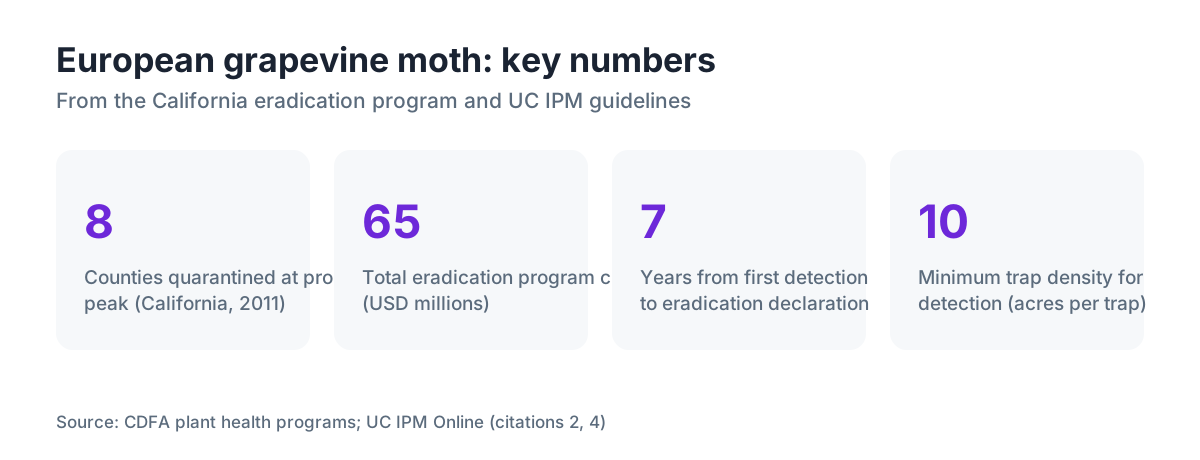
California recorded the first confirmed U.S. establishment in Napa County in 2009. By 2011 the California Department of Food and Agriculture had detected it in eight counties, and the eradication program cost more than $65 million before the state declared success in 2016. [2] Other wine regions, including parts of the Pacific Northwest, still run surveillance programs because Lobesia botrana remains present in Europe, South America, and South Africa. Re-introduction is a real risk for any vineyard accepting imported plant material or equipment. [3]
The pest is not a disease in the microbial sense. The phrase "European grapevine moth disease" describes the full pest-and-damage complex: the moth's feeding, the secondary Botrytis and sour rot infections that follow, and the regulatory status its presence triggers. Understanding all three layers is what separates a manager who reacts to it from one who prevents it.
If you farm a region like Paso Robles or the wider vineyard corridor of coastal California, this pest earns a permanent slot on your IPM calendar, quarantine or no quarantine.
What does European grapevine moth damage look like on the vine?
Identification is the first place managers go wrong. Lobesia botrana larvae are small, yellow-green to pinkish, and they hide inside webbed-together flower or berry tissue. By the time you see external damage, the larvae are often done feeding and gone. Knowing what each generation targets helps you look in the right place at the right time. [4]
First-generation larvae (spring) feed on flower clusters before bloom. They web florets and young berries together and leave frass-filled galleries. The cluster looks like it has a cottony or silky net pulled over part of it. Managers routinely write this off as thrips damage or spray residue.
Second-generation larvae (early summer) bore straight into developing berries. The entry hole is tiny, roughly 1 mm, ringed with frass. The berry shrivels and dries, and the skin cracks. Those crack edges are open gates for Botrytis spores.
Third-generation larvae (late summer, pre-harvest) do the most economic damage. They feed inside ripening berries during the warmest, most humid stretch of the season. Botrytis and sour rot rates in infested third-generation clusters can hit 40 to 100 percent in wet years. [4]
Adults are distinctive up close. The forewing carries a mosaic of orange-brown, gray, and tan patches and runs about 6 to 7 mm long. Wing pattern alone lets a trained observer separate them from grape berry moth (Paralobesia viteana), a superficially similar but different pest with different timing and range. UC IPM Online keeps side-by-side photos worth bookmarking for your scouting team. [4]
What is the life cycle of European grapevine moth, and how does degree-day timing work?
Lobesia botrana overwinters as pupae under bark, in leaf litter, or in the soil near the vine base. Adults emerge in spring and mate fast. In California's climate the pest runs two to three full generations a season, sometimes a partial fourth in hot interior valleys. Generation count matters because each one needs its own management response. [4]
Degree-day (DD) accumulation is the standard tool for predicting when each generation shows up. The biofix, your starting point, is set when you catch the first adult moths in pheromone-baited delta traps. From biofix you accumulate degree-days on a base temperature of 41 degrees F (5 degrees C). Key thresholds, drawn from UC IPM and CDFA data [2][4]:
| Generation | Flight peak | Egg hatch target | Action DD from biofix |
|---|---|---|---|
| 1st | ~150 DD | ~250 DD | 100-170 DD for mating disruption check |
| 2nd | ~470 DD | ~570 DD | 470-600 DD for spray window |
| 3rd | ~900 DD | ~1000 DD | 900-1050 DD for spray window |
That table is why pheromone trap monitoring is not optional during a quarantine event. Without a biofix date, none of these numbers work. A trap density of roughly one trap per 10 acres is the recommended minimum for detection, though CDFA often specifies denser grids during active eradication. [2]
Degree-day calculators for Lobesia botrana live on UC IPM's online tools and the UC ANR regional weather station network. If you track by hand, a simple max-min average, (max temp + min temp) divided by 2, minus 41 degrees F, gets you daily DD accumulation close enough for field calls. Just don't use Celsius by accident. That's a common scouting error.
How did European grapevine moth spread to California and what is its current U.S. status?
The first California detection was a single moth in a monitoring trap in Napa County in 2009. Genetic work pointed to a Mediterranean-origin population, which suggests accidental introduction, most likely on infested plant material or wooden packaging. [2] Within two years CDFA had confirmed it in Napa, Sonoma, Mendocino, Lake, Solano, Alameda, Contra Costa, and El Dorado counties.
CDFA ran a formal eradication program built on mating disruption, organic-approved and conventional insecticide treatments, and strict quarantine rules covering movement of grapes, grape pomace, and vine cuttings out of infested areas. The program ran from 2009 through 2016. In August 2016 CDFA declared eradication complete after three consecutive years of zero detections in the quarantine zone. [2]
USDA's Animal and Plant Health Inspection Service (APHIS) keeps an active federal domestic program going, with port-of-entry inspections and cooperative surveillance agreements with state agriculture departments. Lobesia botrana has no established U.S. population today but stays on the federal pest watch list. [1]
For any manager in the American West, the takeaway is plain: your pest-free status rides on continued surveillance. If your county or AVA runs a trapping program, join it. If it doesn't, think hard about running your own. A pheromone trap program for a small vineyard costs maybe $200 to $400 a season. A quarantine costs orders of magnitude more.
What secondary diseases does European grapevine moth damage cause?
The moth doesn't carry Botrytis cinerea or any pathogen. It makes wounds. A tiny larval entry hole breaks the berry skin, and the sugary, moist interior turns into a fungal nursery. Botrytis cinerea is almost always the first organism through the door, and in humid conditions it jumps cluster to cluster fast. [4]
Sour rot is the other big secondary problem. Yeasts, bacteria (especially Acetobacter), and Drosophila flies colonize damaged berries and turn sugars into acetic acid. The result is vinegar-smelling clusters that won't ferment and can taint sound fruit at harvest. In bad third-generation years, sour rot can write off whole rows.
Powdery mildew moves onto cracked berry surfaces too, though it's less tied to Lobesia feeding specifically. Any berry-skin breach during warm, humid weather invites a cascade. That's why the moth's economic damage always runs higher than the direct feeding loss alone. A 5 percent direct infestation rate can turn into 25 percent or more loss once secondary rot is counted, depending on ripening-season weather. The multiplier is real and documented, though the exact percentages swing widely by region and year.
How do you scout for European grapevine moth effectively?
Pheromone traps are the backbone of any scouting program. Delta traps baited with Lobesia botrana-specific lures pull in male moths and give you a catch count to set biofix and track pressure. Replace lures every 4 to 6 weeks per the manufacturer's instructions. A degraded lure hands you falsely low counts. [4]
Put traps at vine canopy height, in the warmest, most sheltered part of the block, where moths like to fly. Check catches twice a week during flight periods, not once. Flight peaks can be short, especially for the first generation, and a weekly check can miss the peak entirely.
Visual scouting is your second layer. At each generation's egg-hatch window (see the degree-day table above), walk at least 10 to 15 randomly chosen vines per block and inspect 5 clusters per vine. Look for webbing at first generation, entry holes with frass at second, shriveled or cracked berries at third. Calculate percent of clusters infested. Outside a quarantine that mandates treatment, the action threshold is generally taken as around 5 percent cluster infestation. UC IPM guidance suggests treating below that in high-value blocks or years with heavy disease pressure. [4]
Keep written records of trap catches, scouting dates, vine locations, and percent infestation. It's more than good practice. It's legally required if your county has an active quarantine order. If you run a field operations platform like VitiScribe, your trap data and scouting notes can sit in the same system as your spray log, which makes compliance reporting far less painful when CDFA or the county ag commissioner asks for documentation.
What are the most effective treatment options for European grapevine moth?
Treatment falls into four buckets: mating disruption, biological controls, conventional insecticides, and organic-approved insecticides. The California eradication program used all four together, for good reason. No single approach is bulletproof. [2][4]
Mating disruption hangs synthetic sex pheromone dispensers through the vineyard to flood the air with female-mimicking scent, so males can't find real females. Isomate LTT and similar products were registered during the California program. It works best deployed before first adult flight, and in blocks large enough (typically 10 acres or more) to limit immigration of already-mated females from outside. Smaller blocks need perimeter sprays as backup.
Biological options include Bacillus thuringiensis var. kurstaki (Btk) formulations. Btk has to hit during egg hatch, before larvae enter the berry. Timing is everything. A Btk spray three days late, after larvae have bored in, does essentially nothing. Granulosis virus (Carpovirusine, Madex) is registered in some European countries with strong efficacy data; U.S. registration is more limited, so check your state's current label database.
Conventional insecticides used in California included spinosad, chlorantraniliprole (Altacor), indoxacarb, and organophosphates. Spinosad is also OMRI-listed and common in organic programs, but manage resistance: don't lean on it across all three generations. Rotate modes of action using the IRAC group classification. [5]
Any spray in a vineyard with workers present triggers the EPA Worker Protection Standard (WPS). Under WPS you post treated areas, supply label-required PPE, and keep application records for at least two years. [6] Many effective Lobesia botrana insecticides carry restricted-entry intervals (REIs) of 12 to 48 hours, and some demand respiratory protection for applicators. Read the label first, not the product summary sheet.
| Product | Mode of action (IRAC) | REI | Organic eligible? |
|---|---|---|---|
| Spinosad | Group 5 | 4 hr | Yes (OMRI) |
| Chlorantraniliprole | Group 28 | 4 hr | No |
| Indoxacarb | Group 22 | 12 hr | No |
| Btk (various) | Group 11 | 4 hr | Yes (OMRI) |
| Neem oil (azadirachtin) | Group UN | 4 hr | Yes (OMRI) |
What quarantine rules apply if European grapevine moth is detected in your county?
A confirmed detection triggers a state quarantine under California Food and Agricultural Code authority, run by CDFA with county agricultural commissioners. [2] The quarantine restricts movement of regulated articles out of the zone. Regulated articles include grapevines, grape clusters, grape pomace, dried fruit, and potentially wooden pallets or equipment that could carry pupae.
Inside a quarantine zone you generally need a compliance agreement with your county ag commissioner before moving any regulated article. The agreement spells out what treatments, inspections, or certifications your operation has to complete. Violations carry civil and criminal penalties under California Food and Agricultural Code sections 5321 through 5341. [11]
Federal restrictions stack on top of state ones. The USDA APHIS phytosanitary certificate process governs interstate movement. Shipping grapes or cuttings across state lines from a quarantine county usually means you need a federal domestic phytosanitary certificate, which requires inspection by a state or federal official. [1]
Quarantine rules change fast during active eradication. The practical move: get the county ag commissioner's current quarantine map and the specific compliance agreement template before you move anything, including moving your own equipment between blocks if those blocks straddle a quarantine line. UC Cooperative Extension and WSU Extension both publish updates during active events. [8]
How does European grapevine moth compare to grape berry moth?
Grape berry moth (Paralobesia viteana, formerly Endopiza viteana) is native to North America and the dominant tortricid grape pest east of the Rockies. Managers in eastern wine regions have far more hands-on experience with it than with Lobesia botrana, and the two are easy to mix up. Sorting them out matters because spray timing and regulatory status are completely different. [9]
Both moths are about the same size and both attack berries. The key differences:
| Feature | European grapevine moth | Grape berry moth |
|---|---|---|
| Species | Lobesia botrana | Paralobesia viteana |
| Origin | Mediterranean/Asia | Native North America |
| U.S. distribution | Eradicated (surveillance continues) | Eastern U.S., Midwest |
| Regulatory status | Federal quarantine pest | No quarantine |
| Generations per season | 2-3 | 2-3 (varies by latitude) |
| Biofix base temp | 41 F (5 C) | 50 F (10 C) |
| Forewing pattern | Mosaic gray-orange | Purplish-blue patch on gray |
The base temperature gap is not trivial. Run the Lobesia botrana degree-day model on grape berry moth by mistake and your timing predictions land days or weeks off, depending on spring temperatures. Cornell University's Network for Environment and Weather Applications (NEWA) has a grape berry moth degree-day model with GPS-linked weather station data, worth using if you're in the eastern U.S. [9]
Trap an unknown tortricid in your vineyard? Don't guess. Send a specimen to your state's plant diagnostic lab. UC Davis's Plant Pest Diagnostics Center, for one, can confirm Lobesia botrana, and that confirmation is what starts the regulatory clock. [4]
What do organic and sustainable vineyards do differently to manage this pest?
Organic programs have genuinely good tools for Lobesia botrana. Mating disruption is compatible with certified organic production and is arguably the single most effective tactic when pressure runs low to moderate. Btk, granulosis virus (where registered), and neem-based products fill out the organic toolkit. [4]
The catch for organic programs is timing precision. Mating disruption has to go up before first flight, so you need a solid historical biofix date for your site. Btk works only during a short egg-hatch window. If your records are thin or your trap monitoring is spotty, you'll miss timing windows and the whole organic program underperforms.
Some sustainable and biodynamic managers build habitat for natural enemies. Generalist predators, parasitic wasps in the Trichogramma genus, and lacewings do prey on Lobesia botrana eggs and young larvae. University of California work during the eradication period reported Trichogramma parasitism of Lobesia botrana eggs ranging roughly 10 to 40 percent in some unsprayed plots, which helps but isn't enough on its own for economic control in high-pressure years. The published figure varies by site and season.
Cover crop and canopy management matter too. Dense, shaded canopies trap humidity and make ideal larval habitat. Shoot thinning and leaf removal in the cluster zone, standard Botrytis practice anyway, cut the protected microhabitat larvae rely on. It's one of the few inputs that hits both the moth and the secondary disease at once.
How should you keep records and stay compliant during a European grapevine moth event?
Compliance paperwork during a quarantine event is heavy and time-sensitive. You'll typically document pheromone trap catch logs with dates and counts; every pesticide application with product name, EPA registration number, rate, gallons per acre, applicator name, date, and weather at application; scouting records with dates, block locations, and percent infestation; and any compliance agreement terms your county has imposed. [6][2]
EPA WPS requires pesticide application records be kept at least two years and be available for inspection. [6] California's Department of Pesticide Regulation (DPR) Pesticide Use Reporting (PUR) system requires licensed applications be reported to the county ag commissioner monthly, by the 10th of the following month. Miss a PUR submission and it's a civil violation. [10]
Paper systems work until an audit. Then they fail in familiar ways: illegible handwriting, missing dates, records that live in the pickup instead of the office. VitiScribe keeps trap catch data, scouting notes, and spray records in one searchable system, so when the county ag commissioner asks for documentation you're not rebuilding records from memory.
If you run multi-county operations or ship out of state, organize records by block, not by product or date. Quarantine compliance often makes you prove which specific blocks were treated or inspected, more than that your operation finished treatments in general. Block-level traceability is what protects your ability to move fruit.
What university extension resources exist for European grapevine moth management?
Three institutions publish the most field-usable resources.
UC Davis and UC ANR (University of California Agriculture and Natural Resources) produced the primary pest management guidelines for Lobesia botrana in California during and after the eradication program. UC IPM Online hosts the official California guidelines, degree-day models, and historical trap data from the eradication effort. They're free, updated regularly, and tuned to California's climate and registered products. [4]
WSU Extension (Washington State University) keeps Lobesia botrana surveillance information relevant to the Pacific Northwest, including links to the cooperative detection trapping network and guidance for growers still monitoring after the California eradication. WSU's viticulture pages also cover general tortricid management for the region. [8]
Cornell University's viticulture and enology program focuses mostly on grape berry moth as the eastern tortricid pest, but its IPM framework and degree-day modeling tools transfer cleanly and are worth understanding if you're building your own Lobesia botrana monitoring program. Cornell's NEWA platform is the standard for weather-based pest timing in the eastern U.S. [9]
All three are online at no cost. If you farm in a state without active university extension support for this pest, start with the UC Davis guidelines, because they came out of an actual U.S. eradication program backed by field data.
Frequently asked questions
Is European grapevine moth still present in the United States?
No established U.S. population has been confirmed since California declared eradication in 2016. USDA APHIS and state agriculture departments keep surveillance running because the pest stays common in Europe, South America, and South Africa. Re-introduction through imported plant material or equipment remains a real risk, which is why trapping programs in major wine regions are still active.
What grapes does European grapevine moth prefer?
Lobesia botrana attacks all Vitis vinifera cultivars. No commercial wine grape variety shows reliable field resistance. Tight-clustered varieties like Pinot Noir and Chardonnay tend to suffer worse secondary Botrytis after infestation because the dense cluster traps moisture around wounded berries. Loose-clustered varieties like Grenache can see similar infestation rates but with less secondary rot spread.
How do I set up a pheromone trap for European grapevine moth monitoring?
Use a standard delta trap with a Lobesia botrana-specific lure, sold by several agricultural suppliers. Place traps at vine canopy height in sheltered, warm areas of the block. One trap per 10 acres is the detection minimum; denser grids give better precision. Record catches twice weekly during flight periods. Replace lures every 4 to 6 weeks. Log trap location, catch count, and date every check.
What is the economic threshold for treating European grapevine moth?
Outside a quarantine, 5 percent cluster infestation is a commonly cited action threshold in UC IPM guidelines. In quarantine zones, treatment is typically required regardless of observed infestation because the goal is eradication, not economic management. High-value blocks or blocks with a Botrytis history warrant treating lower, potentially 1 to 2 percent, because secondary disease loss multiplies the direct feeding damage.
Can European grapevine moth overwinter in cold climates?
The moth overwinters as pupae, usually under bark or in leaf litter near vine bases. It's cold-sensitive compared with native North American tortricids. Long stretches below about 14 F (-10 C) sharply cut overwintering survival. That partly explains its absence from continental interior climates, but California coastal and interior valley climates are mild enough to support winter survival, which drove the eradication urgency.
What is the difference between mating disruption and insecticide sprays for this pest?
Mating disruption floods the vineyard with synthetic female pheromone, disorienting males so they can't find mates. It blocks the next generation and carries no REI or harvest interval. It works best in large, isolated blocks with low immigration. Insecticide sprays target existing larvae at egg hatch; they act faster once populations are established but carry REI, resistance management, and label compliance requirements.
Do I need a licensed pest control adviser to treat for European grapevine moth in California?
In California, a commercial agricultural pesticide application requires a written recommendation from a licensed Pest Control Adviser (PCA) if you're using a restricted-use pesticide. Several effective Lobesia botrana treatments, including some organophosphates and certain formulations, are restricted-use. General-use products like Btk or spinosad don't need a PCA recommendation but still require proper labeling compliance and Pesticide Use Reporting to the county ag commissioner.
How long did the California European grapevine moth eradication program take?
About seven years, from the first confirmed detection in Napa County in 2009 to CDFA's eradication declaration in 2016. The program cost more than $65 million and covered eight California counties at its peak. It combined mating disruption, biological and conventional insecticide treatments, and strict quarantine on movement of grapes and vine material out of affected zones.
What's the best way to confirm a European grapevine moth identification?
Collect the suspect specimen in a small vial with 70 percent isopropyl alcohol and send it to your state's plant pest diagnostic lab. In California, the UC Davis Plant Pest Diagnostics Center handles this. Don't rely on photos alone for a regulatory-level ID; morphological examination, sometimes with DNA barcoding, is what CDFA and USDA require to trigger official quarantine actions. A misidentification either way, false alarm or missed detection, carries serious consequences.
Can European grapevine moth spread to other crops besides grapes?
Lobesia botrana has a documented host range beyond grapes. In Mediterranean Europe it's been recorded on rosemary, jasmine, olive, and other plants. In practice grapes are by far its preferred host and the main economic concern. Adjacent olive or lavender plantings in vineyard landscapes aren't generally considered significant reservoirs, but they're worth noting when you design a monitoring program near mixed agricultural land.
What worker protection rules apply when spraying for this moth?
EPA's Worker Protection Standard (40 CFR Part 170) applies to all agricultural pesticide applications, including Lobesia botrana treatments. Requirements include posting treated areas during the restricted-entry interval, supplying label-specified PPE to handlers and early-entry workers, offering decontamination supplies, and keeping application records for two years. Some products used for this pest, particularly organophosphates, require added respiratory protection for applicators. Always follow the specific product label as the legal document.
How does climate affect how many generations of European grapevine moth occur per year?
Generation count depends on heat units accumulated during the growing season. In cooler coastal California climates and northern European wine regions, two generations a season is typical. Warmer interior valleys, including parts of Napa, Lodi, and the Central Valley, can support three generations and sometimes a partial fourth. More generations mean more spray windows to manage and higher potential crop damage, especially from the third generation hitting during ripening.
Are there resistant grapevine varieties that aren't affected by European grapevine moth?
No commercial wine grape variety shows consistent field resistance to Lobesia botrana. European breeding programs have looked at native Vitis species with some early results, but nothing is available for commercial planting in the U.S. Your options stay cultural: canopy management, biological controls, mating disruption, and targeted insecticide applications timed to the pest's degree-day model.
What should I do if I find a suspected European grapevine moth in my vineyard today?
First, don't move any fruit, vines, or equipment out of that block until you've reported the find. Contact your county agricultural commissioner right away; in California there's a legal duty to report suspected quarantine pests. Collect a specimen if you can. The commissioner notifies CDFA, and a confirmation inspection usually happens within 24 to 72 hours. Don't spray before confirmation; you need the specimen intact for identification.
Sources
- California Department of Food and Agriculture, plant health programs: CDFA confirmed Lobesia botrana in eight California counties after 2009 detection; eradication program cost more than $65 million; eradication declared in 2016
- EPPO (European and Mediterranean Plant Protection Organization), Lobesia botrana data sheet: Lobesia botrana is present in Europe, South America (Chile, Argentina), and South Africa, sustaining re-introduction risk for U.S. vineyards
- UC IPM Online, UC ANR, Lobesia botrana pest management guidelines for grapes: Degree-day thresholds, larval generation damage descriptions, economic thresholds, treatment options including Btk and spinosad, and scouting protocols for Lobesia botrana in California vineyards
- IRAC (Insecticide Resistance Action Committee), Mode of Action classification: Spinosad is IRAC Group 5, chlorantraniliprole Group 28, indoxacarb Group 22; rotation of modes of action recommended for resistance management
- EPA, Worker Protection Standard (40 CFR Part 170): EPA WPS requires pesticide application records kept at least two years, posted restricted-entry intervals, and label-specified PPE for agricultural handlers
- Washington State University Extension, Viticulture and Enology: WSU Extension maintains Lobesia botrana surveillance information and cooperative detection trapping guidance for Pacific Northwest growers
- Cornell University NEWA (Network for Environment and Weather Applications), Grape Berry Moth model: Cornell NEWA provides degree-day models with GPS-linked weather stations for grape berry moth (Paralobesia viteana), the primary eastern U.S. tortricid pest, with base temperature 50 F
- California Department of Pesticide Regulation, Pesticide Use Reporting: California DPR requires licensed pesticide applications to be reported to the county ag commissioner by the 10th of the month following application
- California Food and Agricultural Code, sections 5321-5341: California Food and Agricultural Code sections 5321-5341 establish civil and criminal penalties for violations of plant quarantine orders
Last updated 2026-07-09