Fungal grapevine disease: the grower's field guide to identification and control
TL;DR
- Fungal diseases are the leading cause of crop loss in vineyards worldwide.
- Powdery mildew, downy mildew, botrytis bunch rot, black rot, and Eutypa dieback are the five you must know.
- Each has its own infection window, scouting trigger, and fungicide class.
- Miss the timing by a week and you can lose 30 to 80 percent of a block.
Which fungal diseases actually matter in vineyards?
Five diseases account for nearly all fungal crop loss in North American and European vineyards: powdery mildew (Erysiphe necator), downy mildew (Plasmopara viticola), botrytis bunch rot (Botrytis cinerea), black rot (Guignardia bidwellii), and Eutypa dieback (Eutypa lata). If you grow in a humid region east of the Rockies, all five can hit you in the same season. If you're in a dry western climate like the San Joaquin Valley or the Columbia Basin, powdery mildew is the constant threat and downy mildew is largely absent unless you irrigate heavily and get summer rain [1].
Eutypa is the odd one out. It's a wood disease, not a foliar one, so in-season sprays do nothing to it. It shows up years after the pruning wound that let it in. The other four are active in the canopy all season and need a spray program timed to weather and growth stage.
Black rot is underrated. Growers in the mid-Atlantic and Southeast who pour all their attention into botrytis sometimes watch black rot take 50 percent of their crop in a wet July, because the infection happened unnoticed six weeks earlier when berries were still hard [2].
Knowing which disease you're actually fighting changes everything: the fungicide class, the timing, the canopy strategy. Spray for botrytis when you really have powdery mildew and you burn money while losing the crop.
How do you identify powdery mildew on grapevines?
Powdery mildew is the one disease that doesn't need free moisture to infect. That's what makes it so persistent in dry climates, and why it sneaks up on growers who assume a dry stretch means they're safe. The pathogen, Erysiphe necator, is an obligate parasite that lives entirely on the grapevine surface. Spores germinate and infect at temperatures between 50°F and 90°F, with the sweet spot around 68°F to 77°F [1].
On leaves, look for a white to grayish powdery coating, usually on the upper surface first. Under a good hand lens you can see the cleistothecia (tiny black fruiting bodies) embedded in older colonies. On green berries before véraison, the fungus leaves a russet webbing pattern when the berry tries to grow faster than the arrested skin. That russeting gets mistaken for spray damage or sunburn all the time.
The most expensive symptom is berry cracking at or just after véraison, when infected, tough-skinned berries can't expand. Cracked berries invite botrytis. So a mildew infection in July can set up a botrytis explosion in August.
UC IPM uses a degree-day model, the powdery mildew risk index, that tracks ascospore maturity from budbreak using a base temperature of 50°F. The model has been validated in California and adapted elsewhere. By the time you see symptoms on shoots, infection started 7 to 14 days earlier. Scouting for early flag shoots (the whitened, distorted growth tips) right after budbreak is your best early warning [3].
What does downy mildew look like and when does it infect?
Downy mildew (Plasmopara viticola) is a water mold, technically an oomycete rather than a true fungus, but every grower calls it a fungal disease and manages it with the same spray logic. It needs free water and warm temperatures to sporulate. The classic infection rule of thumb is the "10-10-10 rule": risk is high when shoot growth exceeds 10 cm, temperature is above 10°C (50°F), and there's been at least 10 mm of rain in the past 24 to 48 hours [4].
On the upper leaf surface, look for pale yellow oily spots, the classic "oil spots." Turn the leaf over after a humid night and you'll see white cottony sporulation directly beneath them. That's the sporangiophores pushing through the stomata. On clusters, infection before bloom causes gray rot of the rachis (the flower cluster stem) and can kill the whole cluster. Infection between bloom and berry set turns young berries grayish and hard, then they drop.
Downy mildew pressure is highest in the eastern US, the Pacific Northwest in wet years, and across European wine regions. In California's North Coast it's occasional rather than chronic, but the wet spring of 2023 was a reminder that even Napa and Sonoma can face real risk.
Cornell's integrated pest management program recommends timing sprays off a disease forecasting model, not a calendar. Their NEWA (Network for Environment and Weather Applications) platform gives you downy mildew risk forecasting free of charge [4].
How serious is botrytis bunch rot and what triggers it?
Botrytis cinerea is the most economically damaging fungal pathogen in the wine industry, full stop. USDA data puts US grape losses from botrytis and related bunch rots in the tens of millions of dollars a year, though precise national figures are hard to pin down because many losses go unreported at the farm level [5].
Botrytis is everywhere. The spores overwinter on dead cane tissue, old cluster material, and any organic debris in the vineyard. It doesn't blow in. It's already there. What it needs to sporulate and infect is moisture (relative humidity above 90 percent for several hours) and moderate temperatures (59°F to 77°F is optimal). The two highest-risk windows are bloom, when open flowers are extremely susceptible, and the stretch from véraison to harvest, when sugar-rich, thin-skinned berries in tight clusters become the ideal substrate.
Tight-clustered varieties get hit hardest. Pinot Noir, Gewürztraminer, Zinfandel, and Muscat are notoriously bad. Loose-clustered varieties like Grenache or Malvasia handle humid harvest weather better because air moves through the cluster.
Canopy management is your first defense. Opening the canopy around clusters through leaf removal and shoot positioning breaks up the humidity microclimate botrytis needs. A Washington State University extension trial found that early leaf removal in the cluster zone, done before bloom, cut botrytis incidence by 30 to 50 percent in susceptible varieties compared to unpruned controls [6]. That's real, and it costs you labor, not fungicide.
What is black rot and why do eastern growers underestimate it?
Black rot (Guignardia bidwellii) is mostly a disease of humid eastern vineyards. It's almost unknown in California or the Pacific Northwest, but it can wipe out unprotected blocks in Virginia, New York, Missouri, or anywhere with warm wet summers.
The infection calendar is tight and unforgiving. Green tissues stay susceptible from budbreak through about 4 to 6 weeks post-bloom. The berry infection window closes once berries reach roughly 8 mm in diameter, after which the skin toughens and turns resistant [2]. That window is usually 3 to 5 weeks after bloom, depending on variety and season temperature.
Leaf symptoms appear 8 to 25 days after a wet weather event as circular reddish-brown lesions with darker margins. In the center of older lesions you'll see tiny black pycnidia (fruiting bodies), which are diagnostic for black rot. On berries, infected fruit first looks light brown and soft, then shrivels fast into hard, wrinkled black mummies. Those mummies are next season's primary inoculum, so sanitation matters.
Cornell extension is the best resource for black rot management in the Northeast. Their spray timing recommendations key off degree days accumulated from budbreak and the severity of each weather event [2]. The bottom line: if you're east of the Rockies and you stop spraying before berry hardening, you're gambling on the weather.
What fungicide classes work for each disease, and how do you prevent resistance?
Fungicide selection has gotten complicated. Most commercial programs draw from five FRAC (Fungicide Resistance Action Committee) code groups, and resistance to several of them is now documented in commercial vineyards.
| Disease | First-line FRAC groups | Known resistance risk |
|---|---|---|
| Powdery mildew | 3 (DMI/sterol inhibitors), 7 (SDHI), 11 (QoI/strobilurins), U8 (cyflufenamid) | QoI resistance widespread; DMI reduced sensitivity documented |
| Downy mildew | 4 (phenylamides/metalaxyl), 40 (carboxylic acid amides), 45 (mandipropamid) | Phenylamide resistance common; CAA resistance emerging |
| Botrytis | 2 (dicarboximides), 7 (SDHI), 17 (hydroxyanilides/fenhexamid) | Multi-site resistance documented in some populations |
| Black rot | 3 (DMI), 11 (QoI), M (multi-site/captan, mancozeb) | QoI resistance in some regions |
The FRAC recommends alternating or tank-mixing fungicides from different mode-of-action groups to slow resistance development [7]. You can't just spray the same DMI product all season, because powdery mildew populations have shown reduced sensitivity to DMIs after repeated selection pressure. The rule most advisors follow: no more than two consecutive applications of the same FRAC group before rotating to another.
Multi-site products like mancozeb (FRAC M3) and captan (FRAC M4) earn their place because resistance to them is extremely slow to develop. They don't have the kick of newer single-site chemistries, but they anchor a rotation and they're cheap. Mancozeb runs roughly $4 to $8 per acre per application at typical field rates. Compare that to some newer SDHIs or QoIs at $25 to $45 per acre. Know your budget and your resistance situation.
For organic programs, sulfur (FRAC M2) is the backbone for powdery mildew. It works applied at 3 to 14 day intervals and stays safe below 95°F (phytotoxicity risk climbs sharply above that). Copper products (FRAC M1) handle downy mildew in organic systems, but copper builds up in soil over time and that's a long-term concern in intensively managed blocks [8].
How do spray timing and growth stage affect disease control?
Fungicides are protective, not curative. Pin that sentence to every spray rig in every vineyard. Most commercial fungicides form a protective barrier on plant surfaces before infection happens. Once the pathogen has germinated and penetrated the tissue, your options narrow fast. A few products (some DMIs, some SDHIs) have limited post-infection activity within a kickback window of 24 to 96 hours. After that, you're managing symptoms, not controlling infection.
The UC Integrated Viticulture program flags five highest-risk growth stages for powdery mildew: early shoot growth (2 to 4 inch shoots), immediate pre-bloom, bloom, post-set (2 to 4 weeks after bloom), and berry touch (when clusters close and you lose spray penetration) [3]. Miss pre-bloom or bloom and you'll likely have fruit infection no matter what you do later.
For botrytis, the two most cost-effective spray timings are early bloom (5 to 10 percent bloom) and late bloom (80 to 100 percent bloom, or fruit set) [5]. Applications outside those windows show consistently lower efficacy in replicated trials. A third application at bunch closure is often warranted for tight-clustered, susceptible varieties.
Spray interval depends on disease pressure, weather, and product label. In high-pressure periods (wet springs, dense canopies), 7-day intervals are common. In dry years in low-humidity climates, stretching to 14 days can be safe for some products. The label is the law: don't exceed re-entry intervals or application rates, and don't apply within the preharvest intervals the label specifies [9].
Spray record-keeping isn't optional. California, Washington, Oregon, and most other wine-producing states require pesticide application records including product name, EPA registration number, rate, acres treated, applicator name, and weather conditions at the time of application. If you're managing more than a few blocks across a season, a digital record system pays for itself in audit time saved. This is where a tool like VitiScribe fits: it logs spray events, tracks re-entry and preharvest intervals by block, and keeps your records audit-ready without a separate spreadsheet.
What does Eutypa dieback look like and how do you prevent it?
Eutypa lata infects grapevines through pruning wounds and takes 3 to 7 years to show foliar symptoms. By the time you spot the stunted, chlorotic, cupped leaves on one or two arms of a vine, the fungus has been colonizing the wood for years. Cut through an affected arm and you'll find a wedge-shaped brown to gray canker at the point of infection.
No spray reverses Eutypa once it's in the wood. Management is entirely preventive. Prune during periods of low infection risk (hot, dry stretches, late in the dormant season). Protect large wounds with a registered wound sealant or biological protectant right after cutting. Remove and burn infected wood rather than leaving it in the vineyard [10].
UC Davis research found infection risk is highest when rainfall falls within 3 days of pruning and temperatures sit between 40°F and 68°F. That's common in California's North Coast in December and January, which is exactly when many crews are pruning. Delaying pruning until late February or March, when infection windows are shorter and cuts callous faster, cuts Eutypa pressure meaningfully.
In heavily infected older vineyards, the only fix is aggressive trunk renewal: training a new sucker or basal shoot as a replacement trunk while the infected old trunk is still alive. This buys the vine a clean start but takes 2 to 3 years before the new trunk is fully productive. It's tedious and expensive per vine, but it beats replanting.
Eutypa and Botryosphaeria (another wood pathogen in the same complex, sometimes called Bot canker) matter more every year as California vineyards age and replanting costs rise. Some vineyards planted in the 1980s and 1990s now show 20 to 40 percent vine loss from wood diseases in individual blocks.
How does canopy management reduce fungal disease pressure?
Canopy management is the single most undervalued part of a disease program. Every spray you apply works better in an open canopy: coverage improves, drying time shortens, and the humidity microclimate pathogens depend on gets disrupted.
Shoot positioning, leaf removal in the cluster zone, and hedging all matter. Cornell research in the Finger Lakes showed that pulling leaves opposite the cluster zone at or just before bloom cut botrytis incidence significantly and improved spray coverage compared to unpruned controls [4]. Timing decides the payoff: early leaf removal (before or at bloom) beats post-fruit-set removal for botrytis, and it may also delay or prevent powdery mildew getting established on clusters.
Vine spacing and trellis choice are longer-term levers. High-density plantings with poor air movement are a recipe for chronic botrytis in humid regions. Some eastern growers have shifted toward high-wire cordon or Scott Henry systems partly for disease management, more than for yield.
Irrigation timing feeds into disease too. Drip irrigation run in the evening or night keeps the soil surface wet during the high-risk overnight hours. Morning irrigation, or furrow irrigation that wets the leaves directly, raises infection pressure. This sounds basic. It gets overlooked constantly in practice.
For growers in California's wine regions like Paso Robles, where dry summers usually suppress downy mildew, the risk math looks different from what humid eastern states face. But powdery mildew pressure in those warm, dry climates can be brutal precisely because there's no rain to wash spores off leaves and shoots.
What are the worker protection and re-entry rules for vineyard fungicide applications?
The EPA Worker Protection Standard (WPS), revised in 2015 and effective in 2017, governs pesticide safety for agricultural workers and handlers. For vineyard operations, the key requirements are: posting pesticide application information at a central location, training workers who enter treated areas, making personal protective equipment (PPE) available and used per label, and observing restricted entry intervals (REIs) before crews go back into treated blocks [9].
REIs for common vineyard fungicides range widely. Captan carries a 24-hour REI for most formulations. Some carbamate fungicides have 12-hour REIs. Certain oil-based or biological fungicides have 4-hour REIs. Extension pesticide safety publications summarize these, but the label is always the legally controlling document.
As of 2017, the WPS requires workers to get pesticide safety training every 12 months, not every 5 years as under the old rule. It also requires a pesticide safety poster displayed at a central location and requires that workers get the pesticide label and safety data sheet on request. Violations can bring civil penalties. EPA has assessed penalties against small farming operations for WPS non-compliance.
California layers its own rules on top of federal WPS through the California Department of Pesticide Regulation. California requires a County Agricultural Commissioner permit for restricted materials, requires written pesticide illness prevention programs for some operations, and keeps reporting requirements stricter than federal minimums [11]. If you operate in California and don't have a licensed Pest Control Adviser (PCA) signing off on restricted material applications, you may already be out of compliance.
Good spray records protect you during a DPR or county ag commissioner audit. The date, product, EPA registration number, rate, acres treated, applicator name, and field conditions all need to be in writing and kept for the required period (2 years federally, 3 years in California).
How do you build a season-long fungal disease spray program?
A season-long program isn't a list of products. It's a decision framework built around your region, your varieties, your weather patterns, and your budget. Here's how experienced advisors put one together.
Start with your disease history. Which diseases have cost you yield in the past three years? That tells you where your program needs to be strongest. A grower with chronic powdery mildew in Zinfandel needs a different emphasis than a grower fighting botrytis in Pinot Noir.
Layer in the forecasting tools. The UC powdery mildew risk index, Cornell's NEWA platform, and WSU's Decision Aid System (DAS) all give you weather-based disease models online [3][4][6]. None are perfect, but all beat a fixed calendar. A dry week with no infection events is a week you can potentially stretch your spray interval and save an application.
Rotate FRAC groups on purpose. A workable rotation for a moderate-pressure powdery mildew program might run: sulfur (M2) at early shoot growth, a DMI (FRAC 3) at 4 to 6 inch shoot, sulfur at pre-bloom, a QoI+SDHI premix (FRAC 11+7) at bloom, a DMI at post-set, back to sulfur at bunch closure. That uses four different modes of action across the critical early-season window.
For a grower running multiple varieties and blocks with different disease pressures and spray dates, the record-keeping load is real. Paper logbooks work, but they make audit prep slow and error-prone. VitiScribe was built specifically to handle per-block spray logs with REI and PHI tracking, so the compliance piece doesn't fall through the cracks while you're also managing harvest prep.
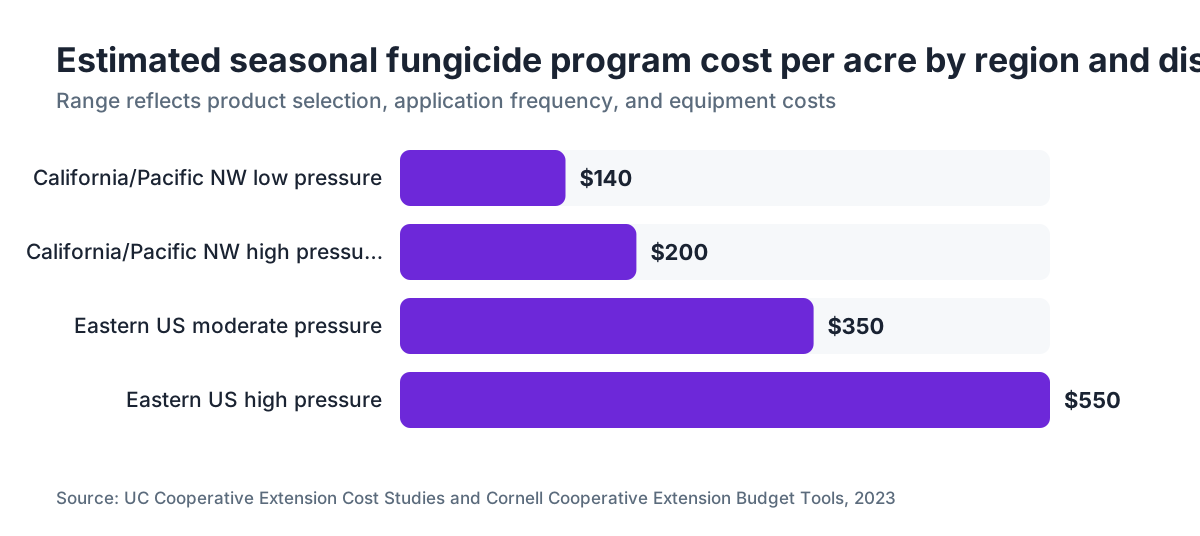
Budget honestly. A full-season commercial fungicide program in a disease-prone eastern region can run $200 to $600 per acre depending on products, application frequency, and equipment costs. In a lower-pressure western region, $80 to $200 per acre is more typical for commercial growers. These figures come from extension budgets published by Cornell (for the Northeast) and UC Cooperative Extension (for California), though input costs shift with supply chains, so confirm current prices with your supplier [12].
What are the best university extension resources for grapevine fungal disease management?
Three university programs dominate the practical information available to North American grape growers.
UC Cooperative Extension and the UC Integrated Viticulture program are the deepest resource for California growers. Their pest management guidelines for grape are published by UC IPM (ipm.ucanr.edu) and cover identification, thresholds, spray timing, and product selection for every major grapevine pest and disease. The powdery mildew section alone is the most-cited practical document in California viticulture.
Cornell Cooperative Extension runs the viticulture extension program for New York and is the research hub for the northeastern US. Their publications on managing botrytis bunch rot and grape IPM in the Northeast are benchmarks [2]. They also run the NEWA platform for weather-based disease forecasting, free for registered users.
Washington State University Extension (extension.wsu.edu) covers the Pacific Northwest and publishes detailed spray guides for Washington grape growers. Their Viticulture and Enology program at Prosser is especially strong on powdery mildew management in irrigated vineyards, downy mildew in the Puget Sound region, and the emerging Botryosphaeria wood disease complex [6].
All three programs keep email lists, and some run text-alert services for disease risk during the season. Signing up is free and often more timely than checking websites by hand. Your local extension viticulture advisor, if you have one, is worth more per hour of their time than almost any other advisor you'll pay.
Frequently asked questions
What is the most common fungal disease in grapevines?
Powdery mildew (Erysiphe necator) is the most widespread fungal disease in grapevines globally. It occurs in nearly every wine-producing region and is the primary disease target in dry western US climates where other fungal diseases are rare. In humid eastern regions, botrytis bunch rot competes for that title on economic impact.
Can you spray fungicides after rain to stop grapevine disease?
Most fungicides work protectively, not curatively. Spraying after infection has already occurred is largely ineffective. A few DMI and SDHI products offer a short kickback window (24 to 96 hours post-infection) for powdery mildew, but effectiveness drops sharply after 48 hours. Your best tool is a pre-rain or immediately pre-infection application before a high-risk weather event.
What is the difference between powdery mildew and downy mildew on grapes?
Powdery mildew (Erysiphe necator) is a true fungus that doesn't need free water to infect and appears as a white powdery coating on leaf surfaces. Downy mildew (Plasmopara viticola) is an oomycete that requires free moisture and warm temperatures, appearing as yellow oil spots on upper leaf surfaces with white fuzz on the undersides. They need different fungicide classes to control.
How does botrytis spread in a vineyard?
Botrytis cinerea overwinters on dead cane and cluster material in the vineyard. Spores release during wet periods and infect susceptible tissues: open flowers at bloom and ripening berries near harvest. The fungus also spreads berry-to-berry within a cluster through direct contact once one berry is infected. Tight clusters and dense canopies raise the spread rate dramatically.
What is Eutypa dieback and can it be cured?
Eutypa dieback is caused by Eutypa lata, a fungus that enters through pruning wounds and colonizes the woody tissue of the vine. It cannot be cured once established in the wood. Management is entirely preventive: prune during dry weather, apply wound protectants right after cutting, and remove infected wood. Trunk renewal can rescue heavily infected vines but takes 2 to 3 years.
How long do I need to keep pesticide application records for my vineyard?
Federal law under FIFRA requires pesticide application records kept for 2 years. California's Department of Pesticide Regulation requires 3 years. Records must include the product name, EPA registration number, application date, rate, acres treated, applicator name, and application site. County agricultural commissioners in California run periodic audits and can request these records.
Is sulfur safe to use on grapevines at any temperature?
No. Sulfur is phytotoxic to grapevines when applied within 2 weeks of certain other products or when temperatures exceed 90 to 95°F. At high temperatures sulfur volatilizes and can cause significant leaf and berry burn. Most extension programs recommend avoiding sulfur when temperatures in the next 24 to 48 hours will top 90°F. Check the label for the specific product you're using.
What does FRAC resistance management mean for my spray program?
FRAC (Fungicide Resistance Action Committee) assigns mode-of-action codes to fungicides. Using the same FRAC group repeatedly selects for resistant pathogen strains. Resistance to QoI (FRAC 11) strobilurins in powdery mildew is now widespread in commercial vineyards. Best practice is to rotate among at least two to three FRAC groups across your seasonal applications and include multi-site products (M codes) as anchors.
What's the best timing for a botrytis spray program in wine grapes?
The two highest-efficacy timing windows for botrytis control are early bloom (5 to 10 percent bloom) and late bloom to fruit set (80 to 100 percent bloom). A third application at bunch closure is often warranted for tight-clustered susceptible varieties like Pinot Noir or Zinfandel. Applications outside these windows show consistently lower returns in replicated trials.
Does variety selection affect fungal disease risk in the vineyard?
Yes, a lot. Tight-clustered varieties (Pinot Noir, Zinfandel, Gewürztraminer) are far more susceptible to botrytis than loose-clustered varieties (Grenache, Carignan). Thin-skinned varieties are more susceptible to powdery mildew berry infection. Some hybrid varieties like Marquette, Traminette, and Norton were bred partly for disease resistance and perform better in humid climates with fewer spray applications.
How can I tell black rot from botrytis on my grapevines?
Black rot (Guignardia bidwellii) mummifies berries into hard, black, wrinkled structures that often stay attached to the cluster. Botrytis produces soft, watery rot with a grayish-brown fuzzy sporulation visible in humid conditions. On leaves, black rot leaves circular lesions with tiny black pycnidia; botrytis leaf lesions are less common and lack the distinct circular pattern with embedded fruiting bodies.
Are there organic-approved options for controlling grapevine fungal diseases?
Yes. For powdery mildew, sulfur (FRAC M2) and potassium bicarbonate are the primary organic tools. Copper products (FRAC M1) handle downy mildew in organic programs. Several biological fungicides (Bacillus subtilis, Bacillus amyloliquefaciens) are OMRI-listed and have modest efficacy against botrytis and powdery mildew. Organic programs need shorter spray intervals and more precise timing than conventional programs.
What are the EPA Worker Protection Standard requirements for vineyard fungicide applications?
The revised WPS (effective 2017) requires annual pesticide safety training for agricultural workers, posting of application information at a central location, PPE per label, and strict observance of restricted entry intervals (REIs). In California, added requirements include County Ag Commissioner permits for restricted materials and written illness prevention programs for some operations. Records must be available for worker inspection.
What weather conditions trigger the highest fungal disease risk in vineyards?
For downy mildew, the '10-10-10 rule' captures the triggers: shoot growth over 10 cm, temperatures above 10°C, and 10 mm or more of rain in 24 to 48 hours. Powdery mildew risk peaks at 68°F to 77°F with moderate humidity, even without rain. Botrytis needs relative humidity above 90 percent for several hours and moderate temperatures (59°F to 77°F). Forecasting tools from UC IPM, Cornell's NEWA, and WSU DAS integrate these factors.
Sources
- UC IPM, University of California Agriculture and Natural Resources: Grape Pest Management Guidelines, Powdery Mildew: Powdery mildew (Erysiphe necator) infects at temperatures between 50°F and 90°F without requiring free moisture; UC IPM guidelines detail growth-stage spray timing.
- Cornell Cooperative Extension: Grape IPM in the Northeast, Black Rot Management: Black rot berry infection window closes approximately 4 to 6 weeks post-bloom when berries exceed approximately 8 mm diameter; Cornell recommends degree-day-based spray timing.
- Cornell NEWA (Network for Environment and Weather Applications): Grapevine Downy Mildew Forecasting: NEWA provides free weather-based downy mildew risk forecasting for vineyard managers; Cornell research shows early leaf removal reduced botrytis incidence in Finger Lakes trials.
- USDA National Agricultural Statistics Service: Noncitrus Fruits and Nuts Summary: Botrytis bunch rot is among the leading causes of economic grape crop loss in the US; highest-efficacy spray timings are early and late bloom.
- Washington State University Extension: Viticulture and Enology, Grape Pest Management: WSU extension trial data show early leaf removal in the cluster zone before bloom reduced botrytis incidence by 30 to 50 percent in susceptible varieties.
- Fungicide Resistance Action Committee (FRAC): FRAC Code List for Fungicides: FRAC recommends alternating or tank-mixing fungicides from different mode-of-action groups to slow resistance development; QoI resistance is widespread in powdery mildew.
- UC IPM, University of California: Organic and Alternative Pesticides for Grapes: Sulfur phytotoxicity risk rises sharply above 90 to 95°F; copper accumulation in vineyard soil is a documented long-term concern with repeated organic program use.
- U.S. EPA: Agricultural Worker Protection Standard (WPS): The revised WPS (effective 2017) requires annual worker safety training and strict observance of restricted entry intervals; REIs for common vineyard fungicides range from 4 to 24 or more hours.
- UC IPM, University of California: Grape Pest Management Guidelines, Eutypa Dieback: Eutypa lata infects through pruning wounds and takes 3 to 7 years to show foliar symptoms; infection risk is highest with rainfall within 3 days of pruning at 40°F to 68°F; management is preventive.
- California Department of Pesticide Regulation: Pesticide Use Reporting and Enforcement: California DPR requires County Agricultural Commissioner permits for restricted materials, maintains stricter reporting requirements than federal minimums, and requires records retained 3 years.
- UC Cooperative Extension: Sample Costs to Establish a Vineyard and Produce Wine Grapes: UC and Cornell extension cost budgets estimate commercial fungicide program costs at $80 to $200 per acre per season in lower-pressure western regions and $200 to $600 per acre in high-pressure eastern regions.
Last updated 2026-07-09