Boron foliar spray in vineyards: rates, timing, and what actually works
TL;DR
- Apply foliar boron at 0.1 to 0.3 lb actual B per acre from pre-bloom through early bloom to correct deficiency and improve fruit set.
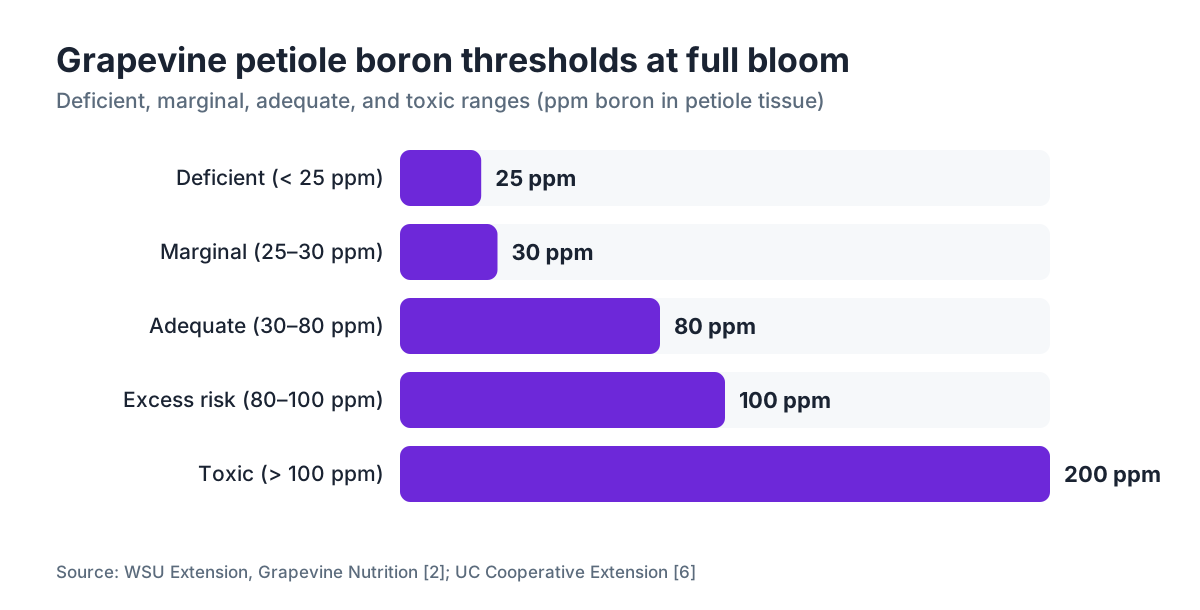
- Petiole boron below 25 ppm at bloom means deficient; above 100 ppm means toxic.
- High-pH soils above 7.0 and coarse sandy soils are the highest-risk sites.
- One or two sprays a season is usually enough.
Why does boron matter so much for grapevines?
Boron is a micronutrient, but the word micronutrient undersells it. It's tied directly to pollen tube germination, cell wall formation, and the movement of sugars through phloem. Let supply drop at bloom and pollen tubes fail to elongate, fertilization stalls, and you get shatter: clusters with few berries, sized every which way. That's a yield loss you can't repair once you see it.
University of California Cooperative Extension has documented fruit set reductions of 20 to 50% in boron-deficient Chardonnay and Chenin Blanc blocks. [1] Those aren't edge cases. Sandy soils, high-pH soils above 7.0, and wet springs that leach soluble boron below the root zone all set you up for it.
Boron also doesn't move around inside the plant once it lands. Most of it enters a leaf and stays put. That immobility is the reason a soil application made in late winter often can't rescue a deficient block before bloom arrives. A foliar spray puts boron into the tissue fast, and that speed is why it's the standard corrective tool.
What are the symptoms of boron deficiency in grapevines?
Boron deficiency shows up in a predictable order. Early season, you'll see shortened, zig-zagged shoot internodes and leaves with chlorotic, mottled margins. Tendrils sometimes brown out and abort. The clearest field signal comes at bloom: shot berries, thin rattly clusters, and berries sized all over the map inside a single bunch.
Visual symptoms only get you so far. Tissue testing is the only reliable confirmation. WSU Extension sets the adequate range for petiole boron at 30 to 80 ppm at full bloom, sampled as opposite-leaf petioles when you collect your standard nutrient sample. [2] Below 25 ppm is deficient. Between 25 and 30 ppm is marginal and worth treating. Don't trust the eye alone here, because several other problems, zinc deficiency most of all, throw similar shoot and fruit-set symptoms.
Soil testing for boron with a hot-water extraction helps with background diagnosis. But soil boron availability is so pH-sensitive and so patchy across a block that tissue testing gives you a far more useful number. If your soil pH runs above 7.5, boron availability falls even when total soil boron looks fine, and you should be pulling petioles every year out of habit.
When should you apply boron foliar spray in a vineyard?
The window is 2 to 3 weeks before bloom through early bloom, roughly 50% capfall. Cornell Cooperative Extension and UC Davis both point to pre-bloom as the period when boron in the tissue can actually feed pollen germination at flowering. [1][3] Spray too early, at tight cluster, and you get some benefit but you're ahead of the plant's peak need. Spray after 80% capfall and you're mostly setting up next season through what dormant wood retains, not helping this year's set.
A two-spray program many advisors run: one shot at 3 to 5 mm berry cluster (late tight cluster), a second at 50% capfall. Splitting the dose keeps leaf concentrations in the safe zone and improves uptake over a single heavy application.
Don't spray boron during heat stress above 90 degrees F, on drought-stressed vines, or right after a rain has washed off a recent application. Morning sprays before the heat climbs get absorbed better because stomata sit more open. Give the spray at least 6 to 8 hours of dry weather afterward for decent uptake.
What rate of boron should you apply per acre?
The standard corrective rate is 0.1 to 0.3 lb actual B per acre per application. Most commercial products are either solubilized borate materials or boric acid solutions, and actual boron content swings widely between them. Solubor (20.5% B) is the most common broadcast-label product in California and the Pacific Northwest, and at that strength 0.5 to 1.5 lb product per acre delivers the target elemental rate. [4]
Here's where growers wreck a block: they calculate the rate off the product label without converting to elemental boron. A rate that's safe with enough water goes phytotoxic if you cut carrier volume too far on a hot afternoon with slow drying. Run a minimum 50 gallons per acre carrier for ground applications in a full canopy. Dilute solutions cut the risk of tip burn and contact damage.
For maintenance in blocks with no deficiency history, a single 0.1 lb B/acre application at pre-bloom is plenty. For blocks with documented deficiency (petiole below 25 ppm), 0.2 to 0.3 lb B/acre split across two sprays does more. Don't push past 0.5 lb B/acre per season from foliar sources. Beyond that you're courting phytotoxicity with no meaningful gain in correction.
| Situation | Rate (lb actual B/acre) | Timing | Applications |
|---|---|---|---|
| Maintenance (no deficiency) | 0.1 | Pre-bloom | 1 |
| Marginal (25 to 30 ppm petiole) | 0.1 to 0.2 | Pre-bloom | 1 to 2 |
| Deficient (<25 ppm petiole) | 0.2 to 0.3 split | Pre-bloom + 50% capfall | 2 |
| Sandy/high-pH soil, history of shatter | 0.2 to 0.3 split | Tight cluster + 50% capfall | 2 |
How do you actually apply a foliar boron spray in a vineyard?
Ground applications with an airblast sprayer or low-volume rig are the standard method. Full-canopy coverage of leaves and clusters means calibrating the sprayer for the canopy volume you have on the day you spray. [5] Pre-bloom canopy is open and much smaller than what you'll carry at veraison, so don't just reload last season's settings.
Mix boron products into a small volume of water before adding to the tank, especially Solubor, which needs agitation to dissolve fully. Tank-mixing with a fungicide? Check compatibility first. Boron plays well with copper materials and most sulfur formulations, but pairing it with some systemic fungicides can cut the efficacy of both. Run a small jar test before you commit the whole tank.
Speed matters too. Running the sprayer at 3 to 4 mph gives enough dwell time and drop-size spread for thorough coverage. Faster passes throw drift and leave gaps. A vineyard trained to a vertically divided canopy like VSP needs far less water volume than a sprawl or overhead system, so adjust for what you've got.
Aerial application by helicopter shows up occasionally in large blocks with access problems, but coverage uniformity suffers and aerial rates need a separate label review. Most small and mid-size operations should stay on ground equipment.
If you keep pesticide and nutrient records in a digital system, this is where something like VitiScribe saves you time: every application date, rate, formulation, and field map lands in one place, so you're not retyping handwritten spray notes on Friday afternoon.
What's the toxicity risk, and how do you avoid burning vines?
Boron has the narrowest sufficiency-to-toxicity window of any micronutrient grapevines deal with. Leaf tissue above 100 ppm B shows tip and marginal burn, and above 200 ppm brings severe necrosis. [6] The gap between 25 ppm (deficient) and 100 ppm (toxic) is real, but it isn't wide.
Field toxicity almost always traces to one of three things: too high a rate, too little carrier water, or repeated sprays without retesting tissue. The vine doesn't shed boron once it's in the leaf, so applications stack across a season. Test tissue after the first spray, before you decide on a second.
High-pH soils and soils with naturally elevated boron (parts of the San Joaquin Valley, stretches of arid Nevada and Arizona) can already have leaves sitting at 60 to 80 ppm before you touch the sprayer. Know your baseline.
Carrier volume and canopy temperature at application both drive burn risk. Sprays above 90 degrees F with low carrier volume are the most common cause of field burn complaints. Don't exceed the product label rate, full stop.
Does soil-applied boron work instead of, or alongside, foliar?
Soil boron makes a good foundation, but it doesn't replace pre-bloom foliar spray for correcting an active deficiency. Soil-applied boron (usually borax or sodium tetraborate) rebuilds root-zone reserves over the dormant season, which matters most in sandy soils that won't hold water-soluble boron through a wet winter. Rates of 0.5 to 1.0 lb B/acre banded or broadcast ahead of a rain event are the usual approach. [4]
The catch with leaning only on soil boron is timing and uptake. Apply borax in November and you still have no guarantee that root uptake and translocation deliver enough boron to young flower tissue before capfall in May or June. Soil pH, soil moisture, root activity, and spring temperature all decide how much reaches the leaf. Foliar application skips every one of those variables.
Most PCA advisors land in the same place: use soil boron to build reserves on chronically deficient sites, and use foliar boron to hit the pre-bloom window reliably every year. They aren't competing strategies. They work together.
What are the EPA Worker Protection Standard requirements for boron foliar sprays in vineyards?
The pesticide label sets the protection requirements under the EPA Worker Protection Standard (WPS), and here's the wrinkle: boron sold as fertilizer and boron classified as a pesticide can carry different labels. Products like Solubor carry fertilizer labels in most states; other formulations are labeled as pesticides. If your product shows an EPA registration number, WPS applies. [7]
For WPS-registered products, you must provide workers with pesticide safety training, post application information at a central location (the Application Information Display), and observe the label re-entry interval (REI). Many boron foliar products carry a 4-hour REI, though the language varies by product and state registration. Read the specific label. Never assume.
Personal protective equipment for mixing and loading boron typically means chemical-resistant gloves, eye protection, and long sleeves. Those are label requirements and WPS requirements at the same time. Spray operators should review the Safety Data Sheet for the exact product before handling it.
California operations carry an extra layer of oversight from CDPR and Cal/OSHA: pesticide use reports (PURs) are required for every registered pesticide application, and county agricultural commissioner notification rules vary by county. UC Cooperative Extension IPM guidelines are a solid first stop for current state requirements. [8]
How do you record and track boron spray applications for compliance?
Spray records for a micronutrient application need to capture the date and time, product name and EPA registration number (if it has one), rate (both per acre and per treated area), crop and growth stage, applicator name and license number, equipment used, and weather at the time of spray. In California that's required for any registered pesticide and gets spot-checked by county ag commissioners. [8]
Organic operations carry another layer. Boric acid and sodium tetraborate sit on the OMRI-allowed list with restrictions under the National Organic Program (NOP), and the annotation is what counts. NOP requires that soil and crop nutrients be used to maintain or improve soil organic matter, so you need documentation that a tissue or soil test justified the application. [9]
Paper records work, but they breed transcription errors and make it a chore to pull block-specific history at audit time. By mid-season, with foliar fungicide programs running, the paper stacks up fast. VitiScribe is built for exactly this: application records, tissue test results, and spray maps stay attached to individual vineyard blocks, so your compliance history is current and exportable whenever a certifier asks.
Keep records for at least two years (the California DPR requirement for pesticide use reports) and longer if you hold organic certification, which can require a five-year audit trail. [11]
Is boron beneficial for all grape varieties, or are some more sensitive?
Every Vitis vinifera variety can run short on boron, but susceptibility isn't uniform. Varieties with loose, open flower clusters and long cap retention, like Sauvignon Blanc and Grenache, tend to show symptoms more sharply than tight-clustered varieties like Cabernet Sauvignon, simply because failed pollen tubes are more visible in an open cluster. Cabernet isn't immune, though. Poor-set years in Cabernet often carry a boron component that gets blamed entirely on weather.
Hybrid varieties (Norton, Chambourcin, Traminette) and American species like Concord tolerate a wider soil boron range and rarely show classic deficiency symptoms. Nobody has good large-sample data on variety-by-variety boron thresholds. The 25 to 80 ppm petiole range comes largely from work on vinifera.
Rootstock choice interacts with boron uptake. Some rootstocks pull micronutrients more efficiently from low-availability soils, but that isn't well-characterized for boron across the commercial rootstock lineup. The practical takeaway: don't assume a new planting on a different rootstock carries the same boron status as the block you pulled out.
What does the research actually say about boron and fruit set improvement?
The most-cited work on boron and grapevine fruit set comes from UC Davis and WSU field trials going back to the 1990s. UC Davis researchers found significant fruit set gains, up to 40% more berries per cluster in deficient blocks, following pre-bloom boron sprays against untreated Chardonnay controls. [1] WSU research in Washington's Columbia Basin confirmed similar responses and set the petiole sampling benchmarks growers use today. [2]
One finding runs through all of it: boron response only matters where a deficiency exists. If your petioles read 50 ppm at bloom, more boron won't improve set and may scorch margins. The trials showing dramatic gains all start from deficient blocks. That's why the research frames boron as a corrective tool tied to soil and tissue testing, not a blanket recommendation for every vineyard.
Cornell extension research noted that boron sprays paired with adequate zinc status produced better fruit set than boron alone in some blocks, which suggests that once a set problem is bad enough to test for boron, it's worth running a full micronutrient panel at the same time. [3] The interaction isn't fully worked out in the literature, but the practical advice holds: fix the whole picture, not one number.
Frequently asked questions
How much boron per acre should I apply as a foliar spray on grapevines?
The standard corrective rate is 0.1 to 0.3 lb actual boron per acre per application. For maintenance in blocks with no deficiency history, 0.1 lb B/acre at pre-bloom is adequate. For confirmed deficient blocks (petiole below 25 ppm), use 0.2 to 0.3 lb B/acre split across two applications at tight cluster and 50% capfall. Never exceed 0.5 lb B/acre per season from foliar sources.
When is the best time to spray boron on grapevines?
Pre-bloom to early bloom is the window that matters, specifically 2 to 3 weeks before bloom through 50% capfall. Sprays in this period support pollen tube germination and fruit set. Applying before tight cluster gives some benefit; applying after 80% capfall mainly affects next season's stored reserves. Two-spray programs at tight cluster and 50% capfall are standard for deficient blocks.
What are the signs of boron deficiency in a vineyard?
Watch for shortened, zig-zagged shoot internodes, chlorotic leaf margins, aborted tendrils, and poor fruit set at bloom with shot berries and rattly clusters. Tissue testing is the only reliable confirmation: petiole boron below 25 ppm at bloom is deficient. These visual symptoms overlap with zinc deficiency, so testing tissue before you treat is worth the cost.
Can boron foliar spray burn grapevine leaves?
Yes. Boron has a narrow safe range: leaf tissue above 100 ppm causes tip and marginal burn, and above 200 ppm causes severe necrosis. Toxicity risk climbs with high rates, low carrier water, and sprays during heat above 90 degrees F. Stay at recommended rates, use at least 50 gallons per acre carrier, spray in cool morning hours, and retest tissue before a second application.
Is Solubor the best boron product for foliar application on grapes?
Solubor (20.5% B) is the most widely used commercial product in California and the Pacific Northwest because it dissolves cleanly and has a long track record. Boric acid solutions work similarly. Granular borax is poorly suited for foliar use because it doesn't dissolve well enough for even spray distribution. Whatever product you use, calculate the rate off actual elemental boron content, not product weight.
Do I need to report boron spray applications in California?
If the boron product carries an EPA registration number as a pesticide, you must file a pesticide use report (PUR) with your county agricultural commissioner within the required window. Fertilizer-only boron labels with no EPA reg number don't require a PUR in California, but documenting every application is good practice for organic certification audits and general compliance. Check your specific product label.
How do I test for boron deficiency in my vineyard?
The standard test is petiole tissue sampling at full bloom, collecting the opposite-leaf petiole (the leaf at the same node as the flower cluster). Send it to a certified agricultural lab. Adequate range is 30 to 80 ppm boron in the petiole; below 25 ppm is deficient. Hot-water extraction soil tests are a useful secondary tool but predict actual vine uptake less well than tissue values.
Can I tank-mix boron with my pre-bloom fungicide spray?
Usually yes. Boron is compatible with most copper and sulfur fungicide formulations and with many systemic fungicides used at pre-bloom. Run a small jar compatibility test before mixing a full tank, and check both product labels for listed incompatibilities. Some growers add boron to their pre-bloom downy or powdery mildew sprays to cut spray passes, which is practical and works well.
Does soil pH affect how much boron my vines can take up?
Yes, a lot. Boron availability drops sharply as soil pH rises above 7.0 and is strongly restricted above 7.5. That's one main reason high-pH soils in arid regions and limestone-influenced sites show chronic boron deficiency even when total soil boron isn't low. Liming a previously acidic site can trigger boron deficiency that wasn't there before. In these cases, foliar application is more reliable than correcting through soil. [10]
How does the EPA Worker Protection Standard apply to boron foliar sprays?
WPS applies when the boron product carries an EPA registration number as a pesticide. Requirements include applicator and worker safety training, posting application information at a central location, observing the label REI (commonly 4 hours for boron products), and providing required PPE for mixing and loading. Fertilizer-labeled boron products without an EPA registration number aren't covered by WPS, though basic handling protections still apply.
Is boron allowed under organic certification for vineyards?
Boric acid and sodium tetraborate are on the OMRI-allowed list and permitted under USDA NOP organic standards with an annotation: use must be tied to a documented soil or tissue deficiency and aimed at correcting a nutritional need, not applied as a routine blanket. Keep your tissue test results and application records as part of your organic system plan. Check with your certifier before first use.
How long do I need to keep boron spray records?
California DPR requires pesticide use records to be kept at least two years from the application date. For organically certified operations, USDA NOP requires records supporting your organic system plan to be kept five years. Even if your boron product is fertilizer-labeled rather than pesticide-labeled, retaining application records for at least three years protects you in any compliance review or certification audit.
Will boron spray improve wine quality, or just yield?
The direct effect is on fruit set and cluster uniformity, which drives yield and berry size distribution. Better, more uniform set can indirectly help quality by cutting the share of small shot berries that skew skin-to-juice ratios. There's no published evidence that boron above deficiency thresholds directly improves flavor chemistry. The quality case for boron rests on preventing the deficiency, not on any stimulant effect.
Sources
- UC Cooperative Extension, Nutrient Management in Vineyards: Fruit set reductions of 20 to 50% documented in boron-deficient Chardonnay and Chenin Blanc, and pre-bloom foliar boron improved set by up to 40% in deficient blocks
- Washington State University Extension, Grapevine Nutrition: Adequate petiole boron range at full bloom is 30 to 80 ppm; below 25 ppm is deficient
- Cornell Cooperative Extension, Viticulture Program: Boron sprays combined with adequate zinc status produced better fruit set results than boron alone in some trial blocks
- UC Davis Plant Sciences, Micronutrient Use in Vineyards: Solubor (20.5% B) standard foliar rate is 0.5 to 1.5 lb product/acre; soil borax applications of 0.5 to 1.0 lb B/acre used to rebuild root-zone reserves
- UC Agriculture and Natural Resources, Pesticide Application Methods: Airblast sprayer calibration for canopy volume and application speed (3 to 4 mph) recommendations for foliar vineyard sprays
- UC Cooperative Extension, Grapevine Micronutrient Toxicity: Leaf tissue boron above 100 ppm causes visible tip and marginal burn; above 200 ppm causes severe necrosis
- U.S. EPA, Worker Protection Standard for Agricultural Pesticides: WPS requirements including REI posting, worker training, and PPE apply to all EPA-registered pesticide products applied in agricultural settings
- California Department of Pesticide Regulation, Pesticide Use Reporting: All registered pesticide applications in California require a pesticide use report filed with the county agricultural commissioner; records must be retained for at least two years
- USDA National Organic Program, Allowed and Prohibited Substances: Boric acid and sodium tetraborate are permitted under NOP with the annotation that use must correct a documented deficiency; OMRI listing applies
- WSU Extension, Soil pH and Micronutrient Availability in Vineyards: Boron availability drops sharply as soil pH rises above 7.0 and is strongly restricted above 7.5, creating deficiency even when total soil boron is adequate
- UC Cooperative Extension, Organic Viticulture Nutrient Management: Organic NOP-compliant boron applications must be documented with supporting soil or tissue test results as part of the organic system plan
Last updated 2026-07-09