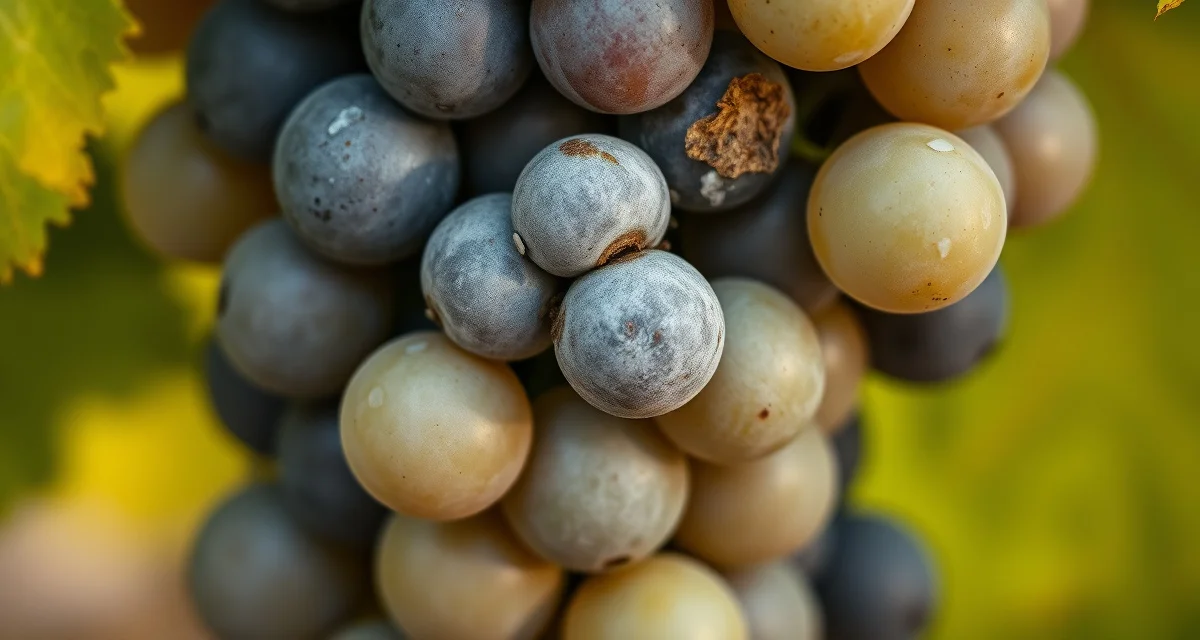
Botrytis Bunch Rot Vineyard IPM: Complete Hub
Botrytis cinerea doesn't announce itself. It waits. It lives as mycelium in mummified berries, dead flower parts, and dried leaf debris that sits inside your clusters from bloom through harvest. When conditions turn right -- moisture, moderate temperatures, injured or stressed berries -- it activates and moves through clusters faster than most growers expect.
TL;DR
- Botrytis needs an entry point to infect -- flower parts at bloom, feeding wounds from insects, powdery mildew lesions, berry cracking, or skin splitting from rapid water uptake
- A Chardonnay block can go from clean to 30% bunch rot in four days after a late September rain event -- scouting frequency after rain events must increase to every 2-3 days near harvest
- Early leaf removal in the cluster zone reduces botrytis incidence by 30-60% in susceptible varieties -- this is often more effective than adding a third fungicide application to a closed canopy
- FRAC group rotation is required for botrytis management: resistance to dicarboximides (Rovral class) is widespread, and Group 17 (fenhexamid) resistance has been documented in high-use California vineyards
- Tight-clustered varieties (Chardonnay, Pinot Noir, Gewurztraminer, Grenache, Riesling) are most susceptible; Cabernet Sauvignon and Syrah have lower baseline risk
- Organic botrytis programs rely primarily on canopy management -- organic fungicide options provide supplemental protection but cannot substitute for aggressive cultural management in high-pressure years
If you've watched a Chardonnay block go from clean to 30% bunch rot in four days after a late September rain event, you understand the problem. This hub covers everything: identification, spray timing, canopy management, fungicide resistance, and how to document your botrytis IPM program.
Botrytis Biology in Vineyards
Botrytis cinerea is a wound pathogen and senescence pathogen. It can't infect healthy, intact berry tissue under normal conditions. It needs an entry point:
- Flower parts (susceptibility window at bloom)
- Insect or bird damage
- Mealybug or leafhopper feeding wounds
- Powdery mildew lesions (co-infection)
- Berry cracking from water stress or excessive vigor
- Skin splitting from rapid berry expansion
The pathogen survives as sclerotia (hard, dark resting structures) in infected tissue and as mycelium in mummified berries. Secondary spread during the season happens through conidia (spores) released from sporulating lesions.
Critical infection windows:
- Bloom: Dead flower parts trapped in developing clusters provide ideal substrate. This is why early leaf removal in the cluster zone matters.
- Pre-veraison: As berries begin softening and sugar accumulation starts, susceptibility increases
- Post-veraison through harvest: High sugar, tight clusters, any wound, rain = botrytis
Identifying Botrytis in Vineyards
Early-Season Shoot Blight
In cool, wet springs, botrytis can infect young green shoots, causing them to collapse and die. This looks like frost damage initially and is often mistaken for it. Look for the gray sporulation mass (conidia) on the collapsed tissue -- that's the tell.
Cluster Infection at Bloom
After bloom, dead flower parts trapped in the cluster are the primary entry point. You won't see visible botrytis at this stage. What you'll see later is the consequence.
Pre-Harvest Bunch Rot
This is what most people think of when they think botrytis:
- Individual berries develop brownish, water-soaked spots
- Berries quickly collapse and develop the characteristic gray mold (conidia production)
- Infection spreads rapidly within tight clusters
- In humid conditions, a cluster can go from 1-2 infected berries to total cluster rot in 48-72 hours
Noble Rot
In specific climate conditions -- alternating humid nights and warm, dry days -- Botrytis cinerea produces "noble rot" (Botrytis pourriture noble) on certain varieties (Riesling, Semillon, Sauvignon Blanc). It concentrates sugars and creates the conditions for great Sauternes-style wines. This is a specialized topic; for most commercial wine grape production, it's not what you're aiming for.
For a detailed symptom guide, see identifying botrytis in vineyards.
Canopy Management: Your Primary Botrytis Defense
No spray program compensates for a closed canopy. The best botrytis management is physical -- create conditions where clusters dry quickly and spray penetration is good.
Leaf Removal
Remove basal leaves in the cluster zone at or just after fruit set. Target 2-4 leaf layers on the morning sun side of the canopy (east-facing rows). This:
- Reduces humidity inside the cluster zone
- Accelerates cluster drying after rain or dew
- Dramatically improves spray penetration to clusters
- Reduces the "leaf nest" debris trapped in clusters
Studies consistently show early leaf removal reducing botrytis by 30-60% in susceptible varieties. It's one of the highest-ROI practices in your IPM program. See botrytis canopy management connection for the full analysis of timing and method.
Shoot Positioning (VSP)
Properly positioned shoots create defined canopy geometry where air circulation is predictable. A tangled, unpositioned VSP canopy with doubled shoots creates micro-environments that stay wet for hours longer than a well-positioned canopy.
Cluster Thinning
Tight clusters trap moisture and limit spray penetration. Loose clusters dry faster. In botrytis-susceptible varieties (Chardonnay, Gewurztraminer, Pinot Noir, Grenache), cluster thinning is an effective management tool beyond its yield management benefits.
Fungicide Program for Botrytis
Botrytis fungicides work best protectively. By the time you see gray sporulation in a cluster, that infection is done -- you're protecting uninfected clusters, not curing infected ones.
FRAC Group 17 (Hydroxyanilides):
- Products: Elevate (fenhexamid)
- Excellent activity, moderate resistance risk
- Maximum 2 applications per season
FRAC Group 2 (Dicarboximides):
- Products: Rovral (iprodione), Endura (boscalid+tebuconazole)
- Resistance common where heavily used -- limit application frequency
- Rovral: PHI 7 days
FRAC Group 7 (SDHI):
- Products: Fontelis (penthiopyrad), Switch (contains FRAC 9+12)
- Fontelis has good botrytis activity; Switch (fludioxonil+cyprodinil) is excellent
- PHI: Check labels
FRAC Group 9+12 (Anilinopyrimidine + Phenylpyrrole):
- Switch (fludioxonil+cyprodinil): One of the most effective botrytis products
- Maximum 2 applications per season
Multi-site materials:
- Captan (FRAC M4): Effective protectant, inexpensive. REI: 48 hours. No resistance risk.
Key Timing Applications for Botrytis:
- Bloom to early berry development: Apply at early bloom or 50% cap fall. Protects dying flower tissue.
- Pre-veraison (bunch closure): Last chance for good spray penetration before clusters tighten.
- Post-veraison if needed: High-risk or wet conditions only. Weigh PHI carefully.
Botrytis Resistance Management
Resistance to dicarboximides (Rovral class) is widespread. Resistance to some anilinopyrimidines has been documented. Rotate FRAC groups to slow resistance development.
FRAC-resistant botrytis populations don't respond to products in that class -- this isn't about reduced efficacy, it's about complete control failure. Track your FRAC group use in VitiScribe to ensure you're not repeating the same class.
For detailed resistance management guidance, see botrytis resistant fungicides for vineyards.
Organic Botrytis Management
Limited effective organic options for botrytis. The program relies heavily on canopy management.
Materials with some botrytis activity:
- Serenade (Bacillus subtilis, FRAC BM02): Some activity, better as a supplement
- Kaolin clay: Physical barrier; limited efficacy as standalone
- Copper: Not effective against botrytis specifically
- Regalia (Reynoutria sachalinensis extract): Plant defense inducer; some botrytis suppression in trials
For organic vineyards, canopy management is not optional -- it's your primary botrytis defense. Aggressive early leaf removal, proper shoot positioning, and careful irrigation management are essential. See organic botrytis control for vineyards for full organic program guidance.
Comparison: Managing Botrytis With and Without VitiScribe
| Task | Paper/Spreadsheet | VitiScribe |
|---|---|---|
| FRAC rotation tracking | Manual lookup | Per-block visual rotation history |
| PHI before harvest | Manual calculation | Auto-calculated alerts |
| Scouting records linked to sprays | Separate notebooks | Integrated in block record |
| Audit/certifier documentation | Manual assembly | One-tap compliance pack |
FAQ
What are the key timings for botrytis fungicide applications in vineyards?
The two most important applications are: (1) at bloom to 50% cap fall, which protects dying flower tissue from becoming infection substrate; and (2) at bunch closure (pre-veraison), which is the last application that achieves good cluster penetration before clusters tighten. Additional applications at pre-harvest may be warranted in high-pressure or wet seasons, but weigh PHI carefully. Protectant timing is critical -- botrytis fungicides prevent infection but don't cure established infections.
How does canopy management reduce botrytis in vineyards?
Canopy management reduces botrytis by improving air circulation and cluster drying time, improving spray penetration to clusters, and removing the leaf litter trapped in clusters that provides substrate for infection. Early leaf removal in the cluster zone at or after fruit set has been shown to reduce botrytis incidence by 30-60% in susceptible varieties. This is often more effective than adding a third fungicide application to a closed canopy.
What varieties are most susceptible to botrytis bunch rot?
Tight-clustered varieties with thin-skinned berries are most susceptible: Chardonnay, Pinot Noir, Gewurztraminer, Grenache, and Riesling. Looser-clustered varieties like Cabernet Sauvignon, Merlot, and Syrah generally have lower botrytis pressure, though they're not immune. Zinfandel's thin skin makes it susceptible, especially where berry cracking from uneven ripening is common.
How do I record botrytis management activities for a sustainable certification audit?
Sustainable certification programs including Lodi Rules, SIP Certified, and Napa Green all review botrytis management documentation as part of their IPM audit process. Your records should show: canopy management activities (leaf removal date, method, blocks treated), scouting records that monitored cluster incidence and severity throughout the season, spray applications with FRAC groups noted and growth stage at application, PHI documentation for late-season applications, and any weather events that triggered monitoring or spray decisions. The combination of cultural management plus monitoring-triggered fungicide applications demonstrates IPM-based management rather than a reactive, calendar-only approach.
How should I handle botrytis pressure in blocks that will be machine harvested vs. hand picked?
Machine harvesting typically happens faster than hand harvesting but is less discriminating -- once a decision is made to harvest mechanically, all fruit in the block comes in regardless of rot level. If botrytis pressure is building in a block targeted for machine harvest, the calculation for an emergency pre-harvest application or a harvest date adjustment is different from a hand-harvest block where pickers can skip individual clusters. Document your harvest method in your block records alongside botrytis incidence data so you can analyze whether harvest method influences how you manage late-season pressure.
What is Botrytis Bunch Rot Vineyard IPM: Complete Hub?
[FAQ_ANSWER_PLACEHOLDER: This answer needs to be generated by AI with specific data, examples, and actionable advice relevant to Botrytis Bunch Rot Vineyard IPM: Complete Hub. Target 50-150 words.]
How much does Botrytis Bunch Rot Vineyard IPM: Complete Hub cost?
[FAQ_ANSWER_PLACEHOLDER: This answer needs to be generated by AI with specific data, examples, and actionable advice relevant to Botrytis Bunch Rot Vineyard IPM: Complete Hub. Target 50-150 words.]
How does Botrytis Bunch Rot Vineyard IPM: Complete Hub work?
[FAQ_ANSWER_PLACEHOLDER: This answer needs to be generated by AI with specific data, examples, and actionable advice relevant to Botrytis Bunch Rot Vineyard IPM: Complete Hub. Target 50-150 words.]
Sources
- California Department of Pesticide Regulation (CDPR)
- UC Cooperative Extension Viticulture
- Oregon Department of Agriculture (ODA)
- American Vineyard Foundation
- American Society for Enology and Viticulture (ASEV)
Get Started with VitiScribe
Botrytis IPM documentation requires linking canopy management records, scouting observations, spray applications, FRAC rotation history, and PHI calculations -- all at the block level across a full season. VitiScribe keeps all of it on the same block timeline so your program tells a coherent story when a certifier or buyer asks to review it. Try VitiScribe free and build your botrytis IPM records from your next scouting visit forward.