Downy Mildew Vineyard IPM: The Complete Hub
Downy mildew (Plasmopara viticola) doesn't exist in most of California's major wine regions -- and California growers can be forgiven for not thinking much about it. But if you're farming in Oregon, Washington east of the Cascades during wet years, New York, Virginia, or any eastern wine region, downy mildew is often a more pressing threat than powdery mildew.
TL;DR
- Downy mildew infection requires three simultaneous conditions: temperature above 50°F, 10 or more inches of shoot growth, and at least 0.1 inch of rainfall in 24 hours -- when all three align, you have an infection event and typically 2-7 days before symptoms appear
- Unlike powdery mildew, downy mildew management is tied to weather-triggered infection events rather than fixed calendar intervals -- protectant materials must be on the vine before rain events
- Phenylamide (FRAC Group 4) resistance is common in downy mildew populations -- limit Ridomil to 2 applications per season and never apply consecutively
- Mancozeb (FRAC M3) has a 66-day PHI -- applications made too late in the season can create pre-harvest compliance problems
- Downy mildew programs in Willamette Valley typically start at 10-inch shoot growth and run through fruit set; Washington's Columbia Valley is lower risk in dry years except during wet spring events
- VitiScribe spray records can incorporate rainfall and temperature data to document the infection event conditions that triggered each application, which is essential for sustainable certification and winery buyer documentation
Plasmopara viticola requires moisture for infection. That free-water requirement means management is tied directly to weather events -- rain, heavy dew, fog -- in ways that California-focused programs don't account for.
The Biology You Need to Know
Plasmopara viticola overwinters as oospores in infected leaf litter on the vineyard floor. In spring, oospores germinate to produce zoosporangia when soil temperatures reach 50°F and there's been 2.5 cm or more of cumulative rainfall. These primary sporangia require splash dispersal -- rain events move them from the soil to lower vine tissue.
The critical rule for infection: The "10-10-24" rule, or variations of it, guides management decisions. Infection occurs when:
- Temperature is above 50°F (10°C)
- Vines have 10 or more inches of shoot growth
- There's been 0.1 inch (2.5mm) or more of rainfall in a 24-hour period
When all three conditions are met, you have an infection event. You typically have 2-7 days before symptoms appear (the incubation period varies with temperature).
Identifying Downy Mildew Symptoms
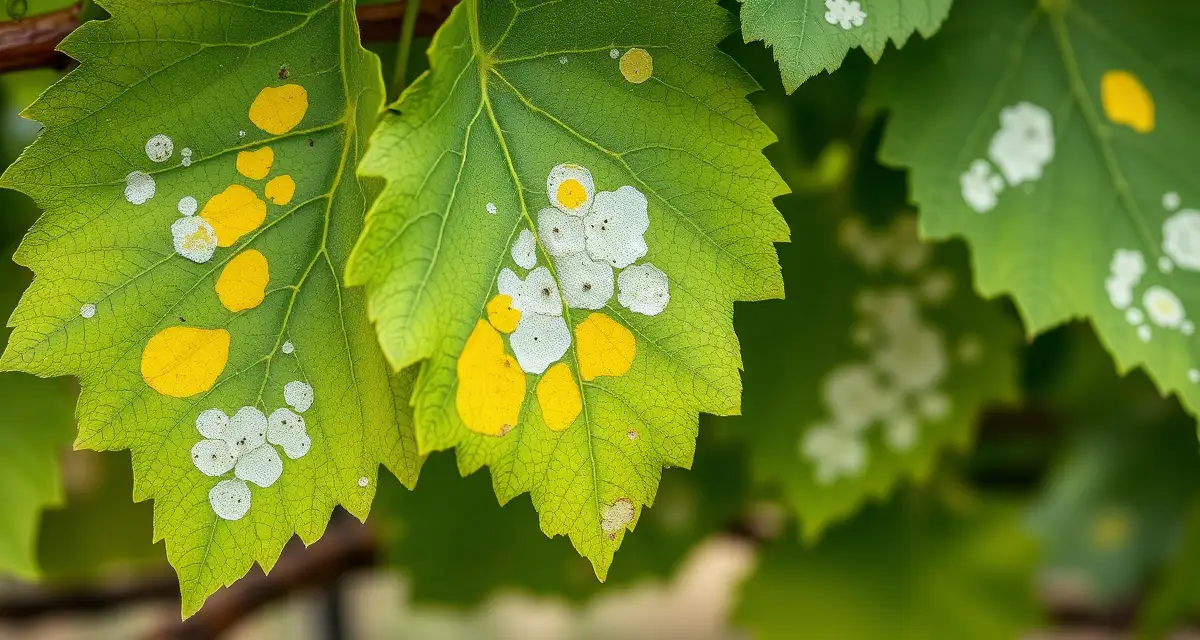
Leaves: The classic sign is "oil spots" -- light yellow-green to yellowish blotches on the upper leaf surface that look oily or water-soaked. On the underside of the same leaf, white cottony sporulation appears during humid conditions (typically overnight or early morning). This white fuzz is the sporangiophores producing the secondary spores that spread disease within the vineyard.
Shoots and tendrils: White sporulation on succulent new growth. Infected shoots can become stunted and die.
Clusters at bloom: Infection of flower clusters causes "first downy mildew" -- clusters turn brown, dry up, and die. This is devastating to yield.
Berries after fruit set: Infected berries turn brown and die ("leather rot") or remain stunted. Late-season berry infections can be mistaken for botrytis in some conditions.
Spray Timing: Responding to Infection Events
Unlike powdery mildew, where calendar-based intervals are a reasonable primary approach, downy mildew management is better tied to weather-triggered infection events.
The key timing decisions:
Before an infection event: Apply a protectant material before rain. Products must be on the vine before the infection period begins. Many growers apply 24 hours before a significant forecast rain event.
After an infection event: If you missed pre-event protection, apply a systemic material with curative activity within 2-4 days of the infection event (before symptom expression).
Interval-based programs: For regions with frequent rain events, a 7-10 day interval program is still used to ensure protection is in place before infection events that can't all be individually timed.
Products for Downy Mildew Management
Copper (FRAC M1): Multi-site contact protectant. OMRI-listed. Effective when applied before infection events. Standard for organic programs. Does not have curative activity. Rate: 1-2 lbs metallic copper per acre per application, watch cumulative totals.
Mancozeb (FRAC M3): Multi-site contact protectant. Conventional programs only. Highly effective when applied before infection events. PHI: 66 days (check current label). REI: 24 hours.
Phosphonate/phosphite materials (FRAC P07): Both protective and systemic; induces plant resistance. Examples: Phostrol, ProPhyt. Excellent rotation partners and can be applied after infection events.
FRAC Group 4 (Phenylamide -- Metalaxyl): Products: Ridomil. Highly systemic, curative activity. Resistance is common -- limit to 2 applications per season and never consecutively. Use in mixtures with contact materials.
FRAC Group 40 (CAA -- Carboxylic Acid Amides): Products: Presidio (fluopicolide), Zampro (dimethomorph+ametoctradin). Systemic, curative activity. Good resistance management tools.
FRAC Group 45: Cymoxanil (Curzate). Short residual curative activity. Use within 24-48 hours post-infection.
FRAC Group 49: Ametoctradin (component of Zampro). Unique mode of action.
Regional Downy Mildew Profiles
Willamette Valley, Oregon: High risk. Cool, wet springs create multiple infection events in May and June. Programs typically start at 10-inch shoot growth and continue through fruit set. Copper backbone + phosphonate rotation is standard in organic operations.
Washington State (west of Cascades): High risk. Columbia Valley east of Cascades: lower risk except in wet years.
Finger Lakes, New York: Moderate to high risk. Wet May-June period is critical. Programs often combine downy and powdery mildew management materials.
Virginia: High risk in humid years. Programs need to address both diseases simultaneously through bloom.
California (Napa, Sonoma): Low risk in most regions and most years. Downy mildew can occur in cool, wet springs, particularly in coastal areas. Not a primary program concern but worth monitoring in wet years.
Documentation for Downy Mildew IPM
Weather-triggered spray decisions need weather data to justify them. VitiScribe's spray records can incorporate rainfall data and temperature records to document the infection event conditions that prompted each application.
Scout records documenting "oil spot" presence and severity provide the field evidence to justify your program decisions to certifiers and winery buyers. For more on how to document weather-triggered spray decisions for sustainable certification review, see the block scouting template guide.
Related Articles
- Organic Downy Mildew Control for Vineyards
- Downy Mildew Fungicide Resistance Management for Vineyards
- Grape Berry Moth IPM for Vineyards: Complete Guide
FAQ
How do I know if I have a downy mildew infection event?
A downy mildew infection event occurs when: temperature is above 50°F (10°C), vines have 10 or more inches of shoot growth, and there has been at least 0.1 inch (2.5mm) of rainfall in 24 hours. When all three conditions are met, apply a protectant before the rain event or a systemic material within 2-4 days after. Some spray scheduling models (like the UC IPM disease models) can help predict infection event timing based on your weather station data.
Does downy mildew occur in California vineyards?
Downy mildew does occur in California but is rarely a major problem in most wine regions. The drier conditions that define most California wine country limit the wet periods needed for infection. In cool, wet years -- particularly in coastal regions near the Pacific -- downy mildew can appear, especially in poorly positioned canopies with limited air circulation. If you're farming in a coastal area and see oil spots on lower leaves after a wet spring, it's worth investigating.
What's the difference between downy mildew and powdery mildew management in vineyards?
Powdery mildew (Erysiphe necator) doesn't need free water and thrives in warm, dry conditions -- calendar-based spray intervals are appropriate. Downy mildew (Plasmopara viticola) requires moisture and is managed by responding to weather-triggered infection events. The products are different (copper and systemic materials for downy vs. sulfur and sterol inhibitors for powdery), and the timing logic is different. In regions where both occur, programs need to address both diseases simultaneously, which can mean tank mixing products from different disease programs.
How should I document downy mildew spray decisions for a sustainable certification audit in Oregon?
Oregon sustainable programs and ODA require that spray decisions be traceable to specific field conditions, not just a calendar. For downy mildew specifically, this means your spray records should note the infection event conditions that triggered the application: the rainfall amount, the temperature during the wet period, and the shoot growth stage at the time of application. If you applied before a forecast rain event, note the forecast data or weather station observation that supported the pre-application decision. VitiScribe's weather conditions field captures this data at the point of spray entry, so the triggering information is in the record rather than reconstructed after the fact. Scouting records showing oil spot incidence before and after application rounds out the documentation package for certifier review.
Can I manage downy mildew organically in the Willamette Valley, and what records does that require?
Yes. Organic downy mildew programs in Oregon rely on copper-based materials (FRAC M1) as the primary fungicide backbone, supplemented by phosphonate/phosphite materials (FRAC P07) which are permitted in most organic programs. The organic program places a premium on protectant timing -- copper has no curative activity, so applications must be timed before infection events. Document the specific products and OMRI listing status for every application, along with the weather-event data that triggered each spray. Oregon Tilth and CCOF certifiers reviewing organic downy mildew records will look for evidence that applications were timed to infection events and that no prohibited conventional materials were substituted when organic options failed. VitiScribe flags non-OMRI materials before they enter an organic block record, preventing inadvertent prohibited input documentation in your organic file.
What is Downy Mildew Vineyard IPM: The Complete Hub?
[FAQ_ANSWER_PLACEHOLDER: This answer needs to be generated by AI with specific data, examples, and actionable advice relevant to Downy Mildew Vineyard IPM: The Complete Hub. Target 50-150 words.]
How much does Downy Mildew Vineyard IPM: The Complete Hub cost?
[FAQ_ANSWER_PLACEHOLDER: This answer needs to be generated by AI with specific data, examples, and actionable advice relevant to Downy Mildew Vineyard IPM: The Complete Hub. Target 50-150 words.]
How does Downy Mildew Vineyard IPM: The Complete Hub work?
[FAQ_ANSWER_PLACEHOLDER: This answer needs to be generated by AI with specific data, examples, and actionable advice relevant to Downy Mildew Vineyard IPM: The Complete Hub. Target 50-150 words.]
Sources
- Oregon Department of Agriculture (ODA)
- UC Cooperative Extension Viticulture
- Washington State Department of Agriculture (WSDA)
- American Vineyard Foundation
- American Society for Enology and Viticulture (ASEV)
Get Started with VitiScribe
Downy mildew management is weather-driven, and the spray records that survive certification audits and winery buyer reviews are the ones that capture the infection event conditions that triggered each application -- not just the product name and date. VitiScribe's weather-integrated spray records and block scouting timeline give you the documentation to show that every downy mildew application was a response to actual field conditions. Try VitiScribe free and log your first weather-triggered spray record with the infection event data built in.