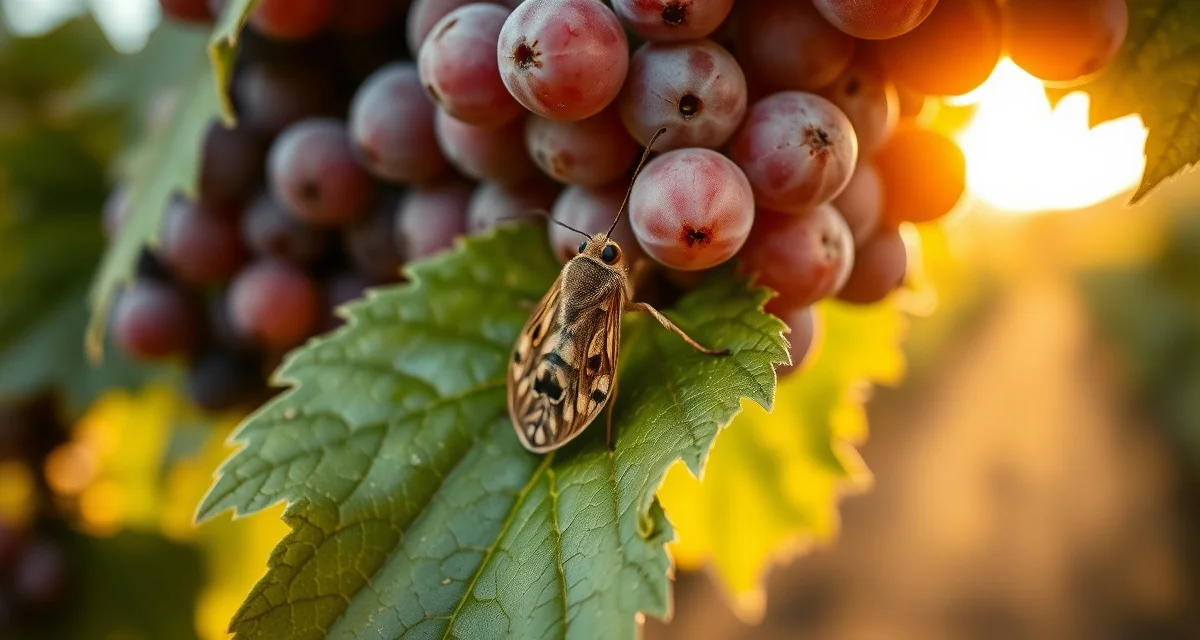
Grape Berry Moth IPM for Vineyards: Complete Guide
Grape berry moth (Paralobesia viteana) is the primary insect threat in most eastern US vineyards. If you're farming in the Finger Lakes, Hudson Valley, Lake Erie region, Pennsylvania, or Virginia, you've dealt with it. In the Midwest, it's also present and increasing. In California, it's not established -- but if you're sourcing fruit or equipment from the east, it's worth knowing.
TL;DR
- GBM has 2-3 generations per season; the second and third generations cause direct berry entry damage that creates entry wounds for botrytis and sour rot -- a wet harvest season with unmanaged GBM is a compounded loss
- First-generation spray timing targets 100-150 degree days (base 50°F) from January 1 (or from biofix); second generation at 800-900 DD; third generation at approximately 1,620 DD
- Pheromone trap monitoring provides local biofix data that improves degree-day model accuracy -- zero adult catch at a DD threshold suggests local population timing has shifted and requires closer observation before spraying
- IRAC Group 28 (diamide) resistance has been documented in some New York GBM populations; rotate Group 28 with Group 5 (spinosyn) and other modes across the three generations rather than applying diamides exclusively
- Entrust (spinosad, Group 5) is the most effective organic option for GBM, OMRI-listed, with a 2-applications-per-season restriction on the label
- VitiScribe's spray records include a "spray decision basis" field where you document cumulative DD50 at application -- the threshold-based IPM documentation that organic certifiers and winery buyers want to see
The damage isn't just aesthetic. GBM larvae feeding in clusters creates wounds that let botrytis and sour rot in. A GBM infestation and a wet harvest are a particularly ugly combination.
Grape Berry Moth Biology
GBM has 2-3 generations per season depending on region and year. The key to timing sprays is the degree-day accumulation model calibrated to your region.
Overwintering: Pupae overwinter in cocoons in bark furrows or grape leaf debris on the vineyard floor.
First adult flight: Adults emerge when degree days (base 50°F) accumulate to approximately 100 DD from January 1. In Finger Lakes, this typically falls in early to mid-May.
Egg laying and larval damage by generation:
| Generation | DD Threshold (Base 50°F) | Target Plant Tissue |
|---|---|---|
| 1st (first flight peak) | ~170-810 DD | Shoot tips, flower clusters (blossoms) |
| 2nd (second flight) | ~810-1620 DD | Berries (first berry entry) |
| 3rd (third flight) | ~1620-2100 DD | Berries (pre-harvest) |
First generation damage: Larvae tie together shot berries and young cluster tissue with silk webbing. Damage is visible but rarely causes severe yield loss.
Second and third generation damage: Direct berry entry. Larvae bore into berries, leaving entry holes. Entry wounds allow infection by botrytis and sour rot organisms. Second-generation timing corresponds to rapid berry sizing -- this is the high-damage window.
Spray Timing Using Degree Days
This is where grape berry moth management is different from most vineyard IPM. You're not spraying on a calendar date -- you're spraying when the degree-day model indicates the pest is at a vulnerable stage.
First spray trigger: Apply when 100-150 degree days have accumulated from January 1 (biofix). This targets egg-laying period of first-generation adults.
Second spray: When 800-900 DD. This covers first berry-entry period of second generation.
Third spray: When 1620 DD if third generation pressure is expected based on local monitoring.
Adjusting based on monitoring: If you have pheromone traps in your vineyard, you can refine timing based on actual adult catch. Zero adult catch at a DD threshold suggests the local population timing is shifted -- adjust accordingly.
GBM degree-day models are available through your state's cooperative extension (Cornell for New York, Penn State for Pennsylvania, Virginia Tech for Virginia). Most extension services have web-based calculators.
See the grape berry moth degree day model guide for detailed biofix determination, regional timing differences, and generation-by-generation DD thresholds.
Products for Grape Berry Moth Control
Diamides (IRAC Group 28):
- Altacor (chlorantraniliprole): Excellent systemic activity, long residual (14-21 days), low bee toxicity. PHI: 7 days. Currently the most effective class.
- Exirel (cyantraniliprole): Similar activity, systemic
Spinosyns (IRAC Group 5):
- Delegate (spinetoram): Very effective, 7-day interval, moderate residual. PHI: 7 days. Organic-approved spinosad formulations also available.
- Entrust (spinosad, OMRI-listed): Organic option, slightly less residual than Delegate
Organophosphates (IRAC Group 1B):
- Imidan (phosmet): Restricted use pesticide. Effective, moderate residual. PHI: 7 days. Older chemistry but still effective. Requires applicator license.
Pyrethroids (IRAC Group 3):
- Mustang Maxx (zeta-cypermethrin): Effective contact activity. PHI: 7 days. Reduced-risk rating. Some concern about disrupting beneficial insect populations.
Organic options:
- Entrust (spinosad): Best organic option for GBM. OMRI-listed. Apply when eggs are hatching (at DD thresholds). 2 sprays per season restriction per label.
- Kaolin clay (Surround): Physical barrier; some deterrence. Best as supplement.
Pheromone Traps and Monitoring
Hanging pheromone traps in your vineyard provides local population monitoring that improves degree-day model accuracy.
Setup: Hang 1 trap per 5-10 acres at vine height in the fruit zone. Use pheromone lures calibrated for GBM. Change lures every 4-6 weeks.
Reading traps: Count and remove moths weekly. Record catches in VitiScribe's scout record system. High adult catch at the DD thresholds confirms timing; zero catch at thresholds suggests monitoring more closely.
Biofix: First consistent adult catch establishes biofix -- the starting date for your degree-day accumulation model. If you're using a regional model without local biofix data, your timing estimates are less precise.
Resistance Management
IRAC Group 28 resistance has been documented in some New York GBM populations near farms with heavy diamide use. Rotate between IRAC groups:
- Diamide (Group 28) -> Spinosyn (Group 5) -> back to Diamide
- Add pyrethroid (Group 3) as a third rotation partner if needed
Don't apply two consecutive applications from Group 28. Track your IRAC rotation in VitiScribe.
Documentation for GBM IPM
Document degree-day accumulations that triggered your spray decision. This is IPM documentation that demonstrates threshold-based decision making -- essential for:
- Organic certification (proving spray decisions were pest-pressure-based)
- Compliance with state pesticide use requirements for restricted use products (Imidan is RUP)
- Winery buyer documentation requests
VitiScribe's spray records include a "spray decision basis" field where you can note "GBM second generation, 850 DD accumulated" -- exactly the documentation an IPM program should show.
Related Articles
- Leafhopper Management in Vineyards: IPM Guide
- Mealybug Control in Vineyards: IPM Guide
- Pierce's Disease in Vineyards: Complete Management Guide
FAQ
How do I know when to spray for grape berry moth?
Use the degree-day accumulation model with base temperature 50°F. First spray timing is at approximately 100-150 accumulated degree days from January 1. Second generation spray timing is at 800-900 DD. Third generation at approximately 1620 DD. Your state's cooperative extension service provides regional degree-day tracking tools. Pheromone traps allow you to confirm adult activity aligns with model predictions.
What is the best insecticide for grape berry moth in organic vineyards?
Entrust (spinosad, IRAC Group 5) is the most effective organic option for grape berry moth. It's OMRI-listed and provides good control when applied at the appropriate degree-day timing. The label restricts use to 2 applications per season to prevent resistance. Apply at 4-6 oz/acre when eggs are hatching (around 170 DD for first generation, 810-900 DD for second generation).
Does grape berry moth occur in California vineyards?
Grape berry moth (Paralobesia viteana) is established in the eastern United States and has been spreading westward, but as of 2025-2026 it's not established as a common pest in California's major wine regions. California vineyards do have other berry moths and cluster moths (like the orange tortrix) with different biology. If you're in California, contact your local UC Farm Advisor for current insect pest presence in your specific region.
How do I document GBM botrytis interaction when both are active simultaneously?
When late-season GBM infestation and botrytis are both active in the same block, your spray records should document both as target pests for any applications made during that window. If you're applying a botrytis fungicide during the third-generation egg hatch window, note that the application was timed to coincide with GBM pressure and record the DD50 accumulation at the time -- this creates a documented basis for the timing that serves both your botrytis program records and your GBM IPM records. For your IPM narrative, documenting the berry entry wounds observed during scouting and linking those observations to your botrytis application decision is the kind of integrated record chain that certifiers look for.
What records are needed to prove IRAC rotation compliance for GBM in a sustainable certification audit?
A sustainable certification auditor reviewing your GBM program will want to see that you didn't apply the same IRAC group in consecutive applications within a season. Your VitiScribe spray history for GBM applications should show the IRAC group for each application, with at least one mode of action change between your first, second, and third generation sprays. If you applied Altacor (Group 28) for first generation, Delegate (Group 5) for second generation, and returned to Altacor for third generation, that rotation is documented in your IRAC rotation report. The combination of DD50 trigger data (showing threshold-based timing) and IRAC rotation data (showing resistance-conscious product selection) is the foundation of a defensible GBM IPM record.
What is Grape Berry Moth IPM for Vineyards: Complete Guide?
[FAQ_ANSWER_PLACEHOLDER: This answer needs to be generated by AI with specific data, examples, and actionable advice relevant to Grape Berry Moth IPM for Vineyards: Complete Guide. Target 50-150 words.]
How much does Grape Berry Moth IPM for Vineyards: Complete Guide cost?
[FAQ_ANSWER_PLACEHOLDER: This answer needs to be generated by AI with specific data, examples, and actionable advice relevant to Grape Berry Moth IPM for Vineyards: Complete Guide. Target 50-150 words.]
How does Grape Berry Moth IPM for Vineyards: Complete Guide work?
[FAQ_ANSWER_PLACEHOLDER: This answer needs to be generated by AI with specific data, examples, and actionable advice relevant to Grape Berry Moth IPM for Vineyards: Complete Guide. Target 50-150 words.]
Sources
- UC Cooperative Extension Viticulture
- American Vineyard Foundation
- American Society for Enology and Viticulture (ASEV)
- Wine Institute
Get Started with VitiScribe
Grape berry moth IPM requires degree-day tracking, trap count records, IRAC rotation documentation, and PHI management across three generations -- all linked to the same block and season. VitiScribe's weather-integrated DD50 calculator, scouting records, and IRAC rotation report give eastern US vineyard operators the connected data infrastructure that threshold-based GBM management requires. Try VitiScribe free and log your first GBM scouting record with degree day accumulation today.