Bud break in grapes: what it means and how to manage it
TL;DR
- Grape bud break is the stage when dormant buds swell and the first green tissue emerges, usually once 10-day average temperatures reach 50°F (10°C).
- It opens your highest frost-damage risk window, sets the ceiling on the season's yield, and is the last practical moment for certain pruning calls.
- Miss it and you spend the rest of the year managing consequences.
What is bud break in grapes, exactly?
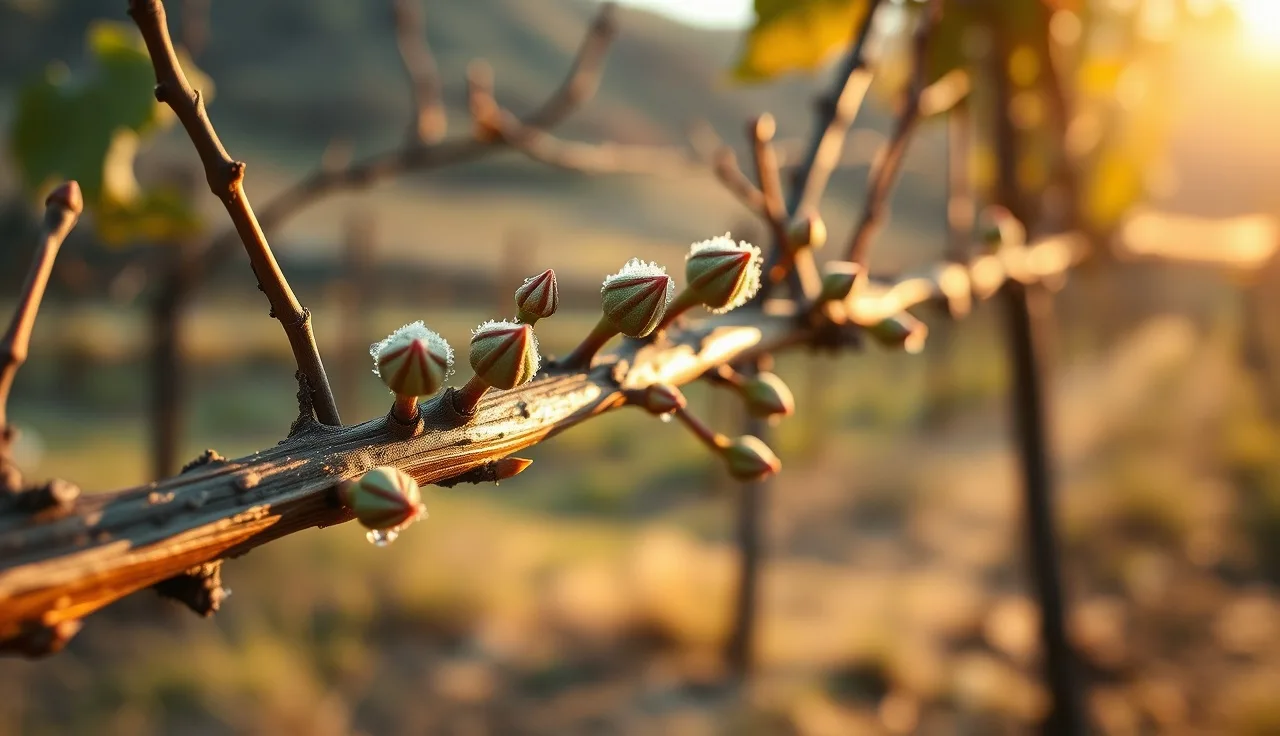
Bud break is the first visible sign a grapevine is leaving dormancy. The bud swells, the brown outer scales split, and a small tuft of woolly tissue pushes out. That first stage, called "woolly bud" or "bud swell," gives way fast to "green tip," where you see actual green leaf tissue for the first time. Most viticulturists treat green tip as true bud break, because that's the first point where frost can kill the primary bud.
The progression from bud swell to the first unfolded leaf takes anywhere from a few days to two weeks, depending on temperature swings. A warm week followed by a cold snap can stall the process. Worse, it can push buds far enough out that a return frost does real damage before you've had time to react.
The staging system most growers in North America use comes from the modified Eichhorn-Lorenz (E-L) scale [1]. Bud break proper spans E-L stages 1 through 5, from dormant to about five small separated leaves. Your spray timing, frost protocols, and some pruning decisions all hinge on knowing exactly where you sit on that scale, more than whether buds have "started moving."
When does grape bud break happen, and what triggers it?
Bud break happens when the vine accumulates enough heat after a cold winter. The standard model uses growing degree days (GDD) with a base temperature of 50°F (10°C). Most Vitis vinifera varieties start bud break somewhere between 50 and 150 GDD base 50, accumulated after January 1 in the Northern Hemisphere [2].
Calendar dates swing hard by region and variety. In warmer inland valleys of California, an early variety like Chardonnay can push buds in late February. In the Finger Lakes of New York or eastern Washington, the same variety might not break until late April. Cornell University's extension viticulture program tracks this variation and publishes regional GDD accumulation data worth bookmarking [3].
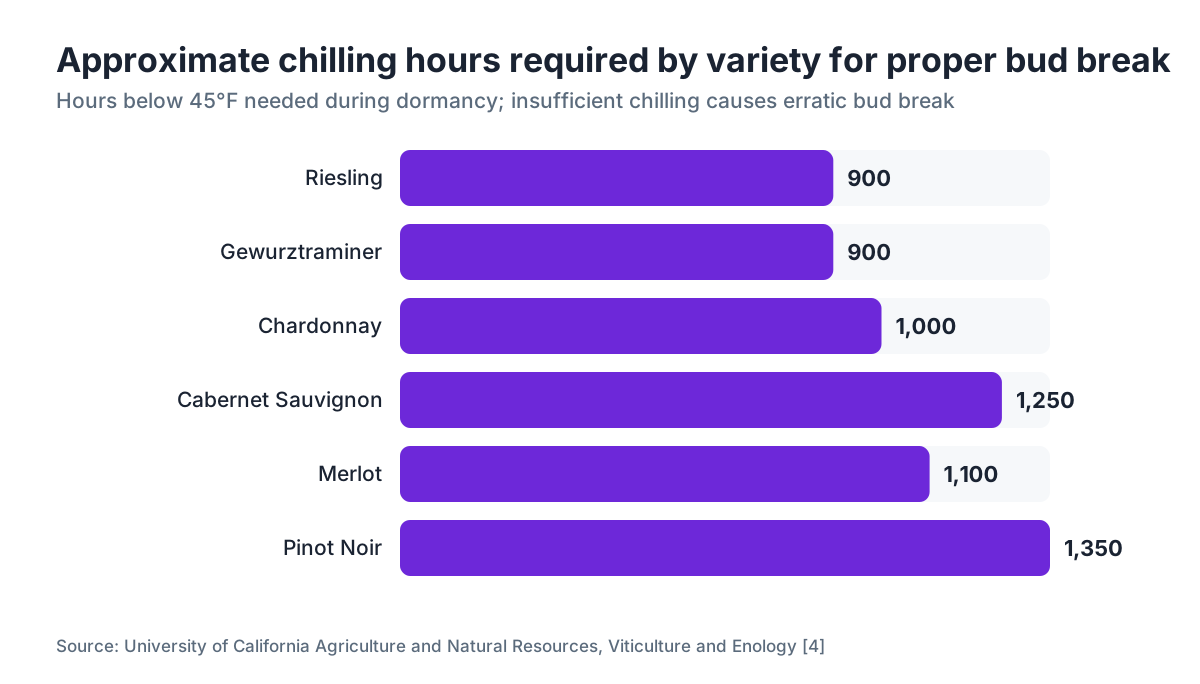
Chilling hours matter too, and this is where it gets complicated. Vines need a certain number of hours below 45°F during dormancy to break dormancy cleanly. Skip enough of those hours, as happens in warm years or marginal climates, and you get erratic, staggered bud break that wrecks spray timing and hand operations. UC Davis viticulture and enology has published baseline chilling requirements by variety. Most vinifera needs 800 to 1,500 hours, with varieties like Pinot Noir sitting at the higher end [4].
| Variety | Typical bud break (Napa/Sonoma) | Typical bud break (Finger Lakes) | Chilling hrs needed (approx.) |
|---|---|---|---|
| Chardonnay | Late Feb to mid-Mar | Late Apr | 900-1,100 |
| Cabernet Sauvignon | Mid-Mar to early Apr | Early May | 1,100-1,400 |
| Pinot Noir | Early to mid-Mar | Late Apr | 1,200-1,500 |
| Riesling | Mid-Mar to late Apr | Late Apr to early May | 800-1,000 |
| Gewurztraminer | Early Mar | Mid to late Apr | 800-1,000 |
The date ranges above are approximate and shift year to year with weather. Use local GDD data, not calendar dates, for any operational decision.
Why is bud break the most dangerous frost window of the year?
Once green tissue is visible, it can freeze and die at temperatures most growers would call a mild spring night. The critical damage threshold for primary buds at green tip is around 28°F to 30°F (-2°C to -1°C) held for two hours or more [5]. Secondary buds run a little hardier and sometimes survive down near 25°F, but they carry far less fruit in most varieties, so surviving on secondaries still means a crop loss.
The damage doesn't announce itself. Frozen tissue looks fine for 24 to 48 hours, then turns brown and collapses. By the time you're sure, there's nothing to do but assess it and decide whether to lean on secondary or tertiary buds for the season.
WSU's frost protection guidance says to have your frost equipment tested and running before bud break, not after [5]. Wind machines need servicing. Overhead irrigation for frost protection needs a pressure check. Heaters need fuel. None of that should wait until the forecast shows 32°F.
The risk window closes gradually as shoot growth hardens off. By the time shoots are 6 to 8 inches long, they tolerate brief dips to around 30°F with less damage. From green tip to about 3 inches of shoot growth, though, you're in the most exposed period of the whole season.
How do you time pruning around grape bud break?
Practice diverges from the textbook here, and it's worth being honest about that.
The textbook position: prune during full dormancy, before any bud swell. That's still the right call in most situations. Dormant pruning is faster, easier on the vine, and avoids snapping off swelling buds with your hands or tools.
The real-world position: pruning deliberately delayed into bud swell, or even just past green tip, actually cuts frost risk in some climates. The logic is simple. Pruning stimulates the remaining buds to push. Prune everything in February and a frost hits in April, and all your buds are exposed. Delay pruning until buds are just starting to move, and you push the vine's response curve later, shrinking the frost exposure window. Cornell's research on delayed pruning in New York shows it can shift bud break by 7 to 10 days in some years [3].
That 7 to 10 day delay is real money in frost-prone regions. It's probably not worth the logistics headache where late frosts are rare.
Parts of New York and the Midwest use a middle path called "double pruning": rough-cut the canes in winter and leave extra wood, then come back to finish the precision cuts as bud break approaches. You get the delayed push on the fruiting wood without doing all your precision work while the ground is still frozen.
Can you prune grapes after bud break has already started?
Yes, with clear tradeoffs.
Pruning at green tip or through the small-leaf stage (E-L 5 to 7) is common practice and not catastrophic if you're careful. The main risk is mechanical: swollen buds break off easily when bumped by a hand, a sleeve, or a tool. You lose buds you meant to keep. On cordon-trained vines, walking the row gets slower for exactly this reason.
The vine also bleeds sap hard at cut sites once the vascular system is active. That "bleeding" from pruning wounds is real, but despite what some growers worry about, it doesn't materially weaken the vine under normal conditions [6]. The sap is largely water and mineral salts, not stored carbohydrates. UC Davis work shows late-pruning sap loss doesn't reduce vigor or yield in the following seasons under normal conditions.
Pruning after bud break turns genuinely problematic once shoot growth passes about 3 to 4 inches. At that point you're cutting away real photosynthetic capacity and carbohydrate reserves the vine already committed. You also raise Botrytis and Eutypa infection risk at wound sites, because spring moisture and active tissue increase pathogen pressure. Eutypa lata spores disperse mostly during wet weather [6], so making fresh wounds during cool, wet spring conditions lines up exactly with peak infection risk.
The practical rule: if you're still finishing pruning at green tip, keep going, be careful with the buds, and get it done. If you're staring at 6-inch shoots and thinking about major structural cuts, you'd better have a very good reason.
What spray programs start at bud break?
Bud break is the trigger for several fungicide and pest programs, and getting the timing wrong in either direction either wastes money or leaves the vine exposed.
Powdery mildew drives most early spray programs. The fungus (Erysiphe necator) overwinters in dormant buds and on bark, and infected buds shed spores as they open. WSU extension recommends the first fungicide application no later than green tip in high-pressure vineyards, and UC Davis's powdery mildew risk model starts tracking conditions from bud break onward [4]. Sulfur is the standard material at this timing. Wettable sulfur at 3 to 6 lb/acre per application is common.
Botrytis management at bud break is mostly about removing infected debris and handling canopy density later, but some operations apply a protective fungicide now if they had heavy Botrytis last vintage.
Mite management, specifically European red mite and Pacific spider mite, often starts with a dormant oil application before bud break, not after. Time the oil spray for before green tip, because oil on open green tissue causes phytotoxicity.
For operations using restricted-use pesticides at any point in the season, the EPA Worker Protection Standard (WPS) requires that workers and handlers receive site-specific pesticide safety training before entering treated areas, and that pesticide application and hazard information be posted or available in a central location [7]. WPS requirements don't change with growth stage, but bud break is when spray activity ramps up sharply, so it's a natural point to confirm your WPS compliance is current.
If you're tracking spray records across multiple blocks with varieties breaking at different times, a field records system helps a lot. VitiScribe was built for exactly this kind of block-level tracking, so your spray records stay organized without a separate spreadsheet for every block.
How does bud break affect the whole season's yield potential?
Bud break doesn't just start the season. It largely sets the ceiling.
The buds that open are the primary buds, and they carry pre-formed flower clusters that became inflorescences during the previous growing season. Those clusters were initiated the summer before, while the vine built next year's buds inside the developing shoot. That's why vine stress in July of one year shows up as fewer clusters per shoot the following spring.
Primary bud fruitfulness varies by cultivar and by shoot position on the cane. Cordon-trained Cabernet Sauvignon usually has higher fruitfulness at nodes 3 through 8 from the cordon. Concord can be highly fruitful even at node 1 or 2. This is why pruning decisions, specifically how many nodes you leave and where, interact directly with what bud break delivers.
Frost kill at or just after bud break forces the vine onto secondary buds. Secondary buds in most Vitis vinifera varieties carry 30 to 70% fewer clusters than primaries, though the range is variety-dependent [2]. In Concord and other American varieties, secondary fruitfulness is much higher, one reason those varieties dominate frost-prone eastern regions.
Your assessment in the first two weeks after bud break, counting live buds, dead buds, and estimating secondary push, gives you the first realistic yield estimate of the season. Most extension programs recommend a structured bud mortality count per block at this point, because it's the input you need to decide whether to adjust crop load targets and canopy plans.
How do you track bud break timing accurately across your vineyard?
A vineyard with multiple blocks, varieties, and aspects will not break uniformly. South-facing slopes break earlier than north-facing ones. Low spots pool cold air and break later. Blocks near water break later because humidity moderates temperature swings. If you manage a vineyard with any real complexity, you're tracking several micro-timelines, not one.
The minimum practical system: walk every block every 2 to 3 days starting two weeks before your expected bud break date. Record the growth stage in E-L notation. Note which blocks lead. This feeds spray timing, frost response order, and labor scheduling.
GDD tracking adds objectivity. A simple max/min thermometer in each major block, or a weather station that accumulates GDD automatically, takes the guesswork out of when you crossed key thresholds. WSU extension provides free GDD accumulation tools through its AgWeatherNet system [8].
Photographic records by block and date are underrated. A photo of the same vine, same block, same date each year builds a multi-year phenology record more useful than any model for predicting your local timing. After four or five years you'll know your site better than any GDD calculator can.
Field records matter here for regulatory compliance, more than your own planning. If you're keeping pesticide application records (required under FIFRA for any restricted-use pesticide application), VitiScribe ties application dates to growth stage records, so your spray log reflects the actual conditions at the time you sprayed.
What varieties break earliest and latest, and why does it matter for planning?
Variety selection is a long-term commitment to a particular frost risk profile. Early-breaking varieties like Pinot Noir, Chardonnay, and Gewurztraminer are consistently more exposed to late frost than late-breaking varieties like Cabernet Sauvignon, Merlot, and most of the Rhone reds.
In regions with meaningful late-frost probability (roughly east of the Rockies and in higher-elevation western sites), variety selection can be the single biggest frost risk decision you make. No amount of wind machine capacity fully offsets planting Chardonnay at 1,800 feet in Pennsylvania.
For growers in established vineyards who can't switch variety, the practical levers are pruning timing (as above), site-specific frost monitoring, and operational frost protection equipment. On California's Central Coast and in warmer inland valleys, where late frosts are uncommon, early-breaking varieties carry less inherent risk and the focus shifts entirely to canopy management.
Approximate relative bud break order, earliest to latest, among common varieties under similar conditions:
| Break order | Varieties |
|---|---|
| Earliest | Pinot Noir, Chardonnay, Pinot Gris, Gewurztraminer |
| Early-mid | Merlot, Syrah, Grenache, Sauvignon Blanc |
| Mid | Cabernet Franc, Tempranillo, Viognier |
| Late | Cabernet Sauvignon, Mourvedre, Zinfandel |
| Latest | Petit Verdot, some Rhone reds, Concord |
This ordering is general. Clone, rootstock, and local conditions all shift the relative timing.
How does rootstock affect bud break timing?
Rootstock is an overlooked variable in bud break timing. The effect is real but modest next to variety and climate.
Vigorous rootstocks like 110R and 140Ru tend to push bud break slightly later than low-vigor stocks like 420A or 101-14. The mechanism isn't fully settled, but it likely traces to differences in root activity and cytokinin production in early spring. Most research puts the effect at 3 to 7 days, small but able to matter in marginal frost years.
Nematode-resistant rootstocks needed in some California soils (like Freedom or Harmony) carry their own phenological quirks that interact with the scion variety in site-specific ways. If you're replanting a block and choosing rootstock, ask your local farm advisor or UC Cooperative Extension viticulture advisor specifically about bud break phenology for your top candidates. The data is rootstock-by-variety-by-site specific, and general tables only get you so far [4].
What records should you keep at bud break for compliance and operations?
A few records taken at bud break pay off all season.
Bud mortality assessment: count 20 to 30 nodes per block and categorize buds as alive (primary), alive (secondary), or dead. Record by block, date, and variety. This feeds crop estimate models and documents any frost loss for insurance or lender reporting.
Growth stage by block: E-L stage recorded per block on each scouting date. If you're applying pesticides, the growth stage at time of application goes on the spray record. Several pesticide labels specify application timing by growth stage rather than calendar date, so this isn't just good practice. It's label compliance.
Pesticide application records: under FIFRA, certified applicators applying restricted-use pesticides must keep records for 2 years [9]. Records need the product name, EPA registration number, crop and site, application date, amount applied, and applicator information. Many states add requirements. California's Department of Pesticide Regulation (CDPR) requires a Pesticide Use Report (PUR) filed within 30 days, and growers in permit-requiring operations must report monthly [10].
Weather and frost events: document any frost during the bud break window, including low temperature, duration, and any protective actions taken. This documentation supports crop insurance claims and helps your own year-over-year learning.
Frequently asked questions
What temperature triggers bud break in grapevines?
Bud break begins when 10-day average daily temperatures consistently reach or exceed 50°F (10°C), the base temperature at which the vine accumulates growing degree days. Most vinifera varieties push buds somewhere between 50 and 150 GDD base 50, accumulated after January 1 in the Northern Hemisphere. A single warm week won't trigger bud break if the accumulated base hasn't been reached.
How early is too early to prune after bud break starts?
Pruning at green tip (E-L stage 4) is still manageable if you work carefully. The main hazard is knocking off swollen buds by hand or tool. Once shoots reach 3 to 4 inches, you're removing real photosynthetic tissue and raising Eutypa lata infection risk at fresh wound sites. Finishing precision cuts by E-L stage 7 (small separated leaves) is a reasonable outer limit for most varieties.
At what temperature do grapevine shoots freeze after bud break?
Primary buds at green tip are damaged at 28°F to 30°F (-2°C to -1°C) held for two or more hours. Secondary buds tolerate slightly lower temperatures, around 25°F to 27°F, but secondary buds in most vinifera produce 30 to 70% fewer clusters than primaries. As shoots harden off and extend past 6 inches, frost tolerance improves noticeably.
Can you prune grapes after bud break without hurting the vine?
Yes, if shoots are still small. Vines bleed sap from cut sites after bud break, but UC Davis research shows this sap loss doesn't reduce vigor or yield in later seasons under normal conditions. The real risks are mechanical bud loss from bumping and fungal infection at wound sites during cool, wet spring weather. Avoid major structural cuts once shoots exceed 4 to 6 inches.
Does delayed pruning actually push bud break later?
Yes, reliably. Cornell University's research in New York shows delayed pruning can shift bud break by 7 to 10 days in some years, by holding the vine in a state where only the most distal buds actively push. The effect is most useful in frost-prone regions. The tradeoff is harder hand labor once the vine is active, so double-pruning (rough cut in winter, finish cut at bud swell) is a common compromise.
What is the modified Eichhorn-Lorenz scale and how does it apply to bud break?
The modified Eichhorn-Lorenz (E-L) scale is the standard phenological staging system for grapevines, running from stage 1 (dormant bud) through stage 47 (berry shriveling). Bud break spans stages 1 through 5, dormant to five small separated leaves. Extension programs and pesticide labels reference E-L stages for spray timing, which makes it the practical common language for describing vine development.
How do I protect my vines from frost at bud break?
Test wind machines and heaters before bud break, not when a frost warning arrives. Wind machines mix warmer air aloft with cold surface air and work best during temperature inversions (typically 3°F to 8°F warmer air at 30 to 50 feet above the vineyard floor). Overhead sprinklers protect tissue by releasing heat as water freezes on the buds. Both need operational equipment, adequate water pressure, and advance planning.
How does bud break timing differ between Pinot Noir and Cabernet Sauvignon?
Pinot Noir is consistently among the earliest-breaking vinifera varieties, often 2 to 3 weeks ahead of Cabernet Sauvignon under similar conditions. That gap is one reason Pinot Noir carries higher frost risk in marginal climates. In the Finger Lakes, Chardonnay and Pinot Noir may break in late April while Cabernet Franc, better suited to the region, breaks in early May with meaningfully less frost exposure.
When should I start my first fungicide spray relative to bud break?
For powdery mildew in high-pressure vineyards, WSU and UC Davis both recommend the first fungicide application at green tip or no later than early shoot growth (2 to 3 inches). Wettable sulfur at 3 to 6 lb/acre is standard at this timing. Dormant oil for mite management must go on before green tip, because oil on open green tissue causes phytotoxicity.
What records am I legally required to keep at bud break for pesticide applications?
FIFRA requires certified applicators using restricted-use pesticides to keep records for 2 years, including product name, EPA registration number, crop, date, amount applied, and applicator information. California's CDPR additionally requires Pesticide Use Reports. Many other states have their own reporting requirements. Check your state's department of agriculture for specifics.
How do I estimate crop yield after a frost at bud break?
Walk each block 5 to 7 days after the frost event, once damaged tissue has turned brown and is clearly distinguishable from healthy tissue. Count 20 to 30 nodes per representative block row, categorizing buds as primary live, secondary live, or dead. Use your variety-specific secondary fruitfulness factor (typically 30 to 70% of primary cluster number) to build a revised yield estimate by block.
Does rootstock affect when bud break happens?
Yes, modestly. Vigorous rootstocks like 110R and 140Ru tend to push bud break 3 to 7 days later than low-vigor stocks like 420A or 101-14. The effect is smaller than variety or climate but can matter in marginal frost years. Ask your local UC Cooperative Extension or WSU extension viticulture advisor for rootstock-specific phenology data for your region and scion variety.
What is double pruning and when should I use it?
Double pruning means making a rough winter cut that leaves extra canes or spurs, then returning to finish precision cuts as bud break approaches. The first rough cut is fast and can be done while the ground is frozen. The finish cut happens at bud swell, which delays the vine's response and shrinks the frost exposure window. It's most useful in frost-prone regions like New York, Michigan, and the Midwest.
How do chilling hours affect bud break in grapes?
Grapevines need 800 to 1,500 hours below 45°F during dormancy to break dormancy cleanly, depending on variety. Insufficient chilling leads to erratic, staggered bud break with uneven shoot development across the canopy, which makes spray timing and hand operations much harder. Warmer winters in some regions are creating chilling-hour deficits that didn't exist historically, particularly for varieties like Pinot Noir that need 1,200 or more hours.
Sources
- Coombe, B.G. (1995). Adoption of a system for identifying grapevine growth stages. Australian Journal of Grape and Wine Research.: The modified Eichhorn-Lorenz (E-L) scale is the standard phenological staging system for grapevines, with bud break spanning stages 1 through 5.
- Washington State University Extension, Viticulture and Enology Program: Most Vitis vinifera varieties start bud break between 50 and 150 GDD base 50°F; secondary buds in most vinifera produce 30 to 70% fewer clusters than primaries.
- Cornell University Cooperative Extension, Viticulture and Enology Program: Delayed pruning can shift bud break by 7 to 10 days in some years in New York; Cornell tracks regional GDD accumulation data.
- University of California Agriculture and Natural Resources, Viticulture and Enology: Most vinifera needs 800 to 1,500 chilling hours below 45°F; UC Davis publishes baseline chilling requirements and powdery mildew risk modeling by variety.
- Washington State University Extension, Frost Protection for Vineyards: Critical frost damage threshold for primary buds at green tip is 28°F to 30°F for two hours or more; WSU recommends frost protection equipment be tested and operational before bud break.
- UC Statewide Integrated Pest Management Program, Eutypa Dieback in Grapevines: Eutypa lata spores are dispersed primarily during wet weather; fresh pruning wounds during cool, wet spring conditions carry highest infection risk, and late-pruning sap loss does not reduce vigor or yield under normal conditions.
- U.S. EPA, Worker Protection Standard (WPS) for Agricultural Pesticides: EPA WPS requires workers and handlers to receive site-specific pesticide safety training before entering treated areas and that pesticide application and hazard information be posted or available in a central location.
- Washington State University AgWeatherNet: WSU extension provides free GDD accumulation tools through its AgWeatherNet system for vineyard phenology tracking.
- U.S. EPA, Pesticide Recordkeeping under FIFRA: Under FIFRA, certified applicators applying restricted-use pesticides must keep records for 2 years including product name, EPA registration number, crop, date, amount applied, and applicator information.
- California Department of Pesticide Regulation, Pesticide Use Reporting: California's CDPR requires Pesticide Use Reports for pesticide applications.
- Cornell University, Viticulture Extension, Finger Lakes Phenology Records: In the Finger Lakes, Chardonnay and Pinot Noir may break in late April while Cabernet Franc breaks in early May.
Last updated 2026-07-09