Pruning grapes after bud break: what you can do and what you'll lose
TL;DR
- You can prune grapevines after bud break, and in cold sites you sometimes should.
- Delayed pruning pushes shoot emergence back five to ten days, which lowers frost exposure.
- The tradeoff is real.
- You knock off live buds and lose fruit.
- Most research puts the yield penalty at 10 to 30 percent depending on cultivar and how late you wait.
- Do it on purpose, not in a panic.
Is it okay to prune grapevines after bud break?
Yes. Pruning after bud break is a real technique, not a sign you blew the timing. Growers have delayed pruning on purpose for decades to shift phenology and keep tender new growth out of a late frost. The vine doesn't read your calendar. It responds to what you cut.
Late pruning still costs you. Every swollen bud you remove was building a shoot with two potential clusters. Knock it off after it breaks and that fruit is gone. The question isn't whether you can prune late. It's whether the frost you're dodging is worth the crop you're trading away.
For most cold-site growers in the eastern U.S. and higher-elevation western ground, the answer is often yes in years when late frost looks likely. In stable maritime climates the tradeoff rarely pencils out. Know your site first.
Why would you delay pruning until after bud break on purpose?
The mechanism is simple. Grapevines break dormancy unevenly across a block and along each cane. Prune early and you strip off the most advanced buds, so the vine funnels energy into whatever's left and speeds those buds along. Wait, and the vine's carbohydrate reserves stay spread across dozens or hundreds of buds at once. That slows the whole thing down.
Cornell Cooperative Extension work puts the delay at roughly five to ten days of pushed phenology per delayed pruning window, depending on variety, vigor, and weather [1]. That sounds like nothing. But in a year when your last frost date is April 20 and your Chardonnay usually breaks bud April 12, ten days can be the line between a crop and a bare trellis.
Washington State University extension has documented similar delays in Pacific Northwest trials. Riesling and Gewurztraminer show a stronger phenological response than varieties like Cabernet Sauvignon, which move less [2].
There's a second reason growers wait. Shoot positioning gets easier when you can see which buds are vigorous before you cut. You're not guessing from cane diameter and node count. You're watching the vine show its hand.
How much yield do you actually lose when you prune late?
This is the number everyone wants and nobody pins down cleanly. The honest range is 10 to 30 percent yield reduction against standard dormant pruning, and the spread is wide because it turns on how late you cut, which variety you grow, and how many live buds you strip in the process [1].
Cornell's Finger Lakes work found yield reductions around 10 to 15 percent when pruning was delayed to early bud swell (BBCH 03 to 05) and up to 25 to 30 percent once green tip was clearly out and shoots had pushed more than a centimeter [1]. UC Davis viticulture extension reports similar ranges from California trials, with one twist: fruit quality often nudges up in delayed-pruning years because a lighter crop concentrates sugar and flavor [3].
So the yield hit isn't purely a loss. If your wine gains from lower yields and better concentration, and if frost regularly hammers your early-breaking vines, delayed pruning can pay for itself in quality even while it costs you tonnage. That's a business call more than an agronomic one.
Hold onto one fact. Every bud you physically remove after break is gone. In dormant pruning, retained buds compensate a little. A late-pruned vine carries fewer buds total, and the ones you cut were already metabolically active. You don't get that back this season.
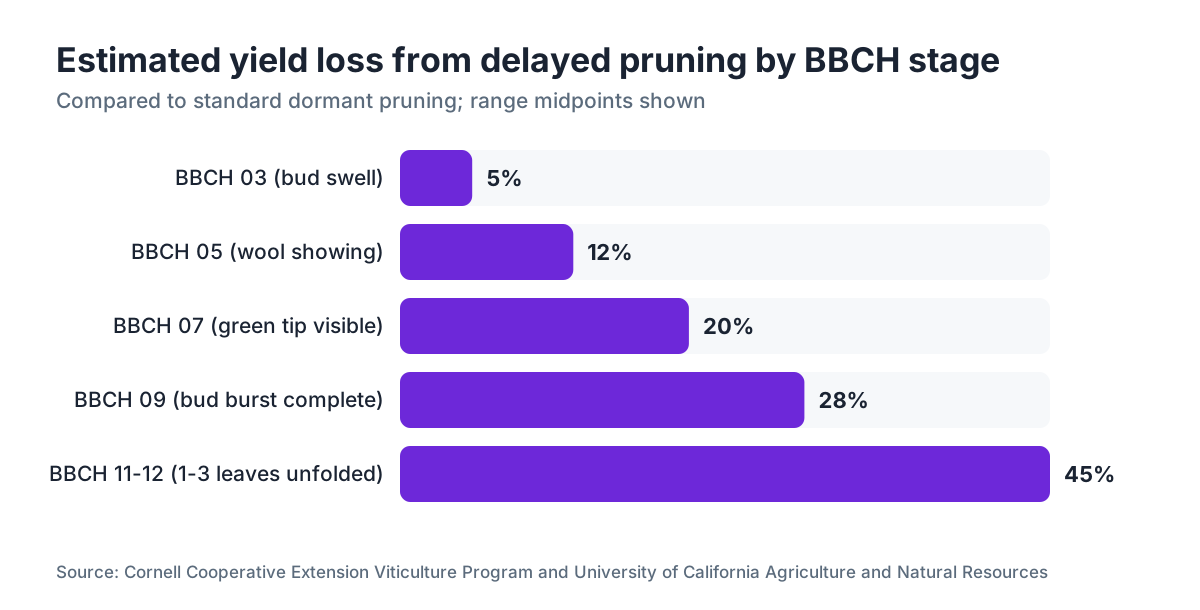
What does the BBCH growth stage chart tell you about pruning timing?
BBCH staging gives you a shared language for exactly where your vines sit and how late is too late for a given goal. The scale runs from 00 (winter dormancy) through 09 (bud burst complete) and on into shoot growth. The German Julius Kuhn-Institut publishes the reference stages [8].
| BBCH Stage | Description | Typical Pruning Implication |
|---|---|---|
| 00-01 | Hard dormancy, bud closed | Standard dormant pruning window |
| 03 | Bud swell visible | Delayed pruning starts here; modest phenology push |
| 05 | Wool showing, green tissue visible | Clear delayed pruning; 5-10 day push, ~10-15% yield loss |
| 07 | Green tip visible, 0.5-1 cm shoot | Late pruning; meaningful yield loss, ~15-25% |
| 09 | Bud burst, leaves separating | Very late; high yield loss, real bud damage risk |
| 11-12 | 1-3 leaves unfolded | Emergency only; yield loss severe, crop salvage logic |
Most growers using delayed pruning as a frost strategy aim between BBCH 03 and 07. Past stage 09 you're in damage control, not strategy [2].
If you track BBCH by block and variety, you need consistent field records. A tool like VitiScribe earns its keep here, logging growth stage by block next to your pruning dates so you can look back and see what actually correlated with final yield.
How do you actually prune after bud break without destroying your buds?
Technique matters more after break than in dormancy. The biggest mistake is rushing. Swollen and emerging buds tear off easy. A careless loppers handle, a tool belt bump, or a dragged brush knocks off buds you meant to keep.
Work slow and set your body to stay off the shoots as you cut. Use sharp bypass pruners, not anvil-style, because crushing the cane near an active bud sends mechanical shock into nearby tissue. After every vine, look at what you left and confirm the retained buds are intact.
Leave your brush in place longer than usual. In dormant pruning you drag brush right away. After break, the shoots on that brush hook and rip your retained buds if you yank it out of the trellis carelessly. Some growers cut brush into short sections or hand-remove it during late pruning just to avoid the snag.
Cane pruning still runs on the old logic: pick replacement canes by diameter and node position. Now you get a bonus cue. Canes with evenly distributed bud break along their length tend to throw more consistent shoots. That's information you never have in January.
Spur pruning after break needs the same care. Trim to target spur length, confirm your count, handle each cordon arm gently. On older vines with set spur positions, late pruning is usually lower risk mechanically than cane work, because you're not dragging long sections of wood through the canopy.
Does pruning after bud break increase disease pressure?
It can. Fresh pruning wounds are open doors for Botrytis, Eutypa lata, and the trunk pathogens in the Botryosphaeriaceae family. Early-season wounds during active sap flow actually resist trunk colonization a bit better than late-dormant wounds, a small point in favor of delaying, but cuts made in wet spring weather with spores flying are genuinely riskier [4].
UC Davis plant pathology work on grapevine trunk diseases recommends protecting wounds with a registered pruning protectant any time you cut within four weeks of significant rainfall, and especially from late February through May, when Eutypa airborne spore counts peak in California [4]. Pruning into bud break during a wet spring is close to the worst case for trunk disease.
What to do about it: prune on a dry forecast window if you can. Apply a registered sealant, Topsin-M paste or similar, to cuts bigger than a thumbnail. Don't skip it on old vines. Trunk disease from one wet late-pruning event can take cordons you spent fifteen years building.
Botrytis is a secondary worry here but worth a look. Cut a lot of stub wounds near buds in a wet stretch and those stubs turn into entry points. Keep cuts clean and as close to the collar as your target spur length allows.
What varieties respond best to delayed pruning for frost protection?
Early-breaking varieties gain the most, because they have the most to lose to a late frost and the most flexibility to gain from a delay. In the eastern U.S. that list includes Chardonnay, Pinot Gris, Pinot Noir, Gewurztraminer, and hybrids like Traminette and Vidal Blanc [1].
Late breakers like Cabernet Sauvignon, Merlot, and California Zinfandel usually don't need the help and don't move much anyway. Pushing a Cabernet's bud break five days does little for frost when it wasn't going to break until May.
Hybrid response deserves its own note. Cornell's New York work found that some cold-hardy hybrids bred for the north, like Marquette and Frontenac, showed a strong phenological response to delayed pruning but also higher bud knock-off during the pruning itself, because their buds swell hard and early relative to many vinifera [1]. Handle those cultivars with extra care at the cut.
Running a mixed-variety vineyard? Prune block by block rather than on one vineyard-wide date. Delay your early-breaking Chardonnay while you hold the standard schedule on late reds. The extra passes cost time, but the frost management gets far more precise.
What's the frost risk calculation that justifies late pruning?
The math is short. If your historical late-frost probability runs high, say a 30 to 40 percent chance of a damaging event after typical bud break, and a frost would cost you 60 to 80 percent of the crop, then a 15 to 20 percent yield cut from delayed pruning is a rational insurance payment.
NOAA's freeze probability data by station is free and built for exactly this [5]. Pull the 30-year climate normals for your nearest station, read the probability of temperatures at or below 28 degrees Fahrenheit (the point where grapevine green tissue is typically killed, per UC Davis viticulture guidance [3]) on dates after your normal bud break, and run the expected-value math.
For plenty of Finger Lakes and Hudson Valley growers, that math favors delaying in marginal frost years almost every time. For Napa Valley floor growers it almost never does. The answer is site-specific.
One thing delayed pruning won't do: save you from a hard freeze. If you're staring at 24 degrees for three hours, your vines take damage whether they broke bud five days sooner or later. This technique is tuned for the marginal frost, the 29 to 30 degree night that happens more often than it should. For real freezes, wind machines, heaters, and overhead irrigation are your tools, not pruning dates.
Can you still use double pruning or pre-pruning with late-season bud break?
Double pruning, or pre-pruning, pairs naturally with delayed pruning instead of fighting it. The move: rough-prune by machine or hand to a long cane length in late winter, while the vine is dormant or barely at swell, leaving more nodes than your target. Then come back for a precision finish cut after bud break, once you can see which buds are vigorous and uniform.
That splits total pruning labor across two passes, which helps on large acreage, and your finish wounds are smaller because you're removing shorter cane sections, which heals better. The winter pre-prune in January or February doesn't trigger the phenological delay. The final pass in April or May does, because that's when you strip the extra active buds [2].
WSU extension in the Columbia Valley has documented pre-pruning as a practical labor strategy on large blocks where you simply can't finish dormant pruning before conditions change [2]. It's a sequenced approach, not a patch for short staffing.
The catch: mechanical pre-pruning needs a trellis and row orientation your equipment can run. High-cordon systems with uniform canopies are good candidates. Old-vine systems with irregular trunk architecture are hard to pre-prune by machine without hitting established wood.
What are the worker safety and spray record rules that apply during late pruning?
Two federal rules matter here. The EPA Worker Protection Standard (WPS) sets when workers can re-enter treated fields after a pesticide application. If you sprayed any fungicide or dormant oil in the weeks before pruning, confirm the restricted-entry interval (REI) for that product has expired before your crew walks in [6]. Same rule as any time of year, but late pruning often lands closer to recent sprays because spring fungicide programs frequently kick off at or just before bud break.
Under WPS, any worker handling pesticide-treated plants gets access to decontamination supplies, emergency medical information, and training records [6]. A pruning crew in a vineyard with recent applications counts as agricultural workers under WPS, not maintenance staff. Keep training records current and reachable in the field or your central system.
On spray records, California and most grape states require pesticide use reports filed with the county agricultural commissioner inside a set window after application, typically by the 10th day of the month following use per the California Department of Pesticide Regulation [7]. If your delayed schedule has you spraying and pruning back to back, keep those records tight. An audit that turns up unlabeled spray dates and missing REI documentation during a late-pruning inspection is an avoidable mess.
A field-operations platform that ties spray records, REI calculations, and block-level pruning logs together, something like VitiScribe, keeps compliance simple when your work compresses into a busy spring.
When is it too late to prune, and what do you do then?
Once your shoots carry two or three full leaves, you're past pruning in any strategic sense. Removing wood now means removing leaves that are already photosynthesizing and feeding cluster development. Yield loss from pruning at this stage can top 40 to 50 percent, and you're wounding an actively growing canopy on top of it [3].
If you're here because frost already hit, the calculus flips. You're not pruning to prevent frost anymore. You're pruning to salvage the season. Freeze-killed tissue should come off, since it harbors Botrytis and blocks light and airflow from any secondary or tertiary buds that might still push. Secondary buds run less fruitful than primary buds, maybe 40 to 70 percent of primary cluster count depending on variety, but some crop beats none [3].
After a frost, wait 48 to 72 hours before you assess. Green tissue that looks fine the morning after often shows brown oxidized injury a day or two later. Don't make irreversible cuts on the first morning.
For a fully lost crop, some growers switch to a rebuild strategy: let the vine grow with minimal intervention to restock carbohydrate reserves for next year. Agronomically sound, psychologically brutal. If the crop's gone, next year's vine health is the only thing left to protect.
Check with your local extension office. The vineyard resources from your state university system are the right first stop before you make major structural cuts on damaged vines.
Frequently asked questions
Can you prune grapevines after bud break without killing the vine?
Yes. Late pruning after bud break won't kill a healthy vine. You'll lose some yield from knocked-off or removed active buds, typically 10 to 30 percent depending on how late you cut and which variety you grow. The vine redirects energy to remaining buds and keeps developing normally. The real risks are mechanical bud damage during the operation and higher disease susceptibility at fresh wound sites.
How many days does delayed pruning actually push back bud break?
Cornell Cooperative Extension research found roughly five to ten days of pushed phenology per delayed pruning window, depending on variety, vigor, and weather. Early breakers like Chardonnay and Gewurztraminer show a stronger response than late breakers like Cabernet Sauvignon. The delay comes from the vine keeping carbohydrate reserves spread across many buds at once instead of concentrating them in fewer retained buds.
What temperature kills grapevine buds after bud break?
UC Davis viticulture guidance puts the damage threshold for grapevine green tissue at or below 28 degrees Fahrenheit, though brief dips to 29 or 30 can cause partial bud damage at sensitive stages. At BBCH 07 and beyond, the same temperatures do more harm because more actively growing tissue is exposed. Kill temperature varies by variety; some cold-bred hybrids handle 26 to 27 degrees with less loss than vinifera.
Does late pruning change the sugar or wine quality of the grapes that do develop?
Often yes, in a good direction. UC Davis extension notes that the lighter crop loads from delayed pruning can improve fruit concentration and raise Brix at harvest in some trials. Fewer clusters per vine means less-divided resources. This won't always make better wine, since that depends on your target style and region, but growers chasing lower-yield, higher-quality fruit sometimes delay pruning for this effect alongside frost protection.
Should you use a wound sealant after late pruning cuts?
Yes, especially on cuts bigger than a thumbnail and during wet spring conditions. UC Davis plant pathology guidance recommends wound protection within four weeks of significant rainfall, when trunk disease spore counts run highest. Registered materials like Topsin-M paste are common. Skip this on old vines and you risk Eutypa or Botryosphaeria entry at fresh wounds that can cost you established cordon wood over following seasons.
What BBCH stage is too late to prune grapes for frost protection?
Past BBCH 09, when bud burst is complete and leaves are actively separating, you're past the strategic frost window. Late pruning here causes severe yield loss and mechanical trauma to growing tissue. If you're past stage 09 and frost still threatens, switch to mitigation tools like wind machines, heaters, or overhead irrigation. BBCH 03 to 07 is the practical window for a meaningful phenological delay.
Can you do mechanical pre-pruning and then hand-prune after bud break?
Yes. It's called double pruning or two-pass pruning, documented by WSU extension in Washington State. The first pass, done by machine in late winter, knocks vines to rough cane length while dormant. The finish cut comes after bud break, letting you see which buds are uniform and vigorous before making final cuts. It spreads labor on large blocks and can improve pruning precision.
Do WPS rules apply to workers pruning vines after pesticide applications?
Yes. Under the EPA Worker Protection Standard, any agricultural worker entering a vineyard with recent pesticide applications must wait until the restricted-entry interval expires. Pruning crews are agricultural workers under WPS. Employers must also provide decontamination supplies, emergency medical information access, and documented training. Confirm your REI windows are closed before crews enter blocks with recent spray records, especially in the compressed spring fungicide and pruning overlap.
Which grape varieties benefit most from late pruning as a frost strategy?
Early-breaking vinifera benefit most: Chardonnay, Pinot Noir, Pinot Gris, and Gewurztraminer in cold regions. In the eastern U.S., hybrids like Traminette and Vidal Blanc respond well too, though Cornell's research found some cold-hardy hybrids like Marquette and Frontenac suffer more mechanical bud loss during late pruning because their buds swell hard and early. Late breakers like Cabernet Sauvignon show a weaker response and rarely need the technique.
How does delayed pruning affect labor scheduling and crew management?
Late pruning compresses your spring workload, since it lands near other early operations like tying, shoot positioning, and the first fungicide passes. A single-variety block you can usually absorb. Mixed-variety vineyards are harder, since blocks break bud at different times and need multiple pruning passes on different dates instead of one vineyard-wide window. Mechanical pre-pruning in winter spreads the load, but the precision finish cut still needs skilled hands at bud break.
After a late-spring frost hits, is it too late to do anything with pruning?
Wait 48 to 72 hours after a frost before you assess, since oxidized tissue often isn't visible right away. Once the damage is clear, remove dead or injured tissue to cut Botrytis habitat and improve airflow. Secondary buds may still push shoots and some fruit, typically 40 to 70 percent of primary cluster numbers depending on variety. If the crop is fully lost, consider letting the vine grow unpruned the rest of the season to rebuild carbohydrate reserves for next year.
How do you calculate whether delayed pruning is worth the yield loss?
Start with NOAA's freeze probability data for your station: find the historical probability of temperatures at or below 28 degrees Fahrenheit after your typical bud break date. Multiply that probability by your expected crop loss from a frost. Compare it to the 10 to 30 percent yield reduction from delayed pruning. If the frost-adjusted expected loss beats the pruning penalty, late pruning is the rational choice. Most cold-site growers in the Finger Lakes or Rockies find the math favors it in marginal frost years.
Do you need to change anything about your trellis management after late pruning?
Nothing structural, but timing shifts. Because canopy development starts later, shoot positioning and tying push back by about the same number of days as your phenological delay. If your standard shoot positioning date is May 15, plan for late May or early June. Fungicide timing tied to canopy stages, like pre-bloom and bloom sprays, shifts too. Adjust your spray calendar to the vine, not the date, which you should be doing anyway.
Sources
- Cornell Cooperative Extension, Viticulture Program (Cornell AgriTech): Delayed pruning to BBCH 05-07 pushes bud break by 5-10 days and causes yield reductions of 10-30% depending on variety and timing; Chardonnay, Pinot Noir, and cold-hardy hybrids show strongest response
- Washington State University Extension, Viticulture: Two-pass or pre-pruning is documented as a practical labor management strategy in Columbia Valley vineyards; Riesling and Gewurztraminer show stronger phenological response to delayed pruning than Cabernet Sauvignon
- University of California Agriculture and Natural Resources, Viticulture: Lower crop loads from delayed pruning can raise Brix and fruit concentration; 28 degrees F is the typical damage threshold for grapevine green tissue; secondary buds carry 40-70% of primary bud cluster count; pruning past 2-3 leaves can exceed 40-50% yield loss
- UC Davis Department of Plant Pathology, Grapevine Trunk Disease research: Pruning wound protectants are recommended within four weeks of significant rainfall; Eutypa airborne spore concentrations peak February through May in California; fresh wounds during wet spring weather carry elevated trunk disease infection risk
- NOAA National Centers for Environmental Information, U.S. Climate Normals: 30-year climate normals provide freeze probability data by station usable for site-specific frost risk calculation
- U.S. EPA, Agricultural Worker Protection Standard: WPS requires workers to wait until restricted-entry intervals expire before entering treated fields; employers must provide decontamination supplies, emergency medical information, and documented training to all agricultural workers
- California Department of Pesticide Regulation, Pesticide Use Reporting: California requires pesticide use reports to be filed with the county agricultural commissioner, generally by the 10th day of the month following the month of application
- Julius Kuhn-Institut, BBCH growth stage scale for grapevine: BBCH stages 00-09 describe grapevine dormancy through bud burst; stage 03 is bud swell, 05 is wool showing, 07 is green tip visible, 09 is bud burst complete
- New York State Integrated Pest Management Program, Cornell University: Late pruning is a documented frost mitigation strategy in New York viticulture with acknowledged yield tradeoffs; early-breaking varieties like Chardonnay and Gewurztraminer are the primary targets for delayed pruning programs
Last updated 2026-07-09