Growing grapes in Michigan: a practical guide for growers
TL;DR
- Michigan grows more than 3,000 acres of wine grapes across four AVAs, and the warmest sites hug Lakes Michigan and Erie, which blunt winter cold.
- Riesling and Pinot Gris ripen near the lakeshore.
- Cold-hardy hybrids like Marquette and Frontenac carry inland sites.
- Plan on 3 to 4 years before a real commercial harvest, plus close attention to pruning timing, disease pressure, and spray records.
What makes Michigan a workable place to grow wine grapes?
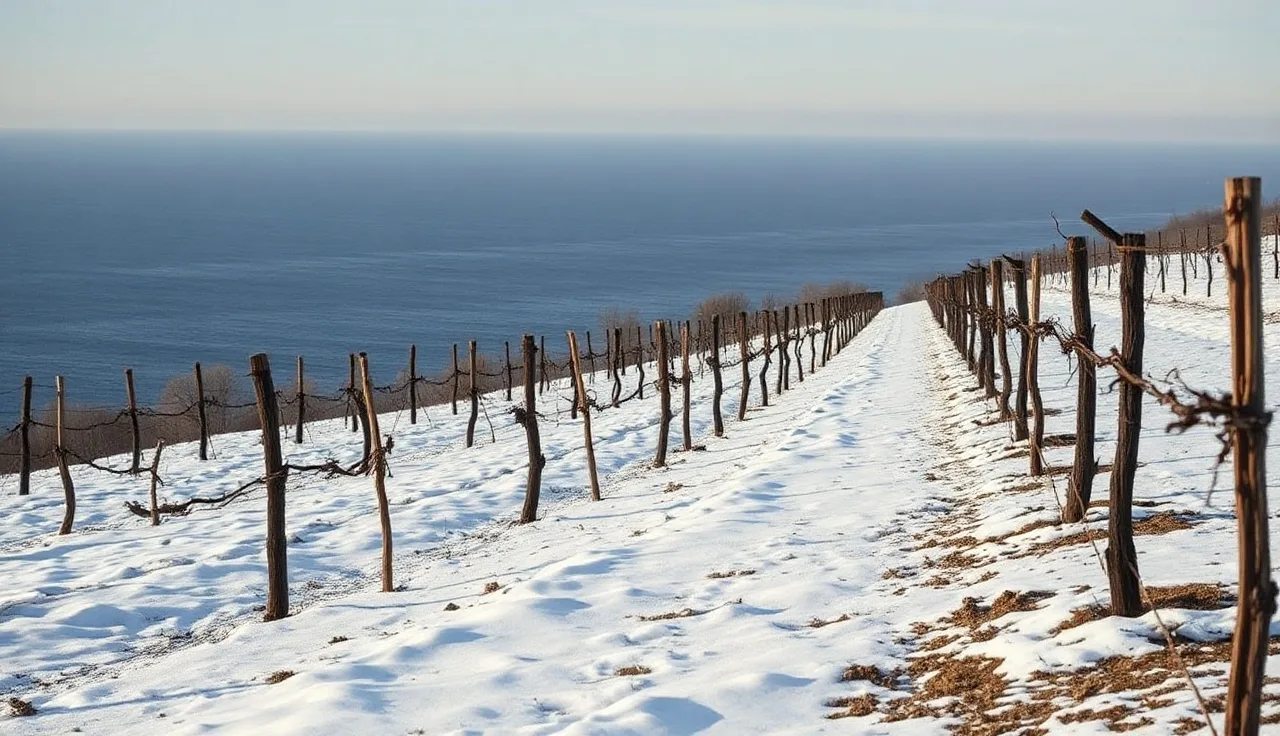
Lake Michigan is the whole story for the western shore, and Lake Erie does the same job in the southeast corner. Those big water bodies store summer heat and give it back slowly in fall, pushing the first killing frost back by two to four weeks compared to sites just 20 miles inland. They also delay spring bud break, which helps vines dodge the April frosts that would otherwise wipe out early-pushing varieties like Chardonnay. The USDA calls this the "lake effect," and it's why the Old Mission and Leelanau peninsulas, both jutting into Lake Michigan, can ripen European varieties at 45 degrees north latitude.
Michigan has four federally recognized American Viticultural Areas: Leelanau Peninsula, Old Mission Peninsula, Lake Michigan Shore, and Fennville.
The AVA lines are not arbitrary marketing. Old Mission Peninsula sits almost entirely in USDA Plant Hardiness Zone 6a, which means average annual minimum temperatures between -10°F and 0°F. Drive ten miles inland from the lake and you're in Zone 5b, where minimums routinely hit -15°F to -20°F, a range that kills unprotected Vitis vinifera outright. [1]
That hardiness zone gap is the most practical fact in Michigan viticulture. It tells you which varieties you can plant where, and whether you'll need burial or trunk protection to get vines through winter.
Which grape varieties actually survive and produce in Michigan?
The answer splits cleanly on location. Within a mile or two of a large lake, on a south-facing slope with good cold air drainage, Riesling, Pinot Gris, Chardonnay, and Pinot Noir all have production histories going back decades. Riesling is the vinifera most growers name as the safest bet across the western Michigan lakeshore AVAs. It handles slightly wetter conditions than Cabernet Franc and ripens fully in Michigan's short growing season.
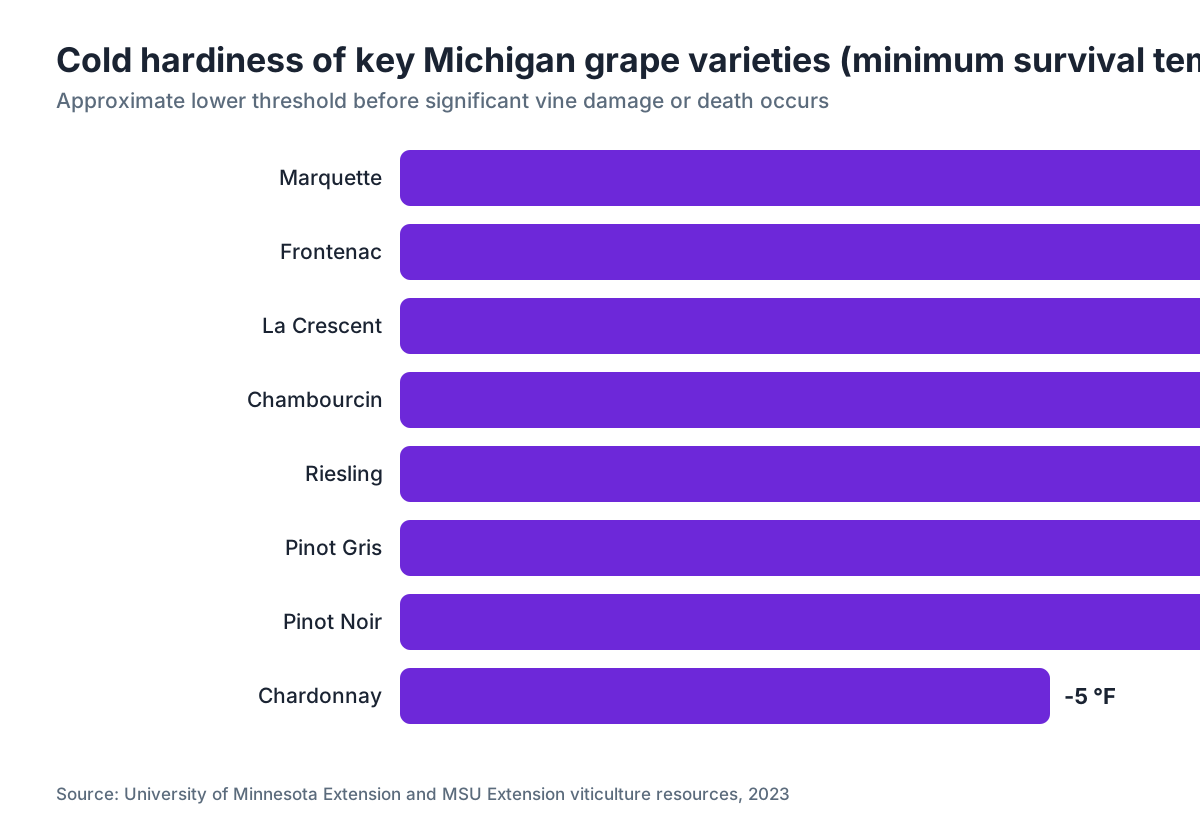
Go inland, or up into the Upper Peninsula where no lake effect reaches, and cold-hardy hybrids are the only honest choice. The University of Minnesota fruit breeding program released Marquette in 2006, and it's now one of the most planted red varieties in the upper Midwest, Michigan's inland regions included. [2] Frontenac, La Crescent, and Itasca are other Minnesota releases worth knowing. Michigan State University Extension also recommends Vignoles and Chambourcin for growers who want French-American hybrids with long track records here. [3]
Here's a realistic variety selection table for the main growing zones:
| Variety | Type | Hardiness (min temp) | Best Michigan zone |
|---|---|---|---|
| Riesling | Vinifera | -5°F to -10°F | Leelanau, Old Mission, Lake Michigan Shore |
| Pinot Gris | Vinifera | -5°F to -10°F | Leelanau, Old Mission |
| Chardonnay | Vinifera | 0°F to -5°F | Old Mission, Fennville |
| Pinot Noir | Vinifera | -5°F to -10°F | Old Mission, Leelanau |
| Marquette | Hybrid | -30°F or below | All Michigan zones |
| Frontenac | Hybrid | -30°F or below | All Michigan zones |
| La Crescent | Hybrid | -30°F or below | All Michigan zones |
| Chambourcin | French-American hybrid | -10°F | Lake Michigan Shore, Fennville |
No variety is carefree. Even Marquette gets powdery mildew and needs a spray program. The hybrid label just means you won't lose the vine to a cold winter.
What do Michigan soils and site conditions look like for vineyards?
Michigan's glacial history left a messy mix of sandy loams, clay loams, and heavy clays, often inside the same field. The best vineyard soils in the state are the well-drained, sandy or gravelly loams on the Old Mission and Leelanau peninsulas, where glacial moraines built natural elevation and good internal drainage. Vines hate wet feet. A site that holds water in spring will stunt roots and invite Phytophthora root rot no matter what variety you put in the ground.
Slope and aspect matter enormously. A south or southwest-facing slope warms faster in spring, banks more heat units over the season, and drains cold air downhill on frost nights instead of pooling it around the canopy. Michigan State University Extension's viticulture program has mapped how topography and cold air drainage interact across the western shore AVAs, and the pattern holds: hilltop and mid-slope sites see 3 to 7 fewer frost events per season than valley floors just a few hundred feet away. [3]
Evaluating a new site? Get a soil test and dig a soil pit before you commit a dime. You want to see the water table, catch any restrictive layers (hardpan, high clay), and check whether the site percolates. A good target is at least 24 inches of rooting depth and no seasonal water table above 36 inches. MSU Extension's vineyard site evaluation publication is free and worth reading before you pull a permit.
When should you plant, and what does establishment actually cost?
Bare-root vines go in the ground after the last hard frost, usually mid-April through mid-May in the lakeshore AVAs. Container-grown vines can go in a little later, but you want them established and actively growing before summer heat sets in. First-year vines need steady moisture. Michigan summers are humid enough that drip irrigation isn't always mandatory for survival, but it speeds establishment noticeably and pays back in earlier production.
Establishment costs swing with trellis system, site prep, and whether you hire labor or do it yourself. A fully trellised, irrigated VSP (vertical shoot positioning) block runs $15,000 to $25,000 per acre in the 2020s, based on enterprise budgets from Michigan State University Extension. [4] That covers plants at $3 to $6 each, trellis materials, drip, deer fencing where needed, and three years of inputs before a commercial harvest. Deer pressure in many Michigan counties is bad enough that an 8-foot perimeter fence is not optional. Budget for it up front.
You will not harvest a meaningful commercial crop until year three or four. Most growers plan for zero revenue through two full seasons and partial revenue in year three. The MSU budgets break this out year by year and are calibrated to Michigan labor and input costs, which makes them far more useful than generic national numbers.
How do you manage pests and diseases in a Michigan vineyard?
Michigan's humid continental climate creates real disease pressure. Powdery mildew (Erysiphe necator) and downy mildew (Plasmopara viticola) are the primary fungal threats, and both can wreck a crop fast in a wet year. Botrytis bunch rot is a secondary but serious problem at harvest, especially in tight-clustered varieties like Pinot Gris.
A standard spray program on a vinifera block in Michigan runs 10 to 14 applications per season, starting at bud swell and ramping through bloom and fruit set. The critical window is from just before bloom through three weeks post-bloom, when clusters are most susceptible. MSU Extension's Enviro-weather platform runs disease risk models (including a Gubler-Thomas mildew model adapted for Michigan) that help growers time sprays instead of spraying on a calendar. [3] A model won't erase sprays, but it usually cuts 2 to 4 per season in an average year.
Japanese beetle (Popillia japonica) and grape berry moth (Paralobesia viteana) are the main insect pests. Grape berry moth is well studied here. MSU Extension publishes degree-day accumulation tables tied to the state's growing regions that tell you when to scout and when to spray. [3] Spotted lanternfly (Lycorma delicatula) has not established permanently in Michigan as of early 2025, but the Michigan Department of Agriculture and Rural Development (MDARD) runs active monitoring given the pest's eastward spread. Check MDARD's current status before you assume you're clear.
Every pesticide application needs a record. The EPA Worker Protection Standard (WPS) requires agricultural employers to post pesticide safety information and keep specific records for each application, including product name, EPA registration number, active ingredient, amount applied, location, and applicator. [5] Growers selling to licensed wineries also face state traceability expectations. Keeping those records in one place, whether a physical logbook or software like VitiScribe, saves real time at audit or sale.
What are the rules around pesticide recordkeeping for Michigan grape growers?
Federal law under FIFRA (the Federal Insecticide, Fungicide, and Rodenticide Act) requires certified applicators using restricted-use pesticides to keep records for two years. [6] Michigan goes further: the Michigan Right to Farm Act and the Generally Accepted Agricultural and Management Practices (GAAMPs) for wine grapes, administered through MDARD, set additional record expectations for commercial producers. [7]
The EPA's Worker Protection Standard applies to any agricultural employer with workers in treated areas. At minimum, you keep a central posting listing the pesticide product name, EPA registration number, active ingredient(s), location and description of the treated area, date of application, and the applicable restricted entry interval (REI). Those records must stay accessible to workers and their designated representatives for 30 years after application for certain pesticides. [5]
MDARD publishes the current version of the wine grape GAAMPs. Download the current edition straight from MDARD's website, since it's updated periodically and the spray record requirements are specific to Michigan-licensed operations. [7]
Managing several blocks with different spray programs? Paper records get unwieldy fast. Plenty of growers start on paper and switch to a digital system once they're tracking more than two or three blocks. Whatever you use, the trick is recording applications the same day they happen, not rebuilding them from memory in December.
How does pruning and canopy management differ in Michigan compared to warmer regions?
The cold winter is your biggest pruning variable. In Michigan, extension advice is to delay dormant pruning as late as you practically can, for two reasons. Late pruning (February through March rather than December) lowers the risk of cutting into wood that hasn't hardened fully. It also nudges bud swell later on vinifera, which trims April frost risk.
Cane pruning is more common in Michigan's vinifera blocks than in California, partly because it keeps more renewal positions available if winter kills some wood. Spur pruning on a VSP trellis is fine for reliably hardy hybrids, but for Riesling or Pinot Noir, most experienced Michigan growers keep one to three backup canes or run a modified cane system that leaves options if part of the vine dies back.
Summer canopy work follows the usual cool-climate playbook: shoot thinning to 10 to 15 shoots per linear foot of cordon, and leaf removal on the east side (morning sun, afternoon shade) to open air circulation and cut disease pressure without cooking the fruit. Michigan's summer humidity means more aggressive leaf pulling is often warranted than on a drier Pacific Northwest site. Cornell University's viticulture program, which publishes widely on cool-climate production that maps onto Michigan conditions, recommends 50 percent or greater leaf removal in the cluster zone by bloom, mostly on the shaded side. [8]
What licenses and registrations does a Michigan grape grower need?
Growing grapes commercially in Michigan doesn't require a viticulture license, but several related activities need permits or registrations. Apply restricted-use pesticides yourself and you need a Michigan pesticide applicator certification from MDARD. [7] Sell directly to the public through a farm market or agritourism operation and you may need a food establishment license, depending on what you're selling alongside the fruit.
Wineries buying your grapes will typically want your spray records, variety certification, and often a grower-winery contract. The Michigan Grape and Wine Industry Council (MGWIC) is the industry body that tracks production data and connects growers with the winery market. [9] Get on their radar early if you plan to sell commercially.
Thinking about a winery on top of growing? That licensing path runs through the Michigan Liquor Control Commission (MLCC) and is a separate, much heavier process. Growers who want to see how established Michigan operations run the consumer end can look at gervasi vineyard and others like it for the full farm-to-glass model.
Property owners also need to understand Michigan's Right to Farm Act, which shields farming operations from some nuisance complaints when they comply with GAAMPs. Following the wine grape GAAMPs is basically a prerequisite for claiming that protection. [7]
How much does it cost to run a Michigan vineyard per acre per year?
Operating costs after establishment run $3,500 to $6,000 per acre per year for a well-managed Michigan vinifera block, based on MSU Extension enterprise budgets. [4] Hybrid blocks cost less, mostly because they need fewer sprays and carry lower input costs overall. The big line items are labor (pruning, shoot positioning, leaf removal, harvest), materials (pesticides, fertilizer), and equipment.
Harvest labor is the single most variable cost. Hand-harvest for premium wine grapes in Michigan runs $250 to $450 per ton depending on the year and local labor supply. Machine harvest, which some larger Lake Michigan Shore operations use, cuts that cost a lot, but it needs a trellis built for a harvester and a machine that works on your slope.
Fruit prices at sale vary by variety and contract. Riesling from the Old Mission Peninsula has pulled $1,200 to $2,000-plus per ton under premium winery contracts, while hybrid varieties for commodity wine typically sell in the $400 to $800 per ton range. Neither figure is guaranteed. Markets shift, and without a contract locked in before harvest, you can find it hard to move fruit at any price in a bumper year.
For growers modeling the numbers, VitiScribe tracks per-block input costs and spray events in real time, which makes end-of-season enterprise analysis much faster than digging through a shoebox of receipts.
What extension and educational resources are available to Michigan grape growers?
Michigan State University Extension has the most relevant, Michigan-specific viticulture resources. Their viticulture team publishes regular updates on pest and disease pressure, spray timing, and regulatory changes. The MSU Enviro-weather platform gives field-level weather data and disease risk models tied to Michigan stations. [3] New growers should look at MSU Extension's introductory viticulture workshops, offered periodically through the Southwest Michigan Research and Extension Center in Benton Harbor. They're practical and run from site selection through first harvest.
Cornell University's viticulture and enology program applies directly, because New York and Michigan share the same cool-climate headaches. Cornell's published work on vinifera variety selection, canopy management, and pest control is widely used by Michigan growers. [8] Washington State University's extension materials on cold-climate viticulture are another legitimate source, especially for growers eyeing sites with harsh winters. [10]
The Great Lakes Fruit, Vegetable and Farm Market EXPO, held annually in Grand Rapids, is the main in-person gathering for Michigan fruit growers, grape producers included. It runs alongside the Michigan Grape Society annual meeting and is the fastest way to see what's working for other growers and talk face to face with MSU extension staff.
Growers curious about how the broader vineyard industry structures field operations can pull extension publications from multiple land-grant universities, all free and without a subscription.
The Michigan Wine Collaborative and MGWIC also publish grower-facing materials and host field days during the season. Get on their mailing list early to stay in the loop on research relevant to Michigan specifically.
What are the biggest mistakes new Michigan grape growers make?
Planting the wrong variety for the site is the most expensive mistake, and it's common. A new grower reads about Riesling on Old Mission Peninsula and plants it on a Kalamazoo County inland site that sees -20°F every third winter. The vines die back to the graft union, production stays inconsistent, and five years in they're pulling vines and starting over. Match the variety's documented cold hardiness to your site's actual recorded minimums, not the averages.
Underestimating deer pressure is second. An unprotected block in most Michigan counties takes deer damage in the first season, and young vines are wide open because the browse line reaches the whole canopy. Factor in fence costs from day one.
Stretching the spray interval during bloom is third. This one doesn't kill vines. It kills crops. Miss the pre-bloom to post-bloom window on mildew in a wet Michigan spring and you can lose 30 to 70 percent of the crop in a single season. Disease pressure here is real, and it moves faster than growers from drier regions expect.
Skipping spray record documentation, then scrambling to rebuild it for a winery buyer or an MDARD inspection, wastes real time and creates compliance exposure. The EPA WPS requires records kept as you go. [5] Building the habit in year one is far easier than fixing it later.
Frequently asked questions
Can you grow Cabernet Sauvignon in Michigan?
In most Michigan locations, no. Cabernet Sauvignon needs a long, warm season and struggles below -5°F, which happens regularly even in the lakeshore AVAs. A handful of growers on the most protected Lake Michigan Shore sites have produced it, but it's a high-risk variety. Most Michigan growers who want a full-bodied red plant Cabernet Franc, which is far more cold-tolerant, or cold-hardy hybrids like Marquette.
How cold does it get in Michigan wine country, and which varieties die at those temperatures?
Leelanau and Old Mission peninsulas average annual minimums of -5°F to -10°F (USDA Zone 6a/6b). Vitis vinifera varieties generally take significant cane damage below -10°F and die below -15°F to -20°F. Inland Michigan regularly hits those lower numbers. Cold-hardy hybrids like Marquette and Frontenac survive -30°F or colder with minimal damage, making them the only reliable choice for non-lakeshore sites.
How many acres of grapes are grown in Michigan?
Michigan has roughly 3,000 to 3,500 acres of wine grapes in production, putting it among the ten largest wine grape states. The Michigan Grape and Wine Industry Council tracks production data annually. Total fruit grape acreage (including Concord for juice and jelly) is much higher, historically over 10,000 acres, concentrated in the Van Buren County area near the Indiana border.
What are Michigan's four wine grape AVAs?
Michigan's four federally approved American Viticultural Areas are Leelanau Peninsula, Old Mission Peninsula, Lake Michigan Shore, and Fennville. Leelanau and Old Mission both sit in the northern Lower Peninsula, jutting into Lake Michigan. Lake Michigan Shore runs along the southwestern coast from roughly Benton Harbor to the Indiana border. Fennville is the smallest, overlapping the southern part of Lake Michigan Shore.
Do I need a license to grow wine grapes commercially in Michigan?
Growing grapes commercially does not require a viticulture license, but you do need a Michigan pesticide applicator certification if you apply restricted-use pesticides yourself. Agritourism activities or a farm market alongside the vineyard may trigger additional food establishment or event permits. Selling to a licensed winery is a private contract, but winery buyers often require spray record documentation before purchase.
What is the Michigan Right to Farm Act and how does it affect vineyards?
The Michigan Right to Farm Act (MCL 286.471 et seq.) protects qualifying farm operations from nuisance lawsuits by neighbors when the operation follows Generally Accepted Agricultural and Management Practices (GAAMPs). MDARD has published specific GAAMPs for wine grape production. Following them is the practical prerequisite for claiming Right to Farm protection against complaints about equipment noise, spray activity, or odors.
How do I find buyers for Michigan wine grapes?
The Michigan Grape and Wine Industry Council and the Michigan Wine Collaborative both connect growers with winery buyers. MSU Extension viticulture specialists can also make introductions to their winery network. Many contracts are set before planting, with the winery specifying variety, training system, and harvest protocols. Grower meetings and industry events like the Great Lakes Fruit EXPO are the fastest way to build those connections.
What trellis systems work best in Michigan vineyards?
Vertical shoot positioning (VSP) on a bilateral cordon or cane-pruned system is the most common in Michigan's vinifera blocks because it suits cool-climate canopy management and keeps fruit accessible for hand harvest. High-wire cordon systems are used for some hybrids. The right system depends on variety, slope, and whether you plan to machine harvest. MSU Extension recommends VSP for most new plantings given its fit with standard Michigan practices.
How do I manage grape berry moth in Michigan?
Grape berry moth (Paralobesia viteana) is managed with degree-day accumulation models tied to Michigan biofix dates. MSU Extension publishes regional degree-day tables updated through the season via Enviro-weather. Sprays are timed to each generation's egg hatch. In most Michigan wine regions, two to three spray windows per season are needed. Mating disruption is an option for larger blocks. Scouting clusters for larval entry holes is the best monitoring tool.
Can Michigan growers use organic or biodynamic practices?
Yes, and several Michigan wineries run certified organic blocks. Organic viticulture is tough here because the humid climate drives strong mildew pressure, and the sulfur and copper-based fungicides allowed under organic certification have real limits in heavy disease years. Scouting frequency and spray timing need to be tighter than in conventional programs. USDA National Organic Program standards apply, and certification goes through a USDA-accredited certifier, not a state agency.
What is the growing degree day (GDD) accumulation in Michigan's wine regions?
Old Mission and Leelanau peninsulas accumulate roughly 2,200 to 2,600 growing degree days (base 50°F) in a typical season, enough for Riesling, Pinot Gris, and Pinot Noir but marginal for later-ripening varieties like Cabernet Sauvignon. The Lake Michigan Shore AVA banks slightly more heat, up to 2,800 GDD in warm years, which widens the variety range modestly. Inland northern sites may accumulate 1,800 GDD or fewer.
How do I protect vines from winter injury in Michigan?
For vinifera on high-risk inland sites, hilling soil over the graft union in late fall and pulling it back in spring protects the most important part of the vine if top growth dies. Trunk wrapping with foam or fabric adds some insulation. Cold-hardy rootstocks and good vine health through summer (no late-season nitrogen, no overcropping) improve cold acclimation. For most lakeshore vinifera sites, managing vine health and choosing well-sited plantings is the main strategy.
How long does it take to get a first harvest from a new Michigan vineyard?
Under normal conditions, you get a small crop in year two that most growers drop to push vine development, and a first modest commercial harvest in year three or four. MSU Extension enterprise budgets treat years one and two as zero-revenue for planning. The timeline depends on plant material quality, site prep, irrigation, and how aggressively you manage canopy and crop load early on.
Sources
- USDA Agricultural Research Service, USDA Plant Hardiness Zone Map: USDA Plant Hardiness Zone classifications and average annual minimum temperatures for Michigan, including Zone 6a on Old Mission Peninsula and Zone 5b inland
- University of Minnesota Extension, Marquette grape variety release information: University of Minnesota released the Marquette cold-hardy wine grape variety in 2006; it tolerates temperatures of -30°F or below
- Michigan State University Extension, Viticulture and Enology Program: MSU Extension recommendations on variety selection, disease risk models via Enviro-weather, grape berry moth degree-day tables, and site evaluation for Michigan vineyards
- Michigan State University Extension, Fruit and Vegetable Enterprise Budgets: Establishment costs of $15,000-$25,000 per acre and annual operating costs of $3,500-$6,000 per acre for Michigan vinifera vineyards, as published in MSU enterprise budgets
- U.S. EPA, Worker Protection Standard for Agricultural Pesticides: EPA Worker Protection Standard requirements for pesticide application recordkeeping, central posting, and 30-year record retention for certain pesticides
- U.S. EPA, Federal Insecticide Fungicide and Rodenticide Act (FIFRA): FIFRA requires certified applicators using restricted-use pesticides to maintain records for a minimum of two years
- Michigan Department of Agriculture and Rural Development, GAAMPs for Wine Grape Production: MDARD-administered Michigan Right to Farm GAAMPs for wine grapes, pesticide applicator certification requirements, and Michigan-specific spray record expectations
- Cornell University, College of Agriculture and Life Sciences, Viticulture and Enology Program: Cornell viticulture recommendations on cool-climate variety selection, canopy management, and 50-percent leaf removal in the cluster zone by bloom on the shaded side
- Michigan Grape and Wine Industry Council: The Michigan Grape and Wine Industry Council tracks state wine grape production data and connects growers with the winery market
- Washington State University Extension, Viticulture and Enology: WSU Extension cold-climate viticulture resources applicable to Michigan growers evaluating sites with harsh winters
Last updated 2026-07-09