Calculating pounds of actual nitrogen per acre from a fertilizer label
TL;DR
- Multiply the application rate (pounds of product per acre) by the label nitrogen percentage as a decimal.
- A 200 lb/acre application of 46-0-0 urea delivers 92 lbs of actual nitrogen per acre.
- Liquid fertilizers need a weight-per-gallon step first.
- Same math for a spray record or a full vineyard nutrient plan.
What does 'pounds of actual nitrogen' actually mean?
When a fertilizer label says 46-0-0, that three-number code is the guaranteed analysis: percent nitrogen (N), percent phosphate (P2O5), and percent potash (K2O) by weight. The first number is the one you care about for nitrogen. 'Actual nitrogen' means the weight of pure elemental nitrogen in whatever amount of product you apply, not the weight of the bag.
That distinction is the whole game. You're matching your application to a nitrogen target from a soil or petiole test. Your advisor says 'apply 30 lbs of actual nitrogen per acre.' That is not 30 lbs of fertilizer per acre. The fertilizer is the truck. Nitrogen is the cargo.
Get those two numbers confused and you can under-apply by half or over-apply by double, and neither shows up until the canopy tells on you months later.
Federal and state law requires a guaranteed analysis on every commercial fertilizer sold in the United States [1]. That label percentage is the starting point for every calculation below.
What is the formula for calculating actual nitrogen from a fertilizer label?
Here's the core formula, and it's short:
Lbs of actual N per acre = (Application rate in lbs of product per acre) × (Label N% ÷ 100)
That's it. Everything else is getting your inputs into the right units before you plug them in.
Worked example. You want to apply 46-0-0 urea at 200 lbs per acre.
200 × (46 ÷ 100) = 200 × 0.46 = 92 lbs of actual nitrogen per acre [2]
Another. 16-16-16 granular at 300 lbs per acre.
300 × (16 ÷ 100) = 300 × 0.16 = 48 lbs of actual nitrogen per acre
To flip it and solve for how much product you need to hit a target:
Lbs of product needed = Target lbs of actual N per acre ÷ (Label N% ÷ 100)
Say you need 40 lbs of actual N per acre using 21-0-0 ammonium sulfate.
40 ÷ 0.21 = 190.5 lbs of product per acre
Round to a practical spreader setting and you're done.
How do you handle liquid fertilizers where the label shows percent by weight?
Liquids are sold by the gallon, so you need the product's weight per gallon before the formula works. The label lists it as weight per gallon, and if it doesn't, the Safety Data Sheet does.
Formula for liquids:
Lbs of actual N per acre = (Gallons per acre) × (Lbs per gallon) × (Label N% ÷ 100)
Worked example with UAN 32 (32-0-0 urea ammonium nitrate solution):
- Label: 32% N
- Weight: about 11.06 lbs per gallon [3]
- Application rate: 10 gallons per acre
10 × 11.06 × 0.32 = 35.4 lbs of actual nitrogen per acre
UAN 28 weighs about 10.66 lbs per gallon, UAN 32 about 11.06 lbs per gallon. Using the wrong weight is one of the most common errors in fertigation records. Pull the exact figure from the label or the manufacturer's technical bulletin. Never from memory.
Foliar products like 9-18-9 or fish emulsion run through a sprayer at low rates use the same math. At 2 gallons per acre of a 9-0-0 fish hydrolysate weighing 9.5 lbs per gallon:
2 × 9.5 × 0.09 = 1.71 lbs of actual N per acre
That number goes on your spray record exactly as calculated.
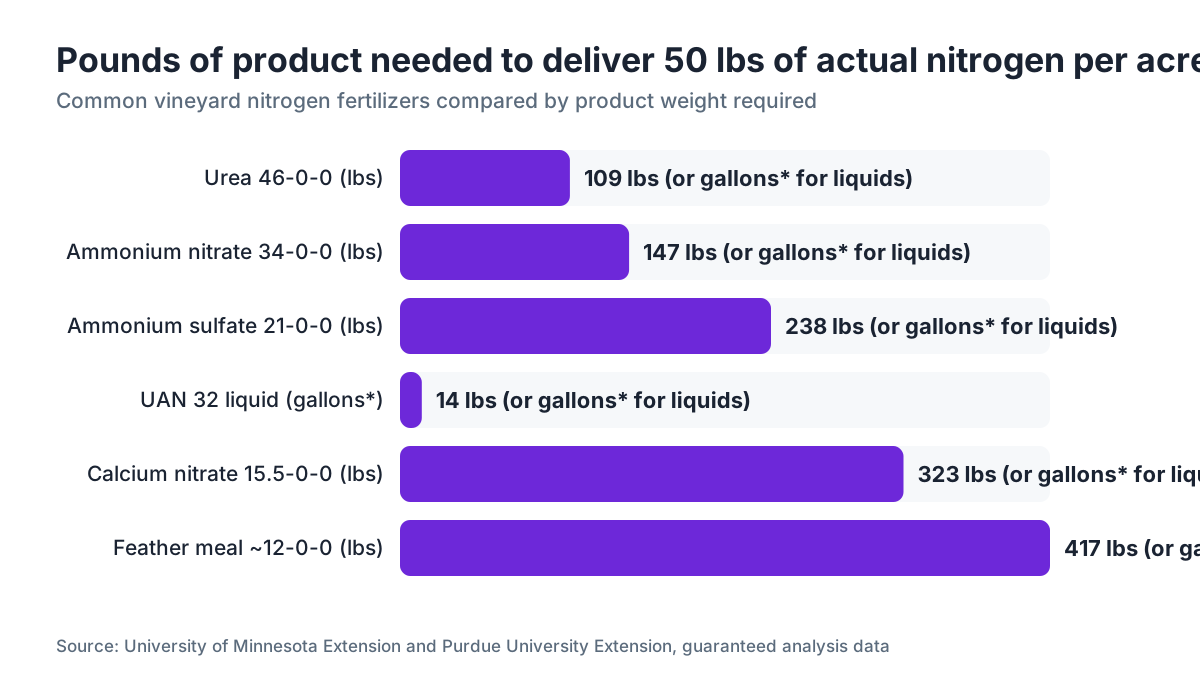
How do common vineyard fertilizers compare for nitrogen delivery?
The lower the N%, the more product weight you haul to hit the same nitrogen target. This table covers the materials most vineyards actually use, based on typical guaranteed analyses. N% shifts a little by lot and manufacturer, so run your specific label.
| Product | Analysis | N% | Lbs of product to deliver 50 lbs actual N/acre |
|---|---|---|---|
| Urea | 46-0-0 | 46% | 108.7 lbs |
| Ammonium nitrate | 34-0-0 | 34% | 147.1 lbs |
| Ammonium sulfate | 21-0-0-24S | 21% | 238.1 lbs |
| UAN 32 liquid | 32-0-0 | 32% | 14.1 gallons* |
| UAN 28 liquid | 28-0-0 | 28% | 16.8 gallons* |
| Calcium nitrate | 15.5-0-0 | 15.5% | 322.6 lbs |
| Feather meal (organic) | 12-0-0 | ~12% | 416.7 lbs |
| Fish emulsion | 5-1-1 | ~5% | 1,000 lbs (or ~105 gal) |
*Gallon figures assume 11.06 and 10.66 lbs/gallon for UAN32 and UAN28 respectively [3].
For most small operations, urea and ammonium sulfate do the heavy lifting. Ammonium sulfate also supplies sulfur, useful in wine grape production where you want sulfur for protein synthesis without excess nitrate driving up vine vigor. UC Cooperative Extension recommends ammonium sulfate where sulfur is also needed [4].
Organic materials like feather meal or fish emulsion carry much lower N%, which is why organic programs run high application rates by volume. The calculation matters more there, not less, because it keeps you inside an organic system nitrogen budget.
What nitrogen rates do vineyards actually need per acre?
Grapevines are light feeders next to row crops. Annual nitrogen uptake in a mature Vitis vinifera vineyard usually runs 20 to 60 lbs of actual N per acre per year, shifting with yield target, rootstock, soil organic matter, and cover crop competition [4].
UC Cooperative Extension guidelines put total nitrogen application (soil plus foliar) for most California wine grape vineyards between 20 and 50 lbs of actual N per acre annually, and name petiole nitrate at bloom as the most reliable indicator of vine nitrogen status [4]. WSU Extension lands in the same range and warns that over-fertilization with nitrogen drives excessive shoot growth and shading, which cuts fruit quality in cool climates [5].
Cornell Cooperative Extension recommends petiole sampling at bloom and veraison for the most accurate reading in Northeast vineyards, and notes that many mature vineyards on loamy soils with cover crops need little or no supplemental nitrogen [6].
Here's the honest takeaway. Knowing your actual N per acre matters most for not over-applying, more than for hitting a minimum. The same formula that gets you to 40 lbs is the one that catches you when you accidentally scheduled 80.
How do you record fertilizer applications for compliance purposes?
Most state fertilizer and pesticide rules want your records to show the product name, guaranteed analysis, amount of product applied, and the resulting nutrient delivery per acre. California's fertilizer laws (California Food and Agriculture Code Section 14501 et seq.) require commercial fertilizers sold in the state to carry a guaranteed analysis, and growers applying those products may owe records under Water Board or county agricultural commissioner rules [7].
USDA NRCS cost-share (EQIP) requires nutrient management plans that document actual N per acre for each application. EPA's Worker Protection Standard doesn't regulate straight fertilizers, but many fertigation products (particularly those mixed with herbicides or fungicides) trigger WPS recordkeeping at the point of the pesticide application [8].
When a fertilizer is tank-mixed with a pesticide, the fertilizer entry usually carries date, field/block ID, product name, label N%, gallons or lbs of product per acre, and the calculated actual N per acre. Getting that last number wrong on an EQIP audit or an organic inspection is the paperwork slip that stalls a cost-share payment.
Manage several blocks with different rates and products and the transcription errors pile up fast. VitiScribe is built for vineyard field records, including fertilizer logs that calculate actual nutrient delivery from the label data you enter, so the math isn't riding on you at every entry.
See also: vineyard recordkeeping practices at vineyard.
How do you calculate actual nitrogen for slow-release or controlled-release fertilizers?
Slow-release fertilizers like polymer-coated urea or IBDU (isobutylidene diurea) still list total nitrogen on the label. The guaranteed analysis gives you total N%, and the label also states what percentage is water-insoluble (WIN) or slowly available.
For what you applied per acre, use total N. A 44-0-0 polymer-coated urea at 150 lbs per acre delivers 150 × 0.44 = 66 lbs of total actual N per acre. The release rate doesn't change how much nitrogen goes in the field. It changes how fast the vine can reach it.
For nutrient management plans and compliance records, total N is the number you report. For agronomic planning you want the release curve, but that's a separate question from the label math.
Organic slow-release materials (blood meal, feather meal, composted manures) get messier. Their N% varies by batch, and the available fraction depends on soil temperature and biology. A feather meal label might say 12-0-0, but only 60 to 80% of that nitrogen may reach the plant in a single season under cool conditions [9]. For recordkeeping, use the labeled N%. For agronomic planning in organics, fold in availability estimates from your certifier or advisor.
What are the most common mistakes when calculating actual nitrogen per acre?
Skipping the gallons-to-pounds conversion on liquids is the most frequent error. If your pump meter reads gallons and you multiply gallons by N% without the density step, you badly undercount actual nitrogen. The classic version: someone grabs 32% off the label, multiplies by gallons, and drops the 11.06 lbs/gallon factor. The result is off by roughly 11-fold.
Wrong rate unit is second. Some spreaders are calibrated in lbs per 1,000 sq ft for small jobs. One acre = 43,560 sq ft = 43.56 units of 1,000 sq ft. Treat a per-1,000-sq-ft number as a per-acre number and you overstate the application by a factor of about 43.
Confusing percent P2O5 with percent elemental P trips people trying to run phosphorus alongside nitrogen. The second number on a label is P2O5, not elemental P. Convert to elemental P by multiplying by 0.436. For nitrogen the label N% is elemental N already, so nothing to convert there [10].
And pulling the N% from memory instead of the bag. Urea is usually 46%, but some coated slow-release products are 42 or 44%. Ammonium sulfate is usually 21%, but blends drift. Read the label in your hand every time.
How does actual nitrogen per acre relate to petiole testing and vine nutrition?
Petiole testing is the standard diagnostic for nitrogen status in grapevines. Bloom-time petiole nitrate (NO3-N) benchmarks for Vitis vinifera, per UC Cooperative Extension, run like this:
- Deficient: below 350 ppm NO3-N
- Sufficient: 350 to 1,500 ppm NO3-N
- Excess: above 1,500 ppm NO3-N [4]
Those benchmarks don't hand you a lbs-per-acre prescription. Soil type, organic matter mineralization, cover crop competition, and irrigation all change how much of your applied nitrogen ever reaches the vine. But your actual N applied per acre, paired with a petiole result, builds a calibrated correction for next season.
Apply 45 lbs of actual N per acre and see petioles at 280 ppm (deficient)? You need more. See 1,800 ppm (excess) on 30 lbs/acre? That's a mineralization or cover crop problem, not a fertilizer rate problem.
WSU Extension recommends recording nitrogen inputs alongside petiole results over multiple seasons to build site-specific calibration data [5]. You can't build that calibration if your records say '2 bags per row' instead of lbs of actual N per acre.
How do you handle tank mixes with multiple nitrogen sources?
Tank mixes with two or more nitrogen-carrying products are routine in fertigation. Total actual nitrogen per acre is the sum of each product's individual contribution.
Example. You're running a fertigation set with UAN 28 at 8 gallons/acre plus a calcium nitrate solution at 5 gallons/acre (weight 11.1 lbs/gal, 15.5% N).
UAN 28 contribution: 8 gal × 10.66 lbs/gal × 0.28 = 23.9 lbs actual N/acre
Calcium nitrate contribution: 5 gal × 11.1 lbs/gal × 0.155 = 8.6 lbs actual N/acre
Total: 32.5 lbs actual N/acre for this application
Each component gets its own line in the record, then you sum for the nitrogen event total. That total is what NRCS nutrient management plans, organic certification records, and water quality compliance reports track as annual nitrogen loading per acre.
A product with no nitrogen (a 0-0-60 potassium source, say) contributes zero and drops out of the nitrogen sum, though it still earns a line on the fertilizer application record.
Where can you find reliable nitrogen rate guidelines for wine grapes?
The best primary resources are university Cooperative Extension publications, not manufacturer rate cards.
UC Cooperative Extension publishes 'Nutrient Management in Winegrapes' through the UC Agriculture and Natural Resources catalog, with petiole sufficiency ranges and nitrogen rate guidance for California conditions [4]. WSU Extension's viticulture publications cover nitrogen for cool-climate and dryland grape production across Washington and Oregon [5]. Cornell Cooperative Extension maintains the 'Cornell Pest Management Guidelines for Grapes,' whose nutrition chapter gives Northeast-specific nitrogen benchmarks [6].
For nutrient management planning tied to USDA cost-share, NRCS Conservation Practice Standard 590 (Nutrient Management) is the federal framework. It requires nitrogen applications be based on realistic yield goals, soil and tissue testing, and documented calculation of actual N per acre [11].
EPA's Worker Protection Standard (40 CFR Part 170) covers worker safety during pesticide applications and can reach fertilizers co-applied with registered pesticides. For straight fertilizer with no pesticide label, WPS doesn't apply, but state department of agriculture rules may still demand application records [8].
VitiScribe's fertilizer log links to block records and pulls petiole test data alongside application history, so you can review N inputs and vine response in one view at season's end.
Frequently asked questions
How do I calculate actual nitrogen from a 46-0-0 urea bag?
Multiply the pounds of urea you're applying per acre by 0.46 (the N percentage as a decimal). At 200 lbs of urea per acre you get 92 lbs of actual N per acre. At 100 lbs per acre you get 46 lbs. The three-number guaranteed analysis on the bag always lists N first, so that first number divided by 100 gives you the conversion factor.
What does the guaranteed analysis on a fertilizer label mean?
It's the three-number code (like 10-5-8) showing the minimum percentages of nitrogen (N), available phosphate (P2O5), and soluble potash (K2O) by weight. These are legally required minimum guarantees under USDA and state fertilizer laws. The first number is always nitrogen, and it represents elemental N as a percent of total product weight, so no additional conversion is needed for the nitrogen figure.
How do I convert liquid fertilizer gallons to actual nitrogen per acre?
You need the product's weight per gallon from the label or SDS. Then: gallons per acre × lbs per gallon × (N% ÷ 100) = lbs of actual N per acre. For UAN 32, that's gallons per acre × 11.06 × 0.32. Skipping the weight-per-gallon step is the most common error in liquid fertilizer records, and it badly understates actual N delivery.
How much nitrogen do grapevines need per acre per year?
Most mature wine grape vineyards need 20 to 50 lbs of actual N per acre annually, per UC Cooperative Extension guidelines. The right amount depends on yield target, rootstock vigor, soil organic matter, and cover crop competition. Many well-managed mature vineyards on loam soils need very little supplemental nitrogen because mineralization supplies enough, which is why petiole testing beats default rate prescriptions.
What records do I need to keep for fertilizer applications in a vineyard?
At minimum: date, field or block ID, product name, guaranteed analysis (N-P-K%), application rate in product per acre, and calculated actual N per acre. California growers may face added requirements from the State Water Board or county ag commissioner. USDA NRCS EQIP participants must document actual N per acre for each application in their nutrient management plan. Certified organic operations must satisfy certifier record requirements too.
How do I calculate actual nitrogen from a slow-release fertilizer?
Use the total N% from the guaranteed analysis on the label, not the water-insoluble or slowly available fraction. For recordkeeping and compliance, total N applied per acre is the number you report. For agronomic planning, factor in the availability curve separately. A 44-0-0 polymer-coated urea at 150 lbs/acre delivers 66 lbs of total actual N per acre regardless of release timing.
What is the formula to find how many pounds of fertilizer I need to hit a nitrogen target?
Divide your target lbs of actual N per acre by the label N% expressed as a decimal. For a 40 lb actual N target using 21-0-0 ammonium sulfate: 40 ÷ 0.21 = 190.5 lbs of product per acre. For liquids, divide the target by (lbs per gallon × N% as decimal) to get gallons per acre.
Does the nitrogen percentage on a fertilizer label represent elemental nitrogen or a compound?
For nitrogen, the label percentage is elemental N. Unlike the phosphorus number (which is P2O5, not elemental P) and the potassium number (which is K2O), the N on a fertilizer label already represents pure elemental nitrogen by weight. No additional conversion factor is needed. That makes nitrogen the simplest of the three primary nutrients to calculate from a label.
How do I add up actual nitrogen from a tank mix with multiple fertilizer products?
Calculate the actual N contribution from each product separately, then sum them. Each product's contribution equals its application rate in lbs per acre (converting liquids from gallons using weight per gallon) multiplied by its N% as a decimal. Record each product individually and total them to get the nitrogen event total for that application date and block.
How does actual nitrogen per acre connect to petiole test results?
Petiole nitrate at bloom (target 350 to 1,500 ppm NO3-N per UC Cooperative Extension) tells you vine nitrogen status, while your actual N per acre records tell you what you applied. Tracking both over multiple seasons builds site-specific calibration: how many lbs of actual N per acre, from which source, under your soil and irrigation conditions, produces a petiole result in the sufficient range.
Is there a difference between 'actual nitrogen' and 'available nitrogen' on a fertilizer label?
Yes. 'Actual nitrogen' is total N by weight as a percent of the product, which is what the guaranteed analysis shows. 'Available nitrogen' is the fraction the plant can take up in a given season, which depends on soil conditions, microbial activity, and product chemistry. For recordkeeping math, use actual N from the label. For agronomic planning with organic or slow-release materials, factor in availability separately.
What unit errors should I watch out for when doing this calculation?
Three common ones: (1) multiplying gallons by N% without converting gallons to pounds first, understating N by roughly 10 to 11 times for typical liquid fertilizers; (2) treating an application rate in lbs per 1,000 sq ft as lbs per acre, understating N by a factor of 43.56; (3) using a remembered N% rather than the label on your specific product lot. Always start from the label in your hand.
Do organic fertilizers use the same calculation method?
Yes. The guaranteed analysis on an organic fertilizer (blood meal, feather meal, fish emulsion) lists N% by weight, and the same formula applies: lbs of product per acre × (N% ÷ 100). The agronomic complication is that the availability fraction varies with soil temperature and microbial activity, so not all labeled N reaches the plant that season. For paperwork and compliance, you still report total actual N applied per acre from the label math.
Sources
- USDA Agricultural Marketing Service, Fertilizer Laws and Regulations: Federal and state laws require a guaranteed analysis (N-P-K percentages) on every commercial fertilizer product sold in the United States.
- University of Minnesota Extension, Fertilizer Urea: Urea (46-0-0) contains 46% nitrogen by weight and is one of the most concentrated dry nitrogen fertilizer sources available.
- Purdue University Extension, Liquid Fertilizer Weights and Measures: UAN 32 solution weighs approximately 11.06 lbs per gallon and UAN 28 weighs approximately 10.66 lbs per gallon at standard temperature.
- UC Cooperative Extension, Nutrient Management in Winegrapes: Bloom-time petiole nitrate sufficiency range for Vitis vinifera is 350 to 1,500 ppm NO3-N; ammonium sulfate is recommended when additional sulfur is also needed; annual N applications for most California wine grape vineyards range from 20 to 50 lbs actual N per acre.
- Washington State University Extension, Viticulture Nutrition: Excess nitrogen promotes shoot growth and canopy shading in cool-climate vineyards, reducing fruit quality; WSU recommends recording N inputs alongside petiole results over multiple seasons to build site-specific calibration.
- Cornell Cooperative Extension, Cornell Pest Management Guidelines for Grapes: Cornell recommends petiole sampling at bloom and veraison for accurate nitrogen status in Northeast vineyards and notes that many mature vineyards may need little or no supplemental nitrogen.
- California Department of Food and Agriculture, Fertilizer Materials and Research Program: California Food and Agriculture Code Section 14501 et seq. requires guaranteed analysis labeling on commercial fertilizers sold in the state; growers may face additional recordkeeping requirements under Water Board or county ag commissioner rules.
- U.S. Environmental Protection Agency, Worker Protection Standard (40 CFR Part 170): EPA's Worker Protection Standard governs pesticide applications and applies when fertilizers are co-applied with registered pesticide products; pure fertilizer applications without a pesticide label are not subject to WPS.
- ATTRA National Sustainable Agriculture Information Service, Organic Nitrogen Sources: Organic nitrogen sources like feather meal (labeled 12-0-0) typically have 60 to 80% nitrogen availability in a single season under cool soil conditions due to dependence on microbial mineralization.
- University of Nebraska-Lincoln Extension, Fertilizer Recommendations Guide: The phosphorus number on a fertilizer label represents P2O5, not elemental P; to convert to elemental P multiply by 0.436. Nitrogen on the label already represents elemental N with no conversion factor needed.
Last updated 2026-07-11