How to calculate vineyard nitrogen fertilizer rate from petiole analysis
TL;DR
- Pull petioles at bloom or veraison, get nitrate-N (NO3-N) back from the lab, compare to your region's sufficiency range (typically 350-1,200 ppm at bloom for Vitis vinifera), then calculate the deficit and apply nitrogen at roughly 10-15 lbs actual N per acre per year maximum.
- Most well-managed vineyards need far less, often zero.
What does a petiole analysis actually tell you about nitrogen?
A petiole is the short stem that attaches a leaf blade to the cane. The vine moves nutrients through that stem constantly, so the tissue concentration reflects what the vine is feeding on right now, not what's sitting in the soil waiting to get absorbed. That makes a petiole test a far more actionable diagnostic than a soil test for nitrogen.
The lab result you care about most is nitrate-N, reported in parts per million (ppm) on a dry-weight basis. Nitrate is the main form of inorganic nitrogen the vine pulls from soil, and it builds up in petiole tissue in a fairly predictable way through the season. Total Kjeldahl nitrogen (TKN) sometimes shows up on the same report, but for fertility decisions in established vineyards, nitrate-N is the number that drives the calculation [1].
Get one thing straight before anything else. Petiole analysis tells you nitrogen status, not nitrogen need in any clean one-to-one way. A vine reading low on petiole nitrate-N might need fertilizer, might need better irrigation timing, or might just sit on a rootstock that restricts uptake. The number starts the conversation. It doesn't finish it.
When should you collect petiole samples for nitrogen assessment?
Timing is not flexible. Two windows produce interpretable results: bloom (when roughly 50% of the cluster flowers are open) and veraison (when roughly 50% of berries begin to soften and color). Every university extension program that publishes sufficiency ranges bases those ranges on one of these two dates [1][2][3].
Bloom is the better window for nitrogen. Petiole nitrate-N runs highest early in the season and drops steadily as summer wears on, so bloom gives you the biggest signal and the cleanest read. If you want to adjust nitrogen before a cover crop termination or a fertigation event, bloom is when to act.
Veraison sampling gets more use for potassium and boron, but it still has published sufficiency ranges for nitrate-N if that's what your operation can manage.
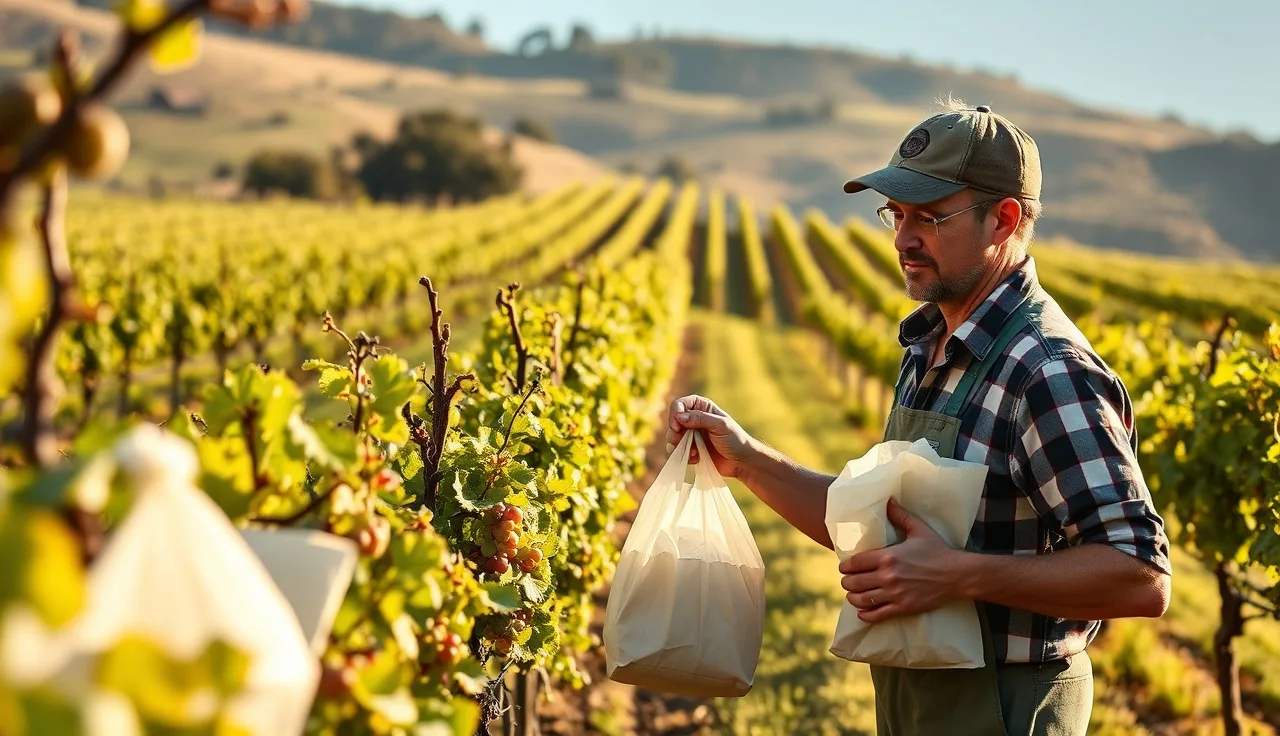
For the mechanics: collect the petiole opposite the basal cluster from 60 to 100 vines in a single uniform block, chosen to represent average vine condition. Skip stunted vines, end posts, and any vine near a deer rub or a leaky emitter. Put the samples in a paper bag, never plastic, so they don't sweat and rot on the way to the lab. Ship overnight if you can [2].
What are the sufficiency ranges for petiole nitrate-N by region and timing?
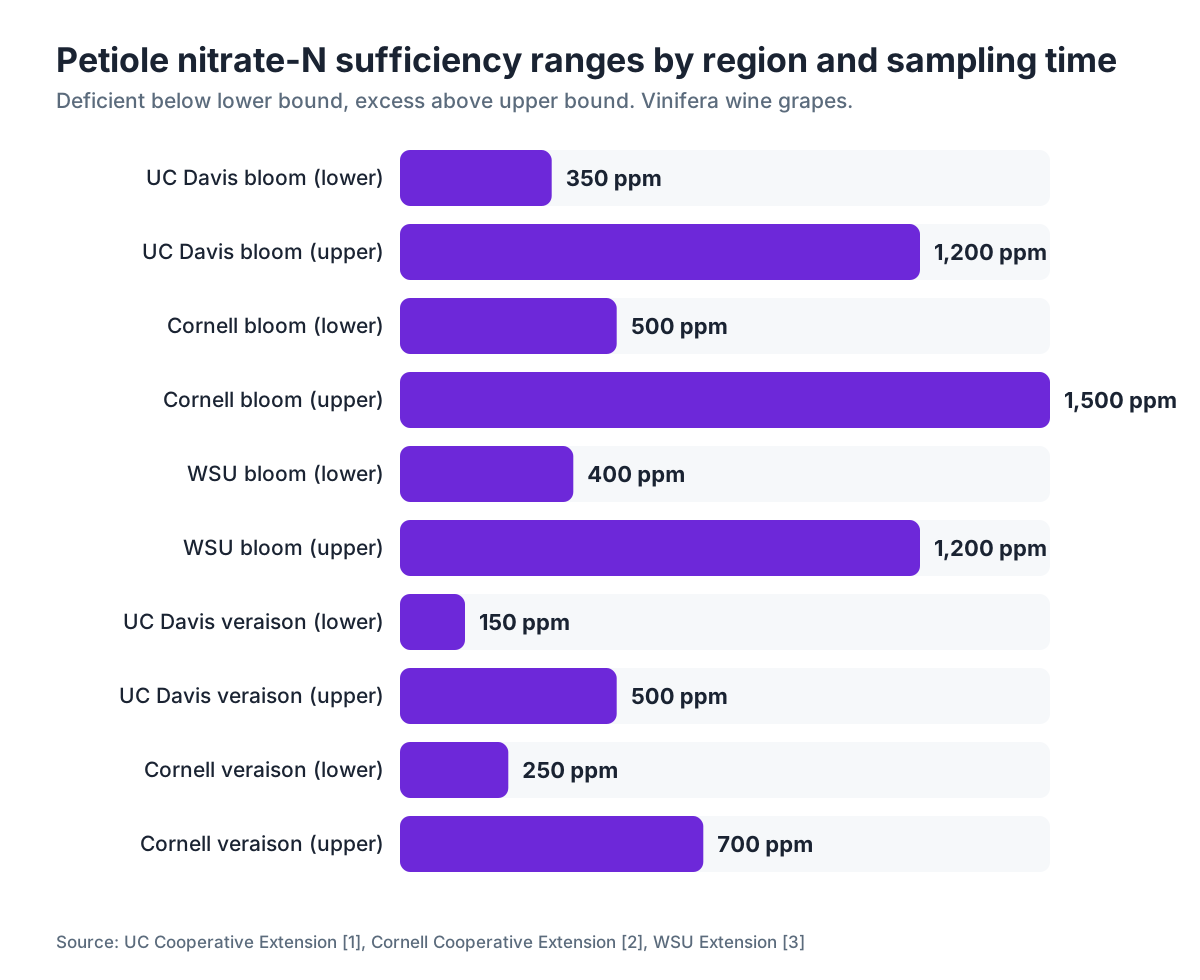
This is where growers get confused, because UC Davis, Cornell, and WSU publish slightly different thresholds. They're not wrong. They're calibrated to different climates, rootstocks, and grape varieties common in each region. Use the range from the extension program that covers your geography.
| Sampling time | UC Davis (vinifera) | Cornell (NY hybrids/vinifera) | WSU (Pacific NW) |
|---|---|---|---|
| Bloom (ppm NO3-N) | 350-1,200 | 500-1,500 | 400-1,200 |
| Veraison (ppm NO3-N) | 150-500 | 250-700 | 200-600 |
| Deficient (bloom) | Below 350 | Below 500 | Below 400 |
| Excess (bloom) | Above 1,200 | Above 1,500 | Above 1,200 |
Sources: UC Cooperative Extension Nutrient Management publication [1], Cornell Cooperative Extension viticulture guidelines [2], Washington State University Extension viticulture program [3].
A reading below the deficient threshold means the vine is likely nitrogen-stressed and you should apply fertilizer. A reading inside the sufficient range means your baseline program is working and you should apply little or nothing unless shoot growth or crop load data say otherwise. A reading above the excess line is a real problem. Excess vine nitrogen drives too much shoot vigor, delays fruit maturity, hurts color, and raises Botrytis risk [1].
Concord and other American varieties (Vitis labrusca) carry higher natural petiole nitrate levels than vinifera, and Cornell's higher thresholds partly reflect that. Don't use vinifera thresholds to judge a Concord block.
How do you calculate the actual nitrogen fertilizer rate from the petiole result?
Here's the step-by-step calculation. Work through it in order and you'll walk away with a documented, defensible rate.
Step 1: Determine your deficit. Take the midpoint of the sufficiency range and subtract your petiole result. For UC Davis bloom sampling, the midpoint sits around 775 ppm NO3-N. If your result came back at 280 ppm, the deficit is 495 ppm.
Step 2: Convert the deficit to a rough nitrogen need. UC Cooperative Extension research suggests every 100 ppm of petiole nitrate-N deficit corresponds to roughly 1 to 2 lbs of actual N per acre, depending on vine spacing, rootstock, and soil organic matter [1]. This is a heuristic, not a chemical equation, and the uncertainty is real. Nobody has published a tight regression across all varieties and regions. The closest data come from Christensen, Bianchi, and others working in the San Joaquin Valley, and their numbers hold the 1-2 lbs per 100 ppm range for moderately vigorous vines on 8x10 or 8x12 spacing.
Step 3: Apply a ceiling. UC Davis and WSU both cap annual nitrogen at no more than 10-20 lbs actual N per acre per year for established vineyards, with most well-managed blocks needing 5-10 lbs or less [1][3]. If your deficit math spits out a number above 20 lbs, something else is wrong: soil pH, compaction, rootstock mismatch, or irrigation uniformity. Nitrogen won't fix any of those.
Step 4: Account for organic matter credits. If you're farming a cover crop, composting, or working in pomace, your soil organic matter mineralizes some nitrogen every year. A rough California rule: each percentage point of organic matter releases about 10-20 lbs of available N per acre per year [1]. Get your soil tested for organic matter at the same time you pull petioles, and subtract the estimated credit before you order a single bag.
So for that 495 ppm deficit above:
- Raw N need: 495 / 100 × 1.5 lbs (midpoint) = 7.4 lbs actual N per acre
- Organic matter credit (say 1.2% OM × 15 lbs/% = 18 lbs): the credit exceeds the raw need, which means you may need zero supplemental nitrogen. That's a legitimate and common result.
Step 5: Choose your product and back-calculate the application rate. Once you know the lbs of actual N you want to apply, divide by the product's guaranteed nitrogen percentage. Urea (46-0-0): lbs product = lbs N ÷ 0.46. Calcium nitrate (15.5-0-0): lbs product = lbs N ÷ 0.155. Fish emulsion (5-1-1): run the same math with 0.05 [4].
What other vine data should you pair with the petiole result before deciding?
The petiole number alone is not enough. Honest nitrogen management needs at least three other data points.
Shoot length and internodal spacing. Measure 10 to 15 shoots per block at bloom. A well-fed vinifera vine usually shows 25 to 35 cm of shoot growth by full bloom and internodal lengths of 7 to 12 cm. Short growth with pale leaves confirms a deficiency. Lush dark green shoots with long internodes suggest excess or adequate nitrogen even if the petiole reads low [2].
Leaf color. Nitrogen deficiency shows up first as yellowing of older basal leaves while young tips stay green. See that pattern and the petiole number usually confirms it. See leaves that are uniformly dark green, and you should doubt any calculation that says add nitrogen.
Prior year pruning weight. This is probably the most ignored metric in small-vineyard operations. Weigh your dormant prunings per vine. The Ravaz Index (crop weight divided by pruning weight, ideally 5 to 10 for most varieties) tells you whether the vine sits in balance. Pruning weights under 0.5 lbs per vine mean you may genuinely be nitrogen-limited. Above 2 lbs per vine, you probably need none [3].
Those three numbers alongside the petiole result give you a much stronger basis for a fertilizer call than any single test.
How do timing and application method affect how much nitrogen you actually need to apply?
Timing and method change the efficiency of every pound you put down, which directly changes the rate.
Fertigation through drip is the most efficient delivery method for established vineyards with uniform systems. You can split applications, hit the exact moment of vine demand, and cut volatilization loss. That lets you apply smaller total quantities because less goes to waste [3]. If you're fertigating with urea or ammonium-based products, apply in several small shots across 3 to 5 weeks around and after bloom, not in one flush.
Surface broadcast granular fertilizer works fine in wet-winter regions because rain moves the nutrients into the rootzone. In arid country like the Central Valley or eastern Washington, broadcast nitrogen without irrigation to water it in works poorly, and you'll have to apply more to hit the vine target [1].
Foliar sprays with urea (2 to 3% solution) give a fast response but tiny amounts of actual N, maybe 0.5 to 1 lb per acre per application. They aren't a substitute for a soil-applied program. They're a rescue treatment for when you spot acute deficiency mid-season and can't wait for a soil application to work.
Timing within the season matters too. Nitrogen applied after veraison carries a high risk of pushing into dormancy, promoting late growth that won't harden off, and raising disease pressure. Most extension programs say apply no nitrogen after veraison in cool climates and no later than 4 to 6 weeks post-bloom in warm ones [2].
What forms of nitrogen fertilizer work best in vineyards?
This is genuinely a regional and operational question, and the honest answer is that most common products work fine when you apply them right.
Urea (46-0-0) is the cheapest source per pound of actual N and it's everywhere. The risk is ammonia volatilization from surface applications in warm, alkaline soils. Soil pH above 7 and you lose a meaningful fraction of the urea to the air before rain or irrigation moves it in. Soil-incorporate it or water it in within 24 to 48 hours [4].
Calcium nitrate (15.5-0-0) is fully soluble and plant-available the moment it hits the root zone. It's the go-to for fertigation and for soils where you also want to address calcium. It costs more per pound of N, but uptake efficiency runs higher.
Ammonium sulfate (21-0-0-24S) helps where you also need sulfur and where you want to nudge a high-pH soil down. It's a common pick in Pacific Northwest vineyards dealing with sulfur co-deficiency.
Organic options like feather meal (12-0-0), blood meal (12-0-0), or composted chicken manure (variable, typically 2 to 4% N) release nitrogen slowly and lean on soil microbial activity. They fit certified organic operations and add organic matter, but they're harder to dose because mineralization depends on soil temperature and moisture. Budget roughly 30 to 50% of the labeled N to stay unavailable in the year you apply it [1].
For the rate math, always use the guaranteed analysis on the label (required by state fertilizer law) to figure lbs of product per acre [4].
How do you document nitrogen applications to stay compliant with pesticide and fertilizer regulations?
Nitrogen fertilizer isn't a pesticide, so it dodges the EPA Worker Protection Standard (WPS) for spray records. It still triggers several other record-keeping requirements depending on your state and how you source the product [5].
In California, commercial fertilizer use falls under the California Department of Food and Agriculture and the regional water quality control boards through the Irrigated Lands Regulatory Program (ILRP). Growers in nitrate-vulnerable areas have to maintain nitrogen management plans and annual use records under the State Water Board's rules [6]. Skip the records and you risk fines and loss of conditional waiver coverage.
Most other states run less prescriptive rules for fertilizer, but your state department of agriculture likely wants you to keep purchase records, application dates, product names, and rates for at least 3 years. Check with your state ag department directly.
Log this for every nitrogen application, whatever state you farm in: date of application, block ID, product name and guaranteed analysis, lbs of product applied, lbs of actual N per acre, application method, weather at the time, and the petiole or tissue test result that justified it. That last piece, the agronomic justification, is what separates a defensible record from a bare-minimum one.
If you run a field record system like VitiScribe, linking the tissue test PDF straight to the application record means you can pull the whole chain of evidence in minutes during an audit instead of digging through a filing cabinet.
What are the most common mistakes growers make when interpreting petiole nitrogen results?
The biggest mistake is applying the wrong sufficiency range. A grower in the Finger Lakes using a UC Davis table for a vinifera variety is working with broadly compatible numbers, but a grower using those same numbers for Concord or Niagara starts from the wrong baseline. Match the reference table to both your grape type and your extension region [2].
The second most common error is ignoring sample timing. A petiole result only means something against the table calibrated to the same developmental stage. If you sampled at 80% bloom, the lab was slow, and you're now at petal fall, you're comparing apples to oranges. Document the sample date precisely, more than just "bloom."
Third: treating a single year's result as gospel. Petiole nitrogen swings with vintage weather, irrigation stress, and crop load. One deficient reading in a high-crop, drought year doesn't mean your management is broken. It may mean the vine diluted its reserves into a big crop. Track results across 3 to 5 years and look for the trend [3].
Fourth: ignoring excess. It's natural to worry about deficiency, but in established vineyards with a history of compost or pomace, excess nitrogen is more common and more damaging to wine quality. A Napa Valley study cited by UC Cooperative Extension found that high vine nitrogen consistently correlated with reduced anthocyanin concentration and color intensity in red varieties. Less is almost always safer than more.
How do cover crops and compost affect your nitrogen fertilizer rate calculation?
They change it a lot, and growers routinely underestimate how much. A legume cover crop (vetch, clover, bell bean) that you mow or incorporate can add 30 to 80 lbs of available N per acre per year through biological nitrogen fixation, depending on stand density and soil conditions [1]. That nitrogen doesn't show up in a soil nitrate test the moment you incorporate. It mineralizes over weeks to months as the organic matter breaks down. Petiole results from blocks with active cover crop programs often read adequate or high with no synthetic fertilizer at all.
Compost at typical vineyard rates (3 to 5 tons per acre per year) adds another 10 to 30 lbs of slowly available N per acre, depending on the compost source and C:N ratio. Chicken manure compost at a 10:1 C:N ratio mineralizes faster. Municipal biosolids compost or wood-heavy composts at 25:1 or higher mineralize much slower [4].
The practical upshot: run the petiole analysis after a few seasons of cover cropping and you'll often find you can cut or drop synthetic nitrogen entirely. That's good for the wine, good for the groundwater, and good for your input costs. The credit isn't free money, though. You need to document what you applied organically, when, and in what quantity, both for your own records and for any regulatory program tracking farm nitrogen loading.
How does the petiole nitrogen calculation change for organic certification?
The math is the same. The inputs are different. Under USDA National Organic Program (NOP) rules, synthetic nitrogen sources like urea, ammonium sulfate, and calcium nitrate are prohibited [7]. You're limited to allowed organic sources: feather meal, blood meal, fish emulsion, composted manure, and other materials on the National List.
The catch is that organic N sources are harder to dose. Feather meal labeled at 12% N has real variability in how fast that nitrogen turns plant-available, depending on soil temperature and biology. A common working rule among organic growers is to apply 1.5 to 2 times the calculated actual-N need with slow-release organic products, to cover the fraction that won't mineralize in-season. Then check petiole results the following year to calibrate.
One place to start for certified operations: the USDA's Organic Integrity database lists allowed materials, and your certifier's approved materials list governs what you can actually use [7]. Get written approval from your certifier before applying a new nitrogen product, even one on the National List, because application timing and rate matter for compliance.
Record-keeping under NOP requires you to document every input by product name, lot number, supplier, rate, and date, and to keep those records for 5 years post-certification [7]. Linking petiole analysis results to input records, something a good field records platform makes much easier, is exactly what an organic inspector wants to see.
How do you build a multi-year nitrogen management plan from annual petiole data?
One year of petiole data is a diagnostic. Three years is a pattern. Five years is a management plan.
Set up a simple spreadsheet or a field records system to track, by block: sampling date, petiole NO3-N result, fertilizer product applied, lbs actual N applied, pruning weight per vine, and estimated yield. Over time you'll see which blocks trend low, which plateau in the sufficient range with your current program, and which drift toward excess.
For blocks that read consistently sufficient or above with no supplemental nitrogen, the right move is to stop applying nitrogen and let the natural system carry the vine. This happens more often than growers expect, especially in blocks with established cover crops and good organic matter.
For blocks that read consistently deficient despite fertilizer, the answer is rarely "apply more nitrogen." It's usually a soil pH problem choking uptake (target 6.0 to 6.5 for vinifera), a rootstock that scavenges nitrogen poorly in shallow soils, or an irrigation problem creating dry zones where the feeder roots can't reach nutrients. Fix the underlying cause and you'll do more than any rate tweak.
VitiScribe's block-level record system lets you tag each application record with the tissue test result that triggered it, so a multi-year report gives you the full picture instead of numbers floating without context.
Shoot for three consecutive years of bloom-time petiole data before you write a formal nitrogen management plan for any block. That's the minimum sample size that's actually predictive.
Frequently asked questions
What is the correct petiole sampling time for nitrogen testing in vineyards?
Bloom is the best time, defined as when roughly 50% of cluster flowers are open. Petiole nitrate-N concentrations run highest at bloom and give you the strongest diagnostic signal. Veraison is a secondary option. Every university extension program that publishes sufficiency ranges calibrates them to one of these two windows, so sampling at any other growth stage gives you uninterpretable results.
How many petioles do I need to collect for a representative sample?
Collect the petiole opposite the basal cluster from 60 to 100 vines per block. Choose vines that represent average conditions; skip end rows, vines near irrigation problems, and visibly stressed outliers. This sample size gives the lab enough tissue for a reliable test and enough vines to average out individual variation within the block.
What is the difference between petiole nitrate-N and total Kjeldahl nitrogen in a lab report?
Nitrate-N (NO3-N) measures inorganic nitrate the vine is actively moving through tissue, which reflects current uptake and drives fertility decisions. Total Kjeldahl nitrogen measures all organic and ammonium-N in the tissue, reflecting longer-term status. For in-season fertilizer rate calculations, use the nitrate-N result against published sufficiency tables, not TKN.
Can I use a soil nitrate test instead of a petiole test to set my nitrogen rate?
Soil nitrate tests are less reliable for nitrogen management in perennial vineyards than petiole tests because soil nitrogen is highly mobile, varies with moisture, and doesn't directly show what the vine is absorbing. Petiole analysis reflects actual vine uptake. Most extension programs recommend petiole sampling as the primary nitrogen diagnostic and soil tests as supplementary context, not as substitutes.
How many pounds of nitrogen per acre do most established vineyards actually need?
UC Davis and WSU both cap recommendations at 10-20 lbs actual N per acre per year for established vinifera vineyards, and most well-managed blocks with cover crops need 5 lbs or less, sometimes zero. Vineyards with compost programs and legume cover crops frequently test sufficient or above with no synthetic nitrogen at all. More is almost never better for wine quality.
What does a petiole nitrate-N result above 1,200 ppm mean for my vineyard?
A result above 1,200 ppm at bloom (UC Davis threshold) means the vine carries excess nitrogen. This links to too much vegetative vigor, delayed fruit maturity, reduced anthocyanin and color in red varieties, and higher Botrytis risk. The response is to stop nitrogen applications, manage vigor with cover crops that compete for nitrogen, and possibly reduce irrigation to slow shoot growth.
How does rootstock affect petiole nitrogen interpretation?
Rootstock affects both nitrogen uptake efficiency and the absolute petiole numbers you'll see. Vigorous rootstocks like 110R or 1103P scavenge nitrogen aggressively and may show higher petiole values than the same scion on a moderate rootstock like 101-14 in the same soil. There is limited published data on rootstock-specific sufficiency ranges, so most growers use variety-based tables and treat rootstock as a contextual adjustment, not a hard number correction.
What records do I need to keep for vineyard nitrogen fertilizer applications in California?
California growers in regulated watersheds under the Irrigated Lands Regulatory Program must maintain nitrogen management plans and annual use records showing product name, rate, date, block, and application method. Retain records for at least 3 years, though 5 is safer. Linking your petiole test result to each application record documents the agronomic justification, which is what auditors and Regional Water Quality Control Boards want to see.
Is petiole sampling different for table grapes versus wine grapes?
The sampling method is the same, but sufficiency thresholds differ. Table grape programs often target higher nitrogen to support large berry size and canopy development, while wine grape programs target lower nitrogen to favor fruit quality and concentrated flavors. Always use sufficiency tables published for your specific crop type. UC Davis publishes separate guidelines for table and raisin grapes versus wine grapes.
How do I adjust my nitrogen rate calculation if I'm using drip fertigation versus broadcast granular?
Fertigation through drip delivers nitrogen right to the rootzone with minimal volatilization loss, so you can apply close to the calculated actual-N need. Broadcast granular without irrigation incorporation loses a meaningful fraction to volatilization, especially urea in warm alkaline soils, so many growers apply 15 to 25% more product to cover the loss, then confirm the following year with petiole results.
Can I apply foliar urea as my primary nitrogen source in a deficient vineyard?
No. Foliar urea sprays at 2 to 3% solution deliver roughly 0.5 to 1 lb actual N per acre per application, which is a rescue treatment for acute deficiency, not a primary program. A deficient vineyard may need 5 to 15 lbs of actual N per acre. You'd need 5 to 15 foliar applications to match that, which is impractical and risks phytotoxicity. Use soil-applied or fertigated nitrogen as your main delivery method.
How does organic matter in my soil affect the nitrogen fertilizer rate I should apply?
Each percentage point of soil organic matter mineralizes roughly 10 to 20 lbs of plant-available nitrogen per acre per year under warm, moist conditions. A vineyard block with 2% organic matter may release 20 to 40 lbs N per acre annually from natural mineralization alone. Subtract this estimated credit from your calculated nitrogen need before ordering product. Get a soil organic matter test alongside your petiole sample every 2 to 3 years.
What is the Ravaz Index and how does it relate to nitrogen management?
The Ravaz Index is the ratio of crop weight to dormant pruning weight per vine. A value of 5 to 10 is considered balanced for most wine grape varieties. Values below 5 suggest the vine is overcropped or underpowered; above 10 suggests excess vigor. Low pruning weights (under 0.5 lbs per vine) alongside low petiole nitrate-N confirm nitrogen deficiency. High pruning weights alongside adequate petiole levels confirm you should apply no additional nitrogen.
Sources
- UC Cooperative Extension, Nutrient Management in Vineyards: Petiole nitrate-N sufficiency range at bloom for vinifera is 350-1,200 ppm; annual N inputs should not exceed 10-20 lbs actual N per acre; soil organic matter credit of 10-20 lbs N per percent OM per year
- Cornell Cooperative Extension, Viticulture Program: Bloom petiole nitrate-N sufficiency range for New York vinifera and hybrid varieties is 500-1,500 ppm; nitrogen should not be applied after veraison in cool climates
- Washington State University Extension, Viticulture and Enology: WSU bloom petiole nitrate-N sufficiency range is 400-1,200 ppm; drip fertigation is recommended for efficient N delivery; annual N ceiling is 10-20 lbs per acre
- USDA Agricultural Research Service, Soil Organic Matter and Nitrogen Mineralization: Compost C:N ratio affects mineralization rate; chicken manure compost at 10:1 C:N mineralizes faster than wood-heavy composts at 25:1 or higher; urea volatilization risk in alkaline soils
- EPA Worker Protection Standard, 40 CFR Part 170: EPA Worker Protection Standard governs pesticide use and records; fertilizers are not classified as pesticides under WPS and fall under separate state fertilizer regulations
- California State Water Resources Control Board, Irrigated Lands Regulatory Program: California growers in nitrate-vulnerable areas must maintain nitrogen management plans and annual use records under the Irrigated Lands Regulatory Program
- USDA National Organic Program, 7 CFR Part 205: Synthetic nitrogen sources including urea and ammonium sulfate are prohibited under NOP; certified operations must retain input records for 5 years post-certification
- Cornell University College of Agriculture and Life Sciences, Petiole Sampling Guidelines: Petioles should be collected opposite the basal cluster from 60-100 vines per block; paper bags prevent tissue sweating and microbial breakdown during transport
- USDA National Organic Program, National List of Allowed and Prohibited Substances: Feather meal, blood meal, fish emulsion, and composted manure are allowed nitrogen sources for certified organic vineyard operations
Last updated 2026-07-11