How to calculate spray interval days between sulfur applications in humid conditions

TL;DR
- In humid conditions, sulfur spray intervals for powdery mildew usually drop to 7-10 days when temperatures stay between 50-90°F and canopies dry slowly.
- Above 90°F sulfur risks burning the vine.
- The right interval comes from tracking a disease pressure index (Gubler-Thomas or Cornell NEWA), not a fixed calendar.
Why does humidity change your sulfur spray interval?
Powdery mildew (Erysiphe necator) does not need free water to germinate. It thrives in moderate humidity, 40-100% relative humidity, and temperatures between 50 and 86°F. That makes it different from almost every other fungal disease you track in a vineyard. Rain does not trigger it. Humid nights followed by warm days do.
The spray interval question is really a question about speed. How fast does the pathogen finish an infection cycle? At peak conditions, around 68-77°F with high humidity, ascospore germination and colony establishment happen in as little as 6-7 days [1]. That's your ceiling. If your interval runs longer than the time it takes the fungus to build a new colony and start sporulating, your program has a gap the disease will find.
Humidity makes this worse in two ways. Conidia (the asexual spores) survive longer on leaf surfaces when relative humidity stays above 60%, so more viable inoculum floats through the canopy [10]. And humid canopies dry slowly, which gives the fungus more hours each day at its preferred water activity. A tight canopy in a wet coastal block behaves like a completely different disease environment than an open canopy in a semi-arid valley, even with identical temperature readings.
So humid conditions compress your safe interval. A 14-day schedule that works fine in eastern Washington's dry summers can leave Willamette Valley or Finger Lakes growers with visible colony expansion between applications.
What is the correct sulfur spray interval in humid conditions?
There is no single correct number. Research gives you a range with decision criteria attached, and the humid-climate answer sits at the short end of that range.
The UC IPM grape guidelines recommend 10-14 day intervals under moderate disease pressure and 7-10 day intervals when conditions strongly favor mildew, meaning temperatures consistently in the 60-80°F range with humidity above 70% [1]. Cornell Cooperative Extension, working in a Northeast where humidity is constant from late May through July, pushes toward 7-day intervals during the most vulnerable window, which runs from budbreak through roughly 8 weeks post-bloom [2].
Washington State University's extension materials treat the Gubler-Thomas risk index as the decision engine instead of a fixed calendar. High index (consecutive days at 70-85°F after temperature reaches 70°F for 6 hours) means intervals of no more than 7-10 days. Moderate index, 14 days is fine. Low index, stretch to 21 [3].
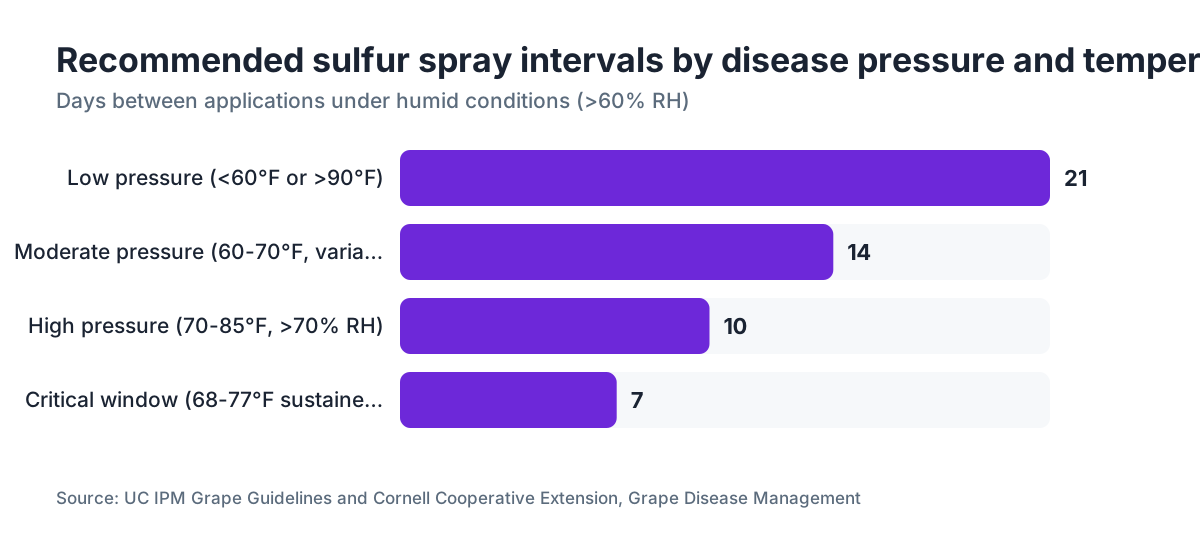
Here is the table most growers actually work from:
| Disease pressure (Gubler-Thomas or equivalent) | Temperature range | Recommended sulfur interval |
|---|---|---|
| Low | Below 60°F or above 90°F | Up to 21 days (or skip) |
| Moderate | 60-70°F, humidity variable | 14 days |
| High | 70-85°F, humidity > 70% | 7-10 days |
| Critical (post-infection period) | 68-77°F sustained, high humidity | 7 days or consider SIs/DMIs |
Those intervals assume wettable sulfur (WS) or dry flowable sulfur at 3-6 lbs/acre with good coverage. Liquid sulfur (52% SC formulations, for example) has a similar residual window but lower rain fastness, which shortens the interval after any rainfall over about 0.5 inches [4].
How does temperature affect sulfur's effectiveness and phytotoxicity risk?
Sulfur works through vapor. The compound volatilizes off the deposit on the leaf, and it's the vapor, not the residue itself, that stops spore germination and hyphal growth. Efficacy and temperature move together: cold conditions slow volatilization and cut protective activity, warm conditions speed it up [1].
Below 50°F, sulfur barely volatilizes. Applications made when the daytime high won't reach 55-60°F give you almost nothing, and you've spent money for nothing.
Above 90°F, sulfur turns into a burn hazard. Volatilization runs so fast that vapor concentrations on leaf surfaces can hit phytotoxic levels, especially with low wind and slow air movement inside a dense canopy. Cornell's extension guidance says phytotoxicity risk climbs sharply when temperatures top 90°F within 24-48 hours of application and advises against spraying sulfur when the forecast shows 90°F or higher in that window [2].
Some varieties burn easier. Concord and other Vitis labrusca types, plus several hybrids including some Catawba selections, show damage at lower temperature thresholds than Vitis vinifera. Read your variety's label guidance.
For a humid coastal region, the summer band between 50 and 90°F is your sulfur zone, and you track both ends. Finger Lakes or North Coast California growers often get a wide, long window. In the San Joaquin Valley, August heat can shut down a sulfur program for weeks.
What is the Gubler-Thomas model and how do you use it for interval timing?
The Gubler-Thomas Powdery Mildew Risk Index came out of Doug Gubler's work at UC Davis and has been the most widely adopted decision tool for California and the western US since the 1990s. It runs on temperature-based rules that assign a risk category to each day, then add up risk over consecutive days.
The core logic: if the temperature reaches 70°F or higher for 6 or more consecutive hours, that day counts toward the index. Three or more such days in a row puts you in the high-risk category. The index resets when temperatures drop below 50°F for extended periods [1].
UC IPM's grape guidelines describe the goal plainly, that the risk index "is used to time fungicide applications more effectively" by matching spray frequency to disease-favorable weather rather than the calendar [1].
You track it by logging hourly temps from your weather station, or by using UC IPM's online tool, or NEWA (Network for Environment and Weather Applications), which Cornell runs and which covers much of the eastern US [8].
When the model puts you in high risk:
- Shorten your interval to 7-10 days
- Confirm your sulfur coverage was complete at the last application
- Check for shoot tips or cluster stems that missed coverage
- Consider a sterol-inhibiting fungicide (SI/DMI) if you're already seeing colonies
When the model reads low risk, you can stretch to 14-21 days. Don't abandon your records, though. A three-day shift in weather flips the index fast. The model is a guide, not an autopilot.
How do you account for infection periods when timing your applications?
An infection period is a block of time when conditions are favorable enough for Erysiphe necator to start new infections. Spotting those periods lets you back-calculate when to spray so the material is present before or right after the infection event.
A practical infection period threshold for powdery mildew is any stretch of 6 or more hours at or above 70°F [1]. That's the Gubler-Thomas criterion. Cornell adds a heat unit layer: after budbreak, they track degree-days above 50°F (base 50) to estimate when primary ascospore release peaks, typically 400-600 degree-days post-budbreak in the Northeast [2].
Once you've flagged an infection period, sulfur needs to be on the vine either before it starts (protectant mode) or within about 24-72 hours after (kickback). Wettable sulfur has limited kickback, maybe 24-48 hours of post-infection activity at best. If you're chasing infection periods instead of staying ahead of them, your interval is too long.
Humidity wrecks the math because it can string infection periods into many consecutive days in spring and early summer. In the Willamette Valley or the Finger Lakes, you can realistically get a 3-week run in June where nearly every day qualifies. A 14-day interval in that run leaves 4-7 days at the tail end with no protection during active infection. That's where the early-season colonies start, and those become your late-season problem.
Log the infection periods in your spray records next to each application. Over a few seasons you build a picture of your site's real risk calendar, which beats any generic regional recommendation.
How much does humidity itself shorten sulfur's residual activity?
Nobody has clean numbers on this, and it's better to say so. The published residual windows for sulfur (usually cited as 10-14 days under dry conditions) come mostly from efficacy trials run in conditions that don't match high-humidity coastal or continental vineyards.
What extension guidance does give us: heavy rain over 0.5-1 inch physically washes sulfur off leaves and resets your protection window [4]. Long stretches of high humidity (above 85-90% RH for 24+ hours) can push sulfur deposits toward polysulfide compounds that lose some biocidal activity, though the effect size is not well quantified in grape-specific literature.
Most experienced growers in humid climates work with a simple assumption: sulfur's effective residual is 7-10 days under their conditions, not 14, and they schedule around that. It's a conservative posture. It's the right one when disease pressure is high.
Rainfall is the cleaner decision point. If you get more than 0.5 inches, consider a reapplication within 3-5 days regardless of where you are in your interval, especially during the 6-8 week post-bloom window when berries are most susceptible [2]. Check the label, because some products carry specific rain re-application language.
A field-level record of rainfall, humidity, and each spray event is what turns this from guesswork into a defensible program. That's what compliance platforms like VitiScribe are built around, logging the conditions alongside each application so you can justify your interval decisions if a regulatory audit or crop insurance claim comes up.
What are the EPA Worker Protection Standard requirements for sulfur applications?
Sulfur is an EPA-registered pesticide, so vineyard applications fall under the Agricultural Worker Protection Standard (WPS), 40 CFR Part 170, with major revisions that took effect January 2017 [5].
The key WPS points for sulfur:
- Restricted-Entry Interval (REI): Most wettable sulfur products carry a 24-hour REI. Some dry flowable formulations state a shorter REI of 4-12 hours when no dust hazard exists. Check the specific label, because the label is the law.
- Application exclusion zone (AEZ): A 100-foot AEZ applies to aerial applications; a 25-foot buffer applies to ground applications with sprayers that are not enclosed-cab when workers or bystanders are present.
- Posting and notification: You post WPS safety information at a central location workers can reach. If the REI runs more than 4 hours, you notify workers of the REI before they enter the treated area.
- Personal Protective Equipment (PPE): Typical label PPE for sulfur includes a long-sleeved shirt, long pants, chemical-resistant gloves, shoes plus socks, and protective eyewear. Some formulations require a NIOSH-approved dust/mist respirator during mixing and loading.
EPA states that the WPS "is aimed at reducing the risk of pesticide poisonings and injuries among agricultural workers and pesticide handlers." [5]
Humid-climate operations spray more often, 7-10 day intervals rather than 14-21, so WPS compliance overhead scales with frequency. More notification events. More REI periods to track. More label-mandated PPE checks. Build that into the season plan.
State rules can be stricter than federal WPS. California's Department of Pesticide Regulation (CDPR) adds record-keeping under the Pesticide Use Report (PUR) system, with specific fields for product, rate, acreage, pest target, and conditions at application [6].
How do you record sulfur spray intervals for compliance purposes?
Every sulfur application in a commercial vineyard needs a paper trail, and in many states the paper trail is legally required. California requires Pesticide Use Reports filed with the county agricultural commissioner within 7 days of application for restricted materials (some sulfur products qualify) and monthly for most others [6]. Other states set their own timelines and formats.
At minimum, a defensible record for each sulfur application includes:
- Date and time of application
- Product name and EPA registration number
- Rate (per acre) and total quantity used
- Acres treated
- Target pest (Erysiphe necator, powdery mildew)
- Applicator name and, where required, license number
- Equipment used
- Environmental conditions: temperature, relative humidity, wind speed and direction
- Days since the last application of the same or a tank-mix partner (this is your interval documentation)
- Post-application notes (visible disease, rain within 24 hours, and so on)
The interval documentation is where small operations fall short. Showing you held a 7-day interval through a high-pressure stretch, or that you extended to 14 days on low Gubler-Thomas readings, is the difference between a defensible record and a guess-and-hope one.
This matters most in two spots. If you sell grapes under a contract that specifies a spray program, your recorded intervals have to match it. And if you're working toward a sustainability certification, several bodies, including SIP (Sustainability in Practice) in California, ask for spray records as audit documentation.
Digital record-keeping platforms built for vineyard compliance, like VitiScribe, can calculate the interval between entries automatically and flag when a new application is overdue based on your documented conditions. That automated check earns its keep when you're managing multiple blocks across a busy spring.
Can you tank-mix sulfur with other fungicides to extend intervals?
Yes. In humid conditions, tank-mixing is one of the better tools for managing interval pressure without just spraying more often.
The common move is alternating or co-applying sulfur with a sterol-inhibiting fungicide (DMI/SI class, FRAC Group 3) such as myclobutanil or tebuconazole, or a QoI like trifloxystrobin (FRAC Group 11). Cornell and WSU both stress rotating FRAC groups to manage resistance, which is a real problem with Erysiphe necator given its documented resistance to several QoI and some DMI fungicides in the eastern US [2][3].
Tank-mixing sulfur with a DMI during a high-pressure period gives you:
- The protectant activity of sulfur (surface residue)
- The systemic and kickback activity of the DMI (up to 72-96 hours post-infection for some products)
- A combined residual that can support a 10-14 day interval even under moderate-to-high humidity
The tradeoff is cost and resistance. DMI fungicides run $30-80 per acre per application depending on product and rate. You don't want them on every spray. Most advisors recommend the same shape of program: sulfur-only at 7-day intervals in the earliest pre-bloom window when pressure is building, a DMI or QoI layered into the highest-risk post-bloom sprays (4-6 weeks after bloom is usually the tightest window), then back to sulfur-only as summer heat and dropping susceptibility allow.
Check the label for compatibility before any tank-mix. Some EC formulations of other pesticides don't mix with wettable sulfur and can cause physical incompatibility or phytotoxicity.
What phenological stages demand the shortest sulfur intervals?
Growth stages don't carry equal risk. Berry infection is only possible during a specific developmental window, and your interval strategy should track that.
The highest-risk window for berry infection runs from just before bloom (about EL stage 17-19) through roughly 3-4 weeks after fruit set (EL stage 29-31), when berries reach about 10mm diameter and the cuticle thickens enough to resist infection [1][7]. During this window, an unprotected berry can be infected in under 6 hours of favorable conditions, and the resulting fruit infection stays invisible until it's too late to stop it spreading through the cluster.
Leaves and shoots are most susceptible on young expanding tissue. Shoot tips and the newest 3-5 leaves stay at risk any time they're expanding, which in a humid, high-nitrogen vineyard can run most of the season.
The phenological priority ranking for interval tightness:
- Pre-bloom through 3-4 weeks post-fruit set: 7-day intervals in humid conditions, no flexibility
- Late shoot growth (after fruit set through veraison): 10-14 days depending on pressure
- Post-veraison: berries lose susceptibility, intervals often extend to 14-21 days
- After harvest: usually no further sulfur unless prepping for next season
The pre-bloom to post-fruit-set window also overlaps peak ascospore release from overwintered chasmothecia, the sexual fruiting bodies in bark and debris. That primary inoculum seeds your season. Missing coverage here costs you for the rest of the year.
How do you adjust sulfur intervals after a missed or delayed application?
It happens. Equipment breaks down, labor isn't there, rain grounds the sprayer for three days. If you've missed your target interval, here's how to think about recovery.
Assess the gap first. A 7-day interval that slipped to 9-10 days in a low-pressure period is a different animal than a 7-day interval that slipped to 12 days during a run of 75°F days at 80% humidity. Check your Gubler-Thomas status for the days you missed.
Inspect the vines before you reapply. Walk a representative sample of shoots and clusters in each block. If you see powdery colonies (the white, talcum-powder look on leaves, or the olive-brown netting on berries), sulfur alone won't cut it anymore. You need a fungicide with kickback, a DMI/SI or a QoI (if your resistance profile supports it), applied within 72-96 hours of visible infection [2].
If you missed the window but see no active disease, spray sulfur as soon as you can and reset the interval from that new date. Don't try to make up the gap by jacking the rate. Exceeding label rates creates burn risk without proportionally better protection.
Document what happened. Record the delay, the reason, the inspection results, and the recovery application. A transparent, auditable record beats one that just shows a 12-day gap with no explanation.
The honest reality: one missed interval rarely causes a season-ending outbreak if you catch it quickly and conditions weren't extreme. Two or three missed intervals during a high-pressure May and June can set up a severe infection you'll fight the rest of the year.
Frequently asked questions
What is the minimum spray interval allowed between sulfur applications?
Most sulfur product labels allow reapplication every 7 days, and some allow shorter intervals under extreme disease pressure, but always check your specific product label first. Going shorter than 7 days rarely improves control and raises phytotoxicity risk, especially if temperatures climb toward 85-90°F. The label sets both the legal minimum and the maximum guidance, and it governs over any general recommendation.
Does rain wash off sulfur and require reapplication?
Rainfall over about 0.5-1 inch can wash a big share of sulfur residue off leaf surfaces and should trigger a reapplication decision, especially during the pre-bloom to post-fruit-set window. Some formulations have better rain fastness than others. Check your product label for specific rainfall re-application language. In humid climates, budget for one or two rain-reset applications per season.
At what temperature does sulfur become phytotoxic to grapevines?
Phytotoxicity risk climbs sharply when temperatures reach 90°F or higher within 24-48 hours of application. Cornell and UC Davis both advise against applying sulfur when the forecast shows 90°F or higher in that window. Some sensitive varieties, including Concord and several hybrids, can burn at lower thresholds, around 85°F. Check your variety's known sensitivity and spray in cooler morning hours when you can.
How do I use the Gubler-Thomas model to set my spray interval?
Track your daily temperatures and flag any day when they reach 70°F or higher for 6+ consecutive hours. Three or more such days in a row puts you in the high-risk category, which calls for a 7-10 day interval. Fewer than three in a row is moderate risk (14 days), and days below 50°F or above 95°F push the index toward low risk (up to 21 days). UC IPM offers a free online tool to run the calculation.
Can I extend sulfur spray intervals by increasing the application rate?
Not effectively, and increasing rates past label maximums is illegal. A higher rate doesn't proportionally extend residual activity; it mostly raises phytotoxicity risk. The better way to stretch intervals in high-pressure conditions is to tank-mix sulfur with a systemic fungicide (DMI/FRAC 3 or QoI/FRAC 11) that adds kickback activity, giving you a longer post-infection window. Keep rates within label guidelines.
What spray records do I need to keep for sulfur applications under California law?
California growers file Pesticide Use Reports (PUR) with their county agricultural commissioner. Required data includes application date, product name and EPA registration number, pest targeted, rate, acres treated, applicator name and license number, and environmental conditions. Reports for most materials are due monthly. Some restricted materials require filing within 7 days. Keep copies on-site per CDPR requirements.
Is wettable sulfur or liquid sulfur better for humid conditions?
Both work. Wettable sulfur (WS) and dry flowable (DF) formulations tend to have slightly better rainfastness and surface adhesion than liquid SC formulations. In very humid conditions with frequent rain, some growers prefer WS or DF for that reason. Liquid formulations mix more easily and cut dust exposure during mixing. Efficacy is comparable at equivalent rates with good coverage. Choose based on your equipment and mixing preferences.
How does canopy density affect sulfur spray intervals in humid vineyards?
Dense canopies trap humidity, slow drying, and create microclimates far more favorable to mildew than open-canopy blocks. They also reduce spray penetration and coverage. In a dense, humid canopy, assume your effective interval sits at the short end of any recommended range, probably 7-10 days regardless of the regional average. Canopy management, hedging and leaf pulling, is one of the best tools for making a spray program actually work.
When during the season can I safely extend sulfur spray intervals to 21 days?
After veraison, berry susceptibility drops sharply and mildew pressure often eases as daytime temperatures swing wider. If the Gubler-Thomas index is low and you're past veraison with clean fruit, a 21-day interval or even suspending the sulfur program is reasonable. Pre-bloom and the 3-4 weeks right after fruit set are the windows where a 21-day interval is never appropriate in humid climates.
Does organic certification change how I calculate sulfur spray intervals?
No, organic certification doesn't require shorter intervals. Sulfur is approved for use in certified organic vineyards under USDA NOP rules (7 CFR Part 205), and the same temperature, disease pressure, and phenological logic applies. Your certifier will want spray records that document applications, rates, and conditions. The Gubler-Thomas or similar models are fully compatible with an organic program.
How do I handle sulfur spray intervals during an extended wet spring?
An extended wet spring often means daily or near-daily infection periods for weeks. In that case, a 7-day interval is your floor, not your ceiling. Inspect vines mid-interval after any multi-day rain event. If you see colonies establishing, pull the next application forward and add a DMI or QoI with kickback. Prioritize coverage of shoot tips and cluster stems, the most susceptible tissue during that period.
What is the pre-harvest interval (PHI) for sulfur on wine grapes?
Most wettable and liquid sulfur formulations have a pre-harvest interval of 0 days for grapes, meaning you can apply up to the day of harvest. But sulfur residue on fruit can affect fermentation and produce hydrogen sulfide off-flavors. Most winemakers prefer no sulfur within 2-3 weeks of harvest for that sensory reason, which is a practical rather than a legal restriction. Always verify the specific product label PHI.
How does variety susceptibility affect sulfur interval decisions?
Highly susceptible varieties like Chardonnay, Cabernet Sauvignon, and Merlot need tighter intervals during high-pressure periods than more resistant varieties like Riesling or some interspecific hybrids. Cornell's powdery mildew susceptibility ratings list Chardonnay and Cabernet Franc as highly susceptible, which in practice means defaulting to the short end of the recommended range during any high-risk period rather than waiting to see pressure develop.
Sources
- UC IPM, University of California, Powdery Mildew in Grapes Pest Management Guidelines: Gubler-Thomas model thresholds, 7-14 day interval recommendations, and 50-90°F efficacy window for sulfur in California wine grapes
- Cornell Cooperative Extension, Grape Disease Management guidelines: 7-day intervals during high-pressure periods, 90°F phytotoxicity threshold, post-infection activity windows, and degree-day tracking for the northeastern US
- Washington State University Extension, Grape Powdery Mildew Management: Gubler-Thomas index used as decision engine; 7-10 day intervals at high index, 14 days at moderate, up to 21 at low; FRAC group rotation for resistance
- UC Davis Department of Plant Pathology: Rain events over 0.5-1 inch can remove significant sulfur deposits and reset the protection window
- US EPA, Agricultural Worker Protection Standard (WPS), 40 CFR Part 170: Federal WPS requirements including REI, application exclusion zones, posting, and PPE for pesticide applications including sulfur in agricultural settings
- California Department of Pesticide Regulation, Pesticide Use Reporting (PUR): California PUR requirements: required data fields, monthly filing deadline, and 7-day requirement for restricted materials
- UC Davis Viticulture & Enology, Eichhorn-Lorenz (EL) Grapevine Growth Stage Descriptions: Berry susceptibility to powdery mildew peaks between EL stage 17 and EL stage 29-31, approximately 3-4 weeks post-fruit-set
- Cornell NEWA (Network for Environment and Weather Applications): NEWA provides real-time degree-day and disease risk calculations for the eastern US, including powdery mildew risk models for grapes
- USDA National Organic Program, 7 CFR Part 205: Sulfur is approved for use in certified organic production under USDA NOP regulations
- UC IPM, Grape Pest Management, Powdery Mildew Biology and Epidemiology: Erysiphe necator can complete an infection cycle in 6-7 days at 68-77°F and high humidity; conidia survive longer above 60% RH
Last updated 2026-07-11