Documenting spray applications on trellised versus head-trained vines

TL;DR
- EPA's Worker Protection Standard and most state pesticide laws require the same core record fields no matter how your vines are trained.
- Canopy shape changes what you log for application method, equipment, and target.
- Head-trained vines often need different nozzles, higher water volumes, and multiple passes than trellised vines, and each of those differences has to show up explicitly in your records to survive an audit.
What do spray records actually need to include under federal law?
The EPA Worker Protection Standard (40 CFR Part 170) doesn't care whether your vines sit on a VSP trellis or a gobelet head on a windswept hillside. The required fields are identical either way: product name, EPA registration number, active ingredient, crop treated, location, date and time, application rate, total amount applied, and the name of the certified applicator or the person who made the application. [1]
California's Department of Pesticide Regulation adds more. You log the precise field location using a county-required geographic identifier, the start and end times, the equipment type, and the pest targeted. [2] Washington and New York run similar lists through their own reporting rules. The federal floor is the floor. Your state almost certainly builds on top of it.
One field does change with training system, even federally: application method. Airblasting with a tower sprayer dialed for an open VSP canopy is a different act than working a hand gun around a dense gobelet head. That distinction belongs in the record. An auditor who reads "airblast sprayer" with no further detail on a block of head-trained Grenache will ask follow-up questions. You want the answers already on paper.
How does trellis training change what you need to document compared to head-trained vines?
Trellised vines spread canopy predictably. VSP, Scott Henry, high-wire Geneva Double Curtain, they all lay tissue across a defined wall or curtain. You can measure canopy height and width with real consistency across the block, so your nozzle pressure, ground speed, and dilute volume per acre hold steady row to row. That makes life easier in one specific way: a single application entry can honestly cover a whole uniform block, provided nothing changed mid-application.
Head-trained vines break that assumption. The canopy is a three-dimensional globe on a short trunk, and vine-to-vine variation in canopy volume runs far wider than in a trellised block. UC Davis extension notes that effective coverage in head-trained systems often needs multiple passes or hand application to reach interior wood and clusters. [3] Two passes at two pressures, or a switch from airblast to hand gun for finish work, means two separate entries. Not one.
Here's the whole difference in a sentence: trellised blocks let you record one uniform application event, and head-trained blocks routinely generate several sub-events in a single day that each need their own line. Missing that split is the most common compliance gap I see. It's also the one most likely to bite if a re-entry interval dispute ever comes up with a worker or a regulator.
Trellised blocks have their own note worth adding: canopy orientation. A VSP block with north-south rows gets very different spray interception on east versus west passes, especially with contact fungicides. That's worth a line in your notes field. It isn't legally required. It's the kind of detail that proves you knew what you were doing when the sprayer was running.
What application method and equipment details matter most in your spray log?
Write the equipment description so a stranger could rebuild your application from scratch. "Sprayer" fails that test. "600-gallon Munckhof airblast, TeeJet hollow-cone nozzles, 150 PSI, 2.5 mph ground speed, 100 GPA" passes it. That detail earns its keep two ways.
First, it lets anyone check whether you actually hit the label rate. If a fungicide label allows 50 to 100 gallons per acre and your log shows 100 GPA at a stated concentration, the math is verifiable by anyone. "Airblast sprayer" alone verifies nothing. [4]
Second, for head-trained vines, the equipment note explains why your per-acre water volume runs higher than a neighbor's trellised block. Head-trained systems routinely run 150 to 200-plus GPA on a dilute basis to reach equivalent coverage, against 75 to 125 GPA for a tight VSP wall. [3] Without that context in the record, the higher water rate reads like a calibration error or an over-application to an outside reviewer.
For trellised systems, note how many nozzles were active per side, whether you sprayed one side or both at once, and whether any nozzles were shut off for a given pass. These entries take thirty seconds. They answer about half the follow-up questions regulators raise during an inspection.
How do canopy volume and vine spacing affect rate calculations you have to record?
Pesticide labels express rates in pounds or fluid ounces of product per acre, or sometimes per 100 gallons of water. None of those units account for canopy volume. But your real risk of under- or over-application, and your liability if coverage fails or residues run high, ties directly to how much green tissue and fruit surface that acre holds.
The Tree Row Volume (TRV) method, which WSU and Cornell extension both describe in their calibration guides, scales the label rate to canopy volume instead of flat acreage. [5][6] The math: TRV equals row spacing (feet) times canopy height (feet) times canopy width (feet), divided by 43,560. You then express your actual spray volume against the TRV-calibrated dilute volume and log a correction factor.
Head-trained vines carry a TRV wrinkle trellised vines don't. Canopy geometry varies vine to vine, so you measure a representative sample, usually ten to twenty vines per block, and average them. Your record should note the average TRV used and how many vines went into the sample. That one line defends every rate decision you made in that block all season.
Log these four fields every time: row spacing, measured canopy height and width (or average TRV for head-trained), actual spray volume applied, and product concentration. With those four numbers, you or an auditor can rebuild your effective rate per unit of canopy. Without them, you're leaning on per-acre figures that may or may not reflect what the vine actually caught.
What's the minimum a spray record needs to show for re-entry interval compliance?
The re-entry interval clock starts when the application ends, not when it starts, and not at the start of the day. [1] Obvious, maybe, but it means your record has to carry an application end time, more than a date. A record that says "June 14" with no time is legally insufficient for REI purposes under the WPS.
For trellised blocks, end time is simple. You finish the last row, note the time, done. For head-trained blocks where you ran a primary airblast pass and then a hand-gun follow-up, the REI clock for any field worker starts at the end of the hand-gun pass, because that's the true end of the application. Both passes need timestamps. The later one governs access.
The WPS also requires the application information to be posted at the central location or field office within 24 hours of the application ending, and to stay posted for 30 days after the REI expires. [1] The posted notice must include product name, active ingredient, REI, and the location of treated areas. On farms with both training types, posting has to be clear about which blocks got treated. A worker who skips a trellised block and walks into an adjacent head-trained block gains nothing from knowing the REI for the wrong block.
The EPA's revised WPS, effective for most requirements in 2017, added a rule that employers record the application information in a format workers and their designated representatives can access on request. [1] So your log, or a clean extract from it, has to be legible and organized by field location in a way a non-specialist worker can actually read.
How should you handle block maps and location descriptions in your spray records?
A description like "East Vineyard Block 4" works fine for internal filing and means nothing to a state inspector who's never set foot on your farm. Most state reporting laws require a field or site description a third party can locate. In California, that means Township, Range, and Section, or an APN. In Washington, the WSDA wants the county and a description sufficient to locate the site. [7]
For farms running both training systems, keep a block map that flags training type per block as a companion to your log. It's not legally required in most states. But when an auditor asks why Block 4 used 150 GPA and Block 7 used 90 GPA with the same product on the same day, a map reading "Block 4: head-trained Grenache, Block 7: VSP Cabernet" answers in three seconds instead of fifteen minutes.
GPS coordinates or GIS shapefiles show up more and more in spray record systems, and they're a good idea if you have the infrastructure. They kill all ambiguity about location and make the state-required site description fields easy to generate. Some platforms built for vineyard compliance, like VitiScribe, attach GPS-defined block boundaries straight to each spray entry, so the location field is always correct and always auditable.
For mixed-training farms, add a one-line training note to every block entry. "VSP, bilateral cordon" or "head-trained, own-rooted" takes five seconds and clears out a whole category of follow-up questions.
Does the type of spray equipment change the record-keeping requirements?
The legal answer is no. A spray is a spray under the WPS, whether you used a tractor-mounted airblast, a backpack, or a drone. The required fields hold constant. The practical answer is yes, because different equipment carries different compliance risks and different documentation gaps.
Airblast sprayers on trellised blocks are the easiest to document, because speed, pressure, and output stay mechanically consistent. A calibration sheet run before the season, referenced in your log, gives you a defensible per-acre rate. For head-trained vines with an airblast, you need that same sheet plus a note on any adjustments made for vine density or canopy volume, because settings tuned for a trellis wall will almost certainly under-apply or over-apply on a dense gobelet head.
Drone application is still a small slice of vineyard spray volume nationally, but it's growing and the paperwork is stricter. FAA Part 137 certification is required for aerial pesticide application, and the records have to meet both FAA and EPA standards. [8] The FAA wants a record of each aerial application including aircraft N-number, pilot certificate number, date, location, and product applied. Those records sit separate from, and in addition to, your WPS pesticide application records.
Hand-gun or backpack work in head-trained blocks needs total volume applied and area covered. If one person spent three hours with a backpack on a one-acre head-trained block, log the hours, the number of tank refills, and the total product mixed. That's how you rebuild the effective rate if anyone ever asks.
What records do you need to keep, and for how long?
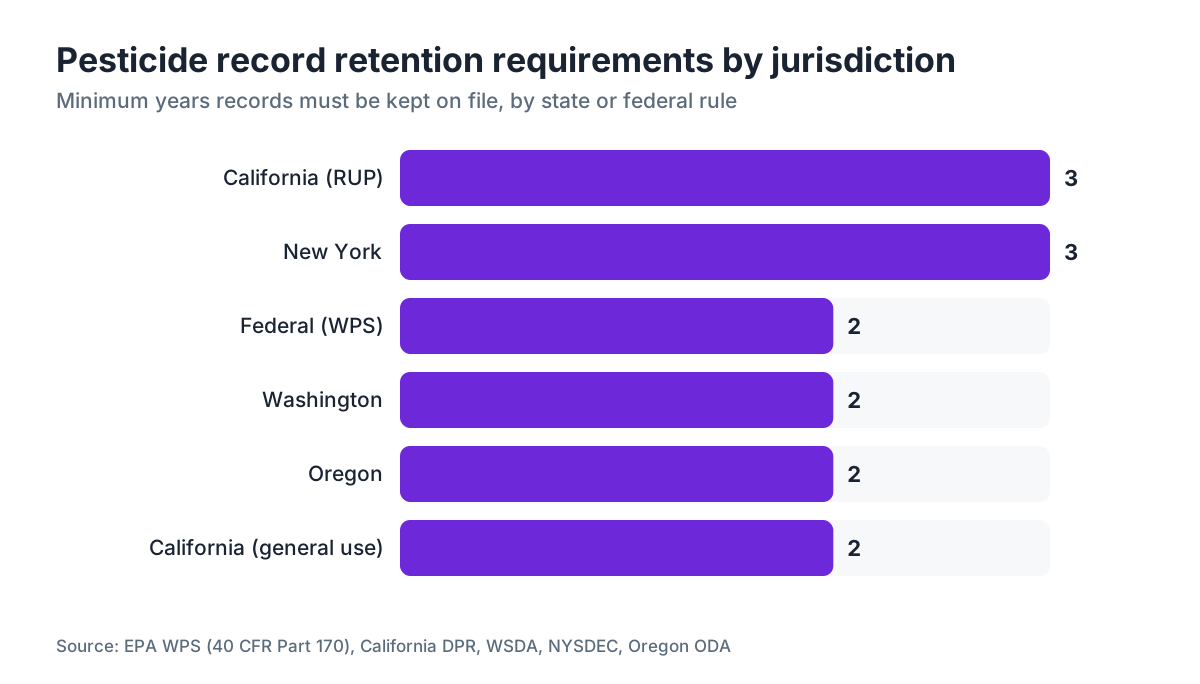
Under the WPS, pesticide application records must be kept for two years from the date of application. [1] That's the federal floor. California requires three years for restricted-use pesticide records and two years for general-use records, submitted monthly to the county agricultural commissioner. [2] Washington requires two years. New York requires three. [9] If you sell fruit to a winery whose farming contract or sustainability program demands longer retention, their requirement beats the legal minimum.
Format doesn't matter federally, paper or digital, as long as the records are legible, organized, and accessible. What matters is that you can produce them during an inspection. "It's in the truck" and "my agronomist has it" are not acceptable answers in the field. Records need to be at the farm or retrievable fast, and most state agencies read "reasonable" as same-day.
For mixed-training farms, organize records by block instead of by date. A date-organized log for a farm with eight blocks across four training systems forces an auditor to flip every page to find one block's entries. A block-organized log lets them pull one section. Same information, but block organization signals competence, shortens the inspection, and tends to lower scrutiny.
| Jurisdiction | Required retention period | Submission required? |
|---|---|---|
| Federal (WPS) | 2 years | No, records on request |
| California | 3 years (RUP), 2 years (general use) | Yes, monthly to county |
| Washington | 2 years | Yes, annually to WSDA |
| New York | 3 years | Yes, annually to NYSDA |
| Oregon | 2 years | No, records on request |
How do sustainability certifications change spray documentation requirements?
Programs like CCOF organic certification, SIP Certified, Lodi Rules, and LIVE (Oregon and Washington) each stack requirements on top of state law. [10] The common additions: recording the pest pressure that justified the spray decision (more than what you sprayed), logging weather at application time, and noting the efficacy outcome at a follow-up scouting visit.
For head-trained vines, weather and canopy-condition notes carry more weight than on trellised systems. A head-trained canopy closes faster and holds more humidity inside the cluster zone, which shifts fungicide timing in ways worth writing down. Spray Botrytis fungicide on a head-trained Grenache block at 70 percent bunch closure with high humidity and bunch compaction noted, and you have a defensible decision. "Applied per schedule" is not defensible, especially under a program that requires IPM justification.
SIP Certified's standards, for one, require records to include the pest or disease threshold that triggered the decision and the scouting data behind it. [10] Lodi Rules requires a farm plan with pest management decision points documented. Neither is WPS or state law. But a certification audit pulls the same records as a regulatory inspection, and a gap in one shows up in both.
What's the most practical system for keeping these records accurate in the field?
Paper logs still work and regulators accept them. They fail one consistent way: the person who ran the sprayer rarely fills out the log right after finishing. By the time they're back in the office, the end time is a guess, the exact rate is approximate, and the nozzle settings from that one adjusted pass on the head-trained block are gone. That's where most compliance gaps come from. Not fraud, not negligence. Normal human memory working normally.
The fix is to shrink the memory gap. A clipboard on the sprayer cab, or a phone voice memo capturing the end time and any mid-application adjustments, is enough. Transcribe the formal log that afternoon from the memo or clipboard. For farms with more than three or four blocks, a digital system that timestamps entries at creation, like VitiScribe, removes the memory problem entirely, because the timestamp is baked in the moment you tap the entry.
For mixed-training blocks, build a checklist into your process that includes training system as a field. If you're on paper, pre-print log sheets with a block header that names the training type, so whoever fills it out gets reminded to note any adjustment made for that canopy. Pre-printing takes twenty minutes at the start of the season and saves hours of reconstruction later.
WSU Extension's calibration guide recommends a full calibration check at the start of each season and after any nozzle replacement, and keeping that sheet as part of the spray record file. [5] That sheet is the foundation document. Without it, all your volume and rate entries are unverified numbers. With it, they're defensible calculations.
What are the most common spray record mistakes specific to vineyards?
Missing end times top the list, as covered above. Second most common is recording the label rate as the applied rate without showing the calculation that ties them together. If the label reads 4 fl oz per 100 gallons and you applied 120 gallons per acre, your applied rate is 4.8 fl oz per acre. Log that number, not "per label."
For head-trained blocks, the next common mistake is treating a multi-pass application as one entry. A pass at 7 AM and a hand-gun follow-up at 11 AM are two entries with two start times and two end times. The REI starts at 11 AM, not 7 AM.
A third mistake is leaving the pest-targeted field generic. "Fungal disease" tells you far less than "Botrytis cinerea, pre-bunch closure," both for your own record and for any program requiring IPM documentation. Cornell's integrated crop and pest management program stresses that decision-based documentation (what pest, what threshold, what you observed) is what separates a real pest management program from a spray schedule with extra paperwork. [6]
For restricted-use pesticides, the certified applicator's license number has to appear in the record, more than their name. This is a federal requirement, and it's one of the first things a state inspector checks. A record listing "John Smith" with no license number for a restricted-use application fails on its face.
Frequently asked questions
Do I need a separate spray record for each vineyard block, or can I combine blocks on one entry?
You can combine blocks in one entry only if the same product, rate, equipment settings, and application method applied equally to all of them. Change anything between blocks, like nozzle pressure moving from a trellised block to a head-trained block, and those need separate entries. Combining dissimilar applications into one line is the record-keeping version of rounding down your field work, and it doesn't hold up under audit.
What's the difference between a pesticide use report and a spray record?
In California, a Pesticide Use Report (PUR) is the monthly submission to your county agricultural commissioner, and it's a legal reporting requirement for any pesticide application. A spray record is the internal working document you keep on the farm. The PUR data comes from your spray records, but the two are separate documents. Most states outside California don't require PUR-style submission, only record maintenance available on request.
Can spray records be kept digitally, or does the EPA require paper?
Digital records are fully acceptable under the WPS and nearly all state pesticide laws. The requirement is that records be legible, retrievable, and producible during an inspection. A spreadsheet, a purpose-built farm management app, or a PDF in the cloud all qualify, as long as you can print or display them the same day they're requested. Back up your digital records off-site.
How does head-training affect my water volume calculation for record-keeping purposes?
Head-trained vines usually hold more canopy volume per vine than trellised vines at the same row spacing, so the same label rate at a standard 100 GPA can under-cover a dense gobelet head. Use the Tree Row Volume method to calculate a calibrated dilute volume, then log both your TRV and your actual spray volume. That two-number entry shows an auditor your rate was intentional and calculated, not arbitrary.
What does the EPA Worker Protection Standard actually require me to post about spray applications?
Under 40 CFR Part 170, you post at the central location or on a field warning sign: product name, active ingredient, location of treated area, date and time of application, and the re-entry interval. Posting must happen within 24 hours of application end and stay posted for 30 days after the REI expires. If the REI runs longer than 48 hours, posting is required even when no workers will enter.
Does my spray record need to include the reason I chose to spray (pest scouting data)?
Under federal law and most state pesticide laws, no. The required fields are product, rate, location, date, and applicator, not the justification. But if you're in any sustainability certification (SIP, Lodi Rules, LIVE, CCOF), those programs typically require IPM decision documentation including pest thresholds and scouting observations. Practically, having the reason on record protects you if a worker or neighbor ever questions whether an application was necessary.
If I hire a PCA or pest control adviser to make spray recommendations, does that change my record-keeping obligations?
No, your obligations stay the same. The grower or farm operator is responsible for maintaining spray records regardless of who recommended the product or who applied it. In California, a licensed PCA must provide a written recommendation for restricted-use pesticides, and that recommendation is part of your supporting documentation, but it doesn't replace the required application record fields.
How do I document a spray application made by a labor contractor rather than my own employees?
The certified applicator or licensed operator who made the application must appear in the record with their license number, regardless of whose payroll they're on. Get a copy of the applicator's license before the season starts and keep it on file. The WPS assigns joint responsibility to both the agricultural employer (you) and the handler employer (contractor) for application records. Don't assume the contractor is filing the record. Confirm it in writing before the season.
What should I do if I made an error in a spray record after the fact?
Correct errors with a single line through the wrong entry, write the correct information nearby, and initial and date the correction. Never use white-out or delete a digital entry without leaving an audit trail. Falsifying pesticide application records is a federal violation under FIFRA, and regulators treat over-corrected or suspiciously clean records as a red flag. Honest errors happen. The correction method is what shows good faith.
Does the type of pesticide (organic vs. synthetic) change what I need to record?
The required record fields are the same for organic-listed and synthetic pesticides. The difference is that restricted-use pesticides, organic or synthetic, require a certified applicator and trigger stricter state reporting in most jurisdictions. Under organic certification, you also document that the product is on the approved materials list and, in many programs, why a non-chemical option wasn't enough. The chemistry changes the program requirements, not the base record fields.
How do I calculate and record the REI for a block where I sprayed both head-trained and trellised sections on the same day?
The REI applies per treated area. If your head-trained block finished at noon and your trellised block finished at 3 PM, those are two separate REI start times for two separate areas. Post or log each treated area with its own end time. If a single pass covered both block types without stopping, the end time of the full application governs both, but document which block types were included so a worker can tell whether their destination block was treated.
Are there any exceptions to spray record requirements for very small vineyard operations?
The WPS applies to any agricultural establishment that uses pesticides and has workers or handlers, with very limited exceptions. Farms that use only general-use pesticides and have no outside workers aren't covered by the WPS, but may still fall under state pesticide record requirements. California has no acreage exception: any commercial pesticide application requires a record. Check your state's ag commissioner or department of agriculture for the specific threshold, because it varies.
Sources
- EPA, Worker Protection Standard (40 CFR Part 170): WPS requires records of product name, EPA reg number, active ingredient, crop, location, date, rate, amount applied, and applicator identity; records must be kept 2 years and posted within 24 hours of application end.
- California DPR, Pesticide Use Reporting: California requires monthly Pesticide Use Reports submitted to the county agricultural commissioner, with records retained 3 years for restricted-use pesticides.
- UC Agriculture and Natural Resources, Cooperative Extension (spray application technology in vineyards): Effective coverage in head-trained systems often requires multiple spray passes or hand-application to reach interior wood and clusters; head-trained systems routinely require higher water volumes per acre to achieve equivalent coverage.
- EPA, Pesticide Registration and FIFRA Label Requirements: The pesticide label is a legal document; application outside label rate ranges constitutes a federal violation of FIFRA.
- WSU Extension (spray calibration for vineyards): WSU recommends the Tree Row Volume method for scaling spray rates to canopy volume in vineyards, and advises full calibration checks at the start of each season and after nozzle replacement.
- Cornell CALS, New York State Integrated Pest Management Program: Cornell's IPM program emphasizes decision-based documentation, including pest identification, threshold reached, and scouting observation, as distinguishing a genuine IPM program from a spray schedule.
- Washington State Department of Agriculture, Pesticide Recordkeeping: WSDA requires pesticide application records that include the county and a site description sufficient to locate the treated area, retained for two years.
- FAA, Part 137 Agricultural Aircraft Operations: FAA Part 137 requires aerial pesticide applicators to hold a certificate and to record each application including aircraft N-number, pilot certificate number, date, location, and product applied.
- New York State Department of Environmental Conservation, Pesticide Recordkeeping and Reporting: New York requires commercial pesticide applicators to keep application records for three years and to report annually to the state.
- SIP Certified, Sustainability in Practice Standards: SIP Certified standards require spray records to include the pest or disease threshold that triggered the application decision and the scouting data supporting it.
Last updated 2026-07-09