How to calculate spray interval days between sulfur applications on grapevines

TL;DR
- Sulfur spray intervals on grapevines come down to three things: disease pressure (from powdery mildew forecasting tools), the temperature at application (never spray above 90°F, or within two days of that forecast), and the label's re-entry interval.
- A working baseline is 10 to 14 days under moderate pressure, tightened to 7 days when weather and vine growth favor fast mildew spread.
What actually determines the days between sulfur sprays?
Three things set your interval, and only one of them is the calendar. The first is disease pressure, which shifts week to week with temperature, humidity, and vine growth stage. The second is your product label, a federal legal document that sets a minimum re-entry interval (REI) and often a cap on applications per season. The third is temperature, because sulfur volatilizes into phytotoxic sulfur dioxide above roughly 90°F (32°C) [1], and a badly timed spray can scorch your canopy worse than powdery mildew ever would.
The calendar rule you've heard is 10 to 14 days. That range comes from extension guidance, not from any label requirement, and it assumes moderate disease pressure and normal seasonal temperatures. It's a fine default. It's not a ceiling. In a cool, wet spring with susceptible varieties like Chardonnay or Muscat during rapid shoot elongation, UC Davis and UC Cooperative Extension recommend compressing that interval to 7 days [2].
So here's the honest answer. Your interval is a sliding number between 7 and 21 days, and you calculate it fresh every time you close a spray record.
How do powdery mildew forecasting models change the interval calculation?
Forecasting tools turn temperature and leaf wetness data into an infection risk score so you're working from something better than a hunch. The two most used models are the UC Davis Powdery Mildew Risk Index (the Gubler-Thomas model) and the NEWA tool (Network for Environment and Weather Applications) run through Cornell Cooperative Extension [3].
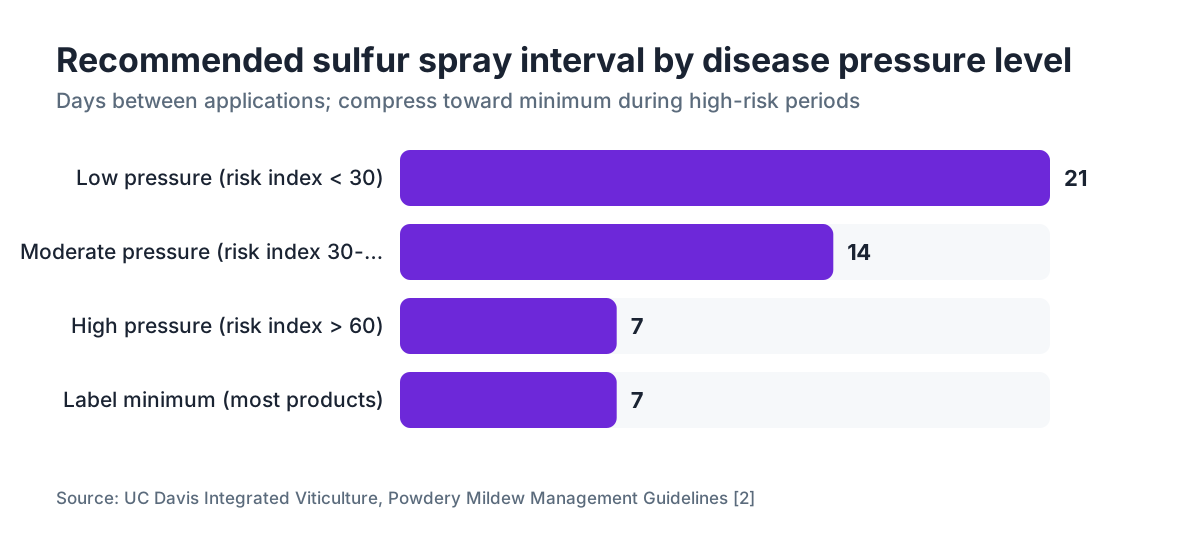
The UC risk index runs on a 0 to 100 scale. Below 30 means low risk and supports the longer 14-day interval. Between 30 and 60 puts you in moderate territory, where 10 days is right. Above 60, the model is telling you conditions are ripe for an epidemic, and a 7-day interval (or a tank-mix with a systemic fungicide) is warranted [2]. Cornell's NEWA tool outputs similar risk categories for New York and the Northeast, and WSU's weather network feeds real-time data to Washington growers running the same kind of math [4].
None of these models are magic. They're built on historical pathogen behavior, and a late-season heat spike or an odd rain pattern can push actual risk past what the model saw coming. Even so, growers who ignore the models and spray on pure calendar timing tend to over-spray in cool dry years or get caught short in warm humid ones. A basic degree-day approach beats eyeballing it almost every time.
Want a starting point without a full weather station? The UC Davis Integrated Viticulture site keeps current risk index maps for California counties through the growing season [2].
What is the minimum interval the sulfur label actually requires?
This is where growers trip. The label is the law under FIFRA (the Federal Insecticide, Fungicide, and Rodenticide Act), and it beats any extension recommendation or your own field read [5].
Most wettable sulfur and liquid sulfur labels allow applications every 7 days when pressure is high. Some say 'as needed' with no stated minimum, which drops the decision back on you. What every label does state is a maximum number of applications per season and a pre-harvest interval (PHI). For elemental sulfur on grapes, the PHI reads as 'do not apply within X days of harvest,' and that number moves by product. Common values are 3, 7, or 10 days, so read yours before you build a late-season schedule [6].
The EPA Worker Protection Standard sets the sulfur re-entry interval at 24 hours for most formulations, meaning workers can't enter the treated block without PPE for that window [7]. A 24-hour REI is shorter than your spray interval in nearly every case, so it rarely squeezes your schedule. You still document it, because a WPS audit will ask.
Keep a table like this posted in the spray shed:
| Risk Condition | Recommended Interval | Label Minimum (typical) | Notes |
|---|---|---|---|
| Low (dry, cool) | 14-21 days | 7 days | Can stretch; watch growth rate |
| Moderate | 10-14 days | 7 days | Standard program |
| High (warm, humid, rapid growth) | 7 days | 7 days | Consider adding a systemic |
| PHI window | None (stop) | 3-10 days pre-harvest | Label-dependent |
Why does temperature matter so much for timing sulfur applications?
Sulfur works by volatilizing. At the right temperature, elemental or wettable sulfur particles release sulfur dioxide vapor that kills powdery mildew spores on contact. The trouble is that the same process that makes sulfur work turns it phytotoxic once it gets too hot.
The widely cited danger line is 90°F (32°C) [1]. Above that, sulfur volatilizes so fast it can cause severe leaf burn, shoot tip dieback, and berry russet. Some sources drop the safe ceiling to 85°F for sensitive varieties, and UC Davis names Concord, Sultana, and a handful of other cultivars as lower-tolerance [2]. In practice, if temperatures will hit 90°F or above within 24 to 48 hours of your planned spray, you postpone.
The flip side is real too. Sulfur underperforms when it's cold. Below about 60°F (15°C), volatilization slows enough that sulfur loses most of its eradicant punch and works mainly as a protectant. That matters for your interval, because a week of cool weather after an application means your effective coverage window is shorter than 7 days, not longer.
So the working checklist for each spray decision is: (1) check your forecasting model score, (2) check the 48 to 72 hour temperature forecast, (3) confirm you're past the REI from the last spray, and (4) confirm you're still inside the label's pre-harvest window. All four have to clear before you spray.
How does vine growth stage affect how often you need to spray?
Powdery mildew risk isn't flat across the season. The highest-risk window for bunch grapes runs from budbreak to about 6 to 8 weeks post-bloom, roughly from 1-inch shoot to pea-size berry [2][3]. During that stretch, the vine is pushing new tissue faster than any spray program can fully cover, and newly emerged leaves and flower clusters have basically no natural resistance.
That growth-rate effect is what forces the 7-day interval in spring even when the weather data looks calm. A vine growing an inch of new shoot per day (common on vigorous sites in warm springs) is making unprotected tissue nonstop. A 14-day interval leaves two full weeks of new growth with no sulfur on the tips.
After veraison, the picture flips. Berries build a waxy bloom and higher sugar that the fungus finds unfriendly, and shoot elongation mostly stops. Most programs back off to 14 to 21 days post-veraison, assuming the earlier season went well. WSU Extension's disease management guidance for Washington growers recommends the same kind of seasonal timing shift [4].
You can track this with a phenology calendar, but growing degree days (GDD) is the more reliable method. Most extension programs use a base temperature of 50°F (10°C) for grapevine phenology. Growers running estate vineyard blocks or working near Paso Robles wineries have started pulling local weather station GDD logs straight into their spray record systems, which makes the interval calculation far easier to defend in an audit.
What is the step-by-step calculation process for a spray interval decision?
Here's the process, in plain terms.
Step 1: Pull the date of your last sulfur application from your records. Count the days elapsed.
Step 2: Check your disease forecasting model. In California, use the UC Davis Integrated Viticulture risk index. In the Northeast, check Cornell's NEWA. In the Pacific Northwest, use WSU's resources or a private weather service covering your county [2][3][4].
Step 3: Look at the 72-hour temperature forecast for your site. If any day in that window hits 90°F or higher, plan around it. Either spray today (if your REI has cleared and you're at or past your minimum interval) or wait for the heat to break.
Step 4: Match the interval to the risk level. Low: hold at 14 days. Moderate: target 10 to 12 days. High: go at 7 days.
Step 5: Confirm the label permits the application. Check you haven't hit the max applications per season, and check you're outside the pre-harvest interval if you're within 3 to 4 weeks of harvest.
Step 6: Record everything before you spray, not after. Date, product, rate, water volume, temperature at application, wind speed, target pest, and REI expiration. This is exactly what WPS auditors check, and it's what protects you if a drift or damage complaint lands [7].
A digital spray record system like VitiScribe can handle steps 1, 2, and 5 for you by logging prior applications and flagging interval conflicts. That pays off most when you're running several blocks under different programs.
How do you adjust the interval when mixing sulfur with other fungicides?
Tank-mixing sulfur with systemic fungicides (DMI products like myclobutanil, or SDHI and strobilurin partners) is common and usually stretches your effective coverage. The systemic partner brings curative activity and longer residual, so you can often push the interval to 12 to 14 days even during moderate-to-high pressure without giving up ground [6].
The catch is resistance. Lean too hard on systemics and you build resistance pressure fast. UC Cooperative Extension and most integrated pest management guidelines put sulfur at the base of the program, with systemics rotated in rather than used back-to-back in every tank [2]. A mix every other spray is reasonable on high-pressure years.
Never mix sulfur with oil-based products (horticultural oils or neem oil). That combination raises phytotoxicity risk sharply. Most labels require at least a 14-day gap between an oil application and a sulfur application, and some say 21. Order matters too: oil after sulfur is generally riskier than sulfur after oil [6].
Mixing sulfur with copper (common in organic programs) carries no real phytotoxicity interaction, but copper REIs can run longer (often 24 to 48 hours). When you tank-mix, your combined REI is the longest one among the products in the tank.
What do WPS and state regulations require you to document for each sulfur spray?
The EPA Worker Protection Standard at 40 CFR Part 170 requires agricultural employers to keep records of all pesticide applications and make them available to workers and handlers [7]. For each sulfur application you need the product name and EPA registration number, the date and time, the treated area location (block ID or field description), the amount applied, and the REI with a 'do not enter' notice posted at the field entry.
Most states stack their own rules on top. California's Department of Pesticide Regulation requires licensed pest control advisers (PCAs) to write a recommendation before commercial applications, and growers file pesticide use reports with their county agricultural commissioner [8]. The Washington State Department of Agriculture keeps its own record requirements under state pesticide law [9].
Federal record retention under FIFRA is 2 years. California requires 3. When you calculate a spray interval off your records, that multi-year archive is what lets you look back at a block's history and see whether you keep hitting the same late-season pressure problem every year.
Want to see what a compliant record form looks like? Both UC Cooperative Extension [2] and Cornell Cooperative Extension [3] publish sample templates you can download.
Does the sulfur formulation (wettable vs. liquid vs. dust) change the interval?
Formulation changes your application technique and canopy coverage more than it changes the interval math. Wettable sulfur (WS) and dry flowable (DF) give you better coverage control with standard equipment. Liquid sulfur (flowable or suspension concentrate) mixes easier and meters more evenly through modern rate controllers.
Sulfur dust is the oldest formulation and still shows up in some organic operations. It drifts more, needs careful wind management, and is harder to document precisely for coverage rate. The interval math doesn't shift, but your confidence in full coverage should shape how far you stretch.
Here's one real difference. Fine-particle wettable sulfurs (some products run 3 to 5 micron median particle size) have slightly stronger eradicant activity than coarse products, because more surface area touches the spore. Some growers argue that with a high-quality fine-particle product and good conditions, you can hold 14 days under moderate pressure where a coarse product would need 10 or 12. Nobody has solid multi-site trial data on this; it's practitioner logic built on coverage physics, so treat it as a hedge, not a rule.
Rate matters more than formulation. Under-applying sulfur (going below label rate to save money) shortens effective coverage no matter the interval. The label rate is set to lay down a protective deposit. Cutting 20 to 30% below it to stretch the product is a false economy that usually reappears as a mildew flare in week two.
How should you record and track intervals across multiple blocks?
Once you're managing more than three or four blocks, keeping intervals in your head or on a paper calendar breaks down fast. Blocks often run different programs, especially with mixed varieties or organic and conventional sections side by side. A Pinot Noir block on an organic program might sit on a 7-day pure sulfur schedule while a Cab block with a systemic rotation runs 12 days.
The minimum you need is a per-block spray log with the last application date visible at a glance. A whiteboard in the spray shed works for small operations. A spreadsheet with a simple formula like =TODAY()-[last application date] gives you days elapsed per block the moment you open it each morning.
For operations juggling multiple varieties or working toward organic certification, a dedicated spray record system saves real time and cuts audit risk. VitiScribe is built for exactly this, with per-block spray history, REI tracking, and interval flags in the workflow. That earns its keep most when you're scaling up or when a state inspector asks for three years of block-level records with no warning.
Whatever you use, update the record the same day as the application. Post-dating spray records is a compliance violation in most states and one of the most common findings in CDPR and WSDA audits [8][9].
What are the most common interval calculation mistakes grape growers make?
The biggest mistake is treating 14 days as a fixed rule instead of a maximum for low-pressure conditions. Space every spray at 14 days regardless of weather or vine stage and you'll get burned in a warm, humid spring when you should have been at 7 to 10.
Second most common: forgetting rain wash-off. Sulfur has moderate rain fastness. Roughly 0.5 inches of rain within 4 hours of application can strip enough material to cut coverage badly. Some extension guidance says re-apply after a significant early rain event even if you're not at your interval target, as long as the label allows it [2]. That's not ignoring your interval math. It's recognizing your coverage got wrecked.
Third: not adjusting the interval as harvest approaches. Growers heads-down in the home stretch sometimes miss that their pre-harvest interval has arrived. A 7-day PHI means your last application must go on 7 days before your projected harvest date. Project harvest for September 15 with a 7-day PHI, and your last spray date is September 8. Push harvest up a week without recalculating and that math falls apart.
Fourth: failing to document the interval. The calculation that counts legally is the one in your record. Knowing in your head that you waited 10 days means nothing if your records show two applications 4 days apart because you logged the second one wrong.
Frequently asked questions
What is the minimum number of days between sulfur sprays on grapes?
Most wettable sulfur and liquid sulfur labels allow a minimum of 7 days between applications on grapes. That minimum applies when disease pressure is high and conditions favor fast powdery mildew spread. Under low pressure and cool dry conditions, extension recommendations from UC Davis and Cornell suggest stretching to 14-21 days to avoid unnecessary sprays. The label is the legal floor; extension guidance sets your target.
Can I spray sulfur on grapevines every week?
Yes, if the label permits it and disease pressure warrants it. Most sulfur labels allow a 7-day interval, which works out to weekly applications during peak pressure. The UC Davis powdery mildew risk index recommends 7-day intervals when the risk score tops 60. Watch your maximum-applications-per-season limit and your pre-harvest interval, both stated on the product label.
What temperature is too hot to spray sulfur on grapevines?
The commonly cited threshold is 90°F (32°C). Above that, sulfur volatilizes fast and can cause phytotoxic burn to leaves, shoot tips, and berries. UC Cooperative Extension recommends avoiding sulfur when temperatures will reach or exceed 90°F within 24-48 hours of the planned spray. Sensitive varieties like Concord and Sultana can show injury lower, around 85°F.
How does rainfall affect my sulfur spray interval?
Rain washes off sulfur deposits and can gut your canopy coverage. Roughly 0.5 inches of rain within a few hours of application is enough to cut residue significantly. If you get substantial early rain after a spray, consider re-applying sooner than your normal interval, as long as the label permits it. Document the rain event and the re-application reasoning in your spray record.
What is the pre-harvest interval for sulfur on wine grapes?
The pre-harvest interval (PHI) for elemental sulfur on grapes varies by product. Common values are 3, 7, or 10 days before harvest. Read your specific product label for the correct PHI, since it's a legal requirement under FIFRA. If your harvest timing shifts later, recalculate your last allowable spray date from the new projected harvest date.
How do I use the UC Davis powdery mildew risk index to set my spray schedule?
The UC Davis Gubler-Thomas Powdery Mildew Risk Index runs 0 to 100 based on temperature conditions. Below 30 supports a 14-21 day interval. A score of 30 to 60 calls for 10-14 days. Above 60, compress to 7 days and consider adding a systemic fungicide to the tank. UC Cooperative Extension publishes current risk index maps for California counties through the growing season on its Integrated Viticulture site.
What records do I need to keep for sulfur applications under the EPA Worker Protection Standard?
Under 40 CFR Part 170, you record the product name and EPA registration number, application date and time, treated area location, amount applied, and the re-entry interval (REI), which is 24 hours for most sulfur formulations. The record must be available to workers and handlers, and you must post an entry restriction at the field. Federal retention is 2 years; California requires 3.
How does vine growth stage affect how often I should spray sulfur?
The highest-risk window runs from budbreak through roughly 6-8 weeks post-bloom, when the vine makes new susceptible tissue daily. During that stretch, a 7-10 day interval is often warranted even in moderate weather. After veraison, berries gain resistance and shoot elongation stops, so many programs back off to 14-21 days. Use phenology stage and disease pressure together, more than the calendar date.
Can I mix sulfur with other fungicides, and does that change my spray interval?
Yes. Tank-mixing sulfur with systemic DMI or SDHI fungicides is common and often lets you extend the interval to 12-14 days even in moderate-to-high pressure, because the systemic partner brings curative and longer residual activity. Never mix sulfur with oil-based products; most labels require a 14-21 day gap between oil and sulfur. Check each product's label for mixing restrictions.
What is the re-entry interval (REI) for sulfur sprays on grapevines?
The EPA Worker Protection Standard sets the sulfur REI at 24 hours for most formulations. Workers and handlers stay out of the treated area (or use full PPE) for 24 hours after application. This REI is usually shorter than your spray interval, so it rarely affects your schedule directly, but you must document it in the record and post it at the field entry after each application.
How do I calculate my spray interval if I'm running an organic program?
The process is the same: use disease pressure data, growth stage, and temperature to set the interval. Organic programs are often sulfur-only or sulfur plus copper, with no synthetic systemics as backup. That means you may need to hold the 7-day interval more consistently during high-pressure periods, since you have no eradicant partner to fall back on. OMRI-listed sulfur products carry the same label restrictions as conventional sulfur.
How far in advance should I plan sulfur applications to avoid heat injury?
Check the 72-hour temperature forecast before every application decision. If any day in that window is forecast to reach or exceed 90°F, either spray now (if you're at or past your interval minimum) or wait for the heat to break. Building a 48-72 hour weather check into your spray-decision routine prevents most heat-damage incidents. Short-range NOAA or local forecasts are accurate enough for this.
Does the sulfur formulation (wettable vs. flowable vs. dust) affect how long the interval can be?
Formulation has a smaller effect on interval than rate and coverage quality do. Fine-particle wettable sulfurs may offer marginally better eradicant activity thanks to higher surface area. Dust formulations drift more and dose imprecisely, which undermines coverage confidence and pushes you toward shorter intervals. Applying below label rate to any formulation shortens your effective residual coverage no matter the interval math.
What happens if I accidentally spray sulfur too close to harvest?
Spraying inside the product's pre-harvest interval is a federal FIFRA violation and a food safety issue. Sulfur residue on fruit at harvest can affect fermentation, since sulfur dioxide is toxic to yeast at elevated concentrations. If you realize you applied within the PHI, contact your state department of agriculture and your winery or buyer right away. Document everything. Do not harvest and process the fruit without disclosing the situation.
Sources
- UC Cooperative Extension, Phytotoxicity from Sulfur Applications: Sulfur volatilizes into phytotoxic sulfur dioxide above approximately 90°F (32°C), causing leaf burn and berry russet on grapevines
- UC Davis Integrated Viticulture, Powdery Mildew Management Guidelines: UC Davis powdery mildew risk index runs 0-100; scores above 60 call for 7-day intervals; interval compresses to 7 days in cool wet springs with susceptible varieties
- Cornell Cooperative Extension NEWA, Grape Powdery Mildew Forecasting: Cornell's NEWA tool outputs powdery mildew risk categories for Northeast growers to adjust spray intervals
- Washington State University Extension Viticulture, Disease Management Guidelines: WSU Extension recommends adjusting sulfur spray intervals based on seasonal phenology, with reduced frequency post-veraison
- U.S. EPA, Federal Insecticide, Fungicide, and Rodenticide Act (FIFRA): The product label is a legally binding federal document under FIFRA; application intervals and rates must comply with label requirements
- UC Cooperative Extension, Fungicide Resistance Management for Grape Powdery Mildew: Sulfur labels specify maximum applications per season and pre-harvest intervals; oil-sulfur combinations require 14-21 day separation to avoid phytotoxicity
- U.S. EPA, Worker Protection Standard (40 CFR Part 170): WPS requires documentation of product name, EPA registration number, application date, location, amount, and REI; sulfur REI is 24 hours for most formulations; federal record retention is 2 years
- California Department of Pesticide Regulation, Pesticide Use Reporting: California requires licensed PCA recommendations before commercial pesticide applications and grower record retention of 3 years; post-dating spray records is a compliance violation
- Washington State Department of Agriculture, Pesticide Registration and Licensing: WSDA maintains pesticide record-keeping requirements for commercial agricultural applicators under state pesticide law
Last updated 2026-07-09