Recording kaolin application rates and reapplication after rain in vineyard logs

TL;DR
- Kaolin clay goes on at 25 to 50 lb/acre per pass, and each pass needs a log entry with rate, water volume, growth stage, and equipment settings.
- After any rain above roughly 0.25 inches, walk the vines and check coverage.
- Log the rain trigger, the inspection date, and your reapply-or-hold decision.
- That record satisfies EPA Worker Protection Standard rules and organic audits.
What information does a kaolin spray log entry actually need to include?
A complete kaolin entry has more fields than most growers expect. The bare minimum for EPA Worker Protection Standard compliance is product name and EPA registration number, application date, location (block or APN), applicator name, and a description of the application equipment [1]. Kaolin records need a few extra fields that a plain pesticide log skips.
Kaolin is a mineral, not a synthetic pesticide, and it sits on the OMRI (Organic Materials Review Institute) list for organic production. That status matters at certification audits, so give yourself a column that flags whether each entry is an OMRI-listed material. Your certifier will ask.
The fields that make a kaolin log genuinely useful: product name and lot number, application date, block ID, target pest or purpose (sunburn protection, leafhoppers, grape berry moth deterrent), water volume per acre, kaolin rate in pounds per acre, dilution percentage in the tank, total acres treated, equipment type and nozzle setup, wind speed and direction, temperature, applicator name and signature, and a comments field for canopy notes.
That comments field is where you write 'coverage light on west-facing rows due to wind' or 'reapplication triggered by 0.4 inch rain on 6/18.' Those notes look like extra work. They save you when a certification auditor or a crop insurance adjuster asks exactly what you did and when.
What are the standard kaolin application rates for wine grapes?
Field rates land at 25 to 50 lb of kaolin per acre per application, and the number moves with canopy density and the water volume you need for full coverage. The most widely cited concentration comes from USDA Agricultural Research Service and university extension trials: 25 to 50 pounds of Surround WP per 100 gallons of water, sprayed to runoff or near-runoff [2].
WSU Extension work on grape berry moth and leafhopper management starts at the low end (25 lb/acre) for the first pass, when foliage is young and expanding, then climbs toward 50 lb/acre as the canopy fills and you need a heavier residue to hold coverage [3].
A common dilution is 50 lb Surround WP per 100 gallons of water. At typical wine grape spray volumes of 50 to 100 gallons per acre, that delivers 25 to 50 lb of kaolin per acre per pass. Record the rate both ways: as lb/100 gal concentration and as lb/acre applied. Auditors want the concentration. Your spray budget wants the per-acre number.
Never write '50 lbs' alone. That entry is ambiguous and useless in a compliance review. Write '50 lb Surround WP per 100 gal water; 75 gal/acre spray volume; estimated 37.5 lb kaolin/acre applied.'
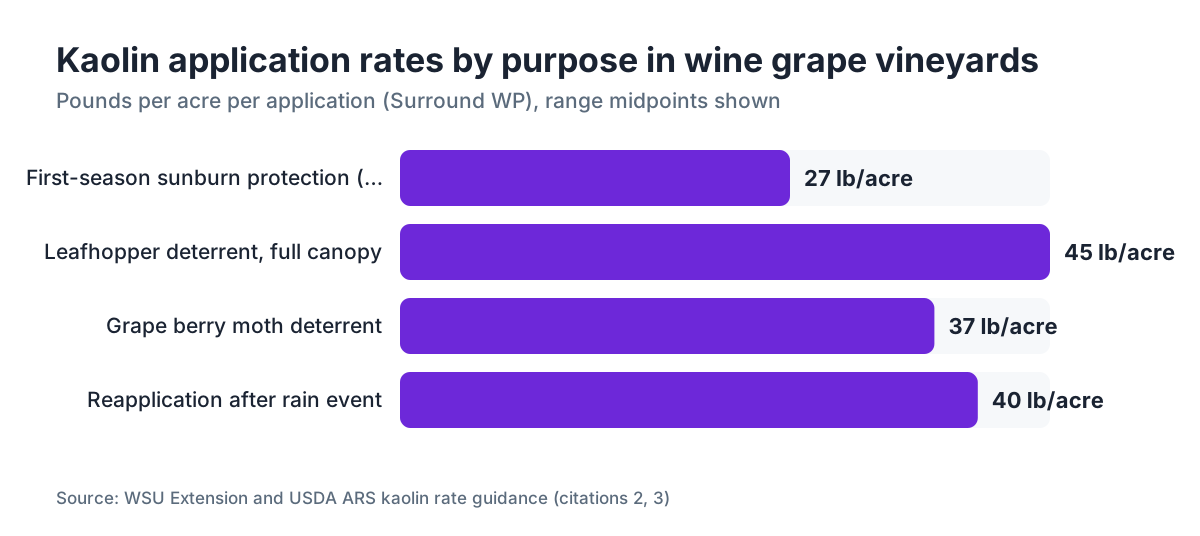
| Application purpose | Typical rate (lb/acre) | Water volume (gal/acre) | Notes |
|---|---|---|---|
| First-season sunburn protection | 25 to 30 | 50 to 75 | Young foliage; lower rate avoids heavy residue |
| Leafhopper deterrent, full canopy | 40 to 50 | 75 to 100 | Heavier deposit needed for adults |
| Grape berry moth deterrent | 25 to 50 | 50 to 100 | Timing to egg hatch matters more than rate |
| Reapplication after rain | 25 to 50 | 75 to 100 | Match or slightly exceed prior rate |
How much rain actually washes off kaolin coating and when do you need to reapply?
The honest answer: research gives you a rough threshold, not a hard rule. Cornell and Penn State extension work on kaolin in tree fruits found that roughly 0.25 to 0.5 inches of rain begins to compromise the white residue visibly, and events above 0.5 inches generally warrant reapplication to hold efficacy [4]. Wine grape data is thinner. The closest transferable studies come from apple and peach trials, where kaolin has a longer research history.
Most experienced applicators use two triggers: a rain volume threshold and a visual inspection. Get more than 0.25 inches in a single event, and you walk the vines the next morning and look at berry and leaf surfaces. If the white coating is gone or patchy on sun-exposed fruit, reapply. If it still looks continuous, log the rain event and the inspection decision, then check again after the next rain.
Why both triggers? Light rain followed by heavy dew strips kaolin more than the rain gauge suggests. Wind-driven rain hits harder than vertical rain. Your notes on 'coating appearance at inspection' protect you from the argument that you sprayed on an arbitrary schedule instead of responding to real conditions.
A reasonable post-rain entry looks like this: 'Rain event 6/18, 0.38 inches (NOAA station X). Visual inspection 6/19 AM: coating 60 to 70% intact on east-facing clusters, heavy loss on west-facing rows. Decision: reapply west half of Block 3 on 6/20 at 40 lb/acre.'
Does the EPA Worker Protection Standard require kaolin to be in your spray records?
Yes. Surround WP carries an EPA registration number (EPA Reg. No. 61842-18), and because it holds a federal registration, it falls under WPS recordkeeping even though it's a mineral-based OMRI product [1]. The WPS rule at 40 CFR Part 170 requires records for any WPS-covered application to be kept for two years and made accessible to workers on request within 24 hours [1].
EPA guidance says records must include product name and EPA registration number, the location and description of the treated area, the application date, the time the application ended, and information about restricted-entry intervals (REIs). Surround WP has a 4-hour REI [5].
Organic certifiers add a second layer. National Organic Program regulations (7 CFR Part 205) require records that fully disclose all materials applied to certified acres, kept for five years [6]. So your kaolin log has a two-year floor from WPS and a five-year floor from NOP. Keep five years and you're covered on both.
One thing trips people up: the WPS rule doesn't specifically require you to record the application rate. Rate recording comes from state pesticide use reporting rules (which vary) and from NOP audit expectations. California growers report rate data for all applications including Surround WP through the county agricultural commissioner's Pesticide Use Report (PUR) system [7]. Record the rate every time, whatever your state, so you keep one consistent practice.
How should you structure a kaolin reapplication entry differently from the first application?
The reapplication entry needs one thing the first application doesn't: the trigger event. Every reapplication log entry should start with why you're reapplying before it says what you're applying.
A clean reapplication record includes the original application date and rate for context, the trigger event (rain volume and date, or calendar interval if you're on a schedule), the inspection date and coating condition observed, then the reapplication date, rate, water volume, and applicator. Link these entries by a batch number or a cross-reference note like 'Reapplication per 6/18 rain event; original application 6/10.'
During an organic certification review, an auditor wants to see that your kaolin use was responsive and documented, more than that you made entries. A run of reapplication entries with no rain trigger noted reads like an arbitrary spray schedule. That's fine agronomically, but it becomes a problem if your certifier wants to understand your input use intensity.
For vineyards tracking spray records across many blocks and seasons, a tool like VitiScribe can link rain event records to spray decisions automatically, so each reapplication entry carries the weather trigger without manual cross-referencing. That's genuinely useful when you have ten blocks with different canopy densities and different rain exposure.
One more thing about blocks: log reapplications at the block level, not the vineyard level. You'll almost never need to reapply everywhere at once. West-facing blocks dry faster, young canopy loses coating faster than mature canopy, and headlands near windbreaks hold coating longer. Block-level records let you trim input use and prove the trim to your certifier.
What spray log format works best for tracking kaolin across a full season?
The format depends on what you're going to do with the records: compliance filing, crop certification, or day-to-day decisions. For kaolin, a season-long tracking format beats individual-application cards, because you need to see the full reapplication history against the weather record.
A spreadsheet or digital log with one row per application event, sortable by block and date, answers the questions that come up fast. How many total pounds of kaolin went on Block 4 this season? How many days elapsed between applications? Did I reapply within 48 hours of every rain event above 0.25 inches? Those show up in certification audits and in your own end-of-season cost accounting.
Columns that matter for kaolin across a season: Block ID, Application date, Material (Surround WP), Lot number, Rate (lb/acre), Water volume (gal/acre), Total lbs used, Trigger type (scheduled or rain event), Rain event date and amount (if applicable), Inspection date, Coating condition observed, Applicator, Equipment ID, and Notes.
Paper logs are legal and often plenty for small operations. The trouble with paper for kaolin is that rain events happen at odd hours, and recording the decision logic ('inspected Tuesday, held off because coating was still 80% intact') means legible handwriting in the rain. A tablet or phone entry takes 90 seconds and timestamps itself.
University of California Cooperative Extension recommends completing spray records within 24 hours of application for accuracy [8]. That's good practice, but don't confuse it with the rule. The WPS 24-hour window is about making completed records available to workers, not about when you finish writing them.
How does kaolin interact with other pesticides in the spray record and on the vine?
Kaolin goes on far more often than most pesticides, especially in hot regions where sunburn is a season-long problem. In the central San Joaquin Valley and warm coastal zones, growers sometimes spray Surround WP every 10 to 14 days from berry set through veraison, which stacks up to 6 to 8 applications per season. That frequency means kaolin entries can outnumber your fungicide or insecticide entries, and the records have to stay organized enough to separate them for compliance.
The tank-mix question comes up constantly. Surround WP mixes with many conventional and organic-approved fungicides, and WSU Extension notes that kaolin doesn't generally reduce fungicide efficacy at standard rates [3]. But when you tank-mix, your entry has to capture every component with its own rate and EPA registration number. A single entry that reads 'Surround + sulfur' with no rates is incomplete under both WPS and NOP.
Log tank-mix entries as separate rows linked by a mix batch number, or use a sub-entry format with the primary application date and each component listed below it. The goal: someone can reconstruct exactly what went on the vine on any date without calling you.
For vineyard operations with multiple certifications (organic, Salmon Safe, LIVE, and the like), check each program's input documentation rules. Some third-party programs want the product's certifying body in the record (an OMRI listing number, for example) alongside the EPA registration number.
What records do you need if an employee applies kaolin rather than the owner?
If an agricultural handler (employee or contractor) applies kaolin, the WPS requires that person to have access to the pesticide label and safety data sheet (SDS) during application, and it requires the employer to keep records of the application including the applicator's name [1]. In most states the applicator doesn't have to be licensed for a reduced-risk mineral product like Surround WP, but check your state. California requires a Qualified Applicator License or Certificate for certain applications even when the product is OMRI-listed [7].
Your log entry for an employee-applied kaolin application should include the employee's name, the fact that they got the label and SDS before spraying, and the PPE worn. Surround WP label requirements for handlers: long-sleeved shirt and long pants, chemical-resistant gloves, shoes plus socks [5]. The label is the law under FIFRA. If your entry doesn't show that WPS and label requirements were followed, you have a gap.
For organic certification, NOP regulations don't add handler-specific record requirements beyond WPS, but some certifiers want a sign-off that the applicator understood the input was NOP-compliant. A one-line note ('Applicator briefed on OMRI status and NOP approval of Surround WP') takes five seconds and closes that gap.
How does tracking weather data improve your kaolin reapplication decisions over time?
Growers who log weather triggers next to spray decisions build a calibrated reapplication model over two or three seasons that generic guidance can't give them. The generic line says reapply after 0.25 to 0.5 inches of rain. Your block-level records tell you whether Block 7, southwest-facing on a ridge with afternoon wind, actually loses coating faster than the gauge suggests, while Block 2 on the valley floor holds coating through 0.6-inch events because the air is still and humid.
That calibration is worth money. Surround WP runs roughly $2 to $3 per pound, and at 25 to 50 lb per acre per pass, unnecessary reapplications on blocks that still have intact coverage add up fast. One avoided reapplication across 10 acres saves $500 to $1,500 in material alone, before labor and water [2].
Linking a weather station (even a cheap personal one) to your spray log by logging daily precipitation against your block map takes about 10 minutes per rain event. Over a season, you build a record showing whether your reapplication decisions tracked real conditions. Over three seasons, you have real data on how your specific site, canopy shape, and spray equipment affect kaolin persistence.
NOAA's Climate Data Online tool pulls historical precipitation for any station near your vineyard for free, which helps if you're documenting a rain event after the fact that you forgot to log at the time [9].
What are the most common kaolin recordkeeping mistakes and how do you fix them?
The most common mistake: recording 'applied kaolin' with no rate. It's almost always applicators filling out logs from memory after the fact. The fix is to record rate at the time of calibration, not after spraying. Write the rate on your spray card before you leave the shop.
Second most common: no lot number. Lot tracking matters if there's ever a product recall or a contamination question. Surround WP bags carry a lot code. Record it. Three seconds.
Third: mashing rain events and reapplication decisions into one entry with no clarity about which came first. An entry dated 6/20 that says 'reapplied after rain' with no separate rain record leaves gaps. Log the rain on 6/18 separately, even as a one-liner ('0.4 in. rain, NOAA station'). Then log the inspection on 6/19. Then the reapplication decision on 6/20.
Fourth: one log for all blocks instead of block-level entries. If you spray blocks 1, 3, and 5 but not 2 and 4, and you write 'applied to vineyard,' you've thrown away the traceability that makes your records worth keeping.
Fifth: tossing logs before the retention period ends. WPS requires two years [1]. NOP requires five [6]. California PUR records must be kept three years from submission [7]. The safe practice is five years, stored somewhere a shed fire won't reach. Digital backup of paper logs is a good habit.
If you want to simplify all of this, VitiScribe's spray record module is built around exactly these fields and stores them with automatic timestamps and weather integration. That's a real answer to the 'we filled it out later' problem.
Does kaolin affect harvest record requirements or residue testing?
Kaolin has a zero-day pre-harvest interval (PHI) because the plant doesn't absorb it and it leaves no toxic residue. The Surround WP label confirms this [5]. You can apply right up to harvest, with no residue hold or sampling required from a regulatory standpoint.
Winery contracts and buyer specs are a different story. Some include language about 'no spray residue on fruit at delivery,' and a visible white coating on clusters can start a conversation with your winemaker. Log your last kaolin application date and the weather (rain, wind, dew) between application and harvest. If you can show three rain events between the last spray and the harvest date knocked down the visible coating, that's a documented record in a dispute.
For wineries doing their own crush, the white residue enters the press and partially into the juice. UC Davis research found that kaolin in juice settles with gross lees under standard settling conditions and doesn't affect fermentation or wine sensory characteristics at typical application rates [8]. Still, note the last application date in your harvest block records so winemakers have it for their process calls.
Export markets have their own tolerances. The EU Maximum Residue Level (MRL) for kaolin on grapes is 2 mg/kg under Regulation (EC) No 396/2005 [11]. If you sell fruit or wine into the EU, that's a number your records should support, though at standard rates with any pre-harvest weathering, residue levels sit well below it.
Frequently asked questions
What is the standard kaolin application rate per acre in wine grape vineyards?
Most university extension guidance puts the rate at 25 to 50 pounds of Surround WP per acre per application, depending on water volume and canopy density. A common dilution is 50 lb per 100 gallons of water; at 50 to 100 gallons per acre spray volume, that delivers 25 to 50 lb kaolin per acre. Always record both the tank concentration and the estimated pounds per acre in your log.
How much rain causes kaolin coating to wash off and require reapplication?
The rough threshold from Cornell and Penn State extension research is 0.25 to 0.5 inches of rain per event. Above 0.5 inches generally warrants reapplication. Wind-driven rain and dew can strip coating below that volume, so a visual inspection the morning after any rain above 0.25 inches is the most reliable guide. Log the rain event, the inspection, and your reapplication decision separately.
Does kaolin need to be recorded in EPA Worker Protection Standard spray logs?
Yes. Surround WP carries an EPA registration number (EPA Reg. No. 61842-18), so it's covered under the WPS recordkeeping rule at 40 CFR Part 170. Records must be kept for at least two years and made available to workers within 24 hours on request. If you're also NOP-certified organic, the five-year NOP recordkeeping requirement extends that retention floor.
How long do I need to keep kaolin spray records?
The EPA WPS rule requires two years. USDA National Organic Program regulations require five years for inputs applied to certified acres. California's Pesticide Use Report system requires three years from the submission date. The practical answer is five years minimum, stored so it survives physical damage to the farm office. Digital backups of paper logs are worth the five minutes.
Can kaolin be tank-mixed with fungicides and how do I log that?
Kaolin mixes with many conventional and OMRI-approved fungicides without reducing efficacy, according to WSU Extension. When you tank-mix, log every component with its own rate and EPA registration number in the same application record. A single entry saying 'Surround + sulfur' with no rates fails both WPS and NOP. Use a batch number to link all components of the same tank mix.
Is Surround WP approved for certified organic vineyards?
Yes. Surround WP (kaolin clay) is on the OMRI (Organic Materials Review Institute) list and is allowed under USDA National Organic Program regulations. When logging it for organic certification audits, include the product's OMRI listing status alongside the EPA registration number. Some certifiers want a note confirming the applicator was briefed on its NOP-compliant status.
What is the pre-harvest interval for kaolin on wine grapes?
Surround WP has a zero-day pre-harvest interval (PHI), so application is allowed right up to harvest with no required waiting period. It leaves no systemic residue. Even so, log your last application date in your harvest records so your winemaker has the information. Visible white coating on clusters can raise questions at the crusher even when there's no regulatory concern.
Do I need a pesticide applicator license to apply kaolin?
In most states, Surround WP can be applied by an unlicensed agricultural handler under employer supervision, since it's a reduced-risk, OMRI-listed mineral product. California is an exception: certain applications may require a Qualified Applicator License or Certificate depending on site and use pattern. Check your state's department of pesticide regulation or department of agriculture before delegating application to unlicensed employees.
How do I document a decision NOT to reapply kaolin after rain?
Log the rain event with the date and volume, then log a separate inspection entry with the date, coating condition observed (estimate the percentage intact on berries and leaves), and your decision to hold. Something like: 'Inspection 6/19: coating 75 to 80% intact across all blocks, no reapplication needed.' That entry shows your decision was observation-based, which matters for organic audits and for your own end-of-season analysis.
What fields should a kaolin reapplication log entry include that differ from the initial application?
A reapplication entry needs the same core fields as any application (date, rate, water volume, block, applicator) plus the trigger event (rain date and amount, or calendar interval), the inspection date and coating condition observed, and a cross-reference to the original application entry. Without the trigger documented, a series of reapplication entries looks arbitrary rather than responsive, which can create issues in an NOP audit.
How does kaolin affect fermentation if residue carries through to harvest?
UC Davis research found that kaolin residue settles with gross lees under standard juice settling conditions and doesn't affect fermentation or wine sensory characteristics at typical field application rates. There's no required harvest testing for kaolin residue. The EU MRL for kaolin on grapes is 2 mg/kg; at normal application rates with any pre-harvest weathering, residue levels are generally well below that threshold.
Can I use weather station data retroactively to document rain events I forgot to log?
Yes. NOAA's Climate Data Online tool provides free historical precipitation records for stations near your vineyard and is commonly accepted in compliance reviews as third-party verification of weather events. Pull the data, note the station ID, and add a retroactive rain event entry with the NOAA source cited. Retroactive entries beat missing entries; just date them accurately.
How many kaolin applications per season is typical for wine grapes in warm climates?
In hot interior regions like California's San Joaquin Valley, growers managing sunburn and leafhopper pressure may apply Surround WP every 10 to 14 days from berry set through veraison, resulting in 6 to 8 applications per season. In cooler coastal regions, 2 to 4 applications focused on heat events or leafhopper peaks is more common. Each application and each rain-triggered reapplication counts as a separate log entry.
Sources
- EPA, Worker Protection Standard 40 CFR Part 170: WPS requires records of pesticide applications including product name, EPA registration number, location, date, and applicator; records must be kept two years and provided to workers within 24 hours.
- USDA Agricultural Research Service, Surround WP Crop Protectant technical information: Kaolin application rate is 25 to 50 lb per acre per application; product cost context used to estimate material cost per avoided reapplication.
- WSU Extension, Kaolin clay use in Pacific Northwest vineyards: WSU recommends starting at 25 lb/acre for early-season applications and increasing toward 50 lb/acre at full canopy; kaolin does not generally reduce fungicide efficacy when tank-mixed at standard rates.
- Penn State Extension, Kaolin clay (Surround WP) use and rain wash-off in tree fruit: Roughly 0.25 to 0.5 inches of rain begins to compromise the kaolin residue coating visibly; events above 0.5 inches generally warrant reapplication.
- EPA, Surround WP pesticide label (EPA Reg. No. 61842-18): Surround WP has a 4-hour restricted-entry interval (REI) and a zero-day pre-harvest interval (PHI); handler PPE requirements include long-sleeved shirt, pants, chemical-resistant gloves, and shoes plus socks.
- USDA National Organic Program, 7 CFR Part 205: NOP regulations require certified operators to keep records that fully disclose all materials applied to certified acres for five years.
- California Department of Pesticide Regulation, Pesticide Use Reporting: California requires Pesticide Use Reports for all pesticide applications including OMRI-listed materials; PUR records must be retained for three years from submission; certain applications require a Qualified Applicator License or Certificate.
- UC Davis, UC Agriculture and Natural Resources, kaolin clay use in wine grape production: UC Davis found kaolin residue settles with gross lees under standard settling and does not affect fermentation or wine sensory characteristics; recommends completing spray records within 24 hours of application.
- NOAA National Centers for Environmental Information, Climate Data Online: NOAA Climate Data Online provides free historical precipitation records for stations near vineyards, useful for retroactive documentation of rain events in spray logs.
- OMRI (Organic Materials Review Institute), Surround WP product listing: Surround WP is on the OMRI list for organic production under USDA NOP.
- European Commission, Regulation (EC) No 396/2005 on maximum residue levels: The EU MRL for kaolin on grapes is 2 mg/kg under Regulation (EC) No 396/2005.
Last updated 2026-07-09