California sprawl trellis system: how it works and who should use it
TL;DR
- California sprawl is a low-cost, cane-pruned trellis where shoot tips drape downward from a single catch wire set 12 to 18 inches above a fixed cordon wire.
- It suits hot, high-vigor sites in the Central Valley and inland coastal valleys.
- Establishment costs run lower than VSP, canopy work is minimal, and it performs well for varieties that tolerate shade.
- Yield per acre is high.
- Quality trade-offs are real.
What is the California sprawl trellis system?
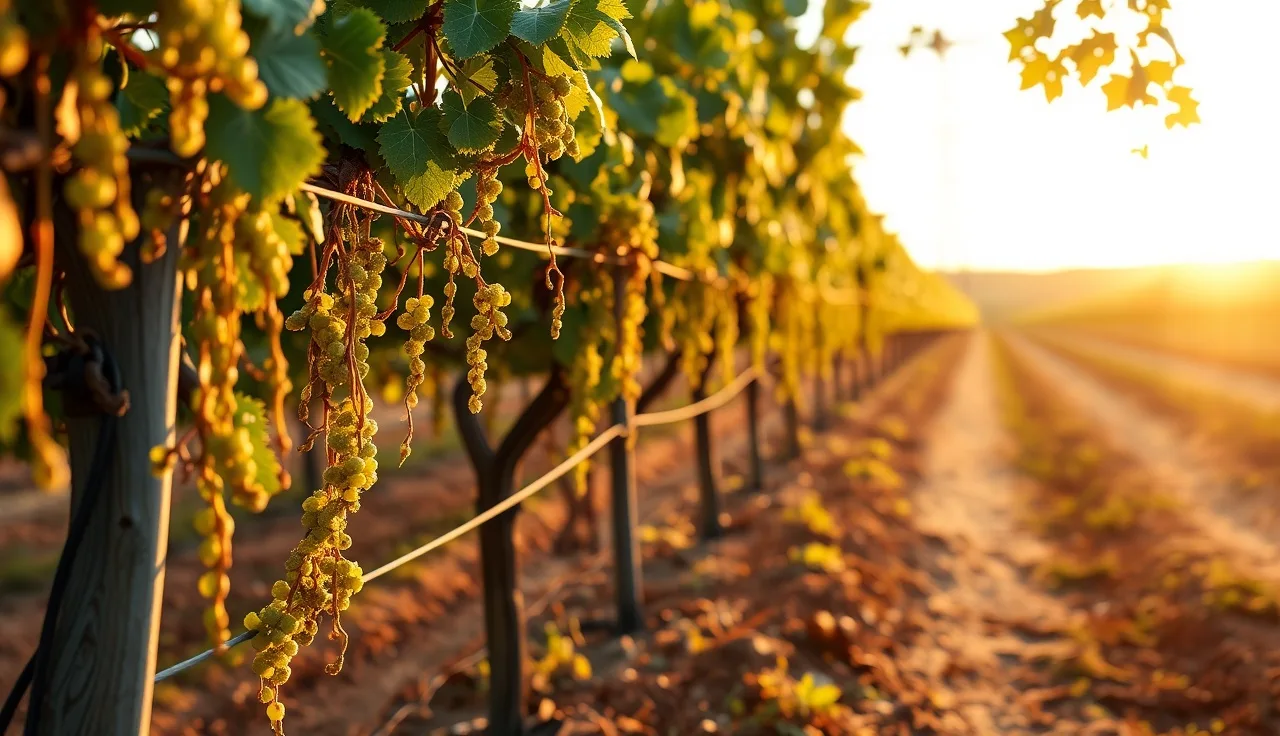
California sprawl is a cane-pruned, single-catch-wire system. Shoots grow up from a cordon or head, reach a single catch wire set roughly 12 to 18 inches above the cordon wire, and then drape or 'sprawl' down toward the ground on both sides. No hedging. No tucking. In most operations, no shoot positioning at all after the initial tie-up. The shoots just fall where gravity takes them.
The cordon wire usually sits 30 to 48 inches above the ground. The catch wire is a second, higher wire at around 48 to 60 inches total height from the soil. That puts the fruiting zone, which sits just below the catch wire, at 36 to 54 inches off the ground, which works for hand harvest crews and mechanical harvesters alike [1].
The name comes from California's Central Valley wine grape history. Growers there needed a system that was cheap to install, took little labor to run, and could handle very vigorous vines on fertile valley soils. Sprawl did all three. It's still the dominant trellis form on high-production valley floor blocks, and it turns up in inland coastal sites like parts of Lodi, the San Joaquin Valley, and some warmer Paso Robles vineyard blocks.
Don't confuse California sprawl with a Geneva Double Curtain or a bilateral cordon VSP. Those systems actively position shoots upward or split the canopy. Sprawl just lets gravity do the work.
How does California sprawl differ from VSP and other trellis systems?
The comparison growers ask about most is sprawl versus vertical shoot positioning (VSP). VSP keeps shoots vertical between foliage wires, builds a thin open canopy wall, and is the workhorse of Napa, Sonoma, and the North Coast. Sprawl does the opposite. Shoots hang down, and you get a dense, layered canopy with a lot of interior shade.
Here's how the two systems compare on the metrics that matter for your operation:
| Feature | California Sprawl | VSP |
|---|---|---|
| Shoot positioning labor | Very low to none | Moderate (2-3 passes) |
| Wire count | 2 (cordon + 1 catch) | 4-5 (cordon + 3-4 foliage wires) |
| Post/stake cost | Lower | Higher |
| Canopy density | High | Low to moderate |
| Fruit sun exposure | Low to moderate | High |
| Suited vigor level | Medium-high to high | Low to medium |
| Mechanical harvest compatibility | Good | Moderate to good |
| Typical yield (tons/acre) | 6-12+ (table/commodity wine) | 2-6 (premium wine) |
A Scott Henry or Smart-Dyson splits shoots up and down to raise light interception without a second cordon wire. Sprawl doesn't manage light at all. That's its main limitation for premium fruit.
The UC Davis Department of Viticulture and Enology points out that canopy management decisions directly affect fruit microclimate, berry temperature, and disease pressure [2]. In cooler coastal sites where Botrytis is a constant threat, a dense sprawl canopy is a liability. In hot, dry, low-humidity Central Valley conditions, that same density can buffer berry temperature and cut sunburn damage.
Geneva Double Curtain (GDC) gets confused with California sprawl because both let shoots hang down. The difference: GDC uses two parallel cordons spread 48 inches apart on a T-bar, splitting the canopy into two curtains. Sprawl uses one cordon or head-trained vine with a single catch wire and doesn't divide the canopy.
What does it cost to install a California sprawl trellis?
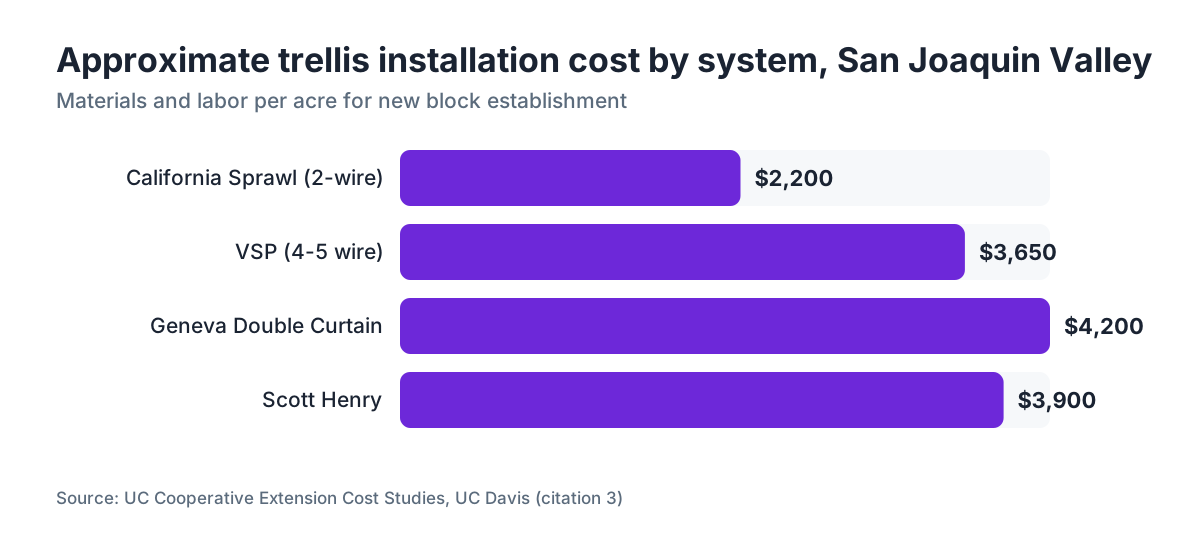
Honest answer: published installation cost data for California sprawl specifically is thin. Most trellis cost studies cover VSP or general trellis types. The figures below come from UC Cooperative Extension sample cost studies for wine grapes in the San Joaquin Valley and Central Coast, adjusted for the simpler wire requirements of sprawl [3].
A two-wire sprawl system uses roughly 35 to 40 percent fewer wire line-feet than a five-wire VSP setup. Install labor is lower too, because there's no wire tensioning or stapling at multiple heights. End-post assemblies and anchoring cost about the same regardless of system.
For a new block planted in the Central Valley:
- End posts and anchors: $800 to $1,200 per acre
- Line posts (T-posts or round wood, 20-24 ft spacing): $400 to $700 per acre
- Wire (2 wires, 12.5 gauge high-tensile): $180 to $300 per acre
- Labor to install: $300 to $500 per acre
- Total trellis materials and installation: roughly $1,700 to $2,700 per acre [3]
A comparable VSP system in the same region runs $2,800 to $4,500 per acre once you count 4-5 wires, extra foliage stakes or clips, and the added labor passes. That $1,000 to $2,000 per acre savings is real money when you're establishing 40 acres.
Maintenance runs cheaper over time too. No foliage wire re-tensioning, no clip replacement, and shoot positioning drops out as a labor category entirely.
Which grape varieties perform best on California sprawl?
Sprawl rewards high-vigor varieties that shrug off moderate interior shade without a quality penalty. It punishes low-vigor varieties and any variety where sun exposure directly drives flavor compound development.
Varieties that have done well on California sprawl include Zinfandel (especially old-vine head-trained blocks that shift into a sprawl-like structure), Barbera, French Colombard, Chenin Blanc, and Thompson Seedless for table grapes. In the commodity wine market, Cabernet Sauvignon and Merlot grow on sprawl too, though both show better color and tannin when the fruit sees light.
Varieties to think hard about before choosing sprawl:
- Pinot Noir: low to medium vigor, very sensitive to Botrytis, needs light for color development. Sprawl is usually a poor choice.
- Sauvignon Blanc: methoxypyrazines (vegetal notes) climb in shaded fruit. Sprawl can exaggerate green character.
- Syrah: takes moderate shade well for pepper character, but mildew pressure in dense canopies can bite.
- Chardonnay: works in hot sites where sun protection helps, though oxidative winemaking usually wants cleaner fruit.
For operations chasing bulk or commodity pricing, sprawl's yield edge can outweigh varietal quality concerns. For estate or direct-to-consumer programs at premium prices, the fruit quality compromises are harder to absorb.
How does California sprawl handle heat and sunburn in hot climates?
This is one place sprawl has a genuine, underappreciated advantage. In the Central Valley and hot inland valleys, berry temperature during ripening can climb high enough to degrade color, aroma, and acid. A dense sprawling canopy shades the cluster zone and buffers berry temperature against what exposed VSP fruit sees in the same conditions.
Research from UC Davis and USDA-ARS found shaded berries run 2 to 8 degrees Fahrenheit cooler than fully exposed berries under high radiation [4]. For varieties prone to sunburn (bleaching and browning from direct UV), that shade is protective. In Fresno County, Kern County, and the hotter San Joaquin Valley, that buffering is not trivial.
The trade-off: shade also slows sugar accumulation, holds malic acid higher, and can delay even ripening across clusters. In a cool or moderate vintage, that delay pushes harvest into October when temperatures drop, which actually helps acid retention. In an unusually cool year, it can leave you with fruit that won't reach full physiological maturity before the first rain.
The most useful intervention for sprawl in heat-stressed sites is early-season shoot density management. Drop excess shoots to 4 to 6 per linear foot of cordon (instead of the 8 to 12 you'll get if you do nothing) and you open enough canopy to lower disease pressure while keeping fruit shade adequate. That one practice does more than almost any other investment in the system.
What pruning and canopy management does California sprawl require?
Sprawl runs on cane pruning, or occasionally spur pruning. Cane pruning is the traditional choice in California sprawl blocks. Each dormant vine gets cut back to 2 to 4 canes of 8 to 14 buds each, tied to or draped over the cordon wire or head. The catch wire holds the canes through budbreak, then shoots grow up until they reach the wire and drape over it.
After that, the system mostly runs itself through the first half of the season. You're not positioning shoots, tucking, or hedging. Your main early intervention is shoot thinning, which pays for itself many times over. Pulling one to two leaves per cluster on the morning-sun side of the fruit zone improves spray penetration without giving up much shade protection.
Hedging happens in some sprawl blocks, usually a single rotary-hedger pass in July to keep row middles passable and stop shoots tangling across rows. That's optional in wide-row plantings (12 feet or wider) but necessary in tighter spacings.
Harvest on sprawl blocks is usually mechanical. The drooping canopy presents clusters at a consistent height that harvester picking heads handle well. Hand crews work sprawl blocks efficiently too, because clusters are accessible from the row middle without reaching into a vertical wall.
If you're keeping spray and harvest records, a tool like VitiScribe can log pruning weights, shoot density counts, and phenology dates by block. That's genuinely useful for year-over-year comparisons on a sprawl block, where yield swings between vintages run wide.
What are the disease and pest management challenges with California sprawl?
Dense canopies drive most of the disease pressure. Powdery mildew (Erysiphe necator) thrives in low light and poor airflow, and the interior of a sprawl canopy from May through July is exactly that. In dry Central Valley conditions this stays manageable. In coastal-influenced inland sites with morning fog or high humidity, you need a proactive mildew program.
Botrytis cinerea (bunch rot) is the other concern. Sprawl blocks with tight-cluster varieties or high yield targets get hit hard in wet harvest seasons. UC Cooperative Extension recommends a 14-day or shorter spray interval with FRAC-code-rotating fungicides from bloom through veraison in high-pressure environments [5].
Spray penetration into a dense sprawl canopy is harder than into a VSP wall. You'll typically need higher water volumes (50 to 75 gallons per acre rather than 25 to 30) or airblast speed adjustments to push material into the fruit zone. Some growers add a single leaf-removal pass at fruit set just to open spray channels.
Pest management under California's Worker Protection Standard (WPS, 40 CFR Part 170) applies to all trellis systems the same way [6]. Restricted-entry intervals (REIs) after fungicide or insecticide application have to be posted and followed no matter the canopy type. Dense sprawl canopies can complicate REI compliance, because workers thinning shoots need to enter the canopy, and residue drying time in a dense interior runs longer than in an open VSP block. Build that into your application timing.
For Glassy-winged sharpshooter (GWSS) pressure and Pierce's Disease risk in Southern California inland valleys, sprawl blocks with dense canopies give vectors more habitat than open-canopy systems. In a GWSS-endemic area, canopy management intensity goes up no matter the trellis type [7].
How does California sprawl affect yield and wine quality?
Yield is the system's strength. Well-managed sprawl blocks in the San Joaquin Valley regularly produce 8 to 12 tons per acre of wine grapes, and some high-input commodity blocks push past 15 tons per acre [3]. That's two to four times the yield of a managed VSP block in the North Coast. Commodity wine grape economics depend on that yield advantage.
Wine quality is the trade-off, and it's real. Shaded fruit produces lower phenolic content, less color in red varieties, higher pH, and in some studies meaningfully higher methoxypyrazine concentrations. Smart and Robinson's 1991 book on canopy management (still the most cited practical viticulture reference) concluded that shaded fruit in dense canopies consistently produces wines rated lower by sensory panels than fruit from the same varieties grown in open canopies [8].
That said, the quality impact depends on variety and site. In very hot climates, some shade improves quality by protecting aromatics and holding acid. Zinfandel from old-vine head-trained blocks in Lodi (which behave much like sprawl in canopy structure) regularly makes wines that command premium prices.
The number most growers watch is the Ravaz Index, the ratio of crop weight to pruning weight. For sprawl blocks, a healthy Ravaz Index runs 5 to 10. Below 5 means you're overcropping relative to vine capacity. Above 10 says the vine is stressed by excess crop load, which in sprawl systems often means you've let vigor outrun what the system can carry [2].
For operations chasing the Paso Robles wineries premium market or selling to estate labels, sprawl is usually the wrong choice. For Central Valley commodity production, it stays the economically rational system.
What are the row spacing and vine spacing guidelines for California sprawl?
Traditional California sprawl blocks in the Central Valley use wide rows. The most common spacing is 12 feet between rows by 6 to 8 feet between vines, giving roughly 680 to 900 vines per acre. Some older blocks run 10 by 8 (544 vines/acre) or wider at 12 by 12 (302 vines/acre).
Wide row spacing does two things. It lets mechanical equipment (large airblast sprayers and mechanical harvesters) move through without canopy interference. And it gives each vine enough horizontal room that sprawling shoot tips from adjacent rows don't tangle, which they will if row spacing drops below 10 feet.
For new plantings, UC Cooperative Extension sample budgets for San Joaquin Valley wine grapes most often model 12 by 6 spacing, which gives roughly 605 vines per acre [3]. At that density under sprawl management, vine establishment in years 1 through 3 is straightforward because you're not fighting excess density.
Post spacing in the row runs 20 to 24 feet for T-posts in most commercial sprawl blocks, with end-post assemblies every 200 to 300 feet. That's wider than VSP, which often uses 12 to 16 foot intervals because the extra wire weight and wind loading need more support points.
Converting an existing block to sprawl from VSP happens when growers pick up old Central Valley blocks. You can often pull the upper three foliage wires and convert the existing VSP infrastructure to a two-wire sprawl setup without replacing posts. That conversion can cost as little as $200 to $400 per acre in wire and labor.
Is California sprawl compatible with mechanization and organic farming?
Mechanization is where sprawl earns its keep. Mechanical harvest with over-row harvesters works well because the fruiting zone sits at a consistent height and the drooping shoots present clusters where the picking head can reach. Mechanical pruning (a winter pre-pruning pass followed by detail hand-pruning) is practical too, and some large San Joaquin Valley operations have moved to full mechanical pruning with minimal hand work.
Under-vine weed management works mechanically with rotary cultivators, though the wider vine spacing of most sprawl blocks means more cultivation passes or wider under-vine herbicide strips than you'd run in a dense VSP planting.
Organic certification under USDA National Organic Program (NOP) rules is compatible with California sprawl [9]. The system itself has no conflict with organic practices. The challenge is disease management: the dense canopy makes organic-approved fungicide programs (sulfur, copper, bicarbonates) more demanding, because penetration is harder and coverage has to be more thorough. Organic sprawl blocks in humid microclimates need more spray passes, not fewer.
For integrated pest management (IPM) and the California Department of Food and Agriculture's Pest Management Alliance programs, sprawl blocks can qualify for cost-share if you document spray decisions and monitoring records [10]. Keeping those records consistently is where operations get tripped up. A block-by-block spray log that notes application date, product, rate, REI, and weather conditions is required for WPS compliance and useful for IPM program documentation. VitiScribe was built to make that logging fast enough that field crew can do it on a phone the same day as the application.
For south coast winery and mountain winery operations in California running mixed trellis blocks, sprawl sections can coexist with VSP sections on the same property with separate spray programs managed by block.
How does California sprawl fit into water use and sustainable viticulture programs?
Sprawl blocks usually carry higher vigor and larger canopies than VSP blocks in the same region, so they can support higher water use per vine. In the Central Valley, where most sprawl production happens, drip irrigation is standard and water budgets are built on evapotranspiration (ET) calculations.
The California Department of Food and Agriculture's climate-smart agriculture programs and the California Sustainable Winegrowing Alliance (CSWA) both include canopy management and water use efficiency as scored categories in their sustainability assessments [11]. A dense sprawl canopy is not inherently unsustainable, but it needs documentation that you're managing within ET-based water budgets, which most major water districts require anyway through their water use efficiency plans.
Deficit irrigation strategies (regulated deficit irrigation, or RDI) show up in some sprawl blocks to control vigor and improve fruit quality. The typical RDI target is 50 to 60 percent of full ET from fruit set through veraison, then back to full ET through harvest. UC Davis irrigation research found that moderate water stress during this window can improve berry skin-to-juice ratio and reduce berry size, both quality-positive, without meaningful yield loss when managed carefully [4].
In drought years, sprawl blocks on deep, moisture-retentive soils often outperform VSP blocks on shallow soils, because the wider vine spacing and lower vine density give each vine access to a larger soil volume. That soil water reserve matters when you're cutting irrigation to stay inside allocation limits.
What are the common mistakes growers make with California sprawl?
The most common mistake is doing nothing. Sprawl's low-labor reputation leads some growers to underinvest in the one intervention that matters most: early-season shoot thinning. Skip it on a vigorous block and you get canopy densities that defeat sprayer coverage, harbor mildew, and ripen unevenly. Ten hours per acre of shoot thinning in May saves you real disease cost and yield loss in August.
The second mistake is underestimating Botrytis risk in transition-climate sites. Growers moving from a dry Central Valley location to a site with any marine influence (morning fog in the Delta region, coastal influence in parts of Monterey County) often carry over their old sprawl practices and get burned badly in their first foggy vintage.
Third: using sprawl on low-vigor varieties or stressed vines. A vine fighting nematodes, phylloxera, or water stress doesn't have the canopy volume to make sprawl work. You end up with an underfilled canopy that hands you the disease and shading problems of sprawl with none of the yield upside. For stressed blocks, look at a cordon-trained, spur-pruned system that doesn't lean on long canes to fill the trellis zone.
Fourth: ignoring the Ravaz Index. Sprawl blocks that consistently run above 10 to 12 are overcropping, which speeds vine decline and makes the block harder to manage every year. Crop thinning fixes it, but it eats into the yield economics that made you pick sprawl in the first place. Getting the site right for the system before planting is worth more than any post-establishment fix.
For growers at ponte winery or allegretto vineyard resort style estate operations chasing both fruit quality and visitor experience, sprawl blocks can handle back-acres commodity production while VSP works the estate-facing rows.
Frequently asked questions
Is California sprawl the same as head training?
No, but they're related. Head training is a vine architecture: the trunk terminates in a single head from which canes or spurs grow. California sprawl describes how those canes and shoots are managed after pruning, specifically by letting them drape down from a catch wire. A head-trained vine can be managed as sprawl, but sprawl also works with bilateral cordon-trained vines.
Can I use California sprawl with Cabernet Sauvignon in a warm coastal climate?
It depends on the site. In spots with good air drainage, low humidity, and higher heat accumulation, Cabernet Sauvignon on sprawl can work for commodity production. In sites with morning fog, real Botrytis pressure, or winemaking goals that need phenolic ripeness, shaded sprawl fruit usually creates problems. Most premium Cabernet operations in coastal California use VSP for a reason.
What's the difference between California sprawl and the Geneva Double Curtain?
Both let shoots hang down, but Geneva Double Curtain (GDC) uses two parallel cordons set 48 inches apart on a horizontal crossarm, splitting the canopy into two downward-hanging curtains. California sprawl uses a single cordon or head-trained vine with one catch wire and does not divide the canopy. GDC is a more complex, higher-cost system with better light interception per acre than sprawl.
How many wires does California sprawl need?
Two wires are standard. The lower wire at 30 to 48 inches holds the cordon or acts as the cane-tie wire. The upper catch wire at 48 to 60 inches is where shoots drape. Some operations add a second catch wire 4 to 6 inches from the first to keep shoots from slipping off in wind, but a third or fourth wire is uncommon and not characteristic of the system.
Does California sprawl work with drip irrigation?
Yes. Most modern California sprawl blocks in the San Joaquin Valley use drip, typically one emitter per vine or one per two vines at flows of 0.5 to 1.0 gallon per hour. The wider vine spacing makes drip line installation straightforward, and the large soil volume available to each vine in wide-spaced blocks makes drip scheduling more forgiving than in high-density plantings.
What yield can I realistically expect from a California sprawl block?
On fertile valley floor soils with adequate water, 8 to 12 tons per acre is reasonable for commodity wine varieties. Well-managed blocks on very productive soils can top 15 tons per acre. Yield swings a lot with variety, vine age, irrigation, and how hard you crop-thin. Older vines usually show more yield stability but lower peak production than younger blocks.
How do you prune a California sprawl vine in winter?
Most sprawl blocks use cane pruning. During dormancy you pick 2 to 4 healthy, pencil-diameter canes from last season's growth, cut them to 8 to 14 buds each, and tie or drape them along the cordon wire. All other canes come off. Some growers leave a 2-bud renewal spur near the head to develop cane selections for future years, which is good practice for long-term vine structure.
Is California sprawl approved for certified sustainable viticulture programs in California?
The California Sustainable Winegrowing Alliance's self-assessment scores canopy management practices by outcome, not by trellis type. California sprawl can meet sustainable certification standards if you show appropriate canopy density management, disease monitoring, and water use efficiency. The system itself is not penalized or excluded from any of the major California sustainable winegrowing frameworks.
How does California sprawl affect spray timing and pesticide records under WPS?
The Worker Protection Standard (40 CFR Part 170) applies identically no matter the trellis system. You must post restricted-entry intervals, provide PPE, and keep application records. The practical wrinkle with sprawl is that REI compliance gets complicated by longer spray-drying times in dense canopies and the need for workers to enter the canopy during shoot thinning. Time applications to allow full REI before the next canopy entry.
What's a Ravaz Index and what does it mean for sprawl management?
Ravaz Index is the ratio of crop weight harvested to cane pruning weight from the same vine. A value between 5 and 10 generally means balanced vine capacity and crop load. Sprawl blocks running above 10 are overcropped relative to vine capacity, which leads to vine stress and decline over time. Measuring Ravaz Index yearly on a representative sample of vines is one of the better diagnostic tools you have for sprawl block health.
Can I convert an existing VSP block to California sprawl?
Yes, if the row spacing is wide enough (10 feet minimum, 12 feet preferred). Pull the upper foliage wires and leave the cordon wire plus one wire above it as your catch wire. Retrain canes to drape rather than tuck upward. The work is modest, around $200 to $400 per acre in labor and materials, and makes sense when you're acquiring a block and want to cut per-acre management cost for commodity production.
Do mechanical harvesters work well on California sprawl?
Yes. Sprawl is one of the more mechanically harvestable systems because the fruiting zone sits at a consistent height and clusters hang in an accessible position. Over-row harvesters with lateral-movement picking heads are standard equipment for sprawl block harvest in the San Joaquin Valley. The main variable is row width: you need at least 10 to 11 feet of row spacing for most commercial harvesters to operate comfortably.
Where can I find UC Cooperative Extension cost budgets for California sprawl systems?
UC Cooperative Extension publishes free sample cost-of-production studies for wine grapes in major California regions including the San Joaquin Valley, Central Coast, and North Coast. These are available through the UC Davis Department of Agricultural and Resource Economics website. Search 'UC wine grape cost study' plus your target region. The budgets cover trellis establishment, irrigation installation, annual production costs, and harvest, and get updated periodically to reflect input cost changes.
Sources
- UC Davis Viticulture and Enology, 'Trellis and Training Systems for Wine Grapes': Cordon wire height in California sprawl typically 30-48 inches; catch wire at 48-60 inches total height; fruiting zone accessible to mechanical harvesters
- UC Davis Viticulture and Enology, Canopy Management: Canopy management decisions affect fruit microclimate, berry temperature, and disease pressure; Ravaz Index 5-10 indicates balanced vine
- UC Cooperative Extension, Sample Costs to Establish a Vineyard and Produce Wine Grapes, San Joaquin Valley: Trellis installation costs and vine spacing norms for San Joaquin Valley sprawl-type systems; 12x6 spacing (~605 vines/acre) typical; yield 8-15+ tons/acre
- UC Davis Department of Viticulture and Enology, Irrigation Research: Shaded berries 2-8 degrees F cooler than exposed berries in high-radiation conditions; regulated deficit irrigation at 50-60% ET from fruit set to veraison improves berry skin-to-juice ratio
- UC Statewide IPM Program, Grape Powdery Mildew and Botrytis Management: 14-day or shorter spray interval with FRAC-code-rotating fungicides from bloom through veraison recommended in high-disease-pressure environments
- EPA, Worker Protection Standard, 40 CFR Part 170: WPS restricted-entry intervals, posting requirements, and PPE provisions apply to all agricultural pesticide applications regardless of trellis system
- California Department of Food and Agriculture, Pierce's Disease Control Program: Glassy-winged sharpshooter and Pierce's Disease risk management in Southern California inland valleys; dense canopy provides more vector habitat
- Smart, R. and Robinson, M., 'Sunlight into Wine: A Handbook for Winegrape Canopy Management', 1991, Winetitles: Shaded fruit in dense canopies consistently produces wines rated lower by sensory panels than fruit from open canopies of the same variety
- USDA National Organic Program: USDA NOP organic certification rules are compatible with any trellis system; restrictions apply to inputs used, not to physical training or canopy architecture
- California Department of Pesticide Regulation, Pesticide Use Reporting: California requires pesticide use reporting for all agricultural applications; spray records must include date, product, rate, acres treated, and applicator information
- California Sustainable Winegrowing Alliance, Sustainable Winegrowing Program: CSWA sustainability assessment scores canopy management and water use efficiency as program categories; trellis type itself is not scored or restricted
- WSU Extension, Wine Grape Trellis Systems Overview: Overview of cane vs. spur pruning approaches and catch-wire systems applicable to California sprawl design principles
Last updated 2026-07-09