Guyot trellis system: how it works and when to use it
TL;DR
- The Guyot trellis trains one or two renewal canes flat along a single fruiting wire, with shoots growing up through catch wires.
- Single Guyot suits low-vigor sites; Double Guyot doubles the fruiting zone.
- It's the default in Burgundy and Champagne, common in cool climates, and runs on basic one-wire infrastructure.
- Cane selection at pruning is the whole game.
What is the Guyot trellis system?
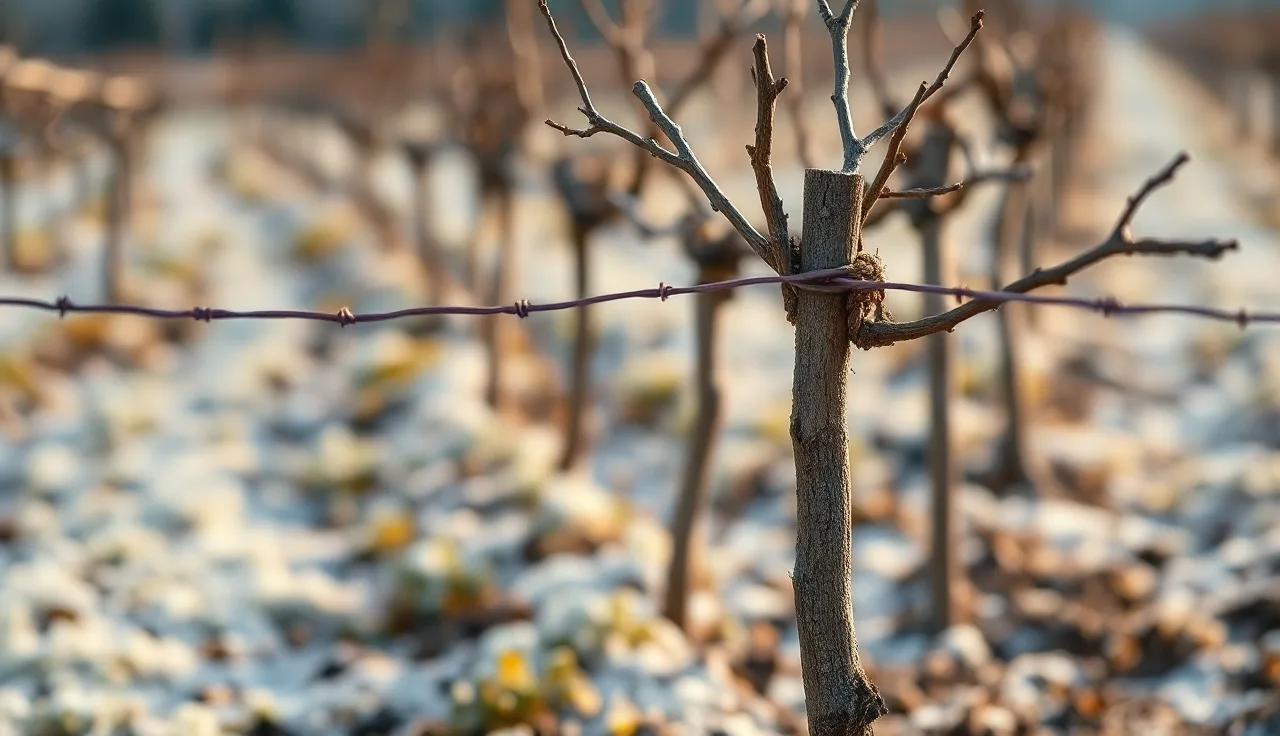
The Guyot system is a cane-pruned trellis method. You select one or two long canes from last season's growth, bend them flat along a bottom wire, and tie them down. Shoots from those canes grow upward and get tucked into two or three pairs of movable foliage wires above. At season's end you cut those canes off completely and start fresh with new ones grown from a replacement spur near the head of the vine.
That replacement spur is the whole trick. You're doing more than removing the old cane. You're choosing next year's cane before you've even cut this year's. Get that wrong and you spend the next growing season fighting your vine's structure instead of managing fruit.
The system is named after Jules Guyot, a 19th-century French physician and agronomist who formalized it for Bordeaux and Champagne in the 1860s. His goal was to balance vine production against wine quality, and the design hasn't changed much since. Single Guyot uses one cane. Double Guyot uses two, one on each side of the trunk. Some growers run a third variation called Guyot Poussard, which keeps a longer spur to protect against dieback.
What the system buys you is a clean canopy with no permanent cordon wood sitting on the wire all year. Less permanent wood means less woody tissue for trunk diseases to colonize. And every year you fruit on one-year-old wood, which is exactly where Vitis vinifera wants to fruit.
How does Guyot compare to VSP, Scott Henry, and cordon systems?
Most American growers default to bilateral cordon: two permanent arms running along the fruiting wire, spur-pruned each year. It prunes fast once established, it forgives mediocre labor, and it runs through a mechanical pruner. Guyot asks for a more skilled hand because you make a new structural decision every single winter.
Here's how the common trellis styles stack up:
| System | Pruning type | Fruiting wood | Trunk disease risk | Typical vigor suitability |
|---|---|---|---|---|
| Single Guyot | Cane | 1 cane, 8-12 buds | Lower (no permanent cordon) | Low to moderate |
| Double Guyot | Cane | 2 canes, 16-24 total buds | Lower | Moderate |
| Bilateral cordon (VSP) | Spur | Permanent cordon arms | Higher over time | Moderate to high |
| Scott Henry | Spur or cane | Split canopy, 2 levels | Moderate | High vigor |
| Lyre (U-system) | Spur | Divided canopy | Moderate | Very high vigor |
People use VSP (Vertical Shoot Positioning) as a synonym for trellis style, but VSP only describes how shoots are managed above the fruiting zone. You can run VSP shoot management on a Guyot, a cordon, or almost anything else. [1]
Guyot wins in cool climates because of bud fruitfulness. In Champagne, Burgundy, and much of the Willamette Valley, Pinot Noir's most fruitful buds sit at positions 3 through 7 on a cane. Spur-pruned systems cut back to bud 1 or 2, which are often the least fruitful buds on the shoot. Cane pruning keeps the productive ones. WSU Extension's viticulture team notes that cane pruning is generally recommended for cultivars whose basal buds are low in fruitfulness. [2]
Scott Henry earns its keep on vigorous, fertile sites where you need more canopy surface area and can't tame shoot growth any other way. On a low-to-moderate vigor Pinot Noir block sitting on lean hillside soil, it's overkill and costs too much to manage.
Single Guyot vs. Double Guyot: which one should you choose?
Single Guyot runs one cane, usually 8 to 12 buds, in one direction from the trunk head. It's the right call on low-vigor sites, in dry-farmed blocks, or where tighter vine spacing means you don't want shoots crowding each other.
Double Guyot runs a cane each direction, often 8 to 12 buds per side, for 16 to 24 buds per vine. It works where you have vigor to fill the canopy and row spacing to spread out. Champagne uses Double Guyot as its primary system for Chardonnay and Pinot Meunier across most of the region.
A rough heuristic. If your vines struggle to fill a single wire at 1 to 1.2 meters of horizontal cane, stay Single. If shoots top your catch wires and you're cutting half of them off, Double Guyot lets you move production outward instead of just up.
Vine spacing matters too. At 1-meter vine spacing (common in French AOC regions), each vine has little horizontal territory, so single canes make sense. At 1.5 meters or more per vine, a double cane fills that space more efficiently. Cornell's viticulture program is clear that cane length and bud count should match vine capacity as measured by the prior season's pruning weight, targeting roughly 20 to 40 grams of pruning wood per retained bud. [3]
What does Guyot trellis infrastructure actually require?
The setup is simpler than most people expect. You need end posts, line posts, and wires. The fruiting wire (bottom wire) usually sits 60 to 90 cm above the ground, and that's where you tie the cane. Above it, two or three pairs of foliage wires hold the shoots upright. That's the whole system.
End posts need solid anchoring because the tension on a fully loaded wire in summer is real. Concrete anchors or deadman anchors are standard. Line posts run every 6 to 8 meters, tighter on steep slopes. UC Cooperative Extension recommends a minimum of 12.5-gauge high-tensile wire for the fruiting wire; foliage wires can be a bit lighter at 14 gauge. [10]
A standard Guyot VSP wire layout runs something like this:
- Fruiting wire: 75 cm from ground
- First catch wire pair: 115 cm
- Second catch wire pair: 145 cm
- Top wire (optional fixed): 175 cm
Movable foliage wires beat fixed wires because they let you tuck shoots progressively through the season. Fixed wires save money upfront and create a traffic jam of shoots in June if you're not tucking constantly.
For tying canes, plenty of growers still use paper or jute twine, which rots before it girdles the vine. Others use degradable tape applicators (Max Tapener is the brand you'll see most). Wire ties and plastic twist ties are a bad idea on the fruiting wire. They don't break down, and they cut into the cane as it swells through the season.
Material costs vary a lot by region, but a rough budget for establishing a Guyot trellis on a new acre runs $3,000 to $6,000 for posts and wire alone, before labor. Installation labor typically adds another $1,500 to $3,000 per acre depending on terrain and local wages. [10] These are ballpark ranges. Get real bids from your local suppliers.
How do you prune a Guyot vine correctly?
Winter pruning starts when the vine is fully dormant, usually late December through February across most North American wine regions. The sequence matters:
- Look at the vine before you touch it. Find the current cane (from last year), the replacement spur (if you did this right last year), and the new growth off that spur.
- Select your new cane from the shoots on the replacement spur. You want internodes that aren't too compressed or too stretched, pencil-thick wood (roughly 8 to 12 mm at the base), and a position that lets you bend it to the wire without cracking.
- Leave a replacement spur. Two buds, no more. That spur grows two shoots next year, and you pick one as next year's cane.
- Cut everything else off. The old cane, any leftover clusters, all water shoots.
- Bend the new cane gently along the fruiting wire and tie it. Bend from the tip toward the base so you don't split the cane at the trunk junction.
Cane length depends on vine capacity. The standard tool is the Ravaz index: crop weight at harvest divided by pruning wood weight. A ratio of 5 to 10 is generally balanced for most varieties. Below 5 suggests overcropping, above 10 suggests undercropping. [3] In practice most growers pick a target bud count from variety and site experience, then adjust year to year.
The most common mistake is leaving the replacement spur too far from the trunk head. Every year that spur creeps outward, your trunk extension gets longer, and eventually the vine's head sits nowhere near where you want it. Keep the spur as close to the head as a well-positioned shoot allows.
Timing matters for disease too. Eutypa lata (the cause of Eutypa dieback) colonizes fresh pruning wounds, with infection risk highest in wet weather. UC research has shown that late pruning (closer to bud swell) lowers wound susceptibility, and applying wound protectants right after cutting infected wood reduces spread. [4]
Which grape varieties and climates work best with Guyot?
Guyot works best where cane pruning beats spur pruning on fruitfulness. The clearest cases: Pinot Noir, Pinot Meunier, Chardonnay (especially on cooler sites), Gewurztraminer, Riesling, and Gamay. These varieties have relatively infertile basal buds, meaning the buds closest to the base of each shoot make fewer and smaller clusters than buds further out. Spur pruning cuts everything back to positions 1 and 2. Cane pruning keeps positions 3 through 10 and beyond.
Varieties where spur pruning (and cordon systems) hold their own: Cabernet Sauvignon, Merlot, Syrah, Zinfandel, and Grenache. Their basal buds are reasonably fertile, so you don't lose much cutting back hard. Plenty of Bordeaux and Napa producers still cane-prune Cabernet. It's not wrong, just not always necessary.
Climate matters because of disease pressure. Guyot gives you an open canopy that dries fast, a real edge in wet climates. The Willamette Valley, the Finger Lakes, parts of the Hudson Valley, and cool coastal California all see meaningful benefit from Guyot's air circulation over dense cordon systems. In hot, dry climates the extra effort of cane pruning may not pay off.
Elevation and frost risk connect to Guyot through bud placement. Setting the fruiting wire at 75 cm instead of 60 cm lifts your buds out of the coldest air near the ground. On frost-prone sites that's a real gain. Some Finger Lakes growers and colder Willamette sub-AVAs raise their fruiting wires for exactly this reason.
What are the labor and cost implications of Guyot vs. cordon systems?
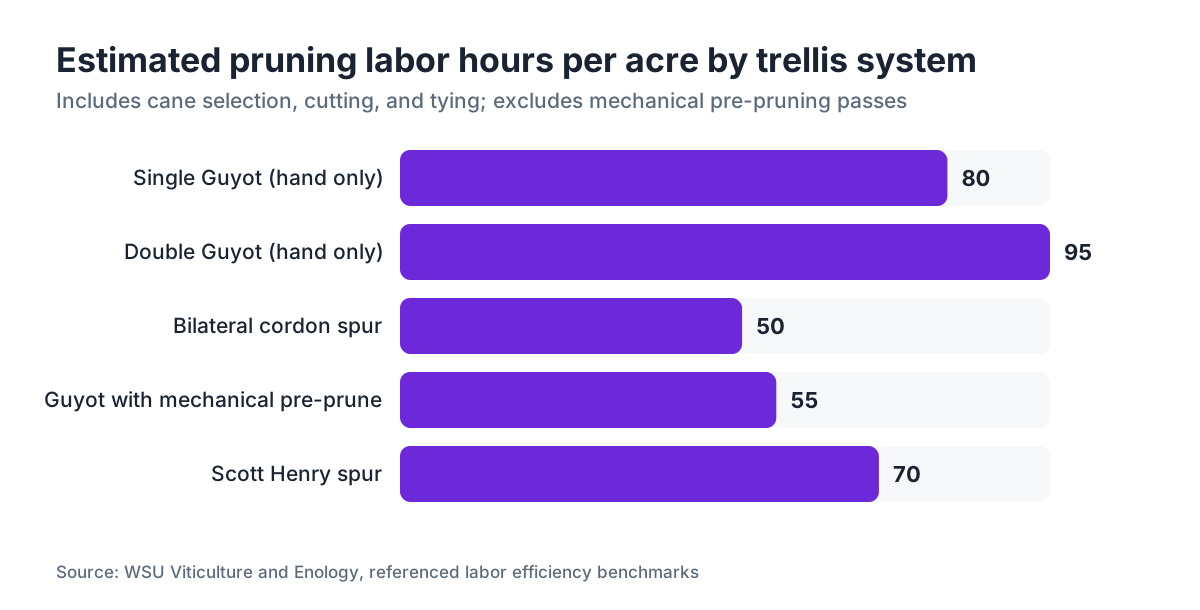
This is where growers have to get honest with themselves. Cane pruning takes longer. A skilled pruner on a cordon block might do 150 to 200 vines an hour. On a Guyot block, figure 80 to 120 vines an hour for most workers, because cane selection and bending eats real time. At $18 to $22 an hour (a rough 2024 range for experienced pruners in California and Oregon, varying widely by region and labor market), that gap compounds fast across a 1,000-vine or 5,000-vine block. [11]
Mechanical pre-pruning helps. Run a hedger over the block first to strip most of the brush, then follow with hand labor for final selection and tying. WSU Extension has documented that pre-pruning cuts hand-pruning time by 30 to 50 percent depending on vine density and vigor. [2]
Tying cane adds time cordon work doesn't. A two-person team with a tape gun (one bending, one tying) beats solo work. Build that into your labor model.
Guyot blocks often need less shoot thinning and hedging later because shoot positioning starts more uniform. Whether that evens out the pruning cost premium depends on your block and your management style.
If you're tracking spray records, pruning logs, and labor hours by block, a tool like VitiScribe shows you which blocks actually cost more per ton produced, across multiple seasons, without rebuilding a spreadsheet from scratch every year.
For small wineries running their own vineyard, knowing your real per-block labor cost lets you compare training systems honestly when you replant or establish a new block.
How does Guyot affect fruit quality and yield?
The honest answer: it depends on the variety and how well you run the system. On varieties with poor basal bud fruitfulness, switching from cordon to Guyot usually raises cluster count and yield per vine. Whether that's a quality gain depends on whether you were undercropping or overcropping before.
Champagne caps yields (roughly 10,000 to 13,000 kg per hectare depending on vintage and appellation rules), and Double Guyot is the tool for hitting those targets reliably on Pinot Meunier and Chardonnay. The region prescribes the system because it delivers consistent, predictable bud counts across a uniform canopy. [5]
For quality-focused producers chasing lower yields, the Guyot edge is canopy management. A well-run Guyot vine pushes shoots at even intervals along the cane, spacing them naturally into the foliage wires without the clustering you get when several shoots crowd out of one spur position. Better light into the fruiting zone means better color, better anthocyanin in reds, and better Brix with less green character.
Work from New Zealand's Plant & Food Research, cited across Australian and New Zealand viticulture extension, has found cane-pruned Sauvignon Blanc producing more uniform cluster weights and slightly higher soluble solids at harvest than spur-pruned controls on similar rootstocks, though the yield penalty varied by site. Nobody has a universal number here. Site and season matter too much.
For Pinot Noir specifically, most experienced Willamette Valley and Burgundy growers will tell you Guyot is non-negotiable. The basal bud fruitfulness problem is just too big on Pinot to eat the spur-pruning yield penalty.
What training and worker safety considerations apply to Guyot vineyards?
Cane pruning means more hand time per vine than spur pruning, which means more exposure to sharp tools and repetitive motion. Under the EPA's Worker Protection Standard (WPS), any worker handling pesticide-treated plant material must be trained, and every hand-pruning crew member needs access to decontamination supplies (soap, water) and emergency information. The WPS was revised in 2015; the current version requires annual training for all agricultural workers who may contact pesticide residues. [6]
Pruning wounds are also the main entry point for Eutypa lata and Botryosphaeria dieback fungi. Your spray program should account for wound protection, especially in wet winters. California DPR requires that all pesticide applications, including fungicide wound treatments, get recorded in a pesticide use log. [7] Oregon's Department of Agriculture requires pesticide application records for all agricultural uses, vineyard fungicide sprays included. [8]
For training new pruners on Guyot, the standard move is to send a few experienced hands through a block first to mark vines or leave a taped cane showing the selection, then have newer workers follow and do the cutting and tying. It slows the experienced pruners down and saves a lot of correction labor later. Pruning errors in Guyot blocks (wrong cane, spur left too far out, cane bent too sharply) take two to three seasons to fully recover from.
Ergonomics matter more here than in cordon work because the cane-bending motion puts lateral stress on wrists and shoulders. Tying at fruiting wire height is generally comfortable. Tying the tip of a long cane bent downward puts workers in awkward positions. Worth thinking about in crew training and PPE setup.
How do you establish a new vineyard block on Guyot from planting to first crop?
Year one is about roots. You're not training anything to the fruiting wire yet. You let the vine grow one or two shoots and build a strong root system. Most growers tie a single shoot to a bamboo stake or grow tube and let it run. Trellis posts should already be in before or right after planting.
Year two: get trunk wood to the fruiting wire height. Ideally one shoot reaches 75 to 90 cm and goes woody enough to tie. Some vines make it, some don't. That's normal. Don't rush to bend a cane that's too thin or too short. A weak first cane means a weak first fruiting structure.
Year three is usually the first real Guyot structure year. You select a cane off the trunk head, bend it, tie it, leave a replacement spur. A few clusters may show. In most quality programs you strip them entirely in year three to push energy into structure. First commercial crop lands in year four for most regions, though some high-density cool-climate blocks don't take a meaningful crop until year five.
The single most common establishment mistake is letting too many trunks develop in years one and two. Pick one. Cut the rest. A multi-trunk Guyot vine is structurally messy and harder to manage long-term. Two trunks make sense in Double Guyot programs where each trunk feeds one cane, but even then, clean structure from the start is worth a little slower growth.
For operators running new blocks alongside mature ones, logging each vine's development stage by row and block (rather than by variety) makes it far easier to track when a section is ready for a crop and whether establishment is on schedule. VitiScribe keeps per-block field notes across multiple seasons, which saves the inevitable confusion when your memory of block 4B row 12 in year two no longer matches your paper notes from three winters back.
What are the most common Guyot management mistakes and how do you fix them?
Replacement spur drift is the most common problem. Every year the pruner leaves the spur a little farther from the head because that's where the best shoot grew. After five years the vine's "head" sits 30 cm up the old cane, and you've got a permanent woody extension that stores disease and complicates cane selection. The fix is aggressive. Once drift starts, find a basal shoot off the trunk itself (a sucker or water shoot) that can become the new trunk extension, then cut everything above it. You lose a season of production. Worth it.
Cane cracking on the bend is second. Canes crack when you bend them too fast, when they're very cold (early morning pruning in frost), or when they're unusually thick. Warm the cane a little, bend slowly from tip to base, and avoid wood thicker than 12 to 14 mm. A cracked cane doesn't automatically cost you the season. If the crack is minor and above a bud, the cane may still push. If it splits at the base, pick a different cane.
Uneven shoot distribution happens when you tie the cane in a curve instead of flat and horizontal. Gravity makes buds at the low point of the curve push harder (horizontal placement blunts apical dominance, but a drooping arc creates a fresh low point). Tie the cane flat to the wire along its full length.
Overcropping from too many buds tempts you on vigorous vines, and it sets up a multi-year problem. If your Ravaz index runs above 10, you're overcropping, and you'll see it in slow Brix, poor color in reds, and progressively weaker vines. Cut bud count the next year and be disciplined about it.
Frequently asked questions
How many buds should I leave on a Guyot cane?
Usually 8 to 12 buds per cane for Single Guyot, 8 to 12 per side for Double. The right number depends on vine capacity measured by pruning weight. Cornell Extension's standard guidance targets 20 to 40 grams of cane weight per retained bud. A vine that made 200 grams of pruning wood supports roughly 5 to 10 buds at the lower end of that range. Adjust for your variety's fruitfulness and yield targets.
Can you use Guyot on high-vigor sites?
You can, but it's not ideal. High vigor usually means dense canopies with shoot crowding, poor light, and disease pressure. Single or Double Guyot adds no canopy surface area on its own; it just moves where the fruiting wood sits. High-vigor sites generally do better with split-canopy systems like Scott Henry or Lyre. If you're committed to Guyot on a vigorous site, tighter spacing, lower bud counts, and aggressive shoot thinning are your tools.
Is the Guyot system used in Champagne?
Yes. Double Guyot is the dominant system for Pinot Meunier and Chardonnay across much of Champagne, with Cordon de Royat (a spur-pruned cordon) used for Pinot Noir on some sites. The Champagne AOC specifies maximum bud counts and cane lengths in its production rules. Double Guyot's consistent bud numbers match the region's yield management needs while keeping canopies open in a wet northern European climate.
What's the difference between Guyot and cane pruning generally?
Guyot is one specific cane-pruning system; cane pruning is the broader category. Other cane-pruned systems include Hudson River Umbrella, Pendelbogen (arched cane), and some Geneva Double Curtain setups. What they share is that you remove all fruiting wood each winter and start with new one-year-old canes. Guyot's defining feature is horizontal cane placement along a single fruiting wire with an upright shoot canopy above.
How does trunk disease affect Guyot vines differently than cordon vines?
Guyot vines carry less permanent wood above ground, so Eutypa lata and Botryosphaeria fungi have less woody host tissue to colonize. Cordon systems keep the same arms for 20 or more years, and those arms carry a rising load of infected tissue over time. Annual cane removal in Guyot doesn't eliminate trunk disease risk (the trunk itself can still get infected), but it does cut the share of diseased tissue relative to total vine wood in most blocks.
What rootstocks pair well with Guyot-trained vines?
Rootstock choice is more about site conditions (soil pH, nematodes, phylloxera pressure, water) than training system. That said, low-to-moderate vigor rootstocks like 3309C, 101-14 Mgt, or SO4 match Guyot's approach on moderate-fertility sites, avoiding the excess shoot growth that makes canopy management hard. Very high-vigor rootstocks like 110R or 140 Ru are tough to manage on any cane-pruned system unless strong soil constraints do the vigor control for you.
Do I need different spray equipment for Guyot compared to cordon?
Not typically. Standard tower sprayers and air-blast sprayers work well on VSP-trained Guyot canopies. The canopy profile is close enough to cordon VSP that the same nozzle configuration carries over. The open base of a Guyot canopy (no permanent cordon wood in the way) may give slightly better lower-canopy coverage, which helps with bunch rot. If anything, check your nozzle angles at fruiting zone height after transitioning blocks from cordon to Guyot.
Can mechanical pruning be used on Guyot blocks?
Mechanical pre-pruning, yes. Full mechanical pruning of a Guyot block is basically impossible, because the system requires selecting a specific cane and leaving a specific replacement spur, and no current machine does that reliably. What many growers do is run a mechanical hedger or reciprocating-blade pre-pruner through to remove 60 to 80 percent of the brush volume, then follow with a skilled hand-pruner for final selection, replacement spur choice, and tying.
What is the Guyot Poussard variation and who uses it?
Guyot Poussard is a modification where you leave a longer replacement spur (sometimes three or four buds instead of two) near the vine's head, with a slight downward arc. The idea is to keep more bud options for cane selection and protect against shoot loss from dieback or frost. It's used mainly in regions with high Eutypa pressure or unreliable winters. The tradeoff is slightly more complex pruning decisions and a tendency for the head to drift outward faster if the pruner isn't careful.
How does frost risk influence Guyot fruiting wire height?
Cold air is denser and settles near the soil surface, so frost pockets hit the lowest buds first. Moving your fruiting wire from 60 cm to 80 or 90 cm puts your cane buds 20 to 30 cm higher in the air column, meaningfully above the coldest zone during a radiation frost. This is standard practice in parts of the Finger Lakes and colder Willamette sub-AVAs. Passive protection like this costs nothing extra at establishment but requires the decision before posts and wires go in.
How long does it take a Guyot block to reach full production?
Most blocks reach full commercial production in year four or five after planting. Year one is establishment only. Year two aims for trunk extension to the fruiting wire. Year three builds the first real cane structure, and most quality programs remove or severely limit the crop. By year four you're taking a commercial crop, and by year five most vines express close to their mature yield potential, assuming establishment went well and vine health is good.
Are there Guyot-specific records I need to keep for compliance?
Compliance records center on pesticide applications (required in all US states under the EPA Worker Protection Standard and state DPR or ag department rules), not pruning method. That said, keeping pruning records by block, including bud count per vine or block average, date pruned, and cane characteristics, gives you yield prediction data and supports GAP or certification audits. Some wine appellation or sustainability certification programs ask for training system documentation as part of site records.
Sources
- University of California Agriculture and Natural Resources, Integrated Viticulture: VSP (Vertical Shoot Positioning) describes shoot management above the fruiting zone and is compatible with multiple pruning systems including cane and spur
- Washington State University Viticulture and Enology: Cane pruning is recommended for cultivars with low basal bud fruitfulness, and mechanical pre-pruning can reduce hand pruning time by 30 to 50 percent
- Cornell Cooperative Extension, Lake Erie Regional Grape Program: Optimal bud load for balanced vines targets 20 to 40 grams of pruning wood per retained bud, with Ravaz index of 5 to 10 indicating balanced crop load
- University of California Statewide Integrated Pest Management Program, Eutypa Dieback: Late pruning reduces Eutypa lata wound susceptibility, and wound protectants applied immediately after pruning reduce infection spread
- Comité Champagne (CIVC), Technical Regulations for Champagne AOC: Double Guyot is the primary prescribed training system for Pinot Meunier and Chardonnay in Champagne AOC; production regulations specify maximum yields of approximately 10,000 to 13,000 kg per hectare depending on vintage
- US EPA, Agricultural Worker Protection Standard (WPS): The 2015 revised WPS requires annual training for agricultural workers who may contact pesticide residues, and access to decontamination supplies including soap and water
- California Department of Pesticide Regulation, Pesticide Use Reporting: California DPR requires that all pesticide applications, including fungicide wound treatments in vineyards, be recorded in a pesticide use log
- Oregon Department of Agriculture: Oregon requires pesticide application records for all agricultural uses including vineyard fungicide applications
- Cornell College of Agriculture and Life Sciences, Grape Program: Cane length and bud count should match vine capacity as measured by prior season pruning weight; Cornell provides standard guidelines for Ravaz index interpretation
- UC Agriculture and Natural Resources catalog, Grapevine Training and Pruning publications: Trellis infrastructure costs for new vineyard establishment run in the range of thousands of dollars per acre; high-tensile wire recommendations specified for fruiting and foliage wires
- USDA National Agricultural Statistics Service, Farm Labor Report: Agricultural field worker wage rates referenced for pruning labor cost estimates by region
Last updated 2026-07-09