Geneva double curtain trellis system: how it works and when to use it
TL;DR
- The Geneva double curtain (GDC) is a divided-canopy trellis developed at Cornell University in the early 1960s by Nelson Shaulis.
- One trunk splits into two parallel cordons, each carrying its own downward-hanging shoot curtain.
- On the same row spacing, GDC typically raises yield 20 to 50% over vertical shoot positioning, with better fruit exposure and lower disease pressure on high-vigor sites.
What exactly is the Geneva double curtain trellis system?
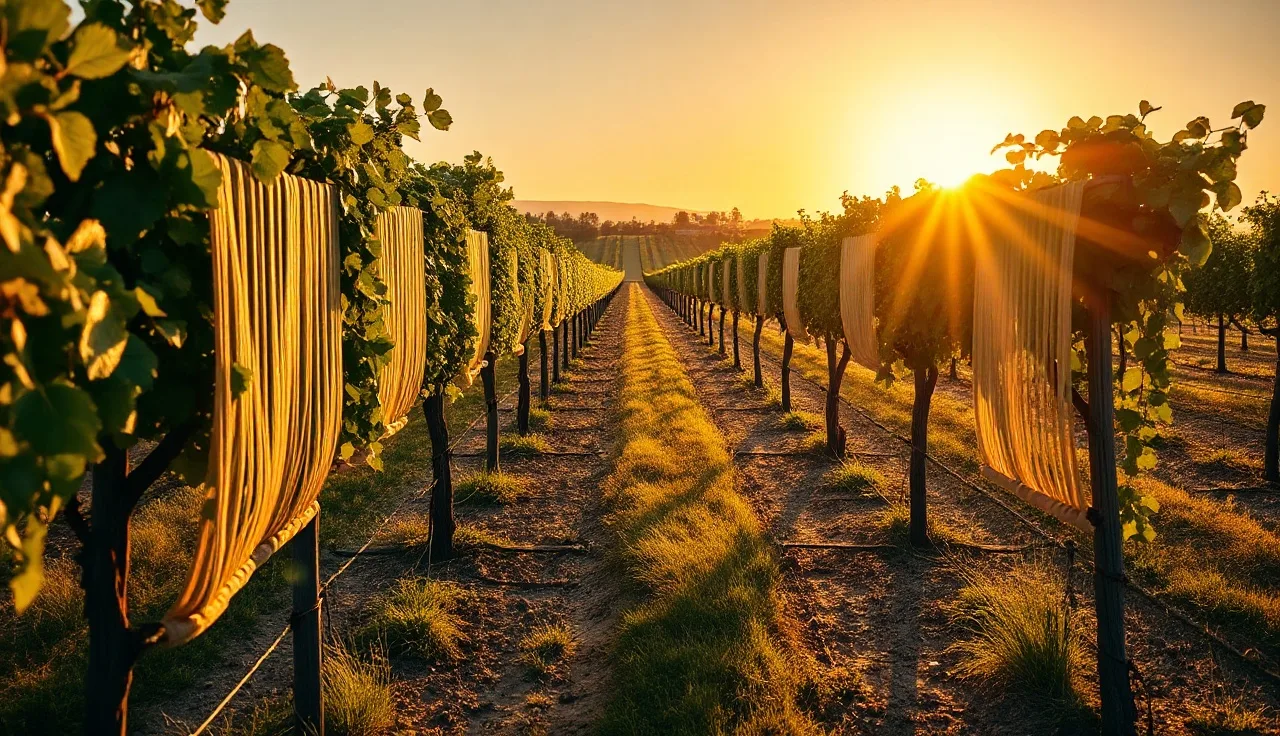
The Geneva double curtain is a bilateral, divided-canopy training system. One vine grows one trunk up to a crossarm, then splits into two horizontal cordons that run parallel down the row, roughly 4 feet apart. Shoots hang downward off each cordon, forming two separate foliage curtains on what looks, from the ground, like a single row. The two curtains never share the same light space. That is the whole point.
Nelson Shaulis and his colleagues at the New York State Agricultural Experiment Station in Geneva, New York built the system in the early 1960s to manage Concord (Vitis labrusca) vines that were simply too vigorous to perform in conventional training [1]. The name stuck. Cornell's viticulture extension team has documented the system's principles ever since.
The architecture solves one specific problem: high-vigor sites where leaf growth outcompetes fruit. A vine pushing 15 to 25 pounds of shoot growth a season, crammed into a single-plane trellis like VSP, just becomes a wall of shade. Split that canopy in two. Expose both curtains to sun and airflow. The same vine now delivers light-exposed clusters and spray that actually reaches the fruit.
How does GDC compare to other trellis systems like VSP and Scott Henry?
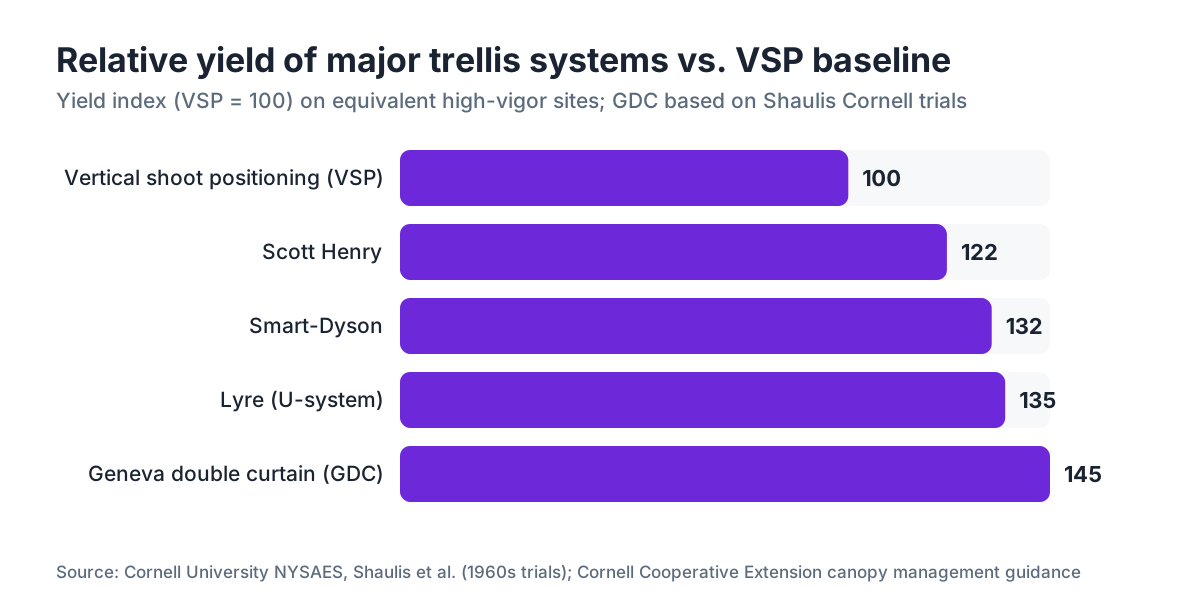
GDC divides the canopy horizontally into two downward curtains, while VSP runs a single upward plane and Scott Henry splits a single plane vertically. Here's a side-by-side on the dimensions a working vineyard manager cares about:
| System | Canopy planes | Shoot orientation | Best vigor level | Relative yield vs VSP | Mechanization ease |
|---|---|---|---|---|---|
| Vertical shoot positioning (VSP) | 1 | Upward | Low to moderate | Baseline | High |
| Scott Henry | 1 (divided vertically) | Half up, half down | Moderate to high | +15 to 30% | Moderate |
| Geneva double curtain (GDC) | 2 (divided horizontally) | Downward | High to very high | +20 to 50% | High |
| Smart-Dyson | 2 (divided vertically) | Half up, half down per cordon | High | +25 to 40% | Lower |
| Lyre (U-system) | 2 (open, angled) | Upward | Moderate to high | +25 to 45% | Lower |
GDC wins on mechanization. Shoots hang down and both curtains run parallel to the row, so a mechanical harvester straddles the row and strips both curtains in one pass [2]. Lyre and Smart-Dyson can't do that without special harvester heads or multiple passes. If you grow Concord, Niagara, or other juice and processing grapes at scale, this drives your harvest economics.
VSP loyalists will tell you GDC is harder to establish, costs more in hardware, and produces looser, more open clusters that shift tannin and anthocyanin profiles. Fair points. GDC was never built for a low-vigor Pinot Noir block in a cool valley. It was built for flat, fertile ground, aggressive vines, and a grower who needs volume without wrecking basic fruit quality.
What are the real yield and quality benefits of GDC?
GDC lifts yield 20 to 50% over single-curtain systems on the same row spacing, and Shaulis's original Concord trials showed that gain came without proportional drops in soluble solids (Brix) [1]. The reason is light interception. Two curtains catch more solar radiation per linear foot of row than any single plane can on equivalent vine spacing.
A Cornell extension publication on canopy management notes that divided systems like GDC improve "light distribution within the canopy" [3]. In practice that means better bud fruitfulness the following season, more even ripening, and lower disease pressure because air moves through instead of stalling. Botrytis and powdery mildew both need still, humid air to set up shop. Open, divided canopies dry fast after rain.
The quality story is messier for wine grapes. Juice and processing varieties (Concord, Catawba, Niagara, Marquette) love it, and GDC is essentially the standard for commercial Concord in New York and Pennsylvania. For vinifera, GDC works best on high-vigor rootstocks and fertile soils where the alternative is crowded clusters and green, vegetal flavors. Put it on a low-vigor sandy site and you'll fight chronic underproduction trying to fill two cordons.
Spray coverage is a benefit people underrate. Two open curtains let a conventional airblast sprayer hit both sides of both curtains in one row pass, assuming your nozzles are calibrated right. Fewer passes cuts labor and product cost. EPA's Worker Protection Standard requires pesticide records tied to each application and re-entry interval [4], so fewer applications means a cleaner compliance record. Tools like VitiScribe let you log each application against the correct canopy zone, so your spray records hold up when an auditor shows up.
What does it cost to set up a GDC trellis?
GDC runs roughly 15 to 35% more per acre than basic VSP, mostly because of crossarms, extra wire runs (four wires total against VSP's two or three), and heavier end posts to carry the lateral load [2]. Nobody has clean published cost data comparing the two head to head, and the spread is wide depending on post material, wire, and how much labor you do yourself.
A well-built VSP trellis in the U.S. has run about $3,000 to $6,000 per acre in materials and labor in recent years, depending on post spacing and wire gauge (prices swing by region and have climbed with steel costs since 2020). GDC adds crossarm fabrication and extra wire, putting it in the $4,000 to $8,000 per acre range for new installs. Rolling terrain that demands closer intermediate posts pushes you to the top of that range fast.
The crossarms are the hardware that sets GDC apart. They're usually 4 to 5 feet wide, welded or bolted steel, mounted at cordon height (roughly 5 to 6 feet off the ground). Some growers fabricate their own from T-posts or angle iron; commercial versions run $20 to $50 each depending on gauge and coating. At 250 to 350 posts per acre for standard row spacing, crossarms alone add $5,000 to $17,500 per acre.
So the math only works where the yield premium and machine-harvest savings pay back that spend over the life of the vines. For high-tonnage juice grape operations, they usually do. For a 5-acre estate wine block chasing dollars per ton, probably not.
How do you set up and train vines on a GDC system?
Year one looks like any other system: plant the vine, establish one straight, strong trunk, build root reserves. Nothing else. Don't rush cordon development.
In year two, once the trunk reaches crossarm height (typically 5 to 6 feet), pick two lateral shoots from the trunk at that level. Train one each direction along the top wires of the crossarm, which run perpendicular to the row. These become your two permanent cordons. Each runs horizontally away from the trunk, aiming for about 2 feet of extension toward the neighboring vine on each side, until it meets the cordon from the adjacent vine and forms a continuous wire-trained cordon on each strand.
Shoots are not trained upward. This is the mistake VSP growers make constantly. In GDC, shoots hang down from the cordon wire, guided by two lower catch wires on each side of the crossarm. Gravity does most of the work. The catch wires hold the curtain in place and stop it blowing into the neighboring curtain in wind [3].
Year three is when the system starts showing what it can do. Expect lighter crops in years two and three while cordons extend and spur positions form. Full production usually lands in year four or five, which tracks with other high-wire cordon systems. WSU extension recommends patience with cordon establishment and warns against overcropping early, which can permanently weaken spurs and cut long-term yield [5].
Pruning is spur pruning: 2-bud spurs spaced 6 to 8 inches along each cordon. That gives you roughly 25 to 35 spurs per cordon, or 50 to 70 total per vine depending on row spacing. Count nodes, not shoots. Pruning by eye instead of by bud count is how you end up with uneven canopy density.
What row spacing and vine spacing work with GDC?
Standard GDC row spacing is 10 to 12 feet, wider than VSP so the two curtains can exist without crowding each other or the next row's curtains. Some growers settle on 11 feet as a compromise between equipment clearance and light interception. Each cordon extends about 2 feet from the trunk in opposite directions, so the divided canopy spans roughly 4 feet inside a 10 to 12 foot row.
Vine spacing in the row is typically 8 feet, sometimes 6 feet on high-vigor sites where you want more roots competing to temper any single vine. UC Davis canopy management guidance notes that in-row vine spacing interacts with rootstock and soil fertility, and that GDC works best when the combination keeps vine size in the "moderately high" range rather than truly out of control, because even GDC can't manage a vine that's genuinely runaway [6].
Row orientation matters more with GDC than with VSP because you have two curtains chasing light. East-west rows give both curtains maximum sun in the northern hemisphere. North-south rows are more common for wind and machinery reasons, work fine, but leave the two curtains catching somewhat uneven light through the day.
Which grape varieties benefit most from GDC?
Concord is the canonical GDC variety, and for good reason. It's high-vigor and shoot-dense, and it outgrows single-plane systems fast. GDC is the dominant system for commercial Concord juice grape production in New York, Pennsylvania, Michigan, and Washington State [1].
Beyond Concord, GDC handles other high-vigor American and hybrid varieties: Niagara, Catawba, Marquette, Frontenac, and their cousins. Most of these grow in the Great Lakes region and the Upper Midwest, where fertile soils and steady rainfall build aggressive vines.
For vinifera, GDC is less common but not rare. Chardonnay, Riesling, and Cabernet Sauvignon on high-vigor rootstocks (SO4, 5BB, 3309 on fertile soils) can benefit. The real question is whether your soil and rootstock combination actually produces excess vigor. On a low- or moderate-vigor site you'll spend years struggling to fill two cordons, and the canopy will never reach the density that justifies the extra trellis cost.
For the paso robles wineries community and other warm, dry regions where vigor is often moderate and water is a lever you manage, GDC is rarely the first pick. Dry-farmed vines on rocky soils don't build the shoot mass that justifies horizontal canopy division. That's not a knock on GDC. It's just the wrong tool for that ground.
How do you manage spray programs and canopy treatments in a GDC vineyard?
Spray programs in GDC are simpler in one way and fussier in another. The open canopy lets your airblast sprayer penetrate both curtains from one row position, cutting passes compared to a dense, closed VSP wall. Extension research keeps showing that canopy openness is one of the strongest predictors of fungicide efficacy, because you can't spray what the air can't reach [3].
The fussy part is targeting. With two curtains hanging at different horizontal positions on the crossarm, you have to confirm your nozzle pattern actually reaches the inner faces, more than the outer face of each curtain. A rear-mounted airblast sprayer with a top-to-bottom nozzle array handles this reasonably well at 10 to 12 foot row spacing. Narrower rows leave coverage gaps on the inner faces.
EPA's Worker Protection Standard (40 CFR Part 170) requires that agricultural pesticide applications carry specific records: product, rate, date, application method, and re-entry interval [4]. In a GDC block where you're logging applications across two canopy zones on the same row, your records need to show clearly that both curtains got coverage at the intended rate. Sloppy record-keeping is the most common compliance failure in vineyard spray programs, and it's completely avoidable. Keeping those records in a field operations platform like VitiScribe makes it easier to document application specifics by block and trellis type.
Pheromone dispensers for grape berry moth or vine mealybug need placement on both cordons for adequate mating disruption. Budget for roughly 1.5 to 2x the dispenser density you'd use in a VSP vineyard of the same acreage, because the canopy volume is larger [5].
What are the main problems people run into with GDC, and how do you fix them?
Uneven cordon fill is the most common problem, worst in years two through four. One cordon extends well; the other lags. It usually traces back to an imbalanced graft union or a lopsided shoot selection in year two. Fix it by leaving an extra spur on the weaker side to push growth, and by aiming the weaker cordon shoot toward the prevailing sun. Be patient. Never compensate by dumping fruit on the stronger cordon.
Cordon drooping shows up when your top wire gauge is too light or your posts are spaced too wide. A fully leafed GDC vine carrying a crop is heavy. Use 12.5-gauge high-tensile at minimum, and many experienced growers run 10- or 11-gauge on the cordon wire specifically. Post spacing of 18 to 24 feet is standard; go wider and you invite wire sag that throws off the curtain geometry.
Curtains collapsing into each other after storms is a real headache. The lower catch wires on each side of the crossarm are your defense. Set them at the right height (roughly 12 to 18 inches below the cordon wire) and keep them tensioned. Collapsed curtains recreate the exact shading problem you installed GDC to avoid.
Over-vigorous shoots that run long (past 50 to 60 inches) get managed with hedging. Mechanical hedging is easy on GDC because the curtains hang in a predictable vertical plane. Set your hedger to trim about 36 to 48 inches below the cordon wire. Severe under-vigor is a different beast, usually a rootstock that doesn't match the site.
Is GDC suited for mechanical harvesting?
Yes, and it's one of the system's strongest arguments. GDC was designed with mechanical harvest in mind. The two downward-hanging curtains sit in a fixed geometric relationship to the trellis, and a standard over-the-row harvester strips both curtains at once as it straddles the row [2].
Concord juice grape operations in New York harvest almost entirely by machine, and GDC's fit with over-the-row harvesters is a big reason the system dominates that industry. Hand harvest of Concord in New York State runs about $300 to $600 per acre against $60 to $150 per acre by machine on similar crop loads (these are rough industry figures, not published research; costs vary a lot by operation size, equipment ownership, and local labor). On a 50-acre Concord block, that gap is real money.
For wine grapes, machine harvest is more contested on quality grounds, but GDC's architecture makes it technically workable where some other divided systems aren't. If you're growing a processing-grade Chardonnay or a large-volume red for direct-to-consumer sales, machine harvest on GDC is worth a look. Gervasi vineyard and similarly scaled operations that run their own production often find harvest-equipment compatibility shapes their trellis choice as much as any agronomic factor.
How does GDC fit into a vineyard record-keeping and compliance program?
GDC needs no special compliance filings beyond what any vineyard needs, but the architecture changes how you structure records. Note the trellis system in the block description on your spray records, because it affects re-entry intervals and what counts as adequate coverage under EPA WPS [4]. If your state requires pesticide use reports (California's CDPR system is the toughest example), your block records need to reflect the canopy volume being treated, since some rate calculations run on canopy volume rather than straight acreage.
Pruning weight data, collected as part of canopy management (the Ravaz Index approach popularized by extension programs), earns its keep in GDC because you're balancing two cordons per vine, and the ratio of fruit weight to shoot weight tells you whether the system is working. Target Ravaz Index for GDC matches other cordon systems: roughly 5 to 10, meaning fruit weight is 5 to 10 times pruning weight [6]. Below 5 suggests overcropping; above 10 suggests undercropping or excess vigor.
Worker safety records under EPA WPS must carry the specific re-entry interval for each product, the application date, and the location [4]. For a GDC block that's the same as any block, but the larger canopy surface area means you're likely applying more product volume per acre to hit equivalent coverage. Log it honestly. Regulatory audits happen, and a spray record showing improbably low product volume for a known high-canopy system raises flags.
Frequently asked questions
Who invented the Geneva double curtain trellis system and when?
Nelson Shaulis and colleagues at Cornell University's New York State Agricultural Experiment Station in Geneva, New York developed GDC in the early 1960s. The work focused on Concord grapes on high-vigor sites in the Finger Lakes and Lake Erie regions. Shaulis published his foundational research through Cornell extension, and the system takes its name from the town where the experiment station sits.
Can you convert an existing VSP vineyard to GDC?
Technically yes, but it rarely pays unless your existing posts already stand at 5 to 6 feet and are in good shape. You'd add crossarms to every post, string new cordon and catch wires, and retrain vines off their current cordon positions. For most vineyards over 10 years old with established VSP cordons, you're better off replanting and starting fresh with GDC architecture than fighting an old cordon structure.
What wire gauge and post height does GDC require?
Use minimum 12.5-gauge high-tensile for cordon wires, and many growers prefer 10- or 11-gauge given the load. Post height should put the crossarm at 5 to 6 feet above the soil, so your line posts typically need to stand 7 to 8 feet above ground after installation. Crossarms are 4 to 5 feet wide. Post spacing of 18 to 24 feet is standard; wider risks wire sag under crop and canopy weight.
Is GDC good for wine grapes or just juice grapes?
GDC works for wine grapes on high-vigor sites with fertile soils and vigorous rootstocks. It's most common for juice and processing varieties (Concord, Niagara, hybrids) where yield volume matters. For vinifera, consider it on sites where VSP keeps producing crowded, shaded clusters and green flavors despite good canopy management. On low- to moderate-vigor sites, VSP or Scott Henry is usually more practical.
How long does it take for a GDC vineyard to reach full production?
Expect years two and three for cordon establishment, with full production usually arriving in year four or five. The two cordons need time to extend to full length and set well-spaced, productive spur positions. Rushing crop load in years two or three weakens spur development and costs you long-term yield. WSU extension viticulture guidance recommends conservative cropping during the first two to three production years on any cordon system.
What's the typical row spacing for a GDC trellis?
Standard GDC row spacing is 10 to 12 feet, with 11 feet common as a compromise. You need enough width for equipment to pass without damaging the hanging curtains, and enough separation between rows so adjacent curtains don't shade each other. In-row vine spacing runs 6 to 8 feet. The two cordons extend roughly 2 feet from the trunk in each direction, so the full canopy width is about 4 feet inside the row.
Does GDC require more pruning labor than VSP?
GDC spur-pruning covers roughly twice the linear cordon length per vine as a bilateral VSP cordon, because you have two cordons instead of one plane of bilateral arms. In practice, experienced pruners move through GDC faster per unit length because the geometry is simple and repetitive. Overall pruning labor per acre runs comparable to or slightly above VSP on equivalent vine spacing. Mechanical pre-pruning works well thanks to the predictable curtain geometry.
How does GDC affect disease pressure and fungicide use?
Open, divided canopies consistently show lower Botrytis and powdery mildew pressure in canopy management research, because airflow dries foliage faster after rain or dew. Cornell and UC Davis extension both treat canopy architecture as a first-line disease management tool. Lower pressure can reduce fungicide frequency, but it's site- and season-dependent. You'll still need a full program in high-pressure years. GDC gives you a structural advantage, not immunity.
What rootstocks work best with GDC?
GDC suits moderate to high-vigor rootstocks: SO4, 5BB Kober, 3309 Couderc, and Riparia Gloire see common use under GDC on fertile soils. The system channels high vigor productively rather than suppressing it, so pairing GDC with a low-vigor rootstock like 101-14 or Schwarzmann on low-fertility ground gives you weak, underfilled cordons and poor canopy. Match rootstock vigor to soil fertility first, then choose GDC if the combination lands you in the high-vigor zone.
How do catch wires work in GDC and why do they matter?
Catch wires run horizontally below the cordon wire on each side of the crossarm, typically at 12 to 18 inch intervals below the cordon. Their job is to guide shoots downward and hold the curtain in a defined vertical plane so the two curtains don't collapse into each other or blow together in wind. Without properly tensioned catch wires, shoots wander, curtains merge, and you lose the light exposure the whole system depends on. Two lower catch wires per side is a minimum; some growers use three.
Can GDC be used in organic or certified vineyard programs?
Yes. GDC is a training architecture, not a chemical program, and it's fully compatible with organic certification under USDA NOP rules. The improved canopy openness can even reduce fungicide reliance, which matters in organic programs where your approved material list is shorter. Your spray records and input logs still need to meet your certifier's requirements regardless of trellis system. The trellis itself carries no certification implications.
What are the EPA worker protection rules for spraying a GDC vineyard?
EPA's Worker Protection Standard (40 CFR Part 170) applies to GDC the same as any vineyard. Records must include product name, EPA registration number, application date, location, rate, and re-entry interval for each application. Workers cannot re-enter during the restricted-entry interval without required PPE. For GDC, make sure records reflect actual canopy coverage; the larger canopy surface area relative to VSP affects the product volume needed per acre to meet label rates.
Is GDC suitable for steep hillside vineyard sites?
GDC is generally not ideal for steep slopes. The crossarm geometry and the need for machinery to straddle the row work best on flat to gently rolling ground. Steep hillsides make crossarms hard to keep level, and the machine-harvest advantage vanishes if equipment can't safely run the slope. VSP or other single-plane systems are more practical on steep sites. Some terraced hillside vineyards use GDC on the flat terrace sections, but it's not the norm.
How does GDC affect fruit maturity and Brix at harvest?
Well-managed GDC vineyards show comparable or better Brix than overcrowded single-curtain systems on the same site, because exposed clusters ripen more evenly. Shaulis's original Concord trials showed yield gains under GDC without proportional Brix drops, which challenged the old assumption that higher yields always mean lower quality. Still, GDC is no substitute for crop thinning when vine balance demands it. An overcropped GDC vine ripens poorly, same as any overcropped vine.
Sources
- Cornell Cooperative Extension, Viticulture and Enology Program - Canopy Management and Trellis Systems: GDC is designed for mechanical harvesting compatibility; over-the-row harvesters can strip both curtains in a single pass, and the system costs 15 to 35% more in trellis materials than VSP due to crossarms and additional wire runs
- Cornell Cooperative Extension, 'Crop Load Management and Canopy Architecture' - Viticulture Extension: Divided canopy systems improve light distribution within the canopy, leading to better bud fruitfulness, more uniform ripening, and lower disease pressure from improved airflow
- U.S. EPA, Worker Protection Standard for Agricultural Pesticides (40 CFR Part 170): EPA WPS requires pesticide application records including product, rate, date, application method, and re-entry interval for all agricultural pesticide applications including vineyards
- Washington State University Extension, 'Vineyard Establishment and Training Systems' - WSU Viticulture: WSU extension recommends conservative cropping during the first two to three production years on cordon systems to protect long-term spur development; pheromone dispenser density should be increased in divided canopy systems
- UC Davis Viticulture and Enology Extension, Canopy Management Guidelines: Target Ravaz Index for cordon systems including GDC is approximately 5 to 10 (fruit weight to pruning weight ratio); vine spacing in the row interacts with rootstock and soil fertility in determining whether GDC is appropriate for a given site
- USDA Agricultural Research Service, Viticulture Research Publications: High-vigor Vitis labrusca varieties including Concord and Niagara are primary candidates for GDC in commercial juice grape production across New York, Pennsylvania, Michigan, and Washington State
- Cornell University, 'Training Systems for Grapevines' - Dept. of Horticulture: GDC crossarm width is typically 4 to 5 feet; cordon wire should be minimum 12.5-gauge high-tensile; post spacing of 18 to 24 feet is standard for the system
- UC Davis Department of Viticulture and Enology, 'Rootstock Selection Guide': Moderate to high-vigor rootstocks (SO4, 5BB Kober, 3309 Couderc) are compatible with GDC on fertile soils; pairing GDC with low-vigor rootstocks on low-fertility sites produces underfilled cordons
- USDA National Organic Program (NOP), Organic Crop Production Standards: GDC as a training architecture carries no NOP certification implications; organic compliance depends on input and spray program, not trellis system choice
- WSU Extension, 'Mechanical Harvesting Considerations for Pacific Northwest Vineyards': GDC's shoot orientation and curtain geometry allow standard over-the-row mechanical harvesters to strip both curtains simultaneously, a key economic advantage for high-tonnage operations
- Cornell Cooperative Extension, Lake Erie Grape Research and Extension Center: GDC is the dominant trellis system for commercial Concord juice grape production in the Lake Erie region of New York and Pennsylvania
Last updated 2026-07-09