Gable trellis system for vineyards: how it works and when to use it
TL;DR
- A gable trellis (also called an open gable) spreads two cordon arms upward and outward at roughly 30-45 degrees to form a V-shaped canopy.
- It improves sunlight exposure and airflow versus vertical shoot positioning, cuts fungal disease pressure, and suits high-vigor varieties in humid climates.
- Installation runs $8,000-$14,000 per acre depending on post spacing and wire count.
What is a gable trellis system and how does it differ from VSP?
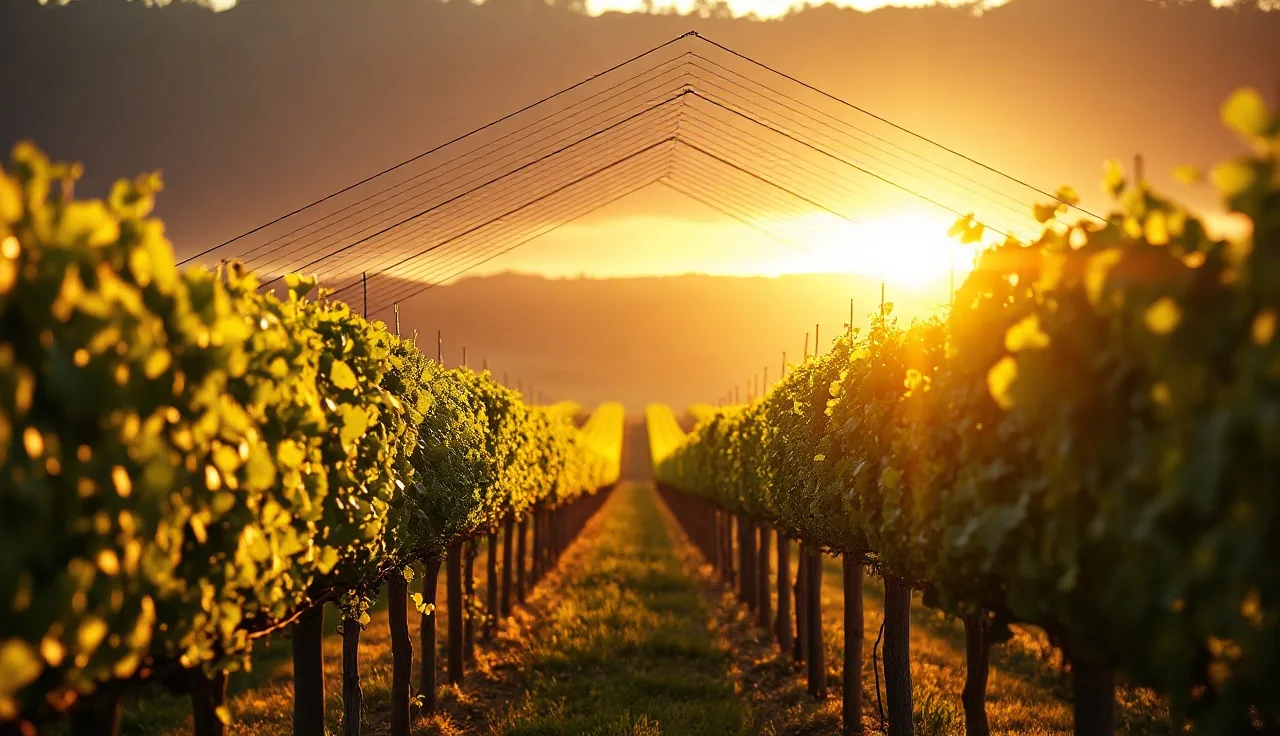
A gable trellis trains shoots upward and outward along two angled wire planes that meet at the base like the roof of a house. That is where the name comes from. The canopy cross-section looks like an open V. Fruit hangs inside the V in the shade while foliage fans out to both sides, catching sun on the outer leaf surfaces.
Vertical shoot positioning (VSP) pushes every shoot straight up into a single flat curtain. That works well on low-vigor sites in dry climates, where sun angles are good and disease pressure is low. But pack a high-vigor variety like Merlot or Marquette into a humid Mid-Atlantic or Great Lakes site and a VSP canopy turns into a wall of overlapping leaves. Air stagnates. Botrytis moves in. The gable pulls that wall apart into two planes so light and air reach the fruit.
The open gable is a specific version where cordon arms train at 30 to 45 degrees from vertical, and shoot positioning wires on each side let shoots hang or tuck outward instead of straight up. Some growers use a fixed-angle gable. Others adjust wire tension through the season. The geometry is the same either way.
Cornell's viticulture program has studied divided-canopy systems since the 1990s. Separating shoot density into two planes drops the average leaf layer count from 6-8 in a dense VSP to 3-4, which is the range where interior cluster light exposure actually improves [1].
What are the advantages of a gable trellis over other trellis systems?
The clearest win is canopy microclimate. Pull the shoots apart into two angled planes and you get more exposed leaf area per vine, better airflow through the fruiting zone, and more direct sun on the outer canopy. That helps two things: photosynthesis and disease control.
On the photosynthesis side, interior leaves working below roughly 30% of full sunlight add little net carbon to the vine and can turn into carbon sinks later in the season. Washington State University extension guidance on canopy management makes this point clearly [2]. The gable's open geometry keeps more leaves in productive light.
On disease control, better airflow shortens leaf wetness after rain or irrigation. Powdery mildew and Botrytis bunch rot both need prolonged wetness to infect. Shorter drying times mean narrower infection windows. Nobody should promise fewer sprays from a trellis choice alone, because in a bad weather year the weather swamps any trellis effect. But in a normal year on a high-vigor site, growers running divided canopies report lower Botrytis incidence.
Yield per acre also tends to run higher under a gable than VSP on the same site, because more shoots can be positioned productively without shading each other. The tradeoff is labor. More shoots mean more tucking and hedging unless you buy a hedger that handles angled wires.
Color improves too. Anthocyanin buildup in red varieties is light-dependent, so clusters that get more light through an open canopy tend to develop deeper color. UC Davis viticulture research has documented the link between fruiting-zone light and berry skin anthocyanin across multiple seasons [3].
What are the disadvantages and limitations of the gable trellis?
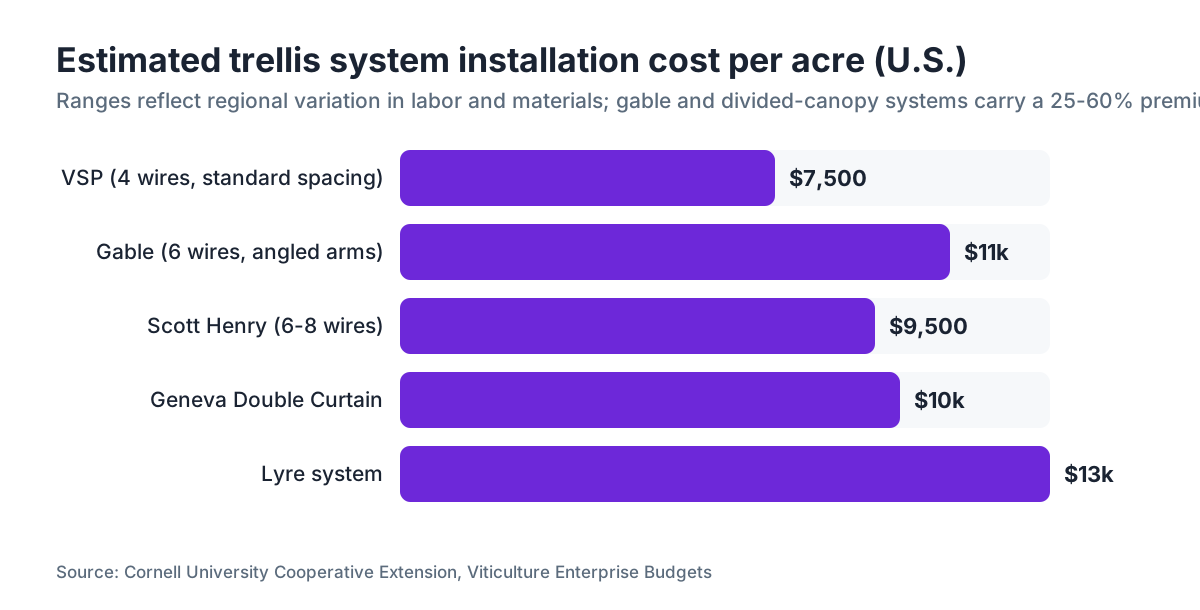
Cost comes first. A gable needs more wire than VSP, sturdier end posts to hold the lateral tension from angled wires, and often wider rows to fit the expanded canopy. That pushes establishment cost to $10,000-$14,000 per acre against $6,000-$9,000 for a basic VSP, depending on region, post material, and wire gauge [4].
It also demands more skill. A neglected gable canopy, one where shoots never got tucked or hedged on time, collapses inward and recreates the dense wall you were trying to avoid. VSP forgives a missed pass. A gable doesn't. If labor is tight, that matters.
Mechanical harvest gets harder. Standard over-the-row harvesters hit a single near-vertical plane. Gable geometry needs either a modified harvester head or handpicking, and both cost money. That's fine for a small winery selling direct. It's a real constraint for high-volume operations.
The gable is also wrong for some sites. Low-vigor vines on lean, well-drained soils in a dry climate don't grow enough shoot to fill two planes. You end up with sparse, gappy wires and no canopy benefit. The system earns its cost where vigor is a problem, not where the vine already struggles to fill a VSP.
How does gable trellis setup and installation work?
Start with row spacing. Gable trellises need rows at least 9 to 11 feet apart so the wider canopy doesn't shade the next row. Anything tighter than 9 feet defeats the point.
End posts take the most abuse because they anchor the angled wire tension. Use pressure-treated wood posts at 6-7 inches diameter or steel H-posts with proper deadman anchors. The angled arms create real outward lateral force at each row end, and undersized anchors pull out within a few seasons.
A typical gable runs one or two fruiting wires low (24-30 inches off the ground) for the cordon, then two pairs of foliage wires on each angled arm at roughly 12-inch spacing up the plane. Arm angle varies by grower and variety, but 30-40 degrees from vertical is the common range.
Intermediate posts hold the wire planes up. Standard spacing is 18-24 feet, though some growers stretch to 30 feet with heavier wire to cut post count and cost. Foliage wires are usually 12.5 gauge, and high-tensile steel holds tension far better than soft wire. It pays for itself.
Install in order: set end posts and anchors, set intermediate posts along the row, string the cordon wire, add the angled arm hardware (welded steel arms or adjustable brackets), then run the foliage wires arm to arm.
Converting an existing VSP block means adding the angled arm hardware and extra wires, and often retraining the cordon position. Figure two seasons to fully convert a mature block without stressing the vines.
Which grape varieties and climates benefit most from a gable trellis?
High-vigor varieties are the obvious candidates. Merlot, Zinfandel, Syrah, Marquette, Frontenac, and most hybrids in humid climates all tend to overgrow a VSP. The gable gives that vigor somewhere productive to go.
Humid climate is the second filter. Farm in the Finger Lakes, the Mid-Atlantic, the Midwest, or the Pacific Northwest west of the Cascades, or anywhere with regular summer rain and the fungal pressure that follows, and the gable's disease-control benefit is real and repeats every year. In an arid site with naturally low disease pressure, the extra cost and management may not pay off.
That said, some California growers run gable systems on very vigorous hillside sites or where they push high yields on fertile valley floor. It isn't a humid-region-only tool. It's a vigor tool, and if you have excess vigor it helps regardless of climate.
Naturally low-vigor varieties, like some Grenache clones or Pinot Noir on lean rootstocks, rarely benefit. You'd be paying for infrastructure the vine can't fill. Get a vine balance assessment on your site before you commit to any trellis change.
Some Paso Robles wineries working Rhone varieties on higher-elevation clay sites have tried gable systems to handle the vigor that coastal influence and rich soils create, though VSP still dominates that appellation.
What does a gable trellis system cost per acre to install?
Honest answer: cost varies enough that any single number needs caveats. The variables are post material (wood vs. steel), post spacing, wire gauge, regional labor rates, and whether you're planting new or converting an existing block.
For new installation in most U.S. wine regions in 2024-2025, expect these ranges:
| Component | Low estimate | High estimate |
|---|---|---|
| End posts, anchors, hardware | $800 | $1,600 per row end |
| Intermediate posts (wood, per post) | $12 | $25 |
| Gable arm hardware (per post) | $8 | $20 |
| High-tensile wire (per acre, 6 wires) | $400 | $700 |
| Labor for post setting and wiring | $2,500 | $5,000 |
| Total installed (per acre) | $8,000 | $14,000 |
Those figures track the ranges published by extension economists at Cornell and WSU for divided-canopy systems, though neither program publishes a single authoritative per-acre gable number because regional variation is too wide [4][5].
A basic VSP with 4 wires and standard post spacing runs $6,000-$9,000 per acre in the same regions. So the gable premium is roughly $2,000-$5,000 per acre upfront. Payback depends on your yield response, your disease-driven spray savings, and what you grow.
Maintenance costs more too. More wire to tension every year, more hardware to inspect, more canopy passes to make. Budget an extra $200-$400 per acre per year for gable upkeep over VSP.
How do you manage the canopy in a gable trellis system throughout the season?
Winter pruning on a gable follows the same rules as VSP. You cane prune or spur prune the cordons and target bud count to your yield and vine balance goals. The difference is two cordon arms per vine instead of one, each running at an angle along its wire plane.
Budbreak through bloom is where the gable's demands split from VSP. As shoots grow you tuck them into the angled foliage wires before they flop and tangle. On a VSP with catch wires, gravity does most of the work. On a gable, shoots on the lower wires still grow more or less upward, but the angled geometry means you have to actively place them into the right plane.
Shoot positioning, usually done when shoots are 8-12 inches long, is your biggest early-season labor input. Get it right and the canopy organizes itself for the rest of the season. Miss the window and you're doing corrective work at bloom, which is expensive and can damage flower clusters.
Hedging (mechanical topping) runs 2-4 times a season depending on variety and vigor. A gable hedger has to cut the top of the canopy and, if lateral growth pushes past the wire plane, the sides. Some growers make two hedger passes per event, one down each side of the row.
Leaf removal in the fruiting zone still helps on a gable, especially on the morning-sun (east) side in warm climates to expose clusters early. In cool climates, pulling leaves on the afternoon-sun (west) side helps ripening. The gable doesn't remove the need for leaf pulling. It just cuts how many leaves you pull, because interior shading is already lighter.
If you track spray records and canopy passes digitally, the gable's extra management events make organized records pay off even more. Tools like VitiScribe log each canopy pass with GPS block ID, date, and operator, which matters when you reconstruct a season for a compliance audit or a buyer verification request.
How does the gable trellis affect spray programs and pesticide records?
The gable's open canopy changes spray penetration in a real way. Because the two wire planes separate the shoot mass, an airblast or tower sprayer reaches both sides of the canopy from one pass with better internal penetration than a dense VSP wall allows. You get better coverage per gallon of material.
That matters for fungicides. Products like mancozeb, captan, or DMI fungicides only work when they reach the cluster and nearby leaf tissue. A dense canopy blocks spray from the interior clusters. An open gable lets the same sprayer reach clusters that would otherwise sit shielded.
On compliance, the EPA Worker Protection Standard requires that pesticide applications be recorded and that restricted entry intervals be posted. Those rules apply regardless of trellis system [6]. But the gable can change which products and rates you actually need, because better coverage means you may not have to compensate with a higher rate.
WSU extension guidance on fungicide timing in Pacific Northwest vineyards points to canopy density at bloom as the strongest predictor of Botrytis pressure later in the season [2]. A gable that keeps density lower through that window lowers your baseline risk going into the critical period.
Keep spray records by block. Note the trellis system, a canopy density rating, and any rate adjustments tied to coverage. If you shift intervals based on canopy condition, write down why. State Department of Agriculture auditors want to see that your rate and timing decisions rest on a reason, not a habit.
What research supports the gable trellis system?
The science behind divided-canopy systems, which include gable, Scott Henry, Geneva Double Curtain, and lyre, is well established. Richard Smart and Mike Robinson's 1991 book "Sunlight into Wine" is the founding practical text, though it's a book, not a journal article.
On the experimental side, Cornell's Finger Lakes research found that divided-canopy systems produced higher yields, often 20-40% more per acre, than VSP on high-vigor sites, with equal or better wine quality scores in sensory panels [1]. The caveat: those gains depend on vine vigor actually filling the system. On low-vigor sites the yield response is close to nothing.
Washington State University's extension viticulture program frames the issue directly, noting that light interception and canopy density are among the most important factors determining wine grape quality in humid regions [2]. That framing supports the gable's whole design logic.
UC Davis research on canopy microclimate has connected fruiting-zone light to both berry composition (sugar, pH, anthocyanins) and disease incidence across California systems [3]. Much of that work sits in VSP and overhead contexts, but the underlying light-quality relationship carries over to gable geometry.
The gap in the literature: most U.S. gable research is observational or from small-plot trials, not large replicated commercial studies. Nobody has great data on long-term ROI across diverse regions. The closest thing is Cornell's economic modeling for New York vineyards, which suggests divided-canopy systems break even on their cost premium in 5-8 years on high-vigor sites [5].
How does the gable trellis compare to Scott Henry, GDC, and lyre systems?
All four are divided-canopy designs. They solve the same problem: too much shoot growth for a single-plane trellis to carry productively. They differ in geometry, cost, and how hard they are to manage.
Scott Henry divides the canopy vertically rather than by angle. It trains alternating shoots up and down from a mid-height cordon. The downward shoots feel backward to manage, but the system works with standard over-the-row harvesters, which is a real advantage at scale.
Geneva Double Curtain (GDC), developed at Cornell in the 1960s, uses two parallel cordons about 4 feet apart on a wide trellis head, each with shoots hanging down. It handles extreme vigor and mechanizes well. It shows up less in new plantings because the drooping shoots trap humidity in the fruiting zone, which partly cancels the canopy-opening benefit.
The lyre system, developed in France by Alain Carbonneau, opens two angled shoot planes into a U, similar in concept to the gable but with a wider base separation. It usually costs more to build and is harder to mechanize than a gable.
The open gable sits between VSP and the more extreme divided systems. It's easier to manage than GDC, works with existing spray equipment better than lyre, and gives a canopy shape most vineyard workers find intuitive after a season or two.
| System | Canopy planes | Shoot direction | Harvester compatible | Relative cost |
|---|---|---|---|---|
| VSP | 1 | Upward | Yes | Baseline |
| Gable | 2 angled | Upward/outward | Modified only | +25-50% |
| Scott Henry | 2 vertical | Up and down | Yes | +15-30% |
| GDC | 2 horizontal | Downward | Yes | +20-40% |
| Lyre | 2 angled, wide | Upward/outward | Rarely | +40-60% |
Can you convert an existing vineyard to a gable trellis?
Yes, but it takes planning and patience. The wire infrastructure can go in during a single winter offseason. Adding angled arm hardware to existing posts, stringing new wire planes, and repositioning cordon training are all tasks your crew can finish before budbreak.
The vine is the harder part. If your vines carry a single horizontal cordon at VSP height, you can either leave that cordon and retrain one new arm upward at an angle, or cut back and start a fresh cordon structure. Cutting back reaches full production slower but gives cleaner geometry long-term. Keeping the old cordon and adding a second arm is faster but creates an awkward transitional structure for the first year or two.
A block in conversion usually loses one vintage of full production during the switch. Plan your cash flow around that.
One practical note: if your rows sit closer than 9 feet, a full gable expansion will shade the neighbors unacceptably. In that case you aren't building a true gable. You're building a modified narrow gable, and the canopy-opening benefit will be smaller than on properly spaced rows.
Document the conversion. Photos of each growth stage, records of which blocks got retrained which year, and notes on vine response all help future management. If you work with a lender or a crop insurance program, they may want records showing the trellis change was planned and done properly rather than thrown together.
What worker safety and regulatory requirements apply to gable trellis vineyards?
The trellis itself triggers no specific regulation, but the spray and field work around it does. The EPA Worker Protection Standard at 40 CFR Part 170 covers all agricultural pesticide applications, including vineyard sprays on any trellis type [6]. Key WPS requirements include posting restricted entry intervals, giving handlers the right PPE, and keeping application records for at least two years.
Some states add rules on top of WPS. California's Department of Pesticide Regulation requires written notice to county agricultural commissioners for certain restricted materials and runs its own pesticide use reporting format [7]. New York's Department of Environmental Conservation has record-keeping rules that align with WPS and extend it in places.
For the physical structure, your county may require grading or land disturbance permits if you're doing significant earthwork for post installation. Agricultural exemptions are common, but check with your local planning department before you assume one applies.
On worker safety, gable systems create their own motion patterns. Workers tucking shoots into angled wire planes do more overhead reaching than VSP tuck work. Note that in your injury and illness prevention program if you operate in California or under an OSHA state plan [9]. Build your safety program around the motions in your actual trellis, not a generic vineyard template.
Frequently asked questions
What is the difference between a gable trellis and an open gable trellis?
They're essentially the same thing. 'Open gable' emphasizes that the V-shaped canopy is intentionally open at the top and between the two shoot planes, letting air and light into the fruiting zone. Some growers use 'gable' for any angled two-plane system and add 'open' for a wider-angle, less-dense version. In most U.S. extension and research literature, the terms are used interchangeably.
What row spacing does a gable trellis require?
Plan on at least 9 feet between rows, and 10-11 feet is more comfortable for the canopy width a gable creates plus equipment clearance. Spacing below 9 feet risks shading the next row, which defeats the purpose. Many new gable plantings use 10-foot rows with 6-8 feet between vines in the row, giving vine populations around 544-726 per acre.
Does a gable trellis work for Pinot Noir?
Usually not the best fit. Most Pinot Noir clones run low-to-medium vigor and do well in VSP, which keeps fruit exposure and yield easier to control. A gable needs vigorous shoot growth to fill two planes productively. If you have an unusually vigorous Pinot Noir site, a narrow gable or Scott Henry might help, but a standard gable on low-vigor Pinot leaves you paying for infrastructure the vine can't use.
How many wires does a gable trellis system need?
A basic gable uses 5-7 wires per row: one or two low cordon support wires and two pairs of foliage wires on each angled arm. Some growers add a third foliage pair for very vigorous varieties. More wires mean more shoot control and a steadier canopy, but also more install cost and annual tensioning. Six wires (two cordon, two foliage pairs) is the most common setup.
Can you mechanically harvest a gable trellis vineyard?
Standard over-the-row harvesters don't fit a gable's geometry well. The angled planes extend beyond the typical harvester head profile. Some growers use modified heads built for divided canopies, and a few manufacturers offer heads for angled wire configurations. Handpicking is the default for most U.S. gable vineyards. If mechanical harvest drives your economics, Scott Henry or GDC may fit better.
How long does it take for a gable trellis to pay for itself?
Cornell's economic modeling for New York high-vigor sites suggests 5-8 years to break even on the cost premium over VSP, assuming the yield and quality gains actually show up [5]. That range assumes 20-35% higher yields, modest spray savings from lower disease pressure, and stable grape prices. On low-vigor sites or in years with bad market prices, the breakeven period runs much longer.
What angle should the gable arms be set at?
Most growers use 30-40 degrees from vertical, which opens the canopy enough to improve airflow without tipping so far that shoots want to fall outward instead of growing up into the wire plane. Steeper angles (45 degrees or more) open the canopy more dramatically but add shoot-management work because gravity then pulls growth sideways. Start at 35 degrees and adjust to your variety's shoot behavior.
Does the gable trellis reduce the need for pesticide sprays?
It can lower infection risk by shortening how long canopy surfaces stay wet after rain, which narrows fungal infection windows. That gives you more room to flex spray intervals in moderate disease-pressure years. But in high-pressure years, the calendar and weather drive your program more than trellis geometry does. A gable is not a substitute for a sound fungicide program. It's a tool that makes the program more efficient.
Which rootstocks work best with gable trellises?
Moderately vigorous rootstocks like 3309 Couderc, 101-14 Mgt, or SO4 fit gable trellises because they grow enough to fill two planes without overwhelming your canopy management. Very high-vigor stocks like 5BB or 110R can make even a gable hard to manage. Rootstock and scion together set your vigor level, so understand that combination before you pick a system.
What records do I need to keep for a gable trellis vineyard under EPA WPS?
EPA WPS at 40 CFR Part 170 requires records of every pesticide application, including product name, EPA registration number, application date, location, and applicator identity, kept for at least two years. The trellis system itself isn't recorded, but your canopy management decisions, which affect spray coverage and interval, should be noted in field records to document the reasoning behind any rate or timing change.
How does the gable trellis affect berry size and wine quality?
Better fruiting-zone light tends to produce smaller, more concentrated berries in red varieties, which most winemakers prefer. Anthocyanin and tannin development are both light-dependent. In whites, better airflow reduces latent Botrytis, which improves aromatic freshness and lowers off-characters from infected fruit. Effect size varies by site and vintage. No trellis guarantees quality, but the gable stacks more variables in the right direction on high-vigor sites.
Is the gable trellis the same as a high-wire cordon?
No. A high-wire cordon (often called a high trellis or overhead trellis) runs a single horizontal cordon at head height and lets shoots hang down by gravity. It's a pendulous system, not an angled two-plane one. The gable trains shoots upward and outward into angled planes. They solve different problems: the high wire shades clusters against heat stress in hot climates; the gable opens the canopy to air and light to manage vigor and disease in humid climates.
Should small wineries with estate vineyards use a gable trellis?
It depends on site vigor and climate, not winery size. A small estate in the Finger Lakes or Willamette Valley with a high-vigor site and steady fungal pressure has strong reasons to consider gable or another divided-canopy system. A small estate in Napa or Paso Robles on well-drained hillside ground with low disease pressure probably doesn't. Trellis choice should follow site diagnosis, not fashion or what the neighbors run.
Sources
- Cornell University, College of Agriculture and Life Sciences, Viticulture and Enology Program: Divided-canopy systems at Cornell Finger Lakes research sites reduced average leaf layer count from 6-8 (dense VSP) to 3-4 and produced 20-40% higher yields on high-vigor sites with equivalent or better sensory wine quality scores.
- Washington State University Viticulture and Enology Extension: WSU extension guidance identifies light interception and canopy density as among the most important factors determining wine grape quality in humid regions, and notes interior leaves below roughly 30% of full sunlight contribute little net carbon.
- UC Davis Department of Viticulture and Enology: UC Davis research documents positive correlations between fruiting-zone light exposure and berry skin anthocyanin concentration across multiple California production systems and varieties.
- Cornell Cooperative Extension, Viticulture Enterprise Budgets for New York: Cornell extension enterprise budgets show VSP trellis installation in New York at $6,000-$9,000 per acre and divided-canopy systems at a 25-50% premium, with regional variation driven by labor and material costs.
- Cornell University Agricultural Experiment Station, Trellis System Economics: Cornell economic modeling estimates 5-8 year breakeven on divided-canopy cost premium over VSP on high-vigor New York sites, assuming 20-35% yield increase and modest disease-pressure-related savings.
- U.S. EPA, Worker Protection Standard for Agricultural Pesticides, 40 CFR Part 170: EPA WPS at 40 CFR Part 170 requires all agricultural pesticide application records to be retained for two years, restricted entry intervals to be posted, and appropriate PPE to be provided to handlers.
- California Department of Pesticide Regulation, Pesticide Use Reporting: CDPR requires written notice to county agricultural commissioners for certain restricted materials and maintains its own pesticide use reporting format requirements beyond federal WPS minimums.
- California Department of Industrial Relations, Cal/OSHA: Cal/OSHA requires employers to address specific ergonomic and motion hazards in injury and illness prevention programs, including overhead reaching tasks characteristic of shoot-tucking in angled trellis systems.
Last updated 2026-07-09