Cordon trellis system: how it works and when to use it
TL;DR
- A cordon trellis system trains permanent vine arms (cordons) along one or more horizontal wires, then hangs or tucks shoot growth from those arms each season.
- Wire height, cordon direction, and shoot positioning vary by variety, climate, and machine access.
- Most vineyards run low (30-36 in), mid (42-48 in), or high-wire (60-72 in) setups.
- Each one trades canopy labor, mechanization ease, and frost risk against the others.
What is a cordon trellis system and how does it work?
A cordon is a permanent woody arm that extends from the trunk of a grapevine along a horizontal wire. The cordon trellis system is the combination of posts, wires, and vine training that makes this possible: the cordon stays fixed year to year, and each season's shoots grow up, down, or sideways from spurs spaced along that cordon. You prune back to those spurs every dormant season.
This is spur pruning. The vine keeps a memory, so to speak, of where its fruit zones are. Compare that to cane pruning, where you select entirely new wood each year and tie it fresh to the wire. With a cordon system the work is faster once the vine is established, and the canopy geometry is more consistent, which matters a lot for mechanized harvesting and spray coverage.
The trellis itself can be single-wire or multi-wire. The simplest version is a single fruiting wire with the cordon running along it, sometimes called a single Guyot or unilateral cordon depending on whether you run one arm or two. More common in the US is the bilateral cordon: two arms running in opposite directions from the trunk, each along the same wire. Add a second wire or a set of catch wires above and you get a vertical shoot positioning (VSP) system, which is its own sub-category but still built on cordon training [1].
Posts are typically wood (Douglas fir, treated pine, or black locust), steel T-posts, or fiberglass. End posts carry the most tension load and usually need to be heavier gauge or braced. Spacing between line posts runs 18-24 feet in most commercial plantings, though tighter spacing is used on steep slopes. Wire gauge for the fruiting wire is typically 9 or 10 gauge high-tensile galvanized [2].
What are the different types of cordon trellis systems?
The main variables are wire height, number of cordons per vine, and how you manage shoot growth. Here's how the common configurations actually differ.
Low cordon (30-36 in): Used frequently with VSP in cool climates. Keeps fruit close to the ground, which can help in regions where heat reflection from soil is an asset. Increases frost risk. Labor-intensive for hand tucking and harvest, but machines handle it well once rows are configured correctly.
Mid-height cordon (42-48 in): The most common US configuration. Comfortable working height for hand harvest and pruning. Pairs well with VSP catch-wire systems (typically two pairs of foliage wires above). Good for Cabernet Sauvignon, Merlot, Syrah, and most major varieties in California and Washington [3].
High wire cordon / top wire cordon trellis system (60-72 in): The cordon sits at or near the top of the trellis structure and shoots hang downward rather than being tucked upward. This is a pendant or curtain system. The most widely referenced version in the US is the Geneva Double Curtain (GDC), developed at Cornell's New York State Agricultural Experiment Station, which uses two high cordons on a T-bar to divide the canopy into two hanging curtains [4]. The simple high wire cordon, used commonly for Zinfandel in California's Central Valley and for many varieties in hot irrigated regions, runs a single cordon at 60-66 inches with downward-hanging shoots.
Scott Henry and Smart-Dyson: These are divided-canopy systems that still use a cordon structure. The Scott Henry system trains shoots from alternating spurs in opposite vertical directions, splitting the canopy into upper and lower shoot zones. It was developed for high-vigor sites [5].
The table below summarizes the key parameters for choosing between configurations.
| System | Cordon height | Shoot direction | Best for | Mechanization | Frost risk |
|---|---|---|---|---|---|
| Low cordon VSP | 30-36 in | Upward | Cool climates, low-vigor | Good | Higher |
| Mid cordon VSP | 42-48 in | Upward | Most CA/WA varieties | Excellent | Moderate |
| High wire cordon | 60-72 in | Downward | High-vigor, hot regions | Good | Lower |
| Geneva Double Curtain | 60-66 in | Downward (2 curtains) | High-vigor, mechanized harvest | Very good | Lower |
| Scott Henry | 42-54 in | Up & down | High-vigor, density limited | Moderate | Moderate |
How does a high wire cordon trellis system differ from VSP?
This is where a lot of growers get tripped up. VSP (vertical shoot positioning) is a shoot management practice that is almost always built on a cordon trellis, but the two things are not the same. VSP means you're tucking shoots upward between catch wires to create a vertical, narrow, well-lit canopy wall. A high wire cordon trellis system does the opposite: shoots hang down by gravity, no tucking required.
The practical consequence is labor. A high cordon pendant system can nearly eliminate the 40-60 labor hours per acre that VSP shoot positioning demands in a vigorous vineyard [6]. Gravity does the work. The downside is that hanging canopies tend to be denser at the base near the fruiting zone, which can create humidity problems and disease pressure if vine vigor is not controlled. That's why high wire systems work best in hot, dry climates or on varieties that are naturally less vigorous.
For Zinfandel and old-vine Grenache in California's interior valleys, the high wire cordon has been standard practice for decades because those vineyards are irrigated, warm, and produce enormous amounts of vegetative growth that would overwhelm a VSP trellis. In a cooler, lower-vigor site like the Willamette Valley or the Finger Lakes, you'd almost never see a high wire pendant system on Pinot Noir.
The top wire cordon trellis system also changes how you spray. With shoots hanging down, the canopy geometry means your airblast sprayer needs to penetrate upward from below rather than across the top. Some growers use under-vine sprayers or invert their airblast settings for better coverage. The EPA Worker Protection Standard requires that all workers and handlers know the application method and canopy type when making pesticide decisions [7], and the configuration genuinely changes exposure geometry.
What does it cost to install a cordon trellis system?
Costs vary a lot depending on post material, row spacing, terrain, and whether you're doing the labor yourself or contracting. That said, some real ranges exist.
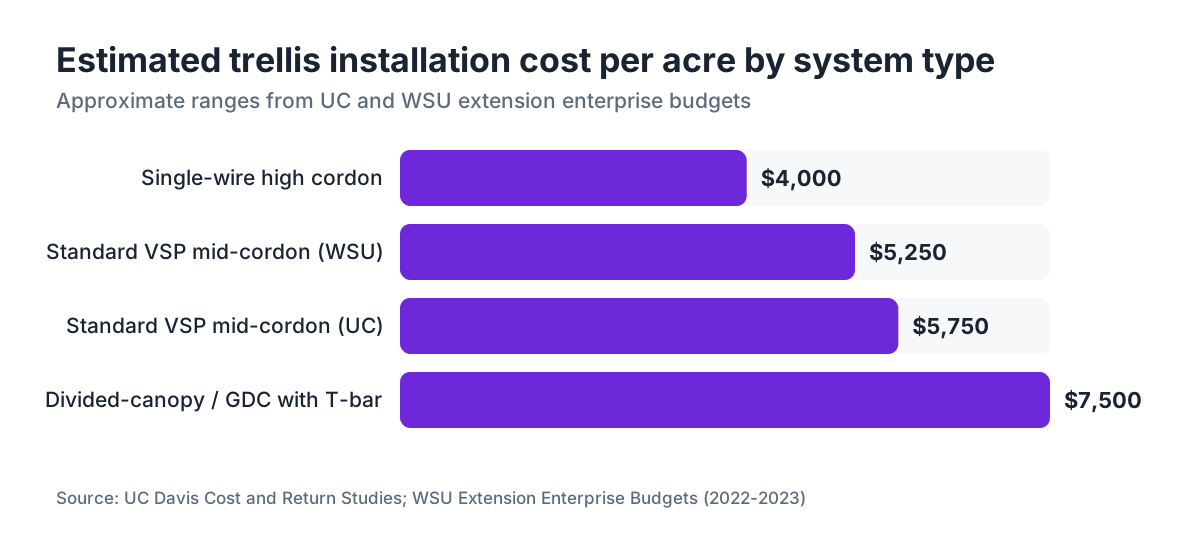
University of California Cooperative Extension enterprise budget data puts trellis installation for a standard VSP system (mid-cordon, two pairs of foliage wires) at roughly $4,500 to $7,000 per acre in California wine grape regions as of their most recent published budgets [8]. That includes posts, wire, installation labor, and end-post anchors. Simpler single-wire high cordon systems come in at the lower end because you're running fewer wires. More complex divided-canopy systems with T-bar crossarms run higher.
In Washington, WSU Extension enterprise budgets for wine grapes in the Columbia Valley put trellis establishment at a similar range, approximately $4,000-$6,500 per acre, depending on post type and row spacing [9]. Wood posts cost less upfront but need replacement on a 15-25 year cycle. Steel and fiberglass posts cost more initially but last longer.
A few cost drivers that tend to surprise first-time vineyard developers:
End-post anchors and bracing can account for 20-30% of total trellis material cost. Skimping here is one of the most common mistakes, and you'll pay for it when wire tension pulls posts over in the second or third year.
Steep slopes or rocky ground add meaningful equipment and labor cost. Figure at least a 25-30% premium over flat-ground estimates if you're drilling or blasting for posts.
High-tensile wire (200,000 PSI tensile strength) costs more than soft wire but is genuinely worth it. It holds tension, resists stretching as temperature swings, and requires fewer retightenings over the life of the trellis.
For a new vineyard development, trellis is typically the second-largest establishment cost after land preparation and vine planting, and it's one of the costs that doesn't get amortized away quickly.
How long does it take to train vines to a cordon system?
Honest answer: two to four years before you have a complete, productive cordon, and the timeline depends heavily on how hard you push vine establishment in year one.
Year 1: You're focused almost entirely on root establishment. Most extension programs recommend allowing the vine to grow freely the first season with minimal crop, letting the root system build. Some growers train a single cane up to the cordon wire in year one if establishment conditions are good [1].
Year 2: If the year-one shoot reached the cordon wire, you select the two best lateral shoots and begin training them in opposite directions along the wire. You're starting to define the bilateral cordon. Ideally you want 12-18 inches of cordon length per arm by end of year two.
Year 3: Cordon arms continue to extend. You begin establishing spur positions at 4-6 inch intervals along the cordon, selecting shoots to become the permanent spurs. Light crop is possible. The temptation to overcrop in year three is real and consistently damages long-term vine health.
Year 4+: Full production. At this point the cordon is set, spur positions are defined, and you're pruning to 2-3 buds per spur each dormant season.
Some high-density European-influenced plantings train more slowly and take a fifth year to reach full production without stressing the vine. Cornell's viticulture extension program has published detailed training guides for both cordon and cane systems that are worth having on hand during establishment [4].
One thing that genuinely slows cordon establishment is choosing a wire height that doesn't match your irrigation system. If drip emitters are at 18 inches and your cordon wire is at 48 inches, getting water to the vine while managing the growing shoot is straightforward. But if something forces you to push hard growth early on poorly established roots, you'll lose vines to sunburn, water stress, or both.
What are the advantages and disadvantages of a cordon trellis system?
Practitioners argue about this based on variety, climate, and labor market, so here's a realistic ledger.
Advantages:
Spur pruning off a cordon is faster than cane pruning. A trained crew can prune 1.5-2x more linear feet of cordon-trained vine per hour than cane-trained vine, because the decision-making is simpler [3]. You're looking at 2-3 buds on established spurs, not selecting and tying new canes.
Canopy geometry is consistent year to year, which helps spray coverage and mechanized harvest. Mechanical harvesters work better when the fruit zone is predictable.
Bilateral cordons create a long, permanent root-to-shoot architecture that many growers believe supports long-term vine health and complexity in the fruit. Old-vine Zinfandel in California and Grenache in Spain are almost always cordon-trained.
High wire pendant systems cut shoot-positioning labor to near zero, which is a real economic advantage in high-wage labor markets.
Disadvantages:
Varieties with basal bud unfruitfulness (Pinot Noir, Riesling, many Chardonnay clones) don't perform well on spur-pruned cordons because their base buds produce mostly vegetative shoots rather than fruit. Cane pruning is often better for these [1].
Cordons can develop gaps over time as spurs die or sections of the cordon are killed by cold. Replacing a cordon arm means losing 1-2 seasons of production on that vine section.
Establishing a uniform cordon on a high-vigor or highly variable block is genuinely hard. Vines of different sizes end up with cordon arms of different lengths and spur counts, which creates uneven cropping and makes uniformity-dependent mechanized operations inconsistent.
Frost management is harder on low-cordon systems, and the difference is not trivial. Moving the cordon from 30 inches to 48 inches can mean the fruiting zone sits 2-4 degrees warmer on a radiative frost night, which can be the difference between a full crop and none [2].
How do you choose the right wire height for your cordon system?
Wire height is one of those decisions that feels like it should have a single right answer, but it genuinely depends on your situation. Here are the factors that actually matter.
Frost risk: In frost-prone sites, get the cordon wire as high as is practical. Cold air drains and pools at low points. A cordon at 48 inches typically sits above the coldest air layer on a calm radiative frost night. UC Davis extension frost management guides support the general principle that raising the fruit zone reduces frost exposure, though the exact temperature benefit depends on site topography and cold-air drainage patterns [10].
Machine clearance: If you plan to use an over-the-row mechanical harvester, you need to know the machine's clearance spec before you set wire height. Most harvesting machines work best with fruit zones between 36 and 54 inches. Go too high and the machine can't reach the cordons; too low and you risk ground contact damage.
Shoot vigor: High-vigor sites benefit from higher cordon placement because the extra wire height gives more distance for downward-hanging shoots before they hit the ground. In practice, cordon heights of 60+ inches with pendant shoot growth handle vigorous sites better than trying to tuck enormous shoot growth upward in a VSP system.
Worker ergonomics: This is underweighted by many developers. Hand pruning and tying at 36-inch cordon height is significantly harder on workers' backs than at 42-48 inches. Some operations that moved from 36-inch to 48-inch cordons report meaningful reductions in worker fatigue and injury claims, though I'm not aware of published studies measuring this specifically in vineyards.
Soil heat: Low cordons in cool climates benefit from radiant heat off warm soils. This is a real effect and it's part of why some European regions have historically maintained very low-trained systems.
What spray and canopy management practices apply specifically to cordon-trained vines?
Canopy architecture determines where pesticide and fungicide applications actually land, and cordon systems create specific exposure patterns that matter for both efficacy and regulatory compliance.
In a VSP system on a mid-height cordon, the canopy is a vertical wall. Airblast sprayers work across that wall, and the goal is full penetration from both sides if you're doing a two-pass application. The EPA Worker Protection Standard (WPS), 40 CFR Part 170, requires that all agricultural workers who enter treated areas receive specific information about the pesticide applied, including re-entry intervals. The WPS applies regardless of trellis type, but high-wire pendant systems create additional complexity because the canopy density at the base of hanging shoots can be difficult to penetrate with standard sprayer settings [7].
For high wire cordon pendant systems specifically, growers who've converted from VSP often find they need to recalibrate sprayer nozzle angles and airflow. WSU Extension pest management guides note that canopy density and shoot architecture significantly affect spray deposition in Washington vineyards, and pendant canopies behave differently from vertical canopies in airblast applications [11].
Powdery mildew management on pendant systems requires particular attention to the cluster zone at the base of hanging shoots, which can become humid if vine vigor is not controlled. The fungal disease pressure in a dense pendant canopy can be higher than in a well-managed VSP canopy with equivalent vine size.
Leaf removal in the fruit zone is standard practice in many VSP systems and happens naturally at the cluster zone. In a pendant system, some growers do targeted leaf removal on the lower portion of the hanging shoot cluster to improve air circulation and spray penetration. The timing and intensity of this work differs from VSP protocols.
Record-keeping for all pesticide applications, including the trellis and canopy type in the block, is required under many state agricultural regulations and is good practice for farm plans. Tools like VitiScribe can track block-level canopy configuration alongside spray records, which helps when pulling audit-ready pesticide use reports or responding to a worker protection inquiry.
How does the cordon system work in high-vigor or irrigated vineyards?
High vigor is the most common reason growers move toward high cordon configurations, and it's worth understanding the physiological logic.
When vines have abundant water and nitrogen, they produce shoot growth fast and long. In a VSP system at 42-48 inches, a vigorous shoot can reach 6-8 feet by midsummer, which means it's flopped over the top of the trellis and shading the lower canopy. Tucking and shoot positioning become a constant battle.
A high wire cordon at 60-66 inches lets those same shoots hang downward. Gravity positions them without labor. The shoots hang 3-5 feet below the cordon wire and then usually stop growing or slow substantially once they hit their natural length. The result is a pendant curtain of foliage with the fruit zone near the top, in good light, and the vegetative growth hanging below.
The GDC system at Cornell was specifically designed for high-vigor, machine-harvested vineyards in the northeastern US, and published trials showed substantial yield increases (50-100% in some blocks) compared to low-cordon systems on the same high-vigor sites [4]. The yield increase comes from better light exposure across a larger canopy surface, not from pushing vine size.
In irrigated desert vineyards in California's San Joaquin Valley or Arizona, the top wire cordon trellis system has been standard for table grape and some wine grape production for much of the 20th century for exactly the same reason. The climate drives enormous vegetative growth and the pendant configuration manages it with minimal labor.
The catch is that converting an established low-cordon vineyard to a high-wire configuration is not straightforward. You can retrain cordons to a higher wire, but it takes 2-3 seasons and stresses the vine. Most growers who want a high wire system plan it from the beginning.
What are the pruning requirements for a cordon trellis system?
Spur pruning on a cordon is conceptually simple. In practice, doing it well consistently at speed is a skill that takes a season or two to develop.
Each spur gets cut back to 2-3 buds. The goal is to maintain spur positions at regular intervals (4-6 inches) along the cordon length. When a two-bud spur produces two shoots and you return the following winter, you're looking at a two-shoot cluster. You select the shoot closer to the cordon base (the basal shoot) as the renewal spur and cut it back to two buds. The other shoot, which carried the fruit, gets cut off entirely. This rotation keeps the spurs close to the cordon wire and prevents the arms from building up excessive length over time.
The biggest long-term management issue in cordon-trained vineyards is spur creep (sometimes called cordon arm elongation), where spur positions gradually walk further from the trunk because growers consistently select the more distal shoot rather than the basal one. After 10-15 years, spur positions can be 8-12 inches from the cordon wire rather than 2-3 inches. This changes canopy geometry and fruit distribution. Catching it early and doing corrective pruning back to younger wood is much easier than dealing with it once it's advanced.
Cold-damaged cordons present a different challenge. When a cordon arm is killed by winter freeze, you have to retrain a new arm from a basal or sucker shoot, which sets that vine section back 1-2 years. In regions with real winter freeze risk, some growers maintain a spare cane (called a guard cane or renewal cane) near the trunk each year specifically for replacing a damaged cordon arm quickly. WSU and Cornell extension materials both address cold-damage recovery for cordon-trained vines [4][9].
Pruning timing matters too. Early pruning (right after dormancy) creates slightly more cold hardiness risk if a late freeze comes. Delayed pruning (waiting until bud swell) reduces that risk but compresses the labor window. Most commercial operations accept the tradeoff and prune when labor is available within the general dormant window.
How do you manage a cordon trellis system for compliance and record-keeping?
Compliance documentation for a vineyard block includes the trellis system as part of the block record, and this matters more than most growers realize until they need it.
California's Department of Pesticide Regulation Pesticide Use Reporting system requires that pesticide applications be reported by site description, which includes crop stage and canopy type. An accurate block record noting cordon height, VSP vs. pendant, and trellis row orientation helps when an inspector or a buyer's sustainability audit asks for verification that application rates were appropriate for the canopy architecture [12].
The EPA Worker Protection Standard requires that worker training include information specific to the pesticide application method and entry restrictions for the specific block. If your cordon configuration affects spray penetration (as in a pendant system), that's relevant to the exposure assessment for re-entry intervals. Keeping a written block record that captures canopy type alongside spray records is the cleanest way to document that WPS requirements were met [7].
For organic or certified sustainable programs (CCOF, SIP, LIVE, LODI), auditors will check that inputs, canopy interventions (leaf removal, shoot positioning dates), and any trellis modifications are documented by block. The trellis system type and any changes to wire height or configuration over time are part of that farm history.
If you're managing multiple blocks with different trellis configurations, the record-keeping burden is real. VitiScribe is built for exactly this, letting you attach canopy configuration, wire height, training system, and spray records to individual blocks, so pulling a compliance report by block takes seconds instead of hours of spreadsheet sorting. Try it free if you're tired of managing this in Excel.
Even without software, the minimum useful record for each block is: trellis type, cordon height, row orientation, planting year, training completion year, and a log of any significant structural changes (wire height adjustment, trellis replacement, major freeze damage and recovery). That covers most audit scenarios.
What research backs up cordon trellis choices, and where does the science actually leave gaps?
There's solid published work on a few questions and almost nothing on others.
The foundational cordon and trellis research in the US comes largely from Cornell's viticulture program, particularly the work of Nelson Shaulis in the 1950s-60s on the Geneva Double Curtain and shoot-positioning systems. His framing of canopy microclimate and light interception as the key variables in trellis design still underlies most extension recommendations [4]. The concept is straightforward: vines produce better fruit from sun-exposed wood, and trellis design is primarily about managing light and air movement through the canopy.
WSU's viticulture extension has published extensively on trellis performance in the Columbia Valley, comparing VSP, high cordon, and Scott Henry systems across multiple varieties. Their work consistently shows that for high-vigor irrigated sites, divided-canopy or pendant systems outperform VSP on yield and fruit quality metrics [9].
UC Davis extension research covers trellis systems primarily in the context of California conditions, with detailed enterprise budget data and canopy management guides. Their work on deficit irrigation and trellis interaction is particularly useful for semi-arid growing regions [10].
Where the science leaves gaps: nobody has clean published data comparing the long-term economic return (full establishment cost amortized over vine life) of different trellis configurations across many California or Pacific Northwest varieties and sites. The closest is the enterprise budget data from UC and WSU extensions, but those are point-in-time snapshots of costs, not multi-decade ROI comparisons. If someone tells you with certainty that VSP has a better 30-year return than GDC on a specific site, they're extrapolating, not citing a study.
There's also limited published work on the interaction between cordon height and worker injury rates, which matters both ethically and economically. Intuitive reasoning suggests higher cordons reduce low-back strain from pruning, but I haven't found a peer-reviewed vineyard study measuring this directly.
Frequently asked questions
What is the difference between a cordon and a cane in vineyard training?
A cordon is a permanent woody arm that stays on the vine year after year, with spurs pruned back to it each dormant season. A cane is a one-year-old shoot selected each winter to carry that season's fruit, then removed entirely the following year. Cordon systems use spur pruning; cane systems use cane renewal. Varieties with poor basal bud fruitfulness, like Pinot Noir, generally do better with cane pruning.
What height should a cordon wire be set at?
Most commercial vineyards set the cordon wire between 36 and 54 inches, with 42-48 inches being the most common range for VSP systems in California and Washington. High wire cordon systems run 60-72 inches, with shoots hanging down. Wire height depends on frost risk (higher is better for frost-prone sites), machine clearance requirements, vine vigor, and worker ergonomics. UC Cooperative Extension enterprise budgets reflect the 42-48 inch range as the industry standard for most wine grape regions.
Can you convert a VSP trellis to a high wire cordon system?
You can, but it takes 2-3 seasons and stresses the vines. You'd need to add height to your posts or replace them, raise the fruiting wire, and retrain the cordon arms upward incrementally. Most growers find it easier to plan the system correctly from the start than to convert. If your site has developed a vigor problem that wasn't expected at planting, conversion is possible but should be done gradually with close attention to vine stress during the transition.
What is a bilateral cordon trellis?
A bilateral cordon means two cordon arms per vine, one running in each direction along the trellis wire from the trunk. It's the most common configuration in US wine grape production. Unilateral (one arm) cordons are used in some high-density plantings or at row ends. Bilateral cordons fill a standard row quickly and distribute cropping load evenly across the vine, which generally promotes uniform ripening and manageable spur counts.
How many spurs per cordon arm is typical?
Spur spacing of 4-6 inches along the cordon is standard, which works out to roughly 8-15 spurs per arm depending on arm length and row spacing. Total spur count per vine in a typical bilateral cordon ranges from 16 to 30. Too many spurs leads to overcrowding and shading; too few leaves wire space empty and wastes potential. The right count depends on the vine's balance between vegetative growth and fruit production, which varies by variety, rootstock, and site.
What varieties work best with a cordon trellis system?
Varieties with good basal bud fruitfulness do best on spur-pruned cordons. These include Cabernet Sauvignon, Merlot, Syrah, Zinfandel, Grenache, Sangiovese, and most Rhône varieties. Varieties with poor basal bud fruitfulness, including Pinot Noir, Riesling, and some Chardonnay clones, typically perform better with cane pruning. UC Davis and WSU extension guides list fruitfulness characteristics by variety and should be consulted before committing to a training system.
What is spur creep and how do you prevent it?
Spur creep happens when spur positions gradually migrate away from the cordon wire and trunk over successive pruning seasons, because pruners consistently select the more distal (further-out) shoot as the renewal spur instead of the basal one. After a decade, spurs can be 8-12 inches from the wire, creating a messy, uneven canopy. Prevention is straightforward in theory: always select the most basal shoot as the renewal spur and cut it back to 2 buds. In practice it requires consistent pruner training.
How does frost affect cordon wire height selection?
Cold air is denser than warm air and pools at low points during radiative frost nights. Raising the cordon wire from 30 to 48 inches can place the fruit zone 2-4 degrees above the coldest air layer on still, clear nights. This is site-specific and depends heavily on cold-air drainage patterns. UC Davis frost management guidance for California vineyards supports the general principle, though exact temperature benefits vary by topography. High wire cordon systems at 60+ inches have the lowest frost exposure of any standard configuration.
How much does it cost to install a cordon trellis per acre?
UC Cooperative Extension enterprise budgets for California wine grape vineyards put standard VSP trellis installation at roughly $4,500-$7,000 per acre, covering posts, wire, anchors, and labor. WSU Extension Columbia Valley budgets show a similar range of $4,000-$6,500 per acre. Simpler single-wire high cordon systems cost less; divided-canopy systems with T-bar crossarms cost more. Steep terrain, rocky soils, and premium post materials add meaningfully to these estimates.
What record-keeping does a vineyard need for trellis and canopy management?
At minimum, keep a block record noting trellis type, cordon height, row orientation, planting year, training system completion date, and any structural changes over time. For pesticide compliance under California's DPR reporting requirements and the EPA Worker Protection Standard, canopy configuration is relevant to spray application records. Certified sustainable and organic programs ask for canopy intervention logs (leaf removal, shoot positioning) by block. Keeping this with your spray records by block simplifies any audit.
What is the Geneva Double Curtain trellis system?
The Geneva Double Curtain (GDC) is a high wire cordon system developed at Cornell's New York State Agricultural Experiment Station by Nelson Shaulis. It uses a T-bar crossarm at the top of each trellis post to support two parallel cordon wires, creating two separate pendant curtains of hanging shoot growth. It was designed for high-vigor sites and machine harvest, and published trials showed yield increases of 50-100% over low-cordon systems on the same vigorous sites. It's still widely used in New York and the Midwest.
Does a cordon trellis system require different sprayer settings than VSP?
Yes, particularly for high wire pendant systems where shoots hang downward. Airblast sprayers calibrated for vertical VSP canopy walls need nozzle angle and airflow adjustments to penetrate a pendant canopy from below. WSU Extension pest management guides note that canopy architecture significantly affects spray deposition, and pendant curtains behave differently from vertical canopies. Poor penetration in a dense pendant canopy increases powdery mildew risk, so recalibrating after any configuration change is worth the time.
How long does a trellis system last before needing replacement?
Wood posts typically last 15-25 years depending on species, treatment, and soil conditions. Steel T-posts can last 30-40 years with minimal corrosion in most vineyard soils. High-tensile galvanized wire lasts 20-30 years if properly tensioned and maintained. The most common failure is end-post movement from wire tension over time, especially in sandy or soft soils. A realistic trellis replacement budget is part of any long-term vineyard financial plan, though most growers replace components as needed rather than doing whole-system replacements.
Is a cordon trellis system suitable for organic or sustainable certification?
Yes. Trellis type has no bearing on organic certification status. What matters for organic and sustainable certifications (CCOF, SIP, LODI, LIVE) is the inputs you use and your documentation practices. The trellis system affects canopy management choices, which in turn affect disease pressure and spray program design, but there's no certification that restricts or requires a specific trellis configuration. Good record-keeping of canopy interventions by block is required by most certification auditors regardless of trellis type.
Sources
- UC Davis Viticulture & Enology, Grapevine Training Systems: Spur pruning on cordons, basal bud fruitfulness by variety, and first-year establishment practices
- UC Cooperative Extension, Napa County, Vineyard Establishment Guide: Post spacing, wire gauge recommendations, and frost-related cordon height guidance
- UC Cooperative Extension, Wine Grape Variety Enterprise Budgets: Mid-height cordon as most common California configuration; pruning labor rates for spur vs. cane
- Cornell Cooperative Extension, Viticulture Program, Geneva Double Curtain and Trellis Systems: GDC development by Nelson Shaulis; yield increases of 50-100% on high-vigor sites; cordon training guides
- WSU Extension, Wine Grape Production in Washington State: Scott Henry system design for high-vigor sites; divided-canopy performance comparisons
- UC Cooperative Extension, Canopy Management in Vineyards: Shoot positioning labor of 40-60 hours per acre in vigorous VSP vineyards
- US EPA, Worker Protection Standard, 40 CFR Part 170: WPS requirements for worker and handler information on pesticide application method and re-entry intervals
- UC Davis Agricultural and Resource Economics, Cost and Return Studies: Trellis installation cost of $4,500-$7,000 per acre for VSP systems in California wine grape regions
- WSU Extension, Columbia Valley Wine Grape Enterprise Budget: Trellis establishment costs of $4,000-$6,500 per acre in Washington; cold damage recovery for cordon-trained vines
- UC Davis Cooperative Extension, Frost Protection for Vineyards: Raising fruit zone reduces frost exposure; cold-air pooling and cordon height interaction
- WSU Extension, Integrated Pest Management for Pacific Northwest Vineyards: Canopy architecture affects spray deposition; pendant canopies require different airblast settings
- California Department of Pesticide Regulation, Pesticide Use Reporting: California DPR requires pesticide use reports by site description including crop stage and canopy conditions
Last updated 2026-07-09