Calvet tunnel sprayer for vineyards: how it works and when it pays

TL;DR
- A Calvet tunnel sprayer wraps each vine row in a U-shaped recovery chamber, catches overspray with air curtains and collection panels, and pumps the recovered liquid back to the tank.
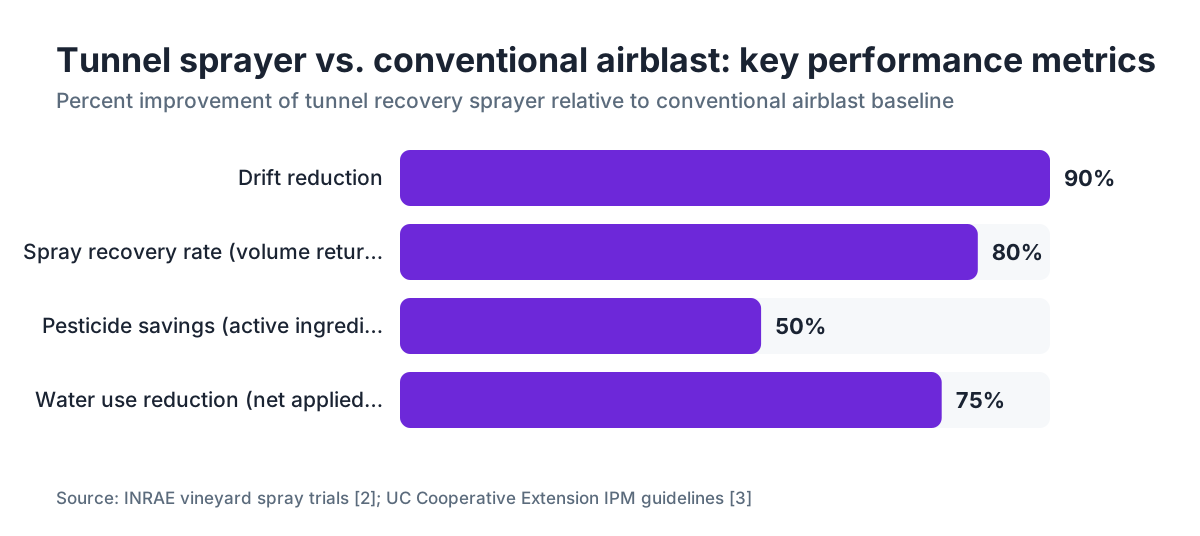
- Recovery runs 70-90% of applied volume.
- That cuts chemical cost, drops drift by more than 90%, and cleans up pesticide record reconciliation.
- Capital cost of $30,000-$80,000 makes it pay best on moderate-to-large vineyards.
What is a Calvet tunnel sprayer and how does it work?
A Calvet tunnel sprayer is a recycling sprayer that wraps the vine row inside a tunnel-shaped metal chamber as the tractor rolls forward. Nozzles sit on both inner walls and the top arch, hitting the canopy from several angles at once. Any spray that misses leaves, shoots, or clusters hits the far wall of the tunnel instead of escaping into the air.
The recovery side is what sets Calvet machines apart from conventional air-blast sprayers. Inclined collection panels, paired with cross-flow air curtains that push droplets back inward, funnel the undeposited spray down to troughs at the base of each chamber wall. A pump sends that liquid straight back to the main tank in real time [1].
The machine straddles one row at a time. Most viticulture models are single-row, though a few manufacturers build two-row rigs for wide-spaced plantings. Ground speed usually runs 4-7 km/h (2.5-4.5 mph), slower than a conventional airblast pass, because the nozzle array needs dwell time to work into the canopy and the recovery system needs a beat to collect before the chamber clears the row.
Calvet, the Spanish agricultural equipment company, commercialized this tunnel concept for vines in the early 1990s. Several European makers now build similar recovery sprayers, and the category goes by "recycling tunnel sprayers" or "recovery sprayers" generically. When people in North American viticulture say "Calvet," they usually mean any tunnel recovery sprayer, the way people say "Kleenex" for facial tissue.
How much spray does a tunnel sprayer actually recover?
Independent field tests keep landing on recovery rates of 70-90% of the volume a conventional sprayer would otherwise lose [2]. The exact number depends on canopy density, growth stage, travel speed, and nozzle setup.
A thin, early-season canopy intercepts less spray on the first pass, so more liquid reaches the collection panels. That sounds like a problem. It isn't. Recovery runs highest exactly when spray waste is worst on a conventional machine. A full summer canopy with good closure deposits more directly on the leaves, leaving less to recover, but overall application efficiency climbs anyway because canopy contact is better too.
The University of California Cooperative Extension has documented drift reduction above 90% for recovery tunnel sprayers against traditional airblast machines under matched conditions [3]. That matters for buffer zone compliance and for vineyards sitting next to homes or sensitive crops.
Here's the practical math. Say your conventional sprayer releases 200 liters per hectare and 40% of that is wasted, a realistic figure for open-canopy early-season passes. A recovery sprayer getting 75% back saves you 60 liters per hectare per pass. Over 50 hectares and 12 spray passes a season, that is 36,000 liters of diluted spray mix recovered. The active ingredient in those 36,000 liters stays in your tank instead of drifting or running off.
What does a Calvet tunnel sprayer cost, and is the ROI real?
New tunnel recovery sprayers sold in North America run roughly $30,000-$80,000 depending on row width capacity, tank size, pump configuration, and nozzle count [4]. European imports (Calvet, Lipco, Berthoud Recovery) sit at the high end once you add freight, customs, and dealer prep. Some regional dealers now stock similar machines built domestically or in South America at lower prices, though parts availability is hit or miss.
Used machines show up at auction, generally $8,000-$25,000, but inspect the collection panels and recovery pump hard. Dented or corroded panels cut recovery efficiency right away, and replacement sheet metal is not cheap.
The ROI equation has three real inputs: pesticide savings, water savings, and avoided drift liability. On pesticide alone, growers using copper-based fungicides (often $15-$40 per kg of metallic copper) or pricey newer chemistries see payback periods of 3-7 years on the machine, depending on program intensity. Organic vineyards running heavy copper and sulfur programs often land at the favorable end because their per-liter spray cost is high.
Water is a secondary but real factor in drought-hit regions like California's Central Coast or Washington's Yakima Valley. Recovering 70%-plus of your spray volume cuts water draw per hectare by a lot.
Drift liability is the piece nobody can put on a spreadsheet. California's Department of Pesticide Regulation has stepped up enforcement around spray drift complaints near populated areas [5]. A single drift investigation, even one with no fine, burns time, documentation, and goodwill with the neighbors. That risk reduction is real money even when it never shows up as a line item.
Honest caveat: nobody has published a clean, peer-reviewed ROI study for North American wine grape conditions. The closest data comes from Spanish and French field trials, which found average pesticide savings of 40-60% versus conventional airblast [2]. Porting those numbers to your operation means knowing your true spray program cost, and most small vineyards undercount it because they never load labor and tractor hours into the figure.
How does a tunnel sprayer compare to a conventional airblast sprayer?
| Factor | Conventional airblast | Calvet tunnel recovery |
|---|---|---|
| Drift reduction | Baseline | 90%+ reduction [3] |
| Spray recovery | 0% (by design) | 70-90% [2] |
| Capital cost | $8,000-$30,000 new | $30,000-$80,000 new [4] |
| Ground speed | 5-10 km/h | 4-7 km/h |
| Row spacing minimum | 2.0 m typical | 2.2-2.5 m for most models |
| Canopy penetration | High (axial fan) | Moderate-high (nozzle array) |
| Maintenance complexity | Moderate | Higher (recovery system) |
| Pesticide record simplicity | Standard | Requires reconciliation of recovered volume |
The airblast machine wins on speed and simplicity. It also handles a wider range of vine shapes and row spacings, including very tight rows where a tunnel chassis physically won't fit.
The tunnel sprayer wins on everything environmental and economic once chemical cost at scale enters the picture. For a 20-hectare vineyard running 10-14 passes a year, the math starts to favor the tunnel machine somewhere around year 4-6 of ownership, assuming you finance rather than pay cash.
Airblast defenders make one point that holds up: penetration from a big axial fan still beats a nozzle array in dense, tightly-trellised canopies like bilateral cordon systems with heavy shoot density. The tunnel covers well but it isn't moving air at the volume a large fan does. For powdery mildew control in a thick, humid canopy mid-season, some growers keep both machines and run the airblast for one or two critical-timing passes. That isn't a knock on the tunnel sprayer. Different tools have different strengths.
What vineyard setups and row spacings work with a tunnel sprayer?
Most single-row Calvet-style tunnel sprayers need a minimum row spacing of 2.2-2.5 meters (roughly 7-8 feet) to fit the chassis width plus clearance for the collection walls [1]. Standard wine grape planting distances in California, Washington, and Oregon range from 2.0-2.7 meters between rows, so many vineyards qualify and some don't.
Vine height matters too. Tunnel dimensions are built for VSP (vertical shoot positioned) canopies with cordon heights of 0.6-0.9 meters and trained canopy up to 1.5-1.8 meters total. Sprawling systems or very high-trained canopies push against the tunnel ceiling and lose coverage on the upper shoots.
Row grade is a real limit. Steeper hillside vineyards, say above 12-15% slope, cause trouble for the recovery trough, which depends on gravity to move recovered liquid to the pump. Some machines offer adjustable trough angles for moderate slopes, but steep terrain is genuinely hard. If your vineyard has significant cross-slope, talk to the dealer before you commit.
Tractor horsepower needs run 70-120 PTO HP depending on machine size and tank volume, which most commercial vineyard tractors handle fine. The added weight of the tunnel chassis and a full tank, often 600-1,000 liters, affects stability on slopes. One more reason to be careful on hillside blocks.
For vineyards with mixed architecture, a workable move is to assign specific blocks to the tunnel sprayer where the row geometry fits and keep the airblast for blocks that don't. Partial adoption still banks real chemical savings on the qualifying blocks.
How do you calibrate and set up a tunnel sprayer correctly?
Calibration starts the way it does for any sprayer: know your application rate in liters per hectare, travel speed, nozzle output, and nozzle spacing. What changes is that you also have to account for recovered volume when you figure how much concentrate to mix.
The standard process: fill the tank with a known volume of clean water, run a full calibration pass, then measure what comes back into the tank through the recovery pump. That gives you your net loss per hectare at that speed and nozzle setup. Mix concentration should target the labeled rate based on net deposited volume, not gross applied volume.
This step trips people up. If you mix to gross applied volume while recovering 75%, you are badly under-dosing against the label rate. Mix without accounting for recovery at all and you can end up applying at an effective rate well below efficacy thresholds. Washington State University Extension's spray calibration guidance addresses net deposition directly for recycling sprayers [6].
Nozzle angle is the other setup variable. Most tunnel machines let you adjust nozzle angle on each boom side to aim at the fruit zone, the shoot tips, or both. Early season, bias toward shoot tips where powdery mildew starts. After bloom, shift to maximize cluster coverage.
Pressure matters more in a tunnel than on an open airblast because the tunnel has no fan pushing droplets into canopy gaps. Keep pressure at the nozzle maker's recommended range (usually 3-8 bar for most vineyard nozzles) and use flat-fan or cone nozzles sized for the coverage pattern inside the chamber.
What pesticide record-keeping rules apply to recovered spray?
Tunnel sprayers create a compliance wrinkle a lot of growers underestimate. EPA's Worker Protection Standard (WPS) and state pesticide use reporting systems require you to record the amount of pesticide applied per application [7]. When you pull 75% of applied spray back into the tank, one question follows: what did you actually apply?
The legally defensible answer is to record the net applied volume, meaning gross applied minus recovered volume. That takes metering the recovery pump return or measuring tank volume before and after. Some tunnel models include a flowmeter on the recovery line; others make you calculate from tank level readings.
California requires pesticide use reports (PURs) within 7 days of application, logged by site, product, gross applied rate, and treated acreage [5]. If you recover material and reapply it on later passes, the DPR treats the reapplied recovered material as counting toward your total active ingredient applied, so you have to track it. Get this wrong and you create a pesticide use report discrepancy that can trigger an inspection.
A spray record system that tracks tank fill volume, recovered volume, and net applied per block makes this easy. VitiScribe, for one, lets you log gross applied and recovered volume separately per field block so your compliance records reconcile on their own instead of forcing manual math after the fact. Dedicated software or a well-built paper log, either works, but the record structure has to capture both numbers.
Cornell Cooperative Extension's integrated crop and pest management resources include a section on pesticide record-keeping formats that apply equally to conventional and recovery sprayers [8].
How does a tunnel sprayer affect drift rules and buffer zone compliance?
Pesticide drift is regulated under federal law through FIFRA (the Federal Insecticide, Fungicide, and Rodenticide Act) and enforced at the state level by departments of agriculture and pesticide regulation [9]. Most pesticide labels carry language barring application "when conditions favor drift to non-target areas," and some spell out minimum downwind buffer distances.
A tunnel recovery sprayer shifts your compliance picture in a big way. Because the canopy is enclosed and recovered liquid gets pulled back rather than carried on the wind, drift outside the chamber drops to near zero during operation. EPA recognizes enclosed cab and tunnel sprayer technology as a drift reduction technology (DRT) in its spray drift label policy [7].
In practice, if your label requires a 50-foot downwind buffer for broadcast applications, using a tunnel sprayer may let you apply closer to property lines or sensitive areas. Confirm that with your local county agricultural commissioner before you assume it. Pesticide labels are federal law and individual label language varies.
For organic growers near conventional operations, or conventional growers near organic vineyards, the drift reduction doubles as a neighbor-relations tool. Copper applications in a tunnel sprayer stay on your rows. That's worth something when the property line runs up against certified organic ground.
What maintenance does a tunnel sprayer need between seasons?
The recovery system breaks most often and costs the most when it does. Before storage, flush the recovery troughs and return lines with clean water, then with a tank cleaner matched to the season's spray program. Copper deposits especially build up in the return lines and pump housing over a season and will eventually restrict flow or pit metal parts if you leave them.
Check collection panel alignment every season. Panels take minor hits from vine posts, wayward trunks, and terrain. A panel that's 5 degrees off angle sends recovered spray to the floor of the trough instead of the collection channel. Realign panels to spec each spring before the first spray.
Inspect and replace nozzles on the same schedule as any sprayer, which most extension programs put at every 50,000-100,000 liters of spray passed through them, or annually, whichever comes first [6]. In a tunnel machine, a partly plugged nozzle is harder to catch by eye because you can't watch the spray pattern during operation. Add a nozzle output check to your pre-season calibration routine.
Recovery pump seals are a known wear item. Keep one spare set on the shelf. A recovery pump that quits mid-season turns your tunnel sprayer into an expensive open sprayer that still crawls along at tunnel speed.
Are there environmental or regulatory incentives to buy a tunnel sprayer?
Several state and federal programs have offered cost-share or grant money for drift reduction equipment, tunnel sprayers included. The USDA's Environmental Quality Incentives Program (EQIP), run by the Natural Resources Conservation Service (NRCS), has funded spray drift reduction practices in several states [10]. Eligible practices and payment rates vary by state and fiscal year, so start at your local NRCS service center.
California's Healthy Soils and air quality incentive programs through CDFA have at times included sprayer upgrades as fundable practices. Washington State's Department of Agriculture has run pesticide reduction programs that include equipment grants. These programs open and close with legislative appropriations, so check every year rather than assuming last year's program is still taking applications.
On the regulatory side, some California counties carrying air quality non-attainment designations have adopted rules that restrict conventional spray drift. Fresno County's air quality rules are one example. Using a documented drift reduction technology like a tunnel sprayer can give you compliance certainty in those jurisdictions that a conventional airblast can't.
The pesticide savings also feed into your overall input budget, which can matter for organic certification cost calculations and for lenders who watch input cost ratios.
What are the real downsides of a Calvet tunnel sprayer?
Let's be honest. The tunnel sprayer is not the right machine for every vineyard or every grower.
Cost is the obvious one. $50,000 for a well-specified machine is a lot for a 10-hectare operation. The payback math may not pencil unless you have a very expensive spray program or you split the machine across multiple properties.
Speed is genuinely slower. A conventional airblast operator covers ground at 8-10 km/h; a tunnel operator sits at 4-6 km/h. On a 50-hectare vineyard, that gap could add 2-3 days to your spray schedule per pass, which is a real agronomic risk when you're chasing a tight fungicide window before rain.
Row geometry is non-negotiable. If you have blocks under 2.2 meters, a standard tunnel machine won't fit, and you're not ripping out and replanting to suit a sprayer.
Repair support varies by location. In Napa or Sonoma, you'll find dealers and mechanics who know these machines. In a more rural wine region, you may be troubleshooting alone with a manual and a parts shipment coming from overseas. That stings when the recovery pump seal fails at 7 a.m. on the morning you planned your downy mildew spray.
Record-keeping complexity is real too, as covered above. If your current spray log is a spiral notebook in the truck, adding recovered volume tracking means changing your system. Not a huge hurdle, but a hurdle.
None of these downsides disqualify the machine for the right vineyard. Just go in with eyes open.
Frequently asked questions
What is the difference between a Calvet tunnel sprayer and a regular airblast sprayer?
An airblast sprayer uses a large fan to blow droplets into the canopy from one side, and undeposited spray drifts away. A Calvet tunnel sprayer encloses the vine row in a chamber, sprays from multiple nozzles on both sides, and recovers overspray via collection panels and a return pump. Recovery runs 70-90% of applied volume versus zero for an airblast, and drift drops by more than 90%.
How much does a Calvet-style tunnel sprayer cost new in the US?
Expect roughly $30,000-$80,000 for a new single-row tunnel recovery sprayer in the North American market. Price moves with tank size, nozzle count, row width capacity, and import costs. Used machines turn up at auction for $8,000-$25,000, but inspect the recovery panels and pump carefully before buying.
Can a tunnel sprayer be used on steep hillside vineyards?
With caution. The gravity-fed recovery trough works well on flat or gently rolling ground but struggles above about 12-15% grade. Steep cross-slopes pool recovered liquid unevenly and can block adequate return to the tank. Some models include adjustable trough angles. If your blocks have significant slope, ask the dealer specifically about grade limits before purchasing.
How do you record pesticide applications made with a recovery sprayer for compliance?
Record the net applied volume: gross volume applied minus recovered volume returned to the tank. California's pesticide use reports require this distinction. You'll need a flowmeter on the recovery line or consistent tank-level measurement before and after each pass. State requirements vary, so confirm with your county agricultural commissioner. A spray record system that accepts both gross and recovered volumes keeps your PURs accurate.
Does using a tunnel sprayer let you spray closer to property lines?
It can, but confirm with the specific pesticide label and your county agricultural commissioner first. EPA recognizes enclosed tunnel sprayers as a drift reduction technology, and some labels allow reduced buffer distances when DRT equipment is used. Buffer requirements vary by product and state, so don't assume. Verify for each product in your spray program.
What row spacing does a Calvet tunnel sprayer require?
Most single-row tunnel recovery sprayers need a minimum row spacing of 2.2-2.5 meters (roughly 7-8 feet) to fit the chamber walls plus tractor clearance. Some compact models work at 2.0 meters, but confirm with the manufacturer. Rows narrower than 2.0 meters are generally incompatible with current production tunnel sprayer designs.
How do you calibrate a tunnel sprayer to apply the correct pesticide rate?
Run a calibration pass with clean water, measure the volume recovered, and calculate your net loss rate per hectare. Mix concentrate to hit the labeled application rate based on net deposited volume, not gross applied volume. Skipping the recovery adjustment leads to under-dosing. WSU Extension's spray calibration resources cover recovery sprayer calibration specifically. Recalibrate whenever you change speed, pressure, or nozzles.
Are there grants or USDA cost-share programs for buying a tunnel sprayer?
Yes. USDA NRCS offers Environmental Quality Incentives Program (EQIP) payments for spray drift reduction practices, which can include recovery tunnel sprayers. Payment rates and eligibility vary by state and fiscal year. California CDFA and Washington State Department of Agriculture have also run equipment incentive programs. Contact your local NRCS service center for the current payment schedule in your state.
What is the payback period for a tunnel sprayer investment?
Roughly 3-7 years for most commercial wine grape operations, depending on vineyard size, spray program cost, and machine price. Organic vineyards with expensive copper and sulfur programs tend toward the shorter end. Nobody has published a clean peer-reviewed ROI study for North American conditions; the available data comes from Spanish and French field trials showing 40-60% average pesticide savings versus conventional airblast.
How does a tunnel sprayer affect powdery mildew and downy mildew control?
Control efficacy is generally comparable to conventional airblast when canopy density is moderate and timing is right. Some growers report slightly weaker penetration in very dense, full-closure canopies mid-season versus a large-fan airblast. A practical fix used by some operations is to run the tunnel sprayer for most passes and an airblast for one or two high-pressure applications during peak canopy density.
What maintenance is most critical on a tunnel recovery sprayer?
Flush and clean recovery troughs and return lines after every season, inspect and realign collection panels annually, and replace nozzles per the manufacturer interval or at least yearly. Recovery pump seals are the most common in-season failure point, so keep a spare seal kit on hand. Copper buildup in return lines is the sneakiest long-term issue and needs an appropriate tank cleaner to manage.
Can a tunnel sprayer be used for herbicide applications between vine rows?
No. Tunnel sprayers are built to spray into and through the vine canopy while enclosing the row. They aren't configured for directed under-vine or inter-row herbicide applications. Use a directed-nozzle setup on a conventional sprayer or a shielded sprayer for herbicide work. Mixing herbicide into a tunnel sprayer tank also creates a serious contamination risk for later fungicide or insecticide passes.
How does a tunnel sprayer help with EPA Worker Protection Standard compliance?
By sharply cutting spray drift outside the treated row, a tunnel sprayer lowers unintended worker exposure in adjacent rows or headlands. WPS bars workers from entering a treated area during application or within the restricted entry interval. Reduced drift means adjacent-row workers face lower exposure risk, though standard WPS personal protective equipment and REI rules still apply fully to the operator and anyone in the treated block.
Sources
- Calvet Agricultural Machinery, product documentation on tunnel recovery sprayer operating principle: Tunnel sprayer encloses vine row in U-shaped chamber with collection panels, air curtains, and a recovery pump returning liquid to tank during operation
- INRAE (French National Research Institute for Agriculture, Food and Environment), peer-reviewed studies on recycling sprayer efficiency in viticulture: Independent field tests find recovery rates of 70-90% of applied volume and pesticide savings of 40-60% versus conventional airblast in European vineyard trials
- UC Cooperative Extension, Pest Management Guidelines for Wine Grapes, spray application technology section: Recovery tunnel sprayers reduce spray drift by more than 90% compared to traditional airblast machines under equivalent field conditions
- UC Agriculture and Natural Resources, sprayer equipment cost and selection resources: New tunnel recovery sprayers in North America range approximately $30,000-$80,000 depending on configuration; used machines sell for $8,000-$25,000 at auction
- California Department of Pesticide Regulation, Pesticide Use Reporting requirements and enforcement guidance: California requires pesticide use reports within 7 days of application, logged by site, product, and treated acreage; DPR has increased enforcement around spray drift complaints near populated areas
- Washington State University Extension, Pesticide Safety and Spray Calibration resources: WSU Extension spray calibration guidance addresses net deposition calculation for recycling sprayers and recommends nozzle replacement every 50,000-100,000 liters or annually
- US EPA, Worker Protection Standard for Agricultural Pesticides and Spray Drift Labeling Policy: EPA WPS requires recording pesticide amounts applied per application; EPA's spray drift label policy recognizes enclosed tunnel sprayers as a drift reduction technology (DRT)
- Cornell Cooperative Extension, Integrated Crop and Pest Management, pesticide record-keeping formats: Cornell Extension provides pesticide record-keeping format guidance applicable to both conventional and recovery sprayer operations
- US EPA, Federal Insecticide, Fungicide, and Rodenticide Act (FIFRA) overview and drift regulation: FIFRA prohibits pesticide application when conditions favor drift to non-target areas; most labels specify minimum downwind buffer distances enforceable under federal law
Last updated 2026-07-09