How to choose a vineyard sprayer for fungicide applications
TL;DR
- For most vineyards under 20 acres, a tractor-mounted airblast sprayer in the 100 to 200 gallon range covers your fungicide program and keeps drift manageable.
- Backpack sprayers handle spot treatments and tight end rows.
- Your right choice hinges on row spacing, trellis height, canopy density, and how many acres you cover per spray window.
What types of sprayers are used in vineyards?
Four equipment categories cover almost all vineyard spraying: airblast sprayers, boom sprayers, backpack or hand-held sprayers, and electrostatic sprayers. Each has a real use case. None is a universal answer.
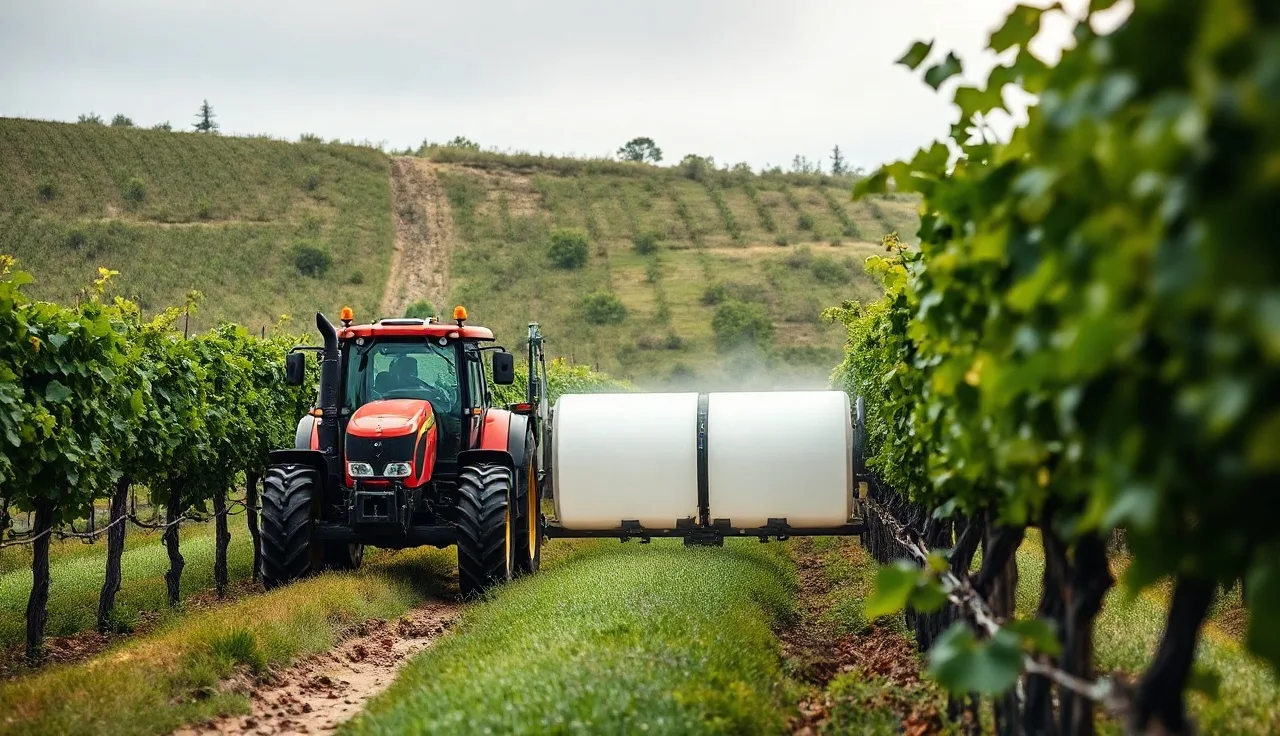
Airblast sprayers are the workhorse of commercial viticulture. They use a high-velocity fan to carry droplets into and through the canopy from both sides at once. A tractor-mounted airblast unit in the 100 to 200 gallon range handles most operations from five acres to several hundred, depending on how fast you cover ground and how tight your spray windows run. Cornell Cooperative Extension recommends airblast sprayers as the standard for grapevine disease management in the northeastern U.S. because they push spray through dense canopy that boom sprayers can't reach [1].
Boom sprayers work in wide-row systems where the vines sit open, or for pre-bloom applications on young vineyards before the canopy closes. They cost less than airblast units. But their coverage drops off badly once leaf area gets heavy. If you have 6-foot-plus row spacing and a relatively open trellis, a boom with drop nozzles can be surprisingly effective early in the season.
Backpack sprayers won't replace mechanized equipment on anything over two or three acres. They're still indispensable for spot-treating disease hotspots, hitting end rows the airblast can't reach cleanly, or handling a small research block. A quality diaphragm-pump backpack (4-gallon Solo or similar) costs $80 to $200 and belongs in every vineyard shed no matter what else you own.
Electrostatic sprayers charge the droplets so they get pulled toward leaf surfaces, which in theory improves coverage at lower water volumes. The technology has real science behind it. But the cost premium is steep and the performance advantage shrinks as canopy density climbs. WSU Extension notes that electrostatic systems can cut spray volume by 30 to 50% compared to conventional airblast under some conditions, while cautioning that canopy architecture and ground speed matter enormously [2]. For most operations under 50 acres, the payback math is hard.
How do airblast sprayers actually work in a vineyard?
An airblast sprayer pairs a high-volume fan, usually driven off your tractor's PTO, with a liquid pump and a nozzle manifold arranged around or across the fan outlet. The fan pushes an air stream moving 80 to more than 200 mph, and that air carries the atomized spray into the canopy. Here's the key physics. Droplets alone don't penetrate a dense grape canopy. You need air turbulence to flip leaves and coat the underside (abaxial) surfaces, which matters a lot for downy mildew [1].
Tunnel sprayers are a refined variation. They wrap the vine row in a partial tunnel with recapture panels, catching overspray and recycling it. Drift reduction is dramatic, sometimes 75 to 90% compared to conventional airblast [3]. The tradeoff is cost. Tunnel sprayers start around $20,000 for small single-row units and run well over $60,000 for multi-row recirculating systems. If you farm next to sensitive crops, residential neighbors, or buffer-zone requirements, they're worth a conversation with your county ag commissioner.
Ground speed and nozzle output rate set your real coverage. Most airblast work in vineyards happens at 2 to 4 mph. Going faster to save time is one of the most common and most expensive mistakes in vineyard spray programs. UC Davis Cooperative Extension has documented that raising ground speed from 2 to 4 mph can cut canopy coverage by 40% under comparable conditions [4]. That means you're either under-dosing the fungicide or burning through more concentrated material to make up for it.
What sprayer size do I need for my vineyard acreage?
Tank size and pump output have to match your acreage, row spacing, target water volume per acre, and the real logistics of your fill station. Here's the honest math.
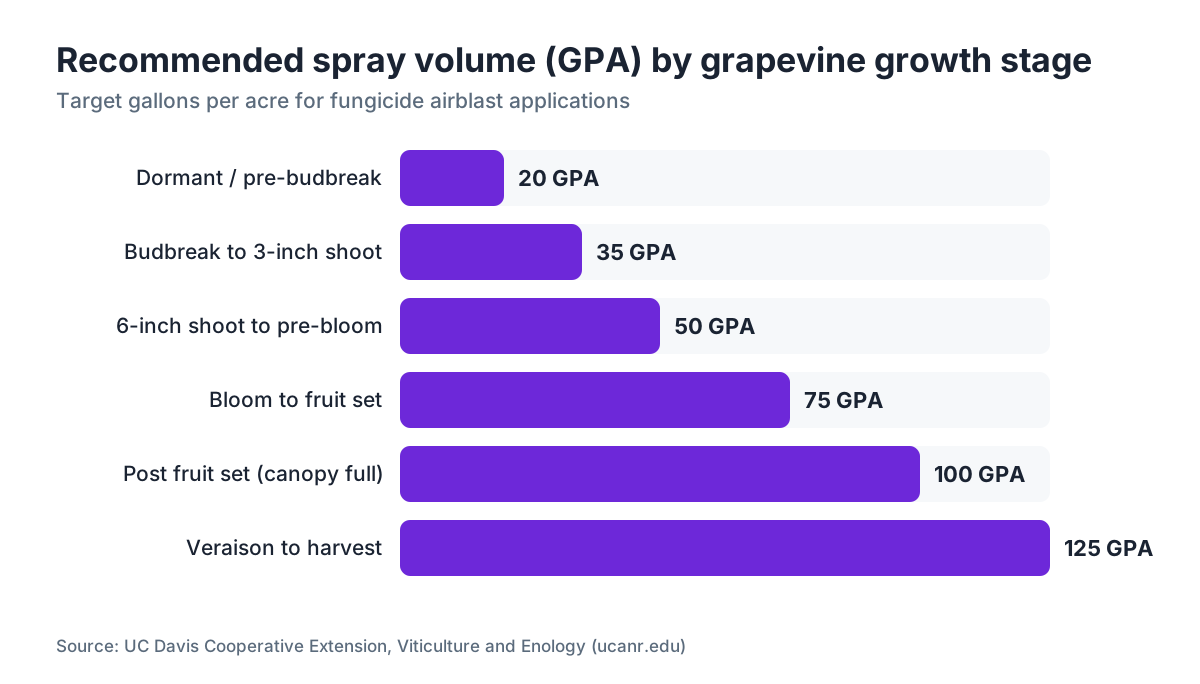
A typical fungicide application in grapevines targets 50 to 150 gallons per acre depending on canopy size and growth stage. Early-season, pre-bloom applications at 30 to 50 GPA are common. At full canopy, high-pressure disease situations push you to 75 to 100 GPA or more [1]. If you're doing two-sided coverage on a 7-foot-row system with a dense Chardonnay canopy, 100 GPA is not conservative.
| Vineyard Size | Recommended Tank Size | Typical Cost Range | Useful Units |
|---|---|---|---|
| Under 5 acres | 50 to 100 gal airblast or backpack | $400 to $6,000 | Rears small ATV units, Solo backpacks |
| 5 to 20 acres | 100 to 200 gal tractor airblast | $4,500 to $14,000 | FMC, Gregoire, Rears 200 |
| 20 to 75 acres | 200 to 400 gal tractor airblast | $10,000 to $28,000 | Rears, Hardi, Durand-Wayland |
| 75 to 200+ acres | 400 to 600+ gal, possibly multi-row | $18,000 to $60,000+ | Gregoire, Lipco tunnel, CFT |
Fill-station distance is underrated. If your water source sits a half-mile from your furthest block, a 100-gallon tank buys you a lot of dead time. On a tight spray window before a rain event, that dead time costs you disease protection. Size your tank against fill distance, not acreage alone.
For operations spread across small, disconnected blocks, some growers keep a 200-gallon tractor unit for main blocks and a good ATV-mounted 50-gallon sprayer for outlying rows. Not elegant. It works.
Which sprayer brands are most reliable for vineyard fungicide work?
A handful of manufacturers have long track records in vineyard airblast work. This isn't a full market survey. It's an honest look at what shows up repeatedly in extension trials and what you can find parts for without a six-week wait.
Rears Manufacturing (based in Eugene, Oregon) makes purpose-built vineyard airblast units from small ATV-scale tanks up through large tractor-mounted systems. Parts availability across the western U.S. is good. Their tower-style fan design does well on bilateral canopy coverage.
Hardi (a Danish manufacturer with North American distribution) produces the Tower and Twin series designed for vineyard rows. Cornell and WSU extension programs have both used Hardi units in spray efficacy trials [1][2]. Dealer networks hold up in most wine-growing regions.
Gregoire makes sophisticated multi-row and tunnel sprayer configurations and shows up in larger California and Pacific Northwest operations. Higher entry cost, but the build quality is excellent, and recirculating tunnel models earn back the price in high-drift-risk situations.
Orchard-Rite and Durand-Wayland carry a stronger reputation in tree fruit but cross over into vineyards. In a mixed orchard-and-vine operation, dealer support may make either brand worth considering.
FMC (now under different ownership structures depending on region) and Pulverizadores Fede from Spain appear in import markets and can be good value. Parts lead times from Europe are real, though. If you buy an imported unit, stock a basic parts kit the day you take delivery.
For backpack sprayers, Solo and Stihl both make reliable diaphragm-pump units that handle the pH range of copper-based fungicides better than cheap piston-pump alternatives. The diaphragm keeps copper away from pump internals.
How does nozzle choice affect fungicide coverage in vines?
Nozzle selection is where most growers leave performance on the table. The nozzle sets droplet size, and droplet size sets both coverage and drift risk. These pull against each other. Smaller droplets coat leaf surfaces better but drift more. Larger droplets cut drift but can skip the fine coverage you need.
For fungicide work in grapes, the target droplet size (VMD, volume median diameter) usually runs 100 to 200 microns [5]. Below 100 microns you generate a fine mist that rides air currents far past the target. Above 300 microns you get ballistic droplets that bounce off waxy leaf surfaces without coating them.
Hollow-cone nozzles are the historic standard for airblast vineyard work because they produce a droplet spectrum fine enough to cover both upper and lower canopy surfaces. Flat-fan nozzles suit boom applications. Air-induction (twin-fluid) nozzles cut drift a lot by making larger droplets, but they need higher pressure and can sacrifice some canopy penetration.
For copper fungicide applications, UC Davis extension recommends recalibrating nozzle placement every season, more than at purchase [4]. Nozzle wear changes output a lot over time, especially with abrasive wettable powder formulations. Check output every 10,000 gallons or at the start of each spray season, whichever comes first.
One practical tip: run a simple catch test before the season. Set containers under your spray pattern at your target operating pressure and measure output per nozzle. If any nozzle reads 10% off from its neighbors, replace it. A worn nozzle running 20% over-rate translates straight into a label-rate violation and possible residue problems.
What's the best way to calibrate a vineyard sprayer?
Calibration is non-negotiable. You can't comply with fungicide labels without it, and the EPA Worker Protection Standard requires that pesticide applications stay within label rates [6]. Good calibration also saves money. A 15% over-application on a $45-per-acre fungicide bill adds up fast across a season.
The basic calibration sequence for a vineyard airblast sprayer:
- Measure your actual row spacing in feet.
- Time your tractor over a known distance (200 feet works well) at your intended spraying speed, in the gear you'll actually use. Do not calibrate in a different gear.
- Catch output from all nozzles for 30 seconds at operating pressure using collection containers or a flow meter. Multiply up to gallons per minute.
- Calculate GPA: GPA = (GPM x 5,940) / (mph x row spacing in feet). The 5,940 constant handles the unit conversions [11].
- Adjust pressure, nozzle size, or speed until output matches your target GPA for that growth stage.
Recalibrate any time you change nozzles, change products (some materials shift solution viscosity slightly), or adjust ground speed. Penn State Extension publishes a sprayer calibration worksheet for airblast vineyard systems that walks through the math step by step [11].
If you log spray records digitally, tools like VitiScribe can capture your calibration settings alongside each application record, which matters when a compliance audit asks you to prove applications matched the label rate.
Calibration records go beyond good practice. Some state pesticide use reporting systems and private certification programs (organic certification, sustainability audits) require documented calibration evidence. Keep the numbers.
How do I reduce spray drift in a vineyard without sacrificing coverage?
Drift is both a regulatory and a practical problem. Regulatory: the EPA label is a legal document, and drift off-target is a label violation [6]. Practical: if your copper or sulfur lands on a neighbor's organic vegetable garden or a stream, you're in trouble fast.
The most effective drift-reduction moves, roughly in order of impact:
Spray when wind sits under 10 mph, ideally between 3 and 7 mph. Dead calm sounds ideal but isn't. A slight breeze carries droplets into the canopy better than still air, which just pools them at the vine top. The sweet spot for most airblast work is 2 to 5 mph with a steady direction.
Slow down. Every extra mph generates turbulence that lifts droplets up and out. The single biggest drift reduction you can make without buying anything is reducing ground speed.
Use air-induction nozzles where coverage demands are modest, like copper applications at full canopy. They trade some fine-coverage performance for a real cut in particles under 100 microns.
Tunnel sprayers cut drift by catching overspray on the far side of each row. For operations near sensitive areas, they're the most complete solution.
WSU Extension's Integrated Pest Management program notes that buffer zones required under some aerial application restrictions also apply to high-pressure ground rigs in certain situations, and recommends keeping at least a 25-foot unsprayed buffer near water features unless label language says otherwise [2].
"No pesticide application is legal if it results in drift to an off-target site" is the plain language from EPA's pesticide label guidance [6]. Read it before your first spray of the season.
What's the cost to buy and maintain a vineyard fungicide sprayer?
Costs span an enormous range depending on scale. Here's where the money actually goes.
Entry-level backpack sprayers run $80 to $200 for a quality unit. ATV-mounted sprayers with a 25 to 50 gallon tank and a small centrifugal pump start around $400 to $1,200. Small tractor-mounted airblast units (50 to 100 gallon) start around $3,500 to $6,000 new. Production-scale airblast sprayers in the 200 to 400 gallon range from established manufacturers run $10,000 to $28,000 new. Tunnel recirculating systems start near $20,000 for simple single-row configurations and scale to $60,000-plus for high-capacity multi-row units.
Used pricing matters if you know what to check. A 10-year-old Rears or Hardi airblast unit in decent mechanical shape with serviceable nozzles and seals might sell for $2,500 to $6,000 at a farm auction in a wine region. The risks: bearing wear in the fan assembly, degraded hose runs, and nozzle bodies that need full replacement. Budget $500 to $1,500 to recondition a used unit before you trust it with a $3,000 fungicide purchase.
Annual maintenance on a mid-range tractor airblast unit runs roughly $400 to $900 if you do it yourself: nozzle replacement sets ($150 to $300 depending on count and type), seal kits, hose inspection, bearing grease, and pump oil. Add dealer labor if you're not mechanically confident and those numbers roughly double.
Pump life is the most expensive single component. Piston pumps on airblast sprayers typically last 800 to 1,500 hours if you flush properly after every copper application. Diaphragm pumps run longer and handle abrasive materials better, but they cost more to replace. Flushing the system with clean water right after each application is the single highest-return maintenance habit you can build.
Are there EPA or worker protection rules that affect how I use my vineyard sprayer?
Yes, and they're specific. The EPA Worker Protection Standard (WPS), revised in 2015 and fully enforceable since 2017, sets requirements for agricultural pesticide applications covering training, notification, personal protective equipment, and restricted-entry intervals (REIs) [6]. Every vineyard operator who applies pesticides needs to read it.
Key WPS points that touch sprayer operation directly:
REIs on the label are mandatory. If a fungicide label says 24-hour REI, workers cannot enter the treated area (including adjacent rows where drift may have landed) until that interval has passed. Posting requirements and oral notification rules apply depending on your worker count.
Personal protective equipment (PPE) requirements are on the label, not optional. Many systemic fungicide labels require chemical-resistant gloves, eye protection, and long sleeves at minimum for mixing and loading. Some require respirators. Check the label for the specific product, not a generic guess.
Application exclusion zones (AEZs) under the 2015 WPS revision prohibit anyone from being within certain distances of an active ground application. For most airblast applications, the AEZ extends at least 25 feet from the sprayer in all directions, or to the edge of the field, whichever is less [6].
State rules add to these federal minimums. California's Department of Pesticide Regulation, for example, carries extra worker notification and posting requirements beyond federal WPS [7]. Oregon and Washington have their own supplemental rules. Learn your state layer before the season starts.
The label is a legal document under FIFRA (Federal Insecticide, Fungicide, and Rodenticide Act). "The label is the law" is the phrase every extension agent repeats, and it's accurate [8]. If your application method (rate, timing, PPE, buffer) doesn't match the label, you're in violation, regardless of whether a regulator ever sees it.
How do I set up a spray record system that works with my sprayer?
Spray records are required by law in most states for commercial pesticide applications, and they're your best defense in any dispute over chemical trespass, worker exposure, or residue. A good record system doesn't take long to maintain. It just has to stay consistent.
At minimum, a compliant spray record entry includes date and time of application, product name and EPA registration number, rate applied per acre, total acres treated, applicator name and license number (if your state requires it), target pest or disease, equipment used, wind speed and direction, temperature, and field block identifier [9].
Physical logbooks work. A dedicated notebook with a consistent format you fill out right after each application is fine. The failure mode isn't complexity. It's delay. Records written three days later from memory introduce errors that turn into compliance problems.
Digital spray record systems add value through automatic alert flags for REI violations, pre-loaded label rate limits, and easier reporting for state pesticide use requirements. VitiScribe is built for vineyard spray records and compliance tracking, and it ties your calibration notes, block maps, and spray logs together in one place. For operations doing 15 or more applications a year across multiple blocks, the time savings are real.
Whatever system you use, your records have to be available for state inspection, typically within 24 to 72 hours of a request depending on your state. Keep them somewhere you can reach, not buried in a tractor cab.
For organic operations, spray records feed straight into your Organic System Plan documentation required by the USDA National Organic Program [10]. Organic certifiers ask for these records at your annual inspection.
What do university extension programs actually recommend for vineyard spray equipment?
Cornell, UC Davis, and WSU are the three land-grant extension programs with the deepest vineyard-specific spray research and the most useful publication libraries. Their recommendations line up on a few points.
Cornell Cooperative Extension's Integrated Crop and Pest Management program recommends airblast sprayers as the standard for commercial vineyard fungicide applications, with specific guidance on canopy management alongside spray efficacy. Their publications note that the same fungicide applied with poor canopy penetration can fail to control Botrytis and downy mildew even at full label rate [1]. Thinning shoots and pulling basal leaves improves spray penetration more than any equipment upgrade.
UC Davis Cooperative Extension's Viticulture and Enology program has published studies on spray volume needs at different growth stages. Their general guidance: use lower water volumes (30 to 50 GPA) before bloom, then climb to 75 to 150 GPA at and after fruit set as the canopy fills in [4]. This staged approach matches spray volume to actual canopy size instead of a fixed rate all season.
WSU Extension's viticulture program has done specific work on mildew management timing and spray coverage, noting that the critical spray windows for powdery mildew run from half-inch green through three to four weeks post-bloom. Missing a spray during that window because of equipment downtime is a far worse outcome than running a slightly suboptimal sprayer that's reliably operational [2].
All three programs stress that equipment condition and calibration matter more than brand. A well-maintained, properly calibrated older unit beats a newer machine that's been neglected. That's probably the most useful summary of what extension research tells us.
Should I buy, lease, or custom-hire for vineyard sprayer applications?
Honest answer: it depends on your acreage and your mechanical confidence, and there's no universally right call.
Custom hire (paying a PCA or commercial applicator to spray your vineyard) makes economic sense below roughly 10 acres in most regions. A licensed custom applicator charges $25 to $70 per acre per application depending on region, product, and complexity (these ranges reflect common California Central Coast and Pacific Northwest figures from grower surveys, not a single study). If you make 12 spray applications in a season on 6 acres, that runs $1,800 to $5,040 per season. Weigh that against buying, maintaining, and insuring your own equipment. Below a certain scale, custom hire wins on cost.
The risk with custom hire is scheduling. Spray windows in viticulture are tight, especially around bloom and during wet springs. A commercial applicator serving multiple clients may not be able to spray your block on your preferred day. Missing a critical spray window because you're third on someone else's schedule has cost real growers real crops.
Owning equipment makes sense once you're past 15 to 20 acres, have adequate tractor power, and have someone with the mechanical aptitude to keep it running. The control over timing alone often justifies the capital above that threshold.
Leasing spray equipment is less common in viticulture than in row crop farming, but some farm equipment dealers and vineyard service companies in Napa, Sonoma, and the Willamette Valley offer seasonal rental arrangements. If you're weighing a purchase and want a season of experience first, ask a local dealer about a rental-to-own arrangement. It's worth the conversation.
For small estate vineyards, a shared equipment cooperative with neighboring growers can split both the capital cost and the maintenance burden. Informal arrangements exist throughout most wine regions.
Frequently asked questions
What PSI should I run my airblast sprayer at for grape fungicide applications?
Operating pressure for most airblast nozzles in vineyard work runs 100 to 200 PSI, though the exact range depends on the nozzle manufacturer's recommendation for your target droplet size. Running too high increases fine-droplet drift. Running too low gives you coarse droplets that bounce off leaves. Check the nozzle manufacturer's chart for VMD at your target pressure and match it to your fungicide coverage needs.
Can I use a boom sprayer for vineyard fungicide applications?
Boom sprayers work in young or open vineyards with wide row spacing, especially pre-bloom. Once the canopy closes in mid-season, a flat boom without an airblast component fails to reach the interior of the canopy, leaving lower clusters and inner leaves unsprayed. If you use a boom, add drop nozzles aimed into the fruiting zone and plan to switch to airblast or hand equipment for dense-canopy applications.
How often should I calibrate my vineyard sprayer?
At minimum, calibrate at the start of each spray season and after any nozzle replacement or pump repair. UC Davis Cooperative Extension recommends also checking calibration mid-season if you apply more than 30 times a year, since nozzle wear on abrasive materials like wettable sulfur or copper accumulates faster than most growers expect. A simple catch-test takes about 20 minutes and tells you whether your GPA is still on target.
What's the restricted entry interval for common grape fungicides?
REIs vary by product. Sulfur-based fungicides typically carry 24-hour REIs. Many synthetic fungicides (DMI class, QoI class) carry 24-hour REIs too, though some drop to 12-hour minimums. Copper hydroxide products commonly carry 48-hour REIs. Always read the specific label for each product you use. The REI is printed in the Worker Safety section and is legally binding under the EPA Worker Protection Standard.
Is a tunnel sprayer worth the cost for a small vineyard?
For most small vineyards under 20 acres, tunnel sprayers are hard to justify on cost alone. They start around $20,000 and deliver their clearest benefit in drift reduction near sensitive areas, or in operations where recycling spray material produces real input savings. If you sit next to a residential area, organic neighbors, or a water body with buffer-zone requirements, the regulatory risk reduction can change the math. Otherwise, a well-calibrated conventional airblast unit is the better value.
How do I clean my sprayer after applying copper fungicide?
Flush the tank, pump, and lines right after each use with clean water. Run the full flush volume through all nozzles to clear residue from the nozzle bodies. For copper-based materials, a dilute citric acid rinse (1 oz per gallon) after the water flush helps neutralize residual copper that can corrode brass and aluminum. Do not let copper solutions sit in a diaphragm pump or nozzle body overnight. Staining inside the tank is normal. Active corrosion is not.
What spray volume per acre is right for grapevine fungicide applications?
Target water volume scales with canopy size. Early-season pre-bloom work typically targets 30 to 50 gallons per acre. At fruit set and through veraison, most disease management programs call for 75 to 150 gallons per acre depending on canopy density and the specific disease target. UC Davis Cooperative Extension publishes growth-stage-specific GPA guidelines for its major wine grape regions that make a useful starting point for calibration targets.
Do I need a pesticide applicator license to spray my own vineyard?
Requirements vary by state. In California, applying a Restricted Use Pesticide (RUP) requires either a licensed Pest Control Adviser (PCA) recommendation and a licensed applicator, or owner/operator exemptions under specific conditions. In Washington and Oregon, private applicator certifications are available for owner-operators applying pesticides on their own land. Federal law under FIFRA does not require a license for general-use pesticides on your own operation, but state law frequently does. Check with your state department of agriculture.
What's the difference between a radial fan and an axial fan on an airblast sprayer?
Axial fans move a high volume of air at moderate velocity and are the standard in most vineyard airblast sprayers. They give good canopy penetration at typical 2 to 4 mph ground speeds. Radial (centrifugal) fans produce higher-pressure, higher-velocity air at lower volume and show up in some tower sprayer designs built for vertical canopy coverage. For most vineyard setups in the U.S., axial fan units from established manufacturers are easier to service and have more documented performance data.
Can I apply organic-approved fungicides like sulfur with the same equipment as synthetic fungicides?
Yes, with proper flushing and compatibility checks. Sulfur is mildly abrasive and acidic. It wears brass nozzle bodies and rubber diaphragms faster than most synthetic fungicides. If your spray program mixes organic and conventional materials, inspect and potentially replace nozzle tips more often. Copper-sulfur tank mixes need careful compatibility checking per each product label. Some combinations cause phytotoxicity that is equipment-agnostic but shows up as spray burn.
What wind speed is too high to spray a vineyard?
Most fungicide labels and EPA guidance advise against application when sustained wind exceeds 10 mph. WSU Extension notes that practical airblast performance falls off above 7 to 8 mph because the fan's air stream can no longer dominate droplet trajectory, and drift turns unpredictable. Early morning applications, usually before 9 a.m., tend to offer the most stable low-wind windows in most wine regions.
How do I keep spray records for regulatory compliance?
Required fields in most state pesticide use records include date, applicator name and license number, product name and EPA registration number, application rate, total area treated, and target pest. California requires submission to the county agricultural commissioner within 7 days of application. Washington and Oregon run their own reporting schedules. Keeping records digitally makes it easier to meet the 24-to-72-hour inspection response windows common in state regulations. Never reconstruct records from memory after the application date.
Does canopy management reduce how much spraying I need to do?
Indirectly, yes. Cornell Cooperative Extension research shows that hedging, shoot thinning, and leaf removal in the fruit zone improve spray penetration enough to meaningfully lower the spray volume needed for equivalent disease control. A tight, closed canopy demands more water volume to reach the same inner-cluster coverage. Removing 2 to 4 leaves per shoot in the fruit zone at fruit set is one of the highest-return practices for improving fungicide program efficiency without changing equipment.
Sources
- Cornell Cooperative Extension, Integrated Crop and Pest Management (Grapes): Airblast sprayers recommended as standard for northeastern vineyard disease management; poor canopy penetration can cause fungicide failure at full label rate; airblast calibration worksheet and full-canopy GPA guidance
- Washington State University Extension, Viticulture and Enology Program: Electrostatic systems can reduce spray volume 30 to 50% under certain conditions; critical powdery mildew spray windows run from half-inch green through 3 to 4 weeks post-bloom; 25-foot buffer recommendation near water features
- USDA Agricultural Research Service, Tunnel Sprayer Drift Reduction Research: Tunnel recirculating sprayers reduce spray drift by 75 to 90% compared to conventional airblast in vineyard applications
- UC Davis Cooperative Extension, Viticulture and Enology: Increasing ground speed from 2 to 4 mph can reduce canopy coverage by 40%; growth-stage-specific spray volume guidelines; nozzle calibration every season recommended
- University of Nebraska-Lincoln Extension, Spray Droplet Size and Coverage: Target VMD (volume median diameter) for fungicide coverage typically 100 to 200 microns; droplets below 100 microns drift readily, above 300 microns risk poor leaf coverage
- EPA Worker Protection Standard, 40 CFR Part 170: WPS sets REI requirements, PPE requirements, and application exclusion zones of at least 25 feet for ground applications; pesticide label is a legal document and off-target drift constitutes a label violation
- California Department of Pesticide Regulation: California has additional worker notification and posting requirements beyond federal WPS minimums for agricultural pesticide applications
- EPA, Federal Insecticide, Fungicide, and Rodenticide Act (FIFRA), 7 U.S.C. 136: Pesticide label is legally enforceable under FIFRA; application inconsistent with label directions is a federal violation
- EPA, Pesticide Use Records and Reporting Requirements: Required spray record fields include date, product EPA registration number, rate, acres treated, applicator name, and field identification
- USDA National Organic Program, 7 CFR Part 205: Organic System Plan documentation requires spray records accessible to certifiers at annual inspection
- Penn State Extension, Vineyard Spray Equipment and Calibration: GPA calibration formula for airblast sprayers: GPA = (GPM x 5,940) / (mph x row spacing in feet); airblast calibration worksheet
Last updated 2026-07-09