How to choose the ideal multi-row sprayer for vineyards
TL;DR
- A multi-row vineyard sprayer covers two or more rows per pass, which cuts labor and fuel against single-row machines.
- Your best choice depends on row spacing (usually 9-12 ft), vine training system, canopy density, and whether an air-blast or tunnel design fits your drift rules.
- Budget $15,000 to $120,000 depending on configuration.
- Above roughly 50 acres, it pencils out.
What is a multi-row vineyard sprayer and how does it work?
A multi-row sprayer spans two or more vine rows in a single pass, treating both sides of multiple rows at once. That's the whole idea. Single-row air-blast sprayers have run this industry for decades, but they need two passes to cover a single pair of rows, one down each alley. A multi-row machine kills at least one of those passes. Across a 50-acre block, that compounds fast.
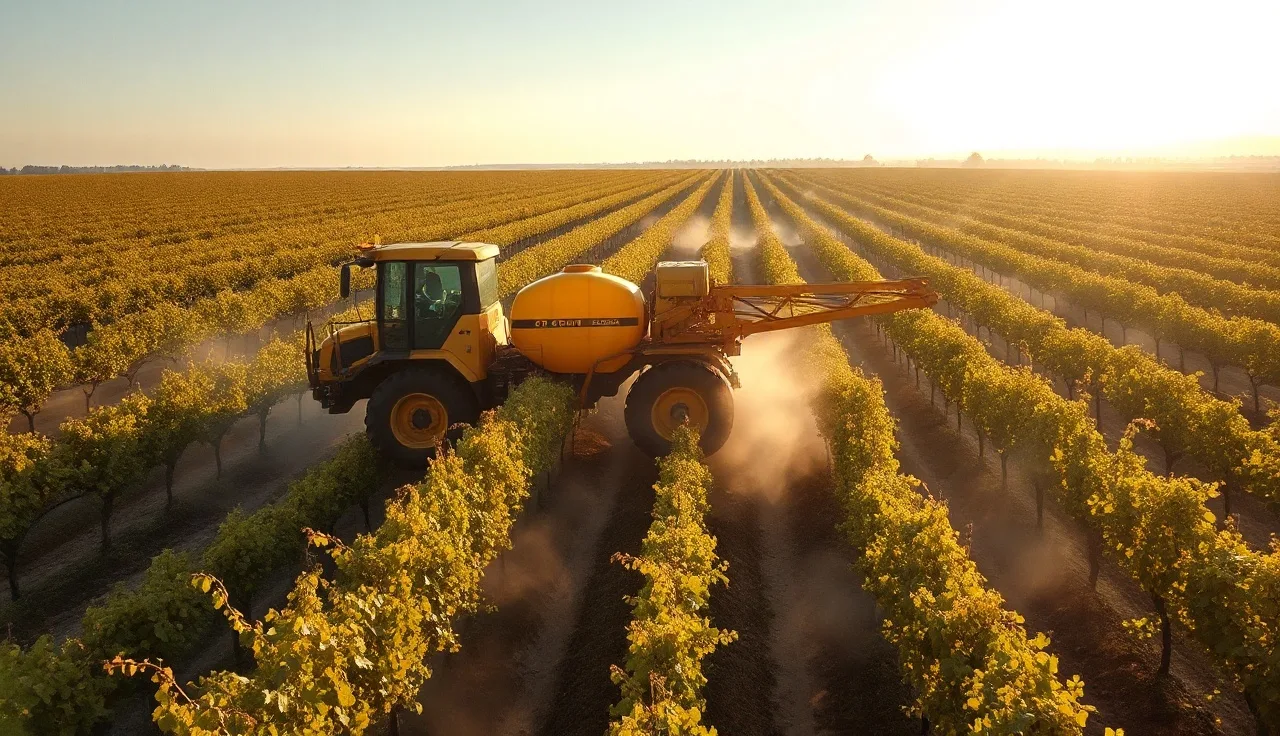
Most multi-row designs fall into one of three shapes. Straddle sprayers ride the row midline with booms that reach over adjacent rows. Tunnel sprayers use a closed hood that captures overspray and recirculates it. Over-row machines use articulated arms that reach across two or more rows from a single alley. The mechanism changes, but the payoff is the same: more canopy per tractor hour.
These machines aren't new. European viticulture, especially the tight-spaced blocks of Bordeaux and Burgundy, drove a lot of the early engineering. U.S. adoption picked up as row spacings in California, Washington, and New York widened and labor got expensive. The University of California Cooperative Extension documented a 40-60% cut in spray passes with multi-row tunnel sprayers in comparative trials [1].
Understand one thing before you shop. A multi-row sprayer is a capital-heavy answer to an operational problem. It makes clear economic sense above roughly 50 acres of continuous blocks. Below that, a well-calibrated single-row air-blast machine and a good spray record system may serve you better. Nobody should buy one because a dealer called it the future.
For more on how vineyard operations structure field equipment decisions, see our overview of vineyard management fundamentals.
What row spacing and vine architecture work best for multi-row sprayers?
Row spacing is the hard physical limit. Most commercial multi-row straddle sprayers are built for rows 9-12 feet apart, center to center [2]. If your vineyard went in at 7-foot spacing (common in older California coastal blocks), many straddle machines just won't fit without modification.
Tunnel sprayers give you a little more room because you can spec the hood dimensions at order time. They still need consistent spacing across the whole block. Variation of even 6 to 8 inches between rows opens coverage gaps or slams the hood into trellis posts, which wrecks equipment and wire in a hurry.
Vine training system matters as much as row spacing. High-cordon VSP (Vertical Shoot Positioning) is the easiest to spray with a multi-row machine because the fruiting zone is well defined and the canopy width is predictable. GDC (Geneva Double Curtain) and sprawl-trained vines throw a wider, more irregular canopy that fights automated boom positioning. Lyre and Y-trellis systems can work with tunnel designs, but they need custom hood geometry.
Slope is the constraint dealers tend to gloss over. Multi-row straddle machines are heavy (some clear 4,000 lbs loaded), and their wide stance gets shaky on cross-slopes above 10-12%. Hillside vineyards in Sonoma's Dry Creek Valley or the Finger Lakes foothills often can't run these safely without serious tractor ballasting and an operator who knows the ground.
| Training System | Multi-Row Compatibility | Notes |
|---|---|---|
| VSP (Vertical Shoot Position) | Excellent | Consistent canopy, easy boom set |
| Scott Henry | Good | Two fruiting zones require boom adjustment |
| GDC (Geneva Double Curtain) | Moderate | Wide canopy; tunnel designs struggle |
| Lyre / Y-trellis | Moderate | Custom hood needed for tunnel sprayers |
| Sprawl / Minimal training | Poor | Irregular canopy defeats coverage consistency |
| Head-trained bush vine | Poor | Row height too variable for most booms |
What are the main types of multi-row vineyard sprayers?
There are four designs you'll actually see from dealers and at trade shows like World Ag Expo.
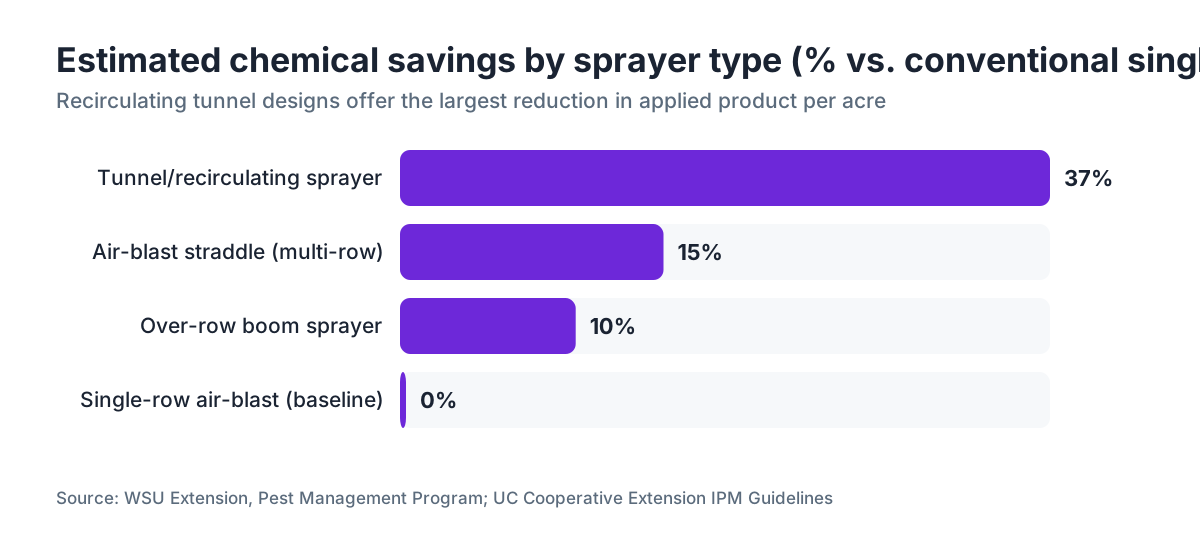
Air-blast straddle sprayers push the classic radial fan into a frame that straddles one row and blows air into the adjacent rows on both sides. They're the cheapest multi-row option, usually $15,000-$35,000, and they slot into an existing spray program without rethinking nozzles. The catch is drift. An air-blast machine throwing air sideways across several rows in any wind above 5 mph creates real off-target movement, which is both an environmental problem and a regulatory one under the EPA Worker Protection Standard [3].
Tunnel (recycling) sprayers are the strongest tool for drift reduction and chemical savings. A rigid or semi-rigid hood encloses each side of the row, nozzles fire horizontally into the canopy, and any droplets that miss a leaf hit a recovery panel and get pumped back to the tank. WSU Extension's pest management program cites 25-50% chemical savings per acre with recirculating tunnel systems against conventional air-blast [4]. These machines run $60,000-$120,000 new, which is real money. The payback math shifts fast when you're spending $80-$120/acre on fungicide.
Over-row boom sprayers put flat-fan or hollow-cone nozzles on articulated arms above the canopy and spray down into the fruiting zone. They handle systemic fungicides in open canopies well but struggle to drive contact materials like copper or sulfur deep enough. Cornell's viticulture program has documented penetration deficits with over-row designs in dense, well-thinned VSP canopies [5].
Electrostatic multi-row sprayers charge the droplets so they wrap around leaf surfaces by attraction. The technology works on paper and in some university trials. Real-world U.S. vineyard adoption is still thin. Equipment costs run high, the charging system is fussy to maintain in the field, and almost no spray contractors own them. Worth watching, not worth buying yet.
How much does a multi-row vineyard sprayer cost?
The honest answer is a lot, and the range is wide enough that sticker price alone tells you almost nothing.
Entry-level air-blast straddle units from Gregoire, Bertoni, or domestically assembled machines start around $15,000-$25,000 used and $28,000-$40,000 new, depending on tank size (200-800 gallon) and fan configuration. Tunnel sprayers from Lipco, Caffini, or Tecnoma start around $55,000 and climb past $120,000 for large-capacity, GPS-integrated units with variable-rate nozzle control.
Operating cost belongs in the same conversation. A 400-gallon tunnel sprayer covering two rows per pass at 3 mph through a 100-acre block finishes a spray event in roughly half the tractor hours of a single-row machine, which drops fuel, operator time, and equipment wear together. The UC Davis cost-and-return studies for wine grapes put spraying labor and equipment at roughly $180-$280 per acre per year in California, depending on pest pressure and program intensity [6]. Even modest efficiency gains at that scale add up.
Don't forget the tractor. Many multi-row machines want 80-120 PTO horsepower, and the larger tunnel units need 150+ hp. If your fleet runs 60-75 hp tractors matched to single-row gear, a new sprayer might also mean a new tractor. Price that in before you sign anything.
Used equipment deserves a serious look. A 3-5 year old tunnel sprayer from a bigger operation that upgraded is often mechanically sound and can knock $20,000-$40,000 off the new price. Inspect the recovery system gaskets, nozzle holders, and pump seals hard. Those wear first.
Growers in destination regions like Paso Robles and South Coast often trade equipment intel through local grower associations. Tap that before you buy.
How do drift reduction and EPA compliance requirements affect sprayer choice?
Most growers underweight this question until a neighbor complains or the county ag commissioner sends a notice.
The EPA's Worker Protection Standard (40 CFR Part 170) requires that workers and handlers be protected from pesticide exposure during applications, including drift onto workers in nearby areas [3]. State rules often go further. California's Department of Pesticide Regulation runs some of the strictest drift rules in the country, and several counties in Sonoma, Napa, and Santa Barbara require specific application buffer distances and, for certain materials, drift-reducing nozzle documentation.
Tunnel sprayers are the clearest answer to drift compliance because the hood physically holds the spray cloud. The National Pesticide Information Center notes that recirculating tunnel sprayers can reduce airborne drift by 80-95% against open air-blast machines [7]. Near schools, homes, or organic blocks where contamination threatens a certification or invites a lawsuit, that reduction is the whole point.
Drift-reducing nozzles (air-induction flat-fan, or Turbo TwinJet styles) help on any machine. ASABE standard S572.1 classifies nozzles by droplet size spectrum, and UC, Cornell, and WSU extension programs publish nozzle selection guides for vineyard use [5]. Larger droplets cut drift but also cut canopy penetration for contact fungicides, so there's a real tradeoff tied to what you're spraying.
One practical note. Whatever machine you run, your application records need to capture equipment type, nozzle configuration, and weather at application time. That isn't optional under most state programs. A platform like VitiScribe structures those records so the drift-related fields get captured the same way on every spray event, which matters a great deal the day a neighbor files a complaint and you need the paper.
What spray coverage quality should you expect from a multi-row machine?
Coverage quality is the thing that actually protects your crop, and it's where multi-row sprayers have taken criticism.
Canopy penetration favors air-blast designs because high-velocity air physically moves leaves and drives droplets into the canopy interior. A tunnel sprayer with low-pressure horizontal nozzles leans on droplet momentum and canopy porosity. In a well-managed VSP canopy with shoot thinning and leaf removal in the fruiting zone (standard in most serious wine grape programs), tunnel penetration is good. In a dense, poorly thinned canopy, it falls short.
WSU Extension's spray application research shows that canopy density, measured as leaf area index (LAI), is the strongest predictor of whether a given sprayer design reaches adequate coverage on interior leaves [4]. A VSP block with an LAI below 3.0 is manageable with a tunnel machine. Above 4.0, you'll likely need air-blast to get the penetration.
Water-sensitive cards are the field tool for checking coverage. Place them at the cluster zone on both the interior and exterior of the canopy, both sides of the row, run the sprayer through, and read the deposit pattern and density. UC Cooperative Extension recommends a minimum of 20-30 impact points per cm² for most fungicide applications [1]. If your interior cards come back at 5-8 impacts, your canopy is too dense for the machine or your settings need work.
Calibration is not a one-time event. Multi-row machines carry multiple nozzle sets across several booms, and individual nozzles clog without any obvious signal at the boom level. Check nozzle output quarterly during the spray season against the manufacturer's rated flow at your operating pressure.
Which brands and models are most widely used in U.S. vineyards?
A few manufacturers hold most of the U.S. market, though the picture shifts as European brands add domestic distribution.
Gregoire (French) makes widely used straddling and over-row machines and has strong dealer support in California. Their G7 and G9 series show up across Napa and Sonoma. Bertoni (Italian) builds air-blast straddle models popular in the Central Valley and Washington's Yakima Valley. Lipco and Caffini are the tunnel names you'll hear most from California growers running recirculating systems.
On the domestic side, Rears Manufacturing (Oregon) builds custom vineyard air-blast units, including some multi-row configurations, and has a solid reputation for parts availability and serviceability across the Pacific Northwest. Durand-Wayland holds a strong presence in eastern U.S. markets.
John Deere and AGCO don't build vineyard-specific sprayers directly, but both have partnered distribution for European vineyard brands, so parts and warranty support are more reliable than they were 10-15 years ago.
Here's the honest ranking by category. For tunnel/recirculating sprayers, Caffini and Lipco are the most refined machines in the U.S. market right now. For air-blast straddle, Gregoire has the best reputation for longevity and boom adjustment precision. For over-row designs in wide-spaced blocks, Bertoni offers solid mid-range options. None of this is fixed. Talk to growers in your region who run the exact machine you're weighing, more than you talk to dealers.
Estate operations like Ponte Winery and South Coast Winery in Southern California sometimes have firsthand experience with equipment built for warm, dry conditions, where powdery mildew pressure and spray timing look very different from western Sonoma.
How do you calibrate a multi-row sprayer for accurate application?
Calibrating a multi-row machine is more involved than a single-row unit because you've got multiple boom sections, sometimes dozens of nozzles across different positions, and occasionally two nozzle types (air-blast and flat-fan) on the same machine.
Start with the basics. Measure your actual ground speed with a GPS unit or by timing a known distance (at least 300 feet) at your planned operating speed, in the field, with a loaded tank. Tractor speed under load on soft ground never matches the speedometer. This matters because your application rate per acre rides directly on speed.
Next, measure individual nozzle output. Collect each nozzle's output for 30 seconds into a graduated container. Compare it to the manufacturer's rated output at your operating pressure. Replace any nozzle delivering more than 10% above or below rated flow. On a machine with 20-40 nozzles, this takes a while. Do it anyway, at the start of each season and again mid-season.
Calculate your actual application rate with the standard formula: GPA = (GPM x 5940) / (MPH x W), where GPM is total nozzle output in gallons per minute, MPH is ground speed, and W is the effective swath width in inches. Cornell's spray calibration guide walks through this step by step and is free online [5].
For tunnel sprayers, check the recovery system. Run the machine with water, collect the recovered material, and measure it as a percentage of total output. A healthy tunnel system recovers 20-40% of total spray volume when running in a vine canopy with good coverage. Recovery below 10% usually points to nozzle misdirection or worn seals on the collection panels.
What record-keeping is required after each vineyard spray application?
Every commercial pesticide application in the U.S. requires a written record. At the federal level, FIFRA (Federal Insecticide, Fungicide, and Rodenticide Act, 7 USC 136 et seq.) requires certified applicators to keep records for restricted-use pesticides for at least two years [8]. State requirements are almost always stricter.
California requires a Pesticide Use Report (PUR) for every application of any pesticide on commercial agricultural land, filed with the county agricultural commissioner within one month [9]. The PUR must carry operator name, site location (legal description or township-range), date, product name and EPA registration number, amount applied, acreage treated, target pest, and equipment type. A multi-row sprayer covering two rows per pass changes your effective acreage per tank load, so record actual treated acreage carefully.
Washington State requires Pesticide Application Records under RCW 17.21 for all commercial applicators, held at least three years [10]. New York's Department of Environmental Conservation has similar requirements under ECL Article 33.
Beyond the legal minimum, good spray records protect you day to day. When a Botrytis program fails and you're trying to sort out whether the problem was timing, coverage, or resistance, you need accurate records of what went on, at what rate, at what canopy stage, with what equipment settings. That detail runs past what most state forms ask for. It's also what actually helps you manage.
VitiScribe is built for exactly this kind of structured field record. You log sprayer type, nozzle configuration, speed, water volume, and weather at application time, past the product and rate. That helps with regulatory audits and with your own agronomic review at season end.
What is the total cost of ownership for a multi-row vineyard sprayer?
Purchase price is the loudest number and the least complete.
Take a mid-range tunnel sprayer at $75,000 new. Annual ownership cost usually includes depreciation (5-10 year straight-line, roughly $7,500-$15,000/year depending on your schedule), maintenance and parts ($1,500-$4,000/year for a well-kept machine), insurance ($800-$2,000/year, varies by state and coverage), and storage. On 100 acres, the ownership cost per spray event is steep, but labor and chemical savings start to offset it. On 200+ acres with 8-12 spray events a season, the math almost always works.
For an air-blast straddle machine at $30,000, the same framework applies at lower absolute numbers. These machines also carry lower maintenance costs because they're far less complex than a tunnel unit with its pumping, sealing, and recovery systems.
Fuel cost per pass depends on tractor size and field conditions, but cutting passes roughly in half halves your fuel per acre per event. At current diesel prices (roughly $4.00-$5.00/gallon for agricultural diesel), a 100-acre block running 10 spray events might save $400-$800 a season in fuel alone against a single-row machine. Not transformative on its own. Still real.
Operator time is the number most managers undercount. At $20-$30/hour fully loaded for a skilled operator (benefits, payroll taxes, housing where it applies), cutting 200 tractor hours a season in half saves $2,000-$3,000 a year on labor. Over 10 years, that's $20,000-$30,000 at current rates, which meaningfully shifts the ROI on equipment that costs $40,000-$75,000 more than a single-row alternative.
How does a multi-row sprayer affect pesticide resistance management?
This question doesn't come up enough in equipment conversations. It should.
Pesticide resistance develops when sublethal exposure lets partially resistant individuals in a pathogen or pest population survive and reproduce. Incomplete coverage, whether from poor canopy penetration or uneven nozzle output, builds exactly those conditions. A multi-row machine that leaves interior cluster zones with low deposit creates selection pressure for resistance, even when the label rate is correct.
The FRAC (Fungicide Resistance Action Committee) guidelines specifically name application quality as a resistance management factor alongside active ingredient rotation [11]. Your sprayer choice is part of your resistance management plan, not separate from it.
Tunnel sprayers, calibrated well in the right canopy conditions, hit more consistent coverage across the cluster zone than open air-blast machines in wind, because the hood shields the spray from drift. Consistent coverage means closer to lethal exposure for every fungal spore in the treated zone, which drops the selection pressure that drives resistance.
Here's the practical part. If you switch to a tunnel sprayer, don't assume you can cut material rates because the machine is more efficient. Your extension agent or certified crop adviser should guide rate decisions from efficacy data, not equipment marketing. What you gain is confidence that the rate you're applying actually reaches the target every time.
What should you check before buying a used multi-row vineyard sprayer?
Used equipment is a real option and often a smart one, but the inspection list for a multi-row sprayer runs longer than for a single-row air-blast machine.
Start with the pump. A diaphragm pump in good shape holds pressure steadily with no pulsing at the gauge. Worn diaphragms create pressure spikes that chew up nozzle tips over time. Ask the seller for maintenance records and pump rebuild dates. Centrifugal pumps are lower maintenance, but check impeller wear by measuring flow against rated specs.
On tunnel sprayers, inspect every seal on the recovery panels. The foam or rubber seals that ride the trellis wires and vine trunks take constant abrasion and UV damage. New seals on a Lipco or Caffini unit can run $2,000-$5,000 in parts alone, which you should build into your offer price.
Check the boom structure for weld cracks and bent sections. Multi-row boom arms take hits from posts, equipment, and uneven ground. Straightened booms re-welded in the field are common and not automatically disqualifying, but they tell you how the machine was run.
Nozzle holders are cheap to replace, but a pile of worn or cracked holders signals that calibration maintenance wasn't a priority for the last owner, which should make you wonder about everything else.
Ask specifically about blockage history in the recovery system plumbing. On machines run with sulfur or copper, mineral deposits in the recovery lines choke flow and drag down performance. Descaling is possible but slow. A machine used mostly with EC formulations and kept clean is meaningfully better than one that ran sulfur all season without flushing.
Frequently asked questions
What row spacing do I need for a multi-row vineyard sprayer?
Most commercial multi-row straddle and tunnel sprayers are built for row spacings of 9-12 feet, center to center. Some manufacturers offer configurations down to 8 feet, but confirm that with the specific brand. Below 8 feet, multi-row designs generally can't fit the equipment frame between rows. Always measure your actual row spacing in several locations before you specify a machine.
Can I use a multi-row sprayer on a hillside vineyard?
It's possible but genuinely hard. Multi-row straddle machines are heavy (3,000-5,000 lbs loaded) and wide, which creates lateral stability problems on cross-slopes above about 10-12%. Steep hillside sites in Sonoma, Napa foothills, or the Finger Lakes often can't run these safely without heavy ballasting and a highly experienced operator. On slopes above 20%, single-row air-blast machines or hand application may be the only safe option.
How much can a tunnel sprayer reduce chemical costs?
WSU Extension research puts chemical savings from recirculating tunnel sprayers at 25-50% per acre against conventional air-blast, because recovered spray gets reused instead of lost to drift and evaporation. Actual savings ride on canopy density, travel speed, and how well you maintain the recovery system. On an $80-$120/acre annual fungicide program, a 30% cut is $24-$36 per acre a year, which adds up fast on a 150-acre block.
What horsepower tractor do I need to run a multi-row sprayer?
Most mid-size tunnel and air-blast straddle sprayers need 80-120 PTO horsepower. Larger units with 600+ gallon tanks and high-volume fans can demand 150 hp or more. Check the manufacturer's PTO requirement before you assume your current fleet fits. Undersizing the tractor creates PTO overload that damages both the tractor and the sprayer's drive components.
Do multi-row sprayers work for both fungicide and insecticide applications?
Yes, the same machine handles both, with the caveat that coverage requirements differ. Fungicide applications targeting Botrytis and powdery mildew need strong cluster zone penetration. Insecticide applications for leafhopper or mealybug may target leaf surfaces more broadly. Adjust nozzle selection and pressure for each target pest. One machine, two or three spray programs, different setups.
How long does it take to calibrate a multi-row vineyard sprayer?
A thorough calibration of a multi-row machine with 20-40 nozzles takes 3-5 hours, including ground speed measurement, individual nozzle output checks, and a spray pattern test with water-sensitive cards. Plan for a full half-day at the start of each season and a shorter recheck (1-2 hours) mid-season. It's tedious. It's also the most direct way to catch coverage problems before they show up as disease pressure.
What records do I legally have to keep after each spray application?
Federal law (FIFRA, 7 USC 136 et seq.) requires restricted-use pesticide records for at least two years for certified applicators. California requires a Pesticide Use Report for all agricultural pesticide applications, filed with the county agricultural commissioner within 30 days. Washington requires records under RCW 17.21 for at least three years. Most states require product name, EPA registration number, date, site, rate, and acreage treated at minimum.
Is a used multi-row sprayer worth buying?
Often yes, especially for tunnel sprayers where new prices clear $60,000. A 3-5 year old machine from a well-maintained operation can save $20,000-$40,000. Inspect the pump condition, recovery system seals on tunnel units, boom structural integrity, and nozzle holder wear. Ask for maintenance records. Machines run hard with sulfur or copper without proper flushing often carry recovery system scaling that's expensive to fix.
How do I reduce pesticide drift with a vineyard sprayer?
Recirculating tunnel sprayers reduce drift by 80-95% against open air-blast machines by enclosing the spray zone. For air-blast sprayers, drift-reducing nozzles (air-induction or Turbo TwinJet designs) help by making larger droplets that resist drift. Avoid applying in winds above 10 mph. California and other states set specific buffer distances for certain materials near sensitive sites, so check your county rules.
What is the EPA Worker Protection Standard requirement for vineyard spraying?
The EPA Worker Protection Standard (40 CFR Part 170) requires agricultural employers to protect workers and pesticide handlers from exposure during applications. That includes maintaining application exclusion zones, providing personal protective equipment, posting treated areas, and providing safety training. The standard covers any farm using pesticides and doesn't distinguish between multi-row and single-row equipment. Full text is on the EPA website.
How does vine training system affect which multi-row sprayer I should buy?
VSP (Vertical Shoot Positioning) is the most compatible with tunnel and straddle designs because the fruiting zone is well defined and canopy width is predictable. GDC and sprawl systems throw wider, irregular canopies that fight hood geometry. Lyre and Y-trellis systems can work with custom tunnel hoods. Head-trained bush vines are generally incompatible with multi-row designs because of variable vine height and non-uniform canopy position.
What's the difference between a tunnel sprayer and an air-blast vineyard sprayer?
An air-blast sprayer uses a high-velocity fan to push droplets into the canopy from an open nozzle ring, relying on air movement for penetration. A tunnel sprayer encloses the vine row in a hood, fires nozzles horizontally into the canopy at lower pressure, and recovers undeposited spray through collection panels that pump it back to the tank. Tunnels sharply reduce drift and chemical loss; air-blast gives better penetration in dense canopies.
How do I know if my canopy is too dense for a tunnel sprayer?
Use water-sensitive cards placed at the interior cluster zone on both sides of the row. After a test pass with the tunnel sprayer, count deposit impacts per cm². UC Cooperative Extension recommends a minimum of 20-30 impacts per cm² for most fungicide applications. If your interior cards run far below your exterior cards, the canopy is too dense for the machine at its current settings, or it needs more shoot thinning and leaf removal.
Can a multi-row sprayer handle both sides of a vine row simultaneously?
Yes, that's the core design intent. A straddle or tunnel multi-row sprayer places spray equipment on both sides of one or more rows at once, treating both canopy walls in a single pass through the alley. That's different from a single-row air-blast machine, which typically sprays one side of two different rows from one alley, so it needs two total passes to cover both sides of any given row.
Sources
- UC Cooperative Extension, Grape Pest Management Guidelines: 40-60% reduction in spray passes using multi-row tunnel sprayers vs. single-row machines; minimum 20-30 impact points per cm² recommended for fungicide coverage evaluation
- EPA, Worker Protection Standard (40 CFR Part 170): WPS requires protection of workers and handlers from pesticide exposure during applications, including drift exposure to adjacent workers
- Washington State University Extension, Pest Management: WSU cites 25-50% chemical savings per acre with recirculating tunnel systems; leaf area index (LAI) is the strongest predictor of adequate coverage for a given sprayer design
- Cornell University, Viticulture and Enology Program: Cornell documented penetration deficiencies with over-row designs in dense VSP canopies; Cornell spray calibration guide provides GPA formula and nozzle selection guidance for vineyard applications
- UC Davis, Agricultural and Resource Economics, Wine Grape Cost and Return Studies: Spraying labor and equipment costs approximately $180-$280 per acre per year in California wine grape production
- National Pesticide Information Center, Oregon State University: Tunnel (recirculating) sprayers can reduce airborne drift by 80-95% compared to open air-blast machines
- EPA, Federal Insecticide, Fungicide, and Rodenticide Act (FIFRA), 7 USC 136 et seq.: FIFRA requires certified applicators to maintain restricted-use pesticide application records for at least two years
- California Department of Pesticide Regulation, Pesticide Use Reporting: California requires a Pesticide Use Report for every application of any pesticide on commercial agricultural land, submitted to the county agricultural commissioner within one month of application
- Washington State Department of Agriculture, Pesticide Application Records (RCW 17.21): Washington State requires commercial pesticide applicators to maintain application records for at least three years under RCW 17.21
- FRAC (Fungicide Resistance Action Committee), Resistance Management Guidelines: FRAC guidelines identify application quality as a resistance management factor alongside active ingredient rotation
Last updated 2026-07-09