Greenhouse gas emissions inventory documentation for vineyard operations

TL;DR
- Vineyards track emissions from fuel, fertilizer, irrigation power, and soil to build a credible GHG inventory.
- EPA's mandatory reporting threshold is 25,000 metric tons CO2-equivalent per year, and most small vineyards fall well below it.
- California and other states add their own rules.
- A documented inventory uses the GHG Protocol or a USDA-approved method, covers Scopes 1, 2, and 3, and gets updated every year.
What is a GHG emissions inventory and why does your vineyard need one?
A greenhouse gas emissions inventory is a structured accounting of every source and sink of greenhouse gases your operation controls or influences. For a vineyard, that means diesel in the tractor, propane in the frost fan, electricity pulled from the grid for pumps, nitrous oxide off-gassing from fertilizer applications, and even carbon stored in your vine biomass and soil. The inventory turns all of that into a single number: metric tons of carbon dioxide-equivalent (MTCO2e) per year.
Most small vineyards have no legal obligation to file a GHG report with the federal government. EPA's mandatory reporting rule (40 CFR Part 98) requires annual reporting only from facilities that emit 25,000 MTCO2e or more per year [1]. A 50-acre estate sits well below that line. So why bother? Three practical reasons.
First, California's cap-and-trade program and the state's Short-Lived Climate Pollutant regulation (SB 1383) push supply-chain pressure downstream onto growers even when they're not regulated entities [2]. Buyers, particularly larger wineries selling into EU markets, ask suppliers for documented emissions data more and more. Second, USDA's climate-smart agriculture programs, including the Partnerships for Climate-Smart Commodities grants, require participating farms to quantify emissions baselines before they can claim credits or payments [3]. Third, if you ever want to sell carbon credits through a voluntary market like the American Carbon Registry or Verra, you need a documented, verified baseline. No inventory, no credits.
Which greenhouse gases does a vineyard need to account for?
Six gases fall under the Kyoto Protocol and the GHG Protocol Corporate Standard: CO2, CH4 (methane), N2O (nitrous oxide), HFCs, PFCs, and SF6 [4]. For most vineyards, only three of them matter in practice.
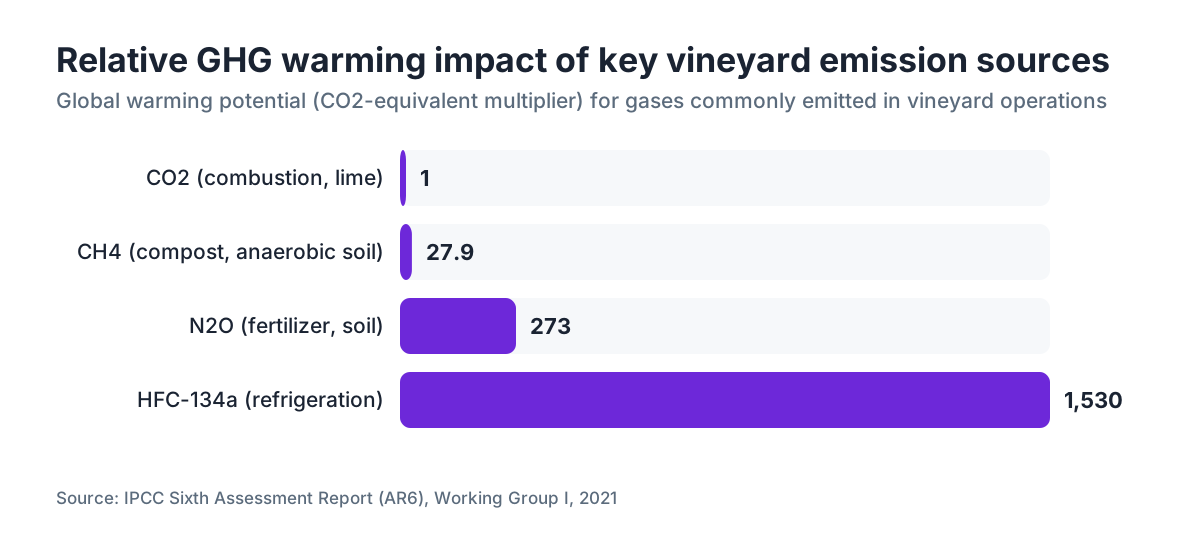
CO2 comes from combustion: your diesel tractors, ATVs, frost protection equipment, and any natural gas burned in a winery attached to the estate. Methane is a minor factor in pure vineyard work compared to livestock or landfill settings, though compost piles and anaerobic soil conditions generate small amounts. N2O is the one most growers underestimate. Synthetic nitrogen fertilizer, and to a lesser extent organic amendments, trigger microbial activity in soil that releases N2O, and N2O carries a global warming potential 273 times that of CO2 over a 100-year horizon, per the IPCC's Sixth Assessment Report [5]. That multiplier means a small nitrogen application can add a disproportionate weight to your inventory.
HFCs matter if you run refrigerated wine storage on-site. SF6 and PFCs are essentially irrelevant to standard vineyard operations, and you can document them as not applicable, which is a defensible position as long as you note it.
| Gas | Main vineyard source | Global warming potential (100-yr) |
|---|---|---|
| CO2 | Fuel combustion, lime applications | 1 |
| CH4 | Compost, anaerobic soil | 27.9 |
| N2O | Synthetic & organic fertilizer, irrigation water | 273 |
| HFCs | Refrigeration equipment | 148 to 12,400 |
All GWP values come from the IPCC Sixth Assessment Report (AR6), 2021 [5].
What are Scope 1, 2, and 3 emissions and which ones apply to a vineyard?
The GHG Protocol splits emissions into three scopes based on who owns or controls the source [4]. Scope 1 is direct emissions from sources your vineyard owns or operates: tractor exhaust, frost protection combustion, stationary generators, on-farm fuel storage, and fertilizer-driven soil N2O. Scope 2 is indirect emissions from purchased electricity and heat. If your well pumps and irrigation run on grid power, the emissions from generating that electricity count here, figured with an emissions factor for your regional grid.
Scope 3 is everything else in your value chain, upstream and downstream. For a vineyard, the Scope 3 categories that carry real weight are purchased inputs (pesticides, herbicides, fertilizers), transportation of grapes to the winery if you sell fruit, and waste. Scope 3 is optional under many reporting frameworks but increasingly expected under supply chain disclosure programs.
For a first-year inventory, fully quantify Scope 1 and 2, then do a screening-level estimate of your biggest Scope 3 categories. UC Davis's Agricultural Sustainability Institute has published guidance on farm-level GHG accounting that follows this tiered approach [6]. Don't try to capture everything perfectly in year one. A documented, reproducible estimate with clear methodology notes beats a perfect number you can't reconstruct.
What protocols and standards should a vineyard use to calculate emissions?
Three frameworks matter most for vineyard operations in the US.
The GHG Protocol Agricultural Guidance (2014) is the most widely recognized standard globally, and most voluntary carbon markets and corporate supply chain programs accept it [4]. It matches ISO 14064-1 and gives activity-based calculation guidance for fertilizer emissions, fuel, and land use.
USDA's COMET-Farm tool is a free, web-based calculator built for US agricultural operations [3]. It uses IPCC Tier 1 and Tier 2 emission factors and it's the tool USDA's Natural Resources Conservation Service (NRCS) uses to estimate GHG benefits for conservation practice payments. If you're in any USDA climate-smart program, COMET-Farm is essentially required. Cornell University's extension team has published worksheets that walk farms through COMET-Farm data entry [7].
California operations should also read the California Air Resources Board's (CARB) inventory methodology documents, which support the state's Cap-and-Trade Regulation (Title 17, California Code of Regulations, Sections 95800 to 96023) [2]. Even if your vineyard isn't a covered entity, CARB-consistent methodology makes your data immediately legible to California buyers and regulators.
Pick one methodology and stick with it year to year. Switching frameworks mid-stream creates comparability problems that undermine the whole point of tracking trends.
What data do you actually need to collect from your vineyard?
This is where most vineyard managers stall out. The calculation methods aren't hard once you have the activity data, and activity data is mostly stuff you already track (or should be tracking) for other reasons.
For Scope 1 fuel combustion, you need total gallons of diesel, gasoline, propane, and natural gas burned by each piece of equipment during the reporting year. Fuel receipts and tank fill logs are the primary source. If you don't track fuel by equipment, a per-acre-pass estimate using engine horsepower and typical pass duration is a defensible Tier 1 approach.
For soil N2O, you need total pounds of nitrogen applied per acre, broken out by fertilizer type (synthetic vs. organic) and application method. This should already sit in your pesticide and fertilizer application records. The IPCC default emission factor for synthetic nitrogen is 1% of applied N converted to N2O-N [5], though California-specific factors can differ. Application timing, irrigation method, and soil type all shift actual emissions, so if you have detailed records, a higher-tier calculation is possible.
For Scope 2 electricity, pull your annual kWh from utility bills and multiply by your regional grid emissions factor. EPA publishes eGRID subregion emission factors updated annually [8]. California's grid factor has dropped a lot as renewables grow, so a current factor matters.
Other data to collect: acres under vine (for land-use calculations), compost and cover crop inputs, refrigerant top-ups in any cooling equipment, and fuel for employee commutes if you want Scope 3.
Record-keeping platforms built for vineyard compliance, including VitiScribe, can pull fuel and fertilizer data from your existing spray and field records into a format that feeds directly into COMET-Farm or a GHG Protocol spreadsheet, which cuts the data assembly time considerably.
WSU Extension has published a Pacific Northwest farm carbon footprint calculator that includes worksheets for vineyard-specific inputs like drip irrigation and trellising materials [9].
How do you calculate soil N2O emissions from fertilizer applications?
N2O from soil is almost always the largest single emission source in a vineyard inventory, so it earns its own section. The basic IPCC Tier 1 method works like this [5]:
- Total nitrogen applied (kg N) x direct emission factor (EF1 = 0.01 for mineral fertilizer) = kg N2O-N
- kg N2O-N x 44/28 = kg N2O
- kg N2O x 273 (GWP) = kg CO2e
- Divide by 1,000 to convert to MTCO2e
So a vineyard applying 40 lb N per acre across 100 acres (4,000 lb N total, or about 1,814 kg N) generates roughly 18 kg N2O-N, which converts to 28.3 kg N2O, or about 7.7 MTCO2e from direct soil emissions alone. That's before volatilization and leaching pathways, which add indirect N2O through separate emission factors.
Organic nitrogen sources (compost, cover crop legumes) use different factors because nitrogen mineralization rates vary. COMET-Farm handles this automatically if you enter your inputs correctly. Doing it by hand in a spreadsheet works, but it's error-prone, and you have to document every assumption.
Application method matters more than most growers realize. Injected or incorporated fertilizer generally produces less N2O than surface broadcast because it cuts volatilization before soil microbes can process the nitrogen. If you're making a practice change like this, document it clearly so the inventory reflects the real reduction.
Does your vineyard qualify as a carbon sink, and can you claim credits?
Vineyards can store carbon, mainly through vine biomass, rootstock, and soil organic matter. Cover crops and compost amendments build soil organic carbon over time. Whether you can count that in your inventory, and whether you can sell credits for it, are two different questions.
For inventory purposes, the GHG Protocol and COMET-Farm both let you include carbon stock changes in soil and perennial biomass. You need baseline soil organic carbon measurements (actual field samples, not estimates) and a remeasurement protocol. UC Davis's Agricultural Sustainability Institute recommends sampling every 3 to 5 years at consistent depth intervals to detect changes with statistical reliability [6].
Voluntary carbon markets set the bar higher. You need additionality (you're doing something you wouldn't have done anyway), permanence (the carbon stays stored), and third-party verification. American Carbon Registry, Verra's Verified Carbon Standard, and the Climate Action Reserve all have protocols for agricultural soil carbon, but verification costs typically run $10,000 to $25,000 for a small operation, and credit prices on voluntary markets have been all over the map (roughly $10 to $50 per MTCO2e across 2022 to 2024, and conditions keep shifting). Nobody has consistent good data on break-even acreage for vineyard-specific carbon projects. The closest published analysis tends to show that operations under 500 acres rarely cover verification costs from credits alone.
Still, the sequestration estimates are worth including in your inventory even if you're not selling credits. They give you a truer net emissions picture, and buyers keep asking for that.
What documents should be in your vineyard GHG inventory file?
A defensible GHG inventory isn't just a final number. It's a file someone else could pick up and verify. Build your documentation around that standard.
Your inventory file should hold, at minimum: a methodology statement (which protocol you used, which emission factors, which tier, and why), all raw activity data with sources (fuel receipts, utility bills, fertilizer records, equipment lists), your calculation workbook with clearly labeled formulas, an organizational boundary statement (which fields, equipment, and operations are in and which are out, and why), and a temporal boundary statement (the exact calendar or fiscal year covered).
Beyond those core documents, include a quality assurance log: who compiled the data, who reviewed it, when it was done, and what cross-checks got run. If you use COMET-Farm, export and save the full report PDF, not the summary number alone. The PDF shows all your inputs, which is what a third-party verifier or a procurement auditor will ask for.
Keep the file somewhere with version control. A simple dated folder structure (2023_GHG_Inventory_v1, 2023_GHG_Inventory_v2_reviewed) works fine. Cloud storage with sharing permissions beats a local drive, especially for multi-person operations.
For operations tracking field data digitally, vineyard record systems that log spray events, fertilizer applications, and equipment hours can export activity data in a format that drops straight into your inventory workbook. That matters a lot when you do this every year.
Retain your inventory files for at least 7 years, consistent with EPA record retention guidance for mandatory reporters [1] and general best practice for USDA program participants.
Are there California-specific GHG reporting requirements for vineyards?
California stacks more layers than any other state. Here's how they actually sort out for a typical vineyard.
The California Air Resources Board's mandatory GHG reporting program (Title 17 CCR Section 95100) requires covered entities emitting 25,000 MTCO2e or more per year to report annually [2]. Almost no stand-alone vineyard hits this threshold. But if you run an on-site winery with heavy natural gas use and your combined emissions cross the line, you're a covered entity.
SB 1383 (the Short-Lived Climate Pollutant regulation) matters more for operations with composting or organic waste. It requires large generators of organic waste to source-separate and arrange for recovery, and it carries downstream tracking requirements. A vineyard generating significant pomace or green waste needs to track disposal routes [2].
The California Healthy Soils Program, run by CDFA, ties financial incentives for cover cropping, compost application, and reduced tillage to documented GHG co-benefits. Applicants use COMET-Farm to estimate those benefits as part of the application [11]. This is voluntary, but the documentation requirements are real and auditable.
Some Napa and Sonoma County wineries join sustainability certification programs (Certified California Sustainable Winegrowing, Fish Friendly Farming, Napa Green) that include GHG tracking. These programs run their own documentation checklists that partly overlap with a standalone inventory.
How do you handle emissions from contracted or custom-harvest operations?
Contract work is one of the biggest documentation gaps in vineyard GHG inventories. If you hire a custom harvester to pick your fruit, the harvester's equipment burns fuel on your property for your benefit. Where do those emissions land?
Under the GHG Protocol, emissions from contractor equipment operated on your behalf and at your direction generally fall into your Scope 3 (specifically Category 1 or Category 4 depending on the structure) rather than your Scope 1 [4]. That means you report them separately, not inside your direct emission total, but you should still estimate and disclose them if you're doing a complete inventory.
Here's the practical move: collect fuel consumption data from your contractor as part of your service agreement. Many contractors won't have it. In that case, use equipment horsepower, operating hours, and a standard fuel consumption factor (ASABE publishes equipment fuel consumption standards that extension services like WSU reference [9]) to estimate it. Document your estimation method clearly.
This applies to aerial spray operations, trucking hired to move grapes, and even infrastructure contractors doing trellis installation. You don't need to account for every nail, but contracted services that are large, recurring, and tied directly to production should be screened.
How often should you update your vineyard GHG inventory, and who should verify it?
Annual updates are the standard. The GHG Protocol recommends annual reporting matched to your financial year so that activity data (fuel purchases, fertilizer invoices) maps cleanly onto existing accounting records [4]. Multi-year gaps are a problem because they make trend analysis impossible and raise questions about which practices drove which changes.
Third-party verification is required for mandatory EPA reporters and for anyone selling carbon credits. For voluntary disclosure or supply chain requests, it's not legally required, but it does add credibility. Verifiers accredited under ISO 14064-3 can review your methodology and activity data and issue a verification statement. Expect to pay $3,000 to $10,000 for a basic verification of a small vineyard inventory, depending on scope and the verifier's location.
For most small operations, internal review is the realistic option: a second person with some grasp of the methodology checks your calculations and sources before you finalize the document. That's not verification in the formal sense, but it beats an unreviewed single-person spreadsheet by a mile.
Even without formal verification, sending your inventory to your buyer or sustainability program with clear methodology documentation signals that you take the data seriously. That matters more than the precision of the number in most commercial settings.
What free tools and resources can help a vineyard build its first inventory?
You don't need to hire a consultant to build your first inventory. The tools exist. You just need to know where they live.
USDA's COMET-Farm (comet.colostate.edu, maintained by Colorado State and USDA) is the most complete free tool for US farms. It handles soil carbon, fertilizer N2O, energy use, and livestock (if you have any) and produces a full report with method citations [3].
EPA's eGRID tool (epa.gov/egrid) gives you state and subregion electricity emission factors, updated annually. You need this for Scope 2 [8].
The GHG Protocol's free calculation tools live at ghgprotocol.org. The Agriculture Guidance document is the one to grab for farm operations [4].
UC Davis's Agricultural Sustainability Institute (ASI) has published farm-level carbon footprint resources and research summaries specific to California viticulture [6]. WSU Extension has published a Pacific Northwest version with worksheets for irrigated crops and perennial systems [9]. Cornell's College of Agriculture and Life Sciences has climate-smart agriculture resources for northeastern grape growers [7].
For ongoing record-keeping, VitiScribe's spray and field record system lets you log fertilizer applications, equipment hours, and fuel use in one place, which makes pulling annual activity data for an inventory much faster than digging through paper records or scattered spreadsheets.
One honest caveat: COMET-Farm has a learning curve. Budget two to three hours for your first full run-through. The Colorado State team that maintains it offers occasional webinars, and NRCS field offices can sometimes walk you through it if you're enrolled in a conservation program.
Frequently asked questions
Does a small vineyard under 50 acres have to file a GHG report with the EPA?
Almost certainly not. EPA's mandatory GHG reporting rule (40 CFR Part 98) applies only to facilities emitting 25,000 metric tons CO2-equivalent or more per year. A 50-acre vineyard's emissions typically land well under 500 MTCO2e annually. State requirements vary, but California's mandatory program uses the same 25,000 MTCO2e threshold for most covered sectors. You may still want a documented inventory for USDA programs, buyer requests, or voluntary carbon markets.
What is the biggest source of greenhouse gas emissions on a typical vineyard?
Soil nitrous oxide from nitrogen fertilizer usually dominates, because N2O carries a global warming potential 273 times that of CO2 (IPCC AR6). Diesel combustion from tractors and equipment is typically the second-largest source. Electricity for irrigation pumping ranks third in many western operations. The relative weight of each depends heavily on your nitrogen application rate, equipment fleet age, and whether your grid power is renewable-heavy.
Can a vineyard earn money by selling carbon credits?
Yes, but the economics are hard at small scale. Verification costs for voluntary carbon markets typically run $10,000 to $25,000, and voluntary credit prices have ranged from roughly $10 to $50 per MTCO2e in recent years. A 100-acre vineyard might sequester 50 to 200 MTCO2e annually through improved practices, generating $500 to $10,000 in credits. That rarely covers verification costs alone, so most small vineyards join aggregated programs rather than individual projects.
What is COMET-Farm and is it actually useful for vineyards?
COMET-Farm is a free, USDA-backed GHG calculator maintained by Colorado State University. It estimates soil carbon changes, fertilizer N2O, and energy emissions using IPCC-aligned methods. It's the tool USDA's NRCS uses for conservation program payments, so it's essentially required if you want USDA climate-smart funding. It works for vineyards but needs accurate data on soil type, crop type, tillage practices, and nitrogen applications. Plan two to three hours for a first complete run.
Do cover crops reduce a vineyard's net GHG emissions?
They can, through two pathways. Cover crops add organic matter that builds soil organic carbon over time, which is sequestration. Leguminous cover crops also fix atmospheric nitrogen, potentially cutting synthetic fertilizer needs and the N2O that comes with them. The size of the effect depends on species, termination method, soil conditions, and how many years you keep the practice going. COMET-Farm can model both effects if you enter accurate cover crop species and management data.
How do I calculate emissions from vineyard irrigation pumping?
Pull your annual kilowatt-hours from utility bills for irrigation pump circuits. Multiply by EPA's eGRID emissions factor for your regional subregion (published annually at epa.gov/egrid). California's average grid factor has been around 0.2 to 0.25 kg CO2e per kWh and is trending down as renewable generation grows. If you're on a solar-plus-grid setup, separate self-generated renewable kWh from purchased grid power in your calculation.
What records do I need to keep to support a vineyard GHG inventory?
At minimum: fuel purchase receipts or tank fill logs showing gallons by fuel type, utility bills showing annual kWh by account, fertilizer application records showing pounds of N applied per field, a list of equipment used on-farm with horsepower ratings, and any refrigerant purchase or top-up records. Retain these for at least 7 years. Your existing spray and application records already capture most of the fertilizer data if you keep them as required under pesticide regulations.
Does applying compost increase or decrease a vineyard's GHG emissions?
Both, depending on how you account for it. Compost adds organic nitrogen that generates some N2O as it mineralizes, which is an emission. But it also builds soil organic carbon over time and may cut the need for synthetic nitrogen, lowering future N2O from that source. Net effect in most studies is modestly positive for the climate over a multi-year horizon, but you need actual soil carbon sampling to document the sequestration side. COMET-Farm models both directions.
What's the difference between a GHG inventory and a carbon footprint label?
A GHG inventory is an operational accounting document covering your whole farm for a reporting year. A carbon footprint label (as on a wine bottle) is a product-level calculation covering emissions per unit of product, including upstream inputs and often packaging and transport. Product footprints use the same underlying emission factors but require allocation of farm emissions across all products grown, plus supply-chain data from your suppliers. Inventory is the foundation; product footprint gets built on top of it.
Are there GHG reporting requirements specific to Napa or Sonoma County vineyards?
No county-level mandatory GHG reporting rules apply specifically to vineyards in Napa or Sonoma as of 2025. Both counties do run voluntary sustainability programs (Napa Green, Certified California Sustainable Winegrowing) that include GHG tracking. Vineyards pursuing these certifications go through documentation audits that effectively function like an inventory review. CARB's mandatory reporting applies only if combined facility emissions exceed 25,000 MTCO2e annually.
How do I account for emissions from frost protection equipment?
Propane or diesel frost fans and heaters are Scope 1 direct emissions. Track fuel consumption for each frost event (actual gallons used, more than hours run) and apply the standard combustion emission factor: propane is about 5.72 kg CO2 per gallon, diesel is about 10.21 kg CO2 per gallon (EPA factors). Wind machines driven by electric motors are Scope 2. If frost events are rare, a log of run-time plus equipment fuel consumption rate is a defensible estimate.
Do wineries and vineyards on the same property file a combined GHG inventory?
It depends on how you define your organizational boundary. The GHG Protocol lets you use either an equity share or operational control approach to set boundaries. If the winery and vineyard sit under the same operational control, you'd normally include both in one inventory, which gives a cleaner total. If they're legally separate entities, they can file separately. Either way, be explicit in your methodology statement about what's included and why, so the document is reproducible.
What does a buyer mean when they ask for a 'Scope 3 supplier emissions disclosure'?
They want your Scope 1 and 2 emissions data so they can include it in their own Scope 3 inventory (specifically Category 1: purchased goods and services). Some buyers also want your Scope 3 data for upstream inputs like fertilizers and pesticides. A documented GHG inventory with clear activity data and emission factors is what you'd share. Many buyers now use platforms like CDP or Sedex to collect this; your inventory file provides the underlying data for any submission format.
Sources
- US EPA, Greenhouse Gas Reporting Program (GHGRP), 40 CFR Part 98: EPA mandatory reporting threshold is 25,000 MTCO2e per year; 7-year record retention requirement
- California Air Resources Board, Cap-and-Trade and Short-Lived Climate Pollutant regulations: California cap-and-trade covers entities at or above 25,000 MTCO2e; SB 1383 regulates organic waste short-lived climate pollutants
- GHG Protocol, Agriculture Guidance and Corporate Standard: GHG Protocol defines Scope 1, 2, 3 boundaries, covers six Kyoto gases, and recommends annual reporting matched to the financial year
- IPCC Sixth Assessment Report (AR6), Working Group I, Chapter 7 (2021): N2O 100-year global warming potential is 273; CH4 GWP is 27.9; IPCC Tier 1 direct emission factor for synthetic nitrogen fertilizer is 1% of applied N
- UC Davis Agricultural Sustainability Institute: ASI recommends soil organic carbon sampling every 3 to 5 years at consistent depth intervals and publishes farm-level GHG accounting guidance for California viticulture
- Cornell University College of Agriculture and Life Sciences, Climate-Smart Agriculture resources: Cornell extension has published COMET-Farm worksheets and climate-smart agriculture resources for northeastern grape growers
- US EPA, eGRID (Emissions and Generation Resource Integrated Database): EPA publishes annual electricity grid emissions factors by subregion for Scope 2 calculation
- Washington State University Extension, Pacific Northwest Farm Carbon Footprint resources: WSU Extension has published a Pacific Northwest farm carbon footprint calculator with worksheets for irrigated crops and perennial systems, including vineyard-specific inputs
- US EPA, Center for Corporate Climate Leadership, Emission Factors for Greenhouse Gas Inventories: EPA emission factors: propane about 5.72 kg CO2 per gallon, diesel about 10.21 kg CO2 per gallon for combustion inventory calculations
- California Department of Food and Agriculture, Healthy Soils Program: California Healthy Soils Program requires COMET-Farm estimates of GHG co-benefits as part of grant applications for cover cropping and compost practices
Last updated 2026-07-11