Centurion herbicide in vineyards: what you need to know

TL;DR
- Centurion is a post-emergent, grass-selective herbicide.
- The active ingredient is clethodim, and it kills grasses under the vine without hurting broadleaf grapevines.
- Rates run 6 to 16 fluid ounces per acre depending on the target.
- The re-entry interval is 24 hours and the pre-harvest interval for grapes is 30 days.
- Most states want a completed application record within a week.
What is Centurion and how does it work in vineyards?
Centurion is a post-emergent herbicide, and its active ingredient is clethodim, a cyclohexanedione (group 1, ACCase-inhibitor). It kills grasses by blocking acetyl-CoA carboxylase, the enzyme grasses use to build fatty acids. Broadleaf plants, grapevines included, carry a form of that enzyme clethodim doesn't touch. That's the whole reason it's labeled for vineyards. The selectivity is real and consistent, more than a marketing line.
The chemistry moves systemically through grass tissue after the leaf takes it up. So the target weed has to be actively growing when you spray. A grass that's drought-stressed or hardened off by cold pulls the chemistry in poorly and moves it around worse. That's where most Centurion failures come from: spraying too late in the season, or into a dry spell.
Centurion is registered for both bearing and non-bearing grapes [1]. That's a bigger deal than it sounds, because plenty of selective grass herbicides carry restrictions on bearing-year use. Clethodim has a 24-hour restricted entry interval (REI) and a pre-harvest interval (PHI) of 30 days for grapes [1]. Keep those two numbers in front of you when you plan a late-season cleanup pass.
What grass weeds does Centurion actually control?
The label covers a long list of annual and perennial grasses. On the annual side you'll be after barnyardgrass, large and smooth crabgrass, the foxtails (giant, yellow, green), and annual bluegrass. Perennials are the harder fight. Clethodim handles johnsongrass, bermudagrass, and quackgrass, but the rates climb and you'll often need more than one pass [1].
Bermudagrass is the case study here. WSU extension work found two applications 3 to 4 weeks apart at the higher labeled rate beats a single pass by a wide margin [2]. The first pass knocks down top growth. The second hits regrowth before the rhizomes recover. Budget for two passes if bermuda is your problem.
Centurion does nothing to broadleaf weeds. Mustard, mallow, filaree, bindweed, hairy vetch: none of them respond. Under-vine floors are usually a mix of grasses and broadleafs, so you'll need a second product for the broadleafs or you'll be unhappy with the result.
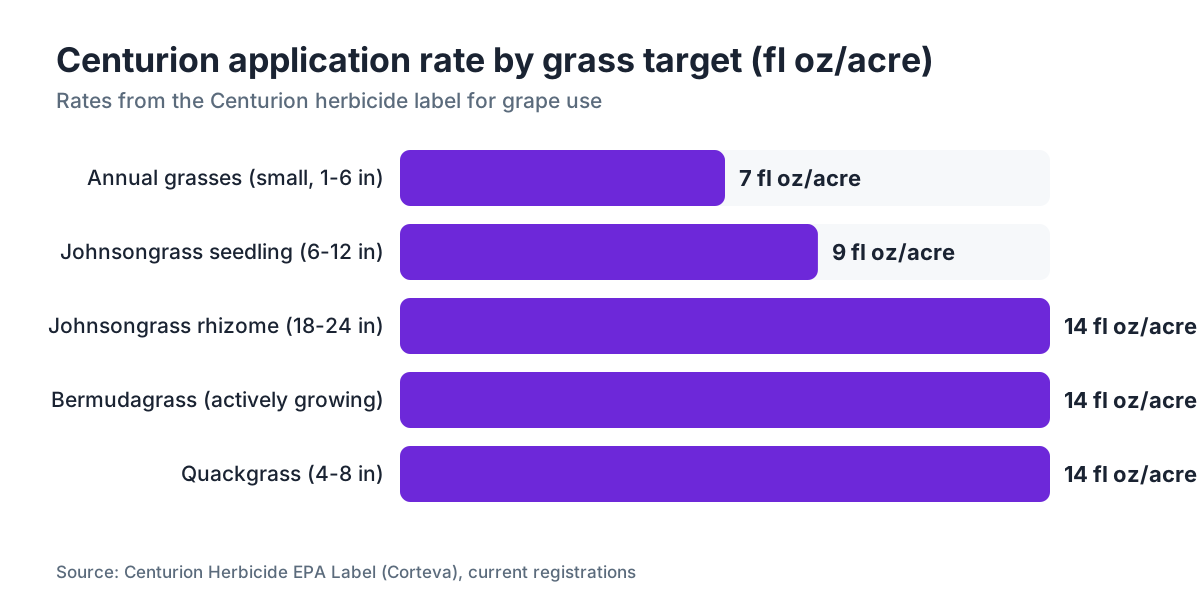
| Target Grass | Growth Stage at Application | Typical Rate (fl oz/acre) |
|---|---|---|
| Annual grasses (foxtail, crabgrass) | 1-6 inch height | 6 to 8 |
| Johnsongrass (seedling) | 6 to 12 inch | 8 to 10 |
| Johnsongrass (rhizome) | 18 to 24 inch | 13 to 16 |
| Bermudagrass | Actively growing, repeat apps | 13 to 16 |
| Quackgrass | 4 to 8 inch | 13 to 16 |
What are the correct Centurion application rates for grapes?
The labeled range for Centurion in grapes is 6 to 16 fluid ounces per acre, and your rate depends almost entirely on what you're killing and how big it is [1]. Small annual grasses at 6 to 8 oz is money well spent. Running 13 to 16 oz on those same small annuals is a waste. It doesn't work any better, and it speeds up selection for resistance.
Almost every Centurion pass needs a crop oil concentrate (COC) or methylated seed oil (MSO). The label calls for 1% v/v COC or equivalent. This is not optional. Skip the adjuvant and you'll lose 20 to 40% of your efficacy. UC IPM guidance on clethodim in tree and vine crops treats adjuvant use as non-negotiable [3].
Water volume matters too. Under 15 gallons per acre and you start losing coverage and uptake on dense grass canopies. Most growers run 20 to 30 gallons per acre through a flat-fan or flood-jet nozzle aimed under the vine row. Sort out boom height and pressure to keep drift off neighboring crops before your first pass, not after a complaint.
Don't mix Centurion with bentazon or similar contact materials unless you've confirmed compatibility. Antagonism between clethodim and certain tank partners is documented, and it drops your grass control. The label has a tank-mix compatibility section. Read it before you pour anything.
When is the best time to spray Centurion in a vineyard?
Timing is where you win or lose with clethodim. Annual grasses are most sensitive when they're small and growing hard, roughly 1 to 6 inches tall [1]. Once they head out or set seed, the window is gone. The weed doesn't die well, and if it does, the seed is already viable.
Spring is usually your best shot. Soil warms up, winter annuals are finishing their cycle, and summer annuals are just breaking ground. A single well-timed spring pass at 6 to 8 oz covers most annual grass pressure for the whole season. That's the cheapest way to use the product.
Perennials flip the logic. For johnsongrass you want the plant moving carbohydrates from leaf down to rhizome, which happens as growth slows in late summer. Spray during fast spring growth and the chemistry doesn't reach the roots as well, so regrowth comes back faster. Late June to mid-July for johnsongrass in most California and Pacific Northwest conditions gives better root kill [2].
Skip the spray when rain is forecast inside an hour or when it's above 90 degrees F. Heat shuts stomata and cuts uptake. Cold nights below 50 degrees F slow translocation. The sweet spot is daytime highs of 65 to 85 degrees F with no rain for 4 to 6 hours after you spray.
What is the re-entry interval and pre-harvest interval for Centurion?
The restricted entry interval (REI) for Centurion is 24 hours [1]. That's the minimum time workers stay out of treated areas after application, unless they're in the full personal protective equipment (PPE) the label specifies for early entry. Under the EPA Worker Protection Standard (WPS) you post warning signs at every entry point during the REI, or notify workers through another WPS-compliant method [4].
The pre-harvest interval is 30 days for grapes [1]. Plan your last pass around it. If harvest is 25 days out and you've still got a johnsongrass flush, you missed the window. Spraying inside 30 days of harvest is a label violation and a residue risk. Wine grape regions with tight harvest schedules usually do better leaning on one spring pass than trying to squeeze in a late-summer one.
Workers have a right to the product's safety data sheet (SDS) under the WPS. Centurion's SDS lists clethodim at 26.7% of the formulation [1]. That access requirement lives in 40 CFR Part 170 [4].
State rules can be tighter than the federal floor. California's Department of Pesticide Regulation (CDPR) layers Pesticide Use Report (PUR) obligations on top of the federal WPS [5]. In California the 30-day PHI and 24-hour REI are the same, but your paperwork runs deeper.
How does Centurion compare to other grass herbicides used in vineyards?
Clethodim (Centurion, Select, Arrow, and various generics) is one of three ACCase-inhibiting herbicides in common vineyard use. The other two are fluazifop-P-butyl (Fusilade II) and sethoxydim (Poast). All three are grass-selective and post-emergent. The differences show up at the edges.
| Product | Active Ingredient | REI | PHI (Grapes) | Perennial Grass Efficacy | Typical Cost Range (per acre) |
|---|---|---|---|---|---|
| Centurion | Clethodim 26.7% | 24 hrs | 30 days | Good-Excellent | $8, $18 |
| Select Max | Clethodim 12.6% | 24 hrs | 30 days | Good-Excellent | $10, $22 |
| Fusilade II | Fluazifop-P-butyl | 12 hrs | 14 days | Fair-Good | $12, $24 |
| Poast | Sethoxydim 18% | 12 hrs | 15 days | Fair | $10, $18 |
Fusilade II has a shorter PHI at 14 days, handy in fast-turn situations, but a lot of growers find it a step behind clethodim on mature perennial grasses. Poast tends to run less consistent on bermudagrass and quackgrass at similar cost. The cost ranges here are rough, pulled from 2023 to 2024 distributor pricing, and your real number depends on volume, region, and distributor.
Resistance is real. Annual bluegrass and Italian ryegrass with ACCase-inhibitor resistance are confirmed in California vineyards and orchards [6]. If Centurion fails on a species you're sure is susceptible, at the correct rate, run a screen with a different mode of action before you blame the applicator.
Generic clethodim (Select, Arrow, various Clethodim 2E labels) is the same active ingredient at similar strength. Most extension guidance treats them as interchangeable when the concentration matches [3]. Buying generic is fine. The adjuvant you add matters more than the brand on the jug.
What does the Centurion label require you to record?
Federal law under FIFRA section 8(a) requires applicators to keep records of restricted-use pesticide applications for two years [7]. Centurion is general-use, not restricted, but most state programs and the EPA WPS still expect records of any pesticide application. California's PUR system wants records of all applications filed within 7 days to the county agricultural commissioner, including product name, registration number, date, location, acreage, and pest treated [5].
At minimum your spray record should capture the product name and EPA registration number, active ingredient, application date and time, field or block ID, acres treated, rate (oz/acre or lbs a.i./acre), water volume, equipment used, applicator name and license number if it applies, and the weather at spray time (wind speed and direction, temperature, humidity). This is more than a compliance chore. It's how you work out why a pass did or didn't take.
Good digital recordkeeping earns its keep here. A tool like VitiScribe lets you log each spray event in the field, auto-fills the EPA registration number from the product database, and timestamps records against the 24-hour compliance window, so you're not rebuilding logs from memory on Friday afternoon. The software isn't the point. The point is that records built from real-time data are more accurate and hold up better under audit.
WSU Extension's small-farm pesticide recordkeeping guide recommends a dedicated application notebook or digital log that matches the use reports you send the county [8]. Cross-referencing spray records against scouting notes is the only honest way to tell whether a program is working across seasons.
Is Centurion safe to apply around grapevines, and what are the drift risks?
Yes, Centurion is safe around established grapevines when you apply it as directed. The ACCase selectivity means the vine itself doesn't react to clethodim at labeled rates. You can spray right under the canopy. That's the main reason people use it: under-vine floor work where cultivation would tear up surface roots or shallow drip line.
Drift onto neighboring grass crops is the real risk. Small grains, corn, turf, and pasture grasses are all wide open to clethodim. If your vineyard borders a wheat field or a neighbor runs alfalfa with a grass component, drift becomes your liability. The label bars application when wind exceeds 10 mph [1]. Most field-side advisors set their own line lower, around 7 mph, as a practical cutoff.
Ornamental grasses count too. The ones planted around tasting rooms and winery grounds are sensitive. Flag any ornamental grass near treated blocks before a crew starts spraying.
For equipment, standard flat-fan nozzles at 15 to 20 PSI with a 30-inch boom height are typical. Air-induction nozzles cut fine droplets and lower drift risk in a tricky wind. Spray when there's no thermal inversion, usually mid-morning after the dew burns off and before afternoon heat lifts fine droplets into the air.
How do you handle resistance to Centurion in vineyard weed populations?
ACCase-inhibitor resistance in annual bluegrass and ryegrass is confirmed in California, Oregon, and Washington [6]. Lean on clethodim as your only grass tool for five or six straight years and you've probably been selecting for it the whole time.
The fix is rotation. Alternate clethodim with a different mode of action: a pre-emergent grass herbicide like pendimethalin or trifluralin (both labeled in grapes), or a contact non-selective herbicide for directed shots. Pre-emergents work before germination, so they catch the weeds a post-emergent misses when you're late getting a pass on [9].
Cover cropping between rows lowers overall weed pressure and can shift species composition under the vine if you mow or roll hard. It won't replace an under-vine herbicide program in most commercial vineyards, but it cuts how hard you have to lean on any single chemistry [2].
Suspect resistance? UC IPM recommends a simple bioassay: collect seed from the suspect population, germinate on filter paper, and compare germination and seedling growth between treated and untreated controls at the label rate [3]. It's not lab confirmation, but it gives you a directional answer without the wait.
The Weed Science Society of America runs a herbicide-resistant weed database sorted by site of action and species [10]. Check it before you build a program for a new block. It shows you what you might already be walking into.
What PPE is required when applying Centurion in a vineyard?
The Centurion label requires applicators to wear a long-sleeved shirt and long pants, chemical-resistant gloves, shoes and socks, and protective eyewear [1]. Mixing and loading calls for the same plus a face shield or goggles if there's splash risk handling the concentrate. These come straight off the label and are enforceable under FIFRA.
The EPA Worker Protection Standard (40 CFR Part 170) extends those rules to early-entry workers who go into a treated area during the REI for tasks like scouting or equipment retrieval [4]. Early-entry workers wear the PPE the label lists for early entry. The WPS also requires the employer to supply PPE at no cost, keep it clean and maintained, and train workers before they work with or near pesticides.
For anyone supervising hired labor, that means documenting the training, keeping records of PPE issuance, and knowing the REI for every product so you can pass it to your crew. OSHA recordkeeping can also apply if a worker gets a pesticide-related illness. Don't assume that sits outside your reporting.
California adds a written Pesticide Safety Information Series (PSIS) handout, given to workers in their primary language before they work treated fields [5]. CDPR publishes them in several languages at no cost. It's one of the most overlooked gaps in small and mid-size operations.
How do you keep compliant spray records for Centurion applications all season?
The two-year federal retention rule is a floor, not a target. Plenty of vineyard operations keep records five years or longer, because resistance analysis, yield correlations, and any future property sale all benefit from the deeper history.
A complete Centurion record for a California vineyard runs long: product name, EPA registration number (EPA Reg. No. 100-1154 for Centurion EC, though verify the current number against the label in hand), application date and time window, APN or field block ID, acres treated, target pest, method, equipment ID, applicator name and California Pest Control Adviser or QAL/QAC license number where required, and weather data [5]. That's a lot to reconstruct honestly if you wait until Friday to write up Monday's spray.
Tools that sync with scouting data take the pain out. VitiScribe is built on the idea that the field log and the compliance record are one document, not two things you reconcile later. Purpose-built software or a tidy spreadsheet, either works. The rule that counts is capturing data at the moment of application, not from memory.
Audit processes vary by state. California county agricultural commissioners can request PUR records on short notice. The Washington State Department of Agriculture runs pesticide compliance audits of commercial applicators [11]. Clean, timestamped digital records that match your PUR submissions are worth a lot in those rooms. Paper logs curling up in a damp equipment shed are not your friend.
For operations running multiple blocks or leased parcels, the biggest gap is usually inconsistent field IDs. If your spray record says "north block" and your county submission calls it something else, reconciling them later is genuinely painful. Pick one block ID convention and use it everywhere from day one.
Frequently asked questions
Can I use Centurion on bearing grapevines?
Yes. Centurion (clethodim) is labeled for both bearing and non-bearing vineyards. The pre-harvest interval for grapes is 30 days, so your last application has to be at least 30 days before you pick. Confirm it on the specific label in your hand, since formulations and registration details change between label revisions.
Does Centurion require a crop oil adjuvant?
Yes, nearly always. The label calls for crop oil concentrate (COC) at 1% v/v or methylated seed oil (MSO) on most applications. Skip the adjuvant and you cut uptake, dropping efficacy by 20 to 40%. Non-ionic surfactant (NIS) is listed as an alternative on some labels but is generally weaker than COC or MSO for clethodim.
What is the re-entry interval for Centurion?
The REI for Centurion is 24 hours. Workers can't re-enter a treated block for 24 hours after application unless they're in the full PPE the label lists for early entry. Under the EPA Worker Protection Standard, you post warning signs at treated-area entry points or use another WPS-compliant notification during the REI.
Will Centurion hurt my grapevines?
No, not at labeled rates. Clethodim is an ACCase inhibitor that hits an enzyme found only in grasses. Grapevines are broadleaf plants and lack the sensitive form of it. Direct contact with vine foliage or fruit at normal rates causes no injury. The selectivity is well-established in university extension trials across California, Washington, and Oregon.
How long after spraying Centurion can I see results?
Actively growing grasses usually yellow and stop growing within 5 to 7 days of a well-timed pass. Full necrosis on annual grasses takes 10 to 14 days. Perennials like bermudagrass or johnsongrass can take 3 to 4 weeks before you can judge whether the rhizomes took the hit. Cool temperatures and drought stress slow the visible response a lot.
Can I tank-mix Centurion with glyphosate?
Yes, it's a common under-vine mix for grass plus broadleaf or total vegetation control. Compatibility is generally good, but some glyphosate formulations slightly antagonize clethodim uptake. The Centurion label allows several herbicide tank mixes. Confirm your specific glyphosate product isn't flagged as antagonistic before mixing, and add adjuvants as directed.
Is Centurion a restricted-use pesticide?
No. Centurion is general-use and needs no private or commercial applicator license to buy or apply. But California requires any agricultural application to a commercial crop to be supervised by a licensed Qualified Applicator or directed by a licensed Pest Control Adviser. Check your state's rules, because they vary.
How do I handle a Centurion application that fails to control grass?
Start with timing and grass growth stage. Small, actively growing grasses at the right rate with a proper adjuvant should give good control. If the pass was made correctly and still failed, look at ACCase resistance. Check the Weed Science Society of America's resistance database for confirmed biotypes in your region, then rotate to a different mode of action.
What records do I need to keep after a Centurion application in California?
California requires a Pesticide Use Report filed with your county agricultural commissioner within 7 days of application. It must include product name, EPA registration number, date, site location, acreage, pest treated, method, and amount applied. You also retain those records at least 2 years under federal FIFRA, though many operators keep them longer.
What is the difference between Centurion and Select herbicide?
Both use clethodim and share similar vineyard use patterns. Centurion is formulated at 26.7% clethodim; Select Max at 12.6%. The active ingredient is the same, and both are labeled for grapes with a 30-day PHI and 24-hour REI. Rate differences reflect the concentration difference. Generic clethodim 2E products are also equivalent at matched a.i. rates.
Can I use Centurion between rows as well as under the vine?
Yes. Centurion can go on grass weeds across the whole vineyard floor, drive rows and between-row areas included. Most commercial vineyards manage the between-row floor with mowing or cover crops and reserve herbicide for the under-vine strip. But the label doesn't restrict where it goes, as long as the spray hits the target grass.
How many times per season can I apply Centurion in a vineyard?
The label allows multiple applications per season but caps the total seasonal rate. The typical maximum for grapes is 64 fluid ounces per acre per season across all passes. Always check the current label in hand for the seasonal maximum. That figure covers all clethodim products combined if you rotate or mix labels across the season.
Does rain after application ruin a Centurion application?
Rain within 1 hour of application badly cuts efficacy by washing the herbicide off leaves before absorption. After 4 to 6 hours most of the clethodim is inside the leaf and rain has little effect. Rainfall timing is one of the most common causes of failed passes. Check the forecast for at least a 4-hour rain-free window after you plan to spray.
Sources
- Corteva / Dow AgroSciences, Centurion Herbicide EPA Label: Labeled for bearing and non-bearing grapes; 24-hour REI; 30-day PHI; application rates 6-16 fl oz/acre; requires COC adjuvant; clethodim active ingredient at 26.7%
- Washington State University Extension, Weed Management in Vineyards: Two applications 3-4 weeks apart at higher labeled rate recommended for bermudagrass; late-season timing for perennial grass control
- UC Davis IPM Program, Weed Management in Vineyards: Adjuvant use with clethodim described as essential; generic clethodim products treated as interchangeable at matched a.i. rates; bioassay method for suspected resistance
- U.S. EPA, Worker Protection Standard, 40 CFR Part 170: REI posting requirements, early-entry PPE rules, and worker right to pesticide safety information under federal WPS
- California Department of Pesticide Regulation, Pesticide Use Reporting: California PUR records due within 7 days to county agricultural commissioner; PSIS handouts required for workers; additional recordkeeping fields required beyond federal minimum
- UC Davis Cooperative Extension, Herbicide-Resistant Weeds in California Agriculture: ACCase-inhibitor resistance confirmed in annual bluegrass and ryegrass populations in California vineyards and orchards
- U.S. EPA, FIFRA Section 8(a), Pesticide Recordkeeping Program: Federal law requires commercial applicators to keep pesticide application records for 2 years
- Washington State University Extension, Pesticide Recordkeeping for Small Farms: WSU recommends dedicated pesticide application log cross-referenced with county use reports
- UC Agriculture and Natural Resources, Pre-emergent Herbicide Options for Vineyards: Pendimethalin and trifluralin labeled as pre-emergent grass herbicides in grapes; rotation recommended for resistance management
- Weed Science Society of America, International Survey of Herbicide Resistant Weeds: Database of confirmed ACCase-inhibitor resistant weed populations by species and geography
- Washington State Department of Agriculture, Pesticide Compliance Program: WSDA conducts pesticide compliance audits of commercial agricultural applicators in Washington State
- Cornell University College of Agriculture and Life Sciences, Integrated Weed Management in Vineyards: Post-emergent grass herbicide timing guidance for northeastern vineyard conditions; cover cropping to reduce weed pressure
Last updated 2026-07-09