Do vineyards spray Bt? How and why growers use it
TL;DR
- Yes, many vineyards spray Bacillus thuringiensis (Bt), a soil bacterium registered as a biopesticide.
- Growers use the kurstaki or aizawai subspecies against leafrollers, grape berry moth, and other caterpillars.
- It's OMRI-listed for organic programs, carries a 0-day pre-harvest interval on grapes, and leaves no detectable residue.
- Timing the spray to egg hatch is everything.
What is Bt and why do vineyards use it?
Bacillus thuringiensis, almost always shortened to Bt, is a soil bacterium that makes crystalline proteins toxic to specific insect larvae. It's not synthetic. The EPA registers it as a biopesticide, and most commercial formulations are OMRI-listed, which means they're allowed under the USDA National Organic Program [1]. For a vineyard manager trying to knock back caterpillars without hammering beneficial insects or bumping into pre-harvest interval limits, Bt is usually the first tool off the shelf.
Why it works comes down to gut chemistry. When a susceptible larva eats Bt-treated leaf tissue, the crystalline proteins (delta-endotoxins, also called Cry proteins) dissolve in the highly alkaline midgut and punch holes in the gut lining. The larva stops feeding within hours and dies within two to five days [2]. Vertebrates, birds, and most beneficial insects don't have the right gut pH or receptor proteins, so Bt is essentially nontoxic to them at any realistic rate.
That selectivity is the whole point. A broad-spectrum pyrethroid would kill your target pest, sure. It would also wipe out the predatory mites, lacewings, and parasitic wasps you've spent months building up in the vineyard. Bt lets you hit the caterpillar and leave the rest of the food web standing.
Which pests in vineyards does Bt actually control?
Bt only works on larvae, and only on species whose gut chemistry matches the Cry proteins in a given subspecies. The vineyard target list is short and specific.
The two biggest caterpillar problems in U.S. vineyards are grape berry moth (Paralobesia viteana) and the leafroller complex, mainly the omnivorous leafroller (Platynota stultana) in California and the European grapevine moth (Lobesia botrana) where it has established. Orange tortrix (Argyrotaenia franciscana) and the variegated leafroller (Platynota flavedana) hit western vineyards too. All are Lepidoptera larvae, and all are susceptible to Bt kurstaki or Bt aizawai [3].
Looper caterpillars (family Geometridae) occasionally defoliate vineyards, especially in the Pacific Northwest. Bt handles them well. Armyworms show up sometimes, though they're a less consistent grape pest.
Here's what Bt won't touch: grape leafhoppers (wrong insect order), spider mites, mealybugs, or anything else outside Lepidoptera. Growers get frustrated when Bt seems to fail, and it often turns out the pest was misidentified. If you see rolled leaves and assume leafroller but can't find any caterpillars inside, you may be looking at something else. Scout before you spray.
| Pest | Order | Bt subspecies that works | Notes |
|---|---|---|---|
| Grape berry moth | Lepidoptera | kurstaki, aizawai | Time to egg hatch per degree-day model |
| Omnivorous leafroller | Lepidoptera | kurstaki, aizawai | Multiple generations per season |
| Orange tortrix | Lepidoptera | kurstaki, aizawai | Common in coastal CA |
| European grapevine moth | Lepidoptera | kurstaki, aizawai | Regulated pest, check state requirements |
| Looper caterpillars | Lepidoptera | kurstaki | Occasional defoliator |
| Grape leafhopper | Hemiptera | none | Bt ineffective; wrong insect order |
| Spider mites | Acari | none | Bt ineffective |
| Mealybugs | Hemiptera | none | Bt ineffective |
Which Bt strains work on vineyard pests and what products are registered?
Two subspecies do almost all the vineyard work. Bacillus thuringiensis subspecies kurstaki (Btk) is the workhorse. It makes a mix of Cry1 proteins that are highly active against most Lepidopteran larvae. You'll find it in products like Dipel DF, Javelin WG, and DiPel PRO DF. Bacillus thuringiensis subspecies aizawai (Bta) reaches a bit wider within Lepidoptera and holds up against some species that shrug off Btk. Agree WG and XenTari DF are the common Bta products [4].
There's also Bacillus thuringiensis israelensis (Bti), but that one targets mosquitoes and fungus gnats and has no job in a grape canopy. Bt tenebrionis (Btt) goes after beetle larvae, not caterpillars. Match the subspecies to your pest when you buy.
Registration status changes by state, so check your state pesticide database or the EPA label before you spray. The federal label is the law, but state registrations can restrict or expand use. In California, the DPR product database is the authoritative source [5]. In the Pacific Northwest, WSU Extension publishes updated spray guides each season listing products currently registered for Washington and Oregon vineyards [6].
Formulation shapes your day too. Wettable granules (WG) and dry flowables (DF) both mix easily and stay in suspension without heavy agitation. Liquids exist but tend to lose shelf life fast once opened. Store all Bt below 40 degrees C and out of direct sun, because the Cry proteins degrade with heat. An unopened bag of Dipel DF usually holds up about two years, but once you open it, use it within the season.
How do you time Bt sprays in a vineyard for best results?
Timing is where Bt programs live or die. The bacteria kill young larvae far better than late-instar caterpillars. Once a grape berry moth larva reaches its third or fourth instar and starts boring into a berry, Bt is nearly useless. You want first and second instars, right after egg hatch, before feeding damage starts.
Degree-day (DD) models make that practical for grape berry moth. UC Davis's UC IPM program publishes a GBM degree-day model using a base temperature of 50 degrees F. First-generation egg hatch peaks around 180 to 360 DD base 50 from a January 1 biofix. The second generation runs around 810 to 1,080 DD. Third-generation timing varies by region [7]. WSU's grape berry moth model is calibrated for eastern Washington and uses similar parameters [6].
For leafrollers, pheromone traps give you the adult flight data you need to predict hatch. Two to three weeks after a sustained trap catch, expect eggs to be hatching. Spray Bt in that window, before larvae burrow into rolled-leaf shelters where the spray can't reach.
Frequency matters as much as the calendar. Bt breaks down in UV light, and field half-life on plant surfaces runs three to seven days depending on sunlight [2]. In a hot, sunny Central Valley summer, plan on the low end. Spray every five to seven days during a high-pressure window, or after rain washes the residue off. In cooler coastal climates, a seven-to-ten-day interval works.
Canopy density decides coverage. Dense, unmanaged canopies wreck Bt performance, not because the product is weak but because the spray never reaches the inner-canopy leaves where larvae feed. Hedging and leaf removal ahead of a Bt window genuinely improve results, which is one more reason to do that work on schedule.
What are the correct Bt application rates and spray volumes for grapes?
Rates come off the label, but for Dipel DF (a widely used Btk formulation), the labeled rate for Lepidopteran pests in grapes runs about 0.5 to 2.0 lbs per acre, with the high end for heavy pressure or dense canopy [4]. XenTari DF (Bta) labels typically list 0.5 to 1.5 lbs per acre. Read the current label every time, because rates shift between registrations.
Spray volume counts as much as the rate. Bt has to coat the leaf surfaces where larvae will feed. Ground applications in vineyards usually run 50 to 100 gallons per acre for good coverage, depending on canopy architecture. A well-calibrated air blast rig gets solid penetration at those volumes. Run 20 gallons per acre and hope for full coverage in a mature Syrah canopy, and you'll be disappointed.
A spreader-sticker helps Bt hold onto waxy leaf surfaces and improves rainfastness. Check the label first. Some Bt products approve specific adjuvants and forbid others. Silicone-based spreaders are generally fine, but confirm it on the label.
Pre-harvest interval for Bt on grapes is 0 days in most registered formulations. That's one of its best practical features in a tight harvest window. You can spray the day before picking if pressure demands it, with no residue concern, and you won't trip any MRL problem in export markets because Bt proteins aren't measured as conventional pesticide residues [1].
Aerial applications happen on some larger California operations. Rates and timing apply the same way, but canopy penetration from the air is generally worse than a well-calibrated ground rig delivers.
Is Bt approved for organic vineyard programs?
Yes. Bt is a mainstay of organic viticulture. The USDA National Organic Program allows it under 7 CFR Part 205, listed in the National List of Allowed and Prohibited Substances as a biological pesticide permitted in organic crop production [10]. Most commercial formulations carry OMRI listing, which keeps the certification paperwork simple [11].
For a certified organic vineyard, that means you can spray Bt against leafrollers and grape berry moth without risking certification, as long as the product is OMRI-listed and you follow the label. Your certifier will want spray records showing product name, EPA registration number, application date, rate, and target pest. That holds for every input in an organic system plan.
One thing organic growers overlook: Bt is a pesticide, and it needs a pesticide application record under most state laws no matter how it fits your organic status. California, for one, requires pesticide use reports for all registered applications, biological products included [5]. Washington and Oregon have similar rules. The organic exemption from synthetic chemical limits does not exempt you from record-keeping law.
If you track spray records for organic certification and state compliance at the same time, the fields overlap but they don't match perfectly. Keeping everything in one place cuts the odds of a gap. VitiScribe's spray log captures both sets of fields in a single entry, which saves time during audit season.
What does the EPA Worker Protection Standard require for Bt applications in vineyards?
Bt has a favorable profile under the EPA Worker Protection Standard (WPS), but it still carries rules you can't skip. The WPS applies to every agricultural pesticide application, biological or synthetic [8].
For most Bt formulations on grapes, the Restricted Entry Interval (REI) is 4 hours. That's the minimum time between the end of an application and when workers can enter the treated block without personal protective equipment. Some labels set a longer REI, so check the specific product. The label is the legal document.
PPE during application usually means long-sleeved shirt, long pants, chemical-resistant gloves, and shoes plus socks. Respiratory protection isn't required for most Bt formulations under field conditions, another practical edge over harsher conventional options.
After application, handlers follow label directions for decontamination and must have access to emergency eyewash. WPS also requires that workers get pesticide safety training before entering treated areas, and training records stay on file [8].
Notification is tied to the REI. For products with an REI over 4 hours, you post warning signs at field entry points or give oral warnings. A 4-hour REI product sprayed in the morning usually clears workers to re-enter by afternoon. Document the application time and REI clearly so a supervisor can make that call with confidence. Cornell's Integrated Pest Management program keeps a WPS compliance checklist that walks vineyard operations through these steps [9].
Does Bt leave residues on grapes or affect wine quality?
No detectable chemical residue. That's the short answer, and decades of regulatory review back it. The EPA has concluded that Bt biopesticides are unlikely to pose dietary or environmental risks because the Cry proteins degrade fast in the gut, aren't toxic to mammals or birds, and don't persist in the environment [1].
On the winemaking side, no credible published research has found that Bt applications change fermentation, wine chemistry, or sensory properties at labeled rates. The proteins break down quickly in UV light and get broken down further during normal winemaking. That's a real difference from some conventional insecticides that can slow yeast or carry flavor-active compounds into the tank.
Export markets with strict MRL rules aren't a worry with Bt, because most markets don't set MRLs for Bt proteins the way they do for synthetic insecticides. Still, if a buyer runs a specific residue test, confirm exactly what they're testing for.
One quality concern does cut the other way. Heavy insect damage from untreated pressure, the damage Bt prevents, opens the door to Botrytis and other rots, and those absolutely hurt wine quality. Controlling grape berry moth and leafrollers with Bt protects fruit integrity, and that pays off in the glass.
What are the limitations and failure modes of Bt in vineyards?
Bt is genuinely good, and it fails in predictable ways when growers ignore its limits.
UV degradation is the big one. Spray on a Sunday in full sun, and by Wednesday your residue is largely gone. If egg hatch runs across that window and you don't re-apply, you've missed it. Good programs build a spray calendar around UV half-life and expected hatch duration, not a single pass.
Coverage failure comes next. Bt can't protect leaf tissue it never reaches. Dense canopies with poor penetration guarantee spotty control. The fix is part cultural (manage the canopy) and part mechanical (calibrate the sprayer for the canopy you actually have, not the one in the manual).
Late instars are the third trap. A Bt spray against third or fourth instar caterpillars already inside rolled leaves or berries does almost nothing. The product can't reach them, and older larvae are less sensitive anyway. Past the ideal window, a conventional insecticide with systemic or translaminar activity is the better bet for that generation. Bt is a preventive and early-intervention tool, not a rescue.
Resistance is theoretically possible with Bt, and it has shown up in some field crops planted to Bt-expressing transgenic varieties under constant selection pressure. In vineyard programs using spray-applied Bt at standard rates and intervals, field-level resistance hasn't been confirmed as a practical problem in the literature I know of. Rotating modes of action is still sound practice. Spinosad (Entrust SC in organic programs) and insect growth regulators like methoxyfenozide are the logical rotation partners for caterpillar programs.
If you're tracking application history to document rotation and watch efficacy trends across seasons, a clean spray log earns its keep. Pattern recognition over several years is hard in a paper binder, and that's exactly the kind of operational data a purpose-built tool like VitiScribe handles well.
How does Bt compare to other vineyard caterpillar control options?
Bt isn't always the right call. Knowing where it sits against the alternatives helps you pick.
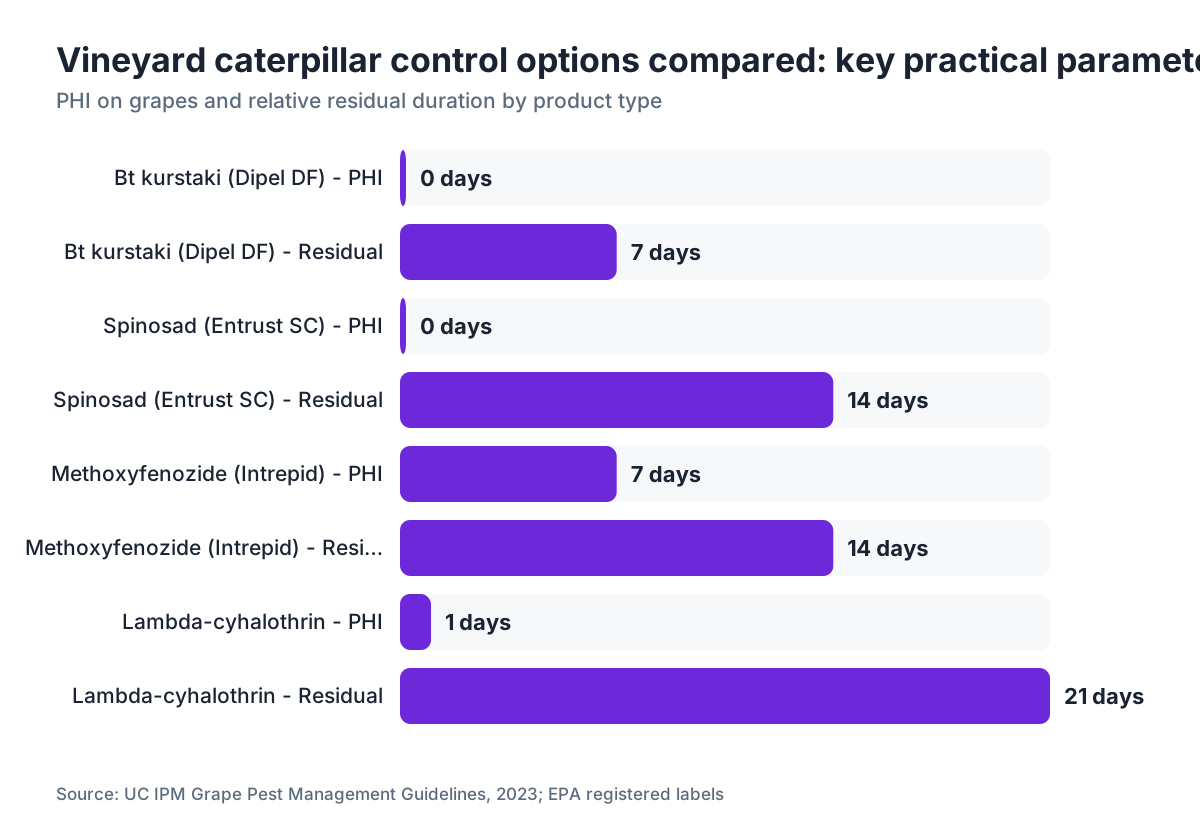
Spinosad (Entrust SC for organics, Delegate WG for conventional) is the most direct competitor for vineyard caterpillars. It holds a longer residual than Bt (10 to 14 days versus 5 to 7), works on slightly older larvae, and covers species where Bt efficacy wobbles. The trade-off: spinosad carries a 4-hour REI, some label limits around pollinator exposure, and a capped number of applications per season before resistance becomes a concern. Bt has no such application cap in current spray programs.
Insect growth regulators like methoxyfenozide (Intrepid) work by mimicking ecdysone and disrupting molting. They're highly selective for Lepidoptera, easy on beneficials, and carry a 7-day PHI on grapes. They work best applied a touch earlier in the egg-hatch window than Bt, because larvae need to eat them during early instars. Methoxyfenozide is not OMRI-listed, so it's off the table for organic.
Conventional pyrethroids like lambda-cyhalothrin are fast and cheap. They're also broad-spectrum, brutal on predatory mites and beneficials, and prone to touching off secondary mite outbreaks. For any operation trying to hold a biological balance, pyrethroids are a last resort.
| Product | Mode of Action | Organic OK? | PHI (grapes) | Residual | Beneficials impact |
|---|---|---|---|---|---|
| Bt kurstaki (Dipel DF) | Gut disruption | Yes | 0 days | 5-7 days | Very low |
| Spinosad (Entrust SC) | Nicotinic receptor | Yes (Entrust) | 4 hours | 10-14 days | Low-moderate |
| Methoxyfenozide (Intrepid) | IGR, ecdysone mimic | No | 7 days | 14+ days | Very low |
| Lambda-cyhalothrin | Pyrethroid | No | 24 hours | 14-21 days | High |
Sources: UC IPM [7], EPA pesticide labels [1]
What do UC Davis, Cornell, and WSU extension programs say about Bt in vineyards?
The three university extension programs that cover U.S. viticulture all list Bt as a first-line option for caterpillar pests in integrated pest management.
UC Davis's UC IPM program ranks Bt kurstaki and aizawai among the top choices for omnivorous leafroller, orange tortrix, and grape berry moth in California vineyards. Their guidelines push timing to first and second instars and note that "efficacy is very dependent on coverage" [7]. The UC IPM online database updates its ratings each year and is free to use. It's the single most useful reference for California growers.
Cornell Cooperative Extension covers grape berry moth hard for eastern vineyards, where GBM is the dominant caterpillar. Their degree-day tools, built into the Network for Environment and Weather Applications (NEWA), pull local weather data to predict egg hatch in real time. Cornell's GBM guide calls for 3 to 5 day Bt spray intervals during peak hatch, given the product's short residual [9].
WSU Extension's Pest Management Guide for Grapes covers both eastern and western Washington. It lists Dipel DF and XenTari as registered options for leafrollers and grape berry moth, with timing tied to regional degree-day models. WSU also notes that Bt fits mite-predator conservation programs, which matters a lot in Yakima Valley blocks managing Pacific spider mite [6].
All three programs post their guidelines free online. There's no reason not to keep the current version for your region bookmarked.
How do you record Bt sprays for compliance and what records do you need to keep?
Bt is a registered pesticide, and it needs a pesticide application record in every major grape state, no matter how organic-friendly or low-toxicity it is.
In California, all pesticide applications must be reported to the county agricultural commissioner within 7 days under the California Food and Agricultural Code [5]. The required fields include operator name, property ID, application date and time, product name, EPA registration number, total amount applied, area treated, and target pest. California's system is the most detailed in the country. Other states vary, but all require at minimum a written record.
Under the EPA Worker Protection Standard, pesticide application records must be kept for 2 years and must include the product, application location, date, REI, and the name of anyone who supervised the application [8].
Certified organic operations have a third layer. Spray records must be available to your certifier on request and must show the product was allowed (OMRI-listed or reviewed by the certifier) and applied at labeled rates. Some certifiers want the product label on file next to the application record.
Here's the practical bind most small operations hit: a single spray event triggers record requirements under three separate systems, state pesticide use reporting, WPS, and organic certification. The fields overlap, the formats don't, and paper logs make it easy to drop one. Keeping everything in a single digital log that covers all three sets saves real time, especially across multiple blocks with different certification statuses.
Frequently asked questions
Can I spray Bt the day before harvest without any residue concern?
Yes. Most registered Bt formulations on grapes carry a 0-day pre-harvest interval. The Cry proteins that make Bt toxic to caterpillars break down quickly in UV light and don't show up in standard residue tests. Confirm the PHI on your specific product label before spraying, but 0-day PHI is standard for Btk and Bta products on grapes.
How many days between Bt applications in a vineyard?
Five to seven days is typical during peak egg hatch, because UV light degrades Bt residue on leaf surfaces within that span. In cooler, cloudier coastal conditions you might stretch to ten days. Rain washes off residue and warrants a re-application regardless of the day count. Cornell recommends 3 to 5 day intervals during peak grape berry moth hatch when relying solely on Bt.
Will Bt hurt beneficial insects or bees in my vineyard?
Bt kurstaki and aizawai have no meaningful toxicity to bees, predatory mites, lacewings, or parasitic wasps at labeled rates. The Cry proteins need the alkaline gut chemistry found in Lepidoptera, and other insects lack the right receptors. Avoid spraying directly onto open flowers as a general practice, but Bt is among the safest options available for beneficials.
What's the difference between Dipel DF and XenTari for vineyard use?
Dipel DF contains Bacillus thuringiensis subspecies kurstaki (Btk), the most widely used Bt strain for Lepidoptera. XenTari DF contains subspecies aizawai (Bta), which reaches a bit wider within caterpillar species and does better against some strains less sensitive to Btk. In practice both work well on grape berry moth and leafrollers. Some growers rotate between them to reduce any theoretical selection pressure.
Does Bt work on grape leafhoppers?
No. Bt is only effective against caterpillar larvae (order Lepidoptera). Grape leafhoppers are in order Hemiptera and lack the gut chemistry that makes Bt's Cry proteins toxic. To control leafhoppers you need a different tool, such as kaolin clay for organic programs or a conventional contact insecticide labeled for leafhoppers.
How do I know when to start spraying Bt for grape berry moth?
Use a degree-day model. For grape berry moth, the UC IPM model uses a base temperature of 50 degrees F and a January 1 biofix. First-generation egg hatch peaks around 180 to 360 degree-days. UC Davis UC IPM and Cornell's NEWA tool both track degree-days in real time for registered vineyard locations. Pair that with pheromone trap data and spray at the egg-hatch window, not on a fixed calendar date.
Is Bt safe for workers entering the vineyard after spraying?
The Restricted Entry Interval for most Bt formulations on grapes is 4 hours. Workers must stay out of the treated block for at least that time after the application ends. Basic PPE is required during application. Bt has no known health effects on humans at normal exposure levels, and the EPA classifies it as a reduced-risk biopesticide, but WPS requirements still apply regardless of toxicity category.
Can I use Bt in my organic vineyard without losing certification?
Yes, as long as you use an OMRI-listed formulation and follow the label. Bt is explicitly listed in the USDA National Organic Program's National List of Allowed Substances for biological pest control. Your certifier will want application records showing product name, EPA registration number, rate, date, and target pest. Keep those records current and available.
Why isn't my Bt spray working on leafrollers?
Three failure modes cover most cases: poor timing (larvae too old, already third or fourth instar), poor coverage (dense canopy, too little spray volume), and UV breakdown (spray applied days before peak hatch, residue gone by the time larvae feed). Bt rarely fails chemically. It almost always fails on application factors. Scout the vineyard, confirm larvae are first or second instar, check canopy penetration, and set your interval to local UV conditions.
Do I need a pesticide license to apply Bt in a vineyard?
Bt products are not restricted-use pesticides. They're general-use, so you don't need a private applicator license to buy or apply them on your own property. If you hire a commercial applicator, they need a valid license. Regardless of license status, you still follow the label, keep spray records, and comply with EPA Worker Protection Standard requirements if you employ agricultural workers.
How should I store Bt products between spray seasons?
Store Bt in a cool, dry spot below 40 degrees C and out of direct sunlight. Heat and UV light degrade the Cry proteins that make Bt work. An unopened bag of Dipel DF typically has a two-year shelf life from the manufacture date. Once opened, plan to use it within the season. Check for clumping or off odor before use; degraded product underperforms even when applied correctly.
What spray volume should I use for Bt in a vineyard?
Ground applications with airblast sprayers typically need 50 to 100 gallons per acre for good leaf-surface coverage in a mature grape canopy. Running low volumes to save time is a common mistake that directly cuts Bt efficacy. Bt has to coat the leaf tissue where larvae will feed. Dense, unthinned canopies need the high end of that range. Calibrate your sprayer for your specific canopy before the season starts.
Are there any resistance concerns with repeated Bt use in vineyards?
Field-level resistance to spray-applied Bt hasn't been confirmed as a documented problem in commercial vineyard programs based on available literature. Resistance has developed in some field crops planted to Bt-expressing transgenic varieties under constant selection pressure. As a precaution, most extension programs recommend rotating Bt with spinosad, methoxyfenozide, or other modes of action across generations within a season.
Sources
- EPA, Biopesticides Registration Action Document for Bacillus thuringiensis: Bt is registered as a biopesticide under FIFRA; OMRI-listed formulations are allowed under USDA NOP; Cry proteins are not detected as pesticide residues; no dietary or environmental risk at labeled rates
- UC Davis, Bacillus thuringiensis as a Biological Insecticide: Bt Cry proteins cause larval mortality within 2-5 days; UV field half-life on plant surfaces is 3-7 days depending on sunlight intensity
- UC IPM, Grape Pests Identification and Management: Omnivorous leafroller, orange tortrix, grape berry moth, and variegated leafroller are all susceptible to Btk and Bta in California vineyards
- Valent BioSciences, DiPel DF EPA Registered Label: DiPel DF labeled rate for Lepidopteran pests in grapes is 0.5-2.0 lbs per acre; 0-day pre-harvest interval on grapes
- California Department of Pesticide Regulation, Pesticide Use Reporting: California requires pesticide use reports for all registered pesticide applications including biological products within 7 days to county agricultural commissioner
- Washington State University Extension, Pest Management Guide for Grapes: WSU lists Dipel DF and XenTari as registered options for leafrollers and grape berry moth in Washington; Bt compatible with predatory mite conservation programs
- UC IPM, Grape Pest Management Guidelines, Leafrollers and Grape Berry Moth: UC IPM recommends Btk and Bta as top options for omnivorous leafroller and GBM; degree-day base 50 F for GBM; first-generation egg hatch 180-360 DD; efficacy very dependent on coverage
- EPA, Worker Protection Standard for Agricultural Pesticides: WPS requires pesticide application records kept for 2 years; REI for most Bt formulations on grapes is 4 hours; training records must be maintained on file
- Cornell Cooperative Extension, Grape Berry Moth Management Guide: Cornell recommends 3-5 day Bt spray intervals during peak GBM egg hatch due to short residual; NEWA degree-day tool available for real-time hatch prediction in eastern U.S. vineyards
- USDA Agricultural Marketing Service, National Organic Program, 7 CFR Part 205: Bt is listed in the National List of Allowed and Prohibited Substances as a biological pesticide permitted for use in organic crop production under NOP
- OMRI, Products List for Organic Use: Major commercial Bt formulations including Dipel DF and XenTari DF carry OMRI listing for use in certified organic production
Last updated 2026-07-09