Cinnamon fungicide spray for vineyards: what actually works

TL;DR
- Cinnamon oil (cinnamaldehyde) has real antifungal activity against Botrytis and powdery mildew in lab and greenhouse trials, but field results in commercial vineyards trail sulfur, copper, and DMI fungicides by a wide margin.
- It earns its keep as a low-residue tool in organic or near-harvest windows, at 0.5 to 2% active ingredient, every 7 to 10 days under pressure.
What is cinnamon oil fungicide and how does it work on grapevines?
Cinnamon oil fungicide is a botanical pesticide built around cinnamaldehyde, the compound behind cinnamon bark's smell and most of its biological punch. Cinnamaldehyde tears at fungal cell membranes, blocks ergosterol biosynthesis, and shuts down spore germination. That triple action is why the literature lists it as active against a broad set of plant pathogens.
On grapevines, the pathogens you fight are Botrytis cinerea (gray mold), Erysiphe necator (powdery mildew), Plasmopara viticola (downy mildew), and the cluster rots that show up late in the season. Lab studies confirm cinnamaldehyde stops spore germination in all of them at 500 to 2,000 ppm. The trouble is holding those concentrations on leaf and berry surfaces in the field, where rainfall, heat, UV, and a dense canopy all work against you [1].
The EPA files cinnamaldehyde as a minimum-risk pesticide under FIFRA Section 25(b) at low concentrations. Many commercial cinnamon oil products skip federal registration entirely, which is a genuine break for paperwork-light organic operations. It also means the EPA never checked the label's efficacy claims the way it does for conventional fungicides [2]. Read your state's exemption rules before you assume you can skip registration, because California requires registration of some 25(b) products.
Cinnamon oil also carries smaller amounts of eugenol, cinnamyl acetate, and linalool, each with its own antifungal activity. Formulated products differ in their ratios of these compounds, which is part of why efficacy data jumps around between studies. A product with 10% cinnamaldehyde is not the same thing as one with 10% total cinnamon oil.
Does cinnamon oil actually control powdery mildew and Botrytis in the vineyard?
Honest answer: better than water, worse than sulfur. That line holds across most published field trials.
A Cornell University cooperative extension review of botanical fungicides found essential oil treatments, cinnamon included, cut powdery mildew severity in greenhouse trials but produced inconsistent results outdoors, running 40 to 70% suppression against 80 to 95% for registered sulfur programs at the same intervals [3]. The mechanism is real. The durability is not.
Botrytis is where cinnamon oil defends its best niche. Several studies in small fruits and grapes found that pre-harvest applications of cinnamaldehyde-based products lower gray mold in clusters, especially applied at véraison and again 2 to 3 weeks before harvest. The payoff is that cinnamaldehyde carries no pre-harvest interval worry under organic rules, and it leaves no detectable residue at harvest-relevant rates.
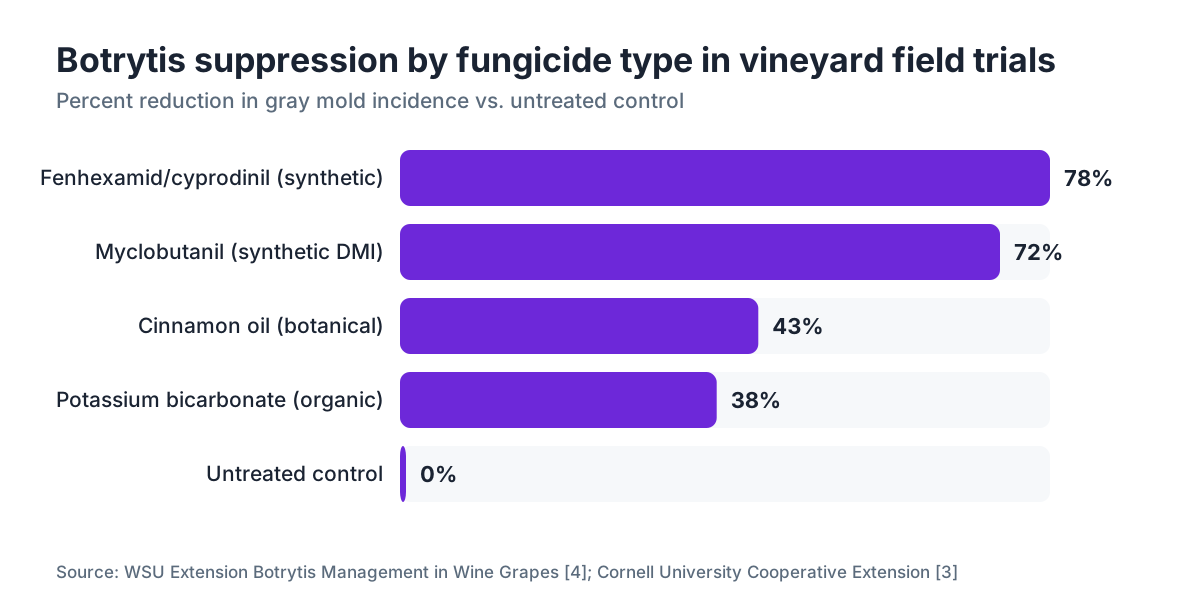
WSU (Washington State University) extension trials on gray mold in wine grapes found botanical treatments including cinnamon oil dropped Botrytis incidence 30 to 55% against untreated controls, while the best synthetic programs (fenhexamid, cyprodinil) hit 70 to 85% reduction [4]. So the practical read is simple. Cinnamon oil as your only Botrytis tool in a wet year with heavy clusters is a losing bet. Cinnamon oil as a late-season rotation partner in an organic program, or as a harvest-window option when you can't spray a restricted material, makes sense.
Downy mildew is the weakest case. Plasmopara viticola is an oomycete, not a true fungus, and its response to cinnamaldehyde in the field is minimal. Copper is still the standard for organic downy mildew control, and cinnamon oil should not replace it [5].
How do you apply cinnamon oil spray in a vineyard, and at what rate?
Rate is where most growers go wrong. Underdose and you get nothing. Overdose and you get phytotoxicity, which with cinnamon oil means leaf burn, defoliation, and in bad cases cluster damage that looks unnervingly like spray drift injury.
Most commercial cinnamaldehyde-based vineyard products call for 0.5 to 1.5% active ingredient in the tank. For a concentrate that runs 25% cinnamaldehyde, that works out to roughly 2 to 6 fl oz per gallon of water, or 2 to 6 quarts per 100 gallons at commercial scale. Start at the low end on a small block. Wait 48 to 72 hours before you treat the whole vineyard [6].
Timing follows the same calendar as any protectant fungicide. You need coverage before infection periods, not after. For powdery mildew, that means applications at 5 to 10% bloom, then every 7 to 10 days through bunch closure if pressure is high. For Botrytis, aim at bunch closure, véraison, and 2 to 3 weeks before harvest.
Coverage matters more with cinnamon oil than with systemic fungicides, because cinnamaldehyde has no translaminar or systemic movement inside the plant. It acts only where it lands. Calibrate the sprayer for your canopy density, hit the cluster zone directly, and spray in early morning or evening to cut volatilization losses in heat. Spraying in midday sun above 85°F is a reliable way to burn leaves and boil off your active ingredient at the same time.
Mixing compatibility is a real concern. Cinnamaldehyde breaks down in highly alkaline tank water. If you're adding a surfactant (most label-registered formulations already include one), check pH and hold the tank between 5.5 and 7.0. Mixing with sulfur is generally fine. Mixing with copper raises phytotoxicity risk and the interaction is poorly characterized, so avoid it or test a small area first.
Is cinnamon oil approved for organic viticulture?
Yes, under most conditions. Cinnamaldehyde is a plant extract, and the USDA National Organic Program (NOP) allows it as a plant disease control material as long as the product carries no prohibited synthetic inerts [7]. The OMRI (Organic Materials Review Institute) has listed several cinnamaldehyde-based products as suitable for organic production.
The catch is that "organic" comes in layers. Federal NOP certification allows it. Your certifier still has to approve the specific product you're using, and some certifiers are strict about inert ingredients. Pull the full label and SDS, hand them to your certifier before you order 50 gallons, and get written approval. Skip this step at your own risk.
For California Certified Organic Farmers (CCOF) and similar third-party certifiers, the process runs the same way: product-level review, not ingredient-level. A product with cinnamaldehyde as its active ingredient but a prohibited synthetic emulsifier in the inerts list gets denied regardless of that active ingredient.
Running an integrated program that also uses registered synthetic fungicides? Cinnamon oil can still fill the pre-harvest window. Many growers lean on sulfur and synthetic DMI fungicides through mid-season, then rotate to cinnamaldehyde-based products in the final 3 to 4 weeks before harvest to hold residues down and protect organic status on specific blocks. Log every application with the material name, formulation, rate, date, and target crop, both for your own records and because your certifier will ask.
VitiScribe's field record-keeping tools let you log botanical spray applications with organic certification flags attached, which makes pulling annual compliance reports for your certifier a lot less painful.
What does EPA worker protection standard require for cinnamon oil applications?
The EPA Worker Protection Standard (WPS) covers agricultural pesticides used on farms, botanical products included, even when they hold a FIFRA Section 25(b) exemption from registration [8]. Here are the WPS requirements that matter for cinnamon oil in vineyards.
Restricted entry interval (REI): Most cinnamaldehyde-based products carry a 4-hour REI on the label, though some list 12 hours. Use the REI on your specific product label. For a 25(b) exempt product with no formal label REI, the default WPS REI is 4 hours for outdoor applications unless the label says otherwise.
Personal protective equipment (PPE): At minimum, long-sleeved shirt, long pants, shoes and socks, and chemical-resistant gloves during mixing and loading. Some labels add eye protection for concentrate handling. Cinnamon oil is a skin and mucous membrane irritant at concentrate strength, and workers who get it on skin or in eyes report real discomfort, more than mild irritation.
Application exclusion zone (AEZ): Under the 2015 WPS revisions, hold an AEZ of 100 feet in all directions for outdoor applications around the point of application while spraying. Workers and other people stay out of the AEZ during application [8].
Posting requirements: If the REI runs longer than 4 hours, post warning signs at vineyard entry points during the REI. At 4 hours or less, posting is not required, but you have to notify workers verbally or in writing before the application.
Training and record-keeping: Every agricultural worker who may enter treated areas gets WPS safety training annually. Keep application records with the product name, EPA registration number (or 25(b) exemption designation), location, date, rate, and REI. The WPS requires you keep these records for 2 years [8].
How does cinnamon oil compare to sulfur, copper, and synthetic fungicides for vineyard disease control?
Here's the table you need before you commit to a cinnamon oil program.
| Fungicide | Primary target | Efficacy (field) | REI | OMRI-listed/organic | PHI (days) | Typical cost per acre-application |
|---|---|---|---|---|---|---|
| Sulfur (wettable) | Powdery mildew | High (80 to 95%) | 24 to 48 hr | Yes (most forms) | 0 to 1 | $8 to 18 |
| Copper hydroxide | Downy mildew | High (75 to 90%) | 24 to 48 hr | Yes (some forms) | 0 | $12 to 30 |
| Cinnamaldehyde | Botrytis, PM | Moderate (30 to 70%) | 4 to 12 hr | Yes | 0 | $18 to 40 |
| Fenhexamid (Elevate) | Botrytis | High (70 to 85%) | 12 hr | No | 0 | $28 to 55 |
| Myclobutanil (Rally) | Powdery mildew | Very high (85 to 95%) | 24 hr | No | 0 | $20 to 45 |
| Bicarbonates (K-bicarbonate) | Powdery mildew | Moderate (50 to 70%) | 4 hr | Yes | 0 | $6 to 15 |
Cost per acre estimates reflect 2023 to 2024 market pricing for typical concentrate rates and are approximate [9]. They vary by region and supplier.
The honest takeaway: cinnamon oil is not a one-tool answer for any of the major vineyard diseases, but it holds a specific role as a harvest-window option with a short REI and no detectable residue at commercial rates. If you're managing Botrytis organically with limited options, a program of cinnamaldehyde plus potassium bicarbonate plus tight canopy management beats cinnamaldehyde alone. Cinnamon oil should never be your first-line powdery mildew tool on a high-value block.
Cost matters too. At $18 to 40 per acre-application on a 7 to 10 day schedule through a 10-week season, you spend $180 to 400 per acre on cinnamon oil alone. That's a lot for moderate efficacy. Sulfur delivers better powdery mildew results at $80 to 180 per acre over the same period [9].
What are the best cinnamon oil spray products for vineyards?
A handful of products have real market presence and at least some published trial data behind them.
Cinnacure (Westbridge Agricultural Products) is the cinnamaldehyde-based product cited most often in published vineyard research. It carries an OMRI listing and has been included in university extension trial programs. Cinnacure runs roughly 12 to 15% cinnamaldehyde active ingredient.
Ef-400 (Brandt Consolidated) is a broader essential oil blend that pairs cinnamaldehyde with thymol and other botanicals. It's OMRI-listed and marketed as a fungicide and bactericide for organic programs.
Mighty Wash and several other retail cinnamon-oil-labeled products fill the consumer and small-farm market. Be careful with these. Some are not formulated for agricultural use, carry no WPS label data, and have no independent efficacy data. The absence of a formal EPA label on a 25(b) product isn't a problem by itself. The absence of field trial data and a proper adjuvant system is.
When you size up any product, look for four things: OMRI listing or equivalent certifier approval, a listed percent active cinnamaldehyde, a clear REI statement, and some independent trial data. University extension programs, especially UC Davis Cooperative Extension and WSU Extension, occasionally publish spray trial results that name commercial products with actual efficacy numbers [3][4].
For any vineyard managing disease pressure at commercial scale, request trial data from the manufacturer and hold it up against published university data before you buy. Manufacturer-funded trials showing 90% efficacy don't always match what independent researchers find.
Can cinnamon oil cause phytotoxicity on grapevines?
Yes. This risk is underreported, and it blindsides growers because cinnamaldehyde sounds harmless.
Phytotoxicity from cinnamon oil on grapevines shows up as marginal leaf burn that mimics salt burn, interveinal chlorosis at high rates, and in severe cases, defoliation. Berry skin russeting has been reported above 2% active ingredient in hot conditions. The threshold depends on concentration, temperature, humidity, timing, and the grape variety [6].
Varietal sensitivity is real but poorly mapped. Thin-skinned varieties like Pinot Noir and Grenache are generally more sensitive than thick-skinned ones like Cabernet Sauvignon or Syrah, but no published sensitivity table exists for cinnamaldehyde across Vitis vinifera varieties. Test first.
Conditions that raise the risk: applications above 85°F, spraying in direct midday sun, concentration above the labeled rate, application to stressed or drought-hit vines, and application within a week of an oil-based product (spreader-stickers or petroleum-based dormant oils).
See burn symptoms after a cinnamon oil application? Check your rate calculation first. Mixing ratio errors are the most common cause. Then check timing and temperature at spray time. If the symptoms are severe, a plain-water foliar rinse within a few hours of application can help on a small block, though that's obviously impractical at scale.
How do you build a spray program that includes cinnamon oil alongside other fungicides?
The most defensible move is to use cinnamon oil at defined, high-value windows rather than as a season-long backbone.
For a conventional program: run registered DMI fungicides (myclobutanil, tebuconazole) and SDHI fungicides for powdery mildew and Botrytis through mid-season, then rotate to cinnamaldehyde-based products in the final 3 weeks before harvest to manage late Botrytis while keeping synthetic residues off harvested fruit. That's legitimate resistance management and it makes regulatory sense.
For a certified organic program: the season-long schedule leans on sulfur for powdery mildew and copper for downy mildew as the backbone. Cinnamon oil slots in as a Botrytis-focused partner at bunch closure and véraison, then again in the pre-harvest window. Potassium bicarbonate is a cheap, useful rotation partner for powdery mildew that cuts total sulfur load [7].
Application intervals: under low to moderate pressure, 10 to 14 days between cinnamon oil applications works. Under high pressure or wet weather, 7 days is more defensible. Don't stretch intervals past 14 days and expect real protection. Cinnamaldehyde degrades faster than sulfur on leaf surfaces.
Keep a spray record for every application. Your certifier, your buyer's residue program, and possibly your state department of agriculture may all ask for it. Date, product, formulation, rate per acre, gallons of water per acre, target pest, and field block belong in every entry. Tracking multiple blocks across a season with rotating programs, a digital field log makes end-of-season compliance reporting much faster. That's exactly what tools like VitiScribe are built for, and for multi-block organic operations with certification requirements, the value is in not spending two days reconstructing your spray history in December.
For growers at operations like those near Paso Robles wineries or South Coast Winery in warm inland climates, where powdery mildew pressure starts early and Botrytis threat spikes in the final 30 days before harvest, this hybrid approach is common.
What does the research actually say about cinnamon oil fungicide efficacy?
The honest read on the published literature: promising mechanism, inconsistent field results, real niche utility.
A 2019 review in Crop Protection by Spadaro and Droby examined botanical fungicides for postharvest and preharvest disease control and concluded that essential oil-based treatments including cinnamaldehyde "demonstrate antifungal activity against major plant pathogens in vitro but face significant challenges in field applications due to volatility, UV degradation, and variable canopy penetration" [10]. That summary has held up.
A UC Davis Cooperative Extension evaluation of alternative fungicides for organic grape production, updated in 2022, found cinnamaldehyde products gave statistically significant Botrytis suppression in two of four trial years, with efficacy climbing alongside application frequency and canopy management. In years with rain during the harvest window, efficacy fell off sharply against synthetic programs [11].
Nobody has good long-term resistance management data for cinnamon oil in commercial viticulture. The mechanism (membrane disruption) is multisite and generally considered low-risk for resistance development, much like sulfur, but the pathogen populations in your vineyard are not laboratory strains. Cornell Plant Pathology extension notes that Botrytis resistance to single-site synthetic fungicides is well documented, and botanical products with multisite mechanisms make valuable rotation partners for exactly that reason [3].
A well-cited 2015 study in the European Journal of Plant Pathology found cinnamaldehyde at 1,000 ppm cut Botrytis cinerea spore germination by 87% in vitro, with activity dropping to 40% under simulated field conditions after 24 hours of UV exposure [12]. That gap between in vitro and field numbers is the core problem, and it explains why growers who run cinnamon oil trials off lab data walk away disappointed.
The practical implication: if you're seeing 30 to 50% Botrytis suppression from cinnamon oil in your vineyard, that lines up with the best published field data. If someone is promising you 85%, ask for the trial design.
What are the spray record-keeping requirements for cinnamon oil applications?
Federal record-keeping requirements for pesticide applications hinge on the product's registration status and your operation type.
For certified private applicators using restricted-use pesticides (RUPs), federal law requires records kept for 2 years under 7 CFR Part 110 [13]. Cinnamaldehyde products are generally not RUPs, so that specific obligation usually doesn't apply. But several states impose record-keeping on all commercial pesticide applications regardless of restricted-use status. California requires a Pesticide Use Report (PUR) for all agricultural pesticide applications, including products with 25(b) exempt status, and those records get filed monthly with the County Agricultural Commissioner [14].
For organic certification, record-keeping is mandatory no matter what state law says. The USDA NOP requires certified operations to keep records for 5 years documenting all materials used in production, including pesticides, the specific product name and rate, application date and location, and the pest target [7].
The WPS layers on a 2-year record-keeping requirement for application records that includes the product name, active ingredient, EPA registration number or exempt designation, location, date, and time, the REI, and the applicator's name [8].
Stack these together. An organic operation in California using cinnamon oil needs records that satisfy the NOP (5 years, organic program system), the WPS (2 years, worker safety), and the California PUR system (monthly reporting to county). Those records have to agree with each other. Running one in a spreadsheet and another in a separate paper binder is how errors sneak in. A single field log, digital or paper, that captures all required fields in one entry kills the reconciliation problem outright.
Frequently asked questions
Is cinnamon oil safe to spray near harvest in vineyards?
Yes, cinnamon oil is one of the better pre-harvest fungicide options, specifically because cinnamaldehyde breaks down quickly and leaves no detectable residue at commercial application rates. Most products carry a 0-day pre-harvest interval (PHI). Above 2% active ingredient, berry skin russeting is possible, so stick to labeled rates and skip applications in extreme heat within 4 to 6 weeks of harvest.
What fungal diseases can cinnamon oil treat in the vineyard?
Cinnamon oil has documented activity against Botrytis cinerea (gray mold) and Erysiphe necator (powdery mildew). It has limited effect against Plasmopara viticola (downy mildew), because downy mildew is an oomycete, not a true fungus, and its cell structure responds less to cinnamaldehyde. For downy mildew in organic programs, copper is still the standard.
How often should I spray cinnamon oil in my vineyard?
Every 7 to 10 days under active disease pressure, or 10 to 14 days under low pressure. Cinnamaldehyde degrades faster than sulfur on plant surfaces, especially in UV-intense or hot conditions, so intervals longer than 14 days are not likely to give you meaningful protection. Match your interval to local weather and disease forecasting tools, and tighten up before rain events.
Can I mix cinnamon oil with sulfur in my spray tank?
Generally yes. Cinnamaldehyde and wettable sulfur are compatible in the tank, and the combination does not produce phytotoxic compounds in published literature. That said, mixing any two products adds complexity. Check your specific product labels for compatibility guidance and run a jar test before full-tank mixing. Avoid mixing cinnamon oil with copper-based materials without testing first, because phytotoxicity risk climbs.
Does cinnamon oil work for grape powdery mildew?
It gives moderate suppression, roughly 40 to 70% efficacy in the field against 80 to 95% for sulfur programs at similar intervals, based on Cornell University extension reviews. It should not be your sole powdery mildew tool on a high-value block. It works better as a rotation partner with sulfur or potassium bicarbonate, or as a pre-harvest substitute when sulfur use has to stop before harvest.
Is cinnamon oil spray OMRI-listed and approved for organic vineyards?
Several commercial cinnamaldehyde-based products carry OMRI listings, including Cinnacure (Westbridge). Cinnamaldehyde itself is permitted under the USDA National Organic Program as a plant-derived pesticide, provided the formulation uses no prohibited synthetic inerts. Always confirm the specific product you're using with your certifier before applying, and get approval in writing.
What is the restricted entry interval (REI) for cinnamon oil fungicide?
Most commercial cinnamaldehyde-based products carry a 4-hour REI, though some list 12 hours. Use the REI on your specific product label. If you're using a FIFRA 25(b)-exempt product with no labeled REI, the EPA Worker Protection Standard default for outdoor applications is 4 hours. Confirm before you schedule any worker re-entry to treated vineyard blocks.
What rate of cinnamon oil should I use in my vineyard sprayer?
Most commercial vineyard formulations call for 0.5 to 1.5% active cinnamaldehyde in the final tank solution. For a 25% cinnamaldehyde concentrate, that's roughly 2 to 6 fl oz per gallon. Start at the lower end on a test block and watch for phytotoxicity for 48 to 72 hours before full application. Temperature above 85°F at spray time raises burn risk, so adjust rate down in heat.
How does cinnamon oil compare to potassium bicarbonate for vineyard disease control?
Potassium bicarbonate is cheaper ($6 to 15 per acre-application versus $18 to 40 for cinnamon oil) and generally shows equal or better powdery mildew efficacy than cinnamaldehyde-based products in field trials. Cinnamon oil has better Botrytis activity. On a tight organic budget, potassium bicarbonate should anchor the powdery mildew program, and cinnamon oil earns its place in the Botrytis and pre-harvest rotation.
Do I need a pesticide applicator license to spray cinnamon oil?
Licensing requirements depend on your state and the specific product. FIFRA 25(b)-exempt cinnamon oil products often don't require a commercial applicator license for private use on your own land, but some states require registration or licensing regardless of exempt status. California requires a Pest Control Adviser recommendation for some applications. Check with your state department of agriculture before you assume no license is needed.
What records do I need to keep for cinnamon oil sprays in an organic vineyard?
At minimum: product name and formulation, active ingredient, rate per acre, gallons per acre, application date, field block, target pest, and applicator name. USDA NOP requires these records for 5 years. The EPA Worker Protection Standard requires 2 years of application records. California requires monthly Pesticide Use Reports filed with the County Agricultural Commissioner. Failing to reconcile these three systems is a common audit problem.
Can cinnamon oil hurt my grapevines?
Yes, at rates above the label recommendation or in high heat. Phytotoxicity symptoms include marginal leaf burn, interveinal chlorosis, and in severe cases defoliation or berry skin russeting. Thin-skinned varieties like Pinot Noir appear more sensitive. Apply at the low end of the labeled rate, avoid spraying above 85°F or in direct midday sun, and test on a small block before you treat the whole vineyard.
Which university extension programs publish vineyard trials on botanical fungicides?
Cornell University Cooperative Extension (Cornell Plant Pathology) publishes annual fungicide efficacy evaluations that include botanicals. UC Davis Cooperative Extension publishes organic viticulture guides with botanical fungicide comparisons. Washington State University (WSU) Extension publishes disease management guides for Pacific Northwest wine grapes with some botanical trial data. All three are free to access and updated regularly.
Sources
- National Library of Medicine (PubMed): Antifungal activity of cinnamaldehyde review: Cinnamaldehyde disrupts fungal cell membranes and inhibits spore germination at concentrations of 500 to 2,000 ppm across multiple plant pathogens.
- EPA: FIFRA Section 25(b) minimum-risk pesticide exemptions: EPA classifies cinnamaldehyde as a minimum-risk pesticide active ingredient exempt from federal registration requirements under FIFRA Section 25(b) when used at low concentrations.
- Cornell University Cooperative Extension: Cornell Plant Pathology fungicide efficacy reviews: Cornell extension reviews found essential oil treatments including cinnamon reduced powdery mildew severity in greenhouse trials but showed 40 to 70% suppression outdoors versus 80 to 95% for registered sulfur programs; Botrytis multisite botanicals valued as resistance rotation partners.
- Washington State University Extension: Botrytis Management in Wine Grapes: WSU extension trials found botanical treatments including cinnamon oil reduced Botrytis incidence 30 to 55% vs. untreated controls, while best synthetic programs reached 70 to 85% reduction.
- UC Agriculture and Natural Resources: Organic Viticulture and Pest Management: Copper remains the standard for organic downy mildew control; cinnamaldehyde shows minimal field activity against Plasmopara viticola.
- UC Agriculture and Natural Resources: Alternative Fungicides for Organic Grape Production (2022 update): Phytotoxicity risk from cinnamaldehyde increases above 2% active ingredient concentration, in high temperatures, and in certain sensitive varieties; application at 0.5 to 1.5% active ingredient is the recommended range.
- USDA Agricultural Marketing Service: National Organic Program regulations (7 CFR Part 205): NOP permits plant-derived pesticides including cinnamaldehyde provided formulations contain no prohibited synthetic inerts; certified operations must maintain production records for 5 years.
- EPA: Agricultural Worker Protection Standard (40 CFR Part 170): WPS requires 4-hour default REI for outdoor applications, 100-foot application exclusion zone, annual worker safety training, and 2-year record retention for all agricultural pesticide applications including botanical products.
- UC Davis: Cost and Return Studies for Wine Grapes: Fungicide cost per acre-application estimates: sulfur $8 to 18, copper $12 to 30, synthetic DMI/SDHI $20 to 55; cost estimates reflect 2023 to 2024 market pricing.
- Crop Protection Journal (via PubMed): Spadaro & Droby, botanical fungicides for pre- and postharvest disease control (2019): Review concluded essential oil treatments including cinnamaldehyde 'demonstrate antifungal activity against major plant pathogens in vitro but face significant challenges in field applications due to volatility, UV degradation, and variable canopy penetration.'
- UC Agriculture and Natural Resources: Alternative and organic fungicide trial results for wine grapes: Cinnamaldehyde products provided statistically significant Botrytis suppression in 2 of 4 trial years; efficacy correlated positively with application frequency and canopy management.
- European Journal of Plant Pathology (via PubMed): cinnamaldehyde activity against Botrytis cinerea under field-simulated conditions (2015): Cinnamaldehyde at 1,000 ppm reduced Botrytis cinerea spore germination by 87% in vitro, declining to 40% under simulated field conditions after 24 hours of UV exposure.
- USDA Agricultural Marketing Service: Pesticide Recordkeeping Program (7 CFR Part 110): Federal law requires certified private applicators using restricted-use pesticides to keep application records for 2 years.
- California Department of Pesticide Regulation: Pesticide Use Reporting: California requires Pesticide Use Reports for all agricultural pesticide applications including 25(b)-exempt products; reports must be filed monthly with the County Agricultural Commissioner.
Last updated 2026-07-09