Cima vineyard sprayer: what it is, how it works, and whether it's worth buying

TL;DR
- Cima s.r.l., an Italian maker in the Veneto, builds airblast and tunnel sprayers used across European and North American vineyards.
- The line runs from compact single-row units to full tunnel sprayers with air recovery.
- New prices run roughly $15,000 to $85,000 USD, with large tunnel rigs past $120,000.
- The build quality is real.
- Parts lead times from Italy are the catch.
What is the Cima vineyard sprayer and who makes it?
Cima s.r.l. is an Italian agricultural machinery maker based in the Veneto, one of the most wine-dense regions on earth. The company has built vineyard spray equipment since the 1970s, and that long run in a demanding home market shows in the metal. They make airblast sprayers, tunnel sprayers (also called enclosed or air-recovery sprayers), and electrostatic units, all built for grapevines and nothing else.
In North America, Cima machines turn up most often in California's coastal valleys, Oregon's Willamette Valley, and parts of Washington State. They come in through regional dealers, not a national distribution network. That detail matters a lot when something breaks at veraison.
Cima isn't a household name in the US the way WECO, Durand-Wayland, or Gregoire are. Among growers who have run European tunnel sprayers, though, the brand carries weight. Their engineering aims at a calibrated, canopy-penetrating spray pattern with minimal drift, which is what modern pesticide rules and IPM programs are built around [1].
What types of sprayers does Cima make for vineyards?
Cima's vineyard lineup splits into four groups.
Start with axial-fan airblast sprayers. These are the workhorses. A PTO-driven fan throws a high-velocity air stream through the canopy while nozzles on curved arms deliver product. Most models hold 400 to 2,000 liters. Application rates usually run 150 to 400 liters per hectare depending on canopy density and travel speed, though your real rate has to be calibrated to your trellis and vine spacing.
Second, tower airblast sprayers. These mount the fan and nozzle array higher on the chassis to handle vertical shoot positioned (VSP) canopies. They show up in Champagne-style training systems and work well in California VSP blocks where standard airblast units either over-spray the tops or starve the midzone.
Third, tunnel (air recovery) sprayers. This is where Cima gets genuinely interesting. A tunnel sprayer wraps a hood structure around both sides of the vine row. Nozzles spray inward, product that misses the leaf gets captured and recirculated, and almost nothing escapes the row as drift. University trials have measured drift reduction of 75 to 95 percent against conventional airblast, depending on conditions [2]. Near homes, waterways, or under sensitive-use permit conditions, that number is not academic.
Fourth, electrostatic sprayers. Cima offers some models with electrostatic charging of droplets, which improves deposition on the underside of leaves where Botrytis and mite pressure concentrate. The tradeoff is added complexity and cost.
Most US buyers land on the axial airblast or tunnel models. The electrostatic units are more common in Europe, where the technology has a longer adoption history.
How does a Cima airblast sprayer work mechanically?
The heart of any Cima airblast sprayer is its axial fan, usually 650 to 900 mm across depending on model size. Power comes off the tractor PTO at 540 RPM. The fan generates air volume of roughly 20,000 to 60,000 cubic meters per hour depending on configuration, and that stream carries atomized droplets from the nozzles into the canopy.
Nozzles are usually hollow-cone or flat-fan ceramic types set on curved aluminum arms. Cima's better models let you close off individual nozzles or nozzle sections, so you're not spraying into a gap where a vine is missing or firing past the end of a row. Sounds minor. Over a season it adds up to real product savings and cleaner drift records.
The tank, pump, and agitation system sit behind the fan. Cima uses centrifugal pumps on most models, with diaphragm pump options available. Diaphragm pumps handle abrasive formulations (some fungicides, wettable powders) better and are worth specifying if you run a lot of sulfur [3].
The hydraulics on the tunnel models run more complex. The tunnel arms fold for transport and open to working position, and the recovery fans need their own drive. Tractor horsepower demand climbs with it, from roughly 40 HP for a small axial unit to 80 to 120 HP for a full tunnel sprayer.
What does a Cima vineyard sprayer cost?
Honest answer: pricing swings hard by dealer, exchange rate (these are Euro-denominated machines), and options. Here's what the ranges look like in the US market for 2024 to 2025, drawn from public dealer listings and importer price sheets.
| Model Type | Tank Size | Approx. USD Price (new) |
|---|---|---|
| Compact axial airblast | 400-600 L | $15,000 - $25,000 |
| Mid-size axial airblast | 800-1,200 L | $25,000 - $45,000 |
| Tower airblast | 600-1,000 L | $30,000 - $55,000 |
| Tunnel (air recovery) | 600-1,000 L | $55,000 - $85,000 |
| Large tunnel, full-canopy | 1,200-2,000 L | $80,000 - $120,000+ |
Those are rough ranges. Add freight from Italy (usually $1,500 to $4,000 depending on port of entry), dealer prep, and any local import duties. The Euro-USD exchange rate in a given year can shift your landed cost by 8 to 12 percent.
For comparison, a comparable Caffini or Nobili airblast unit runs in a similar band. A domestic-built WECO airblast usually starts lower (around $12,000 for a small unit) but has no tunnel option. If you're seriously shopping, get quotes on all three and weigh local dealer service capability above the sticker.
Used Cima sprayers turn up now and then on Machinery Pete, Fastline, and European auction sites. A five-year-old tunnel sprayer in good shape might sell for 40 to 55 percent of new price. Inspect the recovery fans and nozzle bodies hard before you hand over money.
How does a Cima sprayer compare to other vineyard sprayer brands?
Let me be direct. Cima is a solid mid-to-premium European brand. It's not the cheapest, it's not the most widely serviced in North America, and the parts pipeline through Italy is genuinely slower than buying from a US-stocked distributor.
What Cima does well: the fan housing and nozzle arms are noticeably good, the tunnel models are well-engineered, and the calibration documentation beats most, which helps when you're trying to satisfy a PCA or pass an inspector review.
Where competitors have an edge:
Caffini (also Italian) hits a similar quality level and in some California markets has stronger dealer coverage. Bertoni and Spezia are worth a look if you're specifically comparing tunnel sprayers.
Gregoire and Pellenc make high-end multi-function machines (harvester-sprayer combos) that pay off at larger scale.
For operations under 20 acres, a well-calibrated domestic airblast often does the job at a third of the price of a tunnel unit, and the annual pesticide savings from drift reduction may never offset the capital cost inside a reasonable payback window. Cornell's work on sprayer calibration shows a properly calibrated conventional airblast can deliver acceptable coverage on VSP canopies, though tunnel sprayers do outperform on coverage uniformity in dense canopies [4].
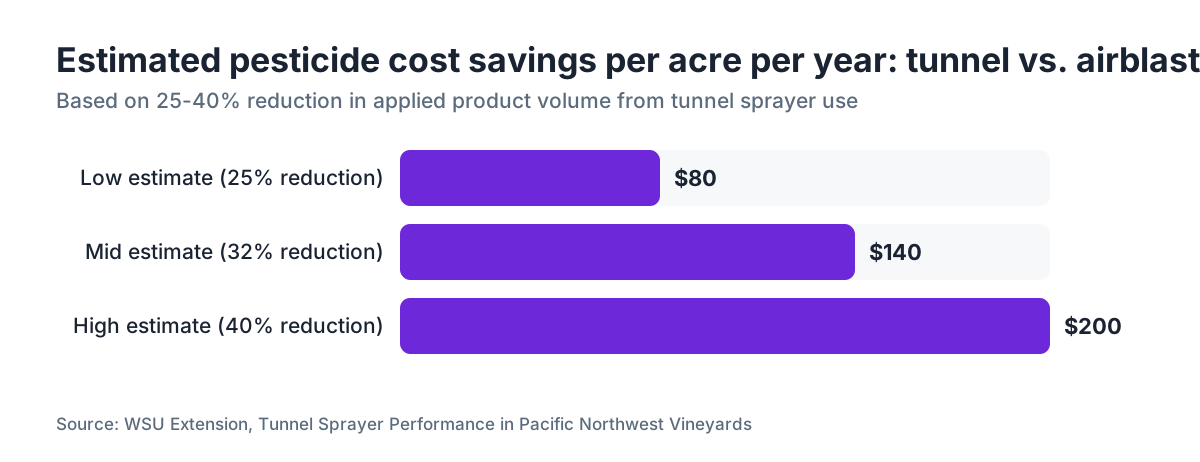
WSU Extension has published comparison data showing tunnel sprayers cut pesticide use by 25 to 40 percent per season on the varieties tested in Washington State, which at typical fungicide costs works out to $80 to $200 per acre per year in savings [5]. At those rates, a $70,000 tunnel sprayer takes 10 to 15 years to pay back on a 30-acre block, before financing. That's a real number to put in your spreadsheet before you sign anything.
How do you calibrate a Cima vineyard sprayer correctly?
Calibration is where most spray problems begin, and that's true no matter the brand. Under-apply and you get disease or pest failures. Over-apply and you burn money, raise residue risk, and can trip re-entry interval and pre-harvest interval compliance problems.
The basic calibration steps for a Cima airblast unit follow the same protocol UC Davis Cooperative Extension publishes for any airblast sprayer [6]:
- Measure your actual ground speed through the vineyard with a stopwatch over a known distance, not whatever the tractor gauge claims.
- Collect output from each nozzle for 30 seconds using a catch container. Compare across nozzles and replace any that deviate more than 10 percent from the mean.
- Calculate output per minute per nozzle, multiply by the number of active nozzles, and cross-reference with your target application rate in gallons (or liters) per acre.
- Adjust pressure, speed, or nozzle size until output matches your target rate.
Cima tunnel sprayers add one step. Verify the recovery fans are running at spec pressure, because a partly blocked recovery filter compromises both recovery efficiency and canopy air penetration.
Cima's operator manual includes a calibration worksheet, and it's worth working through it instead of trusting the previous owner's settings. Spray records should document nozzle type, pressure, speed, and water volume per acre for every application. Those records are required under the EPA Worker Protection Standard and most state pesticide use reporting rules [7].
If you're tracking spray records across multiple blocks and applicators, a field operations tool like VitiScribe can capture calibration data at the moment of application and tie it straight to your pesticide use records, so nobody keys the same numbers twice.
What are the EPA Worker Protection Standard requirements for using a vineyard sprayer?
Any vineyard sprayer application using a registered pesticide falls under the EPA Worker Protection Standard (WPS), last significantly revised in 2015 [7]. The WPS covers all agricultural pesticide applications, not only the hazardous ones, and it reaches both the equipment operator and any workers who re-enter treated areas.
Key WPS requirements for sprayer operations:
Personal protective equipment (PPE) has to match what the pesticide label specifies, not what you figure is probably fine. The label is federal law. If it says chemical-resistant gloves and a respirator, that's the requirement, full stop.
Restricted entry intervals (REI) must be posted and communicated. Workers cannot enter treated areas until the REI expires, and you are legally required to tell workers when and where applications happened.
Application exclusion zones (AEZ) came in with the 2015 revision. During any outdoor application, workers and other people (including the applicator's family and the public) must stay out of an area around the point of application: 100 feet for airblast sprayers in most scenarios [7]. This isn't optional, and it's the one requirement that catches growers off guard most often.
Training applies to handlers (applicators) and workers (those who enter treated areas). Handlers need annual pesticide handler training. Workers need annual WPS worker training.
The EPA's 2015 WPS rule states that "the agricultural employer must ensure that each worker and handler receives the required pesticide safety training before working in a pesticidal environment" [7]. That standard has teeth. Willful violations can run $5,000 to $18,000 per occurrence under FIFRA Section 14 [10].
How should you maintain a Cima sprayer between seasons?
End-of-season maintenance is the single best predictor of how reliably a Cima (or any sprayer) runs next year. None of it is complex. Growers skip steps anyway.
Flush the tank and lines with clean water. Then run a tank cleaner through the system if you used any product that can polymerize or crystallize in the lines (copper-based fungicides are the classic offender). Drain it completely and leave drain valves open for winter storage.
Nozzle inspection comes next. Pull every nozzle body, clean the ceramic discs or stainless orifices, and check actual output against a calibration chart. Any nozzle more than 10 percent over spec from wear should be replaced [9]. Worn nozzles throw larger droplets, worse coverage, and more drift. Replacement ceramic nozzle bodies for Cima units run $8 to $25 each depending on type, and doing them at season end means you're not scrambling during bloom.
Grease all fittings on the fan shaft, tower pivot points (if fitted), and PTO shaft. Check fan blade clearance and inspect for cracks or impact damage. A cracked fan blade is a safety emergency, not a to-do item.
On tunnel models, clean the recovery filter screens and inspect the recovery duct for tears or blockage. Debris builds up in there through the season.
Store with the tank partly filled with clean water or antifreeze solution if temperatures will drop below freezing. A cracked pump body from a winter freeze is a $400 to $800 repair that's entirely avoidable.
Parts for Cima sprayers in North America come through the importing dealer or direct from Italy, and lead times from Italy can run four to eight weeks in busy season. Keep a stock of common wear items: nozzle bodies, diaphragm pump rebuild kits, pressure gauges, and filter screens.
How do you reduce spray drift when using a Cima airblast sprayer?
Drift is an agronomic problem and a legal one. Pesticide drift onto adjacent property or water is a FIFRA violation whether or not it causes visible damage, and a complaint to your state department of agriculture can trigger an investigation and a fine.
For airblast sprayers, the main drift factors are droplet size, air speed, wind speed and direction, and travel speed. You control the first three.
Drop your nozzle pressure. Higher pressure makes smaller droplets, and smaller droplets drift more. Running at 10 to 15 PSI instead of 25 to 30 PSI raises median droplet size a lot while still getting good canopy penetration from the air stream.
Shut off upwind nozzles on the outside rows. Most Cima models allow individual section shutoff. In a 5 mph crosswind, the row-end nozzles facing into the wind are your biggest drift source.
Don't spray when wind tops 10 mph. That's the standard threshold in most state rules and in the label language for many fungicides. Some labels say 15 mph. Read your specific label.
Spray early morning. Wind is usually calmer before 9 AM, temperature inversions are less likely, and the canopy transpires less, so droplets land instead of evaporating.
UC Davis extension research found airblast sprayer drift at canopy height averaged 12 to 35 percent of applied volume under typical field conditions, while tunnel sprayer drift stayed below 3 percent in the same trials [11]. That gap is real, and it's why tunnel sprayers are effectively mandatory in some certified organic programs and buffer zone situations.
For a wider look at how spray management fits into overall farm planning, the vineyard overview covers production system choices in more depth.
What tractor HP and PTO requirements does a Cima sprayer need?
Getting the tractor match right matters more than most buyers realize. Underpower a large-tank Cima and the fan can't hit design RPM, coverage suffers, and you might not catch it because the pressure gauge still reads fine.
Compact Cima axial units (400 to 600 L tanks): 40 to 55 HP tractors work well. PTO output at 540 RPM needs to deliver at least 25 to 35 HP continuously to the fan, and most 40 HP utility tractors manage this if the rest of the tractor is healthy.
Mid-size models (800 to 1,200 L): plan on 60 to 80 HP minimum. Cima's spec sheets list required PTO HP per model, and those numbers are conservative.
Tunnel sprayers: 80 to 120 HP is the realistic range. The tunnel arms, recovery fans, and hydraulics add load beyond the spray fan. Cima tunnel models also need the tractor to supply adequate hydraulic flow for the arm positioning system, typically 20 to 35 liters per minute.
Row spacing shapes the tractor choice too. Cima makes track-width-adjustable models for rows as narrow as 1.5 meters, but the tractor itself still has to fit. In tight Paso Robles or Sonoma Valley blocks, a compact vineyard tractor (Fendt 200 series, Landini Powerfarm narrow, and similar) is often necessary no matter which sprayer you pick.
Always check the model-specific operator manual for PTO shaft profile (standard 6-spline 540 RPM is most common, but some models use 1000 RPM PTO), and confirm your tractor's PTO output matches before you buy.
Is a Cima sprayer a good fit for a small vineyard under 20 acres?
Honest answer: probably not the tunnel models, and maybe not new at all.
On a 15-acre block, even at 6 spray applications a year, total product applied per season is manageable with a well-calibrated mid-size airblast unit. The capital gap between a $20,000 domestic airblast and a $65,000 Cima tunnel sprayer is $45,000, and the pesticide savings from drift reduction (roughly $100 to $200 per acre per year at best, per WSU data [5]) take 15 to 30 years to break even on 15 acres. That math doesn't work.
Where a small Cima airblast might make sense under 20 acres: a sensitive-use situation (buffer zones, near schools or homes), a dense uniform canopy that benefits from Cima's nozzle placement, or a used unit at a real discount.
The growers I'd actually point toward a Cima tunnel sprayer run 40-plus acres of a single training system, face real drift pressure from regulations or neighbors, and either have a local dealer who stocks parts or the patience to manage a European supply chain. At that scale the ROI starts working and the machine earns its cost.
For smaller operations that still want better canopy penetration than a generic airblast delivers, a tower-style unit or a used European airblast with good nozzle arms splits the difference.
Record-keeping matters at every scale. VitiScribe is worth a look if you manage applications across multiple blocks and want pesticide use reports, REI records, and calibration data in one place instead of a paper stack.
Where can you buy a Cima vineyard sprayer in the United States?
Cima has no dedicated US distributor as of 2024 to 2025. Machines arrive through regional importers and dealers, mostly in California and the Pacific Northwest.
The most reliable way to find current US dealers is to contact Cima s.r.l. directly through their official website and ask for North American authorized dealers. A few California equipment dealers (some in the Central Valley, some in the Napa/Sonoma area) carry Cima or can order direct. Oregon and Washington importers serving the Willamette Valley and Yakima Valley sometimes stock Cima units or can source them.
European farm-equipment auction sites, especially in northern Italy and France, list used Cima units regularly. Importing used equipment yourself is possible but adds customs brokerage, freight, and compliance inspection costs. Budget $2,500 to $5,000 for a used machine import on top of the purchase price, and confirm the electrical system is US-compatible (mostly a concern for diagnostic display units, not the spray mechanism, which runs off the PTO).
Before you buy, call three dealers in your region and ask them straight: do you stock Cima parts, and what's your typical lead time on a pump rebuild kit or a nozzle arm replacement? The answer tells you more about whether a Cima fits your operation than any spec sheet does.
Frequently asked questions
How long do Cima vineyard sprayer nozzles last before needing replacement?
Ceramic nozzle discs typically last 50 to 100 hours of spray operation before wear pushes output above 10 percent over the rated rate. Stainless orifice nozzles wear faster in sulfur applications, often needing replacement every 30 to 50 hours. Check output with a calibration container at the start of each season and mid-season during heavy spray programs. Replacement ceramic nozzle bodies for Cima units run $8 to $25 each.
What is the spray drift reduction percentage of a Cima tunnel sprayer versus a standard airblast?
UC Davis and European research trials consistently show tunnel sprayers cut drift by 75 to 95 percent against conventional airblast sprayers under similar conditions. WSU Extension data from Washington State trials put the reduction at the high end of that range in low-wind conditions. The practical result is that tunnel sprayers can allow applications closer to buffer zones and in weather windows where open airblast would be prohibited.
Can a Cima vineyard sprayer be used for cover crop or under-vine herbicide applications?
No. Standard Cima airblast and tunnel models are not built for directed herbicide application to the soil or under-vine strip. Using an airblast sprayer for herbicide risks severe canopy drift damage to the vines. Under-vine herbicide work needs a shielded boom sprayer or a dedicated weed wiper. Some growers mount a small shielded spray boom on the front of the tractor, separate from the airblast unit on the rear.
What PSI should I run a Cima airblast sprayer at for fungicide applications?
Most Cima axial airblast models are designed to run at 10 to 20 PSI at the nozzle for optimal droplet size in typical VSP canopies. Running higher pressure (25 to 30 PSI) produces finer droplets and raises drift risk without meaningfully improving coverage. Always verify against the nozzle manufacturer's output chart for your specific nozzle type, and calibrate to confirm actual output per nozzle matches your target application rate.
Do I need a pesticide applicator license to operate a Cima sprayer in my own vineyard?
Licensing rules vary by state. In California, a vineyard owner applying restricted-use pesticides on their own property generally must hold a Qualified Applicator License or supervise a licensed QAL. Oregon and Washington have similar provisions. General-use pesticides on your own property typically need no license, but the application must still comply with the pesticide label and EPA Worker Protection Standard. Check with your state department of agriculture for current rules.
What is the application exclusion zone requirement for airblast sprayers under the EPA Worker Protection Standard?
Under the 2015 EPA Worker Protection Standard, outdoor airblast sprayer applications require a 100-foot application exclusion zone (AEZ) where no workers or other people can be present during application. This zone extends from the point of application in the direction the sprayer is moving. Growers must confirm all workers are outside the zone before starting and must post treated-area warning signs at block entrances.
How do I find out what Cima sprayer model number I have so I can order the right parts?
The model and serial number plate on Cima sprayers is usually mounted on the main frame near the tank, often a metal plate welded or bolted to the chassis. The serial number encodes year of manufacture and model variant. With that number, contact your regional dealer or Cima s.r.l. directly to confirm the correct pump, nozzle, and bearing specifications. Many older models lack US-market documentation, so the plate number is the only reliable way to spec parts.
How many acres per hour can a Cima airblast sprayer cover in a typical vineyard?
At a travel speed of 3.5 to 4.5 mph and 8-foot row spacing, a Cima airblast sprayer covers roughly 4 to 7 acres per hour on single-row passes. At that rate, a 40-acre block takes 6 to 10 hours of actual spray time per application. Tank capacity sets refills: a 1,000-liter tank at 250 liters per hectare covers about 4 hectares (roughly 10 acres) per fill. Add fill time of 10 to 20 minutes and you get realistic daily capacity.
Is a Cima vineyard sprayer compatible with GPS variable-rate application systems?
Some newer Cima models have provisions for electronic section control and can integrate with GPS-based variable-rate systems using ISOBUS-compatible controllers. Older models need aftermarket additions: a solenoid valve kit on each nozzle section, a flow controller, and a compatible GPS console. Retrofitting is possible but adds $5,000 to $15,000 in hardware and installation. For most small vineyard operations, manual section shutoff at row ends is the more practical approach.
What's the difference between a Cima single-row and twin-row vineyard sprayer?
A single-row (or single-side) Cima sprayer treats one side of one row per pass, so you need two passes per row. A twin-row model treats both sides of a row at once, cutting application time roughly in half. Twin-row models have higher PTO demand and wider overall width, which matters in tight row spacing. In wide-row blocks (10 feet or more) with tractors that can handle the power, a twin-row unit is almost always more economical over a full season.
How do spray records tie into pesticide use reporting for California vineyards?
California's Department of Pesticide Regulation requires all commercial pesticide applications to be reported to the county agricultural commissioner within 30 days of application (7 days for restricted-use pesticides) [8]. Records must include operator name, license number, pest site, product name and EPA registration number, total product applied, acres treated, date and time, and equipment type. Keep these records for three years and make them available to inspectors on request.
Can a Cima tunnel sprayer be used in certified organic vineyards?
Yes. The Cima tunnel sprayer is just equipment and has no organic certification implications. What matters for organic certification is the pesticide product applied, not the sprayer type. Organic-approved materials (copper, sulfur, approved biologicals) can be applied with any sprayer, including Cima tunnel models. The drift-reduction advantage of tunnel sprayers is genuinely valuable in organic programs, where buffer contamination with prohibited materials could jeopardize certification.
What maintenance intervals does Cima recommend for the PTO shaft and fan bearings?
Cima's operator manuals generally recommend greasing PTO shaft universal joints every 8 hours of operation and fan shaft bearings every 50 hours. At season end, bearings should be fully repacked or replaced if you feel any roughness by hand. Fan belt tension (on belt-drive models) should be checked every 20 hours. Following these intervals keeps the fan at design speed, which directly sets spray coverage quality through the season.
Sources
- UC Davis Cooperative Extension, Airblast Sprayer Calibration and Use: Airblast sprayer calibration principles and canopy-penetrating spray design for vineyards
- UC Davis Department of Biological and Agricultural Engineering, Spray Drift Studies: Tunnel sprayers reduce drift by 75 to 95 percent compared to conventional airblast sprayers in vineyard trials
- UC Davis Cooperative Extension, Sprayer Pumps and Formulation Handling: Diaphragm pumps handle abrasive formulations such as sulfur and wettable powders better than centrifugal pumps
- Cornell Cooperative Extension, Vineyard Sprayer Calibration and Coverage: Properly calibrated conventional airblast can deliver acceptable coverage on VSP canopies; tunnel sprayers outperform on coverage uniformity in dense canopies
- Washington State University Extension, Tunnel Sprayer Performance in Pacific Northwest Vineyards: Tunnel sprayers reduce pesticide use by 25 to 40 percent per season; savings of $80 to $200 per acre per year at typical fungicide costs
- UC Davis Cooperative Extension, Sprayer Calibration for Vineyards: Standard airblast sprayer calibration protocol: measure ground speed, collect nozzle output, calculate per-acre application rate, adjust pressure or speed
- US EPA, Worker Protection Standard (40 CFR Part 170): WPS requires annual handler and worker training, 100-foot application exclusion zone for airblast sprayers, and REI posting and communication
- California Department of Pesticide Regulation, Pesticide Use Reporting: California requires pesticide use reports to county ag commissioner within 30 days (7 days for restricted-use pesticides), records kept 3 years
- WSU Extension, Airblast Sprayer Calibration for Pacific Northwest Vineyards: Nozzle output should not deviate more than 10 percent from the mean; worn nozzles produce larger droplets and higher drift
- US EPA, Federal Insecticide Fungicide and Rodenticide Act (FIFRA), Section 14: Willful FIFRA violations can result in civil penalties of $5,000 to $18,000 per occurrence
- UC Davis Cooperative Extension, Pesticide Drift from Airblast Sprayers in California Vineyards: Airblast sprayer drift at canopy height averaged 12 to 35 percent of applied volume under typical field conditions; tunnel sprayer drift below 3 percent
Last updated 2026-07-10