Climate change and viticulture: what's actually happening in vineyards
TL;DR
- Climate change is pushing harvest dates earlier, raising alcohol levels, increasing disease and heat-stress pressure, and threatening the geographic viability of established appellations.
- The data is solid: growing seasons in major wine regions have shifted 6-25 days earlier since the 1980s.
- Growers who adapt varietals, canopy management, and irrigation practices now are already ahead of those who wait.
What is climate change actually doing to wine grapes?
It's getting warmer, faster than most viticultural models predicted even 15 years ago. Average growing-season temperatures in California's Napa Valley increased roughly 1.3°C between 1950 and 2010, according to data compiled by UC Davis viticulture researchers [1]. That sounds modest until you understand that a single degree Celsius shift in mean temperature can move an entire variety's ripening window by 10 to 14 days.
Warmth accelerates phenology. Budburst comes earlier, flowering compresses, veraison arrives sooner, and harvest follows. Across Europe, harvest dates have moved 6-25 days earlier per decade in the warmest years since the 1980s, according to a 2019 analysis in Nature Climate Change [2]. Earlier harvest is not always a disaster, but it stacks up with other pressures.
Sugar accumulation now outruns phenolic and flavor development in many warm-climate vineyards. Grapes hit the target Brix for harvest before seeds are fully mature and tannin structures are integrated. Winemakers respond by picking earlier (and sometimes under-ripe) or accepting higher potential alcohols, now routinely 14.5-15.5% in regions that historically ran 13-13.5%. Neither is a great option.
Beyond heat, the picture includes drought stress, altered rainfall timing, more frequent extreme heat events (days above 38°C / 100°F), and new frost-risk patterns from erratic springs. All of these interact with one another in ways that make season-to-season variation harder to plan for.
How are growing seasons and harvest dates shifting?
Harvest date is the clearest signal we have, because in parts of Europe the record goes back centuries. A reconstruction published by scientists at CNRS Dijon and ETH Zurich, covering Burgundy harvest records since 1354, found that the most consistently early harvests in 664 years all fell after 1988 [2]. That's not a trend. That's a structural break.
In North America the record is shorter but points the same way. Research from Washington State University Extension found that heat accumulation (measured in growing degree days, or GDD) at eastern Washington sites increased meaningfully between 1980 and 2020, with several sites crossing the threshold that separates Region II into Region III under the Winkler classification [3]. Varieties like Riesling and Gewurztraminer, which need a long cool growing season, are already stressed at sites that suited them well in the 1990s.
The chart below summarizes growing degree day changes across major U.S. wine regions since 1980. The direction is uniform. The rate varies.
Earlier budbreak carries a hidden cost: more exposure to spring frost. When vines push two to three weeks earlier than historical averages, they meet the same late-frost probability window with green tissue already out. The April 2021 frost event in France caused an estimated 2 billion euros in losses, partly because vines had pushed unusually early after a warm March [4].
Coastal California complicates the story. Marine layer dynamics there don't track with inland temperature trends. Some Sonoma Coast and Santa Barbara County sites have seen almost no change in growing-season means, even as inland valleys warm fast. That divergence is reshaping where serious Chardonnay and Pinot Noir can reliably be grown.
Which grape varieties are most at risk from rising temperatures?
Cool-climate, early-ripening varieties face the most immediate pressure. Pinot Noir, Riesling, Chardonnay, Pinot Gris, and Gewurztraminer all have their quality sweet spots in relatively cool conditions, roughly 13-16°C mean growing-season temperatures. As those sites warm, these varieties accumulate sugar faster than they build the acid backbone and aroma complexity that define them.
Researchers at UC Davis have documented that in warmer vintages, Pinot Noir in the Carneros region shows lower titratable acidity and higher pH at harvest compared to cooler vintages, with harvest Brix values routinely 2-3 degrees higher than the 1980s baseline [1]. That's not a trend you manage with canopy adjustments alone.
At the other end, thick-skinned, heat-tolerant varieties like Grenache, Tempranillo, Nero d'Avola, Assyrtiko, and several Portuguese cultivars are gaining viable geography. Blocks in the Willamette Valley that once grew only cool-climate varieties are now trialing Grenache. That would have seemed absurd in 1995.
Cornell's viticulture program at the New York State Agricultural Experiment Station has been evaluating cold-hardy and heat-resilient hybrid cultivars (Marquette, Frontenac, Noiret) for exactly this transitional period in the northeastern U.S. [5]. These varieties aren't going to replace Cabernet Sauvignon in Napa, but for growers at the northern and eastern margins of viable viticulture, they're a practical bridge.
The honest answer is that no variety is entirely safe. Even Cabernet Sauvignon, often held up as heat-adapted, produces rounder, lower-acid, more alcoholic wines in very warm vintages, and prolonged heat stress during berry development causes cell damage that winemaking can't fix.
How does climate change affect vineyard disease and pest pressure?
Warmer winters mean more overwintering pests survive. Mealybug populations, leafhoppers, and several mite species all benefit from reduced winter kill. In California's San Joaquin Valley, vine mealybug (Planococcus ficus) pressure has been climbing as average winter lows rise, and the pest's range is expanding northward into Napa and Sonoma counties where it was historically less common [6].
Fungal disease dynamics are shifting too, but not always in the direction you'd expect. Powdery mildew (Erysiphe necator) thrives in warm, dry conditions, and warmer spring temperatures can accelerate primary infection periods. Downy mildew (Plasmopara viticola) needs rain and humidity, so in regions with drier growing seasons its pressure may actually fall, while wetter springs in historically dry regions do the opposite.
Botrytis cinerea is the wildcard. In many California and Pacific Northwest regions, growers are seeing more erratic fall rain that compresses the decision window between optimal harvest and botrytis onset. A week of late-September humidity after a dry summer can swing a block from clean to heavily infected in 72 hours.
For spray programs, this creates real compliance complexity. Programs calibrated around historical infection models may need recalibration as the temperature windows that trigger disease cycles shift. EPA Worker Protection Standard rules still apply regardless of schedule changes, and any shift in application timing or material requires updated spray records [7]. If you're tracking applications on paper and trying to reconcile them with shifting spray intervals, a system like VitiScribe that logs timing, materials, and PHIs in one place will save you headaches at audit time.
Invasive pests are a separate category of climate-linked risk. Spotted-wing drosophila (Drosophila suzukii), which is not native to North America, has pushed its range northward and into higher elevations as winters moderate. Brown marmorated stink bug (Halyomorpha halys) is now established in most wine-producing states east of the Rockies. Neither was a significant vineyard pest in most regions before 2010.
What does drought and water stress mean for wine grape quality?
Mild water stress during berry development is generally good for wine quality. It concentrates flavor compounds, limits berry size (which improves skin-to-juice ratio), and can improve tannin structure. Viticulture has always used regulated deficit irrigation to induce controlled stress. The problem is uncontrolled, severe stress.
Severe water deficit before veraison reduces berry set and can cause early shoot tip death (shoot tip necrosis), which limits canopy development and exposes fruit to sunburn. Post-veraison severe stress stops cell expansion, leads to shriveled berries, and concentrates sugar without the flavor development that makes that concentration desirable. You end up with prune-like fruit and elevated pH from loss of malic acid.
California's water situation has become structurally difficult. The Sustainable Groundwater Management Act (SGMA), fully effective for high-priority basins by 2020 with plans due by 2022, is already restricting groundwater pumping in several Central Valley and Central Coast counties [8]. Growers who relied on deep well water as a drought backup are finding those wells may be curtailed or metered within the decade. Paso Robles wine country, one of the fastest-growing appellations in California (see our coverage of paso robles wineries), sits within a critically overdrafted basin.
Drip irrigation efficiency improvements, deficit irrigation scheduling, and soil moisture monitoring (neutron probes, capacitance sensors, or tensiometers) are now standard tools in any serious irrigation program. The University of California Cooperative Extension publishes evapotranspiration reference data (ET0) by county that growers can use to calculate crop coefficients and target irrigation amounts [1].
Water stress interacts with heat. A vine under drought stress has reduced ability to thermoregulate through transpiration. During a heat spike, a stressed vine may close stomata entirely, halting photosynthesis and causing cell damage that shows up as sunburn, raisin development, or delayed ripening. Managing the two pressures together, not separately, is the approach that actually works.
How are vineyards adapting canopy management and trellising to heat?
Canopy management is the most immediate, lowest-cost lever growers have. The goal in a warming climate often reverses what warm-climate viticulture taught: you want more shade on fruit, not less.
Shoot positioning to create a shade-side fruit zone, later leaf removal (or eliminating it on the sun-exposed side entirely), and double-curtain trellis systems like Scott Henry or Geneva Double Curtain all put more leaf area between the afternoon sun and the fruit. UC Davis viticulture research has documented 5-10°C differences in berry surface temperature between exposed and shaded clusters in high-radiation environments [1].
Row orientation matters more as temperatures rise. East-west rows maximize sun exposure, which was desirable in cool climates. North-south orientation gives fruit a shaded afternoon side. In regions warming toward the upper edge of their variety's comfort zone, that afternoon shade can preserve 0.5-1.0 pH units and 2-4 g/L of titratable acidity at harvest.
Cover crop management affects both temperature and water. Permanent mid-row cover crops maintain evapotranspiration that moderates near-ground air temperatures and can reduce dust (which affects mite pressure). But in drought years, cover crops compete for water. Many growers are moving to alternate-row cover crops or mowing schedules that kill cover in spring before peak water demand.
Practices that seemed like fine-tuning in a stable climate, like the exact timing of hedging or the height of a fruiting wire, become meaningful decisions when you're managing against a shifted phenological calendar. What WSU Extension calls "climate-adaptive viticulture" is mostly about giving yourself more decision points and more flexibility rather than committing to a single system [3].
Should vineyards be replanting with different varieties for a warmer future?
This is the hardest question, because the timescales don't match. A vine planted today will be in production for 20-40 years. Climate projections suggest continued warming of 1.5-2°C or more over that period under moderate emissions scenarios [9]. A variety that's marginally viable at current temperatures may be genuinely unsuited to your site by the time your new block reaches full production.
The practical answer from most extension advisors: replant toward the warmer end of your site's range, not the current center. If your site today suits Cabernet Sauvignon, a Tempranillo or Grenache block in the warmest corner is a hedge, not a gamble. If your site suits Pinot Noir today, at least one block of an earlier-ripening, heat-tolerant alternative makes sense to trial.
Rootstock choice ties into this. Some rootstocks handle drought and heat better than others. 110R and 140Ru are generally more drought-tolerant than 3309C or Riparia Gloire, though they come with different vigor profiles that affect canopy management. Cornell's viticulture program has published rootstock trial data comparing drought tolerance and yield stability across northeastern U.S. conditions [5].
There's also the marketing reality. An appellation built on a specific variety, like Willamette Valley Pinot Noir or Finger Lakes Riesling, faces brand risk if growers shift away from those anchor varieties. The commercial pull to keep the current variety mix can be stronger than the viticultural logic for change. Nobody has clean data on how fast consumer preferences would follow a regional shift, but most industry observers think the window for marketing a "new" variety in an established region is 10-15 years if it's handled proactively.
For small operations facing a vineyard replant decision, the most useful thing is a clear baseline: what are your current growing degree days, what's the trajectory, and what does your soil profile allow in terms of rootstock choice? Start there before committing to a variety.
How is climate change shifting the geographic range of viable viticulture?
The range is moving. Northward, upslope, and toward coastal fog zones that were too cool a generation ago.
England and Wales had approximately 900 commercial vineyards as of 2023, up from around 400 in 2010 [10]. Most grow sparkling wine varieties (Chardonnay, Pinot Noir, Meunier) using the same base grapes as Champagne, and warming growing seasons have made that viable at scale. Southern England now gets summer temperatures comparable to what Champagne saw in the 1980s.
In the western United States, higher-elevation sites in the Sierra Nevada foothills, in Colorado, and in New Mexico are drawing investment precisely because their temperatures in 2025 resemble what lower-elevation sites felt in 2005. That trajectory keeps climbing.
The other direction is the loss of previously viable sites. Parts of the Rhône Valley and Languedoc in France are seeing growing-season temperatures that consistently push Grenache past 16 Brix at harvest in mid-August, weeks ahead of when picking makes qualitative sense. Irrigation is restricted by French appellation rules, which creates a genuine policy crisis.
In California, several San Joaquin Valley regions that once grew wine grapes as a major commodity are losing acreage not to economics but to heat. Average daytime temperatures during July and August in the southern San Joaquin routinely top 38°C (100°F), and the night-temperature recovery that preserves acidity in grapes has vanished in many blocks. Growers there are transitioning to table grape varieties or other crops entirely.
What does the research say about climate projections for wine regions through 2050?
The IPCC Sixth Assessment Report (AR6, 2021) projects continued global surface temperature increases of 1.0-1.8°C above the 2011-2020 baseline through 2050 under intermediate emissions scenarios (SSP2-4.5) [9]. Wine regions are mostly mid-latitude land areas, so the increase tends to run at the higher end of global averages because land warms faster than ocean.
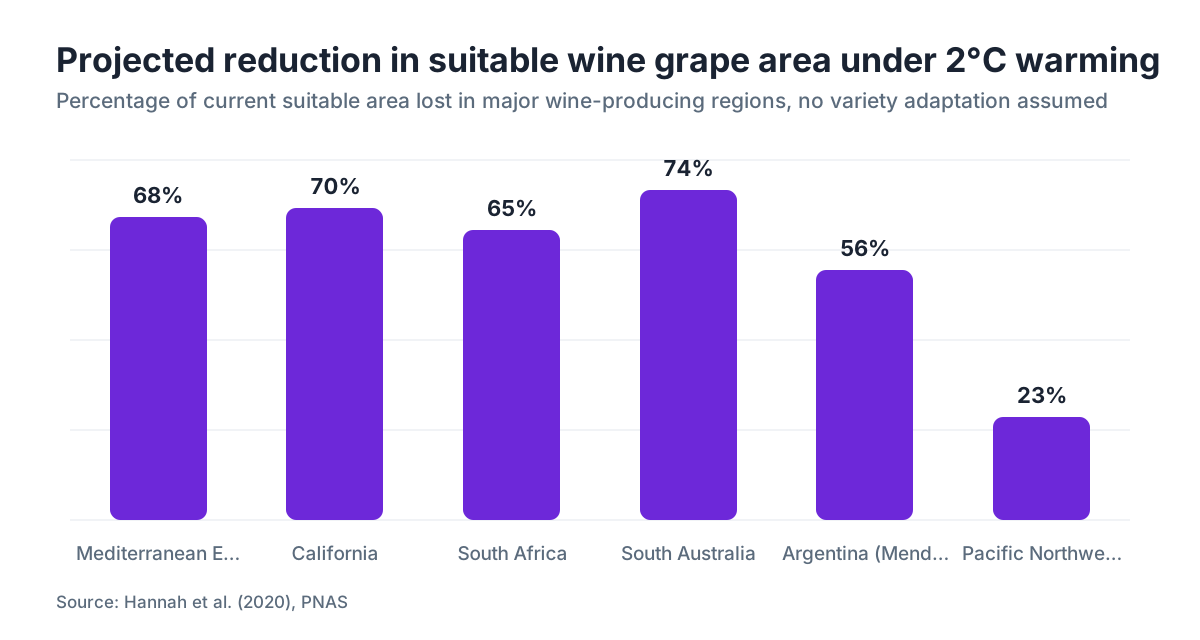
A 2020 paper in PNAS by Hannah et al. modeled changes in the area suitable for premium wine grape cultivation across 11 major producing countries under 2°C warming scenarios. The finding: suitable area in Mediterranean-climate wine regions (southern France, Spain, Italy, California, South Africa, Australia) shrinks by 56-70% under unmitigated warming [11]. That's a striking number. It comes with the caveat that shifting to more heat-tolerant varieties could cut the projected loss in half.
Under lower warming scenarios (1.5°C above pre-industrial), the same model shows losses of 24-56% in traditional regions but real gains in new regions at northern latitudes and higher elevations. The net global suitable area doesn't collapse, but the geography reshuffles dramatically.
For Pacific Northwest growers, WSU research projects that eastern Washington's Columbia Valley will see continued heat accumulation increases, potentially moving the region's warmest sites from Region III into Region IV by mid-century under high-emissions scenarios [3]. That affects which varieties stay commercially viable and which don't.
The honest caveat on all projections is that they model temperature and sometimes precipitation, but they don't capture smoke taint well (increasingly relevant in California, Oregon, and British Columbia after wildfire seasons), fog and marine layer dynamics, or the compound effects of multiple stressors hitting at once. The models tell you direction and rough magnitude. They don't tell you which specific vintage will be the one that breaks your system.
What are the compliance and record-keeping implications of climate-driven changes?
Spray programs recalibrated for shifting pest and disease windows need updated records to stay compliant. EPA Worker Protection Standard (WPS) regulations under 40 CFR Part 170 require that restricted-use pesticide application records be kept for two years and include the date, product, rate, and location of application [7]. If you're compressing or shifting spray intervals to match changed infection periods, those changes need to show up accurately in your records, not against a historical template that no longer reflects what you're doing.
Water records are becoming a compliance issue in ways they weren't a decade ago. Under California's SGMA, growers in adjudicated basins have to document irrigation volume and source. Several other western states have tightened agricultural water use reporting in response to drought. If you're using a combination of surface water (which may be curtailed) and groundwater, tracking the shift between sources accurately protects you in a regulatory dispute.
Carbon and sustainability certifications are growing in market importance but remain voluntary in most U.S. jurisdictions. California Certified Organic Farmers (CCOF), LIVE (Low Input Viticulture and Enology), and SIP Certified all have documentation requirements. Some want multi-year records of soil health indicators, water use, and energy inputs. Keeping those records in a system that lets you pull historical comparisons is genuinely useful when you're trying to document progress over a certification cycle. VitiScribe is built for this kind of multi-year vineyard record-keeping and can simplify the documentation side of sustainability programs.
One area where growers consistently under-document is cold stress and frost damage. When late frosts caused by early budbreak (a climate-linked phenomenon) damage a crop, the insurance claim process runs on dated field observations and temperature logs. USDA Risk Management Agency crop insurance programs for wine grapes require documentation of the loss event, including timing relative to phenological stage [12]. Growers without dated records often leave money on the table.
What practical steps can a vineyard manager take right now?
Install weather stations if you haven't. A single CIMIS station (California's Irrigation Management Information System) or a nearby CoCoRaHS weather station might be close enough for regional trends, but block-level data on temperature, humidity, and wind matters for disease modeling and irrigation scheduling. A basic data-logging station costs $300-800 and pays back quickly in avoided sprays or a single salvaged block [13].
Map your site's heat accumulation (GDD) over at least the last 10 seasons. If the county extension office has historical climate records, pull them. If you've been keeping records internally, that's even better. Know where your site sits in the Winkler scale and whether it's moving.
Review your variety mix against projected warming. You don't have to replant today, but identify the one or two blocks that will turn problematic first and start the variety trial process. A trial block planted now gives you 5-7 years of performance data before you make replant decisions at scale.
Talk to your local extension advisor before adjusting spray programs. UC Davis Cooperative Extension, WSU Extension, and Cornell Cooperative Extension all publish current pest and disease management guides updated for current conditions, and most have farm advisors available by appointment [1][3][5]. Adjusting your program on a blog post (including this one) without ground-truthing it with local expertise is a bad idea.
Document the changes you're making and why. When your canopy practices, spray timing, or irrigation schedule differs from what you did five years ago, write down the reason. That creates a record that's useful for your own decision-making, for certification audits, and for the next manager who works this property.
Frequently asked questions
How much have harvest dates shifted in major wine regions due to climate change?
Harvest dates across major European wine regions have moved 6-25 days earlier per decade in the warmest years since the 1980s, according to a 2019 Nature Climate Change analysis. Burgundy's harvest records since 1354 show the earliest harvests in 664 years of data all occurred after 1988. In the U.S. Pacific Northwest, heat accumulation at several eastern Washington sites has increased enough to shift Winkler climate region classifications upward.
Which wine regions are most threatened by climate change?
Mediterranean-climate regions face the most acute near-term pressure: southern France, Spain, interior California, South Australia, and South Africa. A 2020 PNAS study modeled 56-70% reductions in suitable area in these regions under 2°C warming with no variety changes. Pacific Northwest and Burgundy face different but real pressure from warming that outpaces their cool-climate varieties. England, higher-elevation U.S. sites, and northern Europe are gaining viable growing area.
What grape varieties do best in a warming climate?
Heat-tolerant, thick-skinned varieties handle warming conditions better: Grenache, Tempranillo, Nero d'Avola, Assyrtiko, Monastrell, Touriga Nacional, and several Portuguese cultivars. Cornell's viticulture program has also evaluated cold-hardy hybrids like Marquette and Frontenac for transitional regions. No variety is immune to severe heat stress, but these maintain quality at higher mean growing-season temperatures than classic cool-climate varieties like Riesling or Pinot Noir.
Does climate change make frost risk better or worse for vineyards?
Worse, in a counterintuitive way. Earlier budbreak means green tissue is exposed 2-3 weeks sooner than historical averages, but the late-frost probability window doesn't shift at the same rate. The April 2021 frost event in France caused an estimated 2 billion euros in losses partly because an unusually warm March triggered early budbreak, leaving vines exposed when temperatures dropped. Growers managing frost risk need to account for this changed phenological timing.
How does drought affect wine grape quality?
Mild, controlled water stress improves quality by concentrating flavor and improving skin-to-juice ratios. Severe or uncontrolled deficit, especially before veraison, damages berry cell development and produces shriveled, high-sugar, low-acid fruit that winemaking can't salvage. Post-veraison severe stress can raise pH significantly as malic acid degrades. California's SGMA is already restricting groundwater access in several wine grape counties, making this a compliance and operational issue more than an agronomic one.
What is regulated deficit irrigation and should all vineyards use it?
Regulated deficit irrigation (RDI) deliberately withholds water at specific growth stages, typically post-fruit set through veraison, to induce mild stress and limit berry size. It's standard practice in most quality-focused California and Washington operations. In warming conditions with limited water supply, RDI is often the only way to hold quality while staying within water use constraints. UC Davis Cooperative Extension publishes crop coefficients and ET0 data by county to help growers calibrate RDI programs.
How is smoke taint from wildfires affecting vineyards?
Smoke taint is a growing problem in California, Oregon, and British Columbia, where wildfire frequency and intensity have increased with drought and heat. Guaiacol and 4-methylguaiacol, volatile phenols absorbed through berry skin, produce an ashy, medicinal character that's unremovable in winemaking. Smoke exposure risk peaks in a window starting at veraison and running through harvest. Testing for smoke taint markers costs roughly $75-150 per sample at most commercial wine labs. Some growers now buy smoke-taint crop insurance riders.
What do EPA Worker Protection Standard rules require when spray programs change?
EPA WPS regulations under 40 CFR Part 170 require that restricted-use pesticide records be kept for two years, including date, product, EPA registration number, application rate, and treated area. When climate-driven changes shift your spray schedule or material selection, those changes must be accurately recorded. There's no regulatory requirement to explain why your program changed, but accurate date-stamped records protect you if a worker exposure complaint arises. Records must be accessible to workers and their representatives upon request.
Is England really becoming a competitive wine-producing region because of climate change?
England had approximately 900 commercial vineyards as of 2023, up from around 400 in 2010, and the growth ties directly to warming growing seasons. Southern England now gets summer temperatures comparable to what Champagne saw in the 1980s. Most production is traditional-method sparkling wine from Chardonnay, Pinot Noir, and Meunier. English sparkling wines have won blind tastings against established Champagne houses multiple times in the 2010s. It's a real trend, not marketing.
What does WSU Extension say about climate adaptation for Pacific Northwest vineyards?
Washington State University Extension has documented increasing heat accumulation (growing degree days) at eastern Washington sites between 1980 and 2020, with several sites crossing Winkler region boundaries. WSU's climate-adaptive viticulture guidance recommends monitoring GDD trends over at least a decade, trialing heat-tolerant varieties in warm blocks, evaluating drought-tolerant rootstocks like 110R and 140Ru, and adjusting canopy management to provide afternoon fruit shade. WSU Extension publishes updated variety and rootstock trial data regularly.
How does changing climate affect crop insurance claims for vineyard operations?
USDA Risk Management Agency crop insurance programs for wine grapes require documentation of the loss event, including date, phenological stage of vines at time of damage, and weather records. Climate-linked events like late frost after early budbreak or heat-spike damage require dated field observations and temperature logs to support a claim. Growers without contemporaneous records often receive reduced settlements or claim denials. A simple dated photo log of vine phenology paired with a weather station record is minimum documentation.
What is the IPCC projection for wine region temperatures through 2050?
The IPCC Sixth Assessment Report (AR6, 2021) projects 1.0-1.8°C of additional warming above the 2011-2020 baseline through 2050 under intermediate emissions scenarios (SSP2-4.5). Land areas, which include all wine regions, warm faster than the global average. For mid-latitude wine regions, that likely means 1.5-2.5°C of growing-season warming by mid-century. A 2020 PNAS study found that 2°C of warming could reduce suitable growing area in traditional Mediterranean-climate wine regions by 56-70%.
Can changing canopy management really offset rising temperatures in vineyards?
Partially. UC Davis research documented 5-10°C differences in berry surface temperature between sun-exposed and shaded clusters in high-radiation environments. Shoot positioning, later or eliminated leaf removal on the sun side, and north-south row orientation for afternoon shade can meaningfully reduce heat stress on fruit. These practices won't compensate for a 3°C shift in mean temperature, but they buy time and improve outcomes in marginal vintages. They're the first tool to reach for, and they're cheap compared to replanting.
What role does rootstock selection play in climate adaptation?
Rootstock significantly affects drought tolerance and heat resilience. 110R (Richter 110) and 140Ru handle drought stress better than 3309C or Riparia Gloire, with deeper rooting and higher stomatal regulation under water deficit. The tradeoff is higher vigor, which requires adjusted canopy management. Cornell and UC Davis both publish rootstock trial data comparing performance under different water and heat stress conditions. For new plantings in warming or drought-prone sites, rootstock is a 30-year decision worth spending real time on.
Sources
- UC Davis Viticulture and Enology, Department Research and Extension: Average growing-season temperatures in Napa Valley increased roughly 1.3°C between 1950 and 2010; canopy management can produce 5-10°C differences in berry surface temperature
- Nature Climate Change, Chuine et al. / Daux et al., Burgundy harvest date reconstruction: Harvest dates have moved 6-25 days earlier per decade in the warmest years since the 1980s; the most consistently early Burgundy harvests in 664 years all occurred after 1988
- French Ministry of Agriculture, April 2021 frost damage assessment: April 2021 frost event in France caused an estimated 2 billion euros in vineyard losses, partly due to early budbreak from a warm March
- UC Agriculture and Natural Resources, Integrated Pest Management Program: Vine mealybug pressure has increased in California's San Joaquin Valley as average winter lows rise, with range expanding northward into Napa and Sonoma counties
- U.S. EPA, Worker Protection Standard, 40 CFR Part 170: EPA WPS requires restricted-use pesticide application records be kept for two years, including date, product, rate, and location; records must be accessible to workers and their representatives
- California Department of Water Resources, Sustainable Groundwater Management Act: California's SGMA became fully effective for high-priority basins in 2020 with groundwater sustainability plans due by 2022, restricting pumping in several Central Valley and Central Coast counties including critically overdrafted Paso Robles basin
- IPCC Sixth Assessment Report (AR6), Working Group I, 2021: IPCC AR6 projects 1.0-1.8°C of additional global surface temperature increase above the 2011-2020 baseline through 2050 under intermediate emissions scenario SSP2-4.5
- Wine GB (formerly English Wine Producers), Industry Statistics: England and Wales had approximately 900 commercial vineyards as of 2023, up from around 400 in 2010, driven by warming growing seasons
- Hannah, L. et al. (2020), Climate change, wine, and conservation. PNAS.: Under 2°C warming, suitable area for premium wine grape cultivation shrinks 56-70% in Mediterranean-climate wine regions; switching to heat-tolerant varieties could cut projected losses roughly in half
- USDA Risk Management Agency, Crop Insurance for Grapes: USDA RMA crop insurance programs for wine grapes require documentation of loss events including date, phenological stage at time of damage, and supporting weather records
- California Department of Water Resources, CIMIS (California Irrigation Management Information System): CIMIS provides ET0 reference evapotranspiration data by station and county for irrigation scheduling; growers use crop coefficients with ET0 to calculate target irrigation amounts
Last updated 2026-07-09