Shoot thinning timing and labor hour documentation for block records
TL;DR
- Thin shoots when they're 4 to 8 inches long, usually 2 to 4 weeks after budbreak.
- Labor runs 8 to 20 hours per acre depending on variety, training system, and vine spacing.
- Every block record needs the date, crew size, hours per acre, and growth stage at the time of work.
- That satisfies your own traceability and EPA Worker Protection Standard recordkeeping.
What is shoot thinning and why does timing matter so much?
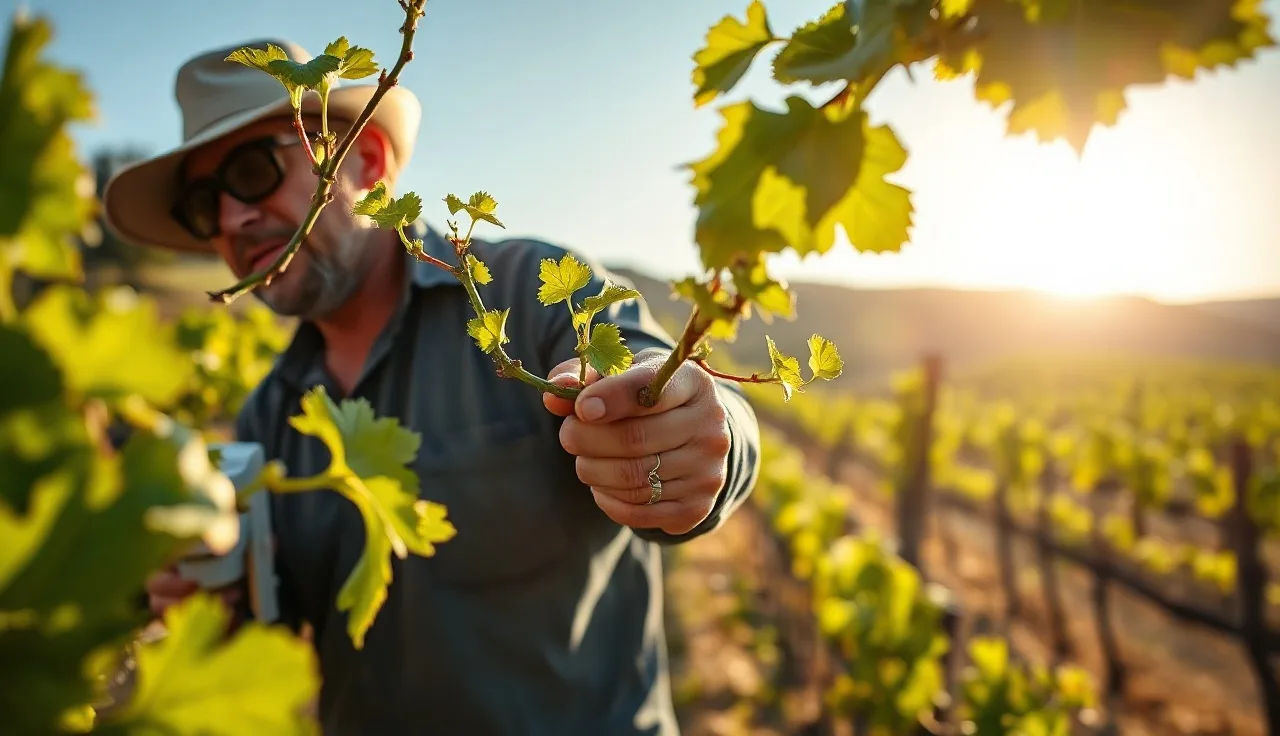
Shoot thinning is pulling unwanted shoots off the vine by hand before they harden into wood. You're removing suckers from the trunk, double shoots from a single bud, and any shoot growing from a position that will crowd the canopy or steal carbohydrates from the shoots you want to keep.
Timing is everything.
Go too early, below about 3 inches of growth, and you'll pull the wrong ones. At that stage it's genuinely hard to tell which shoot from a given node will turn out dominant. Go too late, past 8 to 10 inches, and the shoots have already drawn real energy from the vine, the wound you leave is bigger, and your crew slows down because each shoot snaps instead of peeling clean. The sweet spot is 4 to 8 inches, usually 2 to 4 weeks after budbreak depending on your region and the season's heat [1].
Timing also controls labor cost. A 4-inch shoot comes off with a flick of the thumb in a fraction of a second. A 12-inch shoot needs a deliberate tug and sometimes a second pass. UC Cooperative Extension work in California found shoot thinning labor in poorly managed canopies can eat 15 to 20 percent of total annual vineyard labor cost, which is a real number if you keep letting it slide to late season [1].
Get your crew in the block when shoots are 4 to 6 inches. That's the honest answer.
When exactly should you start shoot thinning by region and variety?
There's no single calendar date, and anyone who gives you one is guessing. Shoot thinning timing runs on growing degree days and what you see in the block, not the date on your phone. Budbreak across most North American wine grape regions lands somewhere between late February and mid-April, and thinning follows it by roughly 14 to 28 days once shoots hit 4 inches.
In Paso Robles and other warm interior California regions, growers are often in the block by late March. In cooler coastal appellations and in Washington's Columbia Valley, late April to mid-May is more common. Cornell Cooperative Extension notes that in the Finger Lakes, shoot thinning usually happens mid-May to early June, with the window compressed in years with fast spring warming [2].
Variety changes the math too. Pinot noir and Chardonnay are prone to double-budding and lateral shoot growth, so your crew spends more time per vine than in Cabernet Sauvignon, which tends toward cleaner bud development in a well-managed system. Zinfandel and Grenache on warm sites push shoots fast enough that you'll need two passes if you miss the window.
WSU Extension recommends scouting 20 to 30 vines per block and holding the full crew until half the shoots in that block have reached 4 inches [3]. That's a practical rule. It keeps you from doing two partial passes because one section wasn't ready.
| Region | Typical budbreak | Shoot thinning window |
|---|---|---|
| Central Valley, CA | Late Feb to mid-March | Mid-March to early April |
| Paso Robles, CA | Early to mid-March | Late March to mid-April |
| Napa/Sonoma, CA | Mid-March to early April | Early to late April |
| Columbia Valley, WA | Early to mid-April | Late April to mid-May |
| Willamette Valley, OR | Late March to mid-April | Mid-April to mid-May |
| Finger Lakes, NY | Late April to early May | Mid-May to early June |
| Virginia/Mid-Atlantic | Late March to mid-April | Mid-April to early May |
How many labor hours per acre should shoot thinning take?
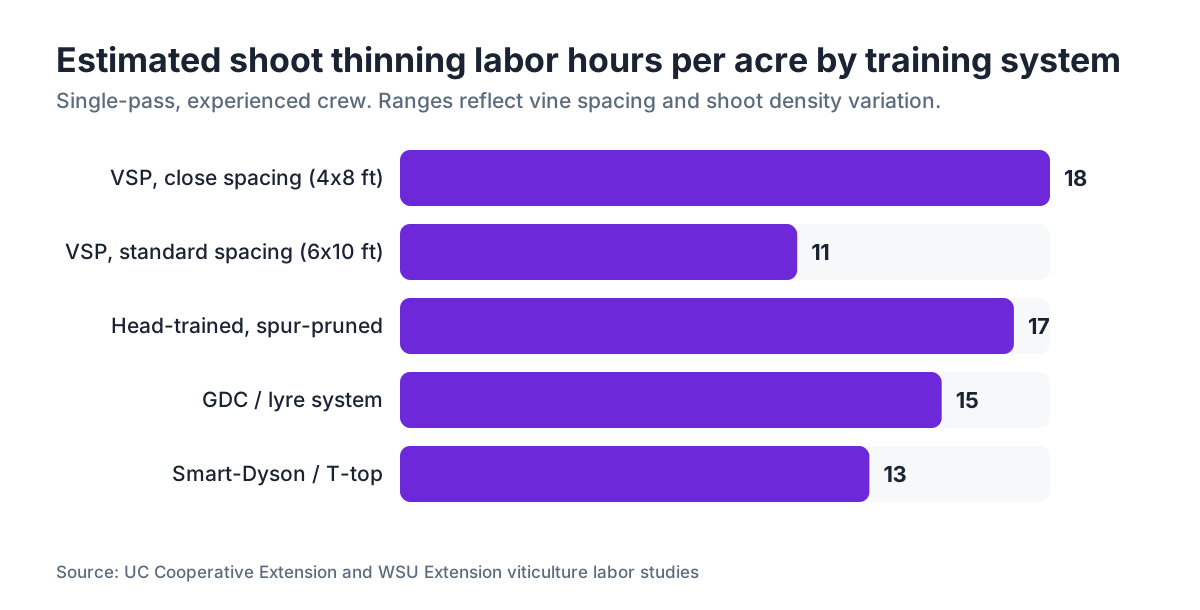
The range is wide, and a single number is a fiction. For VSP (vertical shoot positioning) systems with moderate vine spacing and a well-managed canopy, plan on 8 to 14 hours per acre for one thorough pass [1][2]. In head-trained, spur-pruned systems where you're also fighting trunk suckers, expect 14 to 20 hours per acre. Old-vine head-trained Zinfandel blocks can run higher still because of the shoot count per vine and the sprawling habit.
Here's what actually drives your per-acre hours:
- Vine spacing: 4x8 foot spacing puts roughly 1,360 vines per acre. 6x10 foot spacing puts about 725. That gap explains a lot when you compare block records.
- Training system: VSP is fastest. Lyre and GDC run slower because canopy access is worse.
- Shoot density per vine: A vine that was balance-pruned has fewer unwanted shoots to pull.
- Crew experience: A seasoned worker on familiar vines hits 200 to 250 vines per hour in VSP. A new hire might do 120 to 150.
- Sucker load: Skip or rush dormant suckering and your thinning hours climb.
WSU Extension's vineyard economics work puts average shoot thinning labor cost at $150 to $400 per acre in Pacific Northwest conditions, once you fold in supervision and overhead, and it moves with those same variables [3]. UC Cooperative Extension materials cite a similar range for California [1].
Track your own numbers. After two or three seasons you'll know your specific blocks well enough to staff and schedule them without guessing.
What information belongs in a block record for shoot thinning?
A shoot thinning entry needs enough detail that someone reading it a year later, a USDA auditor, or a wine buyer running a sustainability audit can reconstruct exactly what happened and when. That's the whole test.
Every entry needs, at minimum:
- Block ID (your internal block name or number)
- Date of operation (single date, or a date range if it ran multiple days)
- Growth stage at time of work (BBCH scale or a consistent notation of your own: "shoots 4-6 inches", "pre-bloom", or the BBCH code 12 to 15)
- Number of workers
- Total crew hours (not hours per person)
- Hours per acre (calculated, not eyeballed)
- Supervisor or crew lead name
- Observations: vine health issues, missed vines, pest or disease notes
Some operations also track the target shoot number per linear foot of cordon or per vine and whether they hit it. That's useful agronomic data, especially if you're managing to a specific fruit load.
What you don't need is a paragraph of narrative. Short, factual, consistent entries audit faster and compare cleaner season over season than long notes ever will.
On paper, a pre-printed field sheet with those fields already labeled cuts recording to under two minutes per block per day. In software, VitiScribe lets you log growth stage, crew count, and hours per acre from a phone right in the block, which kills the transcription step where most errors sneak in.
Does the EPA Worker Protection Standard require labor hour records for shoot thinning?
No. The EPA Worker Protection Standard (WPS) under 40 CFR Part 170 doesn't require labor hour documentation for a mechanical task like shoot thinning [4]. What it does require is records of pesticide applications, restricted-entry intervals (REIs), and worker training. Shoot thinning intersects WPS through timing: if you've recently sprayed a product with an active REI, your crew can't enter that block until the REI clears.
The revised WPS rule that took effect in 2017 requires agricultural employers to keep application-specific records for two years, including the product name, EPA registration number, active ingredient, date and time of application, and the REI [4]. When your shoot thinning crew enters a block after a spray, your labor record for that entry date becomes part of the REI compliance trail by association.
Here's how it plays out. Your spray record shows a fungicide with a 24-hour REI on May 3rd. Your block record shows a shoot thinning crew entering on May 4th at 8 AM. Those two records together prove compliance. Lose the block record and you've got no way to show the timing lined up.
The EPA requires handlers to inform workers of pesticide application information and REIs before workers enter a treated area [4]. Clean, date-stamped block entry records are the simplest way to document that nobody got sent into a block under an active REI.
States pile on their own layers. California's DPR, for instance, requires monthly pesticide use reports, and those must line up with your field entry logs if an inspector cross-references them [5].
How do you calculate and record hours per acre accurately?
This is where small operations get sloppy, and it costs them the moment they try to build historical benchmarks or bid out work. The calculation itself is simple: total crew hours divided by acres worked that day in that block. Four workers, 3 hours each, in a 2-acre block, is 12 crew hours across 2 acres, which is 6 hours per acre. Record that number, not the raw crew count and clock-in time.
A few things break the math in practice:
- Mixed tasks: If the crew thins shoots in the morning and pulls suckers in the afternoon, split the hours by task. Otherwise the record turns to mush when you try to benchmark either operation.
- Partial blocks: Work 1.4 acres of a 3-acre block on day one and finish on day two? Record the acreage completed each day. Don't average it over the whole block at the end.
- Travel and setup: Decide once whether drive time to the block counts as crew hours. Always include it or never include it. Pick one and hold it.
- Breaks: Rest breaks are compensated time and belong in crew hours. That's not optional under most state labor law.
Crews on piece rate (common in some regions) still need their hours tracked, more than the piece-rate units, to satisfy minimum wage under the Fair Labor Standards Act and most state labor laws [6].
A plain spreadsheet with columns for date, block, task, workers, start time, end time, acres completed, and calculated hours per acre covers most operations. Cornell Cooperative Extension's vineyard record templates use a similar structure and cost nothing [2].
What's the best way to organize block records for multiple blocks across a season?
Treat your block records like a logbook: one page (or one database row) per block per operation. Not one entry per season. Not one entry per crew member. That single structural choice fixes most of the trouble people run into at audit time.
The layout that works for audits, benchmarking, and your own end-of-season labor analysis:
- One record per block per operation date
- Chronological within each block
- One consistent name per block (don't call it "North Block" one week and "Block 3" the next)
For small operations running 10 to 30 acres, a well-built spreadsheet is genuinely enough. Above 30 acres, or any operation chasing organic or sustainability certification, a purpose-built vineyard system starts paying for itself in saved admin time. USDA organic certification, Lodi Rules, LIVE, Salmon-Safe, and SIP all want multi-season production records, and having them organized by block makes the audit go fast [7].
One move pays off every season: build a block map with fixed IDs for every block you manage. Print it. Laminate it. Keep it in the truck. Every crew lead should know the IDs so records never land under improvised names that create matching headaches later.
The growers who breeze through audits are the ones running simple, consistent systems in real time, not the ones reconstructing a season from memory and a shoebox of receipts.
How does shoot thinning documentation connect to sustainable certification programs?
Every major U.S. sustainable winegrowing certification requires documented canopy management records, and shoot thinning is one of the most commonly audited canopy practices. If you thin shoots and don't write it down, an auditor treats it as if it never happened.
Lodi Rules for Sustainable Winegrowing, California Sustainable Winegrowing (CSWA), LIVE Certification, and Salmon-Safe all require applicants to keep written records of vineyard operations, canopy management included [7][8]. The specifics vary, but they all want the same three things: what you did, when, and where by block.
Organic certification under the USDA National Organic Program (NOP) works a little differently. You don't document mechanical canopy management separately from your farm plan, but your organic system plan has to describe your canopy management approach, and field records that back up that description are expected if the certifier asks [9].
The payoff is that one good block record does all this work at once. A record with date, growth stage, hours per acre, and block ID satisfies essentially every program above. You don't keep a separate log for each certification. One clean record covers them all.
Some certifiers want multi-year records to read the trend. Three seasons of clean records showing you thin at the right growth stage is a real signal of program commitment. No records, and you can't show it even when it's true.
What are common mistakes in shoot thinning records that cause audit problems?
The most common problem is missing dates. An entry that reads "shoot thinning, North Block, 10 hours" with no date attached is nearly worthless for compliance. Date every entry. Every single one.
Second most common: inconsistent block names. It sounds trivial. It isn't. It creates real reconciliation problems when you cross-reference spray records against field entry records for REI compliance.
Third: total crew hours with no acreage. "4 workers, 6 hours" tells you 24 crew hours happened. It doesn't tell you the per-acre rate, which is the number you need to benchmark and staff future work.
Fourth: no growth stage. For compliance and certification, knowing thinning happened on April 22nd is fine. Knowing it happened at BBCH 12 to 15 (shoots 4 to 8 inches) tells a certifier or agronomist something real about how you manage the canopy.
Fifth: paper records with no backup. A box of field sheets in a barn that floods is not a record system. A weekly phone photo of your paper logs beats that. Any digital system with automatic backup beats the photo.
And one that ambushes people: recording a crew entry in a block where the REI on a recent spray hadn't cleared. Spray log shows a 48-hour REI, block record shows a crew entry at 30 hours, and that's a WPS violation whether or not anyone got hurt. The records are what expose it. Fix the REI compliance. Don't fix the records.
What tools and templates are available for vineyard labor documentation?
Several university extension programs give away templates built for vineyard block records, and they're the first place I'd look before paying for anything.
Cornell Cooperative Extension's viticulture team has produced record-keeping guides and spreadsheet templates through its New York viticulture programs, available on the Cornell Cooperative Extension website [2]. They're aimed at small to mid-sized operations and cover canopy management, spray records, and seasonal labor summaries. WSU Extension's Pacific Northwest Pest Management Handbook and its viticulture resources include record-keeping guidance specific to Washington and Oregon conditions [3]. UC Cooperative Extension has labor cost tracking worksheets for California wine grape production that include per-acre benchmarks by operation type [1].
On paper, a landscape field sheet with pre-printed columns for date, block, operation, workers, hours, acres, and notes takes about 5 minutes to build in any spreadsheet app and works fine up to roughly 50 acres.
To log from the field without paper, VitiScribe's block record module records shoot thinning entries, growth stage, and labor hours by block from a phone, with the data organized by season and ready to export. That matters the day a certifier asks for multi-year records in a structured format.
You can also build something serviceable in Google Sheets with a form your crew lead submits from the field. It isn't fancy. It's free, and it works. The whole game is making entry fast enough that it happens in the block instead of getting reconstructed later.
Frequently asked questions
What BBCH growth stage should shoot thinning happen at?
Shoot thinning is most efficient between BBCH 12 and 15, which is shoots at 4 to 8 inches in length. At that stage, unwanted shoots are easy to spot and remove with thumb pressure, wounds stay small, and your crew moves fast. Wait past BBCH 15 to 17 and you add labor time while unwanted shoots keep drawing down vine resources.
How many passes of shoot thinning does a vineyard typically need per season?
Most well-managed VSP vineyards need one thorough pass. Some blocks, especially Zinfandel, Grenache, or any variety with aggressive lateral growth, benefit from a light second pass 10 to 14 days later to catch shoots too small to judge the first time. Head-trained or GDC systems with heavy sucker pressure sometimes need two as well. Budget for one and scout before committing to a second.
Do I need to record shoot thinning in my spray records or just my block records?
Shoot thinning is a mechanical canopy operation, not a pesticide application, so it doesn't belong in your spray records. It goes in your block records or canopy management log. The two connect through REI compliance: spray records establish REI windows, and block records document when crews entered a treated block. Both have to be accurate and consistent with each other.
What's the minimum information the EPA requires me to keep for crew entering a vineyard block?
The EPA Worker Protection Standard (40 CFR Part 170) doesn't specify a format for crew entry logs. It requires that workers be informed of pesticide application information and REIs before entering treated areas. Dated block records showing when crews entered each block are the practical way to prove nobody worked a block during an active REI. Two-year retention matches WPS application recordkeeping.
How do I account for shoot thinning labor when workers are on piece rate?
Even on piece rate, you must track hours worked per worker to verify minimum wage compliance under FLSA and most state laws. Log start and end time for each worker per block. Compare piece-rate earnings to the hourly minimum for hours worked. If piece rate falls below minimum wage for that period, you pay the difference. Keep those records for at least three years under FLSA.
Can shoot thinning and suckering be recorded as one operation in block records?
You can, but separating them is better practice. Suckering removes growth from below the graft union or from the trunk. Shoot thinning removes shoots from the cordon or head. They're often done in one pass, but splitting them in your records lets you benchmark each independently and reads cleaner for certification audits that ask specifically about canopy management versus trunk maintenance.
How many shoots per vine or per foot of cordon should I leave after thinning?
The common target for VSP cordon-trained vines is one shoot every 3 to 4 inches of cordon, or roughly 4 to 6 shoots per linear foot. On a 3-foot bilateral cordon, that's 12 to 18 shoots per vine. The right number depends on variety, rootstock vigor, and fruit load targets. WSU and UC Davis balanced pruning materials give variety guidance, but your own block history calibrates best.
What's the difference between shoot thinning and hedging, and do they need separate records?
Shoot thinning removes whole shoots at or near the base early in the season, before bloom. Hedging trims shoot tips later, typically June through August, to manage canopy height and lateral growth. They're distinct operations with different timing, labor cost, and objectives. Keep them in separate block record entries. Mixing them muddies your benchmarking and can trip up a certification audit.
How long should I keep vineyard block records for shoot thinning?
Keep them for whatever your longest applicable requirement is. EPA WPS requires pesticide application records for two years. USDA organic certification requires five years of records to support the organic system plan. Most sustainability programs want three to five. Keeping all block records for five years covers every one of these. Digital storage is essentially free, so there's no reason to delete them.
Is there a benchmark for shoot thinning cost per ton or per acre that I can compare my operation against?
WSU Extension research puts shoot thinning labor at roughly $150 to $400 per acre in Pacific Northwest operations, with the variation driven by training system, vine spacing, and crew experience. UC Cooperative Extension California data shows a similar range, higher in head-trained old-vine blocks. Per-ton benchmarks are hard to use because thinning happens before crop load is known. Per-acre is the reliable comparison.
What happens if I miss the shoot thinning window and shoots are already 12 inches or longer?
You still do it. Late thinning beats none, but your hours per acre run 20 to 40 percent higher because shoots must be broken or cut rather than thumbed off, and the canopy is already congested. Focus on the obvious problems: double shoots, basal shoots competing with fruiting shoots, and trunk suckers. You won't recover the energy those shoots consumed, but you'll improve air flow and light for the rest of the season.
Do organic vineyards have different shoot thinning requirements than conventional ones?
The mechanical operation is identical. The difference is that under USDA NOP organic certification, your organic system plan has to describe your canopy management approach, and consistent block records help show you're running the vineyard as described. No organic-specific regulation requires shoot thinning, but canopy practices that affect pest and disease pressure matter to your certifier's assessment of your system.
How do I document shoot thinning observations that affect next year's pruning decisions?
Add a short observations field to your block record entry. Note things like heavy double-budding in specific rows, high sucker pressure from a particular rootstock block, or unusual shoot vigor in one section. Tied to the block ID and date, those notes become your institutional memory for dormant pruning the following winter. Two or three words is enough: 'rows 4-7 heavy doubles', 'southeast corner high sucker load'.
Sources
- UC Cooperative Extension, Sonoma County Viticulture: Shoot thinning labor in poorly managed canopies can account for 15 to 20 percent of total annual vineyard labor cost; VSP shoot thinning runs 8 to 14 hours per acre for a thorough single pass
- Cornell Cooperative Extension, New York Viticulture Program: In the Finger Lakes region, shoot thinning typically occurs mid-May to early June; Cornell provides free vineyard record-keeping templates covering canopy management and labor
- Washington State University Extension, Viticulture and Enology: WSU recommends scouting 20 to 30 vines per block and committing the crew when 50 percent of shoots reach 4 inches; shoot thinning labor cost estimated at $150 to $400 per acre in Pacific Northwest operations
- U.S. EPA, Worker Protection Standard (40 CFR Part 170): WPS requires agricultural employers to retain pesticide application records for two years and to inform workers of REIs before entry into treated areas; the revised WPS rule took effect in 2017
- California Department of Pesticide Regulation, Pesticide Use Reporting: California DPR requires monthly pesticide use reports that must be consistent with field entry logs if cross-referenced during inspection
- U.S. Department of Labor, Fair Labor Standards Act (FLSA) Agricultural Provisions: Piece-rate agricultural workers must still be paid at least the applicable minimum wage for all hours worked; employers must keep wage records for at least three years under FLSA
- California Sustainable Winegrowing Alliance (CSWA), Sustainable Winegrowing Program: CSWA and Lodi Rules certifications require documented canopy management records by block, including shoot thinning, as part of program audit requirements
- LIVE Certification, Low Input Viticulture and Enology: LIVE certification requires written records of vineyard operations including canopy management activities, reviewed at annual audits
- USDA National Organic Program (NOP): USDA NOP requires certified operations to maintain records for five years that demonstrate ongoing compliance with the organic system plan, including production and handling records
- UC Davis Viticulture and Enology, Vineyard Management Resources: BBCH growth stages 12 to 15 (shoots 4 to 8 inches) represent the optimal window for shoot thinning across most Vitis vinifera varieties
Last updated 2026-07-10