Pre-bloom spray timing records and label compliance for Botrytis programs
TL;DR
- Pre-bloom is your highest-leverage window for Botrytis, usually from 20% bloom through bunch closure.
- Every application needs a dated record showing the product, rate, REI, and PHI.
- Label compliance means matching the registered use site, staying under seasonal maximums, and rotating FRAC groups.
- Skip any of these and you can lose your license or your crop.
Why does pre-bloom timing matter so much for Botrytis control?
Botrytis cinerea infects grape flowers and then goes latent inside the berry, sitting there quietly until sugar climbs near harvest and the weather turns wet. By the time you spot a rotting cluster in August, the infection happened back in May or June. That biology is exactly why pre-bloom sprays are non-negotiable for wine grapes in humid or coastal climates.
The window most extension programs point to runs from roughly 20% cap fall through bunch closure [1]. Cornell's IPM guidelines call early bloom (E-L stage 23) the single most important spray timing for Botrytis, with a second application at bunch closure if conditions stay wet [2]. UC Davis and UC Cooperative Extension say the same for California coastal regions, especially Pinot Noir and Chardonnay blocks where tight cluster architecture traps humidity [3].
Miss the window by four or five days and you've lost your best shot. The fungus needs petal tissue and anther debris to colonize. Once those are gone and berries are sizing, you're chasing a problem you could have prevented.
Washington State University's viticulture extension adds a useful wrinkle. In cooler seasons when bloom stretches over ten or more days, a second application inside the bloom window may be justified, because one spray can't hold residual activity across an extended infection period [4]. Knowing whether your season is running fast or slow is more than agronomic judgment. It's part of your timing defense if a compliance question ever comes up.
What spray records are legally required for each Botrytis application?
Federal law under FIFRA requires any commercial applicator who applies a restricted-use pesticide to keep records for two years after application [5]. Most states extend that to all pesticides applied on agricultural land, general-use fungicides included. California, for one, requires pesticide use reports (PURs) filed with the county agricultural commissioner within seven days of each application under California Food and Agricultural Code Section 12981 [6].
At minimum, a compliant record for a Botrytis fungicide application needs to capture:
- Date and time of application
- Applicator name and license number (if a restricted-use product)
- Product name and EPA registration number
- Application rate per acre and total volume used
- Target pest (Botrytis cinerea or gray mold)
- Crop and growth stage at time of application
- Block or field identifier with acreage
- REI (re-entry interval) posted or communicated to workers
- PHI (pre-harvest interval) and expected harvest date
- Equipment used and dilution rate
- Wind speed and direction, temperature, relative humidity at application time
Some of those fields feel like overkill on a busy morning. They're not. The EPA Worker Protection Standard (WPS), revised in 2015, requires REI information be posted at a central location in the workplace and communicated to workers before they enter treated areas [7]. If an inspector finds workers pulling shoots in a block you sprayed yesterday with a 24-hour REI fungicide, and you have no record of posting that REI, you have a WPS violation whether or not anyone got hurt.
State departments of agriculture do run field inspections. The most common citation isn't the wrong rate. It's missing or incomplete records. Keep yours in a format you can actually produce on short notice, whether that's a bound field notebook, a spreadsheet, or a digital system. The format doesn't matter. Completeness does.
How do REI and PHI requirements work for common Botrytis fungicides?
REI and PHI are label requirements, not suggestions. The pesticide label is a federal legal document. As EPA puts it: "It is a violation of Federal law to use this product in a manner inconsistent with its labeling" [8]. That sentence sits on virtually every pesticide label in the country.
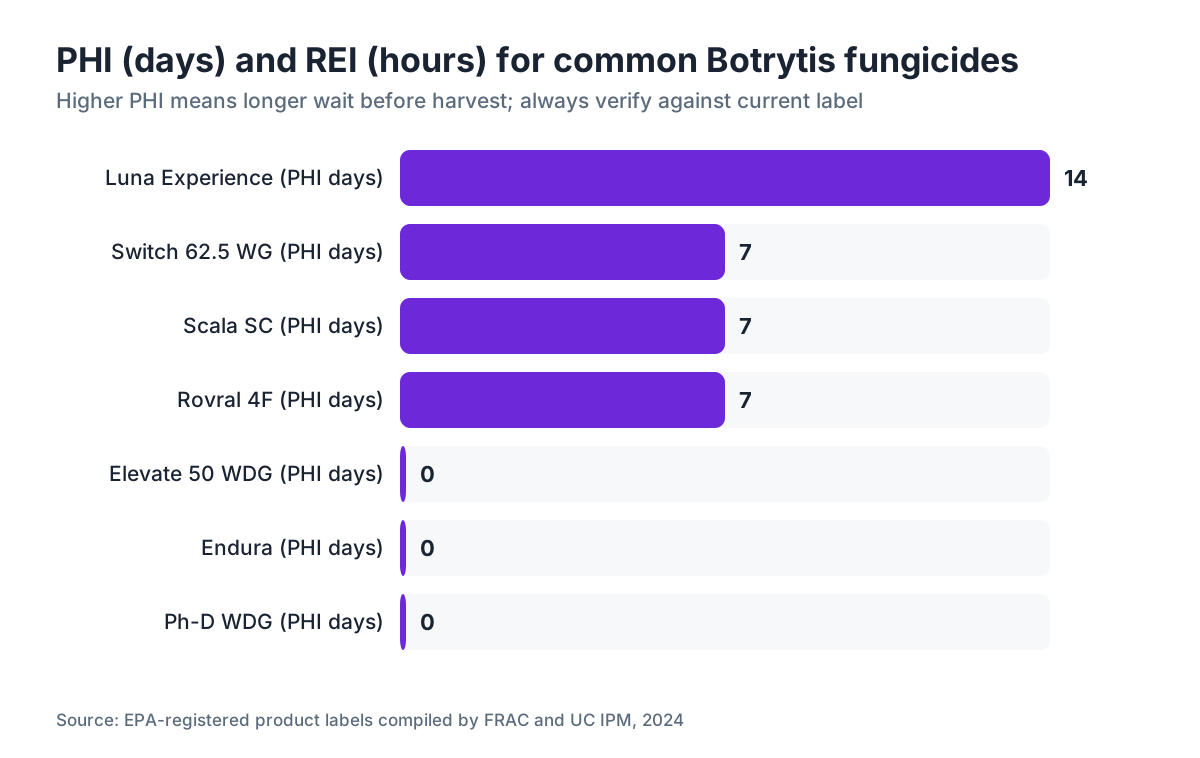
Here's how the numbers look across the fungicides most often used in pre-bloom Botrytis programs:
| Product (common name) | Active ingredient | FRAC group | REI (hours) | PHI (days) | Max applications/season |
|---|---|---|---|---|---|
| Elevate 50 WDG | Fenhexamid | 17 | 12 | 0 | 4 |
| Switch 62.5 WG | Cyprodinil + fludioxonil | 9 + 12 | 24 | 7 | 4 |
| Scala SC | Pyrimethanil | 9 | 12 | 7 | 3 |
| Rovral 4 Flowable | Iprodione | 2 | 24 | 7 | 2 |
| Endura | Boscalid | 7 | 12 | 0 | 2 |
| Luna Experience | Fluopyram + tebuconazole | 7 + 3 | 12 | 14 | 2 (fluopyram) |
| Ph-D WDG | Polyoxin D zinc salt | 19 | 4 | 0 | 6 |
| Quadris (azoxystrobin) | Azoxystrobin | 11 | 4 | 0 | Varies |
A PHI of 0 days sounds like a gift. Read the label anyway. Elevate's 0-day PHI means you could technically spray the day before harvest and stay legal, but the maximum seasonal rate still applies, and if you've already hit your four-application limit, you're done regardless of PHI.
The 14-day PHI on Luna Experience is the one that catches people. Apply it too late in a season where heat pulls harvest forward, and you're either waiting or harvesting with a label violation. Log your expected harvest date when you record the application. It's a five-second step that saves a real headache.
Organic programs run into a tradeoff. OMRI-listed options like Ph-D WDG (Polyoxin D) carry a 4-hour REI and 0-day PHI, but the resistance profile is different. They're FRAC group 19 and fit a rotation well, though they don't match the efficacy of SDHIs or anilinopyrimidines in high-pressure seasons.
What is FRAC group rotation and why do regulators and labels both care about it?
FRAC stands for Fungicide Resistance Action Committee. Each active ingredient gets a FRAC group number based on its mode of action. Botrytis mutates fast and has developed resistance to FRAC groups 1, 2, 4, 9, 11, and 17 in various regions worldwide [9].
Labels for many Botrytis fungicides now carry resistance management language that is part of the legal label, not advisory text. Switch 62.5 WG's label, for example, states that applications should be made as part of a resistance management program that alternates or mixes with fungicides from different FRAC groups. Treat that language as optional and you take on a label compliance risk.
On the ground, the rule is simple: don't apply two consecutive products from the same FRAC group. A common pre-bloom rotation in California and the Pacific Northwest goes FRAC 9 at early bloom, FRAC 12 or 17 at bunch closure, and FRAC 7 later in the season if a third application is warranted. That sequence hits three different modes of action across the Botrytis season.
Write the FRAC group on your record next to the product name. Some county ag departments don't require the field. But if you're ever audited on resistance management or asked to show you followed label directions, a documented FRAC group proves you thought about it. Your records are your argument that you operated professionally.
WSU's pest management program publishes annual fungicide guides for Washington wine grapes with FRAC recommendations tuned to current Pacific Northwest resistance patterns [4]. Cornell does the same for the Northeast [2]. Use the regional guide that matches where you farm.
What does label compliance actually mean in practice for a Botrytis program?
Label compliance for Botrytis programs comes down to four practical dimensions: registered use site, application rate, seasonal limits, and timing restrictions.
Registered use site means the product must be labeled for grapes (Vitis vinifera or wine grapes) in your state. Not everything registered in California is registered in Oregon or New York. EPA tracks federal registrations, and product databases like CDMS and Greenbook hold current labels, but your state department of agriculture keeps its own registered product list. Use a product that isn't registered in your state for grapes and you have a label violation, national EPA registration or not.
Application rate means you can't exceed the labeled rate per application or the labeled volume per season. Going higher buys you nothing. Botrytis fungicides are mostly protectants, and overshooting the rate won't rescue an already-infected crop. It just creates a residue problem and a compliance problem.
Seasonal limits matter more than people think. Endura is capped at two applications per season at the highest labeled rate. Apply it at bloom and again at bunch closure and you're done. A third pass, no matter how bad the pressure, is a label violation. This is where your records protect you directly. When a scout says pressure is intense and you need another hit, your records tell you whether you have applications left and which FRAC group you used last.
Timing restrictions sometimes show up as growth-stage requirements. Some labels say "do not apply before E-L stage 17" or "apply no later than bunch closure." Those aren't agronomic tips slipped into the label. They're conditions of registration. Document the growth stage at application. Record E-L stage 23 (full bloom) on June 4, with a calendar that lines up with your bloom notes from previous years, and you have a contemporaneous record. Write "bloom" with no date and it's much harder to defend.
Tools like VitiScribe can log growth stage, FRAC group, rate, and REI at the moment of application instead of forcing you to reconstruct them later. Real-time records beat reconstructed ones by a wide margin when a question surfaces months after the fact.
What worker protection standard requirements apply specifically during Botrytis spray programs?
The EPA's Agricultural Worker Protection Standard (40 CFR Part 170), revised in 2015 and updated in 2022, sets the baseline for protecting agricultural workers from pesticide exposure [7]. For Botrytis spray programs, three obligations carry the weight.
First, REI posting and communication. Before each application, workers must know an application is happening and know the REI for the treated area. The WPS requires a written or electronic posting at the designated pesticide safety information central location (usually the tool shed or break area) showing the product, location, date and time of application, and REI expiration date and time. Your record should show you did this, which means logging who was notified and when.
Second, early entry restrictions. During the REI, only workers who have completed specific early-entry WPS training and are wearing the label's required personal protective equipment (PPE) may enter treated areas, and only for limited purposes. "Somebody had to check the irrigation" is not a legal basis for early entry without proper documentation.
Third, PPE for handlers. The applicator must wear the PPE the label specifies for the product. Fenhexamid (Elevate) labels generally require chemical-resistant gloves and protective eyewear at minimum. Switch labels require waterproof gloves, protective eyewear, and chemical-resistant footwear. If your records don't reference the PPE used, you have a gap.
The 2022 WPS updates didn't move the core requirements much, but they clarified electronic posting options and tightened the language around handler training records [7]. If you spray with contract labor, the handler training requirement lands on whoever employs those workers. Make your contracts clear about who carries that obligation.
How should spray records be organized to survive an audit or a label compliance review?
Audits in wine grapes come from three directions: state department of agriculture pesticide enforcement, winery quality assurance (QA) audits for programs like SWP or LIVE certification, and, less often, food safety audits under FSMA's Produce Safety Rule.
Each reviewer wants the same core information but frames the question differently. A state pesticide inspector asks whether the product was legally applied. A winery QA auditor asks whether the record matches what came in with the grapes. An FSMA auditor asks whether any agricultural input could be a food safety risk.
Organize your Botrytis records by block, not by date. A date-organized log makes a reviewer search across the whole season to reconstruct what happened in block 7. A block-organized file lays out every application to that block in order: growth stage at each pass, days since the previous application, cumulative applications per product, and remaining applications allowed under the label. That's the format that actually answers the audit question.
Keep your labels. Specifically, keep a copy of the label version current at the time of each application. Labels change. A reformulation or re-registration can shift the PHI or seasonal limit. If you applied a product when the label said the PHI was 7 days, and the label later moved to 14, your file with the original label copy shows you were compliant at the time.
Two years is the federal minimum retention period for restricted-use pesticide records [5]. Several states require three. California requires three years for PURs under county commissioner rules [10]. Keep them three years minimum and you're covered in every major wine-producing state.
What are the most common Botrytis spray record violations found during inspections?
Based on enforcement focus areas published by California DPR and the Washington State Department of Agriculture, the most frequent violations in vineyard pesticide records fall into a predictable pattern.
Missing EPA registration numbers. You wrote "Switch" on the record but skipped the EPA registration number. The inspector can't confirm which formulation you used or whether it was registered for this use site. It's a paperwork violation, and it's also a flag for everything else.
No applicator license number. If the product is restricted use, the applicator must hold a valid license. A record that doesn't name the licensed applicator means you can't prove one was present.
REI not documented. The application happened, the REI was real, but nobody wrote down when it expired or who got notified. If a worker was injured or reported exposure during that window, no documentation means no defense.
Exceeding seasonal limits. This one is usually accidental. Someone grabs a jug of Endura in September because pressure is high and doesn't check the record showing two applications already went on earlier. The third pass is a label violation. A running tally per product per block prevents it.
Wrong growth stage, or none at all. A label that says "apply at bloom" and a record that says "June 15" with no growth stage leaves an ambiguity. Was bloom June 15? Was it earlier and you applied late? Document E-L stage or a phenological descriptor at application.
FWS and EPA have stepped up coordination on agricultural pesticide use near sensitive habitat in recent years. If your vineyard sits near riparian areas, buffer zone compliance belongs in your records too. Products like pyrimethanil carry specific buffer requirements from water bodies depending on the label.
How do you build a Botrytis spray program that's both effective and easy to document?
The easiest records to keep are the ones built around a pre-set program, not reactive decisions. Before the season starts, write out your planned Botrytis program: which products, in what order, at which growth stages, with maximum applications per product noted. That plan becomes the framework your records fill in.
For most wine grape regions, a two-to-three application program covers the critical window. Early bloom with a FRAC 9 (an anilinopyrimidine like pyrimethanil or cyprodinil), bunch closure with a FRAC 17 (fenhexamid) or FRAC 7 (boscalid or a fluopyram-based product), and a conditional third pass driven by actual disease pressure or weather. That's the structure Cornell and UC Davis both recommend for moderate-pressure seasons [2][3].
High-pressure years, tight clusters, Pinot Noir, coastal fog, Chardonnay with a dense canopy: all of these push toward a fuller program. WSU's fungicide guide for Washington wine grapes notes that in years with extended wet bloom periods, the fullest programs may include applications at 20% bloom, 80% bloom, and bunch closure, with products rotated across FRAC groups [4].
When you set the plan, calculate your latest possible application date from your expected harvest window and each product's PHI. It's a ten-minute off-season exercise that prevents an August scramble. Write it down, post it in the spray shed, and revisit it if your harvest estimate shifts.
For operations juggling multiple blocks with different varieties and harvest dates, VitiScribe or a similar field record platform can flag when an application would collide with a PHI window based on the harvest date you entered for each block. That automated check earns its keep when you're running fifty acres across four harvest dates with two employees and a contract spray crew.
What are the resistance management obligations that appear on Botrytis fungicide labels?
Fungicide resistance management language on modern labels has gotten more specific over the past decade, and some of it carries legal weight as part of the use directions.
The resistance management directions you'll see most often on Botrytis labels:
"Do not make more than [X] applications of this product or other products with the same mode of action per season." That's a hard limit, not advice. On Switch 62.5 WG, the limit is four applications per season for the combined FRAC 9 (cyprodinil) component [9].
"Alternate applications with fungicides from a different FRAC group." This means you shouldn't run Switch, then Scala, then Switch again. Both are FRAC 9. You should alternate to a different mode of action between applications.
"Do not apply more than two consecutive applications of this product before rotating to a product with a different mode of action." Language like this appears on several SDHI labels and is legally binding.
The record-keeping response to all of it is one habit: log the FRAC group on every spray record. When your crew or contract applicator asks what to use next, the record shows you ran FRAC 9 last time, so the next product should come from a different group. That's the decision your records enable.
Botrytis resistance to multiple FRAC groups is documented in commercial California and Oregon vineyards. A 2018 study in Plant Disease found strains in California coastal vineyards resistant to fenhexamid (FRAC 17), iprodione (FRAC 2), and cyprodinil (FRAC 9) [9]. This isn't a hypothetical. It's why rotation matters, and why documenting your rotation proves you were actually doing it.
How do California PUR requirements differ from federal record-keeping minimums for vineyard Botrytis programs?
California runs the most demanding pesticide use reporting system in the country. Under California Food and Agricultural Code Section 12981 and implementing regulations in Title 3, CCR Section 6624, anyone who applies pesticides to agricultural land must submit a pesticide use report to the county agricultural commissioner within seven days of the application [6][10].
The PUR has to include the grower name and address, the site identification (usually a Department of Pesticide Regulation site code or location description), the product name and EPA registration number, the quantity applied, the application date, the acreage, the target pest, and the applicator's license number if the product is restricted use. The county commissioner passes these to the California Department of Pesticide Regulation, which compiles them into the statewide pesticide use database. That database is public. Anyone can look up how much of a given product went on in a given county.
The seven-day deadline is stricter than FIFRA's general record-keeping requirements. Spray on a Monday in a busy harvest-prep week and miss filing by the following Monday, and you're in violation.
Certified organic status doesn't change any of it. OMRI-listed products are still pesticides and still require PURs when applied to agricultural land in California. That surprises some new organic growers.
Other major wine states vary a lot. Oregon requires pesticide use reporting for restricted-use products and for applications to school grounds, but its general agricultural reporting framework is lighter than California's. Washington requires records kept on-site for two years but has no centralized PUR filing system like California's. Check your state's current rules directly with your state department of agriculture.
Frequently asked questions
When exactly should I apply the first pre-bloom Botrytis spray?
Most extension guidelines target the start of bloom, typically E-L stage 23, when about 20% of caps have fallen. Cornell's IPM program calls this the highest-priority single timing for Botrytis control in grapes. If your season has a slow, extended bloom over ten or more days, a second in-bloom application may be warranted to hold coverage across the full infection window.
How many days of records do I need to keep for vineyard pesticide applications?
Federal law under FIFRA requires two years for restricted-use pesticide records. California requires three years for pesticide use reports under Title 3, CCR Section 6624. Washington and Oregon require two years minimum on-site. Keeping three years puts you in compliance with the strictest state requirement and covers any latent enforcement or audit scenario.
What happens if I apply a Botrytis fungicide after the PHI has passed relative to my harvest date?
Harvesting inside the PHI window is a label violation and can leave a residue on fruit above the EPA tolerance for that active ingredient. Grapes with a detectable residue over tolerance can be rejected by a winery or failed at state inspection. You'd also face enforcement from your state department of agriculture. Log your expected harvest date when you record each application.
Can I use a Botrytis fungicide not on the label for my state even if it's EPA-registered nationally?
No. Each state separately registers products for sale and use inside its borders. A federal EPA registration doesn't automatically authorize use in every state. Using a product not registered in your state for grapes is a label violation and potentially a state pesticide law violation. Check your state department of agriculture's registered product database before you buy or apply.
Does the EPA Worker Protection Standard apply if I'm the only person working in my vineyard?
The WPS applies to agricultural employers and commercial handlers. If you apply pesticides yourself on your own land with no employees or hired workers, many worker-notification requirements don't apply, because there are no workers to protect. But hire even one employee and the full WPS applies, including REI posting, handler training, and PPE requirements. The threshold is employment, not farm size.
What FRAC group should I avoid repeating back-to-back in a Botrytis spray program?
All of them, in principle. The highest-risk groups given current California and Pacific Northwest resistance profiles are FRAC 2 (iprodione), FRAC 9 (cyprodinil, pyrimethanil), and FRAC 17 (fenhexamid). A 2018 Plant Disease study found Botrytis strains resistant to all three in coastal California vineyards. Rotate FRAC groups on every application and document which group you used on each record.
How do I document the REI on my spray records to satisfy the Worker Protection Standard?
Your record should show the REI duration from the label, the date and time the application ended, and the calculated REI expiration date and time. Note where the posting was made (for example, posted at the tool shed bulletin board at 7:15 AM on June 4) and who was notified. That creates a contemporaneous record that the WPS communication requirement was met before any workers entered the block.
Is there a growth stage I should record on Botrytis spray records, and why does it matter?
Yes. Record the E-L (Eichhorn-Lorenz) growth stage or a phenological descriptor at application. Some Botrytis fungicide labels set timing by growth stage rather than calendar date. If an inspector asks whether you applied within label timing, a record showing E-L stage 23 at application answers directly. A date alone leaves the question open.
How do I track seasonal application limits across multiple Botrytis products so I don't accidentally exceed them?
Keep a running tally by product and by block. A simple table per block with product name, FRAC group, application date, and cumulative applications this season works well. Before you plan the next spray, check the tally against the label's seasonal maximum before choosing the product. Several products used in Botrytis programs, including Endura (boscalid) and Rovral (iprodione), are limited to two applications per season.
Do I need to file a California pesticide use report for OMRI-listed organic Botrytis products?
Yes. California's PUR system applies to all pesticides applied to agricultural land, OMRI-listed products like Polyoxin D (Ph-D WDG) and copper-based materials included. California law defines pesticide broadly enough to cover biological and naturally derived materials. The filing deadline is within seven days of application, the same as for conventional products.
What's the difference between the information winery QA auditors want and what state inspectors require in spray records?
State inspectors focus on legal compliance: registered product, licensed applicator, correct rate, documented REI and PHI. Winery QA auditors, especially for sustainable winegrowing certifications, also want FRAC group rotation, IPM decision notes (why you sprayed when you did), and traceability from block to grape lot. Keeping both compliance fields and agronomic rationale in your records serves both audiences.
Can I reconstruct spray records after the fact if I forgot to log an application in real time?
You can, but reconstructed records are legally weaker than contemporaneous ones. In an audit or enforcement action, a record written two months later and not backed by invoices, purchase receipts, or applicator logs will be questioned. For California PURs, the seven-day filing deadline means reconstruction after the fact is also a filing violation. Log applications the day they happen.
Are there any buffer zone requirements for common Botrytis fungicides near water bodies that I should record?
Yes. Several Botrytis fungicides carry aquatic buffer requirements that vary by application equipment and wind speed. Pyrimethanil (Scala) labels, for example, set buffer distances from water bodies depending on spray volume and equipment type. Your records should note proximity to any water feature and confirm the buffer was observed. Check the current label for the specific product, since buffer language has been updated on several registrations in recent years.
Sources
- UC Cooperative Extension, UC IPM Pest Management Guidelines: Grape, Botrytis Bunch Rot: Pre-bloom through bunch closure is the primary window for Botrytis infection management in grapes.
- Cornell University, Cornell Pest Management Guidelines for Grapes: Cornell IPM identifies early bloom (E-L stage 23) as the single most important Botrytis spray timing, with a second application at bunch closure in wet conditions.
- UC Davis Viticulture and Enology, Grape Disease Management: UC Davis identifies coastal Pinot Noir and Chardonnay blocks with tight cluster architecture as highest-risk for Botrytis due to humidity retention.
- Washington State University Extension, Grape Pest Management Guide: WSU recommends a second in-bloom application in seasons where bloom extends over ten or more days to maintain residual Botrytis protection.
- EPA, Federal Insecticide, Fungicide, and Rodenticide Act (FIFRA) Section 19, Restricted-Use Pesticide Record-Keeping: FIFRA requires commercial applicators to retain restricted-use pesticide application records for two years after each application.
- California Department of Pesticide Regulation, Pesticide Use Reporting: California Food and Agricultural Code Section 12981 requires pesticide use reports to be filed with the county agricultural commissioner within seven days of each application.
- EPA, Agricultural Worker Protection Standard (40 CFR Part 170): The WPS requires REI posting at a central location and communication to workers before they enter treated areas; updates in 2015 and 2022 clarified electronic posting options.
- EPA, Understanding Pesticide Labels: "It is a violation of Federal law to use this product in a manner inconsistent with its labeling" appears on federally registered pesticide labels as a legal requirement.
- Fungicide Resistance Action Committee (FRAC), Mode of Action Classification and Botrytis Resistance: Botrytis cinerea has developed resistance to FRAC groups 1, 2, 4, 9, 11, and 17 in various regions; a 2018 Plant Disease study documented multi-group resistance in California coastal vineyards.
- California Department of Pesticide Regulation, Title 3 CCR Section 6624, Pesticide Use Records: California requires pesticide use records to be retained for three years under Title 3, CCR Section 6624.
- Cornell University, Disease Management Guidelines: Botrytis Bunch Rot of Grapes: A standard moderate-pressure Botrytis program targets early bloom and bunch closure as the two primary application timings.
- UC IPM, Fungicide Efficacy and Resistance Management for Grape Botrytis: FRAC group rotation is recommended to manage Botrytis resistance, with specific label language on products like Switch and Endura now legally binding.
Last updated 2026-07-09