Grapevine diseases in South Africa: a field guide for growers
TL;DR
- South Africa's wine grape regions fight powdery mildew, downy mildew, Botrytis bunch rot, the trunk disease complex (Eutypa, Botryosphaeria, Esca), leafroll virus, and fanleaf virus.
- Powdery mildew alone can wipe out a whole crop in a bad season.
- Managing them takes integrated spray programs, certified plant material, clean pruning, and records that satisfy IPW and EU export rules.
What are the most economically damaging grapevine diseases in South Africa?
South Africa grows around 93,000 hectares of wine grapes, almost all in the Western Cape [1]. That concentrated geography, paired with a warm Mediterranean climate, sets up a small group of diseases that return every season and a few slow ones that quietly build damage for years before anyone notices.
The consistent money-losers are powdery mildew (Erysiphe necator), downy mildew (Plasmopara viticola), Botrytis bunch rot (Botrytis cinerea), and the trunk disease complex: Eutypa dieback, Botryosphaeria dieback, and Esca. Grapevine leafroll-associated virus, mainly GLRaV-3, is the most widespread viral problem in the country's vineyards, with Winetech and Stellenbosch research putting infection above 60% in some older blocks [2].
Nobody has a clean annual rand figure for the combined losses. The Winetech-funded studies out of Stellenbosch University estimate leafroll alone costs the South African wine industry hundreds of millions of rands a year through slower sugar accumulation, delayed ripening, and shorter productive vine life [2]. Powdery mildew years with sloppy spray timing can take 30 to 100% of a crop. That range is honest, and it depends almost entirely on when the first infection lands relative to fruit set.
Trunk diseases are slower and, for the balance sheet, arguably worse. Once Eutypa or Botryosphaeria settles into a cordon, you're facing a replacement decision, not a spray.
How do you identify powdery mildew on grapevines in the field?
Powdery mildew is the one disease every Cape grower knows by feel. The pathogen, Erysiphe necator (formerly Uncinula necator), is an obligate biotroph, meaning it only grows on living plant tissue. That biology drives everything about how it behaves and why it never really goes away.
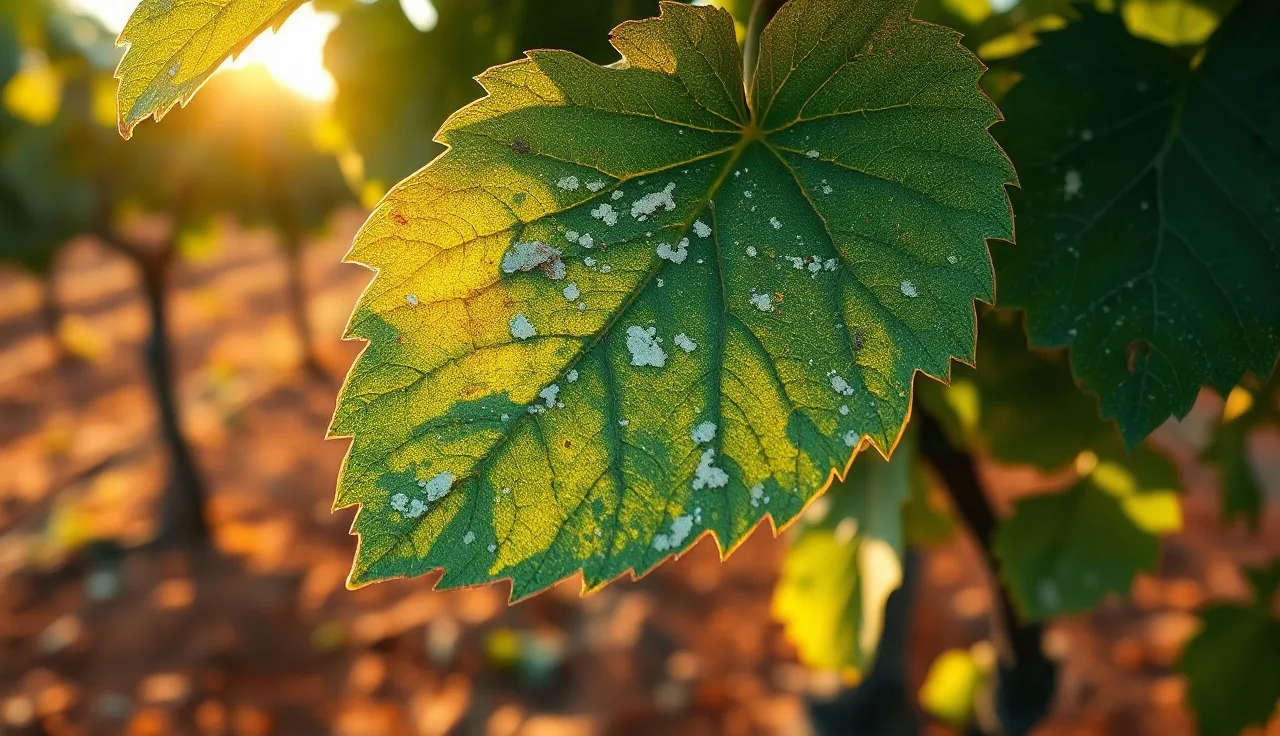
The classic sign is a white to grey powdery coating on shoots, leaf undersides, and green berry skin. On berries it starts as a fine dusty film, then cracks the skin, and secondary rots move in behind it. Infected shoot tips look chlorotic and twisted early in the season, easy to miss until you're hunting for it.
The fungus overwinters as chasmothecia (sexual fruiting bodies) tucked in bark crevices and as mycelium in dormant buds. The first spring ascospore release, which starts primary infection, kicks off when soils hit around 10 C, right around early budbreak. Cornell University's grape IPM guidelines put the critical protection window from 50% budbreak through four weeks past bloom, because berries are most vulnerable before they build enough sugar to shrug off infection [3].
Here's the trap. Stellenbosch, Paarl, and Robertson get warm, dry weather that people file under low disease pressure. Wrong. Powdery mildew likes warm days (25 to 30 C), mild nights, and shade from a thick canopy. It does not need free water to germinate. Wet season or dry, weak canopy management gives you powdery mildew.
Sulfur protectants applied every 10 to 14 days through the critical window are still the backbone of South African programs. When resistance pressure climbs, growers rotate into DMI fungicides (triazoles) or strobilurins. But QoI (strobilurin) resistance is already confirmed in local E. necator populations, so rotating mode of action isn't a preference. It's the price of keeping any of these chemistries working [4].
What is downy mildew and when is it a problem in South African vineyards?
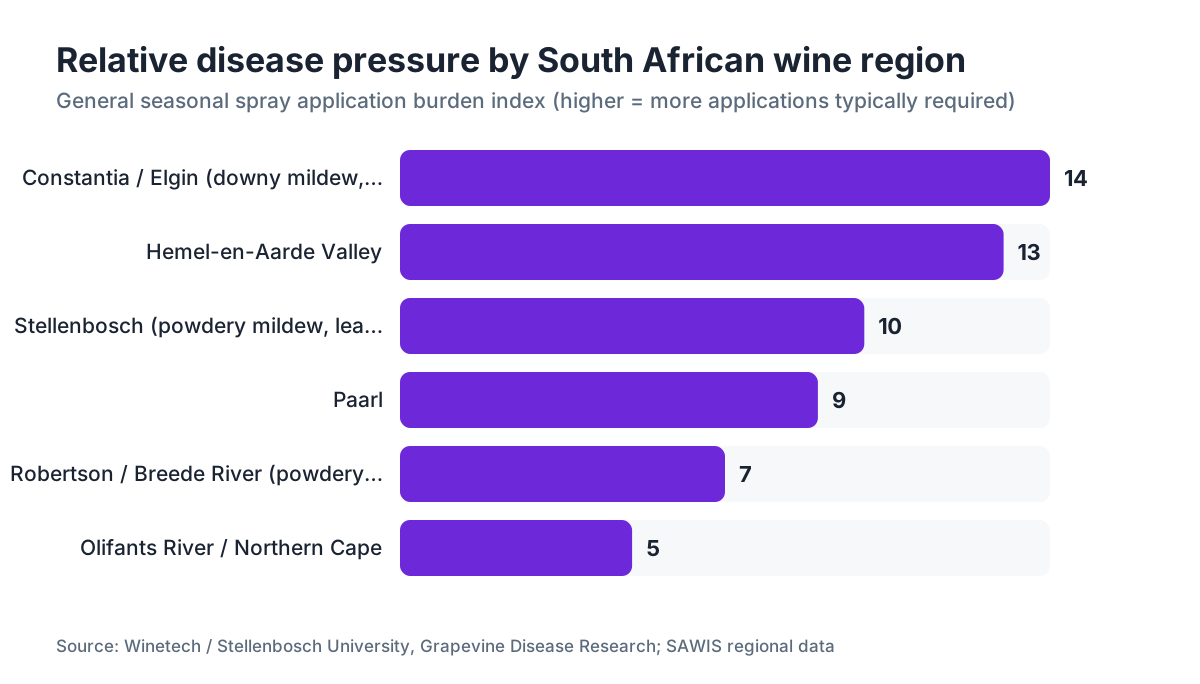
Downy mildew (Plasmopara viticola) plays a completely different game from powdery mildew. It's an oomycete, not a true fungus, and it needs free moisture plus temperatures between 10 and 30 C to sporulate. In plain terms, it's a bigger threat in the wet coastal ground around Constantia, Elgin, and the Hemel-en-Aarde valley than in Robertson or the Breede River Valley.
Most growers learn the 'oil spot' first, a pale green to yellow lesion on the upper leaf that looks oily when you hold it to the light. Flip the leaf and you find white cottony sporulation underneath. On fruit it causes a grey-brown leather rot of the bunch.
Primary infection starts when oospores in last season's dead leaf litter germinate during a rain event of at least 10mm with temperatures above 10 C. UC Davis extension guidelines describe the widely used '10-10-10 rule' as a first-spray trigger: 10mm rain, 10 C minimum, 10 days after budbreak [5]. South African IPM programs mostly run the same trigger to time the first copper application.
Copper protectants (copper hydroxide, copper oxychloride) are the workhorse for downy mildew in both organic and conventional programs. The EU cap of 1.5 kg metallic copper per hectare per year matters to South African producers selling into EU channels, because of certification and residue implications, so confirm the current limit with your certifier [6].
How serious is Botrytis bunch rot, and which grape varieties are most vulnerable?
Botrytis cinerea is an opportunist. It sits on dead organic matter in nearly every vineyard, waiting for the setup it wants: tight bunches, berries cracked by powdery mildew or rain, high humidity, and a dense canopy that holds moisture. When those line up near veraison and into harvest, Botrytis can wreck 30 to 50% of a block inside a week.
Tightly bunched varieties get hit hardest. Chenin Blanc (South Africa's most planted variety at roughly 17% of the national vineyard [1]), Sauvignon Blanc, and Pinot Noir are all notorious because their bunches pack together. Cabernet Sauvignon's looser clusters get more air, so pressure there usually runs lower.
Control is part chemistry, part culture. Leaf removal in the bunch zone, done right around fruit set, drops humidity around the clusters and is probably the single most cost-effective Botrytis practice you have. Fungicides in FRAC Group 7 (SDHI), Group 11 (strobilurin), and Group 17 (phenylpyrroles like fludioxonil) work, but Botrytis builds resistance fast, so rotation isn't optional. Washington State University Extension treats rotating fungicide groups and capping any single mode of action at two applications per season as standard resistance management [7].
For table grapes going to the EU, harvest-timing Botrytis sprays carry residue and tolerance consequences. The Maximum Residue Levels set under EU Regulation 396/2005 apply to all imported produce, and a non-compliant shipment gets turned away at the border [6].
What trunk diseases affect South African grapevines and how do they spread?
The trunk disease complex is the long game. Eutypa dieback (Eutypa lata), Botryosphaeria dieback (from several Botryosphaeriaceae species), and Esca (a complex involving Phaeomoniella chlamydospora and Phaeoacremonium species) all get in through pruning wounds. Once they're in the wood, you don't cure them. You cut them out or you rogue the vine.
Eutypa shows as stunted 'wedge-wood' shoot growth in spring, where only one or two buds near the cordon tip push out vigorously. Cut the cordon and you find a V-shaped necrotic wedge in the cross-section. Botryosphaeria causes dark internal wood staining and cankers, often with gummosis at pruning wounds. Esca throws a tiger-stripe leaf pattern (interveinal chlorosis and necrosis) and, in the acute 'apoplexy' form, can drop a whole vine in one season.
Stellenbosch University, which has done more work on these pathogens in a South African context than anyone else, has confirmed Botryosphaeriaceae species as aggressive colonizers in warm, dry conditions, spreading through airborne conidia released after rain [4].
Pruning wound protection is your main defense. That means either painting cuts with a registered wound protectant (usually a trichoderma-based biological or a systemic fungicide paste) or double pruning: a long cane cut in winter that you shorten to the final spur in early spring, once wound susceptibility has dropped. Eutypa studies put maximum wound susceptibility in the first two weeks after pruning, with infection risk falling off sharply after six weeks [4].
When a block shows real trunk disease, the honest talk is about replant economics. A vine with severe Eutypa might yield 30 to 50% of a healthy vine for three to five years and then die. Run the replacement-versus-continuation numbers early. Watching a block slide is the expensive option.
How widespread is grapevine leafroll virus in South Africa, and what does it do to yield?
Grapevine leafroll-associated virus, mostly GLRaV-3, is the dominant viral disease in South African vineyards. Winetech-funded research has found infection above 60% in some older commercial blocks [2]. That's not an edge case. That's industry scale.
Symptoms show up in late summer and autumn. In red varieties, leaves roll down at the margins and turn red while the veins stay green. In whites, the interveinal areas go yellow instead of red. The pattern is distinct, but it's easy to confuse with potassium deficiency or normal autumn senescence if you catch it late.
The virus slows sugar accumulation in the berries by disrupting phloem function. Harvest gets delayed, potential alcohol drops, and quality suffers. South African studies have documented Brix reductions of 2 to 4 degrees in severely infected vines against virus-free vines of the same variety in the same block [2]. Chasing 24 Brix for a Cabernet red and losing 3 degrees means either hanging fruit longer (disease and weather risk) or picking underripe (a quality hit). Neither is fun.
Spread runs mainly through the vine mealybug (Planococcus ficus), which is established across the Western Cape. Controlling that vector isn't optional if you want to slow leafroll in a block. Monitor mealybug from October, time systemic insecticides (neonicotinoids like imidacloprid, or spirotetramat for systemic coverage) to crawler emergence, and stay on it, because the virus moves fast once a mealybug population takes off.
The only long-term fix is planting certified virus-free material on virus-free rootstocks from certified nurseries in the national vine improvement scheme. No spray cures an infected vine.
What other viral and bacterial diseases do South African growers need to know about?
Past leafroll, a handful of other pathogens show up often enough to earn attention.
Grapevine fanleaf virus (GFLV), carried by the dagger nematode Xiphinema index, causes fan-shaped distorted leaves, shortened internodes, and double nodes. It cuts yield and vine longevity, and because the nematode lingers in soil for years after vine removal, replants on infested ground get reinfected. Soil fumigation before replanting (where registered and permitted) is the main preventive lever, though fumigant access and environmental rules keep shifting.
Grapevine corky bark, the rugose wood complex, and fleck do less economic damage in most South African regions, but they still turn up in older blocks with bad sourcing history. All of them are reason enough to plant only certified material from the ARC Infruitec-Nietvoorbij vine improvement program [8].
Pierce's Disease (Xylella fastidiosa), which has hammered California vineyards and threatens European viticulture, is not established in South Africa but stays on the regulator's surveillance radar. If you import plant material, that's one reason the permitting is strict.
Agrobacterium vitis, the bacterium behind crown gall, throws rough warty galls at the crown and graft union, usually after winter freeze injury to wounded tissue. South Africa's mild winters keep it less common than in cold-climate regions, but it does appear after hailstorms that open wounds.
What does an effective integrated disease management program look like for South African conditions?
The word 'integrated' gets tossed around loosely. In a South African vineyard it means combining cultural practices, genetic resistance (variety and rootstock choice), biologicals, and chemistry so disease pressure stays under economic thresholds while you manage resistance and keep records that hold up for export audits.
Canopy management is the base layer. A Vertical Shoot Positioning (VSP) trellis with sensible shoot spacing (roughly 10 to 15 shoots per meter of canopy) moves air, and moving air slows Botrytis and downy mildew. Boring advice. It also pays the most reliable dividends.
Most successful Western Cape fungicide schedules anchor on four windows:
- Pre-bloom to fruit set for powdery mildew (peak susceptibility)
- Post-bloom for Botrytis (start once flower debris gets trapped in the bunch)
- Veraison through harvest for Botrytis and downy mildew (if late rains arrive)
- Dormant and post-pruning for trunk diseases (wound protectants)
Resistance management means rotating FRAC (Fungicide Resistance Action Committee) groups inside a single season. Never run QoI (Group 11) chemistry twice in a row against Botrytis or powdery mildew. With QoI-resistant powdery mildew confirmed in South Africa [4], a second Group 11 spray isn't just wasted money. It's actively breeding harder resistance.
Spray records are where small operations tend to fall apart. Export certification under WIETA, the IPW (Integrated Production of Wine) scheme, and any GlobalG.A.P. audit all demand documented records: product name, active ingredient, rate, date, operator, and PHI (pre-harvest interval) compliance [9]. Paper works. Digital records just audit faster and pull cleaner two years later when a buyer wants traceability.
This is the point in season planning where a tool like VitiScribe earns its keep. It's built around spray records and field operations logging, so your PHI tracking and active ingredient history stay searchable instead of buried in a binder.
What are the EPA Worker Protection Standard requirements relevant to South African export operations?
South Africa's own pesticide law sits under the Fertilizers, Farm Feeds, Agricultural Remedies and Stock Remedies Act (Act 36 of 1947), administered by the Department of Agriculture, Land Reform and Rural Development (DALRRD) [10]. But producers supplying US importers, or working under US-linked certifications, need some grasp of the EPA Worker Protection Standard (WPS).
The EPA WPS (40 CFR Part 170), revised in 2015, sets rules for pesticide safety training, restricted-entry intervals (REIs), personal protective equipment, and emergency assistance for farm workers [11]. Whether it applies directly to a South African operation depends on the export market and any third-party audit scheme in play. GlobalG.A.P., for one, benchmarks worker protection requirements that line up broadly with WPS principles even outside the US.
The WPS rule states that "agricultural employers must provide specific information to workers and handlers before they enter a pesticide-treated area" and requires REI information posted at a central spot workers can reach [11]. South African IPW-certified estates run functionally equivalent rules under the IPW code of practice, but if you export to the US directly, confirm your buyer's exact expectations.
The practical list is short: post REI information, hand out the right PPE, document training, and log who entered treated areas and when. Good practice no matter which framework technically governs you.
How do South Africa's wine regions differ in disease pressure, and which regions face the worst challenges?
Disease pressure tracks rainfall, humidity, and temperature far more than provincial lines. The patterns are clear.
Constantia, Elgin, and the Hemel-en-Aarde Valley get the most rain (700 to 900mm a year) and the strongest Atlantic influence. Downy mildew and Botrytis pressure here is the highest in the country. Growers run more sprays, often 10 to 14 downy mildew applications in a bad season.
Stellenbosch and Paarl sit in the middle. Warm and dry enough to cut downy mildew risk, not dry enough to escape powdery mildew. Leafroll and the vine mealybug vector are well established across both, thanks to long vine history and a legacy of planting uncertified material.
Robertson and the Breede River Valley run drier (under 300mm across the vineyard season), so most effort goes to powdery mildew and trunk diseases. Breede River irrigation water can carry Phytophthora species into root zones under flood irrigation, though drip has cut that risk a lot.
The Olifants River and Northern Cape are the driest regions with the lowest overall pressure. Powdery mildew still needs active management there, and trunk diseases pile up over time regardless of climate.
For leafroll spread through mealybug, though, every region is exposed wherever Planococcus ficus has established, which is most of the Western Cape.
How do you track spray records and stay compliant with South Africa's IPW and export schemes?
South Africa's Integrated Production of Wine (IPW) scheme, run by the Wine and Spirit Board, requires member cellars and grape producers to keep production records covering every chemical application during the season [9]. This isn't optional for anyone who wants the sustainability seal on the back label.
A compliant spray record has to capture, at minimum: date and time, product name, active ingredient and FRAC or IRAC code, rate per hectare, total volume, target pest or disease, PHI at application, operator name, and weather (wind speed and direction are increasingly required under WPS-aligned schemes). That's a lot of fields, and handwritten spray books turn into a mess fast, especially during the pre-harvest stretch when you're running multiple applications across different blocks.
For EU export, meeting MRL limits under EU Regulation 396/2005 means proving more than what you sprayed. You have to show you held the registered rate and PHI [6]. If a shipment tests over the EU MRL for an active ingredient, accurate records are the only way to trace what happened and dodge an export suspension.
For producers supplying retailers that require GlobalG.A.P. certification, traceability extends to lot-level records linking field sprays to the final product [12].
Software makes audits survivable. Paper binders won't vanish from South African viticulture overnight, but once you're past three blocks and multiple operators, digital records are simply more reliable. VitiScribe was built for exactly this workflow, keeping spray records, block maps, and PHI calendars in one place you can export for an auditor or a buyer's compliance team.
For broader vineyard operations background, the vineyard category on this site covers more record-keeping and field topics relevant to South African and other growers.
What certified plant material and vine improvement resources are available to South African growers?
The single most effective long-term disease decision a South African grower makes is choosing certified planting material. Virus-free, clonally selected vines from an accredited nursery won't guarantee a disease-free vineyard forever, but they give you a clean start, and they tell you that any virus you later find came from outside rather than being baked in on day one.
The ARC Infruitec-Nietvoorbij grapevine improvement program in Stellenbosch holds the national nuclear plant material collection and supplies mother block material to accredited nurseries [8]. The scheme runs under DALRRD certification and tests mother vines for leafroll, fanleaf, rugose wood, and other graft-transmitted pathogens.
Buying from a nursery in the scheme still won't guarantee the grafted vine in your hand is virus-free if handling or secondary indexing was careless, but it's the minimum standard worth demanding. Ask for the batch's certification documentation. Any reputable nursery hands it over without a fuss.
Rootstock choice matters for soil-borne pathogens too. Xiphinema index populations carrying fanleaf are suppressed (not eliminated) by nematode-resistant rootstocks such as 1616C and Harmony, though field resistance varies and depends on climate. UC Davis Cooperative Extension has done rootstock-nematode work that's useful background even when you're adapting it to South African ground [5].
Frequently asked questions
What is the most common grapevine disease in South Africa?
Grapevine leafroll-associated virus (mainly GLRaV-3) is the most widespread, with infection above 60% in some older blocks. Among fungal diseases, powdery mildew (Erysiphe necator) hits every wine-growing region every season and causes the most consistent annual yield loss when spray programs slip.
How do I tell powdery mildew and downy mildew apart on grapevines?
Powdery mildew makes a white powdery coating on the upper leaf and green tissue, and it doesn't need free water to spread. Downy mildew shows oil-spot lesions on the upper leaf with white cottony sporulation underneath, and it needs rain or heavy dew to germinate. Different pathogens, different chemistry, different timing.
Can grapevine trunk diseases be cured once established?
No. Once Eutypa lata or Botryosphaeria species colonize the wood, there's no curative spray. Options are surgical pruning to remove infected cordons (if you catch it early), double pruning to cut new wound infections, and full vine replacement when damage is bad. Wound protection at pruning does most of the real work.
How does grapevine leafroll virus spread in a vineyard?
The main vector in South Africa is the vine mealybug (Planococcus ficus), which picks up the virus feeding on an infected vine and passes it to healthy ones. Spread jumps once mealybug populations build. Controlling that population, plus removing infected vines, is the only way to slow leafroll in an established block.
What spray intervals should I use for powdery mildew in the Western Cape?
Most Western Cape programs run sulfur or DMI applications every 10 to 14 days from 50% budbreak through fruit set, then every 14 days to bunch closure depending on weather and canopy. In warm, shaded canopies the 10-day interval fits better. After bunch closure, berry infection risk drops sharply but shoots can still get infected.
Is Botrytis bunch rot worse in some South African wine regions than others?
Yes. Coastal areas with higher rain and humidity, especially Constantia, Elgin, and the Hemel-en-Aarde Valley, get the worst Botrytis pressure. Tight-clustered varieties (Chenin Blanc, Pinot Noir, Sauvignon Blanc) carry the most risk. Drier inland regions like Robertson see less pressure but can still get hammered in a wet harvest.
What records do I need to keep for IPW certification in South Africa?
The IPW scheme requires documentation of all chemical inputs: product name, active ingredient, rate, date, target pest, operator, and PHI compliance. Irrigation, fertilizer, and yield records are also required. Records must be retained and available for audit by the Wine and Spirit Board. Digital records are accepted and usually easier to produce at audit.
Does South Africa have Pierce's Disease in vineyards?
No. Pierce's Disease (caused by Xylella fastidiosa) is not established in South Africa. It stays a biosecurity concern and sits on the regulator's surveillance list. Strict import permitting for plant material is partly there to keep it out. Anyone importing vines or budwood should use official channels to avoid bringing in new pathogens.
What fungicide resistance problems exist in South African vineyards?
QoI (strobilurin, FRAC Group 11) resistance is confirmed in local Erysiphe necator (powdery mildew) populations. Botrytis cinerea builds resistance quickly across most chemistry classes. Best practice is rotating FRAC groups within one season and holding any single group to no more than two applications per season, following FRAC resistance management guidelines.
What certified planting material options exist for South African grapevine growers?
The ARC Infruitec-Nietvoorbij grapevine improvement program holds the national nuclear vine collection and supplies certified mother block material to accredited nurseries. Buying from a scheme nursery gets you clonal, virus-tested material. Always ask for batch certification documentation before planting, and confirm the nursery's accreditation is current.
How much yield loss can grapevine leafroll virus cause?
South African research documents Brix reductions of 2 to 4 degrees in severely infected vines versus virus-free vines of the same variety in the same block. Yield mass losses vary by variety and severity, but Winetech-funded studies report losses in the 20 to 40% range for heavily infected blocks.
What is the Eutypa dieback wood symptom I should look for when pruning?
Cross-cut a cordon with Eutypa and you see a V-shaped or wedge-shaped zone of dark brown necrotic wood in the section. Above ground, look for stunted shoot growth from one side of the vine in spring, with small, chlorotic, distorted leaves on affected shoots while the rest of the vine leafs out normally.
Can copper fungicides still be used for downy mildew on South African vineyards?
Yes. Copper fungicides (copper hydroxide, copper oxychloride) stay registered and widely used for downy mildew in South Africa. If you export to the EU under organic or conventional certification, note the EU copper limit of 1.5 kg metallic copper per hectare per year under current regulation. Check your certifier's current requirements.
What is the 10-10-10 rule for downy mildew spray timing?
The 10-10-10 rule is a common first-spray trigger: apply a downy mildew protectant when you have at least 10mm of rain, temperatures above 10 C, and vines at least 10 days past budbreak. All three have to hit together. It's a field heuristic built on the infection requirements of Plasmopara viticola.
Sources
- Winetech / Stellenbosch University, Grapevine Leafroll Research Program: Grapevine leafroll-associated virus (GLRaV-3) infection rates above 60% found in some older commercial South African blocks; Brix reductions of 2 to 4 degrees documented in infected vines.
- Cornell University Cooperative Extension, New York State IPM Program, Grapes: The window from 50% budbreak through four weeks post-bloom is identified as the critical protection period for powdery mildew on grapevines.
- Stellenbosch University, Department of Plant Pathology, Grapevine Trunk Disease and Fungicide Resistance Research: QoI (strobilurin) resistance confirmed in South African Erysiphe necator populations; Botryosphaeriaceae species identified as aggressive trunk disease colonizers under warm, dry conditions.
- UC Davis Cooperative Extension, Grape Pest Management Guidelines: The 10-10-10 rule (10mm rain, 10°C, 10 days post-budbreak) described as a downy mildew first-spray trigger; rootstock-nematode resistance interactions documented.
- European Commission, EU Regulation 396/2005 on Maximum Residue Levels: EU MRL requirements under Regulation 396/2005 apply to all grape imports; copper limit for organic use set at 1.5 kg metallic copper per hectare per year under current EU regulations.
- Washington State University Extension, Grape Disease Management: Rotating fungicide FRAC groups and avoiding more than two applications per season of any single mode of action is standard Botrytis resistance management practice.
- ARC Infruitec-Nietvoorbij, Grapevine Improvement Program: ARC Infruitec-Nietvoorbij maintains the South African national nuclear vine collection and tests mother vines for leafroll, fanleaf, rugose wood, and other graft-transmitted pathogens.
- US EPA, Worker Protection Standard (40 CFR Part 170): The EPA WPS requires agricultural employers to provide pesticide safety information to workers before they enter treated areas and to post REI information at a central location.
- GlobalG.A.P., Integrated Farm Assurance Standard for Fruit and Vegetables: GlobalG.A.P. certification requires lot-level traceability linking field spray records to the final product for export compliance.
- FRAC (Fungicide Resistance Action Committee), Mode of Action Classification: FRAC classifies fungicide modes of action and publishes resistance management guidelines; QoI fungicides are FRAC Group 11.
Last updated 2026-07-09