Grapevine diseases in Australia: a grower's field guide

TL;DR
- Australian vineyards fight powdery mildew, downy mildew, botrytis bunch rot, and Eutypa dieback, plus viral threats like leafroll and grapevine fanleaf.
- Trunk diseases alone cost the industry tens of millions of dollars a year in lost production.
- Correct identification, spray timing, and pruning hygiene are the core defences.
- This guide covers symptoms, risk periods, and management for every major pathogen.
What diseases most commonly affect grapevines in Australia?
Australian vineyards run from the wet, humid Hunter Valley to dry, continental Coonawarra, and that spread means growers face a long cast of pathogens. No single disease dominates everywhere. A short list, though, accounts for most of the money lost.
Powdery mildew (Erysiphe necator, formerly Uncinula necator) is the number-one fungal constraint in nearly every Australian wine region. Downy mildew (Plasmopara viticola) follows close behind in cooler, wetter areas. Botrytis bunch rot (Botrytis cinerea) is the big threat close to harvest. Among wood diseases, Eutypa dieback (Eutypa lata) and the Botryosphaeria dieback complex cause the most long-term vine loss. Petri disease and black-foot kill young vines in the nursery and the early establishment years. Crown gall (Agrobacterium vitis) turns up wherever frost cracks the bark.
Viral diseases round out the picture. Grapevine leafroll-associated viruses (GLRaVs) cut berry sugar accumulation and push ripening back two to three weeks, a production hit that compounds over the life of a block [1]. Grapevine fanleaf virus (GFLV), carried by the dagger nematode Xiphinema index, causes yield losses of 20 to 80 percent in infected vines and has no commercial cure once it takes hold [2].
Australia has one big biosecurity advantage. Phylloxera (Daktulosphaira vitifoliae) is still absent from most wine regions. South Australia, Western Australia, and parts of other states remain phylloxera-free under state legislation. The risk of introduction is real, and that is exactly why movement restrictions on plant material and soil exist.
How does powdery mildew spread and when do you spray for it in Australia?
Powdery mildew overwinters in dormant buds and on bark as chasmothecia (cleistothecia). Primary infections start in spring when temperatures sit between 10°C and 32°C and shoots reach the 1 to 3 cm stage. Here is the trap: unlike most fungi, powdery mildew does not need leaf wetness to germinate, and low humidity actually favours it over rain. A dry spring can still be a high-pressure powdery mildew spring [3].
The highest-risk window runs from budburst through to six weeks after flowering. Berry susceptibility peaks just after capfall and drops off sharply once berries reach 6 to 8°Brix. Infections after that threshold rarely cause commercial damage, though they will show at veraison.
Most Australian spray programs use contact sulfur or potassium bicarbonate as the backbone for early sprays, then rotate in sterol inhibitor (DMI) or SDHI fungicides from flowering to protect the bunch. Wine Australia's guidelines and state department resources (the South Australian Research and Development Institute, SARDI, in particular) recommend rotating fungicide groups to manage resistance, which is already documented in some Australian Erysiphe necator populations for certain DMI chemistries [3].
Spray intervals matter more than calendar dates. A degree-day model built for Australian conditions (the UC Davis powdery mildew risk model is also widely used by Australian consultants [4]) predicts when 7-day infection periods stack up. Growers who run these models can often cut two or three spray applications a season without losing disease control. That is real money in a high-cost vineyard.
What are the symptoms and risk factors for downy mildew in Australian vineyards?
Downy mildew (Plasmopara viticola) needs free water and warm temperatures, so it is mostly a problem in Australia's higher-rainfall regions: the Hunter Valley, Yarra Valley, Mornington Peninsula, McLaren Vale in wet years, and Margaret River. Dry country like the Barossa floor sees it rarely.
The classic leaf symptom is the 'oil spot': a yellow-green, oily-looking lesion on the upper surface, with white downy sporulation underneath in humid conditions. On bunches, the fungus kills individual berries (the 'grey rot' stage in cool weather) or collapses the whole bunch. Shoot tips infected early show the 'shepherd's crook'.
The 10-10-10 rule gives a simple trigger for the first spray: 10 mm of rain within 24 to 48 hours, temperatures above 10°C, and shoots longer than 10 cm. Once primary infection is established, sporulation cycles repeat roughly every 5 to 7 days in warm, wet weather. The Australian Wine Research Institute (AWRI) runs a downy mildew risk calculator that pulls in local weather station data, and several commercial crop protection services (Nufarm, Syngenta, and others) run phone-based alerts.
Fungicide groups used against downy mildew in Australia include phosphonate (Group 33), carboxylic acid amides (CAA, Group 40), and phenylamides (Group 4). Resistance to phenylamides is widespread, so never use them alone [5]. Copper-based fungicides stay a permitted option in certified organic systems, though Australian residue standards and the National Residue Survey cap application rates and set pre-harvest intervals.
What is Eutypa dieback and how bad is it in Australian vineyards?
Eutypa dieback comes from the fungus Eutypa lata, and it is one of the most economically destructive diseases in Australian viticulture. The fungus infects pruning wounds, grows slowly through the wood for years, and eventually kills whole canes or cordons. By the time a grower sees obvious symptoms (stunted, cupped leaves, shortened internodes, dead spurs), the fungus may have been in the wood for three to seven years [6].
Australia has clear pressure points. South Australia, New South Wales, and Victoria all carry significant incidence, and surveys in Sunraysia (the Mildura region) have found infection rates above 50 percent in older blocks. The AWRI and the national grapevine trunk disease project, coordinated through the University of Adelaide, have documented losses across major regions.
Spore release from infected wood happens mainly during and after rain, especially through winter and early-spring pruning. Wounds are most vulnerable in the first few hours after the cut. The management is simple but discipline-dependent. Prune in dry conditions where you can, and apply a wound protectant (registered thiophanate-methyl products, or biological agents like Trichoderma species where registered) within hours of cutting [6].
Growers routinely underestimate Eutypa because vines look fine for years. A block that tests clean at age five can show widespread decline by age twelve. Once a cordon is infected, the only cure is to cut back well below the infected wood, retrain from a sucker, and accept several lean years from that vine.
How do Australian grapevine trunk diseases compare to those in California?
Australia and California share the same core complex of grapevine trunk diseases, and that makes sense: many Australian regions were planted with vine material from Europe and California, and the pathogens came along for the ride. Eutypa lata, the Botryosphaeriaceae complex (Diplodia seriata, Neofusicoccum parvum, and others), the Esca and Petri disease fungi (Phaeomoniella chlamydospora, Phaeoacremonium minimum), and the black-foot pathogens (Ilyonectria species) are all present in both countries [6][7].
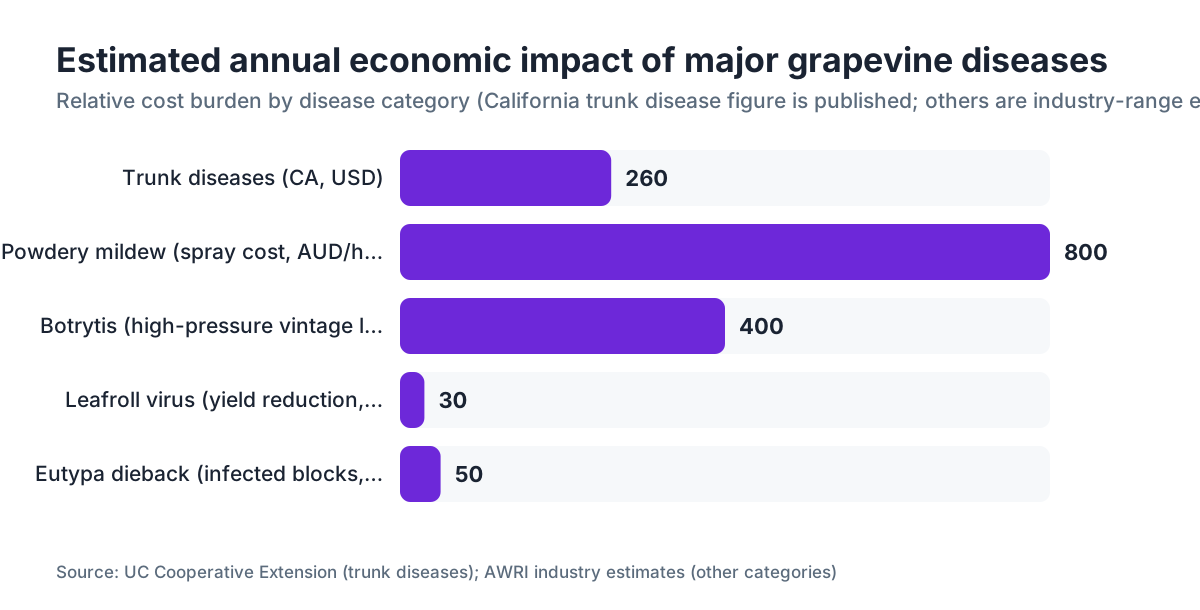
Grapevine trunk diseases cost the California wine grape industry over $260 million USD a year in replanting, lost production, and management, according to a widely cited University of California Cooperative Extension report [7]. Australian figures are harder to pin down, because no national economic study has been published with the same rigour. Industry estimates put annual losses in the tens of millions of AUD across the major regions.
One real difference: California's warmer, drier winters shift the Eutypa infection window slightly compared with Australia's more variable climates. The infection biology is identical, though. UC Davis and Washington State University extension programs have done extensive trunk disease work that Australian researchers actively cite [4][12]. Australia's own research through the AWRI and university programs has added locally relevant data on biological control agents and on the specific Botryosphaeria species turning up in Australian nursery material.
For growers on either side of the Pacific, the advice barely changes. Protect wounds. Source certified clean plant material. Watch young-vine health closely for the first five years.
| Disease | Present in Australia | Present in California | Primary management |
|---|---|---|---|
| Eutypa dieback | Yes (widespread) | Yes (widespread) | Wound protectants, dry pruning |
| Botryosphaeria dieback | Yes (widespread) | Yes (widespread) | Wound protectants, certified material |
| Petri disease / Esca | Yes | Yes | Certified nursery stock, hot-water treatment |
| Black-foot disease | Yes | Yes | Clean nursery stock, soil fumigation (limited) |
| Powdery mildew | Yes | Yes | Sulfur, DMI, SDHI fungicides |
| Downy mildew | Yes (wet regions) | Yes (coastal regions) | Copper, phosphonates, CAAs |
| Botrytis bunch rot | Yes | Yes | Canopy management, fungicides |
| Crown gall | Yes | Yes | Frost protection, clean material |
| Leafroll viruses | Yes | Yes | Roguing, certified material |
| Phylloxera | Limited regions | Present | Rootstocks, quarantine |
What is botrytis bunch rot and how do you manage it before harvest?
Botrytis cinerea is everywhere. The fungus is already in every vineyard, living on dead plant tissue, and it only turns into a problem when the bunch microclimate goes humid and warm (18°C to 23°C is the sweet spot for infection) at or near ripeness. Tight-bunched varieties like Chardonnay, Pinot Noir, Riesling, and Semillon are far more vulnerable than loose-bunched ones.
The stakes climb fast near harvest. In a wet vintage, botrytis can wipe out 10 to 40 percent of a Chardonnay crop within a week once bunch infection starts to spread. Even at low levels, infected berries throw off-flavours (geosmin, trichloroanisole precursors, laccase activity) that taint the whole ferment.
Canopy management is the best money you'll spend. Bunch-zone leaf removal, done at or shortly after flowering, opens up spray penetration, drops humidity, and cuts infection pressure more reliably than any spray program on its own. Research at the AWRI and the University of Adelaide has repeatedly shown that bunch-zone leaf removal at flowering reduces botrytis incidence by 30 to 60 percent in high-pressure seasons [8].
Fungicide programs hit four windows: flowering, bunch closure, veraison, and pre-harvest. Rotating between fenhexamid, cyprodinil plus fludioxonil (Switch), iprodione (where still registered), and biological agents like Bacillus subtilis or Trichoderma species is standard. Resistance to anilinopyrimidines and dicarboximides is documented in Australian Botrytis populations, so rotation is not optional.
How do grapevine viruses spread in Australia and can they be cured?
Grapevine viruses are permanent. Once a vine is infected, no field treatment removes the virus. That is the one fact that shapes all viral disease management: prevention and certified clean planting material are the only real tools you have.
Grapevine leafroll-associated viruses (GLRaV-1, -2, -3, and others) spread mainly through infected planting material, but GLRaV-3 in particular can move vine-to-vine through mealybug vectors (Pseudococcidae). In Australian vineyards, Planococcus ficus (vine mealybug) and Pseudococcus longispinus (longtailed mealybug) are the documented vectors [1]. Leafroll makes leaves roll downward and redden (in red varieties) or yellow (in whites) in autumn, and cuts berry Brix accumulation by two to four degrees, which hits wine quality and alcohol potential directly.
Grapevine fanleaf virus (GFLV) is carried by the soil nematode Xiphinema index, which can survive in soil for 20 or more years after infected vines come out. GFLV causes yellow mosaic, vein banding, leaf deformation, and poor berry set. Once a site carries GFLV and Xiphinema, replanting clean vines without treating the soil usually ends in re-infection within a few years [2].
Australia's certified vine improvement programs, coordinated through the national Grapevine Improvement Australia (GIA) scheme, supply pathogen-tested foundation material. Starting with GIA-certified or state-equivalent certified material is the foundation of any sound program. For leafroll, roguing (pulling infected vines) plus mealybug control can slow spread within a block, but only if neighbouring blocks are managed too.
What are the biosecurity rules for plant material movement in Australia?
Australia's grapevine biosecurity framework has three layers: Commonwealth, state, and regional. The Department of Agriculture, Fisheries and Forestry (DAFF) handles import permits for vine material, and all imported vine material must go through quarantine and post-entry quarantine testing before release [9].
At the state level, phylloxera drives most of the movement restrictions. Victoria, South Australia, and Western Australia all run Phylloxera Exclusion Zones or Phylloxera Risk Zones under their plant health legislation. Moving vine material, grape bins, picking equipment, or soil between zones without proper disinfestation is a regulatory offence. The Phylloxera and Grape Industry Board of South Australia (PGIBSA) and equivalent bodies in other states publish current zone maps and movement rules.
Biosecurity Queensland, NSW DPI, and Agriculture Victoria all publish grapevine disease alerts and management guides. Report unusual symptoms to your state agriculture department, because some pathogens, if newly introduced, can trigger an emergency response.
The industry's voluntary National Winegrape Biosecurity Management Strategy pushes vineyard-level hygiene: clean footwear and equipment at property boundaries, keep soil and plant material of unknown origin off your blocks, and record every plant material purchase and its source.
Record-keeping is more than good practice now. It is expected as part of showing due diligence in certification and export. Tools like VitiScribe let vineyard operators log spray records, plant material sourcing, and disease observations in one place, which matters the moment an auditor or biosecurity officer asks for documentation.
What does the EPA Worker Protection Standard require for pesticide use in Australian-exported vineyards?
This is where Australian growers sometimes get caught. Export into the United States pulls US EPA Worker Protection Standard (WPS) compliance into the picture if your products sell into those supply chains or your winery is chasing US market certification.
The US EPA Worker Protection Standard [10] requires that workers and handlers are protected during pesticide applications, that application-specific information is posted (product, location, time, re-entry interval), and that the label's personal protective equipment (PPE) requirements are followed. For Australian producers, the more direct layer is the Australian Pesticides and Veterinary Medicines Authority (APVMA), which regulates all pesticide use in Australia. Every registered product carries a label that is a legal document, and applying a product off-label (wrong rate, wrong crop, wrong use pattern) is an offence under state and territory agricultural and veterinary chemicals legislation.
For spray records, Australian export certifications (organic certification, plus retailer codes of practice like SSCM or GLOBALG.A.P.) want dated records of product name, registration number, rate, target disease, block or vine row, operator name, re-entry interval, and weather conditions. Keeping those records complete from the first spray of the season is far easier than reconstructing them the night before an audit.
Wine Australia's export framework requires that wineries exporting to most international markets can produce residue compliance records [13]. In practice, that means vineyard-level spray records have to be traceable to the fruit in each lot.
How do you set up a vineyard disease monitoring program?
A monitoring program does not have to be complex to earn its keep. The point is to catch disease early enough to act, and to build a year-on-year record that helps you predict pressure in future seasons.
Start with fixed monitoring points: ten to fifteen representative vines per block, chosen to include the spots where disease historically hits hardest (low ground, dense canopy, blocks near waterways). Mark them permanently. Walk them every seven to ten days from budburst through harvest, and write down what you see.
For powdery mildew, check shoot tips and the undersides of young leaves. For downy mildew, hold leaves up to the light and look for the oily spot on the upper surface. For trunk diseases, flag vines with stunted growth, dead spurs, or wedge-shaped brown staining in a cross-section cut. For viruses, photograph autumn leaf symptoms and send suspicious vines to a NATA-accredited laboratory (several offer PCR-based virus testing for Australian conditions).
Weather monitoring sits right beside visual scouting. A basic on-site weather station logging temperature, humidity, leaf wetness, and rainfall feeds the disease risk models. The AWRI's online resources and several commercial advisory platforms combine weather station data with validated models for powdery mildew, downy mildew, and botrytis.
Once you have records, patterns start to show. A block that carries powdery mildew pressure before E-L stage 12 in two straight seasons will likely do it again, and you can bake that into your spray calendar. Platforms like VitiScribe let you attach disease notes to specific blocks and pull that history up when you plan next season's program. That is genuinely useful when staff turnover means institutional knowledge would otherwise walk out the door.
Cornell University's integrated pest management resources and Washington State University's extension viticulture pages publish model disease scouting sheets that Australian growers can adapt [12].
What rootstocks and cultural practices reduce disease risk in new plantings?
New plantings hand you the most control over disease starting conditions you will ever have, and most growers leave value on the table in that window.
For trunk diseases, the single highest-value move is sourcing certified, pathogen-tested nursery material. Petri disease and black-foot pathogens can ride in nursery material with no visible symptoms, and planting infected vines starts your block on a 5 to 10-year countdown to wood disease decline. Hot-water treatment of dormant cuttings or bare-root vines at 50°C for 30 minutes cuts inoculum in planting material substantially [6], though it has to be done right, because temperatures above 52°C damage buds.
Rootstock choice shapes crown gall and nematode risk. Rootstocks with Vitis berlandieri or Vitis rupestris parentage (110R, 140Ru, 1103P) hold up better against nematodes than own-rooted vines or Vitis riparia-based rootstocks. On GFLV risk sites, rootstocks give no protection against the virus itself, but they can reduce Xiphinema index feeding damage.
Site drainage matters enormously for black-foot and crown gall. Black-foot (Ilyonectria species) thrives in wet, poorly drained soils, and young vines sitting in waterlogged ground are wide open to it. Mounding, subsoil ripping, and tile drainage are not glamorous, but they cut black-foot incidence hard.
Row orientation and trellis height shape powdery mildew and botrytis pressure through the canopy microclimate. North-south rows get more even light in the Southern Hemisphere, and vertical shoot positioning systems that open up spray penetration and airflow carry less fungal pressure than a sprawling canopy.
What organic and low-chemical management options work for Australian grapevine diseases?
The organic vineyard market is growing in Australia, and plenty of growers now manage without synthetic fungicides. It takes more work, and honest acceptance of higher risk in wet seasons.
For powdery mildew, sulfur is the backbone of organic programs and it works well. Potassium bicarbonate (registered products like Armicarb) gives some post-infection activity. Kaolin clay adds a physical barrier. None of these match a well-timed DMI or SDHI in a high-pressure season, so organic growers in humid regions need tighter spray intervals and harder canopy management.
For downy mildew, copper is the primary organic tool. Australian organic standards (Australian Certified Organic, NASAA) permit copper up to a set maximum rate per hectare per year. There is a genuine problem with copper building up in vineyard soils, and several Australian regions are now seeing elevated soil copper in long-farmed blocks. The AWRI has published guidance on cutting copper use while holding efficacy through better timing and reduced-rate programs.
Biological fungicides based on Bacillus subtilis (Serenade), Trichoderma species, and Bacillus amyloliquefaciens are registered in Australia and fit into an integrated disease program. They work best as protectants in low-pressure conditions, or as part of a rotation, rather than as a standalone program when pressure is high.
For trunk diseases, the Trichoderma-based wound protectants (products like Vinevax) are registered in Australia and have real efficacy data behind them from Australian and international trials. That makes them the organic grower's best option for pruning wound protection [6].
Frequently asked questions
What is the most damaging grapevine disease in Australia by economic impact?
Trunk diseases as a group (Eutypa dieback, Botryosphaeria dieback, Petri disease) probably cause the most cumulative damage, because they shorten productive vine life and force costly replanting. Powdery mildew carries the highest annual spray cost across most regions. Leafroll virus causes silent, compounding yield and quality losses that many growers underestimate until a block is formally tested.
How do I identify Eutypa dieback in my vines?
Look for stunted, cupped leaves with chlorotic margins on a cane shorter than its neighbours in spring. Cut that cane back into old wood and you'll see a wedge-shaped brown-to-grey stain in cross-section. That staining is the fungus advancing through the wood. The affected cane may die back entirely in summer. Spurs that fail to push after budburst are another early sign worth a secateurs cut to confirm.
Can phylloxera spread through vineyard equipment in Australia?
Yes. Phylloxera moves on soil stuck to footwear, machinery, quad bikes, harvester tracks, and grape bins. That is why state-level movement restrictions between phylloxera exclusion and risk zones exist in Victoria, South Australia, and Western Australia. Cleaning and drying equipment before moving between zones is the minimum standard. Some states require formal declarations or inspection.
What is the best spray timing for powdery mildew in Australian vineyards?
The highest-risk period runs from 1-3 cm shoot growth through to six weeks post-capfall, and the first spray of the season is often the most important one. Degree-day models (like the UC Davis powdery mildew risk model, widely used by Australian consultants) time sprays to infection risk rather than the calendar. Intervals of 10 to 14 days are typical with protectants; some systemics stretch to 21 days in low-pressure periods.
How do I know if my grapevines have leafroll virus?
In red varieties, infected vines show downward leaf rolling and intense red colour in the interveinal tissue in late summer and autumn while the veins stay green. In whites, the colour is yellow rather than red. Infected vines also ripen two to three weeks later than healthy neighbours, which shows in Brix readings. Confirm with PCR testing through a NATA-accredited laboratory; visual diagnosis alone is not reliable for certification.
What certified vine material programs exist in Australia?
Grapevine Improvement Australia (GIA) coordinates the national certified vine improvement scheme. Individual states run their own programs (the Vine Improvement Association in South Australia, Vine Health Australia, and others) that produce foundation material tested for the major viruses and trunk disease pathogens. Using GIA-certified or state-certified material is the strongest protection against bringing latent pathogens into a new planting.
Are grapevine trunk diseases the same in Australia as in California?
Largely yes. The same pathogen species drive trunk disease decline in both countries: Eutypa lata, the Botryosphaeriaceae complex, and Petri disease fungi (Phaeomoniella chlamydospora, Phaeoacremonium minimum). University of California Cooperative Extension estimates trunk diseases cost over $260 million USD a year in California alone. Australian losses are less precisely documented but understood to be substantial, and management advice from UC Davis research applies directly in Australian contexts.
How do I manage crown gall in an Australian vineyard?
Crown gall (Agrobacterium vitis) infects vines through wounds, especially frost cracks at the graft union or the base of the trunk. No registered bactericide eliminates it. Management is prevention: use certified clean material, avoid planting in frost-prone low spots, protect trunks from frost injury with winter mounding, and remove and destroy severely galled vines. The bacterium survives in soil, so site history counts.
What spray records do I need to keep for Australian wine grape export compliance?
At minimum: the date, product trade name and APVMA registration number, application rate and volume, target pest or disease, block or row identifier, operator name, weather conditions at application, and the pre-harvest interval. Most export schemes (GLOBALG.A.P., organic certification, and Wine Australia export documentation) require these records to be kept for two to five years and traceable to specific lots of fruit.
Can botrytis bunch rot be managed without fungicides?
Partially. Bunch-zone leaf removal at or shortly after flowering is the single most effective cultural practice, cutting botrytis incidence by 30 to 60 percent in research trials. Variety selection, row orientation, shoot spacing, and avoiding excess nitrogen (which drives dense canopies and thick, crack-prone berry skins) all help. In wet vintages with susceptible varieties, canopy work alone rarely holds without at least a couple of fungicide applications in the critical pre-harvest window.
What is Botryosphaeria dieback and how is it different from Eutypa dieback?
Botryosphaeria dieback comes from several species in the family Botryosphaeriaceae (including Diplodia seriata and Neofusicoccum parvum). It infects pruning wounds and produces cankers and dead-arm symptoms much like Eutypa, but it moves faster and can kill cordons within two to three seasons in warm climates. Infected wood shows brown staining that is often darker and more diffuse than Eutypa's classic wedge. Management is the same: wound protectants and dry-weather pruning.
How do I prevent grapevine disease from spreading between blocks during harvest?
Clean bins and harvest gear between blocks where there is known disease pressure, particularly leafroll blocks where mealybug-contaminated fruit material can carry vectors. For soil-borne threats like Xiphinema nematodes and phylloxera, cleaning soil off machinery wheels and tracks before moving between blocks is the priority. Mark infected blocks clearly so they get harvested last, or with dedicated equipment where you can manage it.
Is esca (grapevine apoplexy) a problem in Australia?
Esca and its foliar symptoms (tiger-stripe leaf discolouration, and sudden vine collapse in hot weather known as apoplexy) are present in Australia, historically at lower incidence than in parts of France and Italy. The same fungi behind Petri disease (Phaeomoniella chlamydospora, Phaeoacremonium minimum) drive early esca development. As Australian vineyards age, esca incidence is expected to climb. There is no registered cure; management centres on clean planting material and wound protection.
Where can I get up-to-date grapevine disease information specific to my Australian region?
The Australian Wine Research Institute (awri.com.au) publishes disease management guides and runs a technical review service. State departments (SARDI in SA, NSW DPI, Agriculture Victoria, DPIRD in WA) publish region-specific alerts. Wine Australia (wineaustralia.com) funds research and publishes grower resources. The AWRI's viticulture notes and the national grapevine trunk disease project reports are good starting points for both common and emerging problems.
Sources
- AWRI, Grapevine leafroll disease technical review: Leafroll viruses reduce berry sugar accumulation and delay ripening by two to three weeks
- Wine Australia, Grapevine virus and nematode research resources: Grapevine fanleaf virus is transmitted by Xiphinema index, causes 20 to 80 percent yield loss, and the nematode persists in soil 20+ years
- SARDI / PIRSA (Primary Industries and Regions SA), Powdery mildew management: Powdery mildew does not require leaf wetness to germinate and resistance to DMI chemistries is documented in Australian Erysiphe necator populations
- AWRI, downy mildew fungicide resistance guidance: Resistance to phenylamide fungicides is widespread in Australian Plasmopara viticola populations
- AWRI, grapevine trunk diseases national research and management: Eutypa lata infects pruning wounds; hot-water treatment of cuttings at 50°C for 30 minutes significantly reduces trunk disease inoculum; Trichoderma-based wound protectants have registered efficacy in Australia
- University of California Cooperative Extension, economic impact of grapevine trunk diseases: Grapevine trunk diseases cost the California wine grape industry over $260 million USD per year in replanting, lost production, and management costs
- AWRI, botrytis bunch rot management research: Bunch-zone leaf removal at flowering reduces botrytis incidence by 30 to 60 percent in high-pressure seasons
- US EPA, Worker Protection Standard for agricultural pesticides: EPA Worker Protection Standard requires workers and handlers are protected during pesticide applications and application-specific information is posted including product, location, time, and re-entry interval
- Washington State University Extension, viticulture and enology: WSU Extension publishes trunk disease and fungal disease management resources applicable to commercial viticulture
- Wine Australia, export documentation and residue compliance: Wine Australia export regulatory framework requires vineyard-level spray records traceable to each fruit lot for international market compliance
Last updated 2026-07-09