Grapevine diseases and treatment: a field guide for vineyard managers
TL;DR
- The six diseases that cost North American growers the most are powdery mildew, downy mildew, Botrytis bunch rot, Pierce's disease, Eutypa dieback, and the Botryosphaeria trunk complex.
- Most respond to timely fungicide sprays, canopy work, and honest records.
- No single product covers all of them.
- Pierce's disease has no cure once a vine tests positive.
What are the most common grapevine diseases?
Six diseases account for most of the money North American vineyards lose to pathogens every year. Powdery mildew (Erysiphe necator) is the most widespread fungal threat, present in nearly every grape-growing region on the continent. Downy mildew (Plasmopara viticola) is just as aggressive in humid climates. Botrytis bunch rot (Botrytis cinerea) shows up at harvest and can wreck a crop in days. Pierce's disease (from the bacterium Xylella fastidiosa) kills vines and has no cure. Eutypa dieback (Eutypa lata) and the Botryosphaeria trunk diseases enter through pruning wounds and kill wood over years, not weeks.
Beyond those six, crown gall (Agrobacterium vitis), black rot (Guignardia bidwellii), and Phomopsis cane and leaf spot fill out the list most extension plant pathologists treat as primary concerns [1][2]. The right program depends on where you farm. In California's Central Valley, Pierce's disease is the thing that ends vineyards. In the Finger Lakes or Virginia, downy mildew pressure is a different animal than anything a Napa grower deals with. Start with your state extension service and build a disease calendar calibrated to your region.
For the wider picture of vineyard operations and where disease pressure sits inside the whole production year, the hub page runs from vine establishment through harvest logistics.
How do you identify powdery mildew on grapevines?
Powdery mildew is the one you see coming. Look for a white-to-gray powdery coating on young shoot tips, leaf undersides, and green berry surfaces. Infected berries stop growing, crack, and split open around the seeds, which hands Botrytis an easy entry point later. A flag shoot, one stunted shoot covered in white felt, is the classic tell that inoculum overwintered inside a bud.
Erysiphe necator spreads by asexual spores (conidia) during dry weather with temperatures between 65 and 90 degrees F. It doesn't need free water to germinate. That's the line that separates it from downy mildew. Relative humidity above 40 percent is plenty [1]. So irrigation scheduling and vine density matter as much as your spray tank. Cornell's New York State IPM Program puts the critical infection window at berry set through four to five weeks post-bloom, after which the berry skin lignifies and mildew can't get in [3].
The UC Davis Department of Plant Pathology backs the UC Powdery Mildew Risk Index, which scores degree-day accumulation from January 1 and sets spray intervals off temperature history instead of calendar days [2]. Running the degree-day model instead of a fixed 14-day schedule cuts two to four sprays a season in most years, per UC field trials.
Here is the number that ends the argument about whether to spray. Untreated blocks lose 30 to 60 percent of the crop to powdery mildew, and off-flavors from infection you can barely see still turn up in the finished wine [1].
What causes downy mildew and how do you treat it?
Downy mildew (Plasmopara viticola) is an oomycete, not a true fungus, so the DMI fungicides that flatten powdery mildew barely touch it. You need products labeled for oomycetes: mancozeb, copper materials, phosphorous acid (fosetyl-Al), mandipropamid, or cymoxanil, among others. Rotate FRAC codes hard. Resistance builds fast in this pathogen.
The primary cycle kicks off when soil-borne oospores germinate after about 0.4 inches of rain at temperatures above 50 degrees F, once shoots hit two to three inches. The old "10-10-10" rule (10 mm shoot growth, 10 mm rain, 10 degrees C nighttime low) is a rough field trigger for the first spray [4]. Sporangia then drive secondary infections all season during wet, cool spells.
Symptoms come in a sequence. Yellow oily spots on the upper leaf surface ("oil spots"), white fluffy sporulation on the underside in humid mornings, and brown shriveled flower clusters. Infected berries turn gray, harden, and mummify.
WSU Extension notes that downy mildew pressure in the Pacific Northwest swings hard by site, with east-of-Cascades vineyards seeing far less than coastal ones [4]. Growers in dry inland regions sometimes skip downy programs entirely in low-rainfall years. That's a defensible call, but only if you're watching inoculum and weather every week.
Copper is the backbone of organic programs. California restricts metallic copper above 6 lbs per acre per year under CDFA guidance, so organic growers have to budget copper across the whole season [2].
How serious is Botrytis bunch rot and when do you spray?
Botrytis cinerea is an opportunist. It lives on dead tissue in the canopy all season, then goes after berries once they turn vulnerable at veraison. Dense canopies, late-season rain, heavy crops, and thin-skinned varieties are the multipliers. In a wet harvest, an unmanaged block can run from clean to 80 percent infected in under a week.
Spray timing follows infection windows, not the calendar. Cornell's Botrytis model flags four application timings: early bloom, post-bloom, pre-bunch closure, and veraison [3]. Most programs hit three of the four depending on weather. Post-veraison sprays often work poorly because the material can't reach into tight clusters, and resistance runs high in populations that have seen repeated fenhexamid or iprodione.
FRAC Group 17 (fenhexamid) and FRAC Group 2 (iprodione, the dicarboximides) carry the highest resistance risk. Rotate them with FRAC Group 7 (SDHIs like boscalid), FRAC Group 11 (strobilurins, though resistance is climbing there too), and FRAC Group 1 (benzimidazoles). Cornell's disease management guide says no more than two applications of any single FRAC group per season [3].
Canopy management is not optional here. Pulling leaves in the fruit zone at or just after bloom cuts Botrytis incidence 40 to 60 percent in research trials, sometimes erasing the need for pre-harvest sprays in a quiet year [3]. That's free disease control, and it improves your coverage on the clusters you do treat.
Variety drives risk more than most growers admit. Pinot Noir, Chardonnay, Riesling, and Gewurztraminer sit high. Cabernet Sauvignon and Syrah, with thicker skins and looser clusters, run lower.
What is Pierce's disease and is there any treatment?
Pierce's disease comes from Xylella fastidiosa, a bacterium that colonizes the xylem and chokes off water and nutrient movement. There is no cure. A vine that tests positive dies, usually within two to five years depending on variety. European Vitis vinifera varieties have essentially no tolerance. American species and some hybrids (Muscadine, Norton) carry resistance genes.
The main California vector is the glassy-winged sharpshooter (Homalodisca vitripennis), a strong flier that carries the pathogen from riparian ground into vineyards fast [6]. In the Southeast and Texas, native sharpshooter species do the moving.
Management targets the vector, not the vine. Imidacloprid soil drenches or foliar insecticides (where labeled and legal) knock back sharpshooter numbers, but the insect's mobility limits how much that helps on its own. Buffer plantings of non-host vegetation and pulling infected vines before they turn into inoculum matter more at the landscape scale [6]. California's Glassy-Winged Sharpshooter program runs monitoring; check current trap data for your area.
The UC Davis Department of Plant Pathology has worked on resistant rootstocks and resistant vinifera through conventional breeding and, lately, gene-editing [2]. USDA ARS has released PD-resistant varieties (Blanc du Bois, Cynthiana) [11], but they don't make the wines most vinifera-trained winemakers want.
In a high-pressure zone, Pierce's disease is the strongest argument there is for regular scouting records. Early detection and fast removal are the only levers that slow spread. Document every suspect vine, every scorched leaf margin, every matchstick petiole, every trap count.
How do trunk diseases like Eutypa dieback and Botryosphaeria spread, and what actually works against them?
Eutypa lata, the cause of Eutypa dieback, enters through pruning wounds bigger than about half an inch across. Spores release during rain from October through April in California, which lines up almost exactly with pruning season. The fungus colonizes the wood and pumps out toxins that reach the current year's growth, giving you stunted shoots, small yellow leaves, and dead spurs years after the wound got infected.
Botryosphaeria species (mainly Diplodia seriata and Neofusicoccum parvum) take the same wound pathway but tend to bring faster decline. Both complexes usually get lumped together in the field as "trunk diseases" or "wood diseases."
Pruning wound protectants are your main tool. UC Davis recommends a registered fungicide (thiophanate-methyl, boscalid, or tebuconazole) or a biocontrol (Trichoderma products such as those with T. atroviride) within 24 hours of a large cut [2]. Timing is the whole game. The wound is most open to infection in the first hours after you make it. Double pruning, where you leave a long spur in winter and make the final cut later in spring when spore loads drop, lowers infection risk a lot in heavy-spore seasons.
Surgery works if you catch it early. Cutting back to clean white wood with no brown staining can buy a vine years of life. Some growers swear by Bordeaux paste (copper sulfate plus hydrated lime) as a wound seal. The data on sealants is mixed, and the UC Davis review lands on fungicide protectants beating sealants in most trials [2].
Once grapevine trunk disease is set into the permanent framework, your only real moves are retraining from a sucker shoot or replanting. Neither is cheap.
What fungicide programs actually work, and how do you build a spray calendar?
A spray calendar with no disease model behind it is just insurance you're buying blind. You over-apply in dry years and get caught short in wet ones. The better setup stacks three inputs: a regional disease model (the UC Powdery Mildew Risk Index or Cornell's NEWA tools), real-time weather from your nearest good station, and a baseline calendar built from your own block's disease history.
For powdery mildew, sulfur is the backbone. Wettable sulfur at 3 to 6 lbs per acre per application, every 7 to 14 days depending on temperature and pressure, is cheap, effective, and has no known resistance risk [1][2]. Don't apply sulfur above 90 degrees F or within two weeks of an oil spray. Phytotoxicity is real. DMI fungicides (myclobutanil, tebuconazole) give kickback activity up to four to five days after infection and earn rotation slots during bloom, when sulfur coverage on open flowers is spotty.
| Disease | Primary FRAC Group | Example AI | Resistance Risk |
|---|---|---|---|
| Powdery mildew | M2 (sulfur) | Sulfur | Low |
| Powdery mildew | 3 (DMI) | Myclobutanil | Moderate |
| Powdery mildew | 11 (QoI/strobilurin) | Azoxystrobin | High in some regions |
| Downy mildew | M1 (copper) | Copper hydroxide | Low |
| Downy mildew | 40 (carboxylic acid amide) | Mandipropamid | Moderate |
| Botrytis | 17 (hydroxyanilide) | Fenhexamid | High |
| Botrytis | 7 (SDHI) | Boscalid | Moderate |
| Eutypa/Botryosphaeria | 1 (benzimidazole) | Thiophanate-methyl | Moderate |
Record every application: date, block, product, EPA registration number, rate, water volume, PHI, and applicator name [9]. That's your compliance backbone. It's also how you reconstruct what worked in a bad disease year and what didn't. Vineyard managers keeping detailed digital spray logs cut their end-of-season program analysis from hours to minutes. VitiScribe was built for exactly this field-to-record workflow, holding your PHI countdowns, REI windows, and application history in one place.
Pre-harvest intervals (PHI) are non-negotiable. Sulfur is typically 0 days on most labels. Tebuconazole is commonly 14 days. Fenhexamid is 7 days. Read the current label every time. PHIs change between registrations.
What are the EPA Worker Protection Standard requirements for spray records in vineyards?
The EPA's revised Worker Protection Standard (WPS), effective January 2, 2017, governs agricultural pesticide use and worker safety for any vineyard that employs workers or handlers [7]. WPS requires you to keep records on restricted-use pesticide applications for two years. Product labels set the restricted entry interval (REI), the time workers must stay out of a treated area after a spray. Those four rules are the core of what an auditor checks.
For vineyards, WPS requires posting treated areas with application information during the REI, central posting of pesticide safety information (label and Safety Data Sheet), and training for workers and handlers before they enter treated areas. Under 40 CFR 170.501, "handlers must be trained before they do any handling activity" [7].
Sulfur runs a 24-hour REI under most labels. Captan carries 24 hours. Some SDHI fungicides run 12-hour REIs. Those are label minimums. You can always set a longer exclusion.
California runs stricter rules through CDPR and the CalPIP portal. Growers there file monthly pesticide use reports (PURs) with their county agricultural commissioner [12]. Other states vary. Check your state department of agriculture.
WSU Extension has a clean summary of WPS obligations for Pacific Northwest grape growers [4]. UC IPM Online covers California specifics [1]. If you're building a spray record system from scratch, call the county ag commissioner first. They'll tell you the exact documentation they audit.
What organic and low-input options actually control grapevine diseases?
Organic disease management is harder, not impossible. The toolbox is narrower and you have to stay ahead of the disease instead of chasing it.
For powdery mildew, sulfur is the workhorse and it's OMRI-listed. Potassium bicarbonate (OMRI-listed) gives some kickback and can fill a DMI rotation slot in an organic program. Kaolin clay (Surround) applied as a barrier before spores arrive has field-trial support from Cornell, though coverage is demanding and it washes off [3]. Neem oil is labeled and used, but the efficacy data in grapes is thinner than in other crops.
For downy mildew, copper is the primary organic tool. Copper hydroxide, copper octanoate, and copper sulfate (Bordeaux mixture) are all OMRI-listed. Watch your copper budget for both compliance and soil health. Copper accumulates in vineyard soils over decades and never leaves.
For Botrytis, Bacillus subtilis products (Serenade, Rhapsody) are registered and OMRI-listed with moderate efficacy. Use them in rotation, not as a sole program. Trichoderma products cover wound protection.
Canopy management is the force multiplier for organic growers. Aggressive shoot positioning, leaf pulling, and cluster thinning drop pressure enough to make a lighter spray program work. Some certified organic vineyards in California hold powdery mildew with five to seven sulfur passes a season, against the 10 to 14 passes typical of conventional programs on high-pressure sites.
How do you scout for grapevine diseases and keep accurate records?
Scouting isn't optional. It's the data that makes every other decision defensible. A minimum program walks every block at least once a week from bud break through post-veraison, and twice a week during the bloom-to-fruit-set window.
For powdery mildew, check flag shoots early (bud break through shoots of 6 to 8 inches), then work the shoot tips, both leaf surfaces, and berries from fruit set on. Count infected shoot tips per 100 shoots. One percent infection is the action threshold in most commercial programs [1].
For downy mildew, look at leaf undersides on dewy mornings. Oil spots on the upper surface confirm it. Shake a symptomatic leaf over dark paper. White sporulation means the disease is moving.
For trunk diseases, do a close pass during dormant pruning. Cut cross-sections of suspect wood with your shears. Brown staining in the xylem is diagnostic for Eutypa and Botryosphaeria. Log each symptomatic vine by block and row.
Your spray records need the date and time of application, the field or block, the crop and growth stage, product name and EPA registration number, rate per acre, total amount applied, REI, PHI, and the applicator's name and certification number where it applies. Keep weather at application time too. It matters for drift liability and for figuring out why a spray did or didn't hold.
Digital records remove the friction that creates gaps. A paper log left in a truck cab never gets transcribed. A system that captures spray data at the point of application, syncs to a compliance-ready format, and generates block-level summaries at season's end is the practical answer for anyone farming more than a few dozen acres. VitiScribe's spray log module does exactly that, tracking PHI countdowns and REI windows by block in real time.
For how well-run vineyards at destination properties handle field work alongside a tasting room, Gervasi Vineyard and Allegretto Vineyard Resort are useful examples of operations balancing production rigor with visitors.
Which grapevine diseases are regionalized and how does your location change the threat?
Disease pressure is a function of climate, the varieties you planted, and your region's inoculum history. What kills vines in Temecula is not what kills them in the Hudson Valley.
California coast and mountains: powdery mildew everywhere. Pierce's disease is existential in Southern California and the San Joaquin Valley south of Fresno, and less of a factor in Napa and Sonoma. Botrytis runs high in marine-influenced areas (Carneros, Santa Maria Valley, Sonoma Coast) because of fog and late humidity. Trunk diseases are a growing problem statewide as vines age in the older AVAs. Paso Robles wineries and South Coast Winery operations face meaningfully different disease profiles despite both sitting in California.
Pacific Northwest: downy mildew matters west of the Cascades; east-side sites see little in most years. Powdery mildew is universal. Pierce's disease is limited to the southern margins of the Willamette Valley right now [4]. WSU Extension runs region-specific forecasting for Washington and Oregon.
East Coast and Appalachia: downy mildew and black rot stand shoulder to shoulder with powdery mildew. High humidity and rainfall across Virginia, New York, and North Carolina push program intensity above what western growers run. Cornell's NEWA (Network for Environment and Weather Applications) is the standard modeling tool for the Northeast [10].
Southeast and Gulf Coast: Pierce's disease severely limits vinifera across most of the region. Hybrids (Blanc du Bois, Cynthiana, Muscadine) dominate where PD is heavy. Downy mildew pressure is intense under warm, humid summers.
Knowing your regional baseline lets you build the program around your real threats instead of spending money on protectants that don't touch your actual exposure.
What does it actually cost to manage grapevine diseases per acre?
The honest answer is that cost swings enormously by region, disease pressure, program intensity, and labor rate. But real numbers exist.
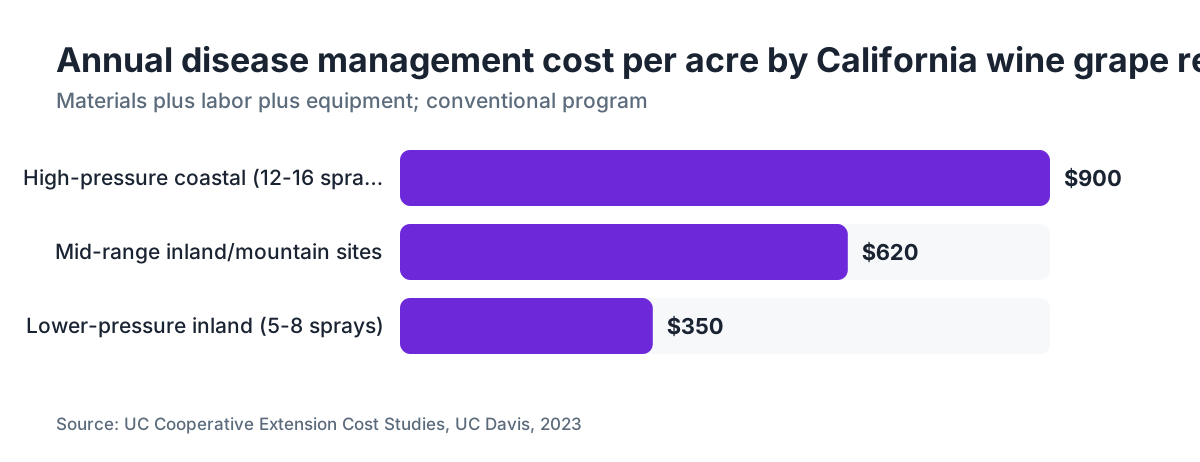
UC Cooperative Extension cost studies for California wine grapes put pest and disease management (materials plus labor plus equipment) at $350 to $900 per acre per year, depending on region and intensity [8]. High-pressure coastal sites running 12 to 16 spray passes sit at the top. Lower-pressure inland sites at five to eight passes sit near the bottom.
Sulfur runs roughly $0.50 to $1.50 per acre per application for material alone. DMI fungicides run $8 to $25 per acre depending on product. SDHIs, usually the priciest rotation slot, run $25 to $50 per acre per application [8]. A tractor spray pass in California averages $30 to $60 per acre in labor, depending on equipment and operator speed.
For a 20-acre vineyard at 10 passes a season, a realistic materials-only budget is $3,000 to $8,000, with labor adding $6,000 to $12,000 on top. These aren't small numbers against crop value in a hard year.
Skipping the program is not the cheaper path. One powdery mildew outbreak that takes 30 percent of the crop off a 20-acre Pinot Noir block at $3,000 per ton (rough Central Coast pricing) costs $90,000 in lost revenue at a modest 5-ton-per-acre yield. The program cost is a known line item. The cost of skipping it is probabilistic and far larger.
The mountain winery segment shows the math plainly. Sites with hard access and higher application costs still run full disease programs, because the grape value pays for it.
Frequently asked questions
What are the first signs of powdery mildew on grapevines?
A white or gray powdery coating on young shoot tips and leaf undersides is the earliest visible symptom. Flag shoots, single stunted shoots fully covered in white mycelium, mean the fungus overwintered in a bud. On berries, a powdery film that halts expansion and leads to cracking is a mid-season sign. Catching it at the flag-shoot stage gives you the widest set of management options.
Can grapevines recover from Pierce's disease?
No. Once Xylella fastidiosa colonizes the xylem, no registered treatment clears the infection. Vines decline over one to five years depending on variety and climate. The only strategy is early detection, removal of infected vines to cut inoculum, and vector control to slow spread to neighbors. Some researchers are studying heat therapy as an experimental tool, but it has no commercial use yet.
How often should I spray fungicide on grapevines?
Interval depends on disease pressure, weather, and product. During the high-risk window from bloom to four weeks post-bloom, most powdery mildew programs run every 7 to 10 days with sulfur or every 10 to 14 days with a DMI. Outside peak risk, intervals stretch to 14 to 21 days. Model tools like the UC Powdery Mildew Risk Index or Cornell's NEWA help you tighten or loosen intervals off real weather instead of calendar dates.
What is the pre-harvest interval for common grape fungicides?
PHI varies by product. Sulfur is typically 0 days on most current labels. Myclobutanil (Rally) is 7 days. Tebuconazole (Elite) is 14 days. Fenhexamid (Elevate) is 7 days. Azoxystrobin (Abound) is 0 days in some registrations. Read the specific label for the lot you're using; PHIs differ between formulations. Missing a PHI is a pesticide residue violation and a serious legal exposure.
What grapevine diseases spread through pruning wounds?
Eutypa lata (Eutypa dieback), Botryosphaeria species, and Phomopsis viticola all enter through pruning wounds. Eutypa spores release during rain from late fall through early spring, which overlaps pruning. Applying a registered wound protectant (thiophanate-methyl, boscalid, or a Trichoderma biocontrol) within 24 hours of a large cut cuts infection risk substantially, per UC Davis disease management guidance.
Is downy mildew the same as powdery mildew on grapes?
No. They're different pathogens with different biology. Powdery mildew (Erysiphe necator) is a true fungus that spreads in dry weather without free moisture. Downy mildew (Plasmopara viticola) is an oomycete that needs wet conditions and free water for spores to germinate. They demand different fungicide classes; most DMI fungicides that control powdery mildew have little to no activity against downy mildew.
What spray records do I legally need to keep for my vineyard?
Federal WPS requires two years of records on restricted-use pesticide applications. California growers also file monthly pesticide use reports with the county agricultural commissioner. Required data typically covers date, field, product name and EPA registration number, rate, total quantity applied, REI, PHI, and the applicator's identity. State rules vary; contact your state department of agriculture or county farm advisor for the format they audit.
How do you manage Botrytis bunch rot organically?
Organic Botrytis control leans on aggressive canopy work (fruit-zone leaf removal at or just after bloom), well-timed Bacillus subtilis sprays (Serenade is the common commercial product), and Trichoderma options for wound sites. Bacillus subtilis works as a preventive, not a rescue. Cornell research shows fruit-zone leaf removal alone cuts Botrytis incidence 40 to 60 percent, a real reduction before any spray goes on.
Which grape varieties are most susceptible to grapevine diseases?
Among Vitis vinifera, Pinot Noir, Chardonnay, Riesling, and Gewurztraminer are highly susceptible to both powdery mildew and Botrytis. Cabernet Sauvignon and Syrah have thicker skins and looser clusters, which lowers Botrytis risk. All vinifera are highly susceptible to Pierce's disease. American species (Muscadine, Concord) and several USDA-bred hybrids carry native resistance, which makes them workable in high-pressure regions where vinifera is a losing bet.
What is the difference between fungicide FRAC groups and why does it matter?
FRAC (Fungicide Resistance Action Committee) groups classify fungicides by mode of action. Products in one group share a biochemical target, so if a pathogen goes resistant to one, it's often resistant to all of them. Rotating groups between applications slows resistance. Never make more than two consecutive powdery mildew sprays from Group 3 (DMIs) without a Group M2 (sulfur) or Group 11 application in between.
How do I know if my vines have trunk disease versus winter cold damage?
Cut a cross-section of affected wood with clean shears. Cold damage usually shows uniform brown or black across the cambium and vascular tissue. Trunk disease (Eutypa, Botryosphaeria) shows dark wedge-shaped or streaked staining, often radiating from a wound or an old pruning scar. Severe cold damage tends to hit whole sections of the vineyard at once; trunk disease shows up vine-by-vine or spur-by-spur.
What is crown gall and can you treat it?
Crown gall comes from Agrobacterium vitis, a soil bacterium that enters through wounds, especially freeze injuries. It throws tumor-like galls at the vine base and wound sites, disrupting vascular tissue. There's no registered chemical treatment. Management means certified disease-free planting stock, avoiding physical injury during cold events, and replacing heavily galled vines. In freeze-prone regions, a less susceptible rootstock lowers but doesn't erase the risk.
Do I need to keep spray records if I only use organic pesticides?
Yes. Federal WPS applies to agricultural pesticide applications regardless of whether the product is synthetic or OMRI-listed. Restricted-use pesticide records are federally required for two years. Many organic certifiers (CCOF, Oregon Tilth, and others) require extra documentation as part of your organic system plan and annual audit. California copper applications also require tracking under CDPR rules because of accumulation. Records are not optional under either framework.
What resources do extension programs have for grapevine disease identification?
UC IPM Online has the most detailed California-specific disease ID guides and management tools, including the Powdery Mildew Risk Index. Cornell's NEWA system runs real-time disease models for the Northeast. WSU Extension covers Pacific Northwest disease management in depth. All three publish free, regularly updated pest management guides and disease calendars specific to their regions.
Sources
- UC IPM Online, UC ANR, Grape Powdery Mildew: Powdery mildew spreads via conidia during dry conditions with relative humidity above 40%; can cause 30 to 60 percent yield loss in untreated blocks
- UC Davis Department of Plant Pathology, Grape Disease Management: UC Powdery Mildew Risk Index, copper budget restrictions under CDFA, and wound protectant recommendations for trunk diseases
- Cornell Cooperative Extension, New York State IPM Program, Grape Disease Management: Critical infection window for powdery mildew is berry set through four to five weeks post-bloom; Botrytis four-timing spray program; leaf removal reduces Botrytis 40 to 60 percent
- WSU Extension, Pacific Northwest Pest Management Handbooks, Grape: 10-10-10 rule for downy mildew first-spray timing; downy mildew pressure highly variable by site in Pacific Northwest; Pierce's disease limited to southern Willamette Valley; WPS summary for grape growers
- California Department of Food and Agriculture, Glassy-Winged Sharpshooter Program: Glassy-winged sharpshooter (Homalodisca vitripennis) is the primary vector of Pierce's disease in California; removal of infected vines reduces inoculum
- EPA, Agricultural Worker Protection Standard (40 CFR Part 170): WPS requires two years of restricted-use pesticide records; handlers must be trained before performing any handling activity (40 CFR 170.501)
- UC Cooperative Extension, Sample Costs to Establish a Vineyard and Produce Wine Grapes: Pest and disease management costs for California wine grapes range from $350 to $900 per acre per year depending on region and program intensity
- FRAC (Fungicide Resistance Action Committee), FRAC Code List: FRAC group classifications for fungicide modes of action used in the spray program table
- Cornell NEWA (Network for Environment and Weather Applications): Real-time disease models for Northeast vineyards including powdery mildew and Botrytis forecasting tools
- USDA ARS, Xylella fastidiosa and Pierce's Disease Research: USDA ARS-developed PD-resistant grape varieties including Blanc du Bois and Cynthiana
- California Department of Pesticide Regulation, Pesticide Use Reporting: California growers must file pesticide use reports monthly with county agricultural commissioner
Last updated 2026-07-09