Manure application records and nitrogen loading calculations for vineyards

TL;DR
- Vineyards applying manure must track application dates, rates, field IDs, and nitrogen loads to satisfy nutrient management permit conditions and avoid Clean Water Act liability.
- Nitrogen loading comes from manure lab analysis, application rate, and crop uptake.
- Keep records three to five years.
- Many states require a certified nutrient management plan before any application.
Why do vineyards need manure application records at all?
Short answer: the law says so, and the fines are real.
The federal Clean Water Act's NPDES program treats concentrated animal feeding operations (CAFOs) as point sources of pollution, but even farms that receive manure from a CAFO face record-keeping obligations once that manure crosses their property line [1]. State programs layer on top of that. California's Irrigated Lands Regulatory Program, New York's Agricultural Environmental Management framework, and Washington's dairy nutrient management rules all require recipients of manure to document what they received, when they applied it, and where it went [2].
A vineyard owner who is not a CAFO but buys composted or raw manure from a neighboring dairy still lives under those rules. If you're in a nitrate-sensitive groundwater basin, which covers much of the Central Valley, the Willamette Valley, and the Finger Lakes region, documentation is the difference between a warning letter and a consent order.
The practical reason to keep good records goes beyond legal exposure. It's agronomic. Grapevines are shallow-rooted perennials with modest nitrogen needs, typically 25 to 60 pounds of actual N per acre per year depending on variety, rootstock, and soil [3]. Over-application is easy to do without records. It leads to excessive vegetative growth, shading, disease pressure, and, eventually, a regulator knocking on your gate.
What information must a vineyard manure application record include?
There is no single federal form, but EPA's nutrient management guidance and most state nutrient management regulations converge on the same required data fields [1][4]. A legally defensible record needs at minimum:
- Field ID or parcel number tied to a map
- Date of application
- Manure type (raw, composted, liquid slurry, litter)
- Source of manure (farm name or supplier, lot or load number)
- Application method (surface broadcast, injected, drip-applied)
- Volume or weight applied per acre
- Total N, P, and K from a lab analysis of that manure batch
- Calculated plant-available nitrogen (PAN) per acre
- Crop or cover crop present at time of application
- Applicator name
Some states, including California under the Irrigated Lands program, also require soil tests from the receiving field within the prior 12 months and a pre-side-dress nitrate test (PSNT) if you're applying significant amounts [2]. Washington State University Extension recommends noting weather conditions at application, particularly if the soil is frozen, saturated, or within 50 feet of a water body, because those conditions trigger setback rules in most state programs [5].
People underestimate one thing: the manure analysis is not optional. You cannot legally or agronomically substitute a book value for an actual lab result when you're making permit-regulated applications. Send a sample to an accredited lab, get the N-P-K report, and staple it to your application record for that load. A manure analysis runs about $20 to $60 depending on the panel. It's the one piece of paper that anchors every calculation downstream.
How do you calculate nitrogen loading from a manure application?
This is the step where most vineyard operators either go wrong or give up. The calculation has three parts: total nitrogen in the material, plant-available fraction in year one, and comparison against your vineyard's nitrogen budget.
Step 1: Total nitrogen from lab analysis
Your lab report gives nitrogen as a percentage of dry matter, as pounds per ton (for solids), or as pounds per 1,000 gallons (for liquid). Apply 5 tons per acre of composted dairy manure testing at 22 lbs N per ton, and total N applied is 5 x 22 = 110 lbs N per acre [6].
Step 2: Plant-available nitrogen (PAN)
Not all of that nitrogen reaches the vine in year one. PAN has two components: the ammonium-N fraction (fast, nearly 100% available) and the organic-N fraction (slow-release, tied to mineralization rate). The formula used by UC Cooperative Extension and NRCS is:
PAN = (NH4-N x availability factor) + (Organic-N x mineralization rate)
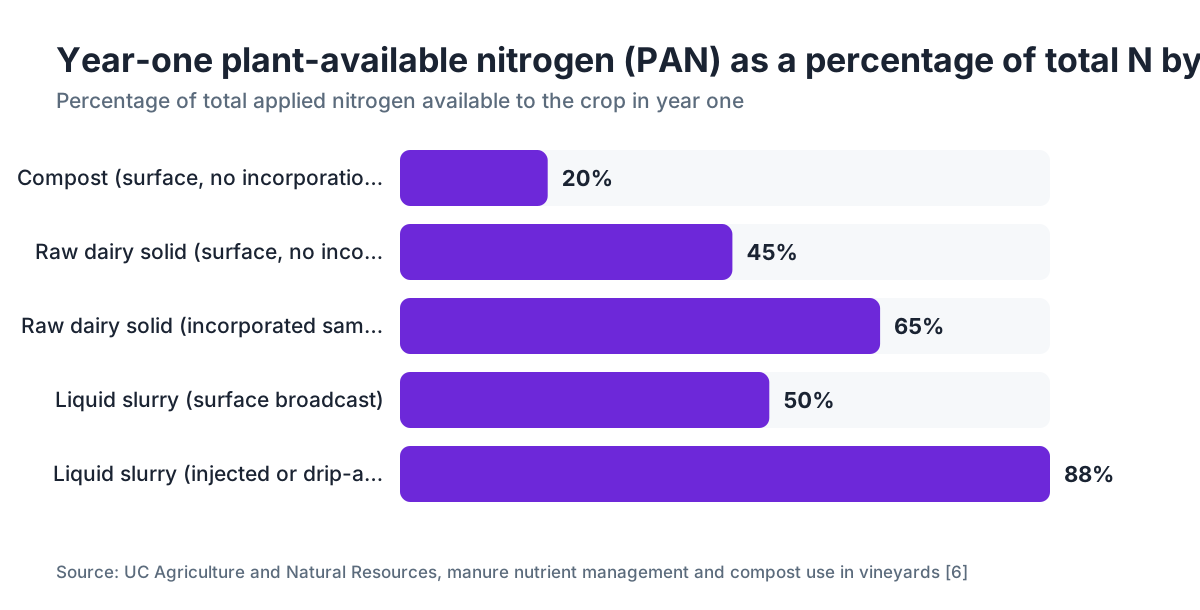
For fresh dairy manure broadcast on soil, typical figures are 0.50 to 0.70 for ammonium availability (accounting for volatilization losses from surface application) and 0.25 to 0.35 for first-year organic-N mineralization [3][6]. Incorporation within 24 hours raises the ammonium factor to 0.90 or higher.
Use the composted dairy example. If the 110 lbs total N is 10% ammonium-N and 90% organic-N:
- Ammonium N = 11 lbs x 0.90 (composted, so low volatilization) = 9.9 lbs
- Organic N = 99 lbs x 0.10 (compost mineralizes slowly) = 9.9 lbs
- Year-one PAN = about 20 lbs N per acre [6]
Compost is a slow nitrogen source. That's often why vineyard managers reach for it. It builds organic matter without spiking the vine into excessive shoot growth.
Step 3: Compare PAN to vineyard N budget
The N budget for your vineyard comes from tissue tests, soil tests, and yield targets. UC Cooperative Extension recommends petiole nitrate benchmarks at bloom and at veraison as the primary diagnostic tool for grapevine nitrogen status [3]. If you're consistently above the sufficiency range, any additional manure-derived N is surplus. It goes somewhere you don't want it, either into groundwater or into shoot growth that costs you money to hedge.
The calculation that lands in your record should read something like: "Applied 5 T/A composted dairy manure (Lot D-24-11, lab analysis dated 3/15/24). Total N: 110 lbs/A. Estimated year-one PAN: 20 lbs/A. Vineyard N budget: 40 lbs/A. Remaining budget for additional fertilizer: 20 lbs/A."
What are the nitrogen loading limits vineyards have to follow?
Limits come from at least three overlapping sources: your nutrient management plan (if you have an NPDES permit), state groundwater protection regulations, and local groundwater management plans.
At the federal level, EPA's CAFO rule does not set a numeric N loading cap for receiving farms, but it prohibits application in amounts that exceed agronomic rate, defined as the amount of nutrients needed by the crop [1]. That's deliberately vague. State programs fill the gap.
California's Central Valley Regional Water Quality Control Board has issued waste discharge requirements that effectively cap nitrogen application at crop nitrogen uptake, plus an efficiency factor. For grapes, the Irrigated Lands program's general permits reference nitrogen application rates typical for the crop, which for wine grapes generally falls in the 30 to 60 lbs N per acre per year range depending on yield and variety [2]. Exceeding that in a regulated basin requires written justification in a nutrient management plan reviewed by a certified crop adviser (CCA).
Washington's Department of Ecology, under the dairy nutrient management rules, caps land application at the agronomic rate as determined by soil testing and expected crop removal. WSU Extension's dairy nutrient management materials give worksheet-based calculations for that determination [5].
Cornell Cooperative Extension's nutrient management guidelines for New York point to phosphorus as the practical limiting nutrient in many fields, not nitrogen. If your soil phosphorus is already high, you may not be able to apply enough manure to meet your nitrogen needs without over-applying phosphorus [4]. That's when you supplement with synthetic fertilizer to close the N gap without adding more P.
One concrete threshold worth knowing: many state programs require a setback of at least 100 feet from surface water and 25 to 50 feet from a wellhead for any manure application, and you must document those setbacks in your records.
How do phosphorus and potassium fit into the calculation?
Nitrogen gets most of the regulatory attention because it moves in groundwater as nitrate. But phosphorus drives a lot of the practical decision-making about manure use in vineyards, and it belongs in your records too.
Manure has a fixed N:P ratio set by the animal species and diet. Dairy manure typically runs about 2:1 N to P2O5. Poultry litter can be closer to 1:1. If your vineyard soil is already phosphorus-saturated (a Bray P-1 above 80 to 100 ppm is the range where most extension programs recommend you stop adding P), applying manure to meet your nitrogen need keeps loading phosphorus that goes nowhere useful and risks loss in runoff [4][5].
Potassium is the nutrient vineyard managers should watch most carefully from a fruit quality standpoint. High-K soils, common in California and Oregon wine regions, already push grapevines toward elevated must pH and high titratable acidity in some varieties. Adding manure high in K to a soil already over-supplied is a quality problem on top of a compliance problem. Include K loading in your calculations even if your permit doesn't require it.
A good record template has a row for each of N, P2O5, and K2O: total applied, estimated crop removal, and net balance. If your net balance is strongly positive year after year, you have a problem building in the soil.
What are the record-keeping retention requirements for vineyard manure records?
Retention periods vary by program, but the most common requirement is five years [1][2]. EPA's CAFO rule requires five years of land application records for permitted operations. California's Irrigated Lands general orders require at minimum three years of records on-site and available for inspection, with some conditional waivers requiring five [2]. New York's Agricultural Environmental Management program recommends five years as a best practice even when state law requires only three [4].
The practical advice: keep everything for five years, regardless of your state's minimum. Enforcement actions take time to develop. An inspector asking to see records from 2021 in 2025 is not unusual.
Records can be paper or electronic, as long as they are legible, organized by field and date, and can be produced within a reasonable time (usually 24 to 72 hours of a request, depending on the state). A spreadsheet with one row per application event, backed by scanned lab reports and delivery receipts, satisfies almost every program's requirements.
This is exactly the kind of workflow where purpose-built software helps. VitiScribe links field maps to application events and stores lab PDFs alongside the calculated N loads, so pulling a five-year record for a specific block takes seconds instead of an afternoon.
Do you need a nutrient management plan before applying manure to a vineyard?
In many states, and for many permit conditions, yes. The answer trends more toward yes over time as groundwater protection rules tighten.
A nutrient management plan (NMP) is a written document, usually prepared or reviewed by a certified crop adviser or professional engineer, that matches nutrient applications to crop needs for each field over a multi-year period. The NRCS defines NMP requirements in Conservation Practice Standard 590, which most state cost-share programs use as their baseline [7].
California requires an NMP for any farm with an NPDES general order in a high-priority groundwater basin. If you grow wine grapes in the Tulare Lake Basin or along the lower San Joaquin River, this applies to you [2]. Washington requires an NMP for any dairy receiving farm if the dairy is under a permit [5]. New York requires an NMP for farms participating in the Agricultural Environmental Management program, which is voluntary but provides liability protection [4].
Even outside permit requirements, an NMP prepared by a CCA is good insurance. It documents that you applied manure at agronomic rates based on professional judgment, which is a meaningful defense if you ever face an enforcement action.
The cost of a professional NMP varies widely. University extension programs in California and Washington have templates that a reasonably capable vineyard manager can use to prepare a basic plan. For complex sites with multiple fields and multiple nutrient sources, expect to pay $500 to $2,500 for a CCA to prepare and sign it [3][5].
How should you handle manure from compost versus raw manure differently in records?
The record-keeping structure is the same, but the data inputs and risk profile differ enough to warrant separate treatment.
Raw manure carries pathogen risk on top of nutrient loading risk. The National Organic Program (for certified organic vineyards) requires a 90-day interval between raw manure application and harvest for crops with no contact between the food part and the soil, and 120 days for crops where the edible part contacts the soil [8]. Grapes fall into the 90-day category under most interpretations, but confirm it with your certifier. Record the application date relative to anticipated harvest date.
Raw manure also has higher ammonium-N content and more variable nutrient analysis than compost. You need a fresh lab analysis for each load, or at least each lot. Book values from extension tables are not adequate for permit compliance when the material is raw.
Composted manure is more stable. The composting process kills most pathogens, reduces volume, and settles the nutrients down. But it mineralizes slowly, which means your year-one PAN estimate for compost can be 15 to 25% of total N, compared to 40 to 70% for fresh liquid dairy manure [6]. If you're counting on compost to meet your vineyard's nitrogen budget in the year of application, you're probably going to be disappointed and may supplement when you don't need to.
In your record, note whether the material is raw, partially composted (windrow turned but not fully stabilized), or fully composted (PFRP-treated, temperature logs available). That distinction affects both the agronomic calculation and the pathogen risk documentation.
How do you calculate plant-available nitrogen from liquid manure slurry?
Liquid slurry is common in regions with dairy operations, and some vineyards apply it through their drip irrigation systems (a practice called fertigation with liquid manure). The calculation logic matches solids, but the units differ.
Lab reports for liquid manure give nitrogen in lbs per 1,000 gallons or mg/L. Apply 10,000 gallons per acre of liquid dairy manure at 20 lbs N per 1,000 gallons:
Total N = 10 x 20 = 200 lbs N per acre
Surface-applied liquid without immediate incorporation loses a lot of ammonium to volatilization. On a warm day it can shed 40 to 60% of its ammonium-N within a few hours [6]. The NRCS Agricultural Waste Management Field Handbook (Part 651) provides volatilization coefficients by application method and temperature that most state NMP templates reference [7].
Injection or immediate incorporation raises efficiency sharply. Injected liquid manure holds 85 to 95% of its ammonium-N. In a drip-applied system, the manure goes straight to the root zone with minimal volatilization, so the availability factor approaches 1.0 for the ammonium fraction, though you need to screen carefully to keep emitters from clogging.
Record the application method precisely, because the PAN calculation swings hard between "surface broadcast" and "drip-applied." An inspector or auditor reviewing your records should be able to reproduce your PAN calculation from the data you've written down.
What does a compliant manure application record template look like in practice?
Here's a realistic example of what a single application event record should contain. This is not a form. It's the data fields laid out in plain language.
| Field | Example entry |
|---|---|
| Record date | 2024-03-18 |
| Field ID | Block 7-North, APN 123-456-789 |
| Field acreage | 4.2 acres |
| Manure type | Composted dairy |
| Supplier | Green Valley Dairy, Lot GVD-2024-03 |
| Lab analysis date | 2024-03-10, Lab report #88421 |
| Total N (lbs/ton) | 22 |
| NH4-N (lbs/ton) | 2.2 |
| P2O5 (lbs/ton) | 14 |
| K2O (lbs/ton) | 18 |
| Application rate | 5 T/acre |
| Total N applied | 110 lbs/acre |
| Year-1 PAN estimate | 21 lbs/acre |
| P2O5 applied | 70 lbs/acre |
| K2O applied | 90 lbs/acre |
| Application method | Surface broadcast, tractor spreader |
| Incorporation? | No (compost, low volatilization risk) |
| Crop present | Dormant Cabernet Sauvignon, bare soil |
| Setback from water | 175 ft from seasonal creek (compliant) |
| Applicator | J. Morales |
| Weather | 52°F, overcast, wind < 5 mph, soil not frozen |
| Vineyard N budget | 40 lbs/A. Remaining after this application: 19 lbs/A |
Keep the lab report and delivery receipt stapled to (or scanned with) this record. If you're in a regulated basin, your certified crop adviser or permit coordinator should review the record within 30 days of application and sign off that the application stayed within the NMP parameters.
For growers managing multiple blocks across a larger vineyard operation, keeping this data in a spreadsheet or a field records platform lets you aggregate total N applied per parcel, total P loaded over multiple years, and flag when any field approaches its phosphorus saturation threshold.
How do USDA NRCS and university extension resources help with these calculations?
You don't have to invent these calculations from scratch, and you shouldn't. There are genuinely good free resources that have been peer-reviewed and are accepted by regulators.
NRCS Conservation Practice Standard 590 (Nutrient Management) is the federal baseline document. It defines agronomic rate, prescribes the minimum components of an NMP, and gets referenced by most state permit programs as the acceptable methodology [7]. The NRCS Agricultural Waste Management Field Handbook (Part 651) goes deeper on manure characterization and PAN calculations, including the volatilization tables mentioned above.
UC Davis and UC Cooperative Extension have published nutrient management guidelines for wine grapes and fact sheets on organic matter and compost management in vineyards, which include grapevine N uptake figures by variety and yield, tissue test interpretation, and application rate guidance [3]. These are the documents a California auditor will expect a vineyard operator to know.
WSU Extension's soil fertility guidance for grapevines and its dairy nutrient management worksheets give Washington-specific numbers that account for the cooler temperatures and different soil types common in the Columbia Valley and Puget Sound regions [5].
Cornell Cooperative Extension's Nutrient Management Spear Program has published detailed worksheets for NMP development in New York, with grape-specific sections covering Finger Lakes and Hudson Valley soil types [4].
One honest caveat: these resources don't always agree on mineralization rates and volatilization coefficients. The underlying science has real uncertainty. If one source gives you 18 lbs PAN and another gives you 24 lbs PAN for the same material and application method, use the lower number to stay within your N budget, and note in your record which methodology you used and why. VitiScribe's calculation templates are built from these extension sources, so your methodology is documented automatically.
For growers who want broader vineyard operations context, Ponte Winery shows how a medium-scale California operation manages nutrient programs across a large estate, and South Coast Winery shows how Southern California's different climate zone shifts both nutrient timing and application rates.
Frequently asked questions
How long do I have to keep manure application records for my vineyard?
Most federal and state programs require five years of retention. EPA's CAFO land application rules specify five years. California's Irrigated Lands program requires at least three years on-site and available for inspection, but five years is the safer practice given how long enforcement actions can take to develop. Keep records in a format you can produce within 24 to 72 hours of a regulatory request.
What is plant-available nitrogen and how is it different from total nitrogen in manure?
Total nitrogen is everything in the manure, both the fast-acting ammonium fraction and the slower organic fraction. Plant-available nitrogen (PAN) is the portion the crop can actually use in the current season. For composted manure, year-one PAN is typically 15 to 25% of total N because organic-N mineralizes slowly. For fresh liquid dairy manure applied without incorporation, year-one PAN is typically 40 to 70% of total N. Use PAN, not total N, to match applications to your vineyard's nitrogen budget.
Do I need a nutrient management plan before applying manure to my vineyard?
Depends on your state and whether you hold or are associated with an NPDES permit. California requires an NMP for growers under Irrigated Lands general orders in high-priority basins. Washington requires one for dairy receiving farms. New York's AEM program is voluntary but provides regulatory protection. Even where not legally required, an NMP prepared by a certified crop adviser is worth having as a defense if an enforcement question ever arises.
What does the Clean Water Act require for vineyard manure application records?
For farms directly permitted under the NPDES CAFO rule, EPA requires records of land application dates, field locations, application rates, manure nutrient analysis, and agronomic rate calculations, kept for five years. Farms that receive manure from a permitted CAFO face similar requirements. Farms not covered by NPDES permits still face state-level requirements and the baseline prohibition on discharges that cause water quality violations.
Can I use book values instead of a lab analysis for nitrogen calculations?
Not for permit-regulated applications, and not advisable even for unregulated ones. Manure nutrient content varies widely with animal diet, bedding type, storage conditions, and dilution. A lab analysis of the actual material you applied is the only defensible basis for your PAN calculation and your agronomic rate documentation. A manure analysis typically costs $20 to $60 from an accredited lab, which is negligible against the cost of an overapplication enforcement action.
How much nitrogen do wine grapes typically need per acre per year?
UC Cooperative Extension cites a range of roughly 25 to 60 pounds of actual nitrogen per acre per year for wine grapes, depending on variety, rootstock, vigor level, soil type, and yield target. Low-vigor sites and deficit-irrigated blocks lean toward the low end. Petiole nitrate testing at bloom is the primary tool for calibrating your actual need year to year. Applying more than the vine can use results in excess shoot growth and groundwater loading.
What records do I need to keep for organic certification if I use manure?
The USDA National Organic Program requires documentation of manure type, source, application date, field applied to, and the interval between application and harvest. For grapes, the required interval for raw manure is 90 days under most interpretations (the edible part does not contact the soil). Compost meeting NOP temperature and turning requirements can be applied without a specific pre-harvest interval. Your certifier may require additional records, so confirm with them before application.
How do setback requirements from water bodies affect vineyard manure application records?
Most state programs prohibit manure application within 100 feet of a stream, pond, or wetland, and within 25 to 50 feet of a wellhead. Your record should document the distance from the nearest application point to any water body or well. If a block has water body setbacks that take out part of the field, record the net application acreage after setback exclusions. Some programs require you to flag these areas on a field map that accompanies your records.
What happens to phosphorus in a vineyard soil that receives manure every year?
Phosphorus builds up because grapevines remove much less P than most row crops. If you're applying manure to meet nitrogen needs annually, phosphorus can accumulate to levels where most extension programs recommend you stop adding P entirely. At that point you either stop using manure, reduce application rates dramatically, or supplement with synthetic nitrogen to meet the N gap without adding more P. Soil phosphorus should be tested every two to three years to catch this trend early.
How do I record manure applications that go through my drip irrigation system?
Record the same fields as for any application: date, source, analysis, volume applied per acre, and calculated PAN. Note the application method as "drip-injected" or "fertigation," because the ammonium availability factor is higher (approaching 1.0) compared to surface broadcast, and your PAN calculation should reflect that. Document the injection rate, total volume, and how you screened or filtered the material to protect emitters. Keep flow meter readings as supporting documentation.
What is the difference between agronomic rate and maximum allowable rate for manure?
Agronomic rate is the amount of nutrients needed by the crop, the number you calculate from tissue tests, yield targets, and soil tests. That's the target. Maximum allowable rate is whatever ceiling your permit or state regulation sets, usually expressed as the agronomic rate but sometimes with a safety factor. Applying above the agronomic rate requires written justification in your NMP in most regulated programs. In practice, for wine grapes, the agronomic rate is the binding constraint.
Are there cost-share programs to help pay for nutrient management plans in vineyards?
Yes. USDA NRCS's Environmental Quality Incentives Program (EQIP) provides cost-share for developing nutrient management plans under Conservation Practice Standard 590. Payment rates vary by state and practice priority. In California, the Healthy Soils Program has supported nutrient and soil management work for small farms including vineyards. Contact your local NRCS field office or county farm bureau for current payment schedules, which change with each fiscal year's ranking.
Do vineyard manure records need to be signed by a certified crop adviser?
Not always, but a CCA signature on your NMP (and sometimes on individual application records) is required under many state permit conditions and is good practice regardless. In California, many Irrigated Lands orders require that nutrient management plans be developed or reviewed by a CCA or licensed pest control adviser. A CCA signature documents that a qualified professional reviewed the agronomic rate determination, which strengthens your defense if a record is ever questioned.
What is the NRCS Conservation Practice Standard 590 and does it apply to vineyards?
NRCS Practice Standard 590 (Nutrient Management) defines the minimum requirements for managing plant nutrients to protect water quality and meet crop needs. It applies to any farm receiving EQIP or other NRCS cost-share for nutrient management, and most state permit programs adopt it as their technical standard. It applies to vineyards just as it does to any other crop. The standard requires a field-by-field nutrient budget, soil and plant tissue testing, and records of all nutrient applications including manure.
Sources
- U.S. EPA, National Pollutant Discharge Elimination System (NPDES) and CAFO program: CAFO land application rules require records of dates, rates, fields, nutrient analysis, and agronomic rate calculations kept for five years; application cannot exceed agronomic rate.
- California State Water Resources Control Board, Irrigated Lands Regulatory Program: California's Irrigated Lands program requires nutrient management plans and application records for growers in high-priority groundwater basins, with minimum three-year retention.
- UC Agriculture and Natural Resources (UC Cooperative Extension), nutrient management guidelines for wine grapes: Wine grapes typically need 25 to 60 pounds of actual nitrogen per acre per year; petiole nitrate at bloom is the primary diagnostic tool for grapevine N status.
- Cornell Cooperative Extension, Nutrient Management Spear Program: Cornell's program recommends five-year record retention as best practice and notes that phosphorus saturation may limit manure application rates before nitrogen needs are met in many New York soils.
- Washington State University Extension, dairy nutrient management resources: WSU Extension sets application rate at the agronomic rate determined by soil testing and expected crop removal; recommends noting weather conditions at application including frozen or saturated soil.
- UC Agriculture and Natural Resources, manure nutrient management and compost use in vineyards: Year-one PAN for composted dairy manure is approximately 15 to 25% of total N; fresh liquid dairy manure surface-applied can lose 40 to 60% of ammonium-N through volatilization.
- USDA Agricultural Marketing Service, National Organic Program, 7 CFR Part 205: NOP requires a 90-day interval between raw manure application and harvest for crops where the edible part does not contact the soil; compost meeting temperature and turning requirements has no required pre-harvest interval.
- U.S. EPA, Agricultural Worker Protection Standard (40 CFR Part 170): EPA's Worker Protection Standard governs applicator safety documentation requirements for pesticide and certain agricultural chemical applications on farms.
Last updated 2026-07-10