Cinnamaldehyde vineyard spray: dilution rates, timing, and what actually works

TL;DR
- Cinnamaldehyde fungicide sprays in vineyards dilute to 0.25 to 1.0% active ingredient in water, roughly 1 to 4 fl oz of a 29% concentrate per gallon depending on target and label.
- It works best as a protectant against Botrytis and powdery mildew, with a zero-day PHI.
- The label is the legal rate.
- No extension recommendation overrides it.
What dilution rate should you use for cinnamaldehyde in a vineyard?
Follow the product label in your hand. That's the honest answer, because cinnamaldehyde concentrates sold for farm use range from about 10% to 29% active ingredient, and the tank math changes with every formulation.
Take the best-studied commercial product, Cinnerate (EcoSMART Technologies, 29% cinnamaldehyde). Its grapevine label rate runs 0.5 to 2.0 fl oz per gallon of water for hand-spray equipment, which lands around 0.23 to 0.91% active ingredient in the tank [1]. That range targets powdery mildew (Erysiphe necator) and Botrytis bunch rot. Cornell Cooperative Extension has tested cinnamaldehyde materials in the Northeast and calls them 'contact-type protectants with limited post-infection activity,' so you have to get coverage on before infection pressure climbs [2].
Here's the ratio a second way. One fl oz of a 29% concentrate in a gallon of water gives you about 0.23%. Two fl oz per gallon gives about 0.46%. Run a 100-gallon tank and that's 100 to 200 fl oz (roughly 3 to 6 quarts) of concentrate per fill.
None of these numbers are one-size-fits-all. Powdery mildew suppression on leaves usually sits at the low end (0.5 fl oz/gal). Botrytis sprays aimed at clusters near bunch closure or before harvest want the high end. The label also sets maximum seasonal rates and minimum intervals, typically 7 to 14 days between applications, and those exist for resistance management more than safety.
One thing to say plainly. Cinnamaldehyde is OMRI-listed and exempt from a pesticide tolerance under 40 CFR 180.1195, because the EPA determined it poses no unreasonable risk at food-contact levels [3]. That exemption is why organic programs like it. But exempt from tolerance does not mean no label required, and it does not mean any rate is fine. The Federal Insecticide, Fungicide, and Rodenticide Act (FIFRA) still governs the application, and the label is a legal document.
How does cinnamaldehyde work against grapevine fungal diseases?
Cinnamaldehyde is the compound that gives cinnamon its smell. To a plant pathologist it's a phenylpropanoid with broad antimicrobial activity. The main mechanism is membrane disruption: cinnamaldehyde reacts with lipid bilayers in fungal cell membranes, raises permeability, and eventually kills the cell [4].
That mode of action carries two practical consequences in the vineyard. It's a contact material, so it has to physically touch the spore or mycelium to do anything. And because it works by breaking membranes rather than hitting one enzyme site, resistance builds slower than with single-site fungicides like the DMIs or QoIs. That makes it a sensible rotation partner in a resistance program.
Washington State University Extension has noted that essential oil-based fungicides including cinnamaldehyde 'perform best when used protectively and when coverage is thorough,' and it recommends them as parts of a broader integrated program rather than a standalone season-long fix [5]. WSU's Viticulture and Enology work has looked at alternative chemistries for organic certification in the Pacific Northwest, where Botrytis pressure in cool wet seasons can swamp lighter materials.
Cinnamaldehyde has a fairly high vapor pressure for a pesticide, so it off-gasses fast in warm conditions. That cuts two ways. Efficacy drops quicker on hot days after application, and worker re-entry is partly governed by that volatility. The EPA classifies it as a minimum-risk pesticide under FIFRA section 25(b) in certain formulations, but agricultural-use registered products still carry full label requirements.
Rainfast interval matters. Most cinnamaldehyde products become rainfast within 1 to 2 hours of drying, a shorter window than systemic fungicides. If rain is forecast within 4 hours of application, you're probably wasting product.
What is the pre-harvest interval for cinnamaldehyde on grapes?
The pre-harvest interval for cinnamaldehyde on grapes is 0 days for most registered products, Cinnerate included [1]. That zero-day PHI is one of the main reasons growers reach for it in the last weeks before harvest, when Botrytis risk spikes and the residue windows on conventional fungicides have already closed.
The EPA's tolerance exemption under 40 CFR 180.1195 covers food commodities including grapes, which is the regulatory basis for the zero-day PHI [3]. The exemption covers residues from cinnamaldehyde and related compounds, including cinnamic acid breakdown products, when the product is used per label directions.
Growing for a certified organic program or a specific winery contract changes things. If your buyer prohibits any spray in the final stretch before pick, check your certifier's rules and your contract terms separately from the PHI. Some wineries, particularly biodynamic operations, set internal pre-harvest spray windows stricter than any regulatory minimum.
Export markets add another layer. The zero-day PHI is a U.S. domestic standard. The EU, Canada, and Japan each set their own maximum residue limits. Cinnamaldehyde at low rates is unlikely to trip an MRL violation, but confirm your importer's requirements before a pre-harvest spray. That's a five-minute email that beats a rejected container.
How do cinnamaldehyde dilution rates compare to other organic fungicides on grapes?
Here's a side-by-side look at common organic and minimum-risk fungicides used in vineyards, their typical in-tank concentrations, and PHI:
| Material | Typical in-tank % AI | PHI (days) | Primary targets |
|---|---|---|---|
| Cinnamaldehyde (e.g., Cinnerate 29%) | 0.23 to 0.91% | 0 | Botrytis, PM, some downy mildew |
| Sulfur (wettable, 80%) | 0.5 to 1.0% | 0 to 7 (label-dependent) | Powdery mildew primarily |
| Copper hydroxide (various) | 0.05 to 0.15% metallic Cu | 0 | Downy mildew, bacterial |
| Potassium bicarbonate (e.g., Kaligreen) | 0.5 to 1.5% | 0 | Powdery mildew |
| Neem oil (clarified hydrophobic) | 0.5 to 2.0% | 0 | PM, some Botrytis |
| Bacillus subtilis (e.g., Serenade) | per label (biological) | 0 | Botrytis, PM |
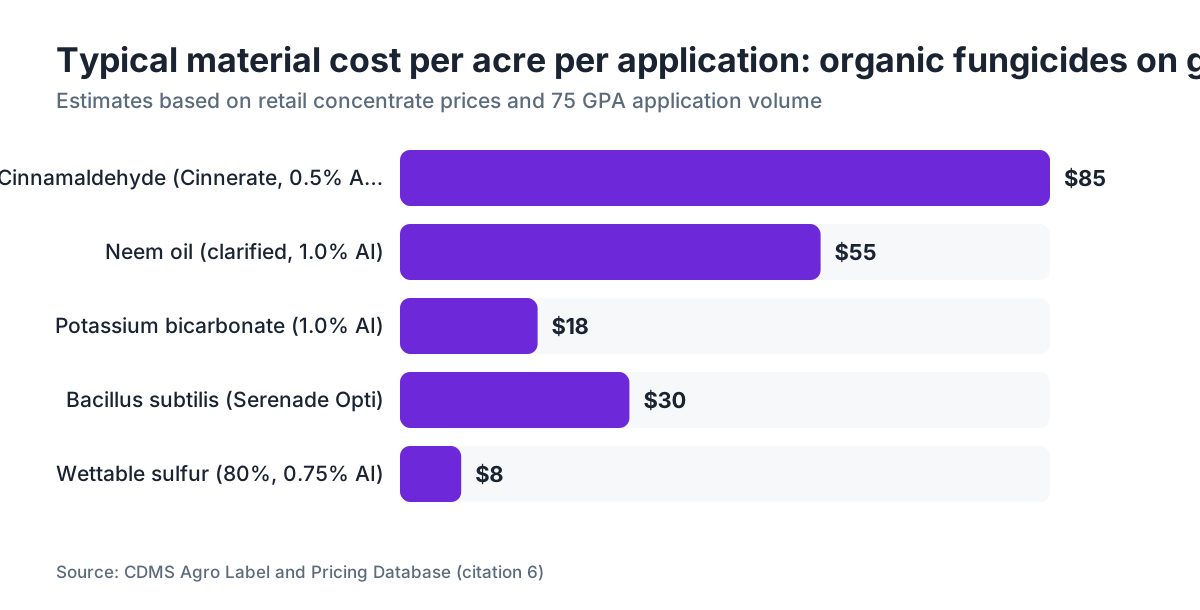
Cinnamaldehyde lands in the same concentration window as sulfur and potassium bicarbonate. Its edge over sulfur is a zero-day PHI without sulfur's injury risk in heat (sulfur can burn tissue above roughly 90 degrees F). Its downside next to sulfur is cost. Cinnamaldehyde products run about $80 to $150 per quart at retail, versus $20 to $40 per 50-lb bag of wettable sulfur [6]. Per acre, sulfur is almost always cheaper unless sulfur phytotoxicity risk is real on your site.
Against Botrytis, cinnamaldehyde beats sulfur, because sulfur barely touches Botrytis cinerea. That's the spot cinnamaldehyde earns, especially in tight-clustered varieties like Chardonnay or Pinot Noir where bunch rot moves fast.
For anyone managing vineyards in warmer climates with late-season heat spikes, the sulfur phytotoxicity window is a genuine problem, and cinnamaldehyde or potassium bicarbonate become the practical late-summer options for powdery mildew.
How often can you spray cinnamaldehyde, and does it build resistance?
Most cinnamaldehyde labels set a minimum interval of 7 days, some listing 7 to 14 days depending on disease pressure and application volume [1]. Seasonal maximums vary by product but commonly fall around 8 to 10 applications, or a stated maximum total active ingredient per acre. Read your label for the exact numbers.
Resistance is a real concern, just a slower-moving one than with single-site fungicides. Because the mode of action is multi-site membrane disruption rather than a single enzyme block, a fungus would need several mutations at once to develop meaningful resistance. Still, nobody has good long-term field data on cinnamaldehyde resistance in Botrytis populations across commercial vineyards. The closest published work is laboratory bioassays showing that repeated exposure at sublethal concentrations can reduce sensitivity over time in some fungal isolates [4].
In practice, resistance management means rotating cinnamaldehyde with materials from different FRAC groups. The Fungicide Resistance Action Committee (FRAC) files cinnamaldehyde and related plant essential oil fungicides under the BM (biological and miscellaneous) category, treating them as low resistance risk but still worth rotating [12].
A reasonable Botrytis program in a high-pressure year might run sulfur or potassium bicarbonate through bloom, a QoI or SDHI at bunch closure (if conventional inputs are allowed), then cinnamaldehyde or Bacillus subtilis in the final 2 to 3 sprays before harvest, once the PHI window closes off conventional options. Cornell's grape IPM program lays out this kind of tiered approach for Northeast vineyards [2].
What are the worker safety rules for cinnamaldehyde vineyard applications?
EPA's Worker Protection Standard (WPS) at 40 CFR Part 170 applies to every agricultural pesticide application, cinnamaldehyde included, no matter the product's minimum-risk status [7]. Here's what you have to meet.
Restricted Entry Interval (REI): For most cinnamaldehyde products the REI is 4 hours. Workers can't enter treated areas until 4 hours have passed after the application ends, unless they're wearing the PPE named on the label.
Personal protective equipment during mixing and loading typically means chemical-resistant gloves, protective eyewear, and long-sleeved clothing. Cinnamaldehyde is a skin and mucous membrane irritant. It's not a cholinesterase inhibitor and not an acute systemic toxin, but direct skin contact or inhaling concentrated material during mixing will irritate. Occupational studies have documented dermal sensitization with repeated contact [8].
Application exclusion zones and central posting requirements under the 2015 revised WPS apply to cinnamaldehyde the same as any registered agricultural pesticide. Run a backpack sprayer and act as both mixer/loader and applicator, and you still comply with PPE requirements during both tasks. One person, both jobs, all the rules.
If you farm organically, your certifier will likely want records of every input, cinnamaldehyde sprays included. That's a separate track from WPS but just as non-optional. A spray record that captures product name, EPA registration number, application date, rate, REI, and applicator name satisfies both WPS documentation and organic audit trails.
Tools like VitiScribe keep that log current without extra paperwork, timestamping applications and storing label REI and PHI data next to your field records.
Does cinnamaldehyde actually control powdery mildew and Botrytis in vineyards?
Efficacy data on cinnamaldehyde in grapes is thinner than for conventional fungicides, but it exists. UC IPM plant pathology work has included cinnamaldehyde materials in Botrytis evaluations, showing moderate efficacy (roughly 50 to 70% disease reduction versus untreated controls) when applied protectively at label rates [9]. That's weaker than the best synthetic Botrytis fungicides (fenhexamid, cyprodinil/fludioxonil) but comparable to or slightly better than Bacillus biologicals in the same trials.
For powdery mildew, efficacy generally runs lower than for Botrytis. The waxy, hydrophobic surface of powdery mildew colonies may partly shield them from cinnamaldehyde's contact action. Cornell trials in the Finger Lakes found cinnamaldehyde materials 'provided inconsistent powdery mildew control when used as the primary material,' working better as a rotation partner with sulfur than as a replacement [2].
Timing is probably the biggest efficacy variable. Applications made at or after 5-day infection periods (Gubler-Thomas index or similar models) showed sharply reduced effectiveness compared to sprays made before infection events in several university trials. Cinnamaldehyde has minimal curative activity. Get it on early or don't bother.
Volume matters too. Airblast application at 50 to 100 gallons per acre for a mature canopy usually gives adequate coverage. Under-application, especially in dense canopies, causes more efficacy failures than the chemistry does. If you're spraying 30 GPA in a full-canopy Chardonnay block and wondering why Botrytis still shows at harvest, coverage is the likelier culprit than the product.
Can you mix cinnamaldehyde with other vineyard spray materials?
Test compatibility before you tank-mix cinnamaldehyde with anything, because it's a reactive organic compound. It can react with alkaline materials (copper hydroxide, lime-sulfur) and with some emulsifiers in other pesticide formulations, causing separation, flocculation, or loss of efficacy in both products.
The general rules from product labels and extension guidance:
Cinnamaldehyde and copper-based fungicides: Generally incompatible in the same tank. The alkaline pH of copper hydroxide suspensions drives hydrolysis of cinnamaldehyde. Keep these as separate applications, at least 24 hours apart.
Cinnamaldehyde and sulfur: Potentially compatible at low sulfur concentrations, but not a tank mix I'd run routinely. The two work better in rotation.
Cinnamaldehyde and potassium bicarbonate: Some formulations mix fine, but a jar test (combine at the intended ratio in a small container and let it stand 15 minutes before committing the tank) is worth the time.
Cinnamaldehyde and kaolin clay (Surround): Generally compatible, and some growers use the combination for Botrytis plus insect management.
WSU Extension's jar test protocol is simple: combine the intended materials in proportional amounts in a clear container, shake, and watch for separation, gelling, or excessive heat over 15 to 30 minutes [5]. If anything looks off, don't mix.
Adjuvants matter. Cinnamaldehyde products often already carry emulsifiers, and a non-ionic surfactant can help coverage on waxy berry surfaces. Oil-based adjuvants are the risk here. Adding them can raise phytotoxicity risk on tender new growth.
What does the EPA registration say about cinnamaldehyde on grapes?
The EPA's tolerance exemption for cinnamaldehyde sits at 40 CFR 180.1195, which states that 'tolerances are not required for residues of the biochemical pesticide cinnamaldehyde...when used in accordance with label directions and good agricultural practice' [3]. That language is the regulatory basis for the zero pre-harvest interval and for cinnamaldehyde's use in certified organic programs under the National Organic Program [11].
Products registered for grapes under this exemption still need an EPA registration number on the label if they make pesticidal claims. Registering a biochemical pesticide like cinnamaldehyde differs from a conventional synthetic. It requires data on biochemical activity, environmental fate, and worker exposure, but the toxicology package is typically smaller because of the exemption.
For FIFRA compliance the practical points are short. Use only products with an EPA registration number for agricultural use, apply at label rates and intervals, and keep spray records that include the registration number for each product. Some state ag departments also require a pesticide applicator license or permit for commercial applications, even for minimum-risk materials. Requirements vary a lot by state, so check yours.
California growers carry an extra layer through the Department of Pesticide Regulation (CDPR), which runs its own registration separate from federal EPA registration. A product with federal registration is not automatically registered in California. The CDPR database is searchable by active ingredient, and you should confirm registration before you buy [10].
How do you calculate the right amount of cinnamaldehyde concentrate for your tank?
The math looks worse than it is once you know your concentrate's active ingredient percentage and your target rate.
Formula: (Target % AI / Concentrate % AI) x Tank volume = Volume of concentrate to add
Example for a 100-gallon tank using Cinnerate (29% AI) at a 0.5% AI target:
(0.5 / 29) x 100 gallons = 1.72 gallons of concentrate, or about 221 fl oz.
That's per tank. Calibrated to 75 GPA over a 10-acre block, you need roughly 13.3 tank fills, so about 22.9 gallons of concentrate for the block at that rate.
At roughly $100 to $140 per quart (32 fl oz) [6], that single block application at 0.5% AI costs $700 to $1,000 in material alone. That's the reality of a cinnamaldehyde program against sulfur, which might run $15 to $25 per acre in material at comparable volumes. The economics work on high-value blocks, organic premiums, late-season Botrytis situations where conventional PHI windows have closed, or blocks with a documented sulfur phytotoxicity history. Otherwise you're paying a premium for a job cheaper materials can do.
For record-keeping, log the concentrate volume added per tank, the tank volume, the spray volume applied, and the acres covered. VitiScribe's spray log captures those fields and pre-populates your application records with REI and PHI from the product label, which saves time when a certifier or auditor asks for paperwork.
Calibrating a new sprayer or working a new block? The UC IPM spray calibration guides walk through the full process for airblast and handgun equipment [9].
When in the season should you apply cinnamaldehyde for best results?
The disease calendar beats the wall calendar. Powdery mildew risk starts at budbreak and peaks from bloom through berry set, when young tissue is most susceptible. Botrytis risk peaks at bunch closure and again in the 2 to 4 weeks before harvest, when sugar accumulation, berry cracking, and tight clusters build ideal infection conditions.
Cinnamaldehyde fits best in the pre-harvest Botrytis window, and secondarily as a late-season powdery mildew rotation partner once you've used up your seasonal doses of single-site fungicides and want to hold off resistance pressure.
Early season (budbreak through bloom): Not the place for cinnamaldehyde. Sulfur works better and costs less, and the high-value early applications benefit from more proven systemic materials if powdery mildew pressure is historically high.
Bloom through bunch closure: A Botrytis application of cinnamaldehyde makes sense here if you're in an organic program. Apply at the higher label rate (2 fl oz/gal for Cinnerate), time it to a 7-day interval just ahead of a forecast wet period, and put your coverage on the cluster zone.
Pre-harvest (last 4 weeks before pick): This is where cinnamaldehyde earns its cost premium. The zero-day PHI, the contact efficacy against Botrytis on ripe fruit, and the absence of systemic residue concerns all line up. Most growers running cinnamaldehyde do 2 to 3 applications in this window.
Cool, overcast days with moderate humidity beat hot afternoons for application. Cinnamaldehyde volatilizes faster in heat, cutting contact time on surfaces and raising inhalation risk for the applicator.
Are there grape variety differences in cinnamaldehyde sensitivity or response?
Published variety-specific phytotoxicity data for cinnamaldehyde on grapes is sparse. Nobody has run a clean trial across Cabernet, Chardonnay, Pinot Noir, and 20 other varieties at multiple rates and reported dose-response curves. The honest answer is we don't have the data for definitive variety guidance.
What advisors and practitioners report is that thin-skinned varieties (Pinot Noir, Gewurztraminer, some Italian varieties) may show more sensitivity to repeated applications at the high end of label rates, particularly on young berry tissue just after set. That tracks with what we know about thin-skinned varieties and other contact materials like copper.
Phytotoxicity from cinnamaldehyde on established vine tissue is not a common complaint in the literature, unlike sulfur, which has well-documented variety sensitivities, especially in Concord grapes and some Vitis vinifera in high heat. Introducing cinnamaldehyde to a new variety or a block you haven't sprayed with it? Apply at the low end of the label rate for the first pass and check the block 48 to 72 hours later. Cheap insurance.
If you want to compare program outcomes across varieties and blocks, track application dates, rates, and disease incidence by block over several seasons. That's the only way to build data for your own site. A structured spray record and field notes tied to block ID are where it starts.
Frequently asked questions
What is the standard dilution rate for cinnamaldehyde on grapevines?
For Cinnerate (29% cinnamaldehyde), the label rate for grapevines is 0.5 to 2.0 fl oz per gallon of water, producing a 0.23 to 0.91% active ingredient concentration in the tank. Higher rates target Botrytis on clusters; lower rates handle general powdery mildew suppression. Always confirm the rate on your specific product label, since concentrations vary by brand.
Is cinnamaldehyde approved for organic vineyards?
Yes. Cinnamaldehyde is OMRI-listed and exempt from pesticide tolerances under 40 CFR 180.1195, making it compatible with USDA National Organic Program certification. Your certifying agency still needs documentation of the application. Confirm your specific product's OMRI status before purchasing, since not all cinnamaldehyde formulations carry OMRI listing.
What is the pre-harvest interval for cinnamaldehyde on grapes?
The pre-harvest interval is 0 days for most registered cinnamaldehyde products, including Cinnerate. The EPA's tolerance exemption under 40 CFR 180.1195 covers grapevine use with no residue threshold required. For export markets or winery contracts with stricter internal rules, confirm acceptable spray windows independently of the regulatory PHI.
Can cinnamaldehyde be mixed with copper fungicide in the same tank?
Generally no. Copper hydroxide and other copper-based materials are highly alkaline and can drive hydrolysis of cinnamaldehyde, cutting efficacy of both. Keep cinnamaldehyde and copper applications as separate sprays at least 24 hours apart. Always run a jar compatibility test before attempting any new tank mix with cinnamaldehyde.
How often can cinnamaldehyde be applied during a grape growing season?
Most product labels set a minimum 7-day interval between applications, with seasonal maximums typically around 8 to 10 applications or a stated maximum total AI per acre. Check the specific label for your product. Rotating cinnamaldehyde with other FRAC groups is recommended even though resistance develops slower with this multi-site material.
What is the re-entry interval (REI) for cinnamaldehyde in vineyards?
The REI for most cinnamaldehyde-based vineyard products is 4 hours. Workers can't enter treated areas until 4 hours after the application is complete unless wearing the PPE specified on the label. EPA Worker Protection Standard rules at 40 CFR Part 170 apply regardless of the product's minimum-risk status.
Does cinnamaldehyde work better for Botrytis or powdery mildew on grapes?
Cinnamaldehyde performs better against Botrytis than powdery mildew in university trials. UC IPM evaluations found roughly 50 to 70% disease reduction against Botrytis when applied protectively. Powdery mildew control is described as inconsistent by Cornell extension when cinnamaldehyde is used as the primary material, working better as a rotation partner with sulfur.
How much does a cinnamaldehyde spray program cost per acre?
Cinnamaldehyde products typically retail at $100 to $140 per quart. At a 0.5% AI rate using a 29% concentrate and 75 gallons per acre, material cost runs roughly $70 to $100 per acre per application. Two to three pre-harvest applications total $140 to $300 per acre in material alone, well above sulfur-based programs at comparable coverage.
What PPE is required when applying cinnamaldehyde in a vineyard?
Typical label requirements include chemical-resistant gloves, protective eyewear, and long-sleeved clothing during mixing, loading, and application. Cinnamaldehyde is a skin and mucous membrane irritant at concentrated levels and has documented dermal sensitization potential with repeated exposure. Respiratory protection may be listed for cab-less equipment; check your specific product label.
How do you calculate how much cinnamaldehyde concentrate to add to a spray tank?
Use this formula: (Target % AI / Concentrate % AI) x Tank volume = Volume of concentrate. For a 100-gallon tank at 0.5% target AI using 29% concentrate: (0.5/29) x 100 = 1.72 gallons of concentrate. Multiply by your number of tank fills for the block to get total concentrate needed for the application.
Does hot weather affect cinnamaldehyde spray efficacy?
Yes. Cinnamaldehyde has relatively high vapor pressure and off-gasses faster in warm conditions, cutting the contact time available for fungicidal activity. Applications in hot afternoon temperatures (above 85 to 90 degrees F) are less effective and raise inhalation risk for applicators. Morning applications on cooler days improve both efficacy and worker safety.
Do I need to register cinnamaldehyde with my state before using it in California?
Yes. California runs a separate pesticide registration process through CDPR independent of federal EPA registration. Federal EPA approval does not automatically authorize sale or use in California. Search the CDPR pesticide database by active ingredient to confirm a specific product is registered in California before purchasing for commercial vineyard use.
What spray timing in the season gives the best cinnamaldehyde results for Botrytis?
The final 2 to 4 weeks before harvest is where cinnamaldehyde earns its cost premium for Botrytis control. Apply at the higher label rate with thorough cluster zone coverage, on a 7-day interval, ideally before forecast wet weather. Bloom-to-bunch-closure applications also make sense for organic programs. Cinnamaldehyde has minimal curative activity, so timing before infection events is essential.
Is cinnamaldehyde safe for beneficial insects in the vineyard?
Cinnamaldehyde is generally considered lower risk to beneficial insects than broad-spectrum synthetic insecticides, and the EPA's minimum-risk classification reflects that. Direct contact with concentrated material is still harmful to bees and other beneficial arthropods. Apply in early morning or evening when bees are less active, and avoid applications on open blooms. Check the label for specific pollinator guidance.
Sources
- EcoSMART Technologies, Cinnerate EPA registered label: Cinnerate label specifies 0.5 to 2.0 fl oz per gallon on grapevines for Botrytis and powdery mildew, with a 0-day PHI and 4-hour REI
- Cornell Cooperative Extension, grape IPM and disease management guidance: Cornell describes cinnamaldehyde materials as contact-type protectants with limited post-infection activity and inconsistent powdery mildew control when used as the primary material
- EPA, 40 CFR 180.1195 Cinnamaldehyde tolerance exemption: Tolerances are not required for residues of cinnamaldehyde when used in accordance with label directions and good agricultural practice on food commodities including grapes
- Bakkali et al., Biological effects of essential oils, Food and Chemical Toxicology, 2008: Cinnamaldehyde disrupts fungal cell membrane integrity through lipid bilayer interaction; repeated sublethal exposure can reduce sensitivity in some fungal isolates
- Washington State University Extension, Organic Viticulture Spray Materials: Essential oil-based fungicides including cinnamaldehyde perform best when used protectively and when coverage is thorough; recommended as components of a broader integrated program
- CDMS Agro Label and Pricing Database: Cinnamaldehyde-based agricultural products retail at approximately $80, $150 per quart; wettable sulfur retails at approximately $20, $40 per 50-lb bag
- EPA, Worker Protection Standard, 40 CFR Part 170: WPS at 40 CFR Part 170 applies to all agricultural pesticide applications including minimum-risk materials; REI and PPE requirements are label-governed
- National Institute for Occupational Safety and Health (NIOSH), Cinnamaldehyde occupational exposure: Repeated dermal contact with cinnamaldehyde has documented skin sensitization potential in occupational exposure studies
- UC IPM (University of California Statewide IPM Program), Grape Pest Management: UC IPM Botrytis evaluations found roughly 50 to 70% disease reduction for cinnamaldehyde-based materials applied protectively; spray calibration guides for airblast and handgun equipment provided
- California Department of Pesticide Regulation, Pesticide Product Search: California maintains a separate pesticide registration process; products require CDPR registration independent of EPA federal registration before use in California
- USDA National Organic Program, Allowed and Prohibited Substances: OMRI-listed materials including cinnamaldehyde are compatible with USDA NOP certification when used according to their labeling and certification body requirements
- Fungicide Resistance Action Committee (FRAC), FRAC Code List: Cinnamaldehyde and plant essential oil-based fungicides classified under FRAC BM category as biological and miscellaneous, considered low resistance risk
Last updated 2026-07-09